

Paper Menu >>
Journal Menu >>
 Vol.5, No.2, 170-174 (2013) Health http://dx.doi.org/10.4236/health.2013.52023 Coping style and mental health on high school students Zhi Wang1,2 1Department of Psychology, Southwest University, Chongqing, China; [email protected] 2Center for Mental Health Education, Southwest University, Chongqing, China Received 27 November 2012; revised 26 December 2012; accepted 3 January 2013 ABSTRACT Objective: To explore the coping style of high school students and its relationship to mental health. Methods: Make a survey upon 320 stu- dents through coping style questionnaire and MSMH. Results: High school students often re- sort to problem solving and appeal to coping factors. No di stinct gend er differe nc e is found in coping style. There are different degrees of correlation between coping style and mental health. Remarkable grade difference is shown in the factor of appealing in coping style and the three factors of compulsion, anxiety and mental imbalance in mental health. Conclusion: Rela- tively mature coping style has come into exis- tence among high school students, but more guidance and assistance are in need in culti- vating the coping style and improving the men- t al health. Keywords: High School Students; Coping Style; Mental Health 1. INTRODUCTION Coping style is the process of cognitive and behavioral efforts made by individuals under pressure to alleviate its negative effects. It is mentally healthy to form a proper cognition and evaluation towards events and adopt a positive coping style in front of pressure. Compas de- fines coping style from the developmental angle, and thinks that coping style is one side of stress reaction. When individual faces stressful events and environments, individual has conscious efforts to regulate emotion, cognition and behavior [1]. High school is a critical pe- riod of life and students are often confronted with pres- sure of further studies and employment as well as mental perplex in puberty. Thus, it is of great significance to explore the relationship between coping style and mental health of high school students. There are preliminary studies made by Huang Xiting, etc. towards the coping style of middle school students, which show that the main coping style of middle school students in China are problem solving, appealing for help, avoidance, abreact- ing, fantasy and endurance and that girls prefer coping style of endurance and abreacting while boys prefer that of fantasy when comparing girls with boys [2]. No dis- tinct change of coping style is noticed in the age of mid- dle school students. Liang Junlin’s study shows that negative coping style has negative correlation with men- tal health [3]. Jiang Qianjin’s study shows that coping style has positive correlation with SCL-90, SDS, SAS and scores of N scale in EPQ [4]. The study finds that coping style is highly associated with mental health [5]. The paper delves into the characteristics of high school student coping style and its relationship towards mental health on the basis of previous studies, in order to pro- vide reference to high school student mental health edu- cation and improve their mental health. 2. PARTICIPANTS AND METHOD 2.1. Participants 320 high school students were recruited to take part in the study. They were from Grades One, Two and Three of Dengfeng High School, Dengfeng city, Henan pro- vince. 284 effective questionnaires were retrieved from 155 male students and 129 female students, with 72 from Grade One, 72 from Grade Two, 67 from Grade Three, and 73 from Grade Three of previous year. The study was approved by the local review board for human par- ticipant research and each participant provided informed consent prior to participate in the experiment. 2.2. Methods 2.2.1. Coping S ty l e Questionnaire The questionnaire is a revised vision by Xiao Jihua and Xu Xiufeng which is based on Folkman and Bond’s coping and defense. There are 62 items, including 6 fac- tors-problem solving, self-accusation, appealing for help, fantasy, avoidance and rationalization. The factor loaded Copyright © 2013 SciRes. OPEN A CCESS 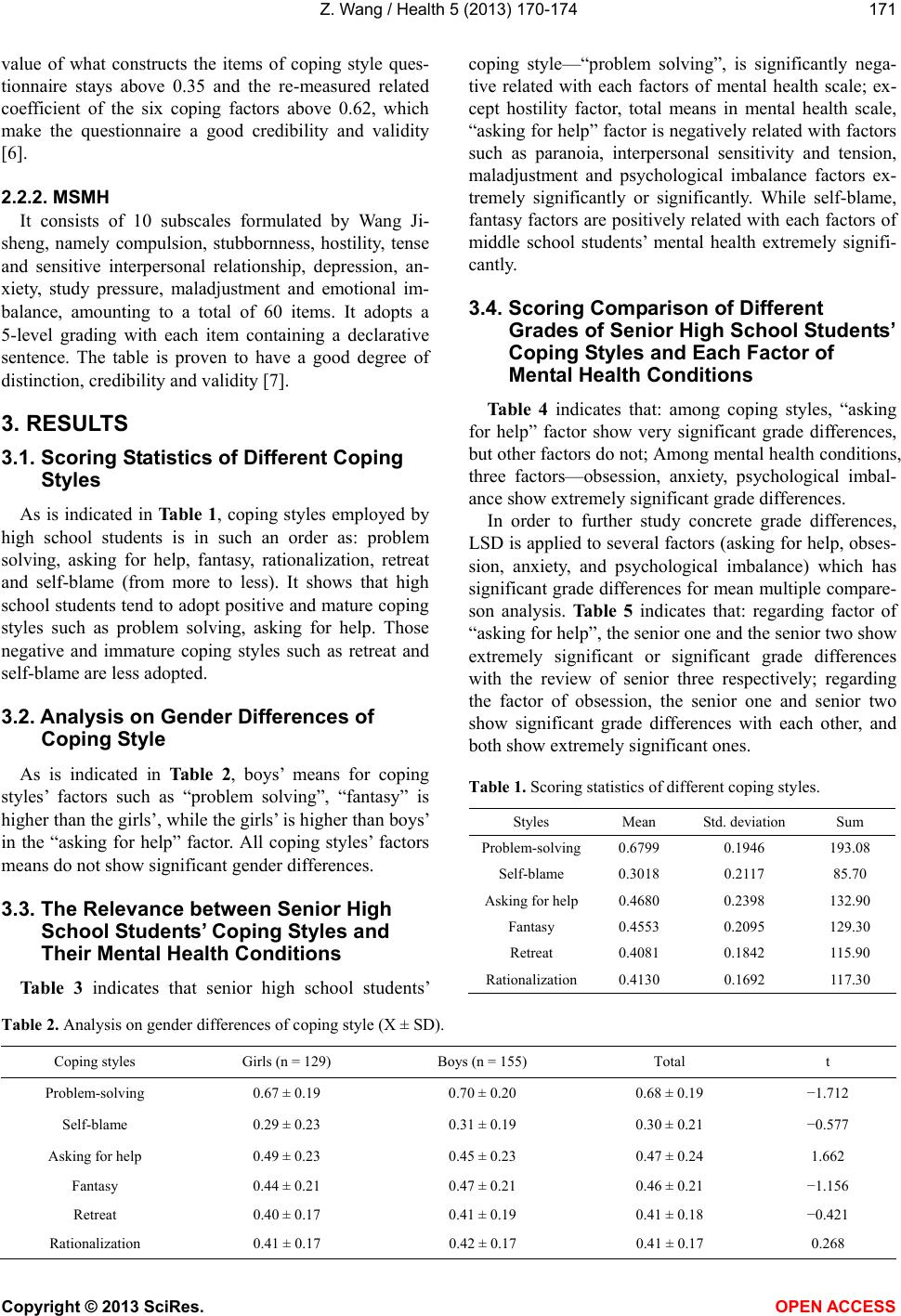 Z. Wang / Health 5 (2013) 170-174 171 value of what constructs the items of coping style ques- tionnaire stays above 0.35 and the re-measured related coefficient of the six coping factors above 0.62, which make the questionnaire a good credibility and validity [6]. 2.2.2. MSMH It consists of 10 subscales formulated by Wang Ji- sheng, namely compulsion, stubbornness, hostility, tense and sensitive interpersonal relationship, depression, an- xiety, study pressure, maladjustment and emotional im- balance, amounting to a total of 60 items. It adopts a 5-level grading with each item containing a declarative sentence. The table is proven to have a good degree of distinction, credibility and validity [7]. 3. RESULTS 3.1. Scoring Statistics of Different Coping Styles As is indicated in Table 1, coping styles employed by high school students is in such an order as: problem solving, asking for help, fantasy, rationalization, retreat and self-blame (from more to less). It shows that high school students tend to adopt positive and mature coping styles such as problem solving, asking for help. Those negative and immature coping styles such as retreat and self-blame are less adopted. 3.2. Anal ysis on Gender Differences of Coping Style As is indicated in Table 2, boys’ means for coping styles’ factors such as “problem solving”, “fantasy” is higher than the girls’, while the girls’ is higher than boys’ in the “asking for help” factor. All coping styles’ factors means do not show significant gender differences. 3.3. The Relevance between Senior High School Students’ Coping Styles and Their Mental Health Conditions Table 3 indicates that senior high school students’ coping style—“problem solving”, is significantly nega- tive related with each factors of mental health scale; ex- cept hostility factor, total means in mental health scale, “asking for help” factor is negatively related with factors such as paranoia, interpersonal sensitivity and tension, maladjustment and psychological imbalance factors ex- tremely significantly or significantly. While self-blame, fantasy factors are positively related with each factors of middle school students’ mental health extremely signifi- cantly. 3.4. Scoring Comparison of Different Grades of Senior High School Students’ Coping Styles and Each Factor of Mental Health Conditions Table 4 indicates that: among coping styles, “asking for help” factor show very significant grade differences, but other factors do not; Among mental health conditions, three factors—obsession, anxiety, psychological imbal- ance show extremely significant grade differences. In order to further study concrete grade differences, LSD is applied to several factors (asking for help, obses- sion, anxiety, and psychological imbalance) which has significant grade differences for mean multiple compare- son analysis. Ta ble 5 indicates that: regarding factor of “asking for help”, the senior one and the senior two show extremely significant or significant grade differences with the review of senior three respectively; regarding the factor of obsession, the senior one and senior two show significant grade differences with each other, and both show extremely significant ones. Table 1. Scoring statistics of different coping styles. Styles Mean Std. deviation Sum Problem-solving0.6799 0.1946 193.08 Self-blame 0.3018 0.2117 85.70 Asking for help 0.4680 0.2398 132.90 Fantasy 0.4553 0.2095 129.30 Retreat 0.4081 0.1842 115.90 Rationalization 0.4130 0.1692 117.30 Table 2. Analysis on gender differences of coping style (X ± SD). Coping styles Girls (n = 129) Boys (n = 155) Total t Problem-solving 0.67 ± 0.19 0.70 ± 0.20 0.68 ± 0.19 −1.712 Self-blame 0.29 ± 0.23 0.31 ± 0.19 0.30 ± 0.21 −0.577 Asking for help 0.49 ± 0.23 0.45 ± 0.23 0.47 ± 0.24 1.662 Fantasy 0.44 ± 0.21 0.47 ± 0.21 0.46 ± 0.21 −1.156 Retreat 0.40 ± 0.17 0.41 ± 0.19 0.41 ± 0.18 −0.421 Rationalization 0.41 ± 0.17 0.42 ± 0.17 0.41 ± 0.17 0.268 Copyright © 2013 SciRes. OPEN A CCESS 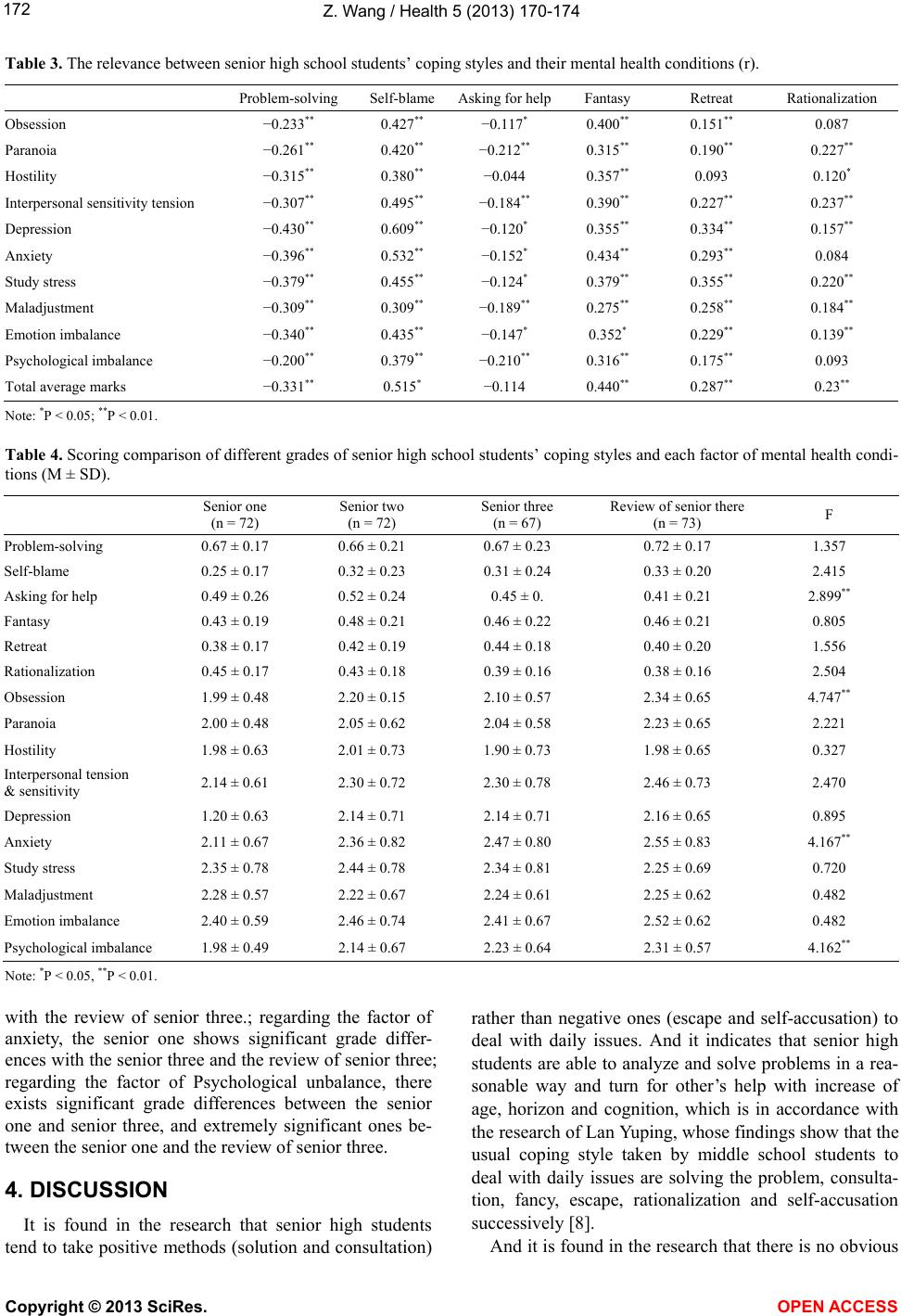 Z. Wang / Health 5 (2013) 170-174 172 Table 3. The relevance between senior high school students’ coping styles and their mental health conditions (r). Problem-solving Self-blame Asking for helpFantasy Retreat Rationalization Obsession −0.233** 0.427** −0.117* 0.400** 0.151** 0.087 Paranoia −0.261** 0.420** −0.212** 0.315** 0.190** 0.227** Hostility −0.315** 0.380** −0.044 0.357** 0.093 0.120* Interpersonal sensitivity tension −0.307** 0.495** −0.184** 0.390** 0.227** 0.237** Depression −0.430** 0.609** −0.120* 0.355** 0.334** 0.157** Anxiety −0.396** 0.532** −0.152* 0.434** 0.293** 0.084 Study stress −0.379** 0.455** −0.124* 0.379** 0.355** 0.220** Maladjustment −0.309** 0.309** −0.189** 0.275** 0.258** 0.184** Emotion imbalance −0.340** 0.435** −0.147* 0.352* 0.229** 0.139** Psychological imbalance −0.200** 0.379** −0.210** 0.316** 0.175** 0.093 Total average marks −0.331** 0.515* −0.114 0.440** 0.287** 0.23** Note: *P < 0.05; **P < 0.01. Table 4. Scoring comparison of different grades of senior high school students’ coping styles and each factor of mental health condi- tions (M ± SD). Senior one (n = 72) Senior two (n = 72) Senior three (n = 67) Review of senior there (n = 73) F Problem-solving 0.67 ± 0.17 0.66 ± 0.21 0.67 ± 0.23 0.72 ± 0.17 1.357 Self-blame 0.25 ± 0.17 0.32 ± 0.23 0.31 ± 0.24 0.33 ± 0.20 2.415 Asking for help 0.49 ± 0.26 0.52 ± 0.24 0.45 ± 0. 0.41 ± 0.21 2.899** Fantasy 0.43 ± 0.19 0.48 ± 0.21 0.46 ± 0.22 0.46 ± 0.21 0.805 Retreat 0.38 ± 0.17 0.42 ± 0.19 0.44 ± 0.18 0.40 ± 0.20 1.556 Rationalization 0.45 ± 0.17 0.43 ± 0.18 0.39 ± 0.16 0.38 ± 0.16 2.504 Obsession 1.99 ± 0.48 2.20 ± 0.15 2.10 ± 0.57 2.34 ± 0.65 4.747** Paranoia 2.00 ± 0.48 2.05 ± 0.62 2.04 ± 0.58 2.23 ± 0.65 2.221 Hostility 1.98 ± 0.63 2.01 ± 0.73 1.90 ± 0.73 1.98 ± 0.65 0.327 Interpersonal tension & sensitivity 2.14 ± 0.61 2.30 ± 0.72 2.30 ± 0.78 2.46 ± 0.73 2.470 Depression 1.20 ± 0.63 2.14 ± 0.71 2.14 ± 0.71 2.16 ± 0.65 0.895 Anxiety 2.11 ± 0.67 2.36 ± 0.82 2.47 ± 0.80 2.55 ± 0.83 4.167** Study stress 2.35 ± 0.78 2.44 ± 0.78 2.34 ± 0.81 2.25 ± 0.69 0.720 Maladjustment 2.28 ± 0.57 2.22 ± 0.67 2.24 ± 0.61 2.25 ± 0.62 0.482 Emotion imbalance 2.40 ± 0.59 2.46 ± 0.74 2.41 ± 0.67 2.52 ± 0.62 0.482 Psychological imbalance 1.98 ± 0.49 2.14 ± 0.67 2.23 ± 0.64 2.31 ± 0.57 4.162** Note: *P < 0.05, **P < 0.01. with the review of senior three.; regarding the factor of anxiety, the senior one shows significant grade differ- ences with the senior three and the review of senior three; regarding the factor of Psychological unbalance, there exists significant grade differences between the senior one and senior three, and extremely significant ones be- tween the senior one and the review of senior three. 4. DISCUSSION It is found in the research that senior high students tend to take positive methods (solution and consultation) rather than negative ones (escape and self-accusation) to deal with daily issues. And it indicates that senior high students are able to analyze and solve problems in a rea- sonable way and turn for other’s help with increase of age, horizon and cognition, which is in accordance with the research of Lan Yuping, whose findings show that the usual coping style taken by middle school students to deal with daily issues are solving the problem, consulta- tion, fancy, escape, rationalization and self-accusation successively [8]. And it is found in the research that there is no obvious Copyright © 2013 SciRes. OPEN A CCESS 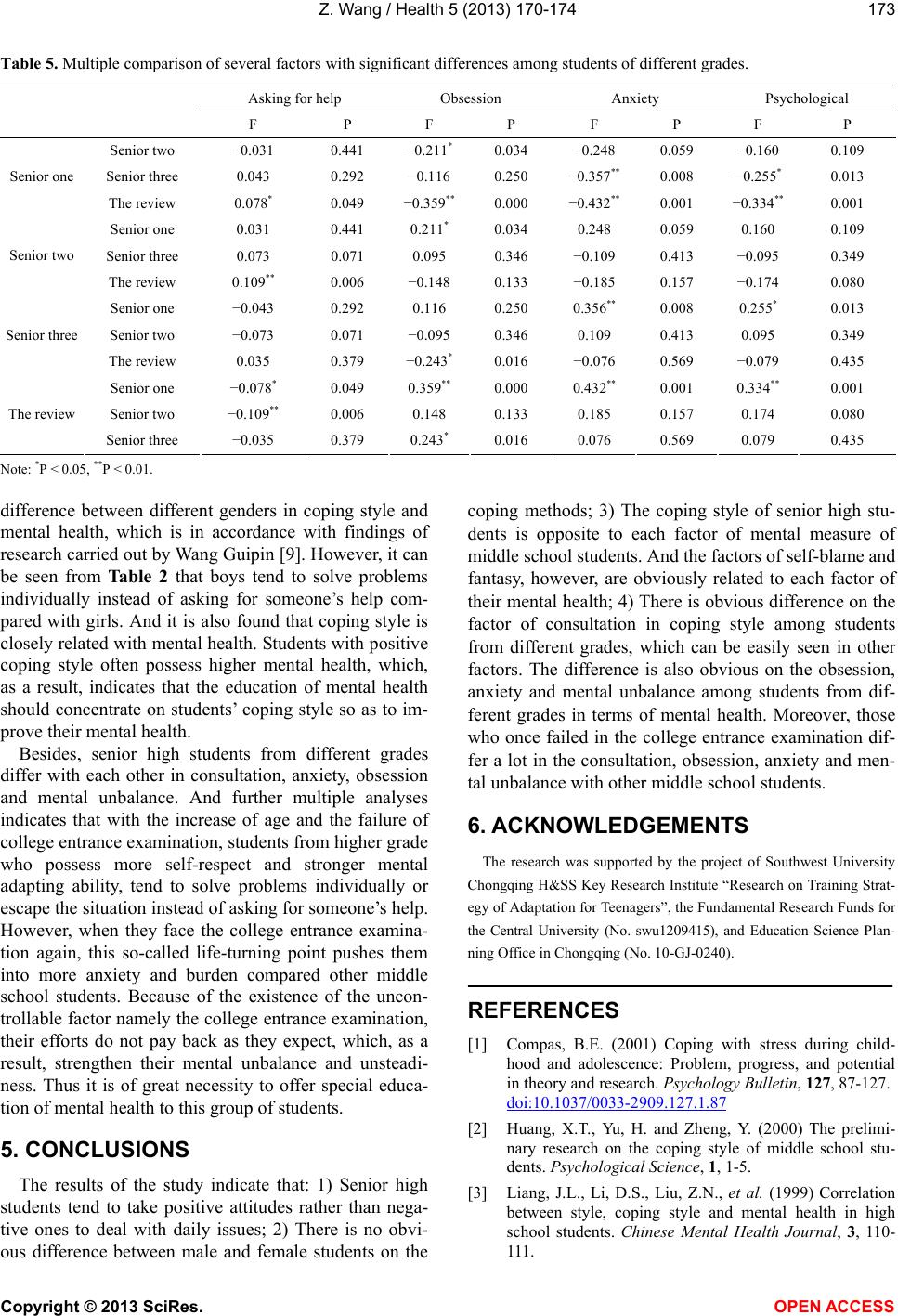 Z. Wang / Health 5 (2013) 170-174 173 Table 5. Multiple comparison of several factors with significant differences among students of different grades. Asking for help Obsession Anxiety Psychological F P F P F P F P Senior two −0.031 0.441 −0.211* 0.034 −0.248 0.059 −0.160 0.109 Senior three 0.043 0.292 −0.116 0.250 −0.357** 0.008 −0.255* 0.013 Senior one The review 0.078* 0.049 −0.359** 0.000 −0.432** 0.001 −0.334** 0.001 Senior one 0.031 0.441 0.211* 0.034 0.248 0.059 0.160 0.109 Senior three 0.073 0.071 0.095 0.346 −0.109 0.413 −0.095 0.349 Senior two The review 0.109** 0.006 −0.148 0.133 −0.185 0.157 −0.174 0.080 Senior one −0.043 0.292 0.116 0.250 0.356** 0.008 0.255* 0.013 Senior two −0.073 0.071 −0.095 0.346 0.109 0.413 0.095 0.349 Senior three The review 0.035 0.379 −0.243* 0.016 −0.076 0.569 −0.079 0.435 Senior one −0.078* 0.049 0.359** 0.000 0.432** 0.001 0.334** 0.001 Senior two −0.109** 0.006 0.148 0.133 0.185 0.157 0.174 0.080 The review Senior three −0.035 0.379 0.243* 0.016 0.076 0.569 0.079 0.435 Note: *P < 0.05, **P < 0.01. difference between different genders in coping style and mental health, which is in accordance with findings of research carried out by Wang Guipin [9]. However, it can be seen from Table 2 that boys tend to solve problems individually instead of asking for someone’s help com- pared with girls. And it is also found that coping style is closely related with mental health. Students with positive coping style often possess higher mental health, which, as a result, indicates that the education of mental health should concentrate on students’ coping style so as to im- prove their mental health. Besides, senior high students from different grades differ with each other in consultation, anxiety, obsession and mental unbalance. And further multiple analyses indicates that with the increase of age and the failure of college entrance examination, students from higher grade who possess more self-respect and stronger mental adapting ability, tend to solve problems individually or escape the situation instead of asking for someone’s help. However, when they face the college entrance examina- tion again, this so-called life-turning point pushes them into more anxiety and burden compared other middle school students. Because of the existence of the uncon- trollable factor namely the college entrance examination, their efforts do not pay back as they expect, which, as a result, strengthen their mental unbalance and unsteadi- ness. Thus it is of great necessity to offer special educa- tion of mental health to this group of students. 5. CONCLUSIONS The results of the study indicate that: 1) Senior high students tend to take positive attitudes rather than nega- tive ones to deal with daily issues; 2) There is no obvi- ous difference between male and female students on the coping methods; 3) The coping style of senior high stu- dents is opposite to each factor of mental measure of middle school students. And the factors of self-blame and fantasy, however, are obviously related to each factor of their mental health; 4) There is obvious difference on the factor of consultation in coping style among students from different grades, which can be easily seen in other factors. The difference is also obvious on the obsession, anxiety and mental unbalance among students from dif- ferent grades in terms of mental health. Moreover, those who once failed in the college entrance examination dif- fer a lot in the consultation, obsession, anxiety and men- tal unbalance with other middle school students. 6. ACKNOWLEDGEMENTS The research was supported by the project of Southwest University Chongqing H&SS Key Research Institute “Research on Training Strat- egy of Adaptation for Teenagers”, the Fundamental Research Funds for the Central University (No. swu1209415), and Education Science Plan- ning Office in Chongqing (No. 10-GJ-0240). REFERENCES [1] Compas, B.E. (2001) Coping with stress during child- hood and adolescence: Problem, progress, and potential in theory and research. Psychology Bulletin, 127, 87-127. doi:10.1037/0033-2909.127.1.87 [2] Huang, X.T., Yu, H. and Zheng, Y. (2000) The prelimi- nary research on the coping style of middle school stu- dents. Psychological Science, 1, 1-5. [3] Liang, J.L., Li, D.S., Liu, Z.N., et al. (1999) Correlation between style, coping style and mental health in high school students. Chinese Mental Health Journal, 3, 110- 111. Copyright © 2013 SciRes. OPEN A CCESS  Z. Wang / Health 5 (2013) 170-174 174 [4] Jiang, Q.J., Huang, L., Lu, K.S., et al. (1993) Psycho- logical stress: classification on coping and physical and spiritual health. Chinese Mental Health Journal, 4, 178- 180 [5] Gao, B.S. and Yang, C.L. (2003) Coping style and mental health on middle school students. Educational Science Research, 3, 3-9. [6] Wang, X.D., Wang, X.L. and Ma, H. (1999) The hand- book to measure psychological health. Press of Chinese Psychological Health, Beijing. [7] Wang, J.S. (1998) Times of spirit-health taken over by mind. Press of Chinese City, Beijing. [8] Lan, Y.P. and Zhang, J.F. (2003) Research on the coping style of middle school students. Research of Social Psy- chology, 2, 9-14. [9] Wang, G.P. and Chen, H.C. (2001) The relationship be- tween the coping style of middle school students and their self-control, self-respect and mental health. Journal of Chinese Psychological Health, 2, 31-34. Copyright © 2013 SciRes. OPEN A CCESS |