

Paper Menu >>
Journal Menu >>
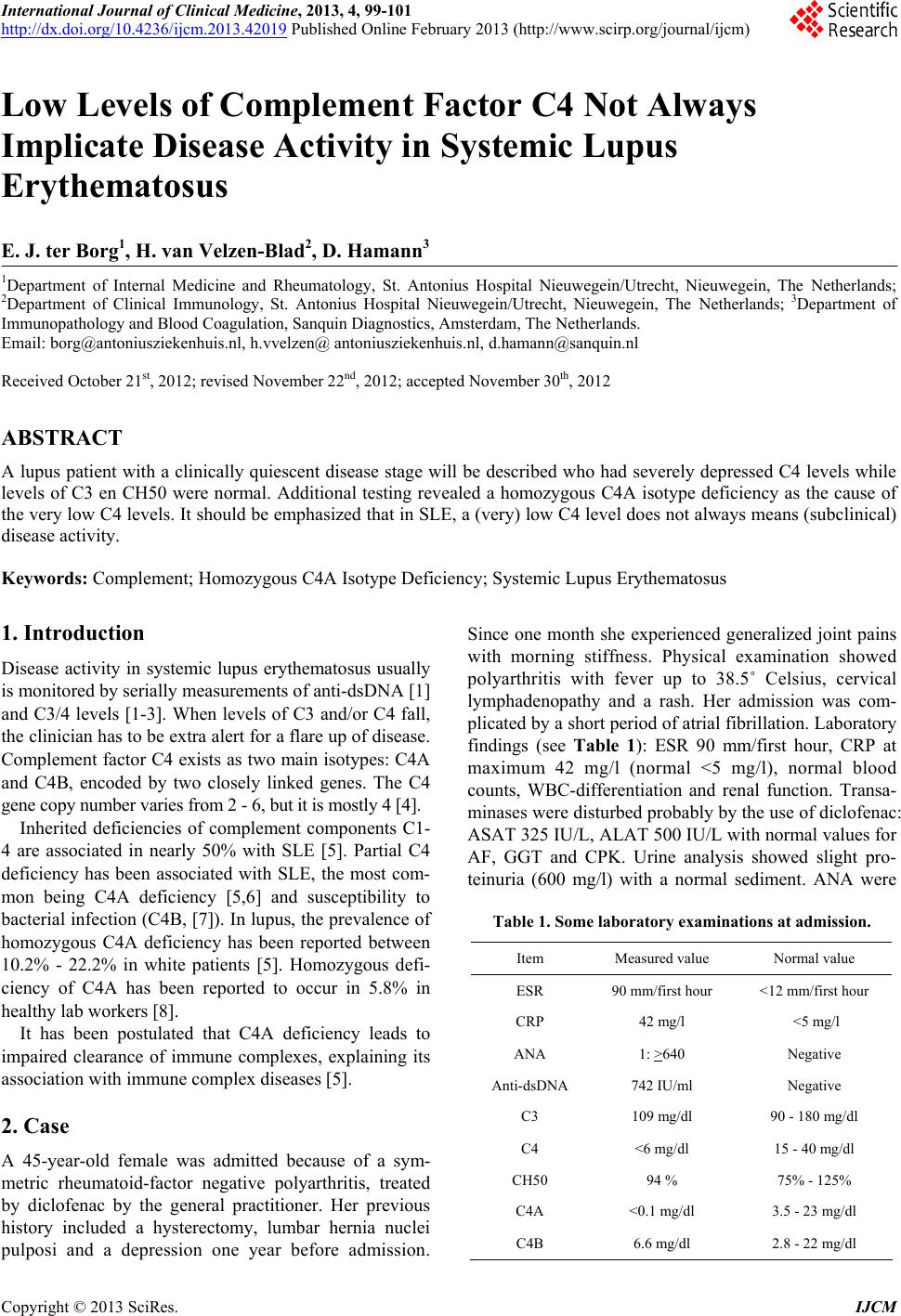 International Journal of Clinical Medicine, 2013, 4, 99-101 http://dx.doi.org/10.4236/ijcm.2013.42019 Published Online February 2013 (http://www.scirp.org/journal/ijcm) Low Levels of Complement Factor C4 Not Always Implicate Disease Activity in Systemic Lupus Erythematosus E. J. ter Borg1, H. van Velzen-Blad2, D. Hamann3 1Department of Internal Medicine and Rheumatology, St. Antonius Hospital Nieuwegein/Utrecht, Nieuwegein, The Netherlands; 2Department of Clinical Immunology, St. Antonius Hospital Nieuwegein/Utrecht, Nieuwegein, The Netherlands; 3Department of Immunopathology and Blood Coagulation, Sanquin Diagnostics, Amsterdam, The Netherlands. Email: [email protected], h.vv elzen@ a ntoniusziekenhuis.nl, [email protected] Received October 21st, 2012; revised November 22nd, 2012; accepted November 30th, 2012 ABSTRACT A lupus patient with a clinically quiescent disease stage will be described who had severely depressed C4 levels while levels of C3 en CH50 were normal. Additional testing revealed a homozygous C4A isotype deficiency as the cause of the very low C4 levels. It should be emphasized that in SLE, a (very) low C4 level does not always means (subclinical) disease activity. Keywords: Complement; Homozygous C4A Isotype Deficiency; Systemic Lupus Erythematosus 1. Introduction Disease activity in systemic lupus erythematosus usually is monitored by serially measurements of anti-dsDNA [1] and C3/4 levels [1-3]. When levels of C3 and/or C4 fall, the clinician has to be extra alert for a flare up of disease. Complement factor C4 exists as two main isotypes: C4A and C4B, encoded by two closely linked genes. The C4 gene copy number varies from 2 - 6, but i t is mostly 4 [4]. Inherited deficiencies of complement components C1- 4 are associated in nearly 50% with SLE [5]. Partial C4 deficiency has been associated with SLE, the most com- mon being C4A deficiency [5,6] and susceptibility to bacterial infection (C4B, [7]). In lupus, the prevalence of homozygous C4A deficiency has been reported between 10.2% - 22.2% in white patients [5]. Homozygous defi- ciency of C4A has been reported to occur in 5.8% in healthy lab workers [8]. It has been postulated that C4A deficiency leads to impaired clearance of immune complexes, explaining its association with immune complex diseases [5]. 2. Case A 45-year-old female was admitted because of a sym- metric rheumatoid-factor negative polyarthritis, treated by diclofenac by the general practitioner. Her previous history included a hysterectomy, lumbar hernia nuclei pulposi and a depression one year before admission. Since one month she experienced generalized joint pains with morning stiffness. Physical examination showed polyarthritis with fever up to 38.5˚ Celsius, cervical lymphadenopathy and a rash. Her admission was com- plicated by a short p eriod o f atrial fibrillatio n . Lab oratory findings (see Table 1): ESR 90 mm/first hour, CRP at maximum 42 mg/l (normal <5 mg/l), normal blood counts, WBC-differentiation and renal function. Transa- minases were disturbed probably by the use of diclofenac: ASAT 325 IU /L, ALAT 50 0 I U/L w ith normal v alu es fo r AF, GGT and CPK. Urine analysis showed slight pro- teinuria (600 mg/l) with a normal sediment. ANA were Table 1. Some laboratory examinations at admission. Item Measured value Normal value ESR 90 mm/first hour <12 mm/first hour CRP 42 mg/l <5 mg/l ANA 1: >640 Negative Anti-dsDNA 742 IU/ml Negative C3 109 mg/dl 90 - 180 mg/dl C4 <6 mg/dl 15 - 40 mg/dl CH50 94 % 75% - 125% C4A <0.1 mg/dl 3.5 - 23 mg/dl C4B 6.6 mg/dl 2.8 - 22 mg/dl Copyright © 2013 SciRes. IJCM 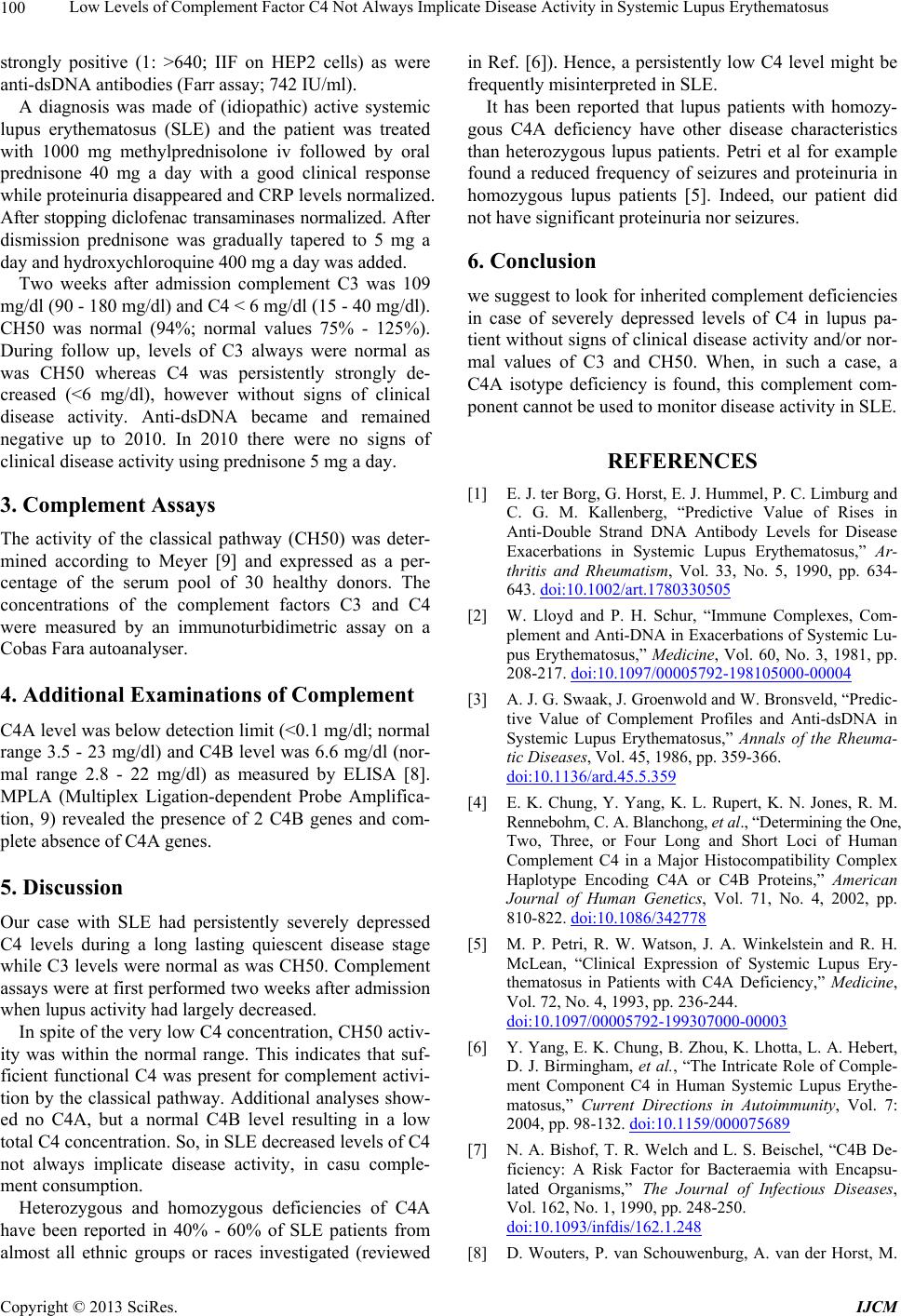 Low Levels of Complement Factor C4 Not Always Implicate Disease Activity in Systemic Lupus Erythematosus 100 strongly positive (1: >640; IIF on HEP2 cells) as were anti-dsDNA antibodies (Farr assay; 742 IU/ml). A diagnosis was made of (idiopathic) active systemic lupus erythematosus (SLE) and the patient was treated with 1000 mg methylprednisolone iv followed by oral prednisone 40 mg a day with a good clinical response while proteinuria disappeared and CRP levels normalized. After stopping diclofenac transaminases normalized. After dismission prednisone was gradually tapered to 5 mg a day and hydro xyc hl o r oquine 400 m g a day was ad ded . Two weeks after admission complement C3 was 109 mg/dl (90 - 180 mg/dl) and C4 < 6 mg/dl (15 - 40 mg/dl). CH50 was normal (94%; normal values 75% - 125%). During follow up, levels of C3 always were normal as was CH50 whereas C4 was persistently strongly de- creased (<6 mg/dl), however without signs of clinical disease activity. Anti-dsDNA became and remained negative up to 2010. In 2010 there were no signs of clinical disease activity using prednisone 5 mg a day. 3. Complement Assays The activity of the classical pathway (CH50) was deter- mined according to Meyer [9] and expressed as a per- centage of the serum pool of 30 healthy donors. The concentrations of the complement factors C3 and C4 were measured by an immunoturbidimetric assay on a Cobas Fara autoanalyser. 4. Additional Examinations of Complement C4A level was below detection li mit (<0.1 mg/d l; normal range 3.5 - 23 mg/dl) and C4B level was 6.6 mg/dl (nor- mal range 2.8 - 22 mg/dl) as measured by ELISA [8]. MPLA (Multiplex Ligation-dependent Probe Amplifica- tion, 9) revealed the presence of 2 C4B genes and com- plete absence of C4A genes. 5. Discussion Our case with SLE had persistently severely depressed C4 levels during a long lasting quiescent disease stage while C3 levels were normal as was CH50. Complement assays were at first performed two weeks after admission when lupus activity had largely decreased. In spite of the very low C4 concentration , CH50 activ- ity was within the normal range. This indicates that suf- ficient functional C4 was present for complement activi- tion by the classical pathway. Additional analyses show- ed no C4A, but a normal C4B level resulting in a low total C4 concentration . So , in SLE decreased lev els of C4 not always implicate disease activity, in casu comple- ment consumption. Heterozygous and homozygous deficiencies of C4A have been reported in 40% - 60% of SLE patients from almost all ethnic groups or races investigated (reviewed in Ref. [6]). Hence, a persistently low C4 level might be frequently misinterpreted in SLE. It has been reported that lupus patients with homozy- gous C4A deficiency have other disease characteristics than heterozygous lupus patients. Petri et al for example found a reduced frequency of seizures and proteinuria in homozygous lupus patients [5]. Indeed, our patient did not have significant proteinuria nor seizures. 6. Conclusion we suggest to look for inherited complement deficiencies in case of severely depressed levels of C4 in lupus pa- tient without signs of clinical disease activity and/or nor- mal values of C3 and CH50. When, in such a case, a C4A isotype deficiency is found, this complement com- ponent cannot be used to monitor disease activity in SLE. REFERENCES [1] E. J. ter Borg, G. Horst, E. J. Hummel, P. C. Limburg and C. G. M. Kallenberg, “Predictive Value of Rises in Anti-Double Strand DNA Antibody Levels for Disease Exacerbations in Systemic Lupus Erythematosus,” Ar- thritis and Rheumatism, Vol. 33, No. 5, 1990, pp. 634- 643. doi:10.1002/art.1780330505 [2] W. Lloyd and P. H. Schur, “Immune Complexes, Com- plement and Anti-DNA in Exacerbations of Systemic Lu- pus Erythematosus,” Medicine, Vol. 60, No. 3, 1981, pp. 208-217. doi:10.1097/00005792-198105000-00004 [3] A. J. G. Swaak, J. Groenwold and W. Bronsveld, “Predic- tive Value of Complement Profiles and Anti-dsDNA in Systemic Lupus Erythematosus,” Annals of the Rheuma- tic Diseases, Vol. 45, 1986, pp. 359-366. doi:10.1136/ard.45.5.359 [4] E. K. Chung, Y. Yang, K. L. Rupert, K. N. Jones, R. M. Rennebohm, C. A. Blanchong, et al., “Determining the One, Two, Three, or Four Long and Short Loci of Human Complement C4 in a Major Histocompatibility Complex Haplotype Encoding C4A or C4B Proteins,” American Journal of Human Genetics, Vol. 71, No. 4, 2002, pp. 810-822. doi:10.1086/342778 [5] M. P. Petri, R. W. Watson, J. A. Winkelstein and R. H. McLean, “Clinical Expression of Systemic Lupus Ery- thematosus in Patients with C4A Deficiency,” Medicine, Vol. 72, No. 4, 1993, pp. 236-244. doi:10.1097/00005792-199307000-00003 [6] Y. Yang, E. K. Chung, B. Zhou, K. Lhotta, L. A. Hebert, D. J. Birmingham, et al., “The Intricate Role of Comple- ment Component C4 in Human Systemic Lupus Erythe- matosus,” Current Directions in Autoimmunity, Vol. 7: 2004, pp. 98-132. doi:10.1159/000075689 [7] N. A. Bishof, T. R. Welch and L. S. Beischel, “C4B De- ficiency: A Risk Factor for Bacteraemia with Encapsu- lated Organisms,” The Journal of Infectious Diseases, Vol. 162, No. 1, 1990, pp. 248-250. doi:10.1093/infdis/162.1.248 [8] D. Wouters, P. van Schouwenburg, A. van der Horst, M. Copyright © 2013 SciRes. IJCM  Low Levels of Complement Factor C4 Not Always Implicate Disease Activity in Systemic Lupus Erythematosus Copyright © 2013 SciRes. IJCM 101 de Boer, D. Schooneman, T. W. Kuijpers, et al., “High- Throughput Analysis of the C4 Polymorphism by a Com- bination of MLPA and Isotype-Specific ELISA’s,” Mo- lecular Immunology, Vol. 46, No. 4, 2009, pp. 592-600. doi:10.1016/j.molimm.2008.07.028 [9] M. M. Meyer, “Experimental Immunochemistry,” 2nd Edition, Charles C Thomas, Springfield, 1961, pp. 133- 240. |