

Paper Menu >>
Journal Menu >>
 Vol.3, No.1, 99-103 (2013) Open Journal of Preventive Medicine http://dx.doi.org/10.4236/ojpm.2013.31012 Multifactorial study of mobile phone dependence in medical students: Relationship to health-related lifestyle, Type A behavior, and depressive state Masahiro Toda1*, Satoko Ezoe2 1Department of Pharmacology, Osaka Dental University, Osaka, Japan; *Corresponding Author: [email protected] 2Shimane University, Health Administration Center Izumo, Shimane, Japan Received 29 October 2012; revised 3 December 2012; accepted 11 December 2012 ABSTRACT We investigated factors contributing to mobile phone dependence. To 139 medical students, we administered a self-reporting questionnaire de- signed to evaluate mobile phone dependence, health-relate d lifesty l e, pattern s of b eh avior, and depressive state. Multivariate logistic regression analysis revealed that scores for poor health- related lifestyle, Type A behavior pattern, and presence of depression are independently as- sociated with degree of mobile phone depend- ency. These findings suggest that persons with an unhealthy lifestyle, Type A behavior traits, or depression might benefit from mo bile phone use guidance. Keywords: Mobile Phone Dependence; Health-Related Lifestyle; Patterns of Behavior; Depressive State; Medical Students 1. INTRODUCTION In Japan, in March 2011 there were about 120 million mobile phones in use, which is almost the same as the total population [1]. Along with the rapid proliferation of mobile phones, various social issues have arisen, includ- ing their use in public places and excessive use or even dependence. View ing problematic mobile phone use as a type of technostress [2], to gauge mobile phone depend- ence and identif y high-risk groups, we were quick to d e- sign the Mobile Phone Dependence Questionnaire (MPDQ) questionnaire, subsequently confirming its reliability and validity [3]. In recent studies, we found that mobile phone de- pendency is associated with unhealthy lifestyle [4,5], extrovert or neurotic personality traits [5], and maternal affectionate constraint in childhood [6]. Other factors that may also contribute to mobile phone dependence remain to be studied. For example, we think that more multifactorial research is needed. Consequently, in the present study, using logistic regression analysis, we ex- amined associations between mobile phone dependence and demographic characteristics, health-related lifestyle, patterns of behavior, and depressive state. 2. MATERIALS AND METHODS 2.1. Subjects We recruited 139 university students from the Faculty of Medicine at Shimane University. After the protocol received the approval of the institute’s review board and informed consent was obtained from each participant, the participants filled out a set of self-reporting question- naires designed to evaluate mobile phone dependence, health-related lifestyle, behavior pattern, and depressive state. The answers of the 130 respondents (47 males, 83 females) who properly completed all the questionnaire items were statistically analyzed. Mean (±SD) age for males was 19.3 ± 1.8 years and for females 18.7 ± 0.9 years. 2.2. Mobile Phone Dependence Mobile phone dependence was evaluated using the MPDQ [3], a self-rating questionnaire which consists of 20 items. Each response is scored on a Likert scale (0, 1, 2, 3). Likert scores for each item are then summed to provide a quantitative overall mobile phone dependence score ranging from 0 to 60. Higher scores indicate greater dependence. Subjects in the highest quartile were put in the high-dependence category. 2.3. Health-Related Lifestyle Health-related lifestyle was evaluated using th e Health Practice Index (HPI) [7,8], in which 1 point is accumu- lated for each desirable response on 8 items (desirable criteria are shown in parentheses): smoking habits (not Copyright © 2013 SciRes. OPEN ACCE SS 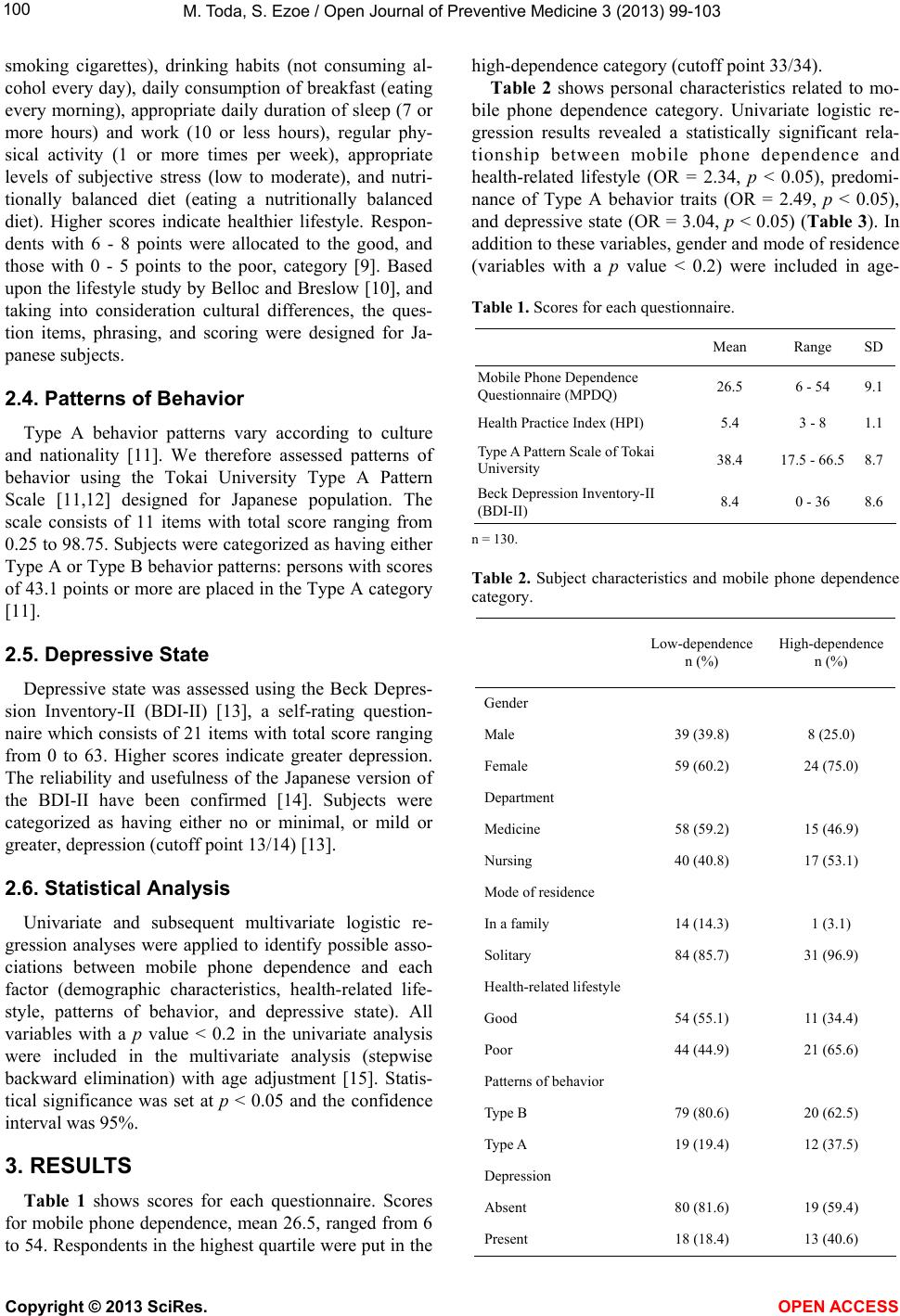 M. Toda, S. Ezoe / Open Journal of Preventive Medicine 3 (2013) 99-103 100 smoking cigarettes), drinking habits (not consuming al- cohol every day), daily consumption of breakfast (eating every morning), appropriate daily duration of sleep (7 or more hours) and work (10 or less hours), regular phy- sical activity (1 or more times per week), appropriate levels of subjective stress (low to moderate), and nutri- tionally balanced diet (eating a nutritionally balanced diet). Higher scores indicate healthier lifestyle. Respon- dents with 6 - 8 points were allocated to the good, and those with 0 - 5 points to the poor, category [9]. Based upon the lifestyle stud y by Belloc and Breslow [10 ], and taking into consideration cultural differences, the ques- tion items, phrasing, and scoring were designed for Ja- panese subjects. 2.4. Patterns of Behavior Type A behavior patterns vary according to culture and nationality [11]. We therefore assessed patterns of behavior using the Tokai University Type A Pattern Scale [11,12] designed for Japanese population. The scale consists of 11 items with total score ranging from 0.25 to 98.75. Subjects were categorized as having either Type A or Type B behavior patterns: persons with scores of 43.1 points or more are placed in the Type A category [11]. 2.5. Depressive State Depressive state was assessed using the Beck Depres- sion Inventory-II (BDI-II) [13], a self-rating question- naire which consists of 21 items with total score ranging from 0 to 63. Higher scores indicate greater depression. The reliability and usefulness of the Japanese version of the BDI-II have been confirmed [14]. Subjects were categorized as having either no or minimal, or mild or greater, depression (cutoff point 13/14) [13]. 2.6. Statistical Analysis Univariate and subsequent multivariate logistic re- gression analyses were applied to identify possible asso- ciations between mobile phone dependence and each factor (demographic characteristics, health-related life- style, patterns of behavior, and depressive state). All variables with a p value < 0.2 in the univariate analysis were included in the multivariate analysis (stepwise backward elimination) with age adjustment [15]. Statis- tical significance was set at p < 0.05 and the confidence interval was 95%. 3. RESULTS Table 1 shows scores for each questionnaire. Scores for mobile phone dependence, mean 26.5, ranged from 6 to 54. Respondents in the highest quartile were put in the high-depend ence category (cutoff point 33/34). Table 2 shows personal characteristics related to mo- bile phone dependence category. Univariate logistic re- gression results revealed a statistically significant rela- tionship between mobile phone dependence and health-related lifestyle (OR = 2.34, p < 0.05), predomi- nance of Type A behavior traits (OR = 2.49, p < 0.05), and depressive state (OR = 3.04, p < 0.05) (Table 3). In addition to these variables, gender and mode of residence (variables with a p value < 0.2) were included in age- Table 1. Scores for each questionnaire. Mean Range SD Mobile Phone Dependence Questionnaire (MPDQ) 26.5 6 - 54 9.1 Health Practice Index (HPI) 5.4 3 - 8 1.1 Type A Pattern Scale of Tokai University 38.4 17.5 - 66.58.7 Beck Depression Inventory-II (BDI-II) 8.4 0 - 36 8.6 n = 130. Table 2. Subject characteristics and mobile phone dependence category. Low-dependence n (%) High-dependence n (%) Gender Male 39 (39.8) 8 (25.0) Female 59 (60.2) 24 (75.0) Department Medicine 58 (59.2) 15 (46.9) Nursing 40 (40.8) 17 (53.1) Mode of residence In a family 14 (14.3) 1 (3.1) Solitary 84 (85.7) 31 (96.9) Health-related lifestyle Good 54 (55.1) 11 (34.4) Poor 44 (44.9) 21 (65.6) Patterns of behavior Type B 79 (80.6) 20 (62.5) Type A 19 (19.4) 12 (37.5) Depression Absent 80 (81.6) 19 (59.4) Present 18 (18.4) 13 (40.6) Copyright © 2013 SciRes. OPEN ACCE SS 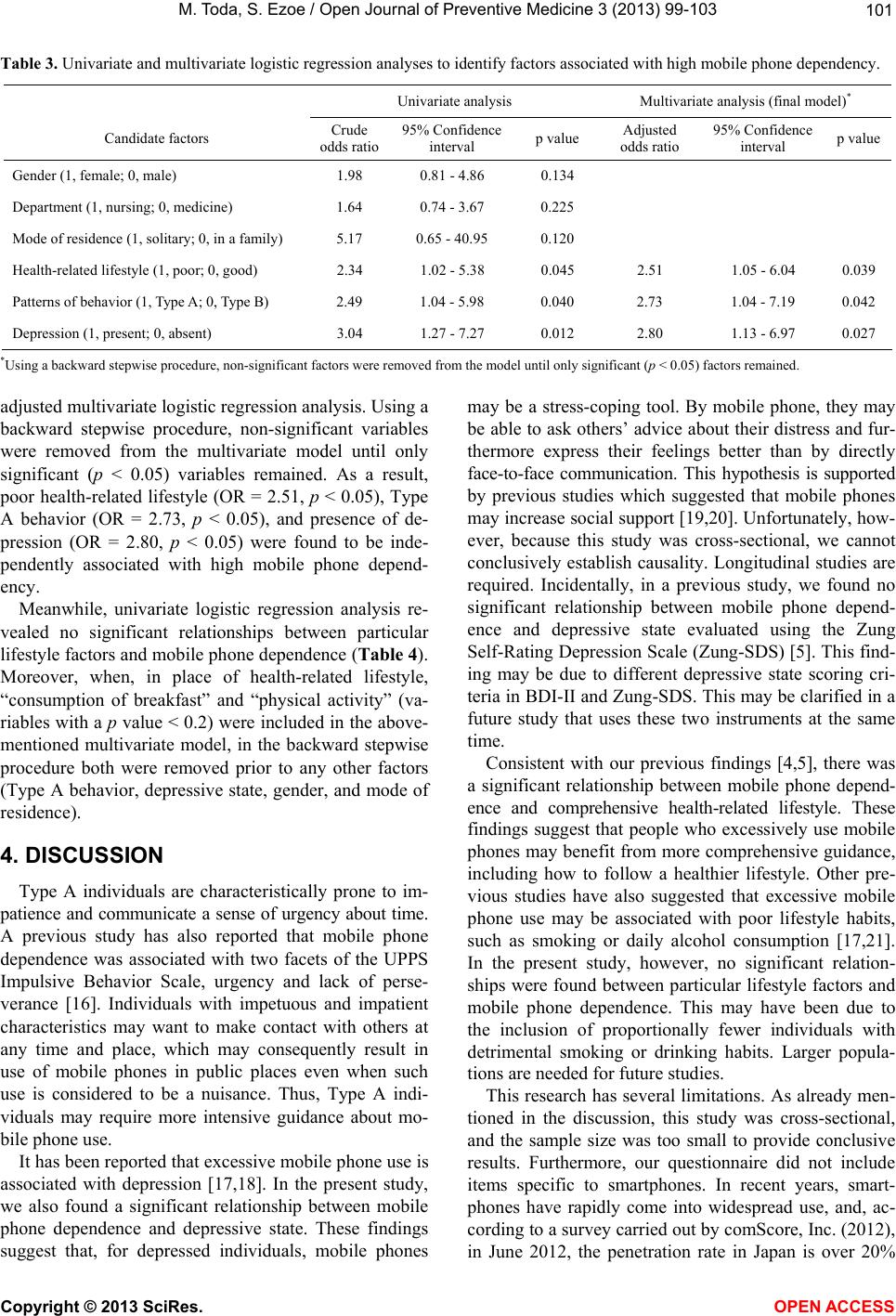 M. Toda, S. Ezoe / Open Journal of Preve nti ve Medicine 3 (2013) 99-103 Copyright © 2013 SciRes. OPEN ACCE SS 101 Table 3. Univariate and multivariate logistic regression analyses to identify factors associated with high mobile phone dependency. Univariate analysis Multivariate analysis (final model)* Candidate factors Crude odds ratio95% Confidence interval p value Adjusted odds ratio 95% Confidence interval p value Gender (1, female; 0 , male) 1.98 0.81 - 4.86 0.134 Department (1, nursing; 0, medici ne) 1.64 0.74 - 3.67 0.225 Mode of residence (1, solitary; 0, in a family) 5.17 0.65 - 40.95 0.120 Health-related lifestyle (1, poor; 0, good) 2.34 1.02 - 5.38 0.045 2.51 1.05 - 6.04 0.039 Patterns of behavior (1, Type A; 0, Type B) 2.49 1.04 - 5.98 0.040 2.73 1.04 - 7.19 0.042 Depression (1, pres en t; 0 , absent) 3.04 1.27 - 7 .27 0.012 2.80 1.13 - 6.97 0.027 *Using a backward st epwise procedure, non-significant factors were rem oved from the model until only significant (p < 0.05) fac tors remained. adjusted multivariate log istic regr ession analysis. Using a backward stepwise procedure, non-significant variables were removed from the multivariate model until only significant (p < 0.05) variables remained. As a result, poor health-related lifestyle (OR = 2.51, p < 0.05), Type A behavior (OR = 2.73, p < 0.05), and presence of de- pression (OR = 2.80, p < 0.05) were found to be inde- pendently associated with high mobile phone depend- ency. Meanwhile, univariate logistic regression analysis re- vealed no significant relationships between particular lifestyle factors and mobile phone dependence ( Tab le 4). Moreover, when, in place of health-related lifestyle, “consumption of breakfast” and “physical activity” (va- riables with a p value < 0.2) were included in the above- mentioned multivariate model, in the backward stepwise procedure both were removed prior to any other factors (Type A behavior, depressive state, gender, and mode of residence). 4. DISCUSSION Type A individuals are characteristically prone to im- patience and communicate a sense of urgency about time. A previous study has also reported that mobile phone dependence was associated with two facets of the UPPS Impulsive Behavior Scale, urgency and lack of perse- verance [16]. Individuals with impetuous and impatient characteristics may want to make contact with others at any time and place, which may consequently result in use of mobile phones in public places even when such use is considered to be a nuisance. Thus, Type A indi- viduals may require more intensive guidance about mo- bile phone use. It has been reported that excessive mobile phone use is associated with depression [17,18]. In the present study, we also found a significant relationship between mobile phone dependence and depressive state. These findings suggest that, for depressed individuals, mobile phones may be a stress-coping tool. By mobile phone, they may be able to ask others’ advice about their distress and fur- thermore express their feelings better than by directly face-to-face communication. This hypothesis is supported by previous studies which suggested that mobile phones may increase social support [19,20]. Unfortunately, how- ever, because this study was cross-sectional, we cannot conclusively establish causality. Longitudinal studies are required. Incidentally, in a previous study, we found no significant relationship between mobile phone depend- ence and depressive state evaluated using the Zung Self-Rating Depression Scale (Zung-SDS) [5]. This find- ing may be due to different depressive state scoring cri- teria in BDI-II and Zung-SDS. This may be clarified in a future study that uses these two instruments at the same time. Consistent with our previous findings [4,5], there was a significant relationship between mobile phone depend- ence and comprehensive health-related lifestyle. These findings suggest that people who excessively use mobile phones may benefit from more comprehensive guidance, including how to follow a healthier lifestyle. Other pre- vious studies have also suggested that excessive mobile phone use may be associated with poor lifestyle habits, such as smoking or daily alcohol consumption [17,21]. In the present study, however, no significant relation- ships were found between particular lifestyle factors and mobile phone dependence. This may have been due to the inclusion of proportionally fewer individuals with detrimental smoking or drinking habits. Larger popula- tions are needed fo r future studies. This research has several limitations. As already men- tioned in the discussion, this study was cross-sectional, and the sample size was too small to provide conclusive results. Furthermore, our questionnaire did not include items specific to smartphones. In recent years, smart- phones have rapidly come into widespread use, and, ac- cording to a survey carried out by comScore, Inc. (2012), in June 2012, the penetration rate in Japan is over 20% 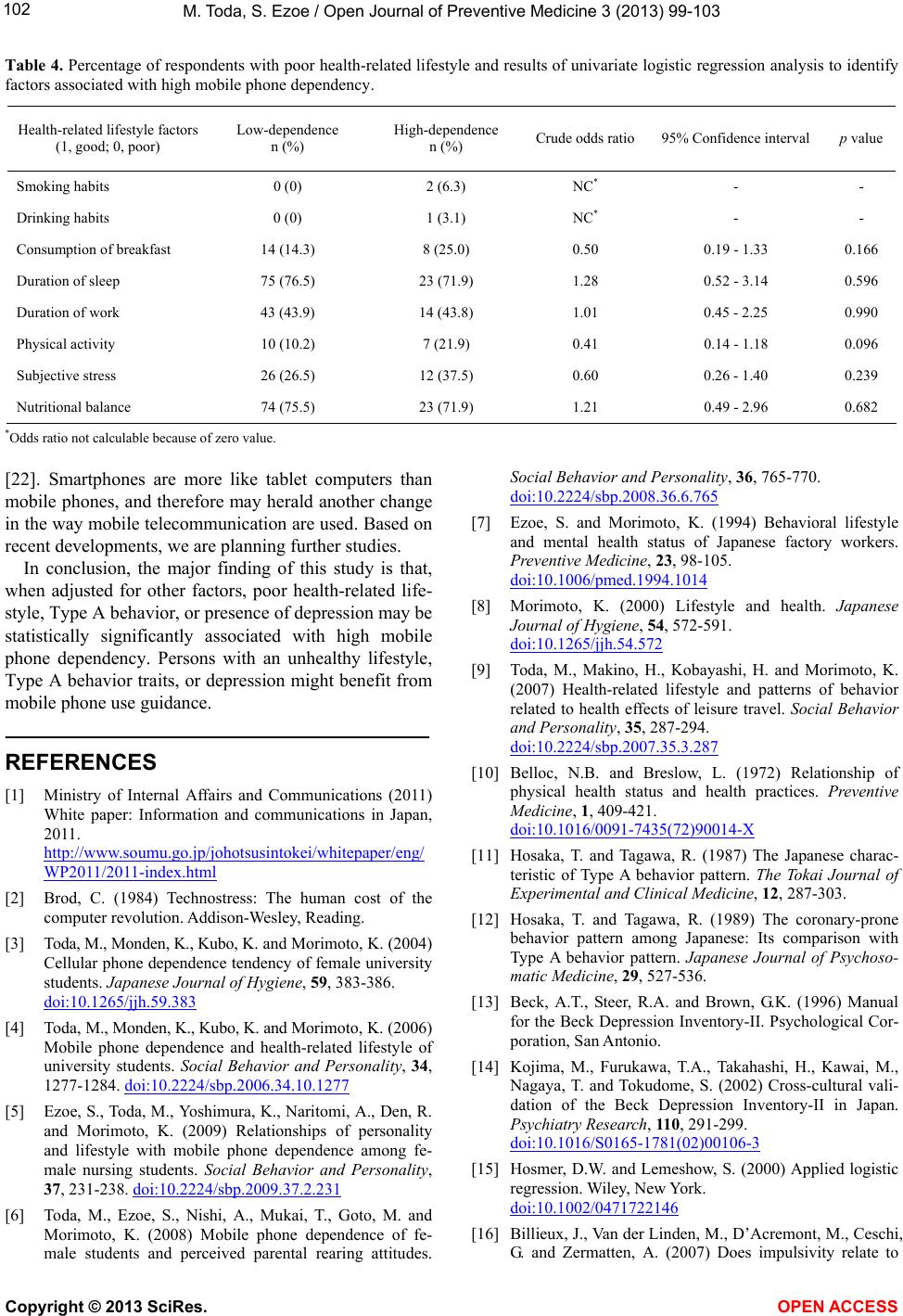 M. Toda, S. Ezoe / Open Journal of Preventive Medicine 3 (2013) 99-103 102 Table 4. Percentage of respondents with poor health-related lifestyle and results of univariate logistic regression analysis to identify factors associated with high mobile phone dependency. Health-related lifestyle factor s (1, good; 0, poor) Low-dependence n (%) High-dependence n (%) Crude odds ratio95% Confidence interval p value Smoking habits 0 (0) 2 (6.3) NC* - - Drinking habits 0 (0) 1 (3.1) NC* - - Consumption of breakfast 14 (14.3) 8 (25.0) 0.50 0.19 - 1.33 0.166 Duration of sleep 75 (76.5) 23 (71.9) 1.28 0.52 - 3.14 0.596 Duration of work 43 (43.9) 14 (43.8) 1. 01 0.45 - 2.25 0 .990 Physical activity 10 (10.2) 7 (21.9) 0.41 0.14 - 1.18 0.096 Subjective stress 26 (26.5) 12 (37.5) 0.60 0.26 - 1.40 0.239 Nutritional balance 74 (75.5) 23 (71.9) 1.21 0.49 - 2.96 0.682 *Odds ratio not calculable b ecause of zer o v alue. [22]. Smartphones are more like tablet computers than mobile phones, and therefore may herald another change in the way mobile telecommunication are used. Based on recent developments, we are planning further studies. In conclusion, the major finding of this study is that, when adjusted for other factors, poor health-related life- style, Type A behavior, or presence of depression may be statistically significantly associated with high mobile phone dependency. Persons with an unhealthy lifestyle, Type A behavior traits, or depression might benefit from mobile phone use guidance. REFERENCES [1] Ministry of Internal Affairs and Communications (2011) White paper: Information and communications in Japan, 2011. http://www.soumu.go.jp/johotsusintokei/whitepaper/eng/ WP2011/2011-index.html [2] Brod, C. (1984) Technostress: The human cost of the computer revolution. Addison-Wesley, Reading. [3] Toda, M., Monden, K., Kubo, K. and Morimoto, K. (2004) Cellular phone dependence tendency of female university students. Japanese Journal of Hygiene, 59, 383-386. doi:10.1265/jjh.59.383 [4] Toda, M., Monden, K., Kubo, K. and Morimoto, K. (2006) Mobile phone dependence and health-related lifestyle of university students. Social Behavior and Personality, 34, 1277-1284. doi:10.2224/sbp.2006.34.10.1277 [5] Ezoe, S., Toda, M., Yoshimura, K., Naritomi, A., Den, R. and Morimoto, K. (2009) Relationships of personality and lifestyle with mobile phone dependence among fe- male nursing students. Social Behavior and Personality, 37, 231-238. doi:10.2224/sbp.2009.37.2.231 [6] Toda, M., Ezoe, S., Nishi, A., Mukai, T., Goto, M. and Morimoto, K. (2008) Mobile phone dependence of fe- male students and perceived parental rearing attitudes. Social Behavior and Personality, 36, 765-770. doi:10.2224/sbp.2008.36.6.765 [7] Ezoe, S. and Morimoto, K. (1994) Behavioral lifestyle and mental health status of Japanese factory workers. Preventive Medicine, 23, 98-105. doi:10.1006/pmed.1994.1014 [8] Morimoto, K. (2000) Lifestyle and health. Japanese Journal of Hygiene, 54, 572-591. doi:10.1265/jjh.54.572 [9] Toda, M., Makino, H., Kobayashi, H. and Morimoto, K. (2007) Health-related lifestyle and patterns of behavior related to health effects of leisure travel. Social Behavior and Personality, 35, 287-294. doi:10.2224/sbp.2007.35.3.287 [10] Belloc, N.B. and Breslow, L. (1972) Relationship of physical health status and health practices. Preventive Medicine, 1, 409-421. doi:10.1016/0091-7435(72)90014-X [11] Hosaka, T. and Tagawa, R. (1987) The Japanese charac- teristic of Type A behavior pattern. The Tokai Journal of Experimental and Clinical Medicine, 12, 287-303. [12] Hosaka, T. and Tagawa, R. (1989) The coronary-prone behavior pattern among Japanese: Its comparison with Type A behavior pattern. Japanese Journal of Psychoso- matic Medicine, 29, 527-536. [13] Beck, A.T., Steer, R.A. and Brown, G.K. (1996) Manual for the Beck Depression Inventory-II. Psychological Cor- poration, San Antonio. [14] Kojima, M., Furukawa, T.A., Takahashi, H., Kawai, M., Nagaya, T. and Tokudome, S. (2002) Cross-cultural vali- dation of the Beck Depression Inventory-II in Japan. Psychiatry Research, 110, 291-299. doi:10.1016/S0165-1781(02)00106-3 [15] Hosmer, D.W. and Lemeshow, S. (2000) Applied logistic regression. Wiley, New York. doi:10.1002/0471722146 [16] Billieux, J., Van der Linden, M., D’Acremont, M., Ceschi, G. and Zermatten, A. (2007) Does impulsivity relate to Copyright © 2013 SciRes. OPEN ACCE SS  M. Toda, S. Ezoe / Open Journal of Preve nti ve Medicine 3 (2013) 99-103 103 perceived dependence on and actual use of the mobile phone? Applied Cognitive Psychology, 21, 527-537. doi:10.1002/acp.1289 [17] Sánchez-Martínez, M. and Otero, A. (2009) Factors asso- ciated with cell phone use in adolescents in the commu- nity of Madrid (Spain). Cyberpsychology & Behavior, 12, 131-137. doi:10.1089/cpb.2008.0164 [18] Yen, C.F., Tang, T.C., Yen, J.Y., Lin, H.C., Huang, C.F., Liu, S.C. and Ko, C.H. (2009) Symptoms of problematic cellular phone use, functional impairment and its associa- tion with depression among adolescents in Southern Tai- wan. Journal of Adolescence, 32, 863-873. doi:10.1016/j.adolescence.2008.10.006 [19] Igarashi, T., Takai, J. and Yoshida, T. (2005) Gender dif- ferences in social network development via mobile phone text messages: A longitudinal study. Journal of Social and Personal Relationships, 22, 691-713. doi:10.1177/0265407505056492 [20] Rettie, R. (2008) Mobile phones as network capital: Fa- cilitating connections. Mobilities, 3, 291-311. doi:10.1080/17450100802095346 [21] Koivusilta, L., Lintonen, T. and Rimpelä, A. (2005) In- tensity of mobile phone use and health compromising behaviours: How is information and communication technology connected to health-related lifestyle in ado- lescence? Journal of Adolescence, 28, 35-47. doi:10.1016/j.adolescence.2004.05.004 [22] comScore, Inc. (2012) Japan smartphone surge. http://www.comscore.com/Press_Events/Press_Releases/ 2012/8/Japan_Smartphone_Surge Copyright © 2013 SciRes. OPEN ACCE SS |