

Paper Menu >>
Journal Menu >>
 Vol.3, No.1, 58-63 (2013) Open Journal of Preventive Medicine http://dx.doi.org/10.4236/ojpm.2013.31008 Spouses of patients with diabetes mellitus type 2 at increased risk of high blood glucose levels* Ganiyu Lanre Yahaya1, Alero Ann Robert s2*, Victor Akpan Inem2 1Department of Family Medicine, Lagos State University Teaching Hospital, Lagos, Nigeria 2Department of Community Health & Primary Care, College of Medicine, University of Lagos, Lagos, Nigeria *Corresponding Author: [email protected] Received 29 December 2012; revised 29 January 2013; accepted 5 February 2013 ABSTRACT Introduction: Diabetes mellitus type 2 is a grow- ing threat in developing countries already bur- dened with high levels of infectious disease. Screening the general population has debatable advant a ges. This s tudy aims to de termine whether spouses of patients with diabetes mellitus have higher random blood glucose (RBG) levels as well as the benefit of RBG testing as a targetted screening tool. Methodology: The survey em- ployed a cross-sectional comparative study of spouses’ of diabetics and non-diabetics attend- ing the general out-patient department of the La- gos State University Teaching Hospital (LASUTH), Ikeja. A modified WHO STEPS Surveillance In- strument and a one-touch Glucometer were used to collect data. Blood pressures and BMI were measured and correlated to blood glucose levels. Results: Prevalence of high RBG was found to be 7% among spouses of diabetics and 3.3% among spouses of non-diabetic patients. Mean RBG was 5.57 mmol/L and 7.7 mmol/L within the age group 40 - 49 years and 50 - 59 years respectively among spouses of diabetic patients compared to 5.4 mmol/L and 5.5 mmol/L within the same age group among the spouses non-diabetics. S pouses of patients with diabetes mellitus had higher systolic and diastolic blood pressures and BMI comp ared to spo uses of non- diabetics. Conclusion: Being male, married to a diabetic patient, lower educational levels and higher body mass index are significantly asso- ciated with higher random blood glucose in the spouses of diabetic patients. Random blood glucose measurements are an effective screen- ing tool and spouses of diabetic patients can benefit from targeted screening in controlled clinical settings. Keywords: Diabetes Mellitus Type 2; Non-Communicab le Disease; Rando m Blood Glucose Levels; Glucose Intolerance; Body Mass Index; Blood Pressure 1. INTRODUCTION Diabetes mellitus type 2 is a growing threat in devel- oping countries already burdened with high morbidity and mortality rates from infectious diseases, maternal and infant health concerns and weak ineffective health systems [1,2]. Analysis of the g lobal and region al burden of non-communicable diseases shows that almost half the disease burden in developing countries is from non- communicable diseases, with 15 to 59 year olds facing a 30% greater risk of death from an NCD than their coun- terparts in the developed world [3]. In Nigeria there has been an increase in the prevalence of diabetes mellitus from 0.39% reported in a hospital population in 1963, to 6.8% in 2003 which is comparable to global estimated prevalence of 6.4%, with the largest proportion of in- crease occurring in developing countries [4-6]. Overall about 1.05 million people are diabetic in Nigeria and most of these are type II. Urban communities had a higher over all prevalence of diabetes mellitus (3.3%) when compared with rural communities (2.6%). The burden of diabetes in Nigeria is expected to increase even further [5]. The rising prevalence of diabetes mellitus cannot be linked only to the genetic factors of ageing populations. Environmental factors of obesity, diet and physical activ- ity have a major influence. Various studies have exam- ined the effect of environmental influences versus ge- netic factors in twins and cohabiting couples in morbid- ities such as coronary disease, cancer, hypertension and depression [7-13]. *Key findings: a statistically significant 7% of spouses of diabetic p atients had random blood glucose levels ove r 11 mmol/L, compared to 3.3% of spouses in the comparative group. It was also observed that spouses of non-diabetic patients had statistically significantly lower systolic and diastolic blood pres s ures. Copyright © 2013 SciRes. OPEN ACCE SS  G. L. Yahaya et al. / Open Journal of Preventive Medicine 3 (2013) 58-63 59 Screening for disease in the general population is ap- propriate when certain condition s are met with regards to representing a public health burden with known patho- physiology and a defined, asymptomatic preclinical stage when the disease can be diagnosed by reliable acceptable tests. Diabetes meets many of the conditions for screening, which is cost-effective if done as a systematic process. Community screening is usually poorly targeted , tends to test those at low risk (the worried well) and those already diagnosed. However, in developing countries, there is benefit to be obtained from case detection using oppor- tunistic events where there is clinical evidence of risk fa ctors [14 ,15]. The cost-effectiveness of targeted scr een- ing of people attending clinics has been shown to have benefits of being able to institute preventive and thera- peutic measures to reduce the impact of more serious complications [16,17]. The use of fasting blood glucose (FBG) and 2-hour blood glucose (2-hBG) have com- monly been used as screening for type 2 diabetes melli- tus especially for making the definitive diagnosis of dia- betes in patients that h ave pr esen ted with th e typical triad of polyuria, polyphagia and polydipsia. However, the use of random blood glucose levels has the advantage of not requiring a special time of day or trained personnel and can therefore be quickly used to screen [18]. This study set out to determine whether spouses of patients with type 2 diabetes mellitus are at risk of developing higher levels of random blood glucose and the value of random blood glucose testing as a screening tool for spouses of identified diabetic patien ts. 2. METHODOLOGY This was a cross-sectional comparative study carried out in the general out-patients department (GOPD) of the Lagos State University Teaching Hospital. One thousand four hundred and sixty two patients attending the outpa- tients’ clinic were divided into 2 groups based on the sampling formula using a prevalence rate of 2.2% [4]. Respondents of the first group was made up of spouses of known diabetics aged 30 years and over who had been diagnosed previously and were attending the GOPD for regular follow-up. The second group was made up of the spouses of other patients attending GOPD who neither had diabetes mellitus nor had been diagnosed with same at the time of recruitment. For this study, spouses re- ferred to a married couple aged 30 years and above, of opposite genders living at the same address, with the same surname [11]. The WHO STEPS questionnaire was administered to each respondent after verbal and written consent had been obtained. The questionnaire examined socio-demo- graphic and socio-economic data, knowledge of diabetes mellitus; its risk factors and management, lifestyle risk perception and behaviour of the respondents of both groups. Diabetic patients were those who had previously been diagnosed by having had two fasting blood glucose lev- els of >7.0 mmol/L, but who did not require insulin for management and had not had ketonuria in the previous six months. All respondents were measured for weight, height and truncal circumferences. The body mass index (BMI) and waist-hip (W-H) ratios were calculated and random blood glucose levels were clinically determined. Blood pressure was measured as three supine readings taken at 5 minute intervals. Diastolic pressure was meas- ured as Korotkoff phase 5. Data was collated and analyzed using SPSS version 14 and presented as means (±SD) and/or medians (range) where relevant. Differences in variables between the two groups was examined using Student’s t test, and χ2 (Chi-Square) was used to examine the discrete variables. Statistical significance was determined at P < 0.05. 3. RESULTS Of the 1462 patients recruited into the study, 62 eith er did no t consent to contin ue in the study, wer e lost to fol- low-up, or could not be reached at the addresses pro- vided. Their data were used to establish the contiguity of the groups but were not included in the final statistical analysis. There was some statistical difference in the socio demographic characteristics between the two groups. More spouses were females and more spouses of diabetics were aged 60 and over. Significantly more spouses of non-diabetics earned over N30,000 ($200) a month. Over a third of the respondents of both groups lived within walking distance (Table 1). Seventy two respondents had random blood glucose levels over 11 mmol/L, of which significantly more than hal f ( 4 9 /7 2) were spouses of diabetic patients (P > 0. 00 1 ) . It was also observed that spouses of non-diabetic patients had statistically significantly lower systolic and diastolic blood pressures (P > 0.001). Waist-hip ratios measured were high in both groups, but significantly lower in the group of spouses of non-diabetics (P = 0.027) (Table 2). Random blood glucose levels in spouses of diabetic patients showed statistically significant association with increasing age, being male and higher income brackets (P > 0.001). Two-thirds of respondents in both groups had body mass indices (BMI) over 30, and this was sig- nificantly more prevalent among spouses of diabetic pa- tients (Table 3). 4. DISCUSSION This study shows that spouses of diabetic patients are twice as likely to have higher than normal random blood glucose levels compared to spouses of patients that did Copyright © 2013 SciRes. OPEN ACCE SS 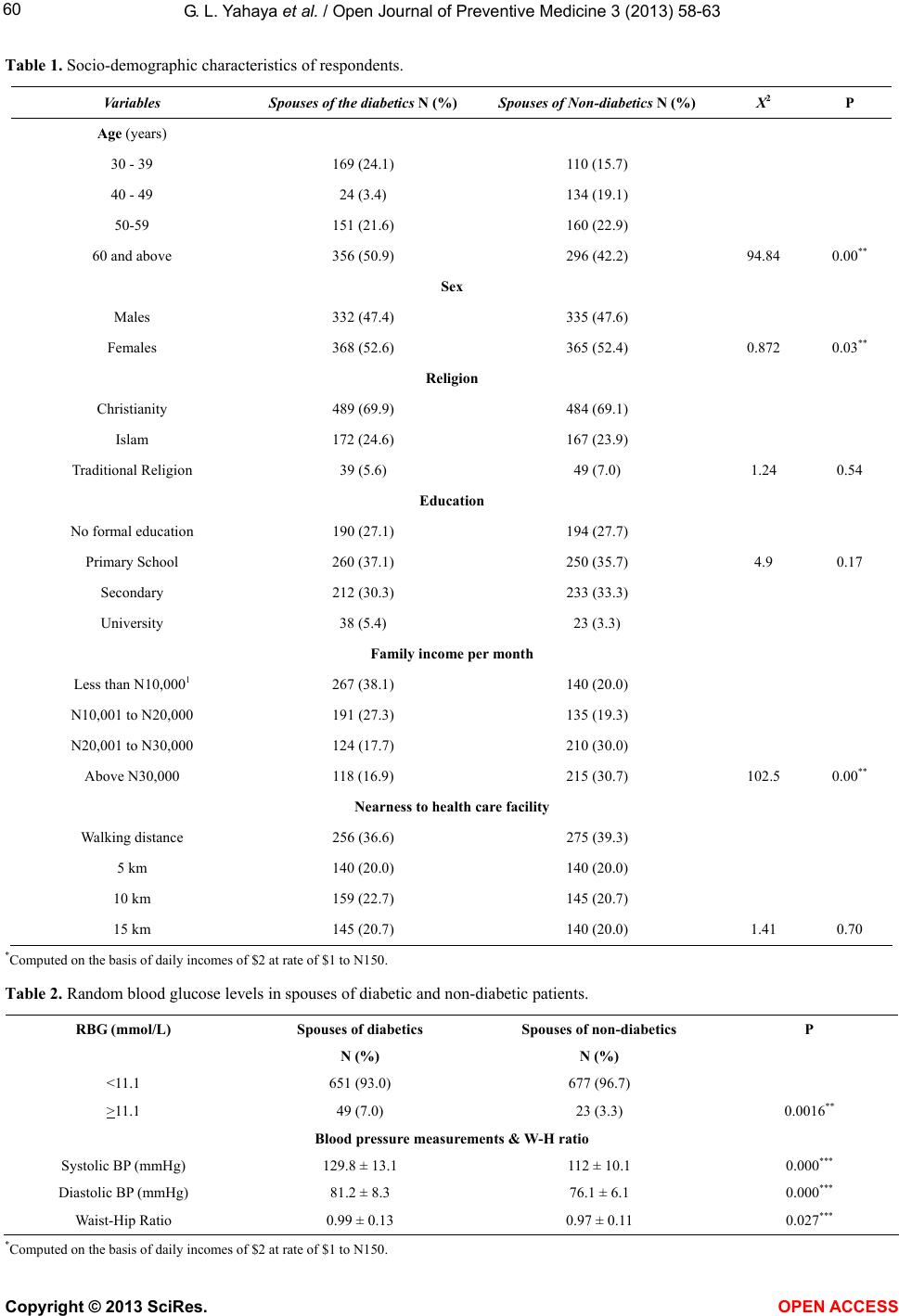 G. L. Yahaya et al. / Open Journal of Preventive Medicine 3 (2013) 58-63 Copyright © 2013 SciRes. OPEN ACCE SS 60 Table 1. Socio-demographic characteristics of respondents. Variables Spouses of the diabetics N (%) Spouses of Non-diabetics N (%) X 2 P Age (years) 30 - 39 169 (24.1) 110 (15.7) 40 - 49 24 (3.4) 134 (19.1) 50-59 151 (21.6) 160 (22.9) 60 and above 356 (50.9) 296 ( 42.2) 94.84 0.00** Sex Males 332 (47.4) 335 (47.6) Females 368 (52.6) 365 ( 52.4) 0.872 0.03** Religion Christianity 489 (69.9) 484 (69. 1) Islam 172 (24.6) 167 (23.9) Traditional Religion 39 (5.6) 49 (7.0) 1.24 0.54 Education No formal education 190 (27.1) 194 (27.7) Primary School 260 (37.1) 250 (35.7) 4.9 0.17 Secondary 212 (30.3) 233 (33.3) University 38 (5.4) 23 (3.3) Family income per month Less than N10,0001 267 (38.1) 140 (20.0) N10,001 to N20,000 191 (27.3) 135 (19.3) N20,001 to N30,000 124 (17.7) 210 (30.0) Above N30,000 118 (16.9) 215 (30.7) 102.5 0.00** Nearness to health care faci li t y Walking distance 256 (36.6) 275 (39.3) 5 km 140 (20.0) 140 (20.0) 10 km 159 (22.7) 145 (20.7) 15 km 145 (20.7) 140 (20.0) 1.41 0.70 *Computed on the basis of daily incomes of $2 at rate of $1 to N150. Table 2. Random blood glucose levels in spouses of diabetic and non-diabetic patients. RBG (mmol/L) Spouse s of diabetics Spouses of non-diabetics P N (%) N (%) <11.1 651 (93.0) 677 (96.7) >11.1 49 (7.0) 23 (3.3) 0.0016** Blood pressure measurements & W-H ratio Systolic BP (mmHg) 129.8 ± 13.1 112 ± 10.1 0.000*** Diastolic BP (mmHg) 81.2 ± 8.3 76.1 ± 6.1 0.000*** Waist-Hip Ratio 0.99 ± 0.13 0.97 ± 0.11 0.027*** *Computed on the basis of daily incomes of $2 at rate of $1 to N150. 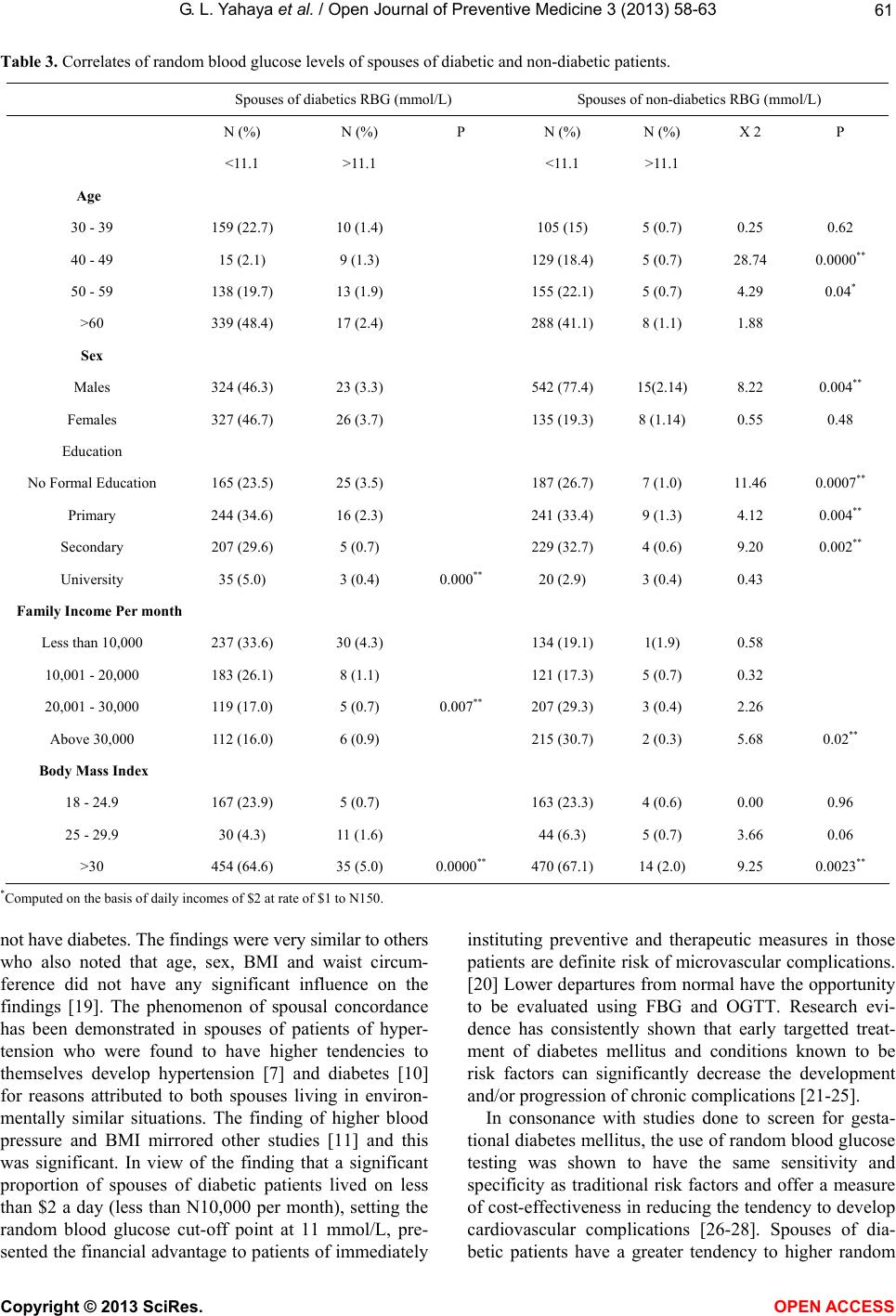 G. L. Yahaya et al. / Open Journal of Preventive Medicine 3 (2013) 58-63 61 Table 3. Correlates of random blood glucose levels of spouses of diabetic and non-diabetic patients. Spouses of diabetics RBG (mmol/L) Spouses of non-diabetics RB G (mmol/L) N (%) N (%) P N (%) N (%) X 2 P <11.1 >11.1 <11.1 >11.1 Age 30 - 39 159 (22.7) 10 (1.4) 105 (15) 5 (0.7) 0.25 0.62 40 - 49 15 (2.1) 9 (1.3) 129 (18.4) 5 (0.7) 28.74 0.0000** 50 - 59 138 (19.7) 13 (1.9) 155 (22.1) 5 (0.7) 4.29 0.04* >60 339 (48.4) 17 (2.4) 288 (41.1) 8 (1.1) 1.88 Sex Males 324 (46.3) 23 (3.3) 542 (77.4) 15(2.14) 8.22 0.004** Females 327 (46.7) 26 (3.7) 135 (19.3) 8 (1.14) 0.55 0.48 Education No Formal Education 165 (23.5) 25 (3.5) 187 (26.7) 7 (1.0) 11.46 0.0007** Primary 244 (34.6) 16 (2.3) 241 (33.4) 9 (1.3) 4.12 0.004** Secondary 207 (29.6) 5 (0.7) 229 (32.7) 4 (0.6) 9.20 0.002** University 35 (5.0) 3 (0.4) 0.000** 20 (2.9) 3 (0.4) 0.43 Family Income Per month Less than 10,000 237 (33.6) 30 (4.3) 134 (19.1) 1(1.9) 0.58 10,001 - 20,000 183 (26.1) 8 (1.1) 121 (17.3) 5 (0.7) 0.32 20,001 - 30,000 119 (17.0) 5 (0.7) 0.007** 207 (29.3) 3 (0.4) 2.26 Above 30,000 112 (16.0) 6 (0.9) 215 (30.7) 2 (0.3) 5.68 0.02** Body Mass Index 18 - 24.9 167 (23.9) 5 (0.7) 163 (23.3) 4 (0.6) 0.00 0.96 25 - 29.9 30 (4.3) 11 (1.6) 44 (6.3) 5 (0.7) 3.66 0.06 >30 454 (64.6) 35 (5.0) 0.0000** 470 (67.1) 14 (2.0) 9.25 0.0023** *Computed on the basis of daily incomes of $2 at rate of $1 to N150. not have diabetes. The findings were very similar to others who also noted that age, sex, BMI and waist circum- ference did not have any significant influence on the findings [19]. The phenomenon of spousal concordance has been demonstrated in spouses of patients of hyper- tension who were found to have higher tendencies to themselves develop hypertension [7] and diabetes [10] for reasons attributed to both spouses living in environ- mentally similar situations. The finding of higher blood pressure and BMI mirrored other studies [11] and this was significant. In view of the finding that a significant proportion of spouses of diabetic patients lived on less than $2 a day (less than N10,000 per month), setting the random blood glucose cut-off point at 11 mmol/L, pre- sented the financial advantage to patients of immediately instituting preventive and therapeutic measures in those patients are definite risk of microvascular complications. [20] Lower departures from normal have the opportunity to be evaluated using FBG and OGTT. Research evi- dence has consistently shown that early targetted treat- ment of diabetes mellitus and conditions known to be risk factors can significantly decrease the development and/or progression of chronic complications [21-25]. In consonance with studies done to screen for gesta- tional diabetes mellitus, the use of random blood glucose testing was shown to have the same sensitivity and specificity as traditional risk factors and offer a measure of cost-effectiveness in reducing the tendency to develop cardiovascular complications [26-28]. Spouses of dia- betic patients have a greater tendency to higher random Copyright © 2013 SciRes. OPEN ACCE SS  G. L. Yahaya et al. / Open Journal of Preventive Medicine 3 (2013) 58-63 62 blood glucose levels and can benefit from targeted ran- dom blood glucose testing as part of a 2-stage screening process that affords them the opportunity to discuss the results and management options with a primary care pro- vider in a clinical setting. Research is needed to deter- mine whether the extra years of treatment that individu- als will receive if screening determines their pre-diabetic state will result in significantly improved diabetes related cardiovascula r out comes in a cost-effe ct i ve manner. 5. KEY MESSAGES • Spouses of diabetic patients with a greater tendency to higher random blood glucose levels can benefit from targetted screening in a clin ical setting. • Random blood glucose measurements are an effec- tive screening tool in controlled clinical setting s. REFERENCES [1] Miranda, J.J., Kinra, S., Casas, JP.., Smith, G.D. and Ebrahim, S. (2008) Non-communicable diseases in low- and middle-income countries: Context, determinants and health policy. Tropical Medicine & International Health, 13, 1225-1234. d oi: 10. 1111/j .1 3 65 -3156.2008.02116.x [2] WHO (2005) Preventing chronic disease: A vital invest- ment. WHO, Geneva. [3] Lopez, A.D., Mathers, C.D., Ezzati, M., Jamison, D.T. and Murray, C.J. (2006) Global and regional burden of disease and risk factors: Systematic analysis of popula- tion health data. Lancet, 367, 1747-1757. doi:10.1016/S0140-6736(06)68770-9 [4] Kinnear, T.W. (1963) The pattern of diabetes mellitus in a nigeria teaching hospital. East African Medical Journal, 40, 288-294. [5] Nyenwe, E.A., Odia, O.J., Ihekwaba, A.E., Ojule, A. and Babatunde, S. (2003) Type 2 diabetes in adult Nigerians: A study of its prevalence and risk factors in Port Harcourt, Nigeria. Diabetes Research and Clinical Practice, 62, 177-185. doi:10.1016/j.diabres.2003.07.002 [6] Shaw, J.E., Sicree, R.A. and Zimmet, P.Z. (2009) Global estimates of the prevalence of diabetes for 2010 and 2030. Diabetes Research and Clinical Practice, 87, 4-14. doi:10.1016/j.diabres.2009.10.007 [7] Gwatkin, D., Guillot, M. and Heuveline, P. (1999) The burden of disease among the global poor. Lancet, 354, 586-589. doi:10.1016/S0140-6736(99)02108-X [8] Di Castelnuovo, A., Quacquaruccio, G., Donati, M.B., de Gaetano, G. and Iacoviello, L. (2009) Spousal concor- dance for major coronary risk factors: A systematic re- view and meta-analysis. American Journal of Epidemi- ology, 169, 1-8. doi:10.1093/aje/kwn234 [9] Brenn, T. (1993) Adult family members and their resem- blance of coronary heart disease risk factors: The cardio- vascular disease study in Finnmark. European Journal of Epidemiology, 13, 623-630. doi:10.1023/A:1007333919898 [10] Freidman, G.D. and Quesenberry, C.P. (1999) Spousal concordance for cancer incidence: A cohort study. Cancer, 86, 2413-2419. doi:10.1002/(SICI)1097-0142(19991201)86:11<2413::AI D-CNCR32>3.0.CO;2-J [11] Kolonel, L.N. and Lee, J. (1981) Husband-wife corre- spondence in smoking, drinking and dietary habit. The American Journal of Clinical Nutrition, 1, 99-104. [12] Hippisley-Cox, J., Coupland, C., Pringle, M., Crown, N. and Hammersley, V. (2002) Married couples’ risk of the same disease: Cross sectional study. British Medical Journal, 325, 636-638. doi:10.1136/bmj.325.7365.636 [13] Khan, A., Lasker, S.S. and Chowdhury, T.A. (2003) Are spouses of patients with type-2 diabetes at increased risk of developing diabetes? Diabetes Care, 26, 710-712. doi:10.2337/diacare.26.3.710 [14] American Diabetes Association (Position Statement) (2003) Screening for type 2 diabetes. Diabetes Care, 26, S21-S24. doi:10.2337/diacare.26.2007.S21 [15] Beaglehole, R., Epping-Jordan, J., Patel, V., Chopra, M., Ebrahim, S., Kidd, M. and Haines, A. (2008) Improving the prevention and management of chronic disease in low-income and middle-income countries: A priority for primary health care. Lancet, 372, 940-949. doi:10.1016/S0140-6736(08)61404-X [16] Waugh, N., Scotland, G., McNamee, P., Gillett, M., Bren- nan, A., Goyder, E., Williams, R. and John, A. (2007) Screening for type 2 diabetes: Literature review and eco- nomic modelling. Health Technology Assessment, 11, 1- 125. [17] Backholer, K., Chen, L. and Shaw, J. (2012) Screening for diabetes. Pathology, 44, 110-114. doi:10.1097/PAT.0b013e32834e8e12 [18] Somannavar, S., Ganesan, A., Deepa, M., DAtta, M. and Mohan, V. (2009) Random capillary blood glucose cut points for diabetes and prediabetes derived from commu- nity-based opportunistic screening in India. Diabetes Care, 32, 641-643. doi:10.2337/dc08-0403 [19] Trejo-Arteaga, J.M., López-Carmona, J.M., Rodríguez- Moctezuma, J.R., Peralta-Pedrero, M.L., Escudero-Mon- tero, R., Gutiérrez Escolano, M.F. (2008) Risk of glucose metabolism changes in spouses of Mexican patients with type 2 diabetes. Medicina Clínica, 131, 605-608 (Article in Spanish). doi:10.1157/13127917 [20] McCance, D.R., Hanson, R.L., Charles, M.-A., Jacobsson, L.T.H., Pettitt, D.J., Bennett, P.H., et al. (1994) Compari- son of tests for glycated haemoglobin and fasting and two hour plasma glucose concentrations as diagnostic meth- ods for diabetes. British Medical Journal, 308, 1323- 1328. doi:10.1136/bmj.308.6940.1323 [21] Diabetes Control and Complications Trial Research Group (1993) The effect of intensive treatment of diabe- tes on the development and progression of long term complications in insulin-dependent diabetes mellitus. The New England Journal of Medicine, 329, 977-986. doi:10.1056/NEJM199309303291401 Copyright © 2013 SciRes. OPEN ACCE SS  G. L. Yahaya et al. / Open Journal of Preventive Medicine 3 (2013) 58-63 Copyright © 2013 SciRes. OPEN ACCE SS 63 [22] Okhubo, Y., Kishikawa, H., Araki, E., et al. (1995) Inten- sive insulin therapy prevents the progression of diabetic micro-vascular complications in Japanese patients with non insulin dependent diabetes mellitus: A randomized prospective 6-year study. Diabetes Research and Clinical Practice, 28, 103-117. doi:10.1016/0168-8227(95)01064-K [23] UK Prospective Diabetes Study (UKPDS) Group (1998) Intensive blood glucose control with sulphonylurea or insulin compared with conventional treatment and risk of complications in patients with type 2 diabetes (UKPDS33). Lancet, 352, 837-853. [24] Stratton, I.M., Adler, A.I., Neil, H.A., et al. (2000) Asso- ciation of glycaemia with macrovascular and microvas- cular complications of type 2 diabetes (UKPDS 35): Pro- spective observational study. British Medical Journal, 321, 405-412. doi:10.1136/bmj.321.7258.405 [25] Simmons, R.K., Harding, A.H., Jakes, R.W., Welch, A., Wareham, N.J. and Griffin, SJ. (2006) How much might achievement of diabetes prevention behaviour goals re- duce the incidence of diabetes if implemented at the population level? Diabetologia, 49, 905-911. doi:10.1007/s00125-006-0163-1 [26] Ostlund, I. and Hanson, U. (2004) Repeated random blood glucose measurements as universal screening test for gestational diabetes mellitus. Acta Obstetricia et Gy- necologica Scandinavica, 83, 46-51. [27] Adegbola, O. and Ajayi, G.O. (2008) Screening for gesta- tional diabetes mellitus in Nigerian pregnant women us- ing fifty-gram oral glucose challenge test. West African Journal of Medicine, 27, 139-143. [28] Chatterjee, R., Narayan, K.M., Lipscomb, J. and Phillips, L.S. (2010) Screening adults for pre-diabetes and diabetes may be cost-saving. Diabetes Care, 33, 1484-1490. doi:10.2337/dc10-0054 |