

Paper Menu >>
Journal Menu >>
 Advances in Nanoparticles, 2013, 2, 32-38 http://dx.doi.org/10.4236/anp.2013.21007 Published Online February 2013 (http://www.scirp.org/journal/anp) Deposition of Monodisperse Platinum Nanoparticles of Controlled Size on Different Supports Zinaida Kaidanovych, Yevhen Kalishyn, Peter Strizhak L.V. Pisarzhevsky Institute of Physical Chemistry, The National Academy of Sciences of Ukraine, Kyiv, Ukraine Email : z.kaida n [email protected] om, kali s hyn.yevhen@gma il.com Received December 18, 2012; revised January 20, 2013; accepted January 30, 2013 ABSTRACT Monodisperse platinum nanoparticles with controlled size were synthesized by polyol synthesis and supported on γ-Al2O3, SiO2 and carbon nanotubes (CNT) by the colloid deposition method. The average size of Pt nanoparticles in colloidal solutions and on supports was determined by TEM images and from XRD patterns. The size of Pt nanoparti- cles supported on SiO2 and CNT determined from XRD patterns is in a good agreement with size obtained from the TEM analyses. There were shown that no agglomeration and size changing of Pt nanoparticles on these supports were observed. All these findings illustrate that the method of colloid deposition allows one to obtain catalyst with monodis- perse platinum nanoparticles of controlled size deposited on different supports without changing the nanoparticle’s size and morphology. Keywords: Platinum Nanoparticles; Pt/γ-Al2O3; Pt/SiO2; Pt/CNT 1. Introduction The pure suppo rted Pt nanopar ticles catalysts are of great interest owing to their specific features resulting from their size and morphology that are exploited as efficient catalysts in both homogeneous and heterogeneous cata- lytic technologies [1,2]. In addition, these have led to investigate the dependence of catalytic activity on the size and shape of Pt nanoparticles as well as the sur- face-to-volume ratio and quantum size effect because of their potential applications in electronics, catalysis, and biology [1-5]. Performance of Pt nanosized catalysts is affected by numerous factors, one of which is the nature and structure of the support materials. Mostly studies of platinum catalysts have been performed with the metal supported on SiO2, Al2O3, MgO, zeolites, and carbon [1-6]. Materials with supported Pt nanoparticles are known to have good catalytic characteristics. For exam- ple, carbon nanotubes (CNT) supported platinum catalyst shows superior activity in catalytic oxidation of various organic compounds [7,8]. Also, the electrocatalytic ac- tivity of Pt/CNT towards methanol oxidations was dis- covered [9]. Silica supported nanoparticles have been used to cata- lyze a wide variety of reactions such as hydrogenations, oxidations, and other organic synthetic reactions. A wide variety of transition metal nanoparticles have also been adsorbed onto Pt/SiO2 shows selective hydrogenation of acetophenone [10] and high catalytic activity in ethanol electrooxidation [11]. Platinum supported on alumina catalyzes a variety of chemical reactions, particularly, processes used in oil refinery [12]. Cubic platinum nanoparticles supported on alumina have been used to catalyze the NO reduction reaction [13]. It was observed a conversion of the low index facets of the cubic nanoparticles to higher index planes that occurs during the reaction conditions, which is attributed to substantial changes in the catalytic activ- ity and selectivity to reaction products [13]. A large morphological evolution of large platinum nanoparticles is also observed during the NO reduction reaction [14]. Moreover, Pt/γ-Al2O3 shows catalytic activity in ethylene glycol reforming [15]. Discovery of carbon nanotubes (CNTs), followed by extensive studies of their properties, has also resulted in highlighting their catalytic properties [16-20]. Particu- larly, comparison of the catalytic activity of metal cata- lysts supported on various oxides, amorphous carbon, and CNTs showed that catalytic performance is generally better for CNTs. For example, a CNT-supported plati- num catalyst shows superior activity in catalytic oxida- tion of vario us organic compo un ds [ 19] . Many studies show that size- and shape-controlled metallic nanoparticles supported onto mesoporous mate- rials are responsible in changing catalytic activity and selectivity [21-24]. The metal-support interaction, which refers to support-induced changes in reaction selectivity of metal nanoparticles, has been shown mostly on 2-di- mensional nanoparticle arrays on oxide substrates, be- C opyright © 2013 SciRes. ANP  Z. KAIDANOVYCH ET AL. 33 cause the oxide thin films and corresponding catalysts are easily prepared and characterized providing kinetic differences which invokes different mechanisms [25,26]. However, there are some studies abou t deposition of col- loidal Pt nanoparticles on different supports [27]. There is no information about size changing of nanoparticles after their deposition. A choice of support is vitally important to improve catalytic characteristics, because a nanoparti- cle-based catalyst can induce reciprocal electronic or chemical interactions. The goal of this study is to show that the method of deposition from colloid solution gives a reliable root to prepare catalyst with monodisperse Pt nanoparticles with controlled size. 2. Experimental All chemicals and solvent were of the highest purity available and were used as purchased without further purification or distillation. A solution o f 3 g of Poly(N-vin yl-2-pyrrolido ne) (PVP, Mw = 40,000) and 0.06 g of sodium hydroxide in 300 ml ethylene glycol were heated to 120˚C under stirring. Varying amounts (40, 60, 160, 240 and 360 ml) of 1% hexachloroplatinic acid in water solution were dosed slowly to the hot ethylene glycol. Next, the solutions were stirred for an additional 30 min and cooled to room temperature. PVP-protected Pt nanoparticles were pre- cipitated by adding acetone and then redispersed in ethanol. CNTs were synthesized by the catalytic decomposition of ethylene according to procedure described elsewhere [28]. γ-Al2O3 and SiO2 was grinded and the fraction of 0.25 - 0.5 mm was heat-treated at 300˚C in air. Deposi- tion of Pt nanoparticles on supports was performed by mixing appropriate amounts of SiO2, γ-Al2O3 or CNTs and colloidal solution of nanoparticles in ethanol under stirring. The obtained samples were dried in air. The ob- tained samples contained 1.0% of platinum. The average particle size was determined from trans- mission electron spectroscopy (TEM) images. TEM stud- ies were carried out using PEM-125K (Selmi, Ukraine). The samples of colloidal solution of nanoparticles for TEM analysis were dropped onto carbon-coated copper grid. The samples of Pt/support previously were grinded into powder and mixed with drop of water. At least 600 nanoparticles per sample were analyzed to determine their size and distribution. The samples of γ-Al2O3, SiO2, CNTs, and Pt/support were grinded into powder and analyzed using the X-ray diffractometer Bruker D8 Advance. The mean particle size also was determinate using the Scherrer equation: 0.9 cosD , (1) where λ is the wavelength used (1.54184 Å), β is the line broadening at half the maximum intensity in radians and θ is the angle of diffraction. 3. Results and Discussion Figures 1(a), (c), (e), (g) show a typical TEM images of Pt nanoparticles in colloidal solutions prepared using different amount of hexachloroplatinic acid. Figures 1(b), (d), (f), (h) give corresponding size distributions of Pt nanoparticles. The presented data indicate that the nanoparticles are almost spherical. It was shown that the average size of Pt nanoparticles depends on concentra- tion of hexachloroplatinic acid. If the concentration of hexachloroplatinic acid is 3.3 mmol/L than the average size of Pt nanoparticles is 1.3 nm as it is shown in Figure 1(a). The 29.3 mmol/L of concentration of hexachloro- platinic acid gives 3.1 nm of Pt nanoparticles. The av- erage size of Pt nanoparticles in colloidal solution in- creases from 1.3 to 3.1 nm with increasing of precursor concentration. Corresponding size distribution of Pt nano- particles is presented in Figures 1(b), (d), (f), (h) show- ing that size distribution is almost Gaussian. All samples are characterized by narrow width of particle size distri- bution with typical standard deviations (SD) less than 15%. Therefore, the synthesized Pt nanoparticles are al- most monodispersed. Pt nanoparticles with average size in colloidal solutio n 2.8 nm (Figure 1(e)) were supported on γ-Al2O3, SiO2 and CNTs in order to determine their size changing after deposition on different supports. Figures 2(a), (c), (e) show typical TEM images of Pt nanoparticles supported on γ-Al2O3, SiO2 and CNTs. The presented data indicate that supported nanoparticles ar e not aggregating and stay almost spherical. Figures 2(b)-(f) give corresponding size distributions of supported Pt nanoparticles. The av- erage size of supported Pt nanoparticles is nearly the same as average size of those particles in solution –2.9 nm for Pt/γ-Al2O3 and 2.8 nm for Pt/SiO2 and Pt/CNTs. Size distribution of supported Pt nanoparticles is almost gaussian with nearly the same SD as for Pt nanoparticles in solution 0.3 - 0.4 nm, what is amount less than 15% of particles size. Therefore, the Pt nanoparticles on these supports stay almost monodispersed as in solution. Com- parison of data presented in Figures 1 and 2 allows one to conclude that deposition of platinum nanoparticles on γ-Al2O3, SiO2 and CNTs does not prod uce changing par- ticles size and morphology. In order to synthesis Pt/γ-Al2O3 with different size of supported nanoparticles the concentration of hexachloro- platinic acid in reaction solution was varying. The ob- tained colloidal solutions of Pt nanoparticles with differ- ent nanoparticles sizes were deposited on γ-Al2O3. The mean sizes and standard deviations of supported nano- particles were measured using their TEM images. Copyright © 2013 SciRes. ANP 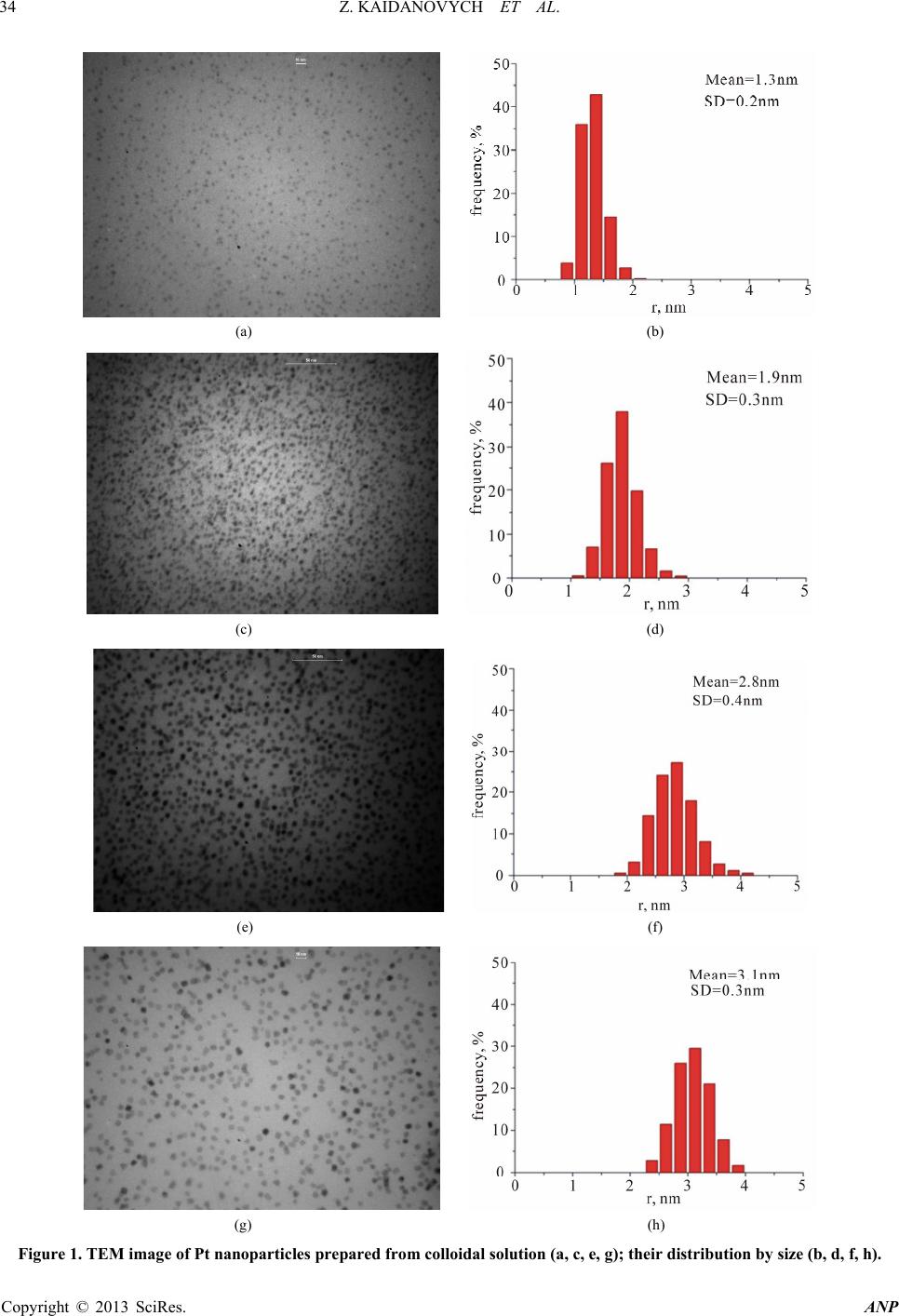 Z. KAIDANOVYCH ET AL. Copyright © 2013 SciRes. ANP 34 (a) (b) (c) (d) (e) (f) (g) (h) Figure 1. TEM image of Pt nanoparticles prepared from colloidal solution (a, c, e, g); their distribution by size (b, d, f, h). 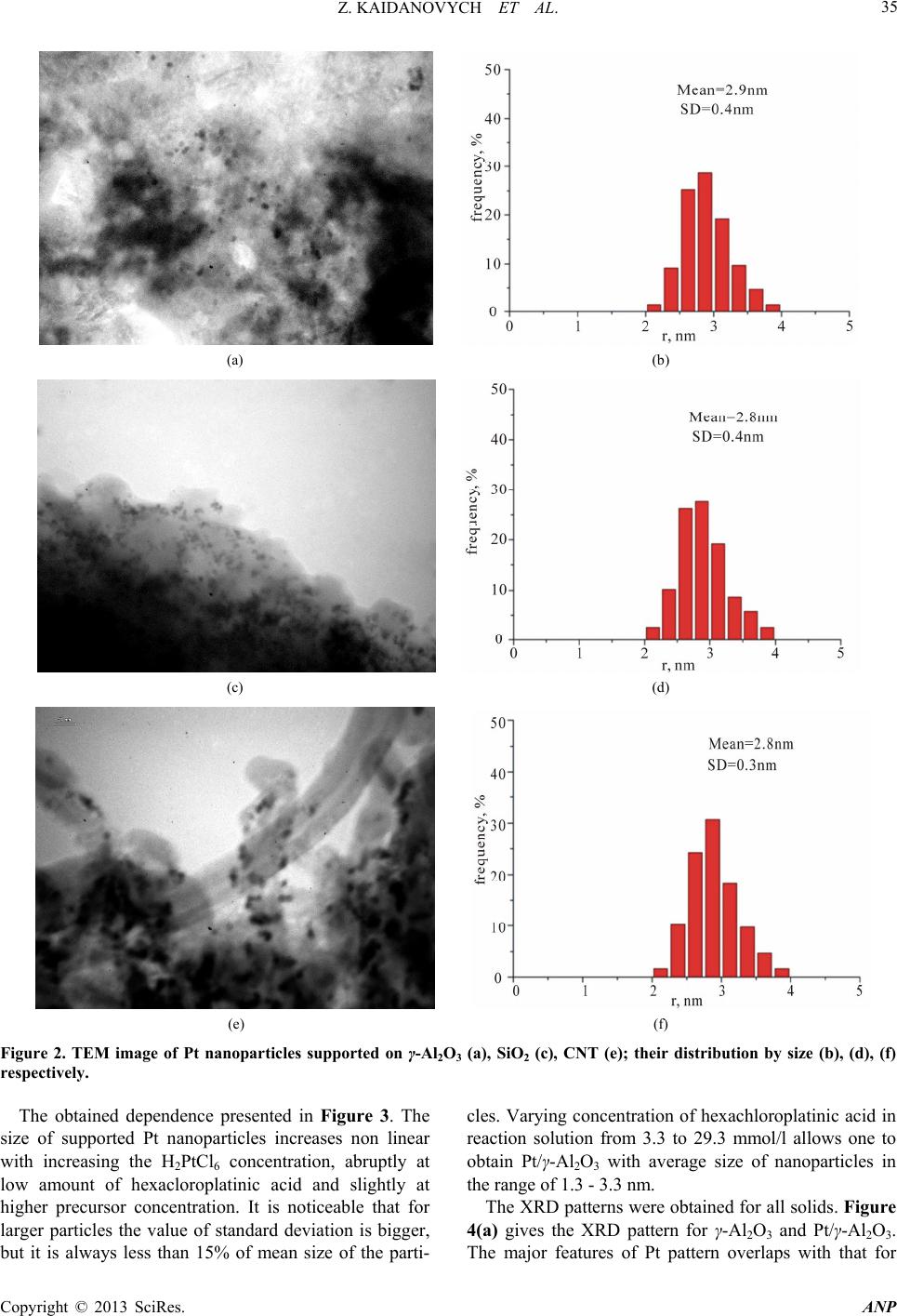 Z. KAIDANOVYCH ET AL. 35 (a) (b) (c) (d) (e) (f) Figure 2. TEM image of Pt nanoparticles supported on γ-Al2O3 (a), SiO2 (c), CNT (e); their distribution by size (b), (d), (f) respectively. The obtained dependence presented in Figure 3. The size of supported Pt nanoparticles increases non linear with increasing the H2PtCl6 concentration, abruptly at low amount of hexacloroplatinic acid and slightly at higher precursor concentration. It is noticeable that for larger particles the value of standard deviation is bigger, but it is always less than 15% of mean size of the parti- cles. Varying concentration of hexachloroplatinic acid in reaction solution from 3.3 to 29.3 mmol/l allows one to obtain Pt/γ-Al2O3 with average size of nanoparticles in the range of 1. 3 - 3.3 nm. The XRD patterns were obtained for all solids. Figure 4(a) gives the XRD pattern for γ-Al2O3 and Pt/γ-Al2O3. The major features of Pt pattern overlaps with that for Copyright © 2013 SciRes. ANP 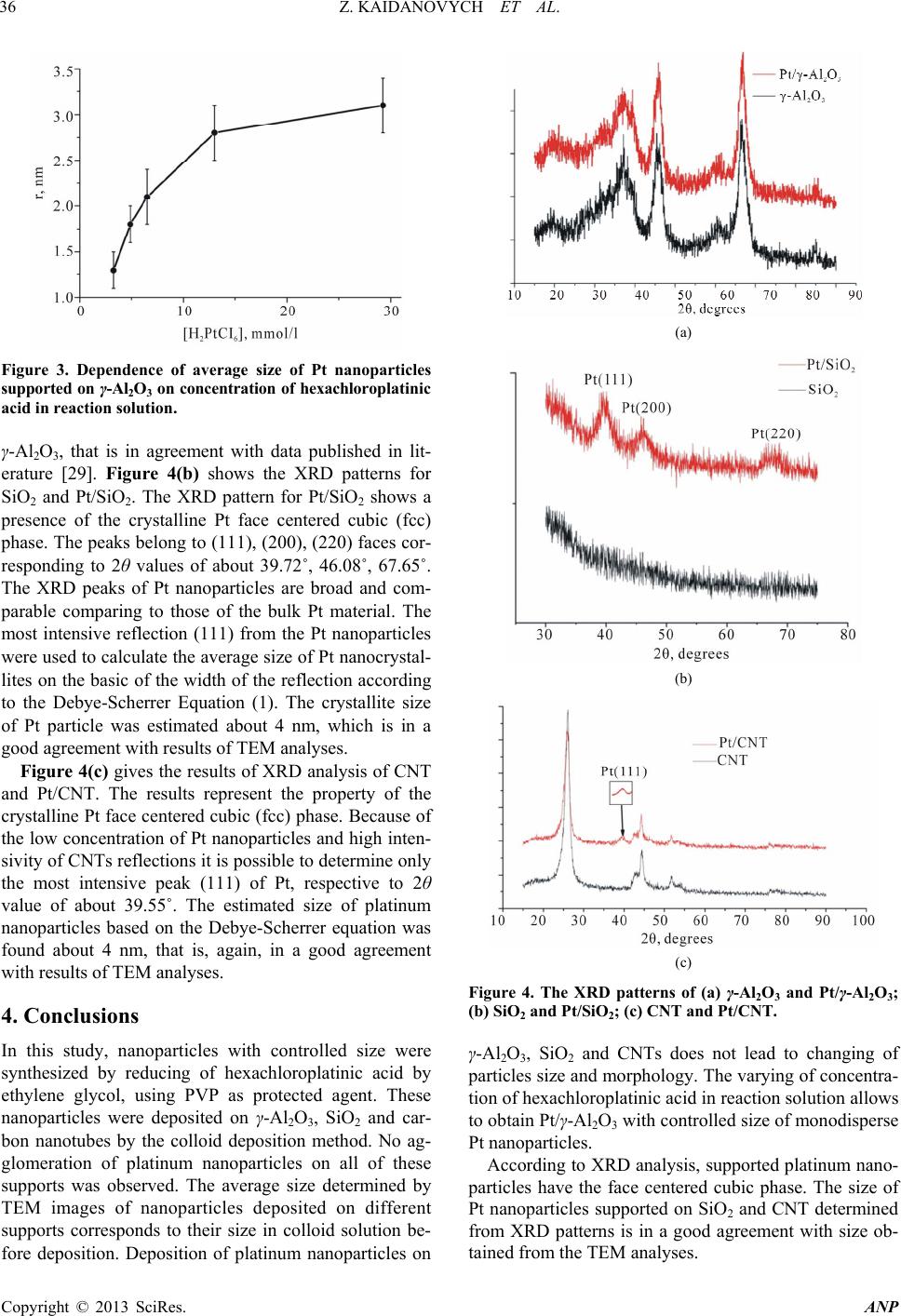 Z. KAIDANOVYCH ET AL. 36 Figure 3. Dependence of average size of Pt nanoparticles supported on γ-Al2O3 on concentration of hexachloroplatini c acid in reaction solution. γ-Al2O3, that is in agreement with data published in lit- erature [29]. Figure 4(b) shows the XRD patterns for SiO2 and Pt/SiO2. The XRD pattern for Pt/SiO2 shows a presence of the crystalline Pt face centered cubic (fcc) phase. The peaks belong to (111), (200), (220) faces cor- responding to 2θ values of about 39.72˚, 46.08˚, 67.65˚. The XRD peaks of Pt nanoparticles are broad and com- parable comparing to those of the bulk Pt material. The most intensive reflection (111) from the Pt nanoparticles were used to calculate the average size of Pt nanocrystal- lites on the basic of the width of the reflection according to the Debye-Scherrer Equation (1). The crystallite size of Pt particle was estimated about 4 nm, which is in a good agreement with results of TEM analyses. Figure 4(c) gives the results of XRD analysis of CNT and Pt/CNT. The results represent the property of the crystalline Pt face centered cubic (fcc) phase. Because of the low concentration of Pt nanoparticles an d high inten- sivity of CNTs reflections it is p ossible to determine on ly the most intensive peak (111) of Pt, respective to 2θ value of about 39.55˚. The estimated size of platinum nanoparticles based on the Debye-Scherrer equation was found about 4 nm, that is, again, in a good agreement with results of TEM analyses. 4. Conclusions In this study, nanoparticles with controlled size were synthesized by reducing of hexachloroplatinic acid by ethylene glycol, using PVP as protected agent. These nanoparticles were deposited on γ-Al2O3, SiO2 and car- bon nanotubes by the colloid deposition method. No ag- glomeration of platinum nanoparticles on all of these supports was observed. The average size determined by TEM images of nanoparticles deposited on different supports corresponds to their size in colloid solution be- fore deposition. Deposition of platinum nanoparticles on (a) (b) (c) Figure 4. The XRD patterns of (a) γ-Al2O3 and Pt/γ-Al2O3; (b) SiO2 and Pt/SiO2; (c) CNT and Pt/CNT. γ-Al2O3, SiO2 and CNTs does not lead to changing of particles size and morphology. The var ying of concentra- tion of hexachloroplatinic acid in reaction solution allows to obtain Pt/γ-Al2O3 with controlled size of monodisperse Pt nanoparticles. According to XRD analysis, supported platinum nano- particles have the face centered cubic phase. The size of Pt nanoparticles supported on SiO2 and CNT determined from XRD patterns is in a good agreement with size ob- tained from the TEM analyses. Copyright © 2013 SciRes. ANP 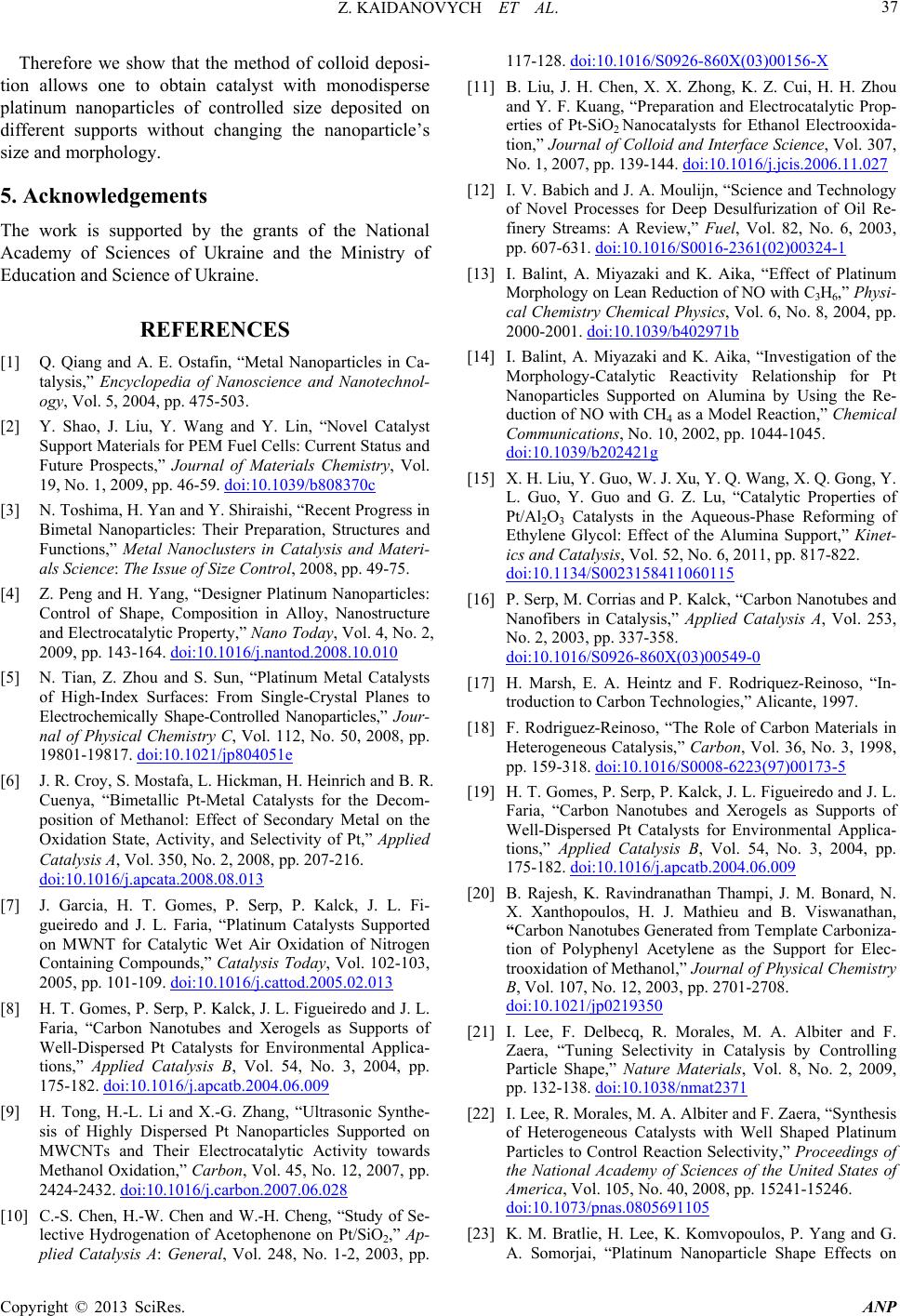 Z. KAIDANOVYCH ET AL. 37 Therefore we show that the method of colloid deposi- tion allows one to obtain catalyst with monodisperse platinum nanoparticles of controlled size deposited on different supports without changing the nanoparticle’s size and morphology. 5. Acknowledgements The work is supported by the grants of the National Academy of Sciences of Ukraine and the Ministry of Education and Science of Ukraine. REFERENCES [1] Q. Qiang and A. E. Ostafin, “Metal Nanoparticles in Ca- talysis,” Encyclopedia of Nanoscience and Nanotechnol- ogy, Vol. 5, 2004, pp. 475-503. [2] Y. Shao, J. Liu, Y. Wang and Y. Lin, “Novel Catalyst Support Materials for PEM Fuel Cells: Current Status and Future Prospects,” Journal of Materials Chemistry, Vol. 19, No. 1, 2009, pp. 46-59. doi:10.1039/b808370c [3] N. Toshima, H. Yan and Y. Shiraishi, “Recent Progress in Bimetal Nanoparticles: Their Preparation, Structures and Functions,” Metal Nanoclusters in Catalysis and Materi- als Science: The Issue of Size Control, 2008, pp. 49-75. [4] Z. Peng and H. Yang, “Designer Platinum Nanoparticles: Control of Shape, Composition in Alloy, Nanostructure and Electrocatalytic Property,” Nano Today, Vol. 4, No. 2, 2009, pp. 143-164. doi:10.1016/j.nantod.2008.10.010 [5] N. Tian, Z. Zhou and S. Sun, “Platinum Metal Catalysts of High-Index Surfaces: From Single-Crystal Planes to Electrochemically Shape-Controlled Nanoparticles,” Jour- nal of Physical Chemistry C, Vol. 112, No. 50, 2008, pp. 19801-19817. doi:10.1021/jp804051e [6] J. R. Croy, S. Mostafa, L. Hickman, H. Heinrich and B. R. Cuenya, “Bimetallic Pt-Metal Catalysts for the Decom- position of Methanol: Effect of Secondary Metal on the Oxidation State, Activity, and Selectivity of Pt,” Applied Catalysis A, Vol. 350, No. 2, 2008, pp. 207-216. doi:10.1016/j.apcata.2008.08.013 [7] J. Garcia, H. T. Gomes, P. Serp, P. Kalck, J. L. Fi- gueiredo and J. L. Faria, “Platinum Catalysts Supported on MWNT for Catalytic Wet Air Oxidation of Nitrogen Containing Compounds,” Catalysis Today, Vol. 102-103, 2005, pp. 101-109. doi:10.1016/j.cattod.2005.02.013 [8] H. T. Gomes, P. Serp, P. Kalck, J. L. Figueiredo and J. L. Faria, “Carbon Nanotubes and Xerogels as Supports of Well-Dispersed Pt Catalysts for Environmental Applica- tions,” Applied Catalysis B, Vol. 54, No. 3, 2004, pp. 175-182. doi:10.1016/j.apcatb.2004.06.009 [9] H. Tong, H.-L. Li and X.-G. Zhang, “Ultrasonic Synthe- sis of Highly Dispersed Pt Nanoparticles Supported on MWCNTs and Their Electrocatalytic Activity towards Methanol Oxidation,” Carbon, Vol. 45, No. 12, 2007, pp. 2424-2432. doi:10.1016/j.carbon.2007.06.028 [10] C.-S. Chen, H.-W. Chen and W.-H. Cheng, “Study of Se- lective Hydrogenation of Acetophenone on Pt/SiO2,” Ap- plied Catalysis A: General, Vol. 248, No. 1-2, 2003, pp. 117-128. doi:10.1016/S0926-860X(03)00156-X [11] B. Liu, J. H. Chen, X. X. Zhong, K. Z. Cui, H. H. Zhou and Y. F. Kuang, “Preparation and Electrocatalytic Prop- erties of Pt-SiO2 Nanocatalysts for Ethanol Electrooxida- tion,” Journal of Colloid and Interface Science, Vol. 307, No. 1, 2007, pp. 139-144. doi:10.1016/j.jcis.2006.11.027 [12] I. V. Babich and J. A. Moulijn, “Science and Technology of Novel Processes for Deep Desulfurization of Oil Re- finery Streams: A Review,” Fuel, Vol. 82, No. 6, 2003, pp. 607-631. doi:10.1016/S0016-2361(02)00324-1 [13] I. Balint, A. Miyazaki and K. Aika, “Effect of Platinum Morphology on Lean Reductio n of NO with C3H6,” Physi- cal Chemistry Chemical Physics, Vol. 6, No. 8, 2004, pp. 2000-2001. doi:10.1039/b402971b [14] I. Balint, A. Miyazaki and K. Aika, “Investigation of the Morphology-Catalytic Reactivity Relationship for Pt Nanoparticles Supported on Alumina by Using the Re- duction of NO with CH4 as a Model Reaction,” Chemical Communications, No. 10, 2002, pp. 1044-1045. doi:10.1039/b202421g [15] X. H. Liu, Y. Guo, W. J. Xu, Y. Q. Wang, X. Q. Gong, Y. L. Guo, Y. Guo and G. Z. Lu, “Catalytic Properties of Pt/Al2O3 Catalysts in the Aqueous-Phase Reforming of Ethylene Glycol: Effect of the Alumina Support,” Kinet- ics and Catalysis, Vol. 52, No. 6, 2011, pp. 817-822. doi:10.1134/S0023158411060115 [16] P. Serp, M. Corrias and P. Kalck, “Carbon Nanotubes and Nanofibers in Catalysis,” Applied Catalysis A, Vol. 253, No. 2, 2003, pp. 337-358. doi:10.1016/S0926-860X(03)00549-0 [17] H. Marsh, E. A. Heintz and F. Rodriquez-Reinoso, “In- troduction to Carbon Technologies,” Alicante, 1997. [18] F. Rodriguez-Reinoso, “The Role of Carbon Materials in Heterogeneous Catalysis,” Carbon, Vol. 36, No. 3, 1998, pp. 159-318. doi:10.1016/S0008-6223(97)00173-5 [19] H. T. Gomes, P. Serp, P. Kalck, J. L. Figueiredo and J. L. Faria, “Carbon Nanotubes and Xerogels as Supports of Well-Dispersed Pt Catalysts for Environmental Applica- tions,” Applied Catalysis B, Vol. 54, No. 3, 2004, pp. 175-182. doi:10.1016/j.apcatb.2004.06.009 [20] B. Rajesh, K. Ravindranathan Thampi, J. M. Bonard, N. X. Xanthopoulos, H. J. Mathieu and B. Viswanathan, “Carbon Nanotubes Generated from Template Carboniza- tion of Polyphenyl Acetylene as the Support for Elec- trooxidation of Methanol,” Journal of Physical Chemistry B, Vol. 107, No. 12, 2003, pp. 2701-2708. doi:10.1021/jp0219350 [21] I. Lee, F. Delbecq, R. Morales, M. A. Albiter and F. Zaera, “Tuning Selectivity in Catalysis by Controlling Particle Shape,” Nature Materials, Vol. 8, No. 2, 2009, pp. 132-138. doi:10.1038/nmat2371 [22] I. Lee, R. Morales, M. A. Albiter and F. Zaera, “Synthesis of Heterogeneous Catalysts with Well Shaped Platinum Particles to Control Reaction Selectivity,” Proceedings of the National Academy of Sciences of the United States of America, Vol. 105, No. 40, 2008, pp. 15241-15246. doi:10.1073/pnas.0805691105 [23] K. M. Bratlie, H. Lee, K. Komvopoulos, P. Yang and G. A. Somorjai, “Platinum Nanoparticle Shape Effects on Copyright © 2013 SciRes. ANP  Z. KAIDANOVYCH ET AL. Copyright © 2013 SciRes. ANP 38 Benzene Hydrogenation Selectivity,” Nano Letters, Vol. 7, No. 10, 2007, pp. 3097-3101. doi:10.1021/nl0716000 [24] S. Alayoglu, C. Aliaga, C. Sprung and G. A. Somorjai, “Size and Shape Dependence on Pt Nanoparticles for the Methylcy clo pe nta ne/Hy dr oge n Rin g Open ing/ Ri n g Enlar ge- ment Reaction,” Catalysis Letters, Vol. 141, No. 7, 2011, pp. 914-924. doi:10.1007/s10562-011-0647-6 [25] A. B. Boffa, C. Lin, A. T. Bell and G. A. Somorjai, “Lewis Acidity as an Explanation for Oxide Promotion of Metals: Implications of Its Importance and Limits for Catalytic Reactions,” Catalysis Letters, Vol. 27, No. 3-4, 1994, pp. 243-249. doi:10.1007/BF00813909 [26] A. Bruix, J. A. Rodriguez, P. J. Ramirez, S. D. Senanay- ake, J. Evans, J. B. Park, D. Stacchiola, P. Liu, J. Hrbek and F. Illas, “Cataly st-Support Interactions: Electr onic Per - turbations,” Journal of American Chemical Society, Vol. 134, No. 48, 2012, pp. 8968-8974. doi:10.1021/ja302070k [27] A. Kwangjin, N. Musselwhite, G. Kennedy, V. Pushkarev, L. R. Baker and G. A. Somorjai, “Preparation of Mesopor- ous Oxides and Their Support Effects on Pt Nanoparticle Catalysts in Catalytic Hydrogenation of Furfural,” Jour- nal of Colloid and Interface Science, Vol. 392, 2013, pp. 122-128. doi:10.1016/j.jcis.2012.10.029 [28] A. I. Tripol’skii, N. V. Lemesh, V. O. Khavrus’ and P. E. Strizhak, “Morphology of Carbon Nanotubes, Obtained by Decomposition of Ethylene on Nickel Nanoparticles at Various Rates of Flow and Concentration of C2H2,” Theo- retical and Experimental Chemistry, Vol. 44, No. 4, 2008, pp. 240-244. doi:10.1007/s11237-008-9034-9 [29] D. S. Brandão, R. M. Galvão, M. da Graça, M. C. da Ro- cha, P. Bargiela and E. A. Sales, “Pt and Pd Catalysts Supported on Al2O3 Modified with Rare Earth Oxides in the Hydrogenation of Tetralin, in the Presence of Thio- phene,” Catalysis Today, Vol. 133-135, 2008, pp. 324- 330. doi:10.1016/j.cattod.2007.12.128 |