

Paper Menu >>
Journal Menu >>
 Vol.5, No.2, 166-169 (2013) Health http://dx.doi.org/10.4236/health.2013.52022 The association of adenosine deaminase with coronary artery disease: Effect of gender and diabetes Fulvia Gloria-Bottini1*, Krzysztof Safranow2, Maria Banci3, Agnieszka Binczak-Kuleta4, Patrizia Saccucci1, Andrzej Ciechanowicz4, Andrea Magrini1, Zdzislawa Kornacewicz-Jach5, Egidio Bottini1, Dariusz Chlubek2 1Department of Biomedicine and Prevention, School of Medicine, University of Rome Tor Vergata, Rome, Italy; *Corresponding Author: [email protected] 2Department of Biochemistry and Medical Chemistry, Pomeranian Medical University, Szczecin, Poland 3Department of Cardiology, Valmontone Hospital, Valmontone, Italy 4Department of Laboratory Diagnostics and Molecular Medicine, Pomeranian Medical University, Szczecin, Poland 5Department of Cardiology, Pomeranian Medical University, Szczecin, Poland Received 16 June 2012; revised 20 July 2012; accepted 1 August 2012 ABSTRACT An association between ADA1 and Coronary Ar- tery Disease (CAD) has been observed in Polish and in Italian populations but in Italian popula- tion the association was present in males only. In order to enlighten these differences we have carried out a collaborative study in the two po- pulations. In Italy 215 subjects admitted to the Hospital for CAD, 275 subjects with Type 2 Dia- betes (T2D) without CAD and 398 healthy new- borns were studied. In Poland 173 subjects w ith CAD and 200 healthy newborns were studied. Written informed consent was obtained from all subjects or from their mothers to participate to the study that was approved by the I.R.B. ADA1 polymorphism was determined by DNA analysis. Three way contingency table analysis was per- formed by a log linear model. The association between CAD and ADA1 is present in non dia- betic male subject s only : OR = 0.195, p = 0.007 in the Italian population and OR = 0.163, p = 0.004 in the Polish population. The data suggest a sig- nificant role of immunological mechanisms in the pathogenesis of CAD without diabetes. Gen- der differences in immune diseases could ex- plain the lack of association in females. Keywords: ADA; CAD; Gender; Diabetes 1. INTRODUCTION An association between Adenosine Deaminase locus 1 (ADA1) and Coronary Artery Disease (CAD) has been described in the Polish population [1] and confirmed in the Italian population [2]. In Italy, however, a significant association was found in males only. In order to enligh- ten these differences we have carried out a collaborative study involving both populations. ADA1 is a polymorphic enzyme present in all mam- malian tissue that catalyzes the irreversible deamination of adenosine to inosine [3]. It is controlled by a locus with 2 codominant alleles ADA1*1 and ADA1*2 located in the long arm of chromosome 20 [4]: the activity asso- ciated to ADA1*2 is lower than that associated to ADA1*1. Adenosine is an important local hormone regulating blood flow, neurotransmission, physiology of smooth muscle and platelet aggregation. In the liver adenosine counteracts insulin action by activating A2B receptors [5]. ADA1 and CD26 are colocalized on T cell surface and these cells are much more resistant to the inhibitory effects of adenosine. Adenosine is a cardioprotective agent [6], thus re- duced activity in ADA1*2 allele carriers may have a beneficial effect on cardiac function. Moreover ecto- ADA1 interacts with Adenosine receptor A1 [7] which plays an important role in ischaemic preconditioning [8]. Inhibition of platelet aggregation and adhesion and anti- inflammatory properties of adenosine [9] may also play an important role in the susceptibility to CAD [10]. 2. MATERIAL AND METHODS The following samples were considered. ITALY 215 subjects admitted to the hospital for CAD. 275 subjects with type 2 diabetes without CAD (as Copyright © 2013 SciRes. OPEN A CCESS 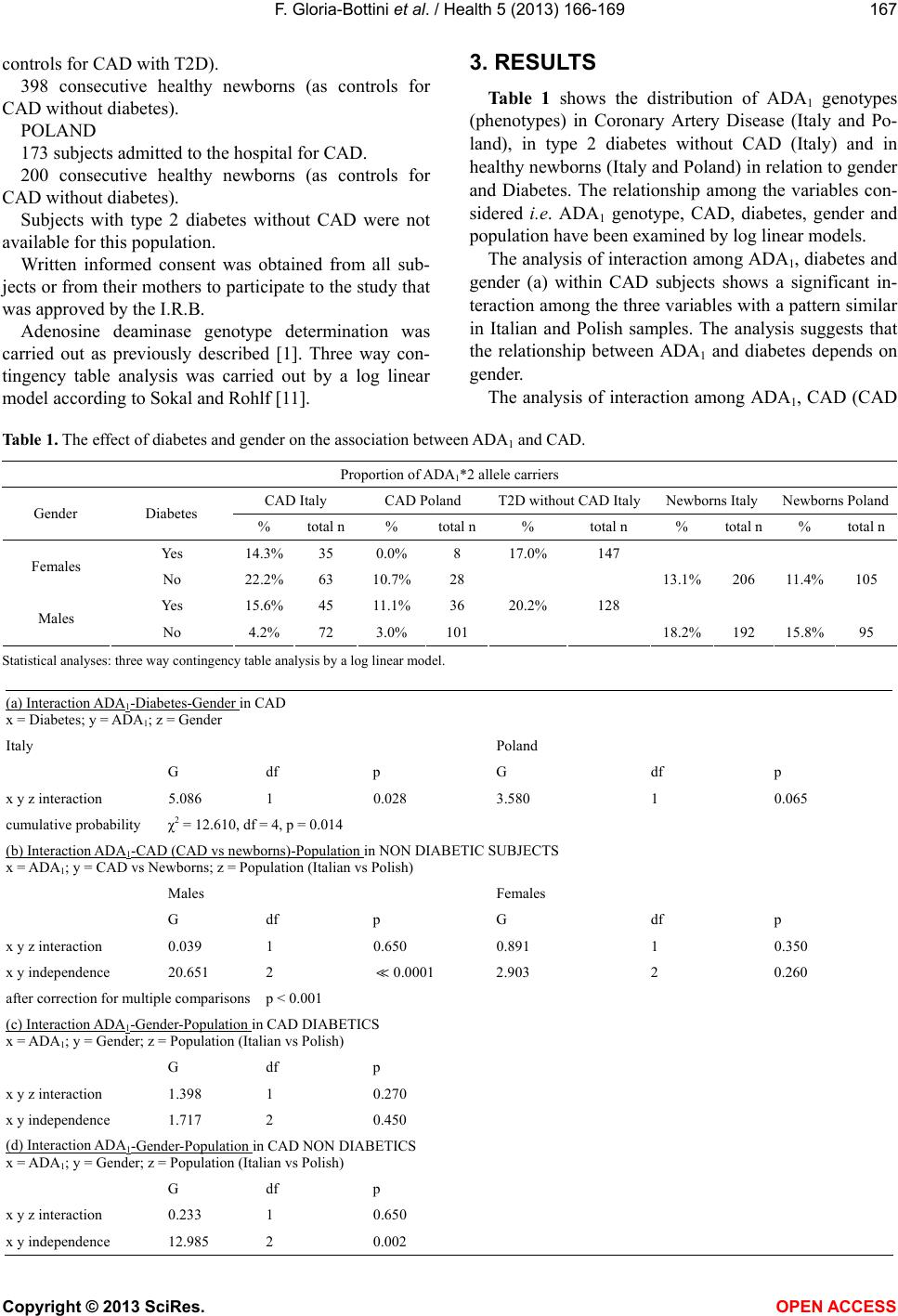 F. Gloria-Bottini et al. / Health 5 (2013) 166-169 167 controls for CAD with T2D). 398 consecutive healthy newborns (as controls for CAD without diabetes). POLAND 173 subjects admitted to the hospital for CAD. 200 consecutive healthy newborns (as controls for CAD without diabetes). Subjects with type 2 diabetes without CAD were not available for this population. Written informed consent was obtained from all sub- jects or from their mothers to participate to the study that was approved by the I.R.B. Adenosine deaminase genotype determination was carried out as previously described [1]. Three way con- tingency table analysis was carried out by a log linear model according to Sokal and Rohlf [11]. 3. RESULTS Table 1 shows the distribution of ADA1 genotypes (phenotypes) in Coronary Artery Disease (Italy and Po- land), in type 2 diabetes without CAD (Italy) and in healthy newborns (Italy and Poland) in relation to gender and Diabetes. The relationship among the variables con- sidered i.e. ADA1 genotype, CAD, diabetes, gender and population have been examined by log linear models. The analysis of interaction among ADA1, diabetes and gender (a) within CAD subjects shows a significant in- teraction among the three variables with a pattern similar in Italian and Polish samples. The analysis suggests that the relationship between ADA1 and diabetes depends on gender. The analysis of interaction among ADA1, CAD (CAD Table 1. The effect of diabetes and gender on the association between ADA1 and CAD. Proportion of ADA1*2 allele carriers CAD Italy CAD Poland T2D without CAD ItalyNewborns Italy Newborns Poland Gender Diabetes % total n % total n% total n % total n % total n Yes 14.3% 35 0.0% 8 17.0% 147 Females No 22.2% 63 10.7%28 13.1% 206 11.4%105 Yes 15.6% 45 11.1% 36 20.2% 128 Males No 4.2% 72 3.0% 101 18.2% 192 15.8%95 Statistical analyses: three way contingency table analysis by a log linear model. (a) Interaction ADA1-Diabetes-Gender in CAD x = Diabetes; y = ADA1; z = Gender Italy Poland G df p G df p x y z interaction 5.086 1 0.028 3.580 1 0.065 cumulative probability χ2 = 12.610, df = 4, p = 0.014 (b) Interaction ADA1-CAD (CAD vs newborns)-Population in NON DIABETIC SUBJECTS x = ADA1; y = CAD vs Newborns; z = Population (Italian vs Polish) Males Females G df p G df p x y z interaction 0.039 1 0.650 0.891 1 0.350 x y independence 20.651 2 0.0001 2.903 2 0.260 after correction for multiple comparisons p < 0.001 (c) Interaction ADA1-Gender-Population in CAD DIABETICS x = ADA1; y = Gender; z = Population (Italian vs Polish) G df p x y z interaction 1.398 1 0.270 x y independence 1.717 2 0.450 (d) Interaction ADA1-Gender-Population in CAD NON DIABETICS x = ADA1; y = Gender; z = Population (Italian vs Polish) G df p x y z interaction 0.233 1 0.650 x y independence 12.985 2 0.002 Copyright © 2013 SciRes. OPEN A CCESS  F. Gloria-Bottini et al. / Health 5 (2013) 166-169 168 vs newborns) and population (b) in non diabetic subjects shows a lack of interaction in both males and females suggesting that the relationship between ADA1 and CAD is similar in the two populations studied. The association between ADA1 and CAD is very strong in males (χ2 = 20.651, df = 2, p 0.0001, after correction for multi- ple comparison p < 0.001) but is lacking in females. Since in the Polish population we had no data on dia- betic subjects without CAD a similar analysis comparing CAD diabetics with non-CAD diabetics could not be performed. The analysis of interaction among ADA1, gender and population in CAD diabetics (c) shows no significant association between ADA1 and gender in both Italian and Polish populations. On the contrary the same analysis in CAD non diabetics (d) shows a significant association between ADA1 and gender that shares a similar pattern in Italian and Polish populations. From these analyses it can be safely concluded 1) that the association between CAD and ADA1 is present in non diabetic subjects only and 2) that the pattern of as- sociation in non diabetic CAD subjects depends on gen- der and it is present and very strong among males only: OR (ADA12-1 vs ADA11/CAD vs controls) = 0.195; 95% C.I. 0.059 - 0.693 (p = 0.007) in the Italian popula- tion and OR = 0.163; 95% C.I. 0.047 - 0.630 (p = 0.004) in the Polish population. For both populations combined O.R. 0.170 95% C.I. 0.064 - 0.425 (p = 0.00002). 4. DISCUSSION Since a number of newborns will suffer CAD later in their life, it could be objected that these infants do not represent a reliable control for our study. However, as- suming that a given genotype is more susceptible with respect to other genotypes to CAD, the difference be- tween cases and newborns would be lower as compared to the difference between cases and adults without CAD. Therefore taking newborns as controls the association of CAD with a given genotype will be underevaluated. If the association is statistically significant “newborns” can be considered a reliable control. The present data collected in two independent White European populations show that the association between CAD and ADA1 is present in non diabetic patients only: moreover such association is present and very marked among males only. Considering both populations in males the proportion of genotypes carrying the ADA1*2 allele is much lower among CAD patients than among controls. The difference between males and females could be due to different early fatality rate; such difference, how- ever, is present in non diabetic but not in diabetic sub- jects and this seems against such hypothesis. Unfortu- nately, we have no data on the subjects died during the early stages of cardiac attack. The fact that association between CAD and ADA1 is present in non diabetic subjects only suggests the exis- tence of different mechanisms leading to CAD. A role of immunological factors has been suggested for athero- sclerosis: taking into account the well known role of ADA1 in immunological diseases, the association of CAD with ADA1 suggests a prevalent role of immu- nological factors in the pathogenesis of coronary artery atherosclerosis in CAD without diabetes. In CAD with diabetes a role of metabolic factors could be more im- portant explaining the lack of association with ADA1 polymorphism. Gender differences in immune diseases are well documented and it has been suggested that in association studies concerning immune diseases males and females should be examined separately [12]. Thus, assuming an immune component in the association between ADA1 and CAD the differences observed between males and females are in line with other studies. Hormonal factors may explain these differences. The immune mechanism, however, does not exclude a direct role of adenosine as a cardioprotective agent. REFERENCES [1] Safranow, K., Rzeuski, R., Binczak-Kuleta, A., Czyzycka, E., Skowronek, J., Jakubowska, K., et al. (2007) ADA*2 allele of the adenosine deaminase gene may protect against coronary artery disease. Cardiology, 108, 275-281. doi:10.1159/000099096 [2] Banci, M., Saccucci, P., D’Annibale, F., Dofcaci, A., Trionfera, G., Magrini, A., et al. (2009) Adenosine deami- nase genetic polymorphism and coronary artery disease. Cardiology, 112, 74-75. doi:10.1159/000139954 [3] Spencer, N., Hopkinson, D. and Harris, H. (1968) Adenosin deaminase polymorphism in man. Annals of Human Ge- netics, 32, 9-14. doi:10.1111/j.1469-1809.1968.tb00044.x [4] Honing, J., Martiniuk, F., D’Eustachio, P., Zamfirescu, C., Desnick, R., Hirschhorn, K., et al. (1981) Confirmation of the regional localization of genes for human acid-glu- cosidase and adenosine deaminase by somatic cell hy- bridisation. Annals of Human Genetics, 48, 49-56. doi:10.1111/j.1469-1809.1984.tb00833.x [5] Yasuda, N., Inoue, T., Horizoe, T., Nagata, K., Minami, H., Kawata, T., et al. (2003) Functional characterization of the adenosine receptor contributing to glycogenolysis and gluconeogenesis in rat hepatocytes. European Jour- nal of Pharmacology, 459, 159-166. doi:10.1016/S0014-2999(02)02832-7 [6] Barankiewicz, J., Danks, A.M., Abushanab, E., Makings, L., Wiemann, T., Wallis, R.A., et al. (1997) Regulation of adenosine concentration and cytoprotective effects of novel reversible adenosine deaminase inhibitors. Journal of Pharmacology and Experimental Therapeutics, 283, 1230-1238. [7] Ciruela, F., Saura, C., Canela, E.I., Mallol, J., Lluis, C. Copyright © 2013 SciRes. OPEN A CCESS  F. Gloria-Bottini et al. / Health 5 (2013) 166-169 169 and Franco, R. (1996) Adenosine deaminase affects li- gand-induced signalling by interacting with cell surface adenosine receptors. FEBS Letters, 380, 219-223. doi:10.1016/0014-5793(96)00023-3 [8] Heusch, G. and Schulz, R. (1997) Endogenous protective mechanisms in myocardial ischemia: Hibernation and is- chaemic preconditioning. American Journal of Cardiol- ogy, 80, 26A-33A. doi:10.1016/S0002-9149(97)00455-4 [9] Jackson, E.K., Koehler, M., Mi, Z., Dubey, R.K., Tofovic, S.P., Carcillo, J.A., et al. (1996) Possible role of adeno- sine deaminase in vaso-occlusive diseases. Journal of Hy- pertension, 14, 9-29. doi:10.1097/00004872-199601000-00003 [10] McCallion, K., Harkin, D.W. and Gardiner, K.R. (2004) Role of adenosine in immunomodulation: Review of the literature. Critical Care Medicine, 32, 273-277. doi:10.1097/01.CCM.0000098026.12020.45 [11] Sokal, R.R. and Rohlf, F.J. (1981) Biometry. Freeman, New York. [12] Whitacre, C.C., Reingold, S.C. and O’Looney, P.A. (1999) A gender gap in autoimmunity. Science, 283, 1277-1278. doi:10.1126/science.283.5406.1277 Copyright © 2013 SciRes. OPEN A CCESS |