

Paper Menu >>
Journal Menu >>
 Creative Education 2013. Vol.4, No.2, 149-153 Published Online February 2013 in SciRes (http://www.scirp.org/journal/ce) http://dx.doi.org/10.4236/ce.2013.42021 Copyright © 2013 SciR e s . 149 High School Students’ Attitudes Associated with Biotechnology and Molecular Genetics Concepts in Brazil* Alexandre de Sá Freire, Márcia Cristina Fernandes Xavier, Milton Ozório Moraes Genetic Epidemiology and Functional Genomics Research Group Oswaldo Cruz Institute, Oswaldo Cruz Foundation, Rio de Janeiro, Brazil Email: [email protected] Received September 3rd, 2012; revised October 7th, 2012; accepted October 18th, 2012 There is an enormous gap between scientific production and scientific education in Genetics and Bio- technology concerning stem cells, transgenics, genetically engineered medicines and so on. In order to investigate the knowledge and the perception of these concepts among teenagers, a total of 334 surveys were distributed to high school students in one private and two state schools in the Rio de Janeiro state, Brazil. Interviews were also used as a qualitative tool to assess the validity of the data obtained in the surveys. Students reported clear ideas about transgenics, but not about genetic engineering of recombinant medication or genomics. The results suggest that when issues are discussed, instead of being explained, they are better assimilated by students, and that association of information in the press with school classes may help to spread scientific concepts. Keywords: Science Teaching; Biotechnology; Opinion; Genetics; Molecular Biology; DNA Introduction Since the rise of recombinant DNA technology, molecular genetics has grown considerably. Terms like molecula r biology and biotechnology have become more frequently used by the media and, therefore, became part of everyday life. Such de- velopment uncovers new issues such as diagnostic tests based on DNA detection, the use of DNA testing for paternity and transgenic food development. These themes are escalating fast enough to create a huge gap between these new discoveries and the average information discussed in class. Although the media attempts to fill in this gap by reporting scientific discoveries and technological innovations, it frequently fails to provide correct information (Eyck, 2005; Massarani & Moreira, 2005). In addition, such development is not properly discussed in high school biology classes. Dawson and Schibeci (2003) have thrown light on the need of teaching students about the recent technological discoveries. The authors said that “we need to prepare students to make personal and social choices about issues related to Science and Technology”. Cavanagh et al. (2005) indicate that efforts in scientific education are still necessary, showing that a signifi- cant portion of high school students do not know about Bio- technology. In this context, Jay Lemke (1990) points out that the science learning process is related to necessity of learning the science language, i.e., as students learn scientific concepts, they learn to speak the scientific language. As a methodological approach, high school students from both state and private schools were submitted to a survey in order to assess their background knowledge. Results show that students have limited view not only about concepts in basic Genetics, but also in relation to new Biotechological innova- tions. Results point out that science and technology education has not been correctly addressed. Methodology Design High school students from one private and two state schools, all located in the State of Rio de Janeiro, in the cities of Petrópolis and Angra dos Reis (with more than 150,000 inhabi- tants) participated in this study. All students were in the third year of high school and most of them (2 out 3 classes) did not take formal genetics classe s. We used quantitative and qualitative approaches comple- mentarily. In a first approach, students’ attitudes were evaluated by a quantitative survey and, secondly, interviews were con- ducted and recorded in order to clarify students’ opinions. Quantitative Approach: The Survey The quantitative approach was performed through a survey. A total of 337 students answered the survey. Among these stu- dents, 198 were from Colégio Estadual D. Pedro II, 105 from Colégio Estadual Arthur Vargas (two State schools in Petrópo- lis and Angra dos Reis, respectively) and 34 students from Colégio Dom Bosco, a private school in Angra dos Reis. All students were 16 - 18 years/old irrespective of the school they attended. No gender bias was observed and our studied popula- tion had 55% of boys. It is important to notice that, in Brazil, private schools are generally from middle, higher classes, while public schools people from lower classes are more prevalent. The issues in the survey included transgenics, genetic im- provement, genetically modified organisms (GMOs), human cloning, stem cells, Genome Project, genetic therapy, molecular diagnosis, paternity tests, and genetic vaccines. The survey was constructed with two sets of questions. In the first set, students were asked to answer whether they agreed with (A), disagreed with (D) or had neutral opinion (N) about issues concerning Biotechnology, including their general acceptance, application, 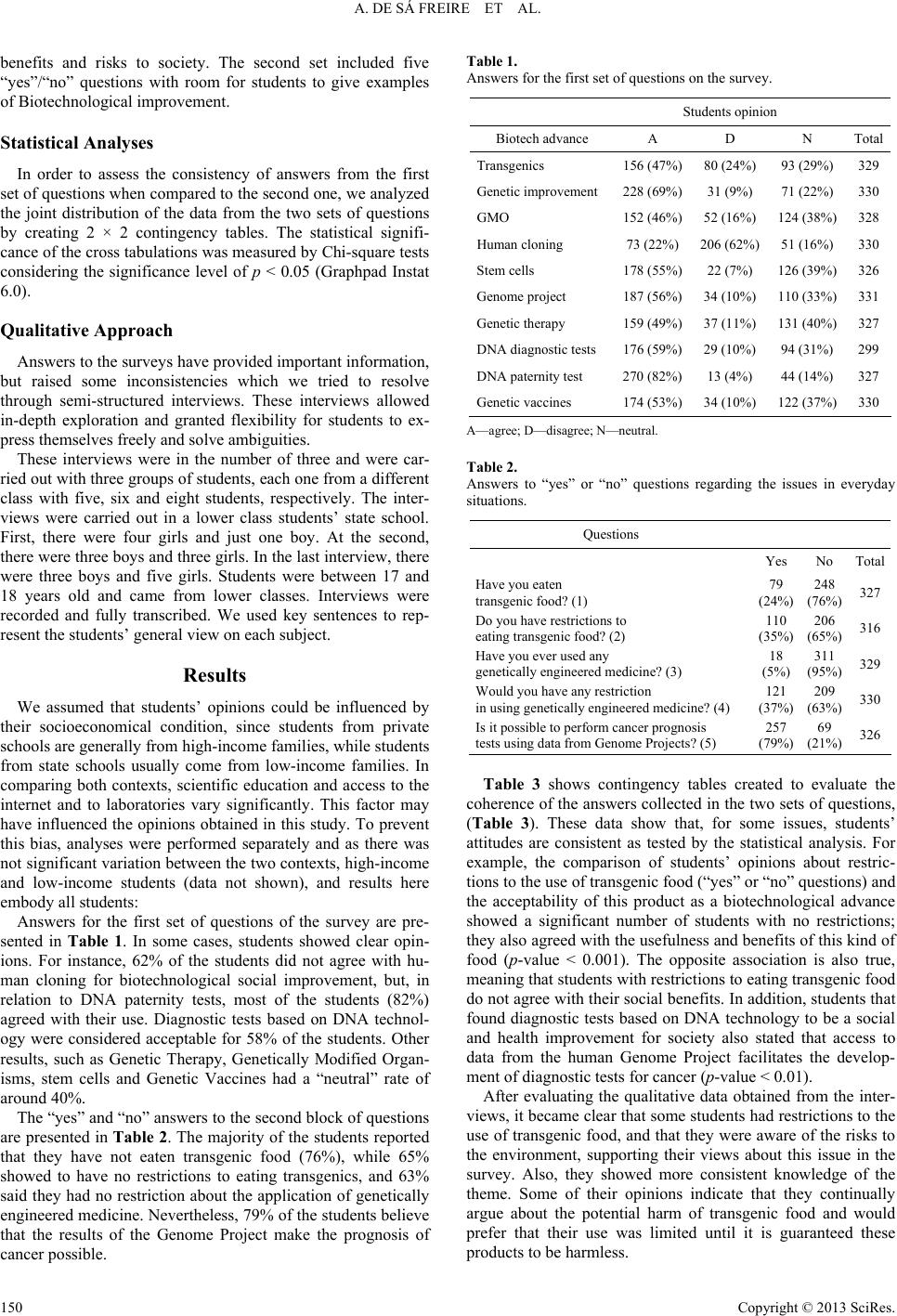 A. DE SÁ FREIRE ET AL. benefits and risks to society. The second set included five “yes”/“no” questions with room for students to give examples of Biotechnological improvement. Statistical Analyses In order to assess the consistency of answers from the first set of questions when compared to the second one, we analyzed the joint distribution of the data from the two sets of questions by creating 2 × 2 contingency tables. The statistical signifi- cance of the cross tabulations was measured by Chi-square tests considering the significance level of p < 0.05 (Graphpad Instat 6.0). Qualitative Approach Answers to the surveys have provided important information, but raised some inconsistencies which we tried to resolve through semi-structured interviews. These interviews allowed in-depth exploration and granted flexibility for students to ex- press themselves freely and solve ambiguities. These interviews were in the number of three and were car- ried out with three groups of students, each one from a different class with five, six and eight students, respectively. The inter- views were carried out in a lower class students’ state school. First, there were four girls and just one boy. At the second, there were three boys and three girls. In the last interview, there were three boys and five girls. Students were between 17 and 18 years old and came from lower classes. Interviews were recorded and fully transcribed. We used key sentences to rep- resent the students’ general view on each subject. Results We assumed that students’ opinions could be influenced by their socioeconomical condition, since students from private schools are generally from high-income families, while students from state schools usually come from low-income families. In comparing both contexts, scientific education and access to the internet and to laboratories vary significantly. This factor may have influenced the opinions obtained in this study. To prevent this bias, analyses were performed separately and as there was not significant variation between the two contexts, high-income and low-income students (data not shown), and results here embody all students: Answers for the first set of questions of the survey are pre- sented in Table 1. In some cases, students showed clear opin- ions. For instance, 62% of the students did not agree with hu- man cloning for biotechnological social improvement, but, in relation to DNA paternity tests, most of the students (82%) agreed with their use. Diagnostic tests based on DNA technol- ogy were considered acceptable for 58% of the students. Other results, such as Genetic Therapy, Genetically Modified Organ- isms, stem cells and Genetic Vaccines had a “neutral” rate of around 40%. The “yes” and “no” answers to the second block of questions are presented in Table 2. The majority of the students reported that they have not eaten transgenic food (76%), while 65% showed to have no restrictions to eating transgenics, and 63% said they had no restriction about the application of genetically engineered medicine. Nevertheless, 79% of the students believe that the results of the Genome Project make the prognosis of cancer possible. Table 1. Answers for the firs t set of questions on t he survey. Students opinion Biotech advance A D N Total Transgenics 156 (47%) 80 (24%) 93 (29%)329 Genetic im provement 228 (69%) 31 (9%) 71 (22%)330 GMO 152 (46%) 52 (16%) 124 (38%)328 Human clonin g 73 (22%) 206 (62%) 51 (16%)330 Stem cells 178 (55%) 22 (7%) 126 (39%)326 Genome pro ject 187 (56%) 34 (10%) 110 (33%)3 31 Genetic therapy 159 (49%) 37 (11%) 131 (40%)327 DNA diagnostic tests 176 (59%) 29 (10%) 94 (31%)299 DNA paternity test 270 (82%) 13 (4%) 44 (14%)327 Genetic va ccines 174 (53%) 34 (10%) 122 (37%)330 A—agree; D—disagree; N—neut ral. Table 2. Answers to “yes” or “no” questions regarding the issues in everyday situations. Questions Yes No Total Have you e aten transgenic food? (1) 79 (24%) 248 (76%) 327 Do you have restriction s t o eating transgenic food? (2) 110 (35%) 206 (65%) 316 Have you ever used any genetically engineered medicine? (3) 18 (5%) 311 (95%) 329 Would you have any restriction in using genetically engineered medicine? ( 4) 121 (37%) 209 (63%) 330 Is it possible to perform cancer prognosis tests using data from Genome Projects? (5) 257 (79%) 69 (21%) 326 Table 3 shows contingency tables created to evaluate the coherence of the answers collected in the two sets of questions, (Table 3). These data show that, for some issues, students’ attitudes are consistent as tested by the statistical analysis. For example, the comparison of students’ opinions about restric- tions to the use of transgenic food (“yes” or “no” questions) and the acceptability of this product as a biotechnological advance showed a significant number of students with no restrictions; they also agreed with the usefulness and benefits of this kind of food (p-value < 0.001). The opposite association is also true, meaning that students with restrictions to eating transgenic food do not agree with their social benefits. In addition, students that found diagnostic tests based on DNA technology to be a social and health improvement for society also stated that access to data from the human Genome Project facilitates the develop- ment of diagnostic tests for cancer (p-value < 0.01). After evaluating the qualitative data obtained from the inter- views, it became clear that some students had restrictions to the use of transgenic food, and that they were aware of the risks to the environment, supporting their views about this issue in the survey. Also, they showed more consistent knowledge of the theme. Some of their opinions indicate that they continually argue about the potential harm of transgenic food and would prefer that their use was limited until it is guaranteed these products to be harmless. Copyright © 2013 SciRe s . 150 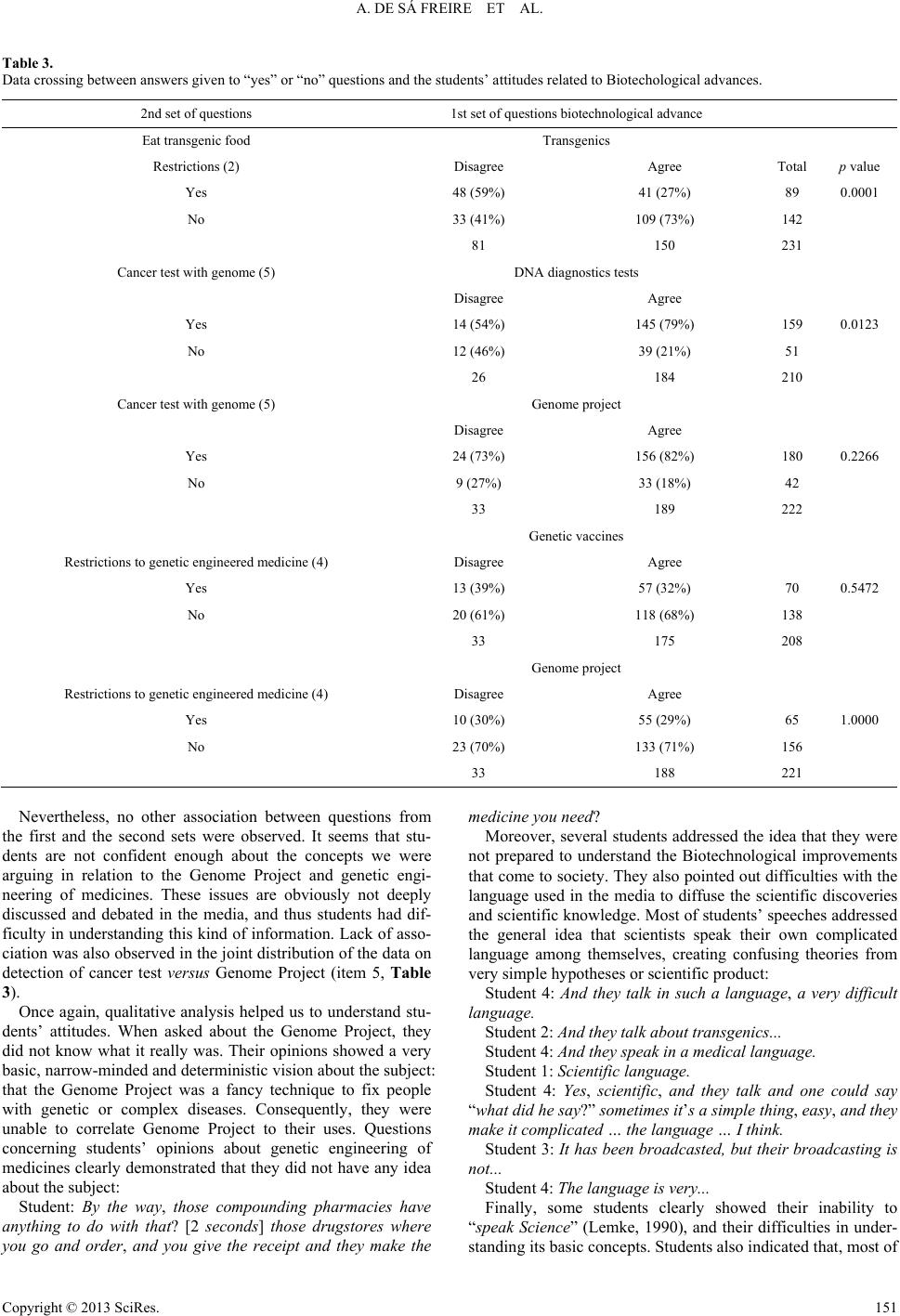 A. DE SÁ FREIRE ET AL. Copyright © 2013 SciRe s . 151 Table 3. Data crossing between answers given to “yes” or “no” questions and the students’ attitudes related to Biotechological advances. 2nd set of questions 1st set of questions bio t echnological advance Eat transgenic food Transgenics Restrictions (2) Disagree Agree Total p value Yes 48 (59%) 41 (27%) 89 0.0001 No 33 (41%) 109 (73%) 142 81 150 231 Cancer test with genome (5) DNA diagnostics tests Disagree Agree Yes 14 (54%) 145 (79%) 159 0.0123 No 12 (46%) 39 (21%) 51 26 184 210 Cancer test with genome (5) Genome project Disagree Agree Yes 24 (73%) 156 (82%) 180 0.2266 No 9 (27%) 33 (18%) 42 33 189 222 Genetic vaccines Restrictions to genetic engineered me dicine (4) Disagree Agree Yes 13 (39%) 57 (32%) 70 0.5472 No 20 (61%) 118 (68%) 138 33 175 208 Genome project Restrictions to genetic engineered me dicine (4) Disagree Agree Yes 10 (30%) 55 (29%) 65 1.0000 No 23 (70%) 133 (71%) 156 33 188 221 Nevertheless, no other association between questions from the first and the second sets were observed. It seems that stu- dents are not confident enough about the concepts we were arguing in relation to the Genome Project and genetic engi- neering of medicines. These issues are obviously not deeply discussed and debated in the media, and thus students had dif- ficulty in understanding this kind of information. Lack of asso- ciation was also observed in the joint distribution of the data on detection of cancer test versus Genome Project (item 5, Table 3). Once again, qualitative analysis helped us to understand stu- dents’ attitudes. When asked about the Genome Project, they did not know what it really was. Their opinions showed a very basic, narrow-minded and deterministic vision about the subject: that the Genome Project was a fancy technique to fix people with genetic or complex diseases. Consequently, they were unable to correlate Genome Project to their uses. Questions concerning students’ opinions about genetic engineering of medicines clearly demonstrated that they did not have any idea about the subject: Student: By the way, those compounding pharmacies have anything to do with that? [2 seconds] those drugstores where you go and order, and you give the receipt and they make the medicine you need? Moreover, several students addressed the idea that they were not prepared to understand the Biotechnological improvements that come to society. They also pointed out difficulties with the language used in the media to diffuse the scientific discoveries and scientific knowledge. Most of students’ speeches addressed the general idea that scientists speak their own complicated language among themselves, creating confusing theories from very simple hypotheses or scientific product: Student 4: And they talk in such a language, a very difficult language. Student 2: And they talk about transgenics... Student 4: And they speak in a medical language. Student 1: Scientific language. Student 4: Yes, scientific, and they talk and one could say “what did he say?” sometimes it’s a simple thing, easy, and they make it complicated … the language … I think. Student 3: It has been broadcasted, but their broadcasting is not... Student 4: The language is very... Finally, some students clearly showed their inability to “speak Science” (Lemke, 1990), and their difficulties in under- standing its basic concepts. Students also indicated that, most of  A. DE SÁ FREIRE ET AL. the time, they tried to answer the survey and the questions in the interviews with “guesstimations” because they did not really know what they were discussing, especially concerning the Genome Project and genetic engineering of medicines. Discussion Many pieces of information concerning concepts in Bio- technology are present in the daily news as well as in TV shows and movies, such as the use of DNA in criminal justice cases or paternity identification; and human cloning in films and in the press (Jensen et al., 2008), for example, are generally perme- ated with dangerous ideas and hope (such as finding the cure to some genetic diseases just by concluding the Genome Project). Also, there are contradictory views in the media and in movies in relation to transgenics. All this misleading information usu- ally creates confusion to the population in general. Most films, for example, portray only the negative, the unethical and the immoral aspect of human cloning, while the media points out the fact that it can be used to save lives of people with genetic diseases (Jensen et al., 2008). In spite of that, students have clear opinions on a few matters. The results of the survey show an approval of paternity tests (82%) and a rejection of human cloning (62%), indicating that highly covered issues generally follow the dominant and polar “good and bad” ideologies. Thus, our data had internal “positive controls” that helped us analyze the second set of answers. The results seem to have been influenced by a popular Bra- zilian soap opera, The Clone, exhibited a few years earlier (2002). It emphasized the negative aspects of cloning, espe- cially human cloning, and showed the possibility of human cloning as something relatively easy to be done. A study using a focal group of high schools students in Brazil analyzed this soap opera corroborating our data indicating that, in fact, few issues in Biotechnology and Molecular Genetics could be de- bated properly and analyzed by students (Moreira & Mas- sarani, 2008). Indeed, in the past years in Brazil, popular TV shows have exhibited situations where families discuss the paternity issue, and DNA test is the motif of these TV programs. In addition, news programs frequently show paternity and criminal cases were DNA tests could be applied to solve such cases. Although such discussion has been raised by mass media, scientific issues tend to show too superficially, leading to an oversimplified view of Biotechnological issues (Massarani, 2005). In addition, the media often portrays a bias point of view about scientific discoveries. Such approach does not allow peo- ple in general to develop critical thinking about Biotechnology (Jensen, 2008; Lind-Balta, 2006; Harms, 2002). In this regard, it is clear that students were able to identify some concepts linked to biotechnology a n d genet ic engineering, such as transgenic food and DNA diagnostic tests. However, this ability was restricted to these two themes while, for other topics, the students’ ideas were limited to abstract and errone- ous conceptions about issues like the Genome Project. Al- though we did not ask this question explicitly, it was possible to notice from the interviews, that the students acquire their notion on biotechnology information through the media more often than from school classes. It is assumed that school is probably a better place to discuss these issues in-depth; that the educa- tional institution has the most important role in individual de- velopment and should provide an environment for the students to develop understanding about new concepts and technologies. But that is not what can be noticed most of the times schools do not provide adequate infrastructure, classes have much more students than it should, there is not sufficient time to teach what is in the school program, and due to many issues (which will not be discussed here) teachers are not well prepared to work with the new issues concerning concepts in Biotechnology. Other studies corroborate to this view. Ramón et al. (2008) analyzed students’ knowledge about Biotechnology issues, and Šorgo and Dolinšek (2009) focused his work on teachers’ knowledge about these topics. Both articles identified the need of discussing the new issues in Genetics and Molecular Biology in school, and teachers’ lack of fluency concerning Biotech- nology issues. Our data endorse the conclusions of these previ- ous publications. Possibly, the introduction of more Genetics and Molecular Biology issues in school books could help stu- dents and teachers cope with this new area. Some basic concepts presented to students in the first year of high school are necessary for the understanding of Genetics and Evolution. Also, other Biotechnological issues need to be dis- cussed in the third year. Assuming that the student learns from what he knows about, it is necessary to present and discuss objectively students’ difficulties about the concepts in Bio- technology. Such difficulties are well exemplified in the stu- dent’s speech: “Can we express ourselves sincerely? … we an- swered based on what we could deduce here.” It is clear that they have never discussed the new Biotechnologies properly. So, they have no way of having concepts in Biotechnology settled. Unfortunately, the learning-teaching process is still based on outdated educational books and mostly solely on lecture classes, which tends to lead to a shallow notion of important Biotech- nological concepts. It would, therefore, be a difficult task for these students to behave as critical and active citizens in a con- stantly changing society. It was also noticed that students often mentioned that scien- tific language sounds unfamiliar. This occurs because they have not been in contact with scientific terminology. Thus, they cannot understand some important relationships between some Biotechnological advances, such as the Genome Project, ge- netically engineered medicines and Genetic Vaccines. The su- perficial level of students’ knowledge in such matters became clear as they get in touch with the scientific language. It is properly exemplified when a student expresses their miscon- ception about genetically engineered medicine, making it a synonym of designed-medicines in drugstores. Teachers were questioned about their sources of information for class planning (Xavier et al., 2006) and it was verified that their major source was the school textbook, which is used by students for classes as well as for studying for tests. The text- book, as told previously, does not present up-to-date and con- textualized contents. Finally, we understand that our approach have limitations since we studied only three schools, although in different loca- tions in Rio de Janeiro state. However, it is difficult to extrapo- late our results to other states in Brazil and even other munici- palities in Rio. Also, we tried to better comprehend differences between public and private schools and, in our hands, we did not capture such differences that could also be accounted for small sample size we used specially concerning the number of private students enrolled. Nevertheless, our data are consistent since we used different methodologies and have been corrobo- rated by others in Brazil (Massarani, 2005). Copyright © 2013 SciRe s . 152  A. DE SÁ FREIRE ET AL. Copyright © 2013 SciRe s . 153 Based on the results, we conclude that high school students do not have proper contact with biotechnology issues at school. Although they may get into contact with biotechnology ad- vances through TV shows or the media, they still demonstrate misconceptions. The scientific language is a barrier because of the lack of an in-depth discussion about scientific discoveries in biotechnology. Anyway, the results presented herein are con- sistent with the lack of discussion of biotechnological issues in school classes. Therefore, changes show to be not only urgent but also extremely important. REFERENCES Araújo-Jorge, T., Cardona, T., Mendes, C., Henriques-Pons, A., Mei- relles, R., Coutinho, C., Aguiar, L., Meirelles, M. N., Castro, S., Barbosa, H., & Luz, M. (2004). Microscopy images as interactive tools in cell modeling and cell biology education. Cell Biology Edu- cation, 3, 99-110. doi:10.1187/cbe.03-08-0010 Cavanagh, H., Hood, J., & Wilkinson, J. (2005). Riverina high school students’ views of biotechnology. Electronic Journal of Biotechnol- ogy, 8, 121-127. doi:10.2225/vol8-issue2-fulltext-1 Dawson, V., & Schibeci, R. (2003). Western Australian high school students’ attitudes towards biotechnlogy processes. Journal of Bio- techological Education, 38, 7-11. doi:10.1080/00219266.2003.9655889 De Mattos, J. C. P. , Dan tas, F. J. S., Cald eiras-d e-A raú j o , A. , & Mo r aes, M. O. (2004). Agarose gel eletrophoresis system in the classroom. Biochemistry and Molecular B iology Education, 32 , 254-257. doi:10.1002/bmb.2004.494032040382 Eyck, T. T. (2005). The media and public opinion on genetics and biotechnology: Mirrors, windows, or walls? Public Understanding of Science, 14, 305-316. doi:10.1177/0963662505052888 Gelbart, H., & Yarden, A. (2006). Learning genetics through an authen- tic research simulation in bioinformatics. Journal of Biological Edu- cation, 40, 107-112. doi:10.1080/00219266.2006.9656026 Harms, U. (2002). Biotechnology education in Schools. Electronic Journal of Biotech n ology, 5, 205-211. doi:10.2225/vol5-issue3-fulltext-i03 Jensen, E. (2008). The Dao of human cloning: Utopian/dystopian hype in the British press and popular films. Public Understanding of Sci- ence, 17, 123-143. doi:10.1177/0963662506065874 Lemke, J. L. (1990). Talking science: Language, learning and values. Stanford: Ablesc/JAI Publishing Corporation. Lind-Balta, E. (2006). Using literature and innovative assessments to ignite interest and cultivate critical thinking skills in an under- graduate neuroscie nce course. Life Sc i en ce s Education, 5, 167-174. doi:10.1187/cbe.05-08-0108 Massarani, L., & Moreira, I. C. (2008). Not in our genes! Um estudo de caso com jovens do ensino médio no Rio de Janeiro. Alexandria Re- vista de Educação em Ciência e Tecnologia, 1, 51-76. Massarani, L., & Moreira, I. C. (2005). Attitudes towards genetics: A case study among Brazilian high school students. Public Understand- ing of Science, 14, 201-212. doi:10.1177/0963662505050992 Peters, M. W., Smith, M. F., & Smith G. W. (2002). Use of critical interactive thinking exercises in teaching reproductive physiology to undergraduate students. Journal of Animal Science, 80, 862-865. Peters, V., & Vissers, G. (2004). A simple classification model for debriefing simulation games. Simulation and Gaming, 35, 20-83. doi:10.1177/1046878103253719 Ramón, D., Diamante, A., & Calvo, M. D. (2008). Food biotechnlogy and education. Ele tronic Journal of Biotechnology, 11, 1-5. Sorgo, A., & Ambrozic-Dolinsek, J. (2009). The relationship among knowledge of, attitudes toward and acceptance of genetically modi- fied organisms (GMOs) among Slovenian teachers. Electronic Jour- nal of Biotechnology, 12, 1-13. doi:10.2225/vol12-issue4-fulltext-1 Xavier, M. C. F., Freire, A. S., & Moraes, M. O. (2006). A nova (moderna) biologia e a genética nos livros didáticos de biologia no ensino médio. Ciência e Educação, 12, 275-289. |