

Paper Menu >>
Journal Menu >>
 Creative Education 2013. Vol.4, No.1, 82-88 Published Online January 2013 in SciRes (http://www.scirp.org/journal/ce) http://dx.doi.org/10.4236/ce.2013.41011 Copyright © 2013 SciRes. 82 Prospective Teachers’ Perceptions of Science Theories: An Action Research Study James P. Concannon1, Patrick L. Brown2, Erikka Brown3 1Westminster College, Fulton, USA 2DuBray Middle Scho ol, St. Peters, USA 3Westminster College, Fulton, USA Email: [email protected] Received November 7th, 2012 ; revised December 10th, 2012; accepted December 24th, 2012 This study investigates prospective teachers’ conceptions of science theories before and after instruction. Instruction focused specifically on prospective teachers’ misconceptions that theories are not used to pre- dict, that laws are more important than theories, and that theories are simply hunches. The action research investigation was successful in helping students accommodate new information presented in the lesson and facilitated their understanding towards the accepted explanation of what a theory in science means; however, the vernacular misconception that “theories are hunches” persisted. Keywords: Nature of Science; Theory; Prospective Teachers; Science Misconceptions Introduction The objective for K-12 science education as outlined in the Benchmarks for Science Literacy (American Association for the Advancement of Science [AAAS], 1993) and the National Sci- ence Education Standards (National Research Council [NRC], 1996) is that students gain a broad understanding of science content and develop abilities to use evidence-based reasoning in their everyday lives. Although achieving higher levels of scien- tific literacy is the ultimate goal, research consistently demon- strates that students’ inaccurate ideas and misconceptions hin- der their abilities to develop more scientifically accurate con- ceptions (Driver, Leach, Millar, & Scott, 1996; Driver, Squires, Rushworth, & Wood-Robinson, 1994). One key component in helping students overcome misconceptions and achieve higher levels of science literacy is how they are taught (Brophy & Good, 1986). As a result, preparing prospective science teach- ers to teach in ways that help students overcome misconcep- tions is a major goal of many teacher education programs (Lemberger, Hewson, & Park, 1999; Russell & Martin, 2007). The knowledge prospective teachers have about the content and their students influences what they will learn from teacher preparation programs, the way they will teach, and what stu- dents will learn. This idea grounds the purpose for this study. The purpose of this study is to evaluate the effectiveness of explicit instruction on prospective science teacher’s develop- ment of knowledge of scientific theories. Theoretical Framework In order to understand prospective science teacher’s development of knowledge of scientific theories, researches must identify important co mponents of knowledge development. Posner, Strike, Hewson, & Gertzog (1982) proposed a model of conceptual change that included 4 sequential phases. In the first phase, the teacher identifies student’s ideas, knowledge, and misconceptions. The literature documented that students have multiple types of misconceptions ranging from preconceived notions, conceptual misunderstandings, to vernacular miscon- ceptions (Center for Science, Mathematics, and Engineering Education [CSMEE], 1997). Misconceptions inhibit students’ learning and progression from being nominally scientifically literate to being functionally, conceptually, or multidimensional literate (Bybee et al., 2008). Thus, it is important that student thinking is made concrete for both the student and teacher at the onset of science instruction. During the second phase, the teacher provides experiences and data to introduce new, accurate ideas. Students benefit from firsthand experiences with evidence in order to find new ideas plausible. The third phase students must find new conceptions more attractive than their misconception. Students should generate scientific claims based on evidence and teachers should discuss ideas in light of students’ firsthand experiences. Finally, students must use evidence-based reasoning and logic to develop deep con- ceptually accurate understanding. Constructing new ideas through interactions with data and evidence, collaborations with other students, and discussions with the teacher should help them refute the accuracy of their misconception. Students benefit from elaborations that allow them to test new con- ceptions in new and different contexts. Testing ideas in new contexts help solidify students’ knowledge by resolving con- flicts between prior conceptions and new understanding. The proven effectiveness of a conceptual change approach on the development of scientific knowledge is well substantiated. A number of studies have contributed to the development, imple- mentation, and demonstrate the robustness of using a con- ceptual change approach to help students overcome miscon- ceptions to develop more accurate understanding (Eaton, Anderson, & Smith, 1983; Clement, Brown, & Zietsman, 1989; Nussbaum & Novick, 1981; Posner et al., 1982; Osborne & Gilbert, 1980). Review of the Literature: Teachers Views of the Nature of Science One of the central goals identified by the National Science  J. P. CONCANNON ET AL. Education Standards (NSES) is that students should understand the nature of science and the tenets of science (NRC, 1996). However, studies at both the K-12 level (Liu & Lederman, 2002) and in college science courses (Kurdziel & Libarkin, 2002) indicate that students are far from achieving this goal. The seven tenets of science describes science as tentative, em- pirically based, subjective, based on human inference, requires imagination and creativity, and is socially culturally embedded (Abd-El-Khalick et al., 1998; Liu & Lederman, 2002). De- spairingly, a number of studies document that teachers and prospective teachers—those who are expected to have an un- derstanding of these tenets—fail to have mature views (Abd- El-Khalick & Akerson, 2004). There is a large body of research that indicates that to be effective, NOS instruction should be explicit (Gess-Newsome, 2002; Scharmann & Smith, 2001; Akerson, Abd-El-Khalick, & Lederman, 2000; Smith & Scharmann, 1999), reflective (Akerson et al., 2000), and taught within an existing meaningful and relevant context (Abd-El- Khalick & Lederman, 2000; Akerson et al., 2000). The studies that follow demonstrate that in spite of explicit and meaningful instruction, teachers’ development of accurate views of NOS is mixed. Murcia and Schibeci (1999) investigated 73 individuals’ perceptions of science using a questionnaire about an article regarding health and alcohol consumption. One question asked: “Those who indulged in alcohol once a week were more likely to suffer serious illnesses or die. Do you think this statement is scientific fact (Italics in original, p. 1128)?” The purpose of this question was to determine if prospective teachers believed scientific fact could stem from one single study. Only 29% of prospective teachers indicated that there would need to be fur- ther studies to validate the statement. In addition, prospective teachers were asked a series of true/false questions pertaining to various aspects of science. Another question focused specifi- cally on what a scientific theory is: “Scientific theories should explain additional observations that were not used in develop- ing the theories in the first place” (p. 1134). Less than half (45%) of the prospective teachers could identify that theories have explanatory power that go beyond the direct observations used to generate theory. In another study of prospective elementary teachers, Coch- rane (2003) examined 15 individuals views of science before and after nature of science instruction. Cochrane reported that prospective teachers had naïve views of theories and laws prior to instruction. Prospective elementary teachers’ believed that scientific theories could not change, or that scientific theories generally do not change. One student wrote, “A law is when it (a theory) has been tested many times and has been proven. It is the answer” (p. 4). Prospective teachers indicate beliefs that theories are static, never changing, and the idea that a theory can turn into a law . Lederman (1999) researched how five secondary biology teachers’ understandings of the nature of science influenced their classroom practices. The secondary biology teachers came from diverse backgrounds and years they had been teaching science. All five had previously had courses or workshops that emphasized the nature of science and were considered to have an advanced understanding of the meanings scientific theory and law. Though all the teachers had a firm understanding of the nature of science, only two teachers’ classroom practices aligned with their views of science. These two teachers were the more experienced of the five. Their intention was not to teach the nature of science; rather, they were using a teaching style that would motivate, promote success, and create positive attitudes about science. Reviewing the teachers’ lesson plans, the teaching of the nature of science through demonstrations and inquiry-oriented lessons was not an intended outcome. When the researcher asked questions about theories and laws to students in the teachers’ courses, students replied with naïve views: “Anyone can have a theory, but with evidence it eventu- ally turns into a law because we now know it’s the case,” ··· “Theories change all the time, but laws come out the same way all the time and so we know they are right” (p. 926). In this respect, students believed that scientific theories were premature laws, laws are definite and true, and that theories are simply ide a s . Kurdziel and Libarkin (2002) examined non-science majors’ views of the nature of science in introductory geology courses across three institutions. The researchers used a quantitative instrument developed by McComas et al. (2001) to assess 73 students’ understandings of the empirical, tentative, creative, and subjective nature of science before and after instruction. In addition, the researchers administered the VNOS questionnaire (Abd-El-Khalick et al., 1998) before and after instruction. Stu- dents held naïve ideas regarding the empirical nature and tenta- tiveness of science. Participants believed scientists solve prob- lems and develop answers that will never change, science dis- covers truth, science produces facts, and theories can change if scientists change their minds (Kurdziel & Libarkin, 2002). This study addresses important gaps in the literature con- cerning teachers’ knowledge of NOS. Although prior research reveals inadequacies in prospective teachers’ knowledge of NOS, no literature has examined misconception about scientific theories and the use of a conceptual change approach for de- veloping knowledge. Moreover, no studies investigate prospec- tive teachers pursuing different certifications development of NOS knowledge using a conceptual change approach. Indeed, little research exists that investigates what prospective teachers learn during teacher preparation programs (Russell & Martin, 2007). Thus, studies are needed that better understand the mis- conceptions that a prospective teacher have at the onset of a teacher preparation course and identifies whether a conceptual change approach influences their development of knowledge. Research Questions Two research questions guide this study: 1) What are mis- conceptions about scientific theories among my prospective science teachers? and 2) What specific strategies address pro- spective teachers’ misconceptions about scientific theories and promote conceptual change? Research Context In this section, the research context, data collection strategies, and conceptual change approach used with prospective teachers are described. Context The sample consisted of 35 prospective teachers at a small liberal arts institution. All prospective teachers were enrolled in an Elementary and Middle School Methods of Teaching Science course or a Secondary Methods of Teaching Science course. The teachers in this study were purposefully selected because Copyright © 2013 SciRes. 83 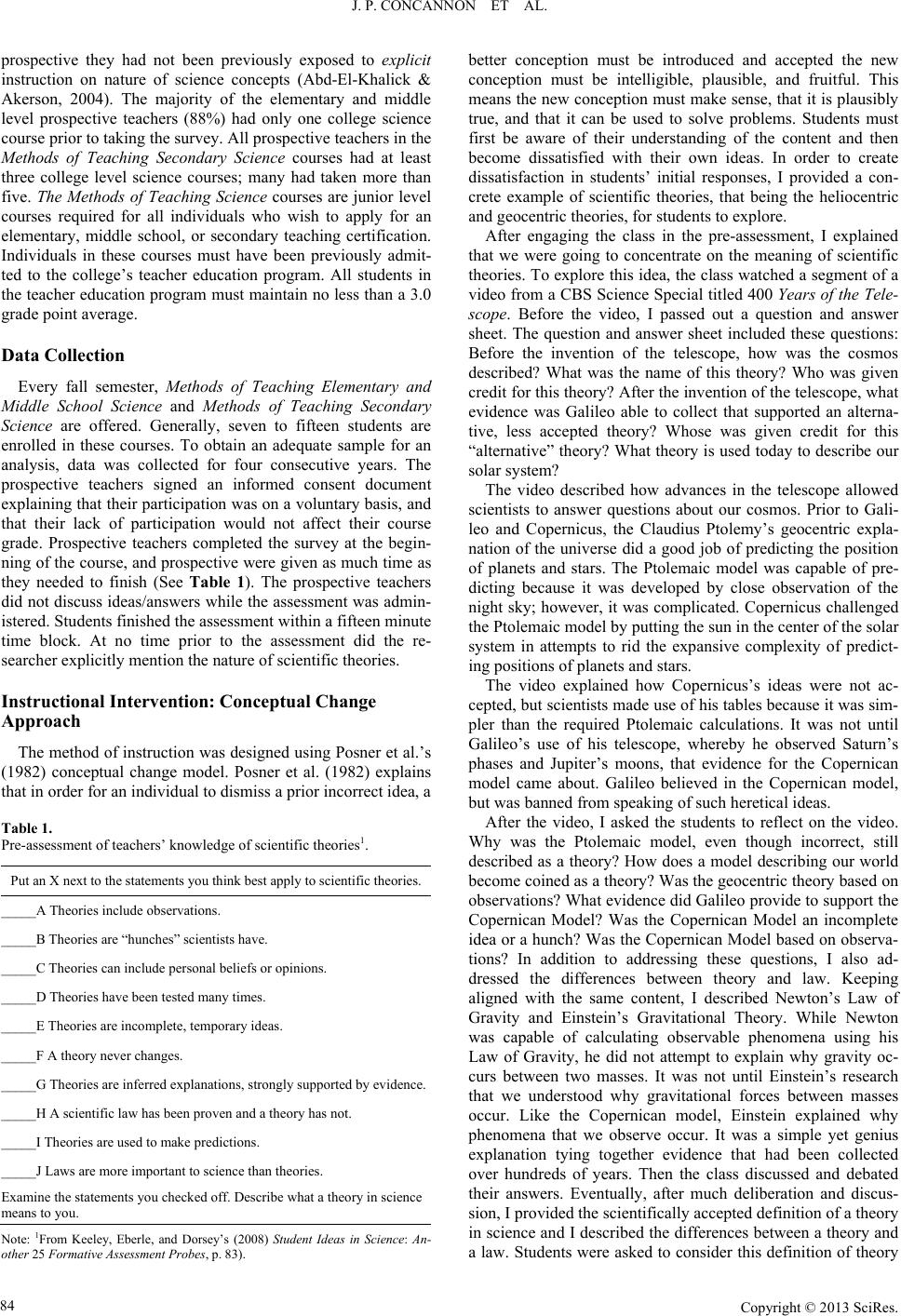 J. P. CONCANNON ET AL. prospective they had not been previously exposed to explicit instruction on nature of science concepts (Abd-El-Khalick & Akerson, 2004). The majority of the elementary and middle level prospective teachers (88%) had only one college science course prior to taking the survey. All prospective teachers in the Methods of Teaching Secondary Science courses had at least three college level science courses; many had taken more than five. The Methods of Teaching Science courses are junior level courses required for all individuals who wish to apply for an elementary, middle school, or secondary teaching certification. Individuals in these courses must have been previously admit- ted to the college’s teacher education program. All students in the teacher education program must maintain no less than a 3.0 grade point average. Data Collection Every fall semester, Methods of Teaching Elementary and Middle School Science and Methods of Teaching Secondary Science are offered. Generally, seven to fifteen students are enrolled in these courses. To obtain an adequate sample for an analysis, data was collected for four consecutive years. The prospective teachers signed an informed consent document explaining that their participation was on a voluntary basis, and that their lack of participation would not affect their course grade. Prospective teachers completed the survey at the begin- ning of the course, and prospective were given as much time as they needed to finish (See Table 1). The prospective teachers did not discuss ideas/answers while the assessment wa s admin- istered. Students finished the assessment within a fifteen minute time block. At no time prior to the assessment did the re- searcher explicitly mention the nature of scientific theories. Instructio nal Interven tion: Concep t u al Change Approach The method of instruction was design ed using Posne r et al.’s (1982) conceptual change model. Posner et al. (1982) explains that in order for an individual to dismiss a prior incorrect idea, a Table 1. Pre-assessment of teachers’ knowledge of scientific theories1. Put an X next to the statements you thin k best apply to scientific theories. _____A Theories includ e observati ons. _____B T heories are “h unches” scientists ha v e. _____C Theories can include personal beliefs or opinio n s. _____D Theories have been tested many tim es. _____E Theories are incomplete, temporary ideas. _____F A the or y never changes. _____G Theories are i n ferred expla nations, strongly supported by evidence. _____H A s cientific la w has been p ro ven and a theory has not. _____I The ori es are u sed to make predictions. _____J Laws are more important to science than theories. Examine the statements you checked off. Describe what a theory in science means to you. Note: 1From Keeley, Eberle, and Dorsey’s (2008) Student Ideas in Science: An- other 25 Formative Assessment Probes, p. 83). better conception must be introduced and accepted the new conception must be intelligible, plausible, and fruitful. This means the new conception must make sense, that it is plausibly true, and that it can be used to solve problems. Students must first be aware of their understanding of the content and then become dissatisfied with their own ideas. In order to create dissatisfaction in students’ initial responses, I provided a con- crete example of scientific theories, that being the heliocentric and geocentric theories, for students to explore. After engaging the class in the pre-assessment, I explained that we were going to concentrate on the meaning of scientific theories. To explore this idea, the class watched a segment of a video from a CBS Science Special titled 400 Years of the Tele- scope. Before the video, I passed out a question and answer sheet. The question and answer sheet included these questions: Before the invention of the telescope, how was the cosmos described? What was the name of this theory? Who was given credit for this theory? After the invention of the telescope, what evidence was Galileo able to collect that supported an alterna- tive, less accepted theory? Whose was given credit for this “alternative” theory? What theory is used today to describe our solar syste m? The video described how advances in the telescope allowed scientists to answer questions about our cosmos. Prior to Gali- leo and Copernicus, the Claudius Ptolemy’s geocentric expla- nation of the universe did a good job of predicting the position of planets and stars. The Ptolemaic model was capable of pre- dicting because it was developed by close observation of the night sky; however, it was complicated. Copernicus challenged the Ptolemaic model by putting the sun in the center of the solar system in attempts to rid the expansive complexity of predict- ing positions of planets and stars. The video explained how Copernicus’s ideas were not ac- cepted, but scientists made use of his tables because it was sim- pler than the required Ptolemaic calculations. It was not until Galileo’s use of his telescope, whereby he observed Saturn’s phases and Jupiter’s moons, that evidence for the Copernican model came about. Galileo believed in the Copernican model, but was banned from speaking of such heretical ideas. After the video, I asked the students to reflect on the video. Why was the Ptolemaic model, even though incorrect, still described as a theory? How does a model describing our world become coined as a theory? Was the geocentric theory based on observations? What evidence did Galileo provide to support the Copernican Model? Was the Copernican Model an incomplete idea or a hunch? Was the Copernican Model based on observa- tions? In addition to addressing these questions, I also ad- dressed the differences between theory and law. Keeping aligned with the same content, I described Newton’s Law of Gravity and Einstein’s Gravitational Theory. While Newton was capable of calculating observable phenomena using his Law of Gravity, he did not attempt to explain why gravity oc- curs between two masses. It was not until Einstein’s research that we understood why gravitational forces between masses occur. Like the Copernican model, Einstein explained why phenomena that we observe occur. It was a simple yet genius explanation tying together evidence that had been collected over hundreds of years. Then the class discussed and debated their answers. Eventually, after much deliberation and discus- sion, I provided the scientifically accepted definition of a theory in science and I described the differences between a theory and a law. Students were asked to consider this definition of theory Copyright © 2013 SciRes. 84 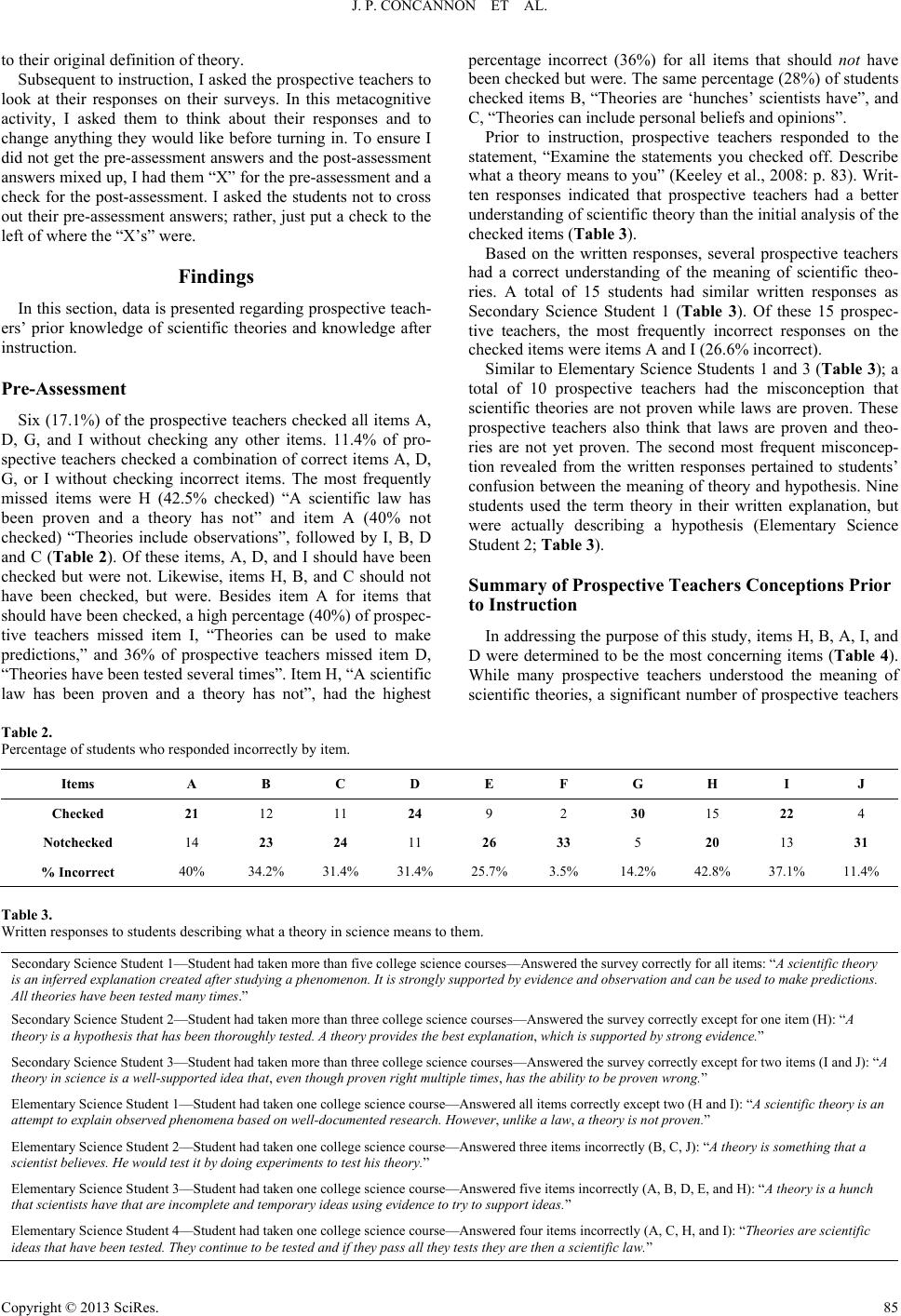 J. P. CONCANNON ET AL. Copyright © 2013 SciRes. 85 to their original definition of theory. Subsequent to instruction, I asked the prospective teachers to look at their responses on their surveys. In this metacognitive activity, I asked them to think about their responses and to change anything they would like before turning in. To ensure I did not get the pre-assessment answers and the post-assessment answers mixed up, I had them “X” for the pre-assessment and a check for the post-assessment. I asked the students not to cross out their pre-assessment answers; rather, just put a check to the left of where the “X’s” were. Findings In this section, data is presented regarding prospective teach- ers’ prior knowledge of scientific theories and knowledge after instruction. Pre-Assessment Six (17.1%) of the prospective teachers checked all items A, D, G, and I without checking any other items. 11.4% of pro- spective teachers checked a combination of correct items A, D, G, or I without checking incorrect items. The most frequently missed items were H (42.5% checked) “A scientific law has been proven and a theory has not” and item A (40% not checked) “Theories include observations”, followed by I, B, D and C (Table 2). Of these items, A, D, and I should have been checked but were not. Likewise, items H, B, and C should not have been checked, but were. Besides item A for items that should have been checked, a high percentage (40%) of prospec- tive teachers missed item I, “Theories can be used to make predictions,” and 36% of prospective teachers missed item D, “Theories have been tested several times”. Item H, “A scientific law has been proven and a theory has not”, had the highest percentage incorrect (36%) for all items that should not have been checked but were. The same percentage (28%) of students checked items B, “Theories are ‘hunches’ scientists have”, and C, “Theories can include personal beliefs and opinions”. Prior to instruction, prospective teachers responded to the statement, “Examine the statements you checked off. Describe what a theory means to you” (Keeley et al., 2008: p. 83). Writ- ten responses indicated that prospective teachers had a better understanding of scientific theory than the initial analysis of the checked items (Table 3). Based on the written responses, several prospective teachers had a correct understanding of the meaning of scientific theo- ries. A total of 15 students had similar written responses as Secondary Science Student 1 (Table 3). Of these 15 prospec- tive teachers, the most frequently incorrect responses on the checked item s were items A and I (26.6% incorrect). Similar to Elementary Science Students 1 and 3 (Table 3); a total of 10 prospective teachers had the misconception that scientific theories are not proven while laws are proven. These prospective teachers also think that laws are proven and theo- ries are not yet proven. The second most frequent misconcep- tion revealed from the written responses pertained to students’ confusion between the meaning of theory and hypothesis. Nine students used the term theory in their written explanation, but were actually describing a hypothesis (Elementary Science Student 2; Table 3). Summary of Prospective Teachers Conceptions Prior to Instruction In addressing the purpose of this study, items H, B, A, I, and D were determined to be the most concerning items (Table 4). While many prospective teachers understood the meaning of scientific theories, a significant number of prospective teachers Table 2. Percentage of students wh o responded incorrectly by item. Items A B C D E F G H I J Checked 21 12 11 24 9 2 30 15 22 4 Notchecked 14 23 24 11 26 33 5 20 13 31 % Incorrect 40% 34.2% 31.4% 31.4% 25.7% 3.5% 14.2% 42.8% 37.1% 11.4% Table 3. Written responses t o s t u d e nt s d e s c ribing what a theory in science means to them. Secondary Science Student 1—Student had taken more than five c ol lege scien ce courses—A ns wered the survey correctly fo r all items: “A scientific theory is an inferred explanation created after studying a phenomenon. It is strongl y supported by evidence and observation and can be used to make predictions. All theories have been tested many times.” Secondary Science Student 2—Student had taken more than three college sc ience courses—Answered the surve y correctly except for one item (H): “A theory is a hypothes is that has been thorough l y tested. A theory provides the best explanation, which is supporte d by strong evidence.” Secondary Science Student 3—Student had taken more than three college sc ience courses—Answered the surve y correctly except for two items (I and J): “A theory in scien ce is a well-supported idea that, even though proven right multiple times, has the ability to be proven wrong.” Elementary Scienc e S t udent 1—Student had taken one c oll ege scien ce course—Answered all items c orr ectly except two (H and I): “A scientific theory is an attempt to explain observed phenomena based on well-documented research. However, unlike a law, a theory is not proven.” Elementary Scienc e S t udent 2—Student had taken one c oll ege scien ce course—Answered t h ree items incorrectl y (B, C, J): “A theory is something that a scientist believes. He would test it by doing experi ments to test his theory.” Elementary Science St udent 3—Student had taken one college science course—Answered fi ve items inc orrectly (A, B, D, E, and H): “A theory is a hunch that scientists have that are incomplete and temporary ideas using evidence to try to support ideas.” Elementary Science St udent 4—Student had taken one college science course—Answered fo ur items inc orrectly (A, C, H, and I ): “Theories are scientific ideas that have been tested. They continue to be tested and if they pass all t hey tests they are then a scientific law.” 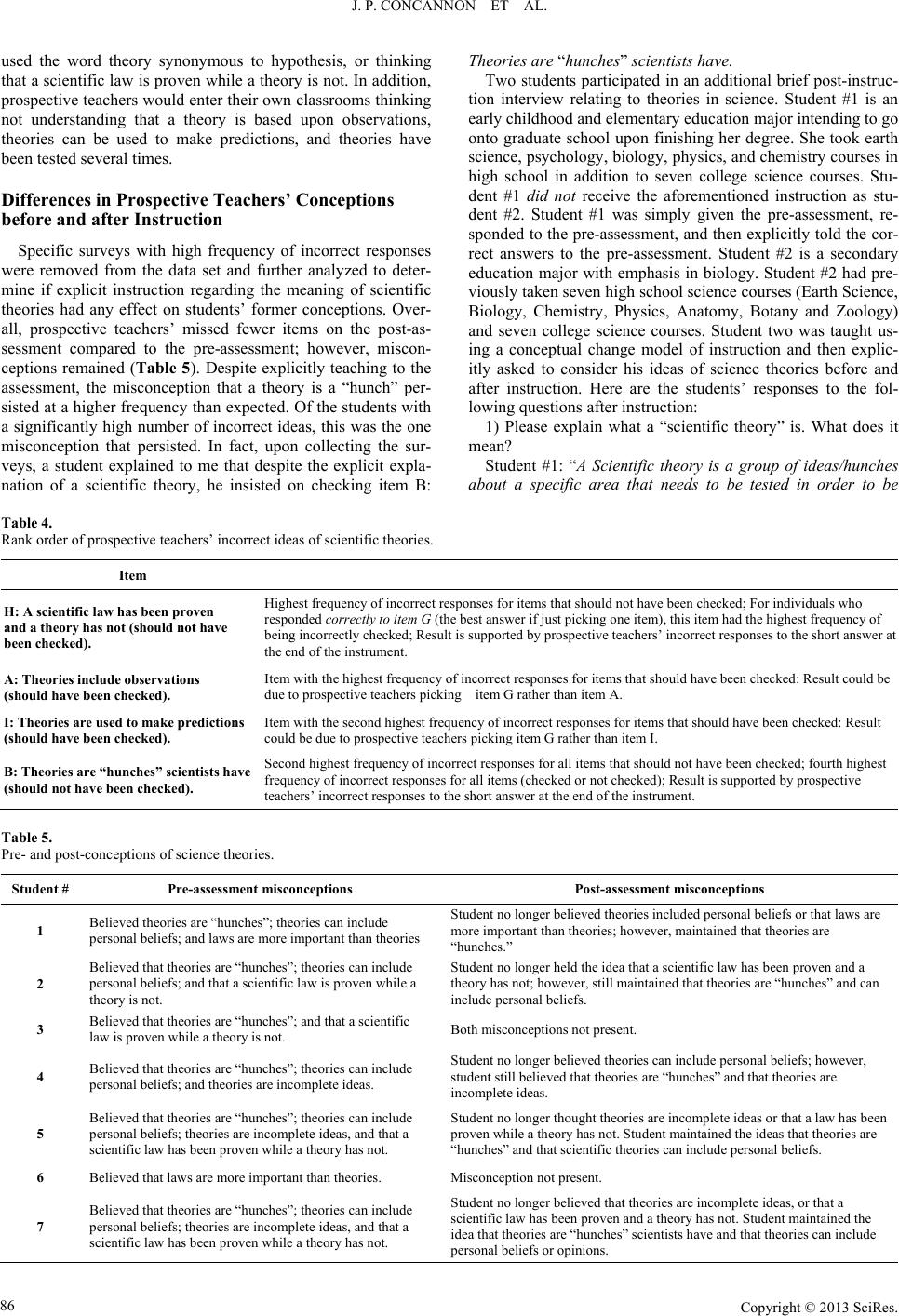 J. P. CONCANNON ET AL. used the word theory synonymous to hypothesis, or thinking that a scientific law is proven while a theory is not. In addition, prospective teachers would enter their own classrooms thinking not understanding that a theory is based upon observations, theories can be used to make predictions, and theories have been tested several t imes. Differences in Prospective Teachers’ Conceptions before and after Instruction Specific surveys with high frequency of incorrect responses were removed from the data set and further analyzed to deter- mine if explicit instruction regarding the meaning of scientific theories had any effect on students’ former conceptions. Over- all, prospective teachers’ missed fewer items on the post-as- sessment compared to the pre-assessment; however, miscon- ceptions remained (Table 5). Despite explicitly teaching to the assessment, the misconception that a theory is a “hunch” per- sisted at a higher frequency than expected. Of the students with a significantly high number of incorrect ideas, this was the one misconception that persisted. In fact, upon collecting the sur- veys, a student explained to me that despite the explicit expla- nation of a scientific theory, he insisted on checking item B: Theories are “hunches” scientists have. Two students participated in an additional brief post-instruc- tion interview relating to theories in science. Student #1 is an early childhood and elementary education major intending to go onto graduate school upon finishing her degree. She took earth science, psychology, biology, physics, and chemistry courses in high school in addition to seven college science courses. Stu- dent #1 did not receive the aforementioned instruction as stu- dent #2. Student #1 was simply given the pre-assessment, re- sponded to the pre-assessment, and then explicitly told the cor- rect answers to the pre-assessment. Student #2 is a secondary education major with emphasis in biology. Student #2 had pre- viously taken seven high school science courses (Earth Science, Biology, Chemistry, Physics, Anatomy, Botany and Zoology) and seven college science courses. Student two was taught us- ing a conceptual change model of instruction and then explic- itly asked to consider his ideas of science theories before and after instruction. Here are the students’ responses to the fol- lowing questions after instruction: 1) Please explain what a “scientific theory” is. What does it mean? Student #1: “A Scientific theory is a group of ideas/hunches about a specific area that needs to be tested in order to be Table 4. Rank order of prospective teachers’ incorrect ideas of scientific theories. Item H: A scientific law has been proven and a theory has not (should not ha ve been checked). Highest frequency of incorrect responses for i t ems that sho uld not have b een checked; For individuals wh o responded correctly to item G (the b est answer i f j ust picking one item), this item had the highest frequency of being incorrectly checked; Result is supported by prospective teachers’ incorrect responses to the short answer at the end of the instrument. A: Theories include observations (should have been checked). Item with the highest frequency of in correct responses for items th at should have been che cked: Result c ou ld be due to prospective teachers picking item G rather than item A. I: Theories are used to make predictions (should have been checked). Item with the second highest frequency of incorrect responses for items that should have been checked: Result could be due to prospective teachers picking item G rather than item I. B: Theories are “hunches” scientists have (should not have been checked). Second highest frequency of incorrect re s po nses for a l l it ems that s ho u ld not ha v e been checked; fourth highest frequency of incorrect respon s es for all items (checked or not checked); Result is supported by prospective teachers’ incorrect responses to the short answer at the end of the instrument. Table 5. Pre- and post-conceptions of science theories. Student # Pre-assessment misconceptions Post-assessment misconceptions 1 Believed th eories are “ hu n ches”; t heories can include personal beliefs; and laws are more important than theories Student no longer believed theories included personal beliefs o r that laws are more important than theories; however, maintained that theories are “hunches.” 2 Believed th at theories are “hunches”; theor i es can include personal beliefs; and that a scientific law is proven while a theory is not. Student no lon ger held the idea that a scientific law has been proven and a theory has not; however , s t i l l maintained that theories are “hunches” and can include personal beliefs. 3 Believed th at theories are “hunches”; and that a scientific law is proven while a theory is not. Both misconc eptions not pre sent. 4 Believed th at theories are “hunches”; theor i es can include personal be l iefs; and theories are i ncomplete ideas. Student no longe r believed theories can include personal beliefs; howeve r, student still believed tha t t heories are “hunches” and that theories are incomplete ideas. 5 Believed th at theories are “hunches”; theor i es can include personal beliefs; theories are incomplete ideas, and that a scientific law has been proven while a theory has not. Student no longer thought theories are incomplete ideas or that a law has been proven while a theory has not. Student maintained the ideas that theories are “hunches” and that scientific theories can include pe r sonal beliefs. 6 Believed t h at laws are more importa n t than theori es. Misconception not present. 7 Believed th at theories are “hunches”; theor i es can include personal beliefs; theories are incomplete ideas, and that a scientific law has been proven while a theory has not. Student no longer believ ed that theories are incomplete ideas, or that a scientific law has been pr oven and a theory has not. S tudent maint ained the idea that theories are “hunches” s cientists have and that theorie s can include personal beliefs or o pi nions. Copyright © 2013 SciRes. 86 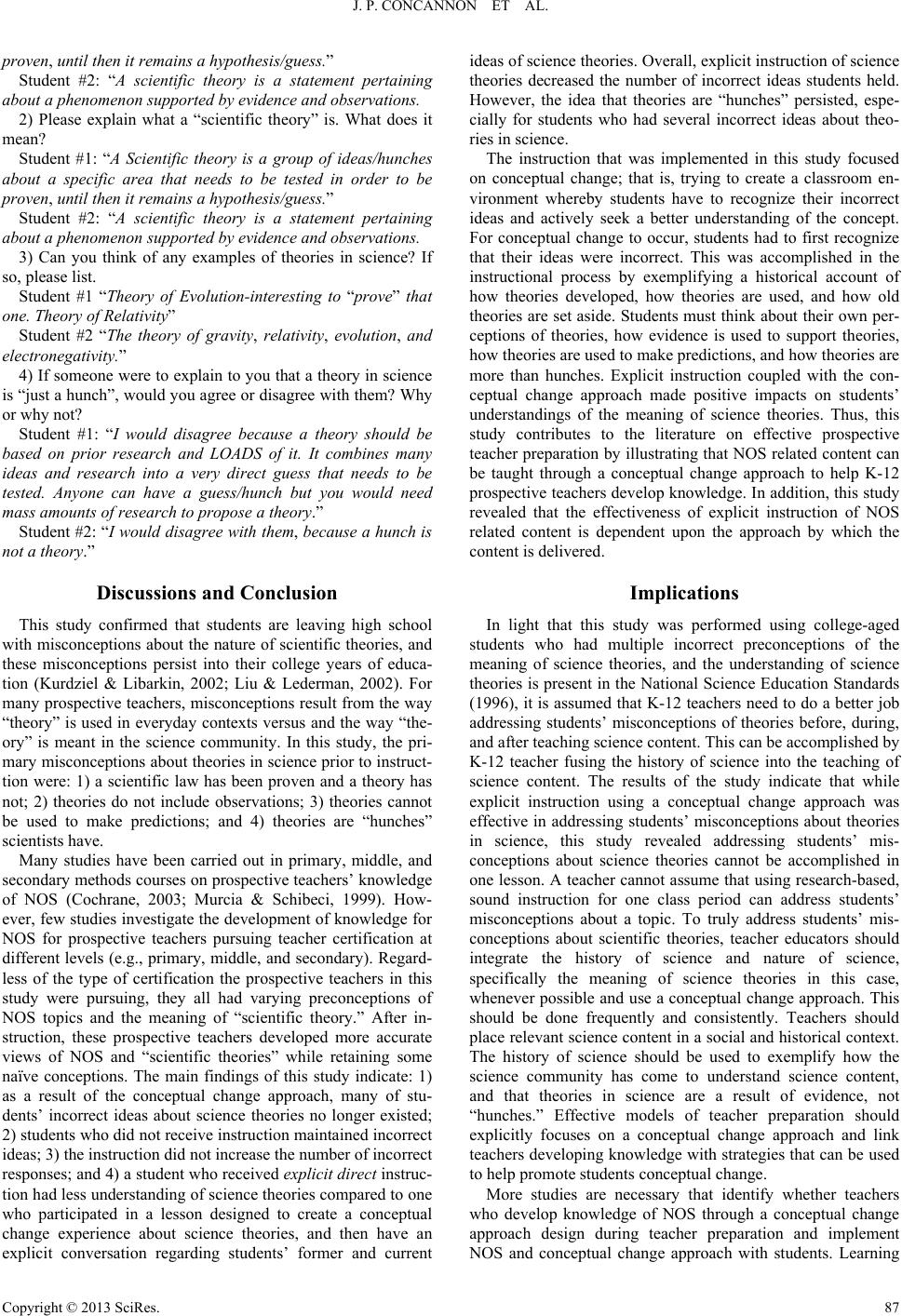 J. P. CONCANNON ET AL. proven, until then it remains a hypothesis/guess.” Student #2: “A scientific theory is a statement pertaining about a phenomenon supported by evidence and observations. 2) Please explain what a “scientific theory” is. What does it mean? Student #1: “A Scientific theory is a group of ideas/hunches about a specific area that needs to be tested in order to be proven, until then it remains a hypothesis/guess.” Student #2: “A scientific theory is a statement pertaining about a phenomenon supported by evidence and observations. 3) Can you think of any examples of theories in science? If so, please list. Student #1 “Theory of Evolution-interesting to “prove” that one. Theory of Relativity” Student #2 “The theory of gravity, relativity, evolution, and electronegativity.” 4) If someone were to explain to you that a theory in science is “just a hunch”, would you agree or disagree with them? Why or why not? Student #1: “I would disagree because a theory should be based on prior research and LOADS of it. It combines many ideas and research into a very direct guess that needs to be tested. Anyone can have a guess/hunch but you would need mass amounts of research to propose a theory.” Student #2: “I would disagree with them, because a hunch is not a theory.” Discussions and Conclusion This study confirmed that students are leaving high school with misconceptions about the nature of scientific theories, and these misconceptions persist into their college years of educa- tion (Kurdziel & Libarkin, 2002; Liu & Lederman, 2002). For many prospective teachers, misconceptions result from the way “theory” is used in everyday contexts versus and the way “the- ory” is meant in the science community. In this study, the pri- mary misconceptions about theories in science prior to instruct- tion were: 1) a scientific law has been proven and a theory has not; 2) theories do not include observations; 3) theories cannot be used to make predictions; and 4) theories are “hunches” scientists have. Many studies have been carried out in primary, middle, and secondary methods courses on prospective teachers’ knowledge of NOS (Cochrane, 2003; Murcia & Schibeci, 1999). How- ever, few studies investigate the development of knowledge for NOS for prospective teachers pursuing teacher certification at different levels (e.g., primary, middle, and secondary). Regard- less of the type of certification the prospective teachers in this study were pursuing, they all had varying preconceptions of NOS topics and the meaning of “scientific theory.” After in- struction, these prospective teachers developed more accurate views of NOS and “scientific theories” while retaining some naïve conceptions. The main findings of this study indicate: 1) as a result of the conceptual change approach, many of stu- dents’ incorrect ideas about science theories no longer existed; 2) students who did not receive instruction maintained incorrect ideas; 3) the instruction did not increase the number of incorrect responses; and 4) a student who received explicit direct instruc- tion had less understanding of science theories compared to one who participated in a lesson designed to create a conceptual change experience about science theories, and then have an explicit conversation regarding students’ former and current ideas of science theories. Overall, explicit instruction of science theories decreased the number of incorrect ideas students held. However, the idea that theories are “hunches” persisted, espe- cially for students who had several incorrect ideas about theo- ries in science. The instruction that was implemented in this study focused on conceptual change; that is, trying to create a classroom en- vironment whereby students have to recognize their incorrect ideas and actively seek a better understanding of the concept. For conceptual change to occur, students had to first recognize that their ideas were incorrect. This was accomplished in the instructional process by exemplifying a historical account of how theories developed, how theories are used, and how old theories are set aside. Students must think about their own per- ceptions of theories, how evidence is used to support theories, how theories are used to make predictions, and how theories are more than hunches. Explicit instruction coupled with the con- ceptual change approach made positive impacts on students’ understandings of the meaning of science theories. Thus, this study contributes to the literature on effective prospective teacher preparation by illustrating that NOS related content can be taught through a conceptual change approach to help K-12 prospective teachers develop knowledge. In addition, this study revealed that the effectiveness of explicit instruction of NOS related content is dependent upon the approach by which the content is delivered. Implications In light that this study was performed using college-aged students who had multiple incorrect preconceptions of the meaning of science theories, and the understanding of science theories is present in the National Science Education Standards (1996), it is assumed that K-12 teachers need to do a better job addressing students’ misconceptions of theories before, during, and after teaching science content. This can be accomplished by K-12 teacher fusing the history of science into the teaching of science content. The results of the study indicate that while explicit instruction using a conceptual change approach was effective in addressing students’ misconceptions about theories in science, this study revealed addressing students’ mis- conceptions about science theories cannot be accomplished in one lesson. A teacher cannot assume that using research-based, sound instruction for one class period can address students’ misconceptions about a topic. To truly address students’ mis- conceptions about scientific theories, teacher educators should integrate the history of science and nature of science, specifically the meaning of science theories in this case, whenever possible and use a conceptual change approach. This should be done frequently and consistently. Teachers should place relevant science content in a social and historical context. The history of science should be used to exemplify how the science community has come to understand science content, and that theories in science are a result of evidence, not “hunches.” Effective models of teacher preparation should explicitly focuses on a conceptual change approach and link teachers developing knowledge with strategies that can be used to help promote students conceptual change. More studies are necessary that identify whether teachers who develop knowledge of NOS through a conceptual change approach design during teacher preparation and implement NOS and conceptual change approach with students. Learning Copyright © 2013 SciRes. 87  J. P. CONCANNON ET AL. from experience can be a valuable for prospective teachers and create drastic changes in their practice (Russell & Martin, 2007). Thus, longitudinal studies are needed to better understand the gap between theory and practice. In this regard, studies are needed that and bridge what we know how prospective teachers learn to become effective beginning teachers both in terms of NOS and using a conceptual change approach. Such studies would lend valuable insight into the factors that facilitate and constrain teacher’s ability to use a conceptual change approach and teach NOS with students. In conclusion, research on knowledge development of NOS during teacher education courses has the potential to redesign how prospective teachers are prepared when pursuing different certifications. Like students leaving high school with miscon- ceptions about scientific theories and laws, prospective teachers have similar inaccurate ideas. These misconceptions result from the way “theory” is used in an everyday context versus and the way “theory” is meant in the science community. To develop more accurate views of NOS, a conceptual change approach can help prospective teachers become dissatisfied with their misconceptions and accept more accurate views. If teachers develop a deeper understanding of both scientific knowledge and the pedagogical effectiveness of a conceptual change ap- proach, profound differences might occur in K-12 students understanding of scientific and theories and NOS. REFERENCES Abd-El-Khalick, F., Bell, R. L., & Lederman, N. G. (1998). The nature of science and instructional practice: Making the unnatural natural. Science Education, 82, 417-436. doi:10.1002/(SICI)1098-237X(199807)82:4<417::AID-SCE1>3.0.C O;2-E Abd-El-Khalick, F., & Akerson, V. L. (2004). Learning as conceptual change: Factors mediating the development of preservice elementary teachers’ views of nature of science. Science Education, 88, 785-810. doi:10.1002/sce.10143 Abd-el-Khalik, F., Bell, R. L., & Schwarz, R. S. (2002). Views of na- ture of science questionnaire: Toward valid and meaningful assess- ment of learners’ conceptions of nature of science. Journal of Re- search in Science Teaching, 39, 497-521. doi:10.1002/tea.10034 Akerson, V. L., Abd-El-Khalick, F., & Lederman, N. G. (2000). Influ- ence of a reflective explicit activity-based approach on elementary teachers’ conceptions of nature of science. Journal of Research in Science Teaching, 37, 295-317. doi:10.1002/(SICI)1098-2736(200004)37:4<295::AID-TEA2>3.0.C O;2-2 Brophy, J., & Good, T. (1986). Teacher behavior and student achieve- ment. In M. C. Wittrock (Ed.), Handbook of research on teaching (3rd ed.). New York: McMillan. Bybee, R. W., Powell, J. C., & Trowbridge, L. W. (2008). Teaching secondary school science (9th ed.). Columbus, OH: Pearson Prentice Hall. Center for Science, Mathematics, and Engineering Education (CSMEE). (1997). Science teaching reconsidered: A handbook. Washington DC: National Academies Press. Clement, J., Brown, D. E., & Zietsman, A. (1989). Not all preconcep- tions are misconceptions: finding “anchoring” conceptions’ for grounding instruction on students’ intuitions. International Journal of Science Education, 11, 554-565. doi:10.1080/0950069890110507 Cochrane, B. (2003). Developing pre-service elementary teachers’ views of the nature of science (NOS): Examining the effectiveness of intervention types. Annual Meeting of the Association for the Educa- tion of Teachers of Science, St. Louis, MO: The Association for the Education of Teachers of Science. Driver, R., Leach, J., Millar, R., & Scott, P. (1996). Young people’s images of science. Philadelphia, PA: Open University Press. Driver, R., Squires, A., Rushworth, P., & Wood-Robinson, V. (1994). Making sense of secondary science: Research into children’s ideas. New York: Routledge Falmer. Eaton, J. F., Anderson, C. W., & Smith, E. L. (1983). When students don’t know they don’t know . Science and Children, 20, 7-9. Gess-Newsome, J. (2002). The use and impact of explicit instruction about the nature of science and science inquiry in and elementary science methods course. Science & Education, 11, 55-67. doi:10.1023/A:1013054823482 Keeley, P., Eberle, F., & Dorsey, C. (2008). Uncovering student ideas in science, volume 3: Another 25 formative assessment probes. Ar- lington, VA: National Science Teachers Association. Koenig, K., (Directo r), Koehler, D. (Produ cer), & Ingrao, A. (Assistant Producer) (2009). 400 years of the telescope: A journey of science, technology, and thought [television broadcast]. Red Lion, PA: Inter- stellar Studios Production, Public Broadcasting Service. Kurdziel, J., & Libarkin, J. (2002). Research methodologies in science education: Students’ ideas about the nature of science. Journal of Geoscience Education, 50, 322-329. Lederman, N. G. (1999). Teachers’ understanding of the nature of science and classroom practice: Factors that facilitate or impede the relationship. Jour nal of Research in Science Teaching, 36, 916-929. Lemberger, J., Hewson, P. W., & Park, H. (1999). Relationship between prospective secondary teachers’ classroom practice and their conceptions of biology and of teaching science. Science Education, 83, 347-371. doi:10.1002/(SICI)1098-237X(199905)83:3<347::AID-SCE5>3.0.C O;2-Y Liu, S., & Lederman, N. G. (2002). Taiwanese gifted students’ views of nature of science. School Science and Mathematics, 102, 114-123. doi:10.1111/j.1949-8594.2002.tb17905.x McComas, W. F., Cox-Petersen, A., & Narguizian, P. (2001). The impact of experiential science learning on participants’ understand- ing of the nature of science. The Meeting of the National Association for Research in Science Teaching, St. Louis, MO: Nati onal Associa- tion for Research in Science Teaching Murcia, K., & Schibeci, R. (1999). Primary student teachers’ concep- tions of the nature of science. International Journal of Science Edu- cation, 21, 1123-1140. doi:10.1080/095006999290101 National Research Council (NRC) (1996). National Science Education Standards. Wa shington DC: National Academies Press. Nussbaum, J., & Novick, S. (1981). Brainstorming in the classroom to invent a model: A case study. School Science Review, 62, 771-778. Osborne, R., Gilbert, J. K. (1980). A method for investigating concept understanding in science. European Journal of Science Education, 2, 311-321. doi:10.1080/0140528800020311 Posner, G. J., Strike, K. A., Hewson, P. W., & Gertzog, W. A. (1982). Accommodation of a scientific conception: Toward a theory of con- ceptual change. Science Education, 66, 211-227. doi:10.1002/sce.3730660207 Russell, T., & Martin, A. K. (2007). Learning to teach science. In S. Abell & N. Lederman (Eds.), Handbook of research on science education (pp. 1151-1178). Mahwah, NJ: Lawrence Erlbaum Associates. Scharmann, L. C., & Smith, M. U. (2001). Further thoughts on defining versus describing the nature of science: A response to Niaz. Science Education, 85, 691- 693. doi:10.1002/sce.1033 Smith, M. U., & Scharmann, L. C. (1999). Defining versus describing the nature of science: A pragmatic analysis for classroom teachers and science educators. Science Education, 8 3 , 493-509. doi:10.1002/(SICI)1098-237X(199907)83:4<493::AID-SCE6>3.0.C O;2-U Copyright © 2013 SciRes. 88 |