

Paper Menu >>
Journal Menu >>
 Open Journal of Political Science 2013. Vol.3, No.1, 53-58 Published Online January 2013 in SciRes (http://www.scirp.org/journal/ojps) http://dx.doi.org/10.4236/ojps.2013.31008 Copyright © 2013 SciRes. 53 New Silk Routes: Pipe Lines and Terminal Markets Ayhan Orhan Department of Economics, Faculty of Economics and Administrative Sciences, University of Kocaeli, Kocaeli, Türkiye Email: [email protected], [email protected] Received November 12th, 2012; revised December 14th, 2012; accepted December 23rd, 2012 Energy will be the main determinant of the economic and political relations between the regions and na- tions during the years to come. The need for energy and the consumption of energy related to this need continues increasingly. The fossil fuels which meet the energy of many of the growing economies in the world, especially China being in the first place will continue to be the main energy source until the year 2050. In today’s world, countries are classified as those which have rich reserves of natural resources and which obtain most of their revenues by selling these natural resources, those which have large amounts of consumption of natural resources and which import natural resources in spite of their own natural re- sources and as those which are dependant on outside resources but are on the route of transmission of natural resources because of their geopolitical positions. Turkey’s place is in the third group. Turkey is the leading country among the countries which are situated on the route of the transmission of the natural resources. Turkey is in a geographical region where its neighbors have rich natural resources, and this geographical region has approximately 70% of the fossil fuels which comprise a great deal of the energy needs in the whole world. Therefore, Turkey is at the center of the transmission corridor of the natural re- sources between the north and the south, and between the west and the east. The United States of America installed itself and settled down in the region at the beginning of the 90’s because of the first Gulf War, and the United States has taken steps and some measures in order to support the establishment of new pipeline corridors for the transmission of natural resources. In the background of this support lies the thought and idea that by virtues of these pipelines the natural resources that exist in the Central Asian countries should be transmitted to the western world countries and to the international markets without any need for dependence on Russia. Another idea behind this is to put an end to the dominance of Russia over these countries. Keywords: Pipe Lines; Transmission of Natural Gas; Terminal Markets; Silk Route Introduction The continuously growing and globalizing world is to come face to face with a very important issue during the years to come. The issue which is accepted as being the energy supply security and sharing the natural resources will make both coun- tries and multinational corporations encounter come across each other and it will cause the competition reach utmost levels. The fact that the fossil origin natural gas and petroleum re- serves in the growing and developing economies of the world which meet a great portion of the energy needs of the world are showing a decreasing trend caused the countries to look for alternative energy resources. As is well known, the demand for energy will increase more and more in the developing and growing economies of the world in the years to come. On the other hand, however, the alternative energy resources usage cannot keep up with the technological developments and are not at a level to meet the sustainable energy needs. Therefore, the generation and production of natural gas and petroleum still maintain their importance. As is proved and well known in the whole world, approxi- mately 70% of the world’s natural gas and petroleum reserves are in the regions of the Middle east and Central Asia, where Turkey is also located (SAE, 2007: p. 2). This closeness to the sources of natural gas and petroleum reserves increases the im- portance of Turkey more and more from the geopolitical point of view. In the region, Turkey is on the main route of these energy resources which In order that the reserves of the natural resources in the region which are the subjects of the petroleum and natural gas trade can be transmitted from their sources to the consuming countries safely and economically, they have to be transmitted through Turkey, which is on the main route. This situation of Turkey is of utmost importance in that the country has no other alternative in this respect, as a result of which Turkey has become an important terminal on the route. This situation is a new development as a result of which Turkey may assume a new role because Russia and the United States try to have dominance over the countries which have these resources and on the countries which demand making use of such re- sources. This may create a new cold war period between these two super powers. This role imposed on Turkey involves a process whereby the rich natural resources of petroleum and natural gas in the cen- tral Asian countries can be transmitted to the international markets in addition to the pipe lines in Russia by virtue of al- ternative pipelines. In this respect, Turkey will not only con- tribute to its own economic development, but it will also con- tribute to the economic development of those countries in cen- tral Asia by helping them sell their natural resources to the in- ternational markets in the countries in the western world. The first priority of Turkey is to have its own energy supply safety. 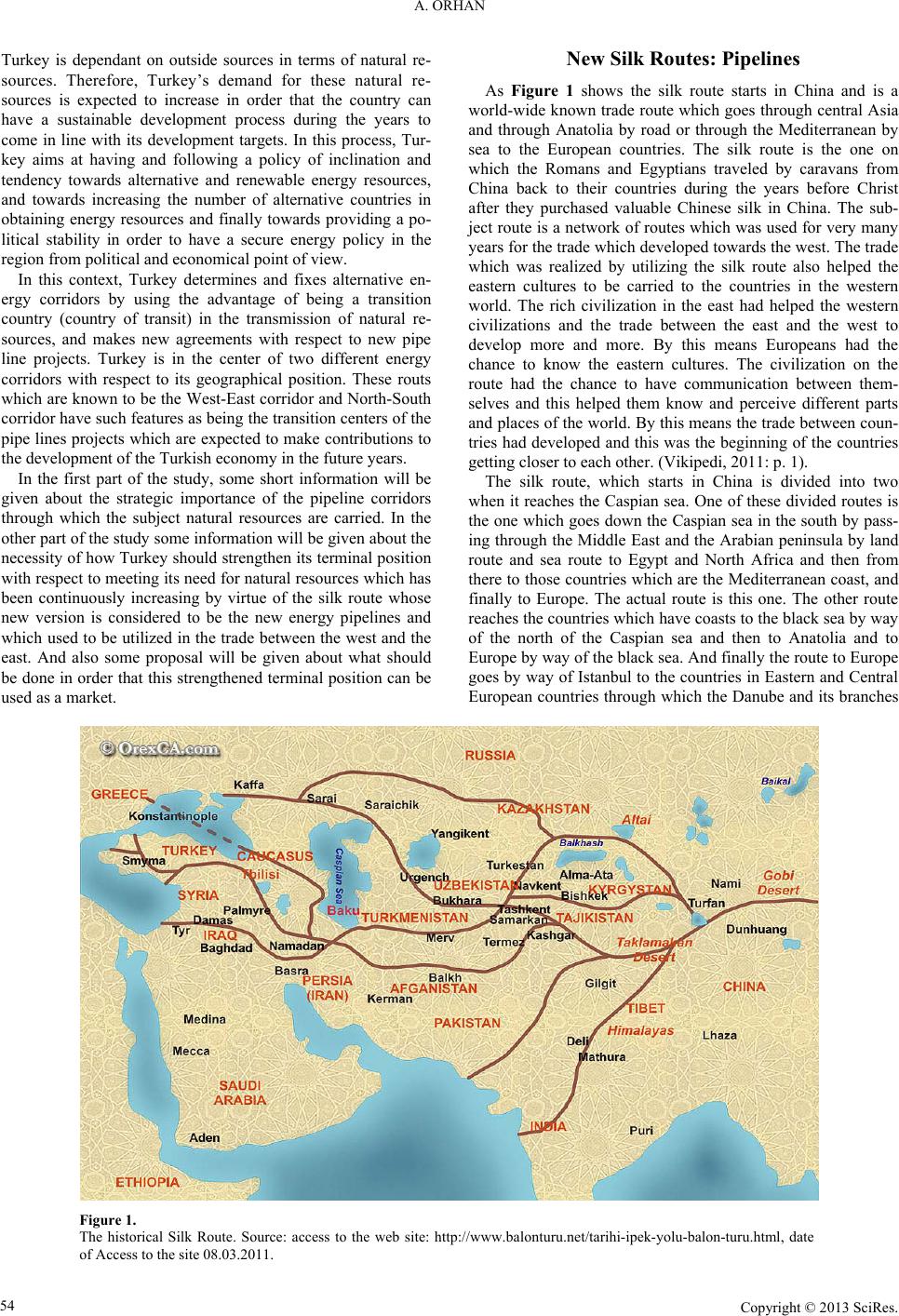 A. ORHAN Turkey is dependant on outside sources in terms of natural re- sources. Therefore, Turkey’s demand for these natural re- sources is expected to increase in order that the country can have a sustainable development process during the years to come in line with its development targets. In this process, Tur- key aims at having and following a policy of inclination and tendency towards alternative and renewable energy resources, and towards increasing the number of alternative countries in obtaining energy resources and finally towards providing a po- litical stability in order to have a secure energy policy in the region from political and economical point of view. In this context, Turkey determines and fixes alternative en- ergy corridors by using the advantage of being a transition country (country of transit) in the transmission of natural re- sources, and makes new agreements with respect to new pipe line projects. Turkey is in the center of two different energy corridors with respect to its geographical position. These routs which are known to be the West-East corridor and North-South corridor have such features as being the transition centers of the pipe lines projects which are expected to make contributions to the development of the Turkish economy in the future years. In the first part of the study, some short information will be given about the strategic importance of the pipeline corridors through which the subject natural resources are carried. In the other part of the study some information will be given about the necessity of how Turkey should strengthen its terminal position with respect to meeting its need for natural resources which has been continuously increasing by virtue of the silk route whose new version is considered to be the new energy pipelines and which used to be utilized in the trade between the west and the east. And also some proposal will be given about what should be done in order that this strengthened terminal position can be used as a market. New Silk Routes: Pipelines As Figure 1 shows the silk route starts in China and is a world-wide known trade route which goes through central Asia and through Anatolia by road or through the Mediterranean by sea to the European countries. The silk route is the one on which the Romans and Egyptians traveled by caravans from China back to their countries during the years before Christ after they purchased valuable Chinese silk in China. The sub- ject route is a network of routes which was used for very many years for the trade which developed towards the west. The trade which was realized by utilizing the silk route also helped the eastern cultures to be carried to the countries in the western world. The rich civilization in the east had helped the western civilizations and the trade between the east and the west to develop more and more. By this means Europeans had the chance to know the eastern cultures. The civilization on the route had the chance to have communication between them- selves and this helped them know and perceive different parts and places of the world. By this means the trade between coun- tries had developed and this was the beginning of the countries getting closer to each other. (Vikipedi, 2011: p. 1). The silk route, which starts in China is divided into two when it reaches the Caspian sea. One of these divided routes is the one which goes down the Caspian sea in the south by pass- ing through the Middle East and the Arabian peninsula by land route and sea route to Egypt and North Africa and then from there to those countries which are the Mediterranean coast, and finally to Europe. The actual route is this one. The other route reaches the countries which have coasts to the black sea by way of the north of the Caspian sea and then to Anatolia and to Europe by way of the black sea. And finally the route to Europe goes by way of Istanbul to the countries in Eastern and Central European countries through which the Danube and its branches Figure 1. The historical Silk Route. Source: access to the web site: http://www.balonturu.net/tarihi-ipek-yolu-balon-turu.html, date of Access to the site 08.03.2011. Copyright © 2013 SciRes. 54  A. ORHAN pass, and through the rivers of Volga and Don and Dinieper it reaches the Baltic sea and the Northern European countries (Scandinavian countries) and to the United Kingdom. Because of the climate conditions this route became the one which was used later on. (Vikipedi, 2011: p. 1). The regions which are on the inbound and outbound silk route include countries which come into prominence in the na- tural resource trade today. The need and demand for energy which is indispensible and irreplaceable for the development of countries in today’s world is continuing everyday in an increa- sing pace. Various methods have been used from the days in the past up to today for the transportation and transmission of the natural resources between the countries which demand the na- tural resources and the countries which supplied these natural resources. For many decades the transportation of natural re- sources by sea which contributed alt to the welfare of countries is carried out by means of pipeline transmission in today’s world. The pipeline transmission and transportation which is disadvantageous in comparison to other methods of transporta- tion due to the fact that pipeline transmission has high invest- ment costs can absorb these high investment costs in a short time by virtue of the fact that it is speedy, economical, and secure. The process of transmission and transportation by pipe- lines which started with short distances at the beginning of the previous century in certain regions is now carried out with lar- ger size pipelines and with higher flow rates at long distances thanks to the continuously developing technology and due to the increasing consumption. Pipeline transmission and transportation is a method which is rather used for the transportation and transmission of petroleum and natural gas, which are defined to be fossil fuels. The re- gions of the Middle East and Central Asia which have appro- ximately 70% of the reserves in the whole world meet 30% of the petroleum production in the world. One of the most impor- tant pipelines which are used for transportation and transmis- sion of these reserves to other countries is the one which ex- tends to the Persion Gulf from Saudi Arabia, which the big- gest petroleum producer in the Middle East. And by this means their petroleum reaches the ports from which it is transported to the various parts of the world. On the other hand, the petroleum reserves in Kirkuk and Mosul are transmitted to the ports on the Mediterranean by way of such countries as Israel, Lebanon, and Turkey. The reserves belonging to Iran are transmitted to both Tahran and to the Persion Gulf in the south by means of two pipelines. Russia, where the most important petroleum reserves in the central Asian region lie carry these reserves in the region of Volga-Ural to the north by means of four different pipelines and then to Europe by way of Lithuania and Poland. The re- serves in the Caspian region and sea belong to Azerbaijan. The subject reserves are transmitted by means of two different pipe- lines. One of these reaches the Black Sea by way of Tbilisi, and the other pipeline reaches the port in the north of the Black Sea. (DPT, 2001: pp. 2-4). The natural gas reserves which have become a substituting natural resource for petroleum as a result of the continuously increasing need for energy during the recent decades takes its place in the world trade by means of safe and speedy transmis- sion through pipelines. Russia is one of the countries which has one of the most important reserves in the world. And the coun- try markets its natural gas reserves by means of transmission to the European countries through four different pipelines. The second biggest reserve that meets the natural gas need of the European countries is in the North African countries of Algeria and Morocco. These natural gas reserves are marketed and transmitted to the European countries by means of pipelines which pass from under the Mediterranean. The third biggest supplier of natural gas for the European countries is Norway. And Germany is the biggest importer of the natural gas of this country. Norway markets natural gas to the European countries by making use of six different pipelines. Iran, which is one of the most important natural gas suppliers in the Middle East transmits its natural gas to the Caspian region through two dif- ferent pipelines (DPT, 2001: pp. 2-4). Turkey has an important position in terms of geopolitical importance. And our country is in the center of the region which is the most important in terms of petroleum and natural gas reserves. Turkey is in the middle of an area which is sur- rounded by the supplier countries of natural resources such as central Asia in the North, by Iran in the east, by the Middle East countries in the south, as well as by the European countries in the west which are the biggest demanders of such natural re- sources. In other words, Turkey is in the center of the passing route between the supplying countries of petroleum and natural gas in the Middle East and the demanding countries in Europe for such natural resources. Turkey, Center of Natural Resource Transportation and Transmission In the 21st century, in addition to the production of natural resources, the transmission and transportation of such resources to those industrialized countries which carry out production with the support of high technologies have importance. With the regions which are accepted as “Strategic Terminal Centers”, the passing route of the natural resource transmission is defined. The passing routes are made up of either certain warehousing and maintaining places or intercontinental geopolitical passing points. The point that these passing routes should have such qualities as being controllable and auditable by the countries trading in the natural resources and by the multinational corpo- rations is an important criteria, because the negative effects of the political and economic instability that may arise in the countries which are on the passing route of these natural re- sources directly influence the international markets. The prices which are influenced by these instabilities that may take place cause increasing costs, stagnation, unemployment, and foreign trade deficits. (Gökırmak, 1996: pp. 154-155). Turkey is a country which has the potentiality of becoming a “Strategic Terminal Center” because the country is on the route between the countries in the Central Asian region and the Mid- dle East where there are rich natural resources produced by the countries in the aforementioned regions and the countries in the European region where there are industrialized nations which have big demand for these natural resources. Generating poli- cies for providing security for the supply and trading of petro- leum and natural gas which are the main products among the fossil fuels and applying such policies are very important for Turkey in the medium run and in the long run. In this context, it is necessary to urgently prepare and actualize projects for the purposes of transmission and transportation of natural resources. In order that the security for the supply and transmission of natural resources can be provided some such criteria as geo- graphical location, political stability, high consumption, guar- Copyright © 2013 SciRes. 55  A. ORHAN anteeing operations come into prominence. And on the other hand, warehousing (maintaining) of the natural resources that are produced, processing them and their transmission become important. Turkey has the potentiality of becoming one of the centers of attraction from the point of view of its suitability for the aforementioned criteria. (Çelepçi, 2000: p. 98). Turkey has been keeping its position as being a country which is the “transit pass country” of the region in the trans- mission and transportation of natural resources. And now our country has come to position where it can provide the safety and control of the north-east and east-west corridors by virtue of the international investments and the agreements that it has made with various countries. With the start of the process of establishing the pipeline between Baku and Ceyhan in the year 1996, the countries in the central Asian region aimed at export- ing their natural resources to international markets without being economically dependant on Russia. The process which started with this investment from the political point of view has become the most important move which would weaken the dominant power of Russia on these central Asian countries. Turkey as a Terminal Market The fundamental target of Turkey in the natural resources trade is to evaluate its own limited resources and the resources that it obtained from external sources in a manner in which it will take into consideration environmental conditions and make use of them at an optimum level. The effective and safe use of natural resources make positive contributions to economical and social development. Turkey is a country which makes con- tributions to the independence of the central Asian countries in that it helps these central Asian countries export their natural resources safely to the export markets. This position has brought Turkey to a point where it has both gained power and strength to bargain and it has made it a key country in the trade of natural resources. In today’s world Turkey’s importance has increased after the increasing demand for natural resources and the determination of speedy and reliable routes as a result of this and making investment agreement at high rates and values. Turkey has a bidirectional advantage in the transportation and transmission of natural resources. In the economical mean- ing the country has a position whereby it can help the transpor- tation of natural resources in the central Asian countries and in the Middle East in the east-west corridor to European countries which have a demand for these natural resources at a value of three hundred billion American dollars. The country also con- tributes to the natural gas trade of Russia in the north-south corridor. Also in terms of politics Turkey is an ideal country in order to exceed the Ukraine walnut that the western countries hold in their hands by virtue of the use of the north-south cor- ridor in addition to making contributions to the natural resource trade of the central Asian countries by use of the east-west cor- ridor without being dependent on Russia. The East-West corridor has an importance in that it has the goal of becoming an alternative supply center for the Caspian and Central Asian regions to the other natural resource supply sources for Europe namely Russia, Norway, and North Africa. The East-West corridor is called BTC (Aktau-Baku-Tbilisi- Ceyhan) by use of which the petroleum of Kazakhstan and Azerbaijan are transmitted to the Mediterranean region. For the natural gas of Azerbaijan the following pipelines are formed within the scope of the Shah sea project: Baku-Tiflis-Erzurum, Caspian-Turkey-Europe, Baku-Tbilisi-Erzurum-Greece-İtaly, and also the following line is formed within nthe framework of the Nabucco Project: Baku-Tbilisi-Bulgara-Romania-Hungary-Aus- tria-Germany (Narin, 2006: p. 164). The North-South corridor is established for the purposes of putting new supply centers into operation in order to meet the additional natural gas need of Europe in addition to meeting the increasing need of Turkey for natural resources. The North- South corridor is made up of Kirkuk-Yumurtalık for petroleum, and Russia-Ukraine-Romania-Bulgaria for natural gas; With the Blue Stream project the line is made up of Russia-Turkey for natural gas, Iran-Turkey-Germany for natural gas, Iraq-Syria- Egypt-Turkey-Europe for natural gas, Qatar-Turkey-Europe for natyral gas, and Turkmenistan-Turkey-Germany for natural gas (Narin, 2006: p. 164). As a result of the agreements that have been made with Rus- sia in the near past the North-South corridor has become a stra- tegic terminal just like the East-West corridor. Three different pipeline projects have reached the stage of construction which have made the North-South corridor important. These pipelines are made up of Samsun-Ceyhan petroleum pipeline, and Blue Stream natural gas pipeline. In Table 1 you can find the list of the active pipelines in Turkey, pipelines the agreements and constructions of which have been made and started, and those pipelines which are planned to be made during the years to come (Yılmaz, 2005: pp. 6-7). Industrialized countries holding aproximately one-third of the whole world population consume a portion close to 80% of the existing natural resources. The increase in production based intensively on industry constitutes a base for growth rates re- cently achieved by developed and developing economies. De- mand increase in relation with natural resources required to meet the needs for raw materials supporting intensive produc- tion and realize output, is the most important factor of eco- nomic growth (Saatçioğlu & Küçükaksoy, 2004: pp. 33-34). In other words, economic growth and increase in product are di- rectly proportional to demand for natural resources. When viewed from this aspect, demand for energy which is a substan- tial input for economic and social growth, and thereby natural resources occupy a major portion in the imports of developed and developing countries. In today’s world, where demand for energy is increased and effective utilization becomes a concern, transportation routes for natural resources and transportation practices which are the fundamental elements that shape trades between the countries having natural resources which are one of the primary inputs for energy and those demanding for the said resources, come into prominence. While marine transportation is predominantly preferred in the past, increasing demand started integrating centers where supply and demand are concentrated with alter- native routes and pipelines as a new transportation practice. When maps in regarding pipeline transportation are examined, you can see that network between supply and demand centers became global. Routes conveying natural resources of Central Asian and Middle East countries constitute the major part of the said routes. Aforementioned pipelines emphasize the impor- tance of Turkey which has a position that has been connecting main trade centers for centuries. Silk road which was one of world’s main trade routes in the first place became recently a new international route for pipelines employed in natural re- sources transportation. Turkey is the most important country of transit in order for such natural resources which are abundant Copyright © 2013 SciRes. 56  A. ORHAN Copyright © 2013 SciRes. 57 Table 1. The pipelines and their projects in Turkey which are present, which have come to the phase of construction and in which Turkey is interested. Present pipelines Pipelines at the stage of being constructed Pipelines which are planned for construction The pipelines that Turkey is interested in Iraq-Turkey crude oil pipeline Batman-Dörtyol crude oil pipe line Ceyhan-Kırıkkale crude oil pipe line Russia-Turkey natural gas pipe line Eastern Anatolia natural gas transmission line Şelmo-Batman crude oil pipeline Karacabey (Bursa)-İzmir M natural gas transmission line Çan-Çanakkale natural gas transmission line Russia-Turkey natural gas pipeline (Blue stream) Baku-Tbilisi-Ceyhan crude oil pipeline South stream natual gas pipeline project Konya-İzmir natual gas pipeline Turkey-Bulgaria-Romania-Hungary natyral bas pipeline (NABUCCO Project) Turkmenistan-Turkey-Europe natural gas pipeline Iraq-Turkey natural gas pipeline project Egypt-Turkey natural gas pipeline project Georgia-Turkey natural gas pipeline Azerbaijan-Turkey (Şhah Sea) natural gas pipeline project Trans-Trakia petroleum pipeline project Eastern black natural gas pipeline project Black Sea-Ereğli-Bartın natural gas pipeline project Turkey-Greece natural gas pipeline project Dolphin natural gas pipeline recently in Central Asia and Middle East as crude oil and natu- ral gas that are substantial inputs for energy, to be transferred to the world markets. In this sense, as we can see from Figure 2, Turkey being in a position of a transition country is one of the leading country among those nominated for trade center of natural resources in the future. Project planning and commissioning new transporta- tion lines with regard to range of resources of crude oil, natural gas and their derivative products, supply reliability and consis- tency, reached the level that impacts policy implementations of Turkey in the future. Turkey with its existing state reached the position of important market in the trade of natural resource reserves covering a large region. Crude oil and natural gas conveyed by means of pipelines through the borders of Turkey are capable of meeting demands for natural resources with agreements entered into. Overall Assessment and Conclusion Turkey has lately had a great impact on world politics as be- ing one of those leading countries in the region. Positive per- ception of trades established with countries in the region, and also effects of historical and cultural connections coming from the past with Central Asian countries have placed Turkey in a dominant position in the region. Position of being a transition country regarding natural resources trade expressed in the study, highlights such characteristics of Turkey that it connects supply and demand centers in respect of natural resources trade with each other and that it is a concentration and distribution center for distinctive transportation practices. Turkey reached such a position that it can ensure crude oil import through pipelines from the stand point of its connections regarding crude oil and natural gas transportations. In other words, transportation of oil and natural gas with pipelines is a potential trade opportunity from which Turkey can benefit interests in terms of economy. In order for Turkey to meet its demand for natural resources under these prevailing circumstances, it has to specify its poli- cies and implementation procedures regarding future by con- sidering national energy policies of supply and demand centers of natural resources. Turkey, as being in a position with no significant production of natural resources, should make use of the advantage of its transit position where major natural re- sources of the world are located. Aforementioned pipeline pro- jects have features to support this very important position of Turkey. Turkey which its characteristic to be the most impor- tant natural resources market increases by leaps and bounds, will also reach the position to meet demands for natural re- sources. Moreover, Nabucco project solely requires approximately an investment amount of 5 billion USD and part of its construction located in Turkey will provide thousands of people with job and help contribute to national employment. Contractor com- panies involved in ongoing pipeline constructions provide sig- nificant contributions to national services sector. Since Baku- Tbilisi-Ceyhan pipeline brings in money annually equal to 300 million USD, pipelines planned to be constructed will likely make significant contributions to national product when they are actualized. Also, being integrated with Europe which are the biggest demand center for Central Asian and Middle East natural re- sources by way of pipelines passing through its borders and connected to natural resource market, Turkey will obtain an ad- vantage during negotiation process. In the future, pipelines will be the most reliable transporta- tion means in order to transmit natural resources which are in- dispensable elements of production and development, from sup- ply centers to demand centers. By means of international pipe- lines, Turkey can: ensure and secure crude oil imports, generate income via pipeline transportation, and minimize increasing traffic in Bosporus due to international treaties and environmental hazards. Turkey has a “transit country” position due to pipelines passing through its borders. Turkey will turn out to be a “Ter- minal Market” in the future with refineries and storage areas that will be built in the regions known as international trans- portation centers. In the course of ongoing processes, logistics centers supporting terminal market must be planned and put into operation, policy implementations dedicated to the feature of being an international trade, main line and control center must be immediately carried out by establishing world crude oil and natural gas stock market. Turkey may somewhat maintain a monopoly of being an international center of natural resources data network by establishing a data center having information network in a control center that will be built and providing storage for all data with regard to pipelines. 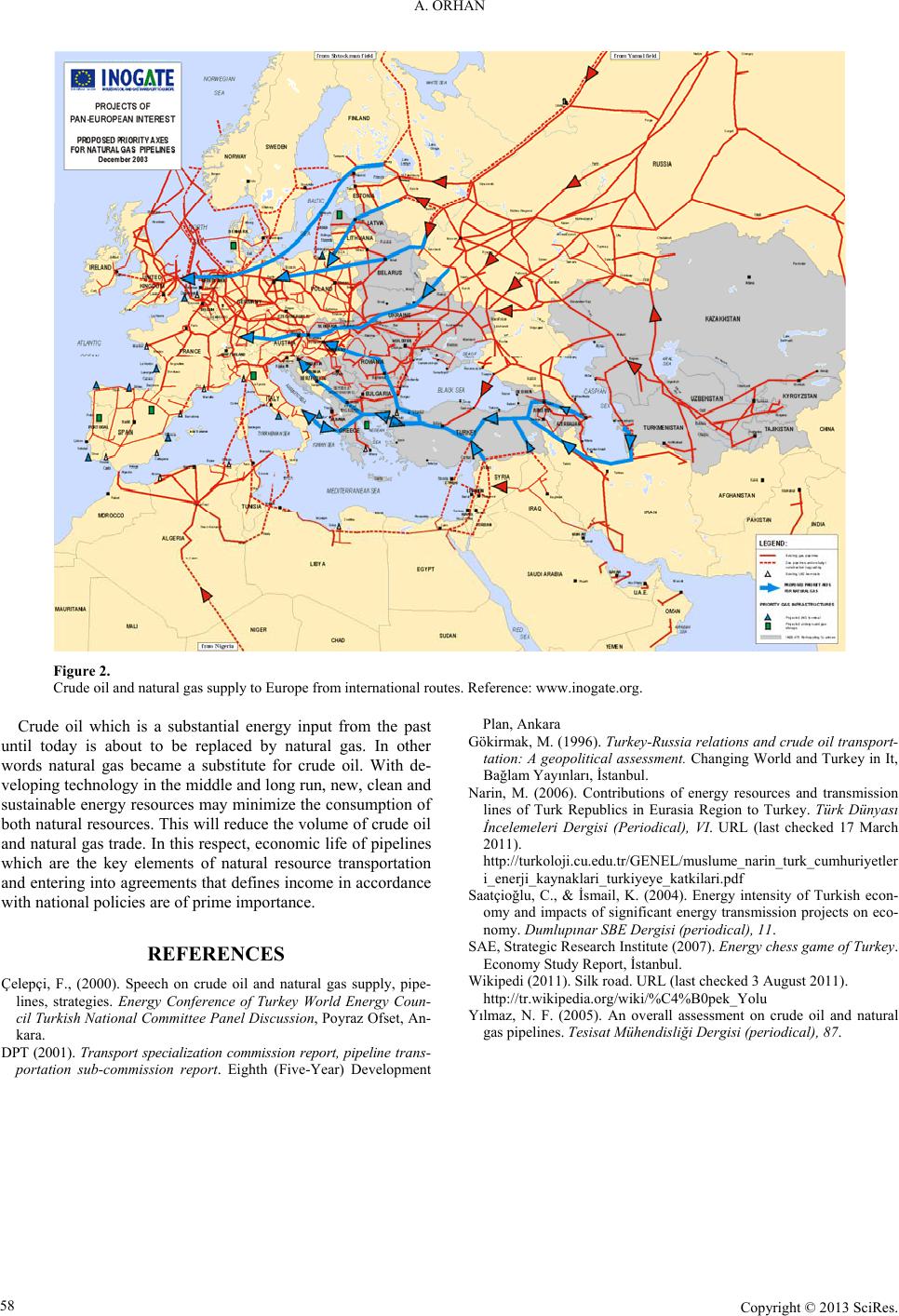 A. ORHAN Figure 2. Crude oil and natural gas supply to Europe from international routes. Reference: www.inogate.org. Crude oil which is a substantial energy input from the past until today is about to be replaced by natural gas. In other words natural gas became a substitute for crude oil. With de- veloping technology in the middle and long run, new, clean and sustainable energy resources may minimize the consumption of both natural resources. This will reduce the volume of crude oil and natural gas trade. In this respect, economic life of pipelines which are the key elements of natural resource transportation and entering into agreements that defines income in accordance with national policies are of prime importance. REFERENCES Çelepçi, F., (2000). Speech on crude oil and natural gas supply, pipe- lines, strategies. Energy Conference of Turkey World Energy Coun- cil Turkish National Committee Panel Discussion, Poyraz Ofset, An- kara. DPT (2001). Transport specialization commission report, pipeline trans- portation sub-commission report. Eighth (Five-Year) Development Plan, Ankara Gökirmak, M. (1996). Turkey-Russia relations and crude oil transport- tation: A geopolitical assessment. Changing World and Turkey in It, Bağlam Yayınları, İstanbul. Narin, M. (2006). Contributions of energy resources and transmission lines of Turk Republics in Eurasia Region to Turkey. Türk Dünyası İncelemeleri Dergisi (Periodical), VI. URL (last checked 17 March 2011). http://turkoloji.cu.edu.tr/GENEL/muslume_narin_turk_cumhuriyetler i_enerji_kaynaklari_turkiyeye_katkilari.pdf Saatçioğlu, C., & İsmail, K. (2004). Energy intensity of Turkish econ- omy and impacts of significant energy transmission projects on eco- nomy. Dumlupınar SBE Dergisi (periodical), 11. SAE, Strategic Research Institute (2007). Energy chess game of Turkey. Economy Study Report, İstanbul. Wikipedi (2011). Silk road. URL (last checked 3 August 2011). http://tr.wikipedia.org/wiki/%C4%B0pek_Yolu Yılmaz, N. F. (2005). An overall assessment on crude oil and natural gas pipelines. Tesisat Mühendisliği Dergisi (periodical), 87. Copyright © 2013 SciRes. 58 |
