

Paper Menu >>
Journal Menu >>
 Open Journal of Political Science 2013. Vol.3, No.1, 16-23 Published Online January 2013 in SciRes (http://www.scirp.org/journal/ojps) http://dx.doi.org/10.4236/ojps.2013.31003 Copyright © 2013 SciRes. 16 Coding Issues in Cognitive Mapping of Games Roel Popping Department of Sociology, University of Groningen, Groningen, The Netherlands Email: [email protected] Received September 17th, 2012; revised October 28th, 2012; accepted November 13th, 2012 In text analysis studies coders have to make qualitative decisions. These decisions are based on interpreta- tions of the texts under study. In such situations it is very helpful to have coding rules. These do not only help as an aid to the coder, but are also useful for readers of the research report that will follow. The rules make visible in considerable extent how the coding task has been performed, they take care of transpar- ency. This contribution focuses on motions that have been treated in the Dutch House of Representatives. Motions usually contain information on why they are needed, the proposing member usually also tells about it. There is a discussion with the secretary, who is supposed to put the motion into effect if it is ac- cepted. The secretary even has to give an advice. It is assumed that under these discussion(s) a cognitive map containing some game theoretic representation can be found. Rules are discussed that are used to code the types of maps that might be found. Keywords: Coding; Text Analysis; Content Analysis; Motions Introduction Many types of text are available that are not exploited yet. Looking at political debates we have among others party mani- festos, speeches, debates. Party manifestos allow investigating parties with respect to their place on a left-right continuum (Laver & Garry, 2000) or on a scale denoting a relevant char- acteristic. This in its turn allows discovering how a party changes position over time. Slapin and Proksch (2008) demon- strate changes in economic, societal and foreign policy for sev- eral political parties in Germany. Speeches might be speeches by party officials, but also speeches by members of the parlia- ment or members of the government. McLean and Patterson (2007) analyzed speeches on Iraq by the British Prime minister, who was at that time also party leader. Debates might be de- bates at a party meeting, but also a debate in democratic gov- ernment’s legislature like a parliament between members of different parties or between such members and the government. Bara, Weale and Bicquelet (2007), who actually compare the results found by using two different computer programs, con- sider the parliamentary debate. They look for dominant themes in the debates and try to find out how far speakers who take different positions follow a distinct pattern of discourse. Very often, certainly in governmental bodies, transcripts of such speeches or debates are available. Harris (1996) summarizes studies in which content analysis was used to understand nego- tiations. She showed that in these studies there has been a lot of attention for positive and negative behaviors and that also style and affect received attention. A disadvantage of discussions in general however is that it is unclear when a party will come with a reaction on an issue or statement; it is even possible that there will be no reaction at all. In debates in parliament sometimes typical formats are used for discussing issues. In many countries parliamentarians have the right to ask questions, to propose amendments to laws that are under construction or to propose motions. A motion is an official statement in which one or more members of the parlia- ment (usually as representative(s) of one or more parties) ask something (usually a change in policy) from the government. In the Netherlands the motion is pre-structured; it consists of a consideration which results in a request. In addition, before the parliament will vote upon the motion, the government is by law obliged to give an advice. In order to really exploit the value of motions one can look at what it is about. Traditional content analysis can be useful here. Now one gets information on themes that are discussed, more interesting might be the possibility to get information on how themes are discussed. The study on how they are discussed gives insight in negotiation and decision processes. However, there is more. The motion hides stations of game theoretic models, which inform about the structure of the nego- tiations and decisions. Traditional content analysis does not show this directly, but can help in finding these models. Game theoretic models can be represented by using cognitive maps, mathematical models of belief systems. The purpose of this text is to indicate that such representa- tions can be found in a structured way by applying text analysis. Actor’s utilities with respect to two situations have to be coded as positive or negative. Based on these codings the game can be determined. The remaining part of the text is on the coding process. How should one look at a text, what should be taken into account to come to a judgment. The decisions made by the coders in the investigation have to be clear and transparent (Popping & Roberts, 2009). The text does not deal with a con- crete analysis of representations of models found. This will come at some other place. Cognitive Maps of Games A cognitive map is “designed to capture the structure of the causal assertions of a person with respect to a particular policy domain” (Axelrod, 1979, p. 58). The map consists on the one hand of concepts that are treated as variables. These variables refer to entities that can take different values (e.g. “education” 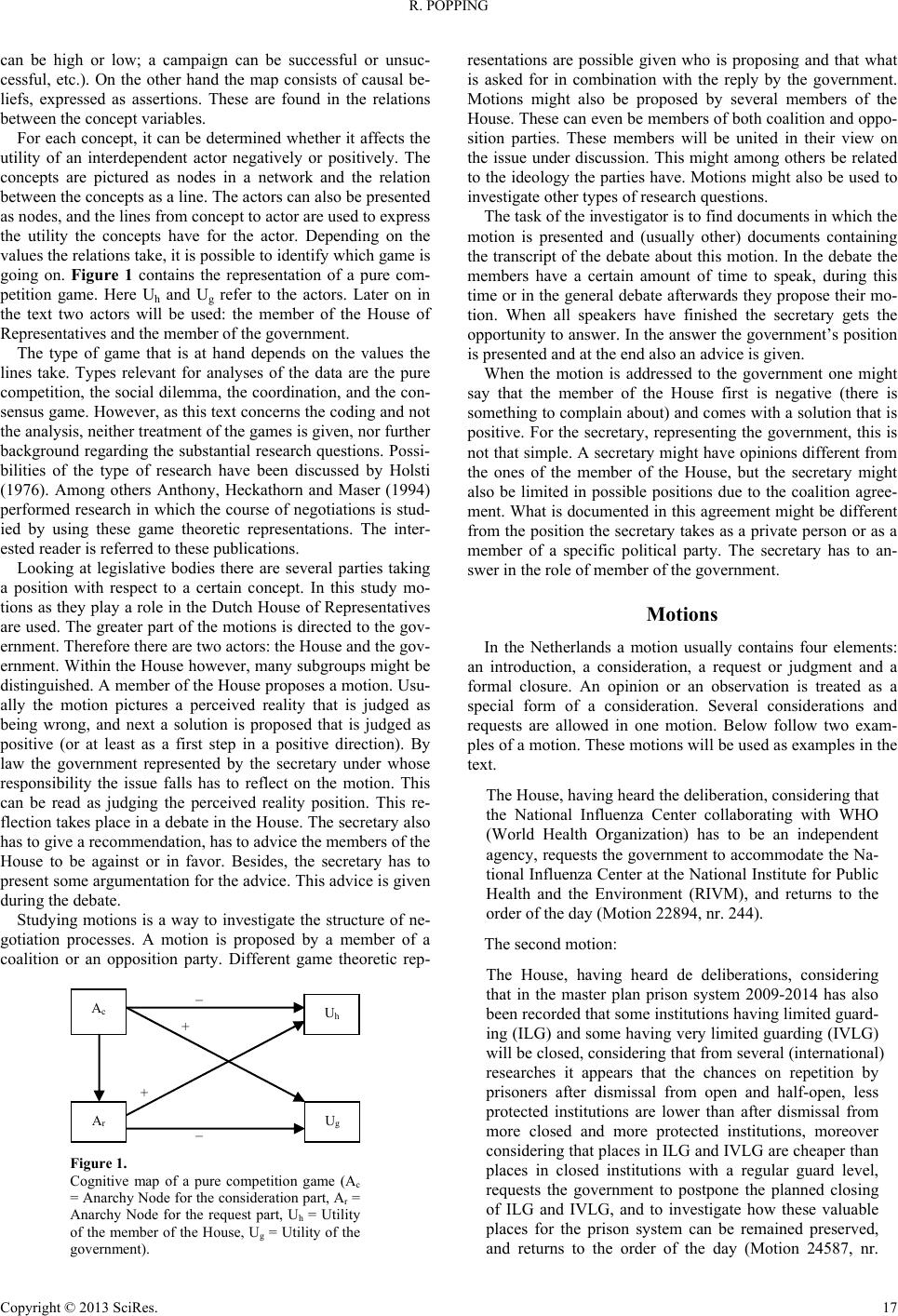 R. POPPING can be high or low; a campaign can be successful or unsuc- cessful, etc.). On the other hand the map consists of causal be- liefs, expressed as assertions. These are found in the relations between the concept variables. For each concept, it can be determined whether it affects the utility of an interdependent actor negatively or positively. The concepts are pictured as nodes in a network and the relation between the concepts as a line. The actors can also be presented as nodes, and the lines from concept to actor are used to express the utility the concepts have for the actor. Depending on the values the relations take, it is possible to identify which game is going on. Figure 1 contains the representation of a pure com- petition game. Here Uh and Ug refer to the actors. Later on in the text two actors will be used: the member of the House of Representatives and the member of the government. The type of game that is at hand depends on the values the lines take. Types relevant for analyses of the data are the pure competition, the social dilemma, the coordination, and the con- sensus game. However, as this text concerns the coding and not the analysis, neither treatment of the games is given, nor further background regarding the substantial research questions. Possi- bilities of the type of research have been discussed by Holsti (1976). Among others Anthony, Heckathorn and Maser (1994) performed research in which the course of negotiations is stud- ied by using these game theoretic representations. The inter- ested reader is referred to these publications. Looking at legislative bodies there are several parties taking a position with respect to a certain concept. In this study mo- tions as they play a role in the Dutch House of Representatives are used. The greater part of the motions is directed to the gov- ernment. Therefore there are two actors: the House and the gov- ernment. Within the House however, many subgroups might be distinguished. A member of the House proposes a motion. Usu- ally the motion pictures a perceived reality that is judged as being wrong, and next a solution is proposed that is judged as positive (or at least as a first step in a positive direction). By law the government represented by the secretary under whose responsibility the issue falls has to reflect on the motion. This can be read as judging the perceived reality position. This re- flection takes place in a debate in the House. The secretary also has to give a recommendation, has to advice the members of the House to be against or in favor. Besides, the secretary has to present some argumentation for the advice. This advice is given during the debate. Studying motions is a way to investigate the structure of ne- gotiation processes. A motion is proposed by a member of a coalition or an opposition party. Different game theoretic rep- U h A c A r U g − − + + Figure 1. Cognitive map of a pure competition game (Ac = Anarchy Node for the consideration part, Ar = Anarchy Node for the request part, Uh = Utility of the member of the House, Ug = Utility of the government). resentations are possible given who is proposing and that what is asked for in combination with the reply by the government. Motions might also be proposed by several members of the House. These can even be members of both coalition and oppo- sition parties. These members will be united in their view on the issue under discussion. This might among others be related to the ideology the parties have. Motions might also be used to investigate other types of research questions. The task of the investigator is to find documents in which the motion is presented and (usually other) documents containing the transcript of the debate about this motion. In the debate the members have a certain amount of time to speak, during this time or in the general debate afterwards they propose their mo- tion. When all speakers have finished the secretary gets the opportunity to answer. In the answer the government’s position is presented and at the end also an advice is given. When the motion is addressed to the government one might say that the member of the House first is negative (there is something to complain about) and comes with a solution that is positive. For the secretary, representing the government, this is not that simple. A secretary might have opinions different from the ones of the member of the House, but the secretary might also be limited in possible positions due to the coalition agree- ment. What is documented in this agreement might be different from the position the secretary takes as a private person or as a member of a specific political party. The secretary has to an- swer in the role of member of the government. Motions In the Netherlands a motion usually contains four elements: an introduction, a consideration, a request or judgment and a formal closure. An opinion or an observation is treated as a special form of a consideration. Several considerations and requests are allowed in one motion. Below follow two exam- ples of a motion. These motions will be used as examples in the text. The House, having heard the deliberation, considering that the National Influenza Center collaborating with WHO (World Health Organization) has to be an independent agency, requests the government to accommodate the Na- tional Influenza Center at the National Institute for Public Health and the Environment (RIVM), and returns to the order of the day (Motion 22894, nr. 244). The second motion: The House, having heard de deliberations, considering that in the master plan prison system 2009-2014 has also been recorded that some institutions having limited guard- ing (ILG) and some having very limited guarding (IVLG) will be closed, considering that from several (international) researches it appears that the chances on repetition by prisoners after dismissal from open and half-open, less protected institutions are lower than after dismissal from more closed and more protected institutions, moreover considering that places in ILG and IVLG are cheaper than places in closed institutions with a regular guard level, requests the government to postpone the planned closing of ILG and IVLG, and to investigate how these valuable places for the prison system can be remained preserved, and returns to the order of the day (Motion 24587, nr. Copyright © 2013 SciRes. 17 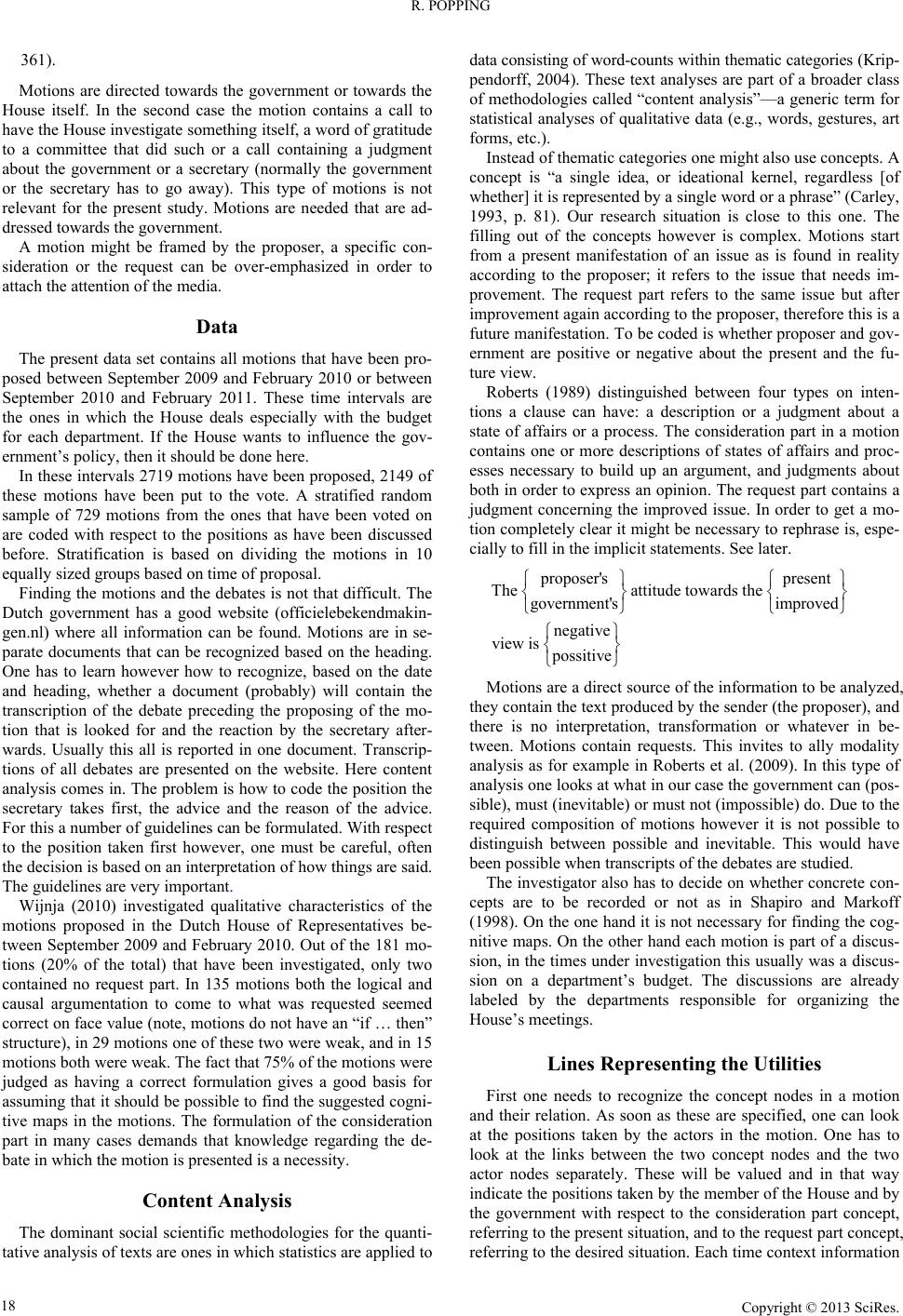 R. POPPING 361). Motions are directed towards the government or towards the House itself. In the second case the motion contains a call to have the House investigate something itself, a word of gratitude to a committee that did such or a call containing a judgment about the government or a secretary (normally the government or the secretary has to go away). This type of motions is not relevant for the present study. Motions are needed that are ad- dressed towards the government. A motion might be framed by the proposer, a specific con- sideration or the request can be over-emphasized in order to attach the attention of the media. Data The present data set contains all motions that have been pro- posed between September 2009 and February 2010 or between September 2010 and February 2011. These time intervals are the ones in which the House deals especially with the budget for each department. If the House wants to influence the gov- ernment’s policy, then it should be done here. In these intervals 2719 motions have been proposed, 2149 of these motions have been put to the vote. A stratified random sample of 729 motions from the ones that have been voted on are coded with respect to the positions as have been discussed before. Stratification is based on dividing the motions in 10 equally sized groups based on time of proposal. Finding the motions and the debates is not that difficult. The Dutch government has a good website (officielebekendmakin- gen.nl) where all information can be found. Motions are in se- parate documents that can be recognized based on the heading. One has to learn however how to recognize, based on the date and heading, whether a document (probably) will contain the transcription of the debate preceding the proposing of the mo- tion that is looked for and the reaction by the secretary after- wards. Usually this all is reported in one document. Transcrip- tions of all debates are presented on the website. Here content analysis comes in. The problem is how to code the position the secretary takes first, the advice and the reason of the advice. For this a number of guidelines can be formulated. With respect to the position taken first however, one must be careful, often the decision is based on an interpretation of how things are said. The guidelines are very important. Wijnja (2010) investigated qualitative characteristics of the motions proposed in the Dutch House of Representatives be- tween September 2009 and February 2010. Out of the 181 mo- tions (20% of the total) that have been investigated, only two contained no request part. In 135 motions both the logical and causal argumentation to come to what was requested seemed correct on face value (note, motions do not have an “if … then” structure), in 29 motions one of these two were weak, and in 15 motions both were weak. The fact that 75% of the motions were judged as having a correct formulation gives a good basis for assuming that it should be possible to find the suggested cogni- tive maps in the motions. The formulation of the consideration part in many cases demands that knowledge regarding the de- bate in which the motion is presented is a necessity. Content Analysis The dominant social scientific methodologies for the quanti- tative analysis of texts are ones in which statistics are applied to data consisting of word-counts within thematic categories (Krip- pendorff, 2004). These text analyses are part of a broader class of methodologies called “content analysis”—a generic term for statistical analyses of qualitative data (e.g., words, gestures, art forms, etc.). Instead of thematic categories one might also use concepts. A concept is “a single idea, or ideational kernel, regardless [of whether] it is represented by a single word or a phrase” (Carley, 1993, p. 81). Our research situation is close to this one. The filling out of the concepts however is complex. Motions start from a present manifestation of an issue as is found in reality according to the proposer; it refers to the issue that needs im- provement. The request part refers to the same issue but after improvement again according to the proposer, therefore this is a future manifestation. To be coded is whether proposer and gov- ernment are positive or negative about the present and the fu- ture view. Roberts (1989) distinguished between four types on inten- tions a clause can have: a description or a judgment about a state of affairs or a process. The consideration part in a motion contains one or more descriptions of states of affairs and proc- esses necessary to build up an argument, and judgments about both in order to express an opinion. The request part contains a judgment concerning the improved issue. In order to get a mo- tion completely clear it might be necessary to rephrase is, espe- cially to fill in the implicit statements. See later. p roposer's present Theattitude towards the government's improved negative view ispossitive Motions are a direct source of the information to be analyzed, they contain the text produced by the sender (the proposer), and there is no interpretation, transformation or whatever in be- tween. Motions contain requests. This invites to ally modality analysis as for example in Roberts et al. (2009). In this type of analysis one looks at what in our case the government can (pos- sible), must (inevitable) or must not (impossible) do. Due to the required composition of motions however it is not possible to distinguish between possible and inevitable. This would have been possible when transcripts of the debates are studied. The investigator also has to decide on whether concrete con- cepts are to be recorded or not as in Shapiro and Markoff (1998). On the one hand it is not necessary for finding the cog- nitive maps. On the other hand each motion is part of a discus- sion, in the times under investigation this usually was a discus- sion on a department’s budget. The discussions are already labeled by the departments responsible for organizing the House’s meetings. Lines Representing the Utilities First one needs to recognize the concept nodes in a motion and their relation. As soon as these are specified, one can look at the positions taken by the actors in the motion. One has to look at the links between the two concept nodes and the two actor nodes separately. These will be valued and in that way indicate the positions taken by the member of the House and by the government with respect to the consideration part concept, referring to the present situation, and to the request part concept, referring to the desired situation. Each time context information Copyright © 2013 SciRes. 18  R. POPPING might be necessary to decide on the position taken. Relating the Member of the House to the Consideration Part Concept Node The position taken by the party or the Member of the House of Representatives responsible for the motion is easiest to grasp. This is so because the core of the necessary information is to be found in the motion; usually the perceived present situation is depicted as bad. In the first motion presented before the pro- posing member states the influenza center has to be an inde- pendent institution. The way the motion is formulated shows that the proposer has doubts on whether this will really be the case in the actual situation. Therefore there is a negative atti- tude with respect to the present situation. As far as the second motion is concerned, the member has stated that the available knowledge regarding people in prison is to be judged in a positive way and the closing in a negative one. The closing is an act the government wants to undertake according to the proposer; therefore it is the concept of interest. The member is negative about the closing. Sometimes the actual wording of the motion suggests that the government does well, but given the request part of the motion it becomes clear that actually something is to be added, namely: “… but the government does not tell how to proceed or how she will proceed.” In the request part of the motion follows a sug- gestion on how to do it. On the other hand there are also mo- tions suggesting there is no policy, the government does not do anything. In her reaction later on the government will explain whether this view is correct or not (see the section where the government is related to the consideration part of the motion). A concrete example: Motion 32123-x, nr. 63 observes that the budget for a project has been exceeded, therefore the govern- ment is encouraged to start new negotiations with the producer in order to cut back the final price. In fact two observations are made: 1) the budget has exceeded, and 2) the government does not start new negotiations, as well as a consideration: the gov- ernment has to start the negotiations. It looked as if the consid- eration part is neutral, but given the interpretation of the con- sideration, it is viewed as negative. Relating the Member of the House of Representatives to the Request Part Concept Node In the consideration part of the motion the message generally is that something is wrong. The request that follows asks to take care of improvements, totally or only with respect to the next step to come in the process that is under discussion. This is considered as positive. The member does not always question whether that what is asked for is possible by law or is realistic. Neither does the member always know what is going on at the side of the government. This is illustrated by an answer given by a secretary. In motion 22894, nr. 243 the government is asked to come with an index in which the relations between pharmaceutical companies and physicians are documented. The secretary: “I already informed the House that a sunshine act will take place that goes further than what you ask for. I do not only want to make visible the contacts, I want that the financial relations are completely visible, we need complete transpar- ency.” The member in the first example motion asks to accommo- date the center at a certain institution. Implicitly it is stated that this guarantees independence. This part of the motion can al- ways be understood from the text in the motion itself. Context information might be necessary to find an explanation for some terminology. Also the position taken by the member of the House with regard to the request part concept in the second example motion can be read from the motion. Relating the Government to the Request Part Concept Node Finding the government’s position regarding the motion is difficult as it is not part of the motion itself. The position must be looked for in the transcription of the debate. The secretary advices the House about the motion during the debate. This advice is not always formulated in a distinct way. In the advice generally the government’s position with respect to the request part concept is explained. Finding the view on the consideration part usually is more difficult. Therefore here the request part is considered first. The advice is not always in the debate, some- times it is presented in a letter send to the House after the de- bate. Such a letter is most clear. It really informs whether a mo- tion is supported or dissuaded. Looking at the first motion it turns out that the government has no authority with respect to where to accommodate the center. Therefore the motion is dissuaded. This indicates a ne- gative relation. After this advice was given, the proposer has withdrawn the motion. The secretary is negative with respect to the second example motion because the proposer did not start from the correct information. The measure’s goal is not reduc- tion of capacity, but re-socialization. The motion was rejected after the voting. The government can be either positive or negative with re- spect to a motion. A motion might support the policy making. According to the secretary motion 32123-xiv, nr. 82, asks for something that already takes place. But it might also be that the policy just started or even has to start. The secretary tells that she will try to use a reverse burden of proof in case of poaching what was asked for in motion 32500-xiii, nr. 50. In both cases the government’s view on the request part is positive. A negative view is found in very different situations. The judgment is based on very different arguments however. The secretary does not agree with the accusation in motion 32500-vi, nr. 48 that policy with regard to vulnerable groups is not bal- anced but biased and merciless. With respect to motion 21501- 32, nr. 366 about the government’s attitude and effort at the amendment of the European directives for experiments on ani- mals the secretary even insists that the claim has no ground and that the country plays an active role when this kind of questions are discussed. Motion 31322, nr. 110 asks for an increase in the tax burden for employers, which is not in line with the coalition agreement saying that a reduction is to be realized. The secretary also might be unwilling to change a practice that works fine. There- fore she does not support motion 32123-viii, nr. 25 which re- quests new methods for testing on conflicts of interest at finan- cial funds, the present system of peer review works well. In case something new is to be realized one has to make a decision and cannot always continue with new research. For this reason the secretary opposes motion 31209, nr. 106, a lot of research has been done and that resulted in the bill as it is now. Sometimes a motion is premature. In motion 32123-xiv, nr. 119 the government is asked to keep the promise that what is in Copyright © 2013 SciRes. 19 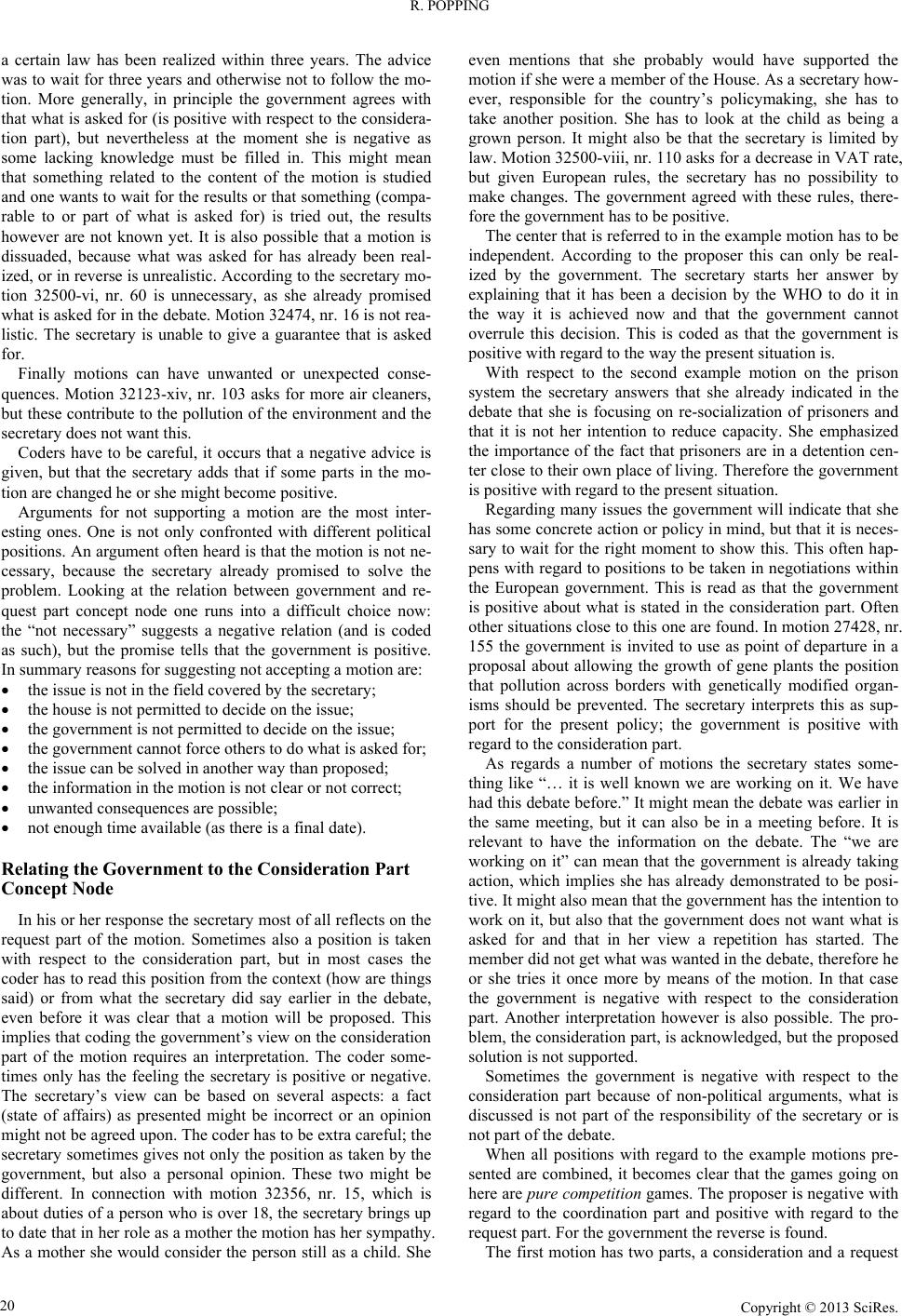 R. POPPING a certain law has been realized within three years. The advice was to wait for three years and otherwise not to follow the mo- tion. More generally, in principle the government agrees with that what is asked for (is positive with respect to the considera- tion part), but nevertheless at the moment she is negative as some lacking knowledge must be filled in. This might mean that something related to the content of the motion is studied and one wants to wait for the results or that something (compa- rable to or part of what is asked for) is tried out, the results however are not known yet. It is also possible that a motion is dissuaded, because what was asked for has already been real- ized, or in reverse is unrealistic. According to the secretary mo- tion 32500-vi, nr. 60 is unnecessary, as she already promised what is asked for in the debate. Motion 32474, nr. 16 is not rea- listic. The secretary is unable to give a guarantee that is asked for. Finally motions can have unwanted or unexpected conse- quences. Motion 32123-xiv, nr. 103 asks for more air cleaners, but these contribute to the pollution of the environment and the secretary does not want this. Coders have to be careful, it occurs that a negative advice is given, but that the secretary adds that if some parts in the mo- tion are changed he or she might become positive. Arguments for not supporting a motion are the most inter- esting ones. One is not only confronted with different political positions. An argument often heard is that the motion is not ne- cessary, because the secretary already promised to solve the problem. Looking at the relation between government and re- quest part concept node one runs into a difficult choice now: the “not necessary” suggests a negative relation (and is coded as such), but the promise tells that the government is positive. In summary reasons for suggesting not accepting a motion are: the issue is not in the field covered by the secretary; the house is not permitted to decide on the issue; the government is not permitted to decide on the issue; the government cannot force others to do what is asked for; the issue can be solved in another way than proposed; the information in the motion is not clear or not correct; unwanted consequences are possible; not enough time available (as there is a final date). Relating the Government to the Consideration Part Concept Node In his or her response the secretary most of all reflects on the request part of the motion. Sometimes also a position is taken with respect to the consideration part, but in most cases the coder has to read this position from the context (how are things said) or from what the secretary did say earlier in the debate, even before it was clear that a motion will be proposed. This implies that coding the government’s view on the consideration part of the motion requires an interpretation. The coder some- times only has the feeling the secretary is positive or negative. The secretary’s view can be based on several aspects: a fact (state of affairs) as presented might be incorrect or an opinion might not be agreed upon. The coder has to be extra careful; the secretary sometimes gives not only the position as taken by the government, but also a personal opinion. These two might be different. In connection with motion 32356, nr. 15, which is about duties of a person who is over 18, the secretary brings up to date that in her role as a mother the motion has her sympathy. As a mother she would consider the person still as a child. She even mentions that she probably would have supported the motion if she were a member of the House. As a secretary how- ever, responsible for the country’s policymaking, she has to take another position. She has to look at the child as being a grown person. It might also be that the secretary is limited by law. Motion 32500-viii, nr. 110 asks for a decrease in VAT rate, but given European rules, the secretary has no possibility to make changes. The government agreed with these rules, there- fore the government has to be positive. The center that is referred to in the example motion has to be independent. According to the proposer this can only be real- ized by the government. The secretary starts her answer by explaining that it has been a decision by the WHO to do it in the way it is achieved now and that the government cannot overrule this decision. This is coded as that the government is positive with regard to the way the present situation is. With respect to the second example motion on the prison system the secretary answers that she already indicated in the debate that she is focusing on re-socialization of prisoners and that it is not her intention to reduce capacity. She emphasized the importance of the fact that prisoners are in a detention cen- ter close to their own place of living. Therefore the government is positive with regard to the present situation. Regarding many issues the government will indicate that she has some concrete action or policy in mind, but that it is neces- sary to wait for the right moment to show this. This often hap- pens with regard to positions to be taken in negotiations within the European government. This is read as that the government is positive about what is stated in the consideration part. Often other situations close to this one are found. In motion 27428, nr. 155 the government is invited to use as point of departure in a proposal about allowing the growth of gene plants the position that pollution across borders with genetically modified organ- isms should be prevented. The secretary interprets this as sup- port for the present policy; the government is positive with regard to the consideration part. As regards a number of motions the secretary states some- thing like “… it is well known we are working on it. We have had this debate before.” It might mean the debate was earlier in the same meeting, but it can also be in a meeting before. It is relevant to have the information on the debate. The “we are working on it” can mean that the government is already taking action, which implies she has already demonstrated to be posi- tive. It might also mean that the government has the intention to work on it, but also that the government does not want what is asked for and that in her view a repetition has started. The member did not get what was wanted in the debate, therefore he or she tries it once more by means of the motion. In that case the government is negative with respect to the consideration part. Another interpretation however is also possible. The pro- blem, the consideration part, is acknowledged, but the proposed solution is not supported. Sometimes the government is negative with respect to the consideration part because of non-political arguments, what is discussed is not part of the responsibility of the secretary or is not part of the debate. When all positions with regard to the example motions pre- sented are combined, it becomes clear that the games going on here are pure competition games. The proposer is negative with regard to the coordination part and positive with regard to the request part. For the government the reverse is found. The first motion has two parts, a consideration and a request Copyright © 2013 SciRes. 20 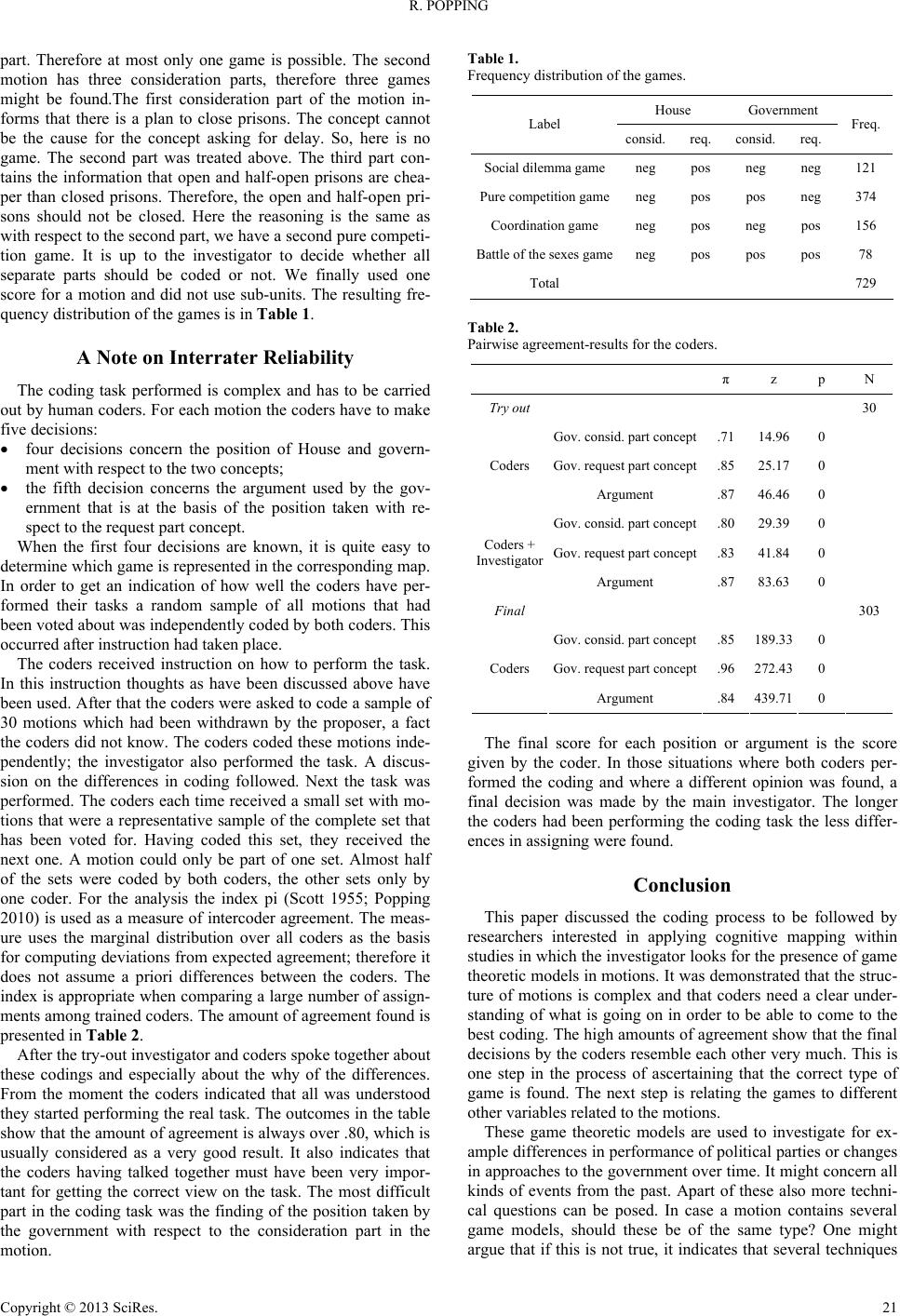 R. POPPING part. Therefore at most only one game is possible. The second motion has three consideration parts, therefore three games might be found.The first consideration part of the motion in- forms that there is a plan to close prisons. The concept cannot be the cause for the concept asking for delay. So, here is no game. The second part was treated above. The third part con- tains the information that open and half-open prisons are chea- per than closed prisons. Therefore, the open and half-open pri- sons should not be closed. Here the reasoning is the same as with respect to the second part, we have a second pure competi- tion game. It is up to the investigator to decide whether all separate parts should be coded or not. We finally used one score for a motion and did not use sub-units. The resulting fre- quency distribution of the games is in Table 1. A Note on Interrater Reliability The coding task performed is complex and has to be carried out by human coders. For each motion the coders have to make five decisions: four decisions concern the position of House and govern- ment with respect to the two concepts; the fifth decision concerns the argument used by the gov- ernment that is at the basis of the position taken with re- spect to the request part concept. When the first four decisions are known, it is quite easy to determine which game is represented in the corresponding map. In order to get an indication of how well the coders have per- formed their tasks a random sample of all motions that had been voted about was independently coded by both coders. This occurred after instruction had taken place. The coders received instruction on how to perform the task. In this instruction thoughts as have been discussed above have been used. After that the coders were asked to code a sample of 30 motions which had been withdrawn by the proposer, a fact the coders did not know. The coders coded these motions inde- pendently; the investigator also performed the task. A discus- sion on the differences in coding followed. Next the task was performed. The coders each time received a small set with mo- tions that were a representative sample of the complete set that has been voted for. Having coded this set, they received the next one. A motion could only be part of one set. Almost half of the sets were coded by both coders, the other sets only by one coder. For the analysis the index pi (Scott 1955; Popping 2010) is used as a measure of intercoder agreement. The meas- ure uses the marginal distribution over all coders as the basis for computing deviations from expected agreement; therefore it does not assume a priori differences between the coders. The index is appropriate when comparing a large number of assign- ments among trained coders. The amount of agreement found is presented in Table 2. After the try-out investigator and coders spoke together about these codings and especially about the why of the differences. From the moment the coders indicated that all was understood they started performing the real task. The outcomes in the table show that the amount of agreement is always over .80, which is usually considered as a very good result. It also indicates that the coders having talked together must have been very impor- tant for getting the correct view on the task. The most difficult part in the coding task was the finding of the position taken by the government with respect to the consideration part in the motion. Table 1. Frequency distribution of the games. House Government Label consid. req. consid. req. Freq. Social dilemma gameneg pos neg neg 121 Pure competition gameneg pos pos neg 374 Coordination game neg pos neg pos 156 Battle of the sexes gameneg pos pos pos 78 Total 729 Table 2. Pairwise agreement-results for the coders. π z p N Try out 30 Gov. consid. part concept .71 14.96 0 Gov. request part concept .85 25.17 0 Coders Argument .87 46.46 0 Gov. consid. part concept .80 29.39 0 Gov. request part concept .83 41.84 0 Coders + Investigator Argument .87 83.63 0 Final 303 Gov. consid. part concept .85 189.33 0 Gov. request part concept .96 272.43 0 Coders Argument .84 439.71 0 The final score for each position or argument is the score given by the coder. In those situations where both coders per- formed the coding and where a different opinion was found, a final decision was made by the main investigator. The longer the coders had been performing the coding task the less differ- ences in assigning were found. Conclusion This paper discussed the coding process to be followed by researchers interested in applying cognitive mapping within studies in which the investigator looks for the presence of game theoretic models in motions. It was demonstrated that the struc- ture of motions is complex and that coders need a clear under- standing of what is going on in order to be able to come to the best coding. The high amounts of agreement show that the final decisions by the coders resemble each other very much. This is one step in the process of ascertaining that the correct type of game is found. The next step is relating the games to different other variables related to the motions. These game theoretic models are used to investigate for ex- ample differences in performance of political parties or changes in approaches to the government over time. It might concern all kinds of events from the past. Apart of these also more techni- cal questions can be posed. In case a motion contains several game models, should these be of the same type? One might argue that if this is not true, it indicates that several techniques Copyright © 2013 SciRes. 21 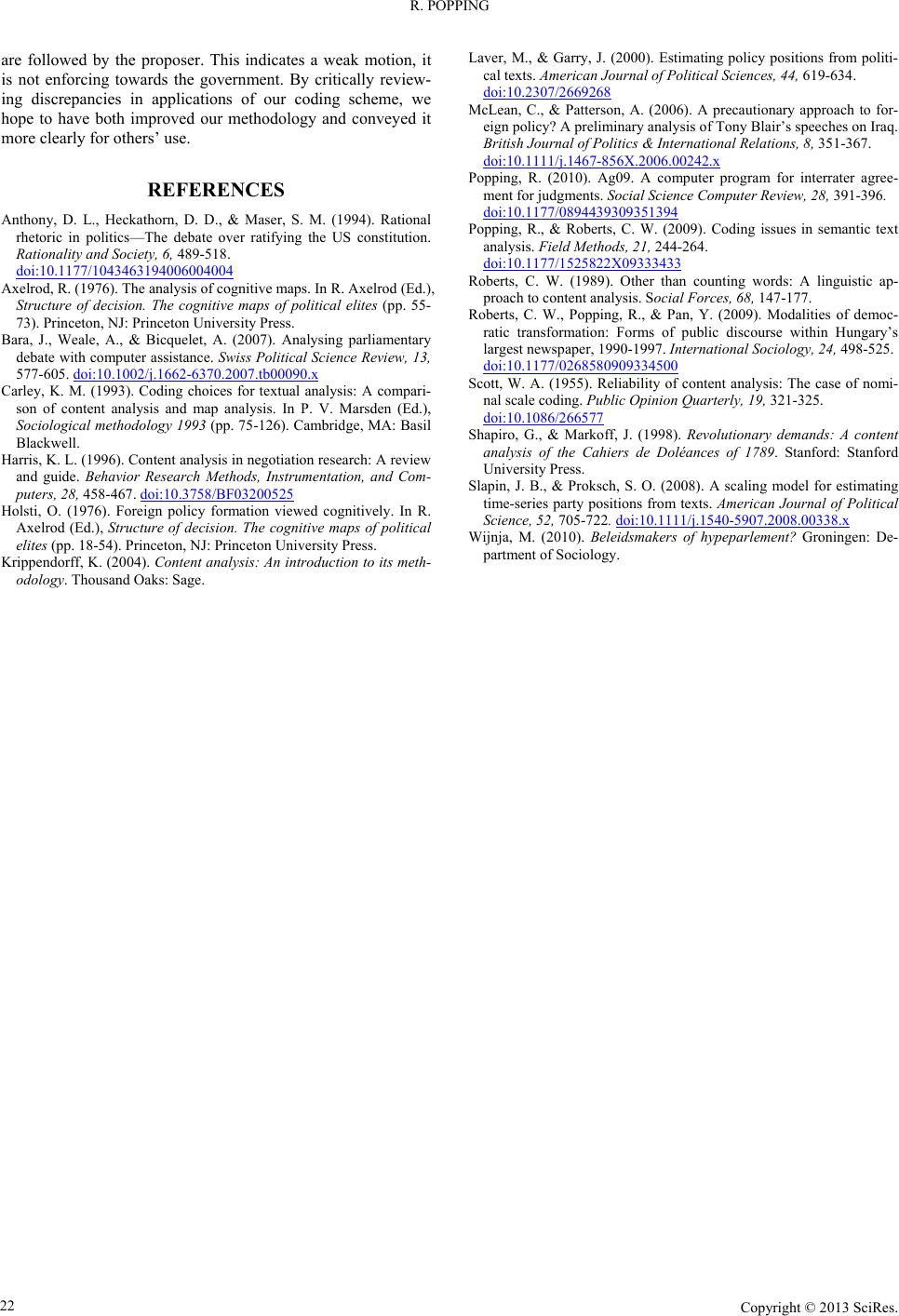 R. POPPING Copyright © 2013 SciRes. 22 are followed by the proposer. This indicates a weak motion, it is not enforcing towards the government. By critically review- ing discrepancies in applications of our coding scheme, we hope to have both improved our methodology and conveyed it more clearly for others’ use. REFERENCES Anthony, D. L., Heckathorn, D. D., & Maser, S. M. (1994). Rational rhetoric in politics—The debate over ratifying the US constitution. Rationality and Society, 6, 489-518. doi:10.1177/1043463194006004004 Axelrod, R. (1976). The analysis of cognitive maps. In R. Axelrod (Ed.), Structure of decision. The cognitive maps of political elites (pp. 55- 73). Princeton, NJ: Princeton University Press. Bara, J., Weale, A., & Bicquelet, A. (2007). Analysing parliamentary debate with computer assistance. Swiss Political Science Review, 13, 577-605. doi:10.1002/j.1662-6370.2007.tb00090.x Carley, K. M. (1993). Coding choices for textual analysis: A compari- son of content analysis and map analysis. In P. V. Marsden (Ed.), Sociological methodology 1993 (pp. 75-126). Cambridge, MA: Basil Blackwell. Harris, K. L. (1996). Content analysis in negotiation research: A review and guide. Behavior Research Methods, Instrumentation, and Com- puters, 28, 458-467. doi:10.3758/BF03200525 Holsti, O. (1976). Foreign policy formation viewed cognitively. In R. Axelrod (Ed.), Structure of decision. The cognitive maps of political elites (pp. 18-54). Princeton, NJ: Princeton University Press. Krippendorff, K. (2004). Content analysis: An introduction to its meth- odology. Thousand Oaks: Sage. Laver, M., & Garry, J. (2000). Estimating policy positions from politi- cal texts. American Journal of Political Sciences, 44, 619-634. doi:10.2307/2669268 McLean, C., & Patterson, A. (2006). A precautionary approach to for- eign policy? A preliminary analysis of Tony Blair’s speeches on Iraq. British Journal of Politics & International Relations, 8, 351-367. doi:10.1111/j.1467-856X.2006.00242.x Popping, R. (2010). Ag09. A computer program for interrater agree- ment for judgments. Social Science Computer Review, 28, 391-396. doi:10.1177/0894439309351394 Popping, R., & Roberts, C. W. (2009). Coding issues in semantic text analysis. Field Methods, 21, 244-264. doi:10.1177/1525822X09333433 Roberts, C. W. (1989). Other than counting words: A linguistic ap- proach to content analysis. Social Forces, 68, 147-177. Roberts, C. W., Popping, R., & Pan, Y. (2009). Modalities of democ- ratic transformation: Forms of public discourse within Hungary’s largest newspaper, 1990-1997. International Sociology, 24, 498-525. doi:10.1177/0268580909334500 Scott, W. A. (1955). Reliability of content analysis: The case of nomi- nal scale coding. Public Opinion Quarterly, 19, 321-325. doi:10.1086/266577 Shapiro, G., & Markoff, J. (1998). Revolutionary demands: A content analysis of the Cahiers de Doléances of 1789. Stanford: Stanford University Press. Slapin, J. B., & Proksch, S. O. (2008). A scaling model for estimating time-series party positions from texts. American Journal of Political Science, 52, 705-722. doi:10.1111/j.1540-5907.2008.00338.x Wijnja, M. (2010). Beleidsmakers of hypeparlement? Groningen: De- partment of Sociology. 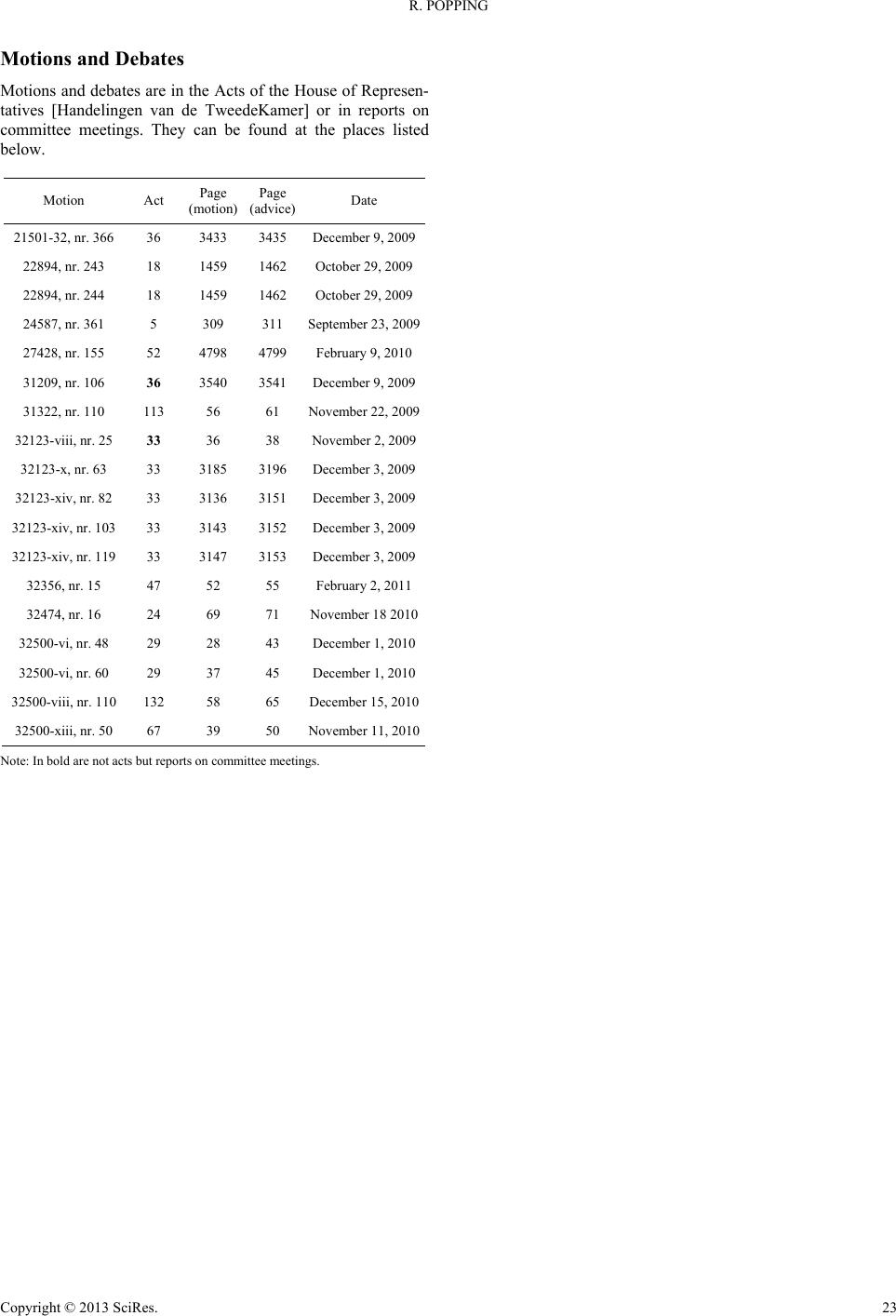 R. POPPING Motions and Debates Motions and debates are in the Acts of the House of Represen- tatives [Handelingen van de TweedeKamer] or in reports on committee meetings. They can be found at the places listed below. Motion Act Page (motion) Page (advice) Date 21501-32, nr. 366 36 3433 3435 December 9, 2009 22894, nr. 243 18 1459 1462 October 29, 2009 22894, nr. 244 18 1459 1462 October 29, 2009 24587, nr. 361 5 309 311 September 23, 2009 27428, nr. 155 52 4798 4799 February 9, 2010 31209, nr. 106 36 3540 3541 December 9, 2009 31322, nr. 110 113 56 61 November 22, 2009 32123-viii, nr. 25 33 36 38 November 2, 2009 32123-x, nr. 63 33 3185 3196 December 3, 2009 32123-xiv, nr. 82 33 3136 3151 December 3, 2009 32123-xiv, nr. 103 33 3143 3152 December 3, 2009 32123-xiv, nr. 119 33 3147 3153 December 3, 2009 32356, nr. 15 47 52 55 February 2, 2011 32474, nr. 16 24 69 71 November 18 2010 32500-vi, nr. 48 29 28 43 December 1, 2010 32500-vi, nr. 60 29 37 45 December 1, 2010 32500-viii, nr. 110 132 58 65 December 15, 2010 32500-xiii, nr. 50 67 39 50 November 11, 2010 Note: In bold are not acts but reports on committee meetings. Copyright © 2013 SciRes. 23 |