

Paper Menu >>
Journal Menu >>
 Sociology Mind 2013. Vol.3, No.1, 114-117 Published Online January 2013 in SciRes (http://www.scirp.org/journal/sm) http://dx.doi.org/10.4236/sm.2013.31017 Copyright © 2013 SciRes. 114 Comparative Study of the Financial Independence, Self-Confidence and Decision-Making Power, Awareness of the Social Resources and Mental Health in the Women Members of SHG and Non-Member of SHG Farhad Asghari1, Abbas Sadeghi1, Khaled Aslani2 1Department of Educational S ciences, University of Guilan, Rasht, Iran 2Department of Counseling, Univer sity of Shahid Chamran, Ahvaz, Iran Email: [email protected] Received August 6th, 2012; re vised October 7th, 2012; accepted October 21st, 2012 The main objective of the present paper was the evaluation of the program of the self help groups in the Kurdistan, Kermanshah, Hamadan and Western Azerbaijan in Iran. The Casual-comparative research method has been used in this research and statistical population was all the women members of SHG and Non-Member of SHG. The statistical samples were included 289 the women members of SHG (137) and Non-Member of SHG (152) due to the size of the population, more than /90 of population has been se- lected. Three different research instrument have been used which are included Demographic features questionnaire, Questionnaire of the evaluation of the self help groups’ empowerment, General Health Questionnaire (GHQ-28). The reliability of the questionnaire of the evaluation of the self help groups’ empowerment was /80 and General health questionnaire (GHQ-28) was /92. According to the research results, there are significant relationship between the amount of the financial independence, self confi- dence, the decision making power and the amount of the awareness of women members of SHG and Non- Member of SHG. Also, there were no significant relationship between the amount of cutting dependency to direct financial supports and mental health the women members of SHG and Non-Member of SHG. Keywords: Financial Independence; Self-Confidence; Decision-Making Power; Social Resources; Mental Health Introduction The concept of feministic empowerment views needs more attention than concepts like economic situation and it includes women’s welfare and strategic benefits (Swain, 2006). Femi- nists have also argued that the given women’s primary respon- sibility for ensuring social reproduction, state policies that sub- sidize the costs of social reproduction are an important aspect of engendered development policy (Power, 2004). Another concept suggested by Sen (1999) which emphasizes on the effects of social empowerment , deals with some crucial matters like co-existence and survivorship which include appropriate nutrition, place of living and suitable hygiene. Regardless of lifestyle these are called the fundamental principles of life. Em- powerment is a multilevel construct and there-fore, analysis of empowerment methods and outcomes should be directed at three interdependent levels. These three levels are: 1) individual or Psychological Empowerment (PE); 2) Community Empow- erment (CE); and 3) Organizational Empowerment (OE) (Rap- paport, 1984; Zimmerman et al., 1992; Israel et al., 1994; Zim- merman, 1995). Mayoux (2000) defines empowerment as a pro- cess of inside change, or inside power, improving capabilities and communal mobilization. The individual empowerment may be describes as appropriate decisions and improving auto- nomy and the control of their own economic resources. In defi- nition of the empowerment he mentioned that the empower- ment has a direct relationship with power as a polyhedral proc- ess which includes: power within: it enables women to express their wishes in detail and also it gives them strategies for ex- pressing changes in their life. Power to: it enables women to improve the needed skills for achieving their wishes. Power with: it enables women to evaluate and expressing their inter- ests to organize and achieve them and to think about other women and men’s organizations. Power over: which includes changing the inequality of power and resources which influ- ences women’s wishes and enable them to achieve their wishes? The component of power incorporates different parts and levels of life. Kabeer (1999) emphasize that empowerment is a proc- ess that women deny their capability for making strategic deci- sions. Women who are in cooperative groups are completely safe by improving the feeling of self or Son. Empowerment helps women to understand identity, capabilities and power. It also helps the women to overcome shyness and to feel confi- dence whenever they talk about themselves (Umushankar, 2006). These groups have an impact on empowerment and im- proving efficiency by controlling the resources and recognition and self-respect (Zamman, 2001). Recently different studies about the positive effects of cooperative groups have been re-  F. ASGHARI ET AL. ported (Simanowitz & Walker, 2002). Usually the main goal of these economical services in India is thriftiness, credibility and products of poor people in the village and urban areas to in- crease the rate of incomes and improving the standards of life (NABARD1, 2006). The result of Tomkha (2002) study about the socioeconomic situation of 560 members of 223 cooperative groups from 11 provinces before and after joining to the group showed that: the average possession of the family increases 72.3% and during three years it reached to 11,793 rupiah. The average net income also increases which was from different businesses by getting the loan. It is from 20,177 rupiah to 26,889 rupiah. The rate of employment growth has been 17 percent. Getting loan for doing business has an increase from 50 percent to 70 percent. 47.8 percent of the families are not below the poverty line anymore. The results of a study from cooperative women group in Tamil Nadu (2007) showed that a member who joins the group has cattle and properties and were in debt. And the age and the productive properties except the land have a negative independency with participation in the group. But social backwardness, being in debt and the need for the loan in the region or neighbor villages, has a positive effect on women contribution. The result of Anjogam and Rasmamy (2007) showed that the most popular reasons for joining to the group are, getting loan, doing business, saving money and re- ducing previous debts. Moreover Puhazhendi and Badatya (2002) in their studies of the cooperative groups found that this program has a positive social effect. Puhazhendi and Satyasai (2000) argued that the social effect of the cooperative groups’ program is more than its economic effect. The results of Rao study (2008) on reforms with a female face showed that the latter lacks administrative support and relies upon the expendi- ture of time and resources by participants themselves, re-em- phasizing class and caste inequalities among women and un- dermining the broader project of empowerment. According to the results of Swain (2006) study, 88% of the members reported that they feel more confidence after joining the group. They showed positive change in expressing their be- liefs and activity, confidence and communication skills have been improved among them. Improving knowledge and contri- bution in local political organization and participation in the government political actions have been observed among the members of the cooperative groups. The main purpose of this article is to evaluate the cooperative groups and deals with economic independency, self-confidence, decision making, and familiarity with social resources in females headed households and mental health of Self-Help Groups (SHG) in Kurdistan, Kermanshah, Hamadan and western Azerbaijan Providences. Methodology The Causative-comparative approach has been used in this research. The research is about the women who members of self help groups and females who are not a member of self help groups which are under protection of welfare organization in the Hamadan, Kermanshah, Kurdistan, and Western Azerbaijan. Because the community and members of the self help groups under study were limited, most of them had been taken as an example. The members of the control group are similar to the self help group members in many areas like cultural, social, educational, economical situation, age and family. Demographic features questionnaire, Questionnaire of the evaluation of the self help groups’ empowerment, General health questionnaire (GHQ-28). Demographic features questionnaire: this questionnaire is about the population of the women who are a member of the SHG and who are not. The questions are about age, education, marriage, place of living, the numbers of the members of the family and the date of constitution which are provided by the researcher. Questionnaire of the evaluation of the cooperative groups’ empowerment: this questionnaire provided by the re- searcher and based on 4 principles: 1) Evaluation of the economic independence; 2) Self-confidence and decision making; 3) Dependence and independence to direct economical sup- port; 4) Recognition of the social resources. This questionnaire is based on some other questionnaires presented by Baland et al. (2008), Basu and Srivastava (2010), Swain (2006), which were about the evaluation of the empow- erment of the cooperative groups. This questionnaire has been confirmed by sociologists and psychologists. The calculated durability of the questionnaire is based on the Cronbach alpha factor which is 80. General health questionnaire firstly conducted by Goldberg (1972). This test evaluates the illness factors, one month before taking the exam. Golberg first calculated the rate of GHQ and then reported that the rate of sensitivity, specifity and the error factor in a category of 60 questions are 77.5%, 88.4% and 15.4% respectively. These GHQ results in Iran are 86.5%, 82% and 16% (Vaghobi, 2008). The results of Gibones et al. (2004) study using test-retest approach are alpha coefficient/74. Ac- cording to the cutting point which is 6.7, the sensitivity is 88 and specifity is 84.2. In Palaheng (1997) study in which the cutting point is 22, the sensitivity, specify, category error, is: 88, 74, 80, 20 and the alpha coefficient in present study is /92. Findings As we see in Table 1, the average and standard deviation re- lated to the Member of SHG and Non-Member of SHG are described. Table 2 shows the one way variance analysis of variables economic independence, self-confidence & decision-making power, Cutting dependency to direct supports, Knowledge of social resources and Mental health in members of SHG and Non-Member of SHG. Discussion and Conclusions Evaluation of the results of the first hypothesis showed that: “there is a huge difference between in the financial independ- ency of the self headed females who are a member of SHG and who are not.” The result of this research is similar to the results of the Microfinance Innovation Department researches (2002), Meyer and Tenkha (2002), Basu (2006) and Tamil Nadu (2007). The results of the Microfinance Innovation Department re- searches (2002) show that the sample members reported a 59 percent increase of their properties. Their living conditions get better and they learned to save money. The results of Meyer and Tankha’s study (2002) showed that the social condition of 560 members of 223 cooperative groups from 11 provinces has a 72.3 growth in the family possessions after joining to the 1National Bank for Agriculture and Rural Development. Copyright © 2013 SciRes. 115 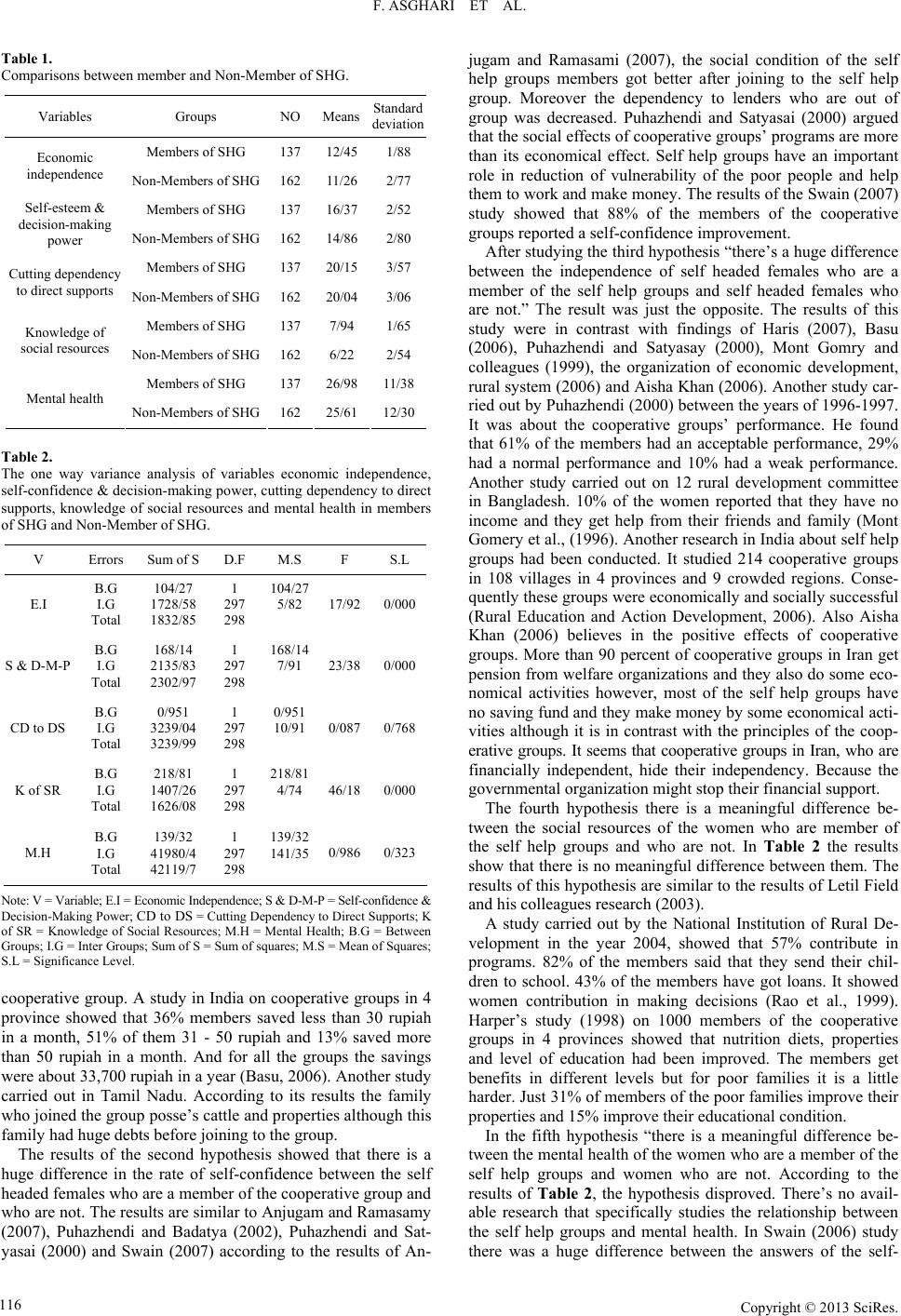 F. ASGHARI ET AL. Table 1. Comparisons between mem ber and Non-Member of SHG. Variables Groups NO MeansStandard deviation Members of SHG 137 45/12 88/1 Economic independence Non-Members of SHG 162 26/11 77/2 Members of SHG 137 Self-esteem & decision-making power Non-Members of SHG 162 37/16 52/2 86/14 80/2 Members of SHG 137 15/20 57/3 Cutting dependency to direct supports Non-Members of SHG 162 04/20 06/3 Members of SHG 137 94/7 65/1 Knowledge of social resources Non-Members of SHG 162 22/6 54/2 Members of SHG 137 98/26 38/11 Mental health Non-Members of SHG 162 61/25 30/12 Table 2. The one way variance analysis of variables economic independence, self-confidence & decision-making power, cutting dependency to direct supports, knowledge of social resources and mental health in members of SHG and Non-Member of SHG. V Errors Sum of S D.F M.S F S.L E.I B.G I.G Total 104/27 1728/58 1 297 104/27 1832/85 298 5/82 17/92 0/000 S & D-M-P B.G I.G Total 168/14 2135/83 2302/97 1 297 168/14 7/91 298 23/38 0/000 CD to DS B.G I.G Total 0/951 3239/04 3239/99 1 297 298 0/951 10/91 0/087 0/768 K of SR B.G I.G 218/81 1407/26 Total 1626/08 1 297 298 218/81 4/74 46/18 0/000 M.H B.G I.G 139/32 41980/4 1 Total 42119/7 297 298 139/32 141/35 0/986 0/323 Note: V = Variable; E.I = Economic Independence; S & D-M-P = Self-confidence & Decision-Making Power; CD to DS = Cutting Dependency to Direct Supports; K of SR = Knowledge of Social Resources; M.H = Mental Health; B.G = Between Groups; I.G = Inter Groups; Sum of S = Sum of squares; M.S = Mean of Squares; S.L = Signifi c ance Level. cooperative group. A study in India on cooperative groups in 4 province showed that 36% members saved less than 30 rupiah in a month, 51% of them 31 - 50 rupiah and 13% saved more than 50 rupiah in a month. And for all the groups the savings were about 33,700 rupiah in a year (Basu, 2006). Another study carried out in Tamil Nadu. According to its results the family who joined the group posse’s cattle and properties although this family had huge debts before joining to the group. The results of the second hypothesis showed that there is a huge difference in the rate of self-confidence between the self headed females who are a member of the cooperative group and who are not. The results are similar to Anjugam and Ramasamy (2007), Puhazhendi and Badatya (2002), Puhazhendi and Sat- yasai (2000) and Swain (2007) according to the results of An- jugam and Ramasami (2007), the social condition of the self help groups members got better after joining to the self help group. Moreover the dependency to lenders who are out of group was decreased. Puhazhendi and Satyasai (2000) argued that the social effects of cooperative groups’ programs are more than its economical effect. Self help groups have an important role in reduction of vulnerability of the poor people and help them to work and make money. The results of the Swain (2007) study showed that 88% of the members of the cooperative groups reported a self-confidence improvement. After studying the third hypothesis “there’s a huge difference between the independence of self headed females who are a member of the self help groups and self headed females who are not.” The result was just the opposite. The results of this study were in contrast with findings of Haris (2007), Basu (2006), Puhazhendi and Satyasay (2000), Mont Gomry and colleagues (1999), the organization of economic development, rural system (2006) and Aisha Khan (2006). Another study car- ried out by Puhazhendi (2000) between the years of 1996-1997. It was about the cooperative groups’ performance. He found that 61% of the members had an acceptable performance, 29% had a normal performance and 10% had a weak performance. Another study carried out on 12 rural development committee in Bangladesh. 10% of the women reported that they have no income and they get help from their friends and family (Mont Gomery et al., (1996). Another research in India about self help groups had been conducted. It studied 214 cooperative groups in 108 villages in 4 provinces and 9 crowded regions. Conse- quently these groups were economically and socially successful (Rural Education and Action Development, 2006). Also Aisha Khan (2006) believes in the positive effects of cooperative groups. More than 90 percent of cooperative groups in Iran get pension from welfare organizations and they also do some eco- nomical activities however, most of the self help groups have no saving fund and they make money by some economical acti- vities although it is in contrast with the principles of the coop- erative groups. It seems that cooperative groups in Iran, who are financially independent, hide their independency. Because the governmental organization might stop their financial support. The fourth hypothesis there is a meaningful difference be- tween the social resources of the women who are member of the self help groups and who are not. In Table 2 the results show that there is no meaningful difference between them. The results of this hypothesis are similar to the results of Letil Field and his colleagues research (2003). A study carried out by the National Institution of Rural De- velopment in the year 2004, showed that 57% contribute in programs. 82% of the members said that they send their chil- dren to school. 43% of the members have got loans. It showed women contribution in making decisions (Rao et al., 1999). Harper’s study (1998) on 1000 members of the cooperative groups in 4 provinces showed that nutrition diets, properties and level of education had been improved. The members get benefits in different levels but for poor families it is a little harder. Just 31% of members of the poor families improve their properties and 15% improve their educational condition. In the fifth hypothesis “there is a meaningful difference be- tween the mental health of the women who are a member of the self help groups and women who are not. According to the results of Table 2, the hypothesis disproved. There’s no avail- able research that specifically studies the relationship between the self help groups and mental health. In Swain (2006) study there was a huge difference between the answers of the self- Copyright © 2013 SciRes. 116  F. ASGHARI ET AL. Copyright © 2013 SciRes. 117 help group and control group. 88% of the respondents reported a increased rate of reliance after joining to the group. And they feel more positive changes in expressing their opinion. Basu and Vastava (2010) regard the increased rate of self-respect and welfare as the effects of the cooperative groups. The results of the Meyer and Tankha (2002) show that the positive effects of the self help groups on the members are: self-confidence, communication skills, participation in social oppositions, logical responses to problems and reduction of aggression. Poverty reveals the story of women and their pres- sures and endeavors. Poverty causes low self-confidence, pres- sure and dependency and limit capacities and participation in self help groups leads to a change. Women show the “feeling of freedom”, increase their self-respect and self-confidence, their understandings change and the feeling of power and motion have its roots in limita tion and force. We should pay attention that where the mental health of the women is not normal. It helps to choose the women for the self help groups. women who are under pressure because of differ- ent reasons such as death of husband, disease, husbands break- down, disease of other members of the family, poverty and financial problems, lack of control in life, lack of basic skills, lack of social and family support, feeling of loneliness, absence of sufficient mental and physical services and absence of psy- chologists and chronic mental and physical disease. REFERENCES Aisha Khan (2006). Women self-help groups in Andhra Pradesh. Pov- erty to prosperity. Self-help groups: Use of modified roscas in micro- finance. First draft. Anjugam, M., & Rasmamy, C. (2007). Determinants of women’s par- ticipation in self-help group (SHG)-Led Microfinance Programme in Tamil Nado. The IDEAS, 20. Baland, J. M., Somanathan, R., & Vandewal, L. (2008) Microfinance life spans: A study of attrition and exclusion in self-help groups in India. The IDEAS, 4, 159-210. Basu, P. (2006). Microfinance and women empowerment—An empiri- cal study with special to West Bengal. West Bangal: Ruje Peary Mo- han College. Basu, P., & Srivastava, P. ( 2010). Scaling-up microfinance for India’s rural poor. Washington DC: World Bank Policy Research Working Paper 3646. Goldberg, D. P. (1972). The detection of psychiatric illness by ques- tionnaire. London: Oxford University Press. Goldberg, D. P., & Hillier, V. F. (1979). A scaled version of general health questionnair e. Psychological Medicine, 9, 131-145. doi:10.1017/S0033291700021644 Gibbons, P., Arevalo, H. F., & Monico, M. (2004). Assessing of the factor structure and reliability of the 28 item versions of the General Health Questionnaire (GHQ-28) in Salvador. International Journal of Clinical Health Psychology, 4 , 389-398. Harris, S. (2004). State of t h e M i c ro c r e d i t S um m i t C a m p ai g n Report. Harper, M. (1998). Profit for the poor—Cases in microfinance. New Delhi: Oxford and IBH Publishing Co., Ltd. Israel, B. A., Checkoway, B., Schulz, A., & Zimmerman, M. (1994). Health education and community empowerment: Conceptualizing and measuring perceptions of individual, organizational and community control. Health Education Quarte r ly , 21, 149-169. doi:10.1177/109019819402100203 Kabeer, N. (2001). Conflicts over credit: Re-evaluating the empower- ment potential of loans to women in rural Bangladesh. World De vel- opment, 29, 63-84. doi:10.1016/S0305-750X(00)00081-4 Kabeer, N. (1999). Resources, agency, and achievements: Reflections on the measurement of women’s empowerment. Development and Change, 30, 435- 464. doi:10.1111/1467-7660.00125 Mayoux, L. (2000). Micro credit and the empowerment of women: A review of the key issues. Social Finance Unit Working Paper, Gene- va. Mont, G. R., Bhattacharya, D., & Hulme, D. (1996). Credit for the poor in Bangladesh. In D. Hulme, & P. Moseley (Eds.), Finance against poverty. London: Rutledge. NABARD (2006). National bank for agriculture and rural development. Annual Report, 2005-2006 . Mumbai. www.nabard.org, 2006 Palahang, H. (1997). Epidemiology of mental health in kashan urban area. Thesis of Masters, Tehran: Iran Medical University. Power, M. (2004). Social provisioning as a starting point for feminist economics. Feminist Economics, 10, 3-19. doi:10.1080/1354570042000267608 Puhazhendi, V., & Badatya, K. C. (2002). Shg-bank linkage program- me for rural poor—An impact assessment. New Delhi: SHG-Bank Linkage Programm e S eminar. Puhazhendi, V., & Satyasai, K. J. S. (2000). Microfinance for Rural People: An Impact Evaluation. Study Report, Mumbai: Nabard. Rappaport, J. (1984). Studies in empowerment: Introduction to the issue. Prevention in Human Services, 3, 1-7. Rao, D. S. R. P., Satish, G. S., & Chauhan, D. S. (1999). Study or shgs as financial intervie d i aries. Working Paper No. 15, New Delhi. Rao, S. (2008). Reforms with a female face: Gender, liberalization, and economic policy in Andhra Pradesh, India. World Development, 36, 1213-1232. doi:10.1016/j.worlddev.2007.06.020 Sen, A. K. (1990). Gender and cooperative conflicts. In I. Tinker (Ed.), Per- sistent inequalities (pp. 123-149). New York: Oxford University Press. Sen, A. (1999). Developme nt as f re e d om. New York: Alfred A Knopf. Swain, B. S. (2006). Can microfinance empower women? Self-help groups in India. Ada Dialogue, 37 , 37-42. Simanowitz, A., & Walker, A. (2002). Ensuring impact: Reaching the poorest while building financially self-sufficient institutions, and showing improvement in the lives of the poorest women and their families. URL (last checked 10-13 Novemb er 2002 ). http://www.microcreditsummit.org/papers/papers.html/ Tamkha, A. (2002). Self-help groups as financial Intermediaries in India cost of promotion, sustainability and impact. New Delhi: Sa-Dhan. Umashankar, D. (2006). Women’s empowerment: Effect of participa- tion in self-help groups. Dissertation Submitted in Partial Fulfill- ments of Requirements for the Post Graduate Program in Public Pol- icy and Management. Indi an Institute of Management Bangalore. Yaghobi, H., Ghaedi, G., Omidi, A., Kehani, S., & Masood, Z. (2008). Primary study of reliability and determination of GHQ-12 and GHQ- 28 on students of Shahed University. Shiraz: Seminar on Mental Health of Students. Zamman, H. (2001). Assessing the Poverty and Vulnerability Impact of Microcrediting Bangladesh: A Case Study of BRAC. World Devel- opment Report 2000-200 1, Washington DC: Wor ld Bank. Zimmerman, M., Israel, B., Schulz, A., & Checkoway, B. (1992). Fur- ther explorations in empowerment theory: An empirical analysis of psychological empowerment. American Journal of Community Psy- chology, 20, 707-727. Zimmerman, M. (1995). Psychological empowerment: Issues and illus- trations. American Journal of Community Psycho logy , 23, 581-599. |