

Paper Menu >>
Journal Menu >>
 Journal of Minerals and Materials Characterization and Engineering, 2013, 1, 20-23 http://dx.doi.org/10.4236/jmmce.2013.11004 Published Online January 2013 (http://www.scirp.org/journal/jmmce) Growth and Characterization of Dichloro Tris(Triphenyl Phosphine Oxide)Cadmium(II) —Second Harmonic Generation from a Centrosymmetric Crystal K. Sreevani1, K. Thangaraj2*, K. Ramamurthi3, S. Selvanayagam4, B. Sridhar5, V. V. Anierudhe6 1Department of Physics, K. S. R. College of Engineering, Tiruchengode, India 2Department of Physics, Kongu Engineering College, Perundurai, India 3Crystal Growth and Thin Film Laboratory, School of Physics, Bharathidasan University, Tiruchirappalli, India 4Department of Physics, Kalasalingam University, Krishnan Koil, India 5Laboratory of X-Ray Crystallography, Indian Institute of Chemical Technology, Hyderabad, India 6Vidyaa Vikas Educational Institutions, Tiruchengode, India Email: *[email protected] Received August 12, 2012; revised September 27, 2012; accepted October 15, 2012 ABSTRACT The title compound dichloro tris(triphenyl phosphine oxide)cadmium(II) were grown by slow cooling method from aqueous solution. The title compound was synthesized and purified by repeated crystallization process. Grown crystals were characterized by X-ray diffraction and FTIR analysis. The range of optical transmission was determined by re- cording UV-Vis-NIR spectrum. Thermal properties were investigated by DTA and TGA analyses. Its mechanical hard- ness was estimated by Vickers microhardness method. Keywords: Crystal Growth; Single Crystal X-Ray Diffraction; Ultraviolet Spectra; Nonlinear Optical Crystals 1. Introduction Growth of single crystals of semi organics has been a subject of perennial concern in order to use the materials for device application. Due to this, the new semi-organic crystals have higher mechanical strength and chemical stability [1]. Metals with d10 configuration like Zinc, Cadmium, Mercury readily combines with organic mate- rials resulting in stable compounds with good physic chemical behaviour. Triphenylphosphine is an interesting candidate as it binds well to most of the transition metals of group VII-X [2]. The basic structure of organic NLO Materials is based on the π bond system, due to the over- lap of π orbital delocalization of electronic density [3]. On the basis of this, in the present investigation, we re- port for the first time, the synthesis, growth, crystal structure and characterization of the title compound di- chloro tris(triphenyl phosphine oxide)cadmium(II). 2. Experimental Section 2.1. Synthesis of CdCl2 (TPPO)4 The title compound was synthesized by dissolving ana- lytical reagent grade cadmium chloride (CdCl2) (HIME- DIA) and triphenyl phosphine oxide (TPPO) (Chanshu Yangvan Chemical China) in absolute ethanol in stoi- chiometric ratio. The temperature of the solution was maintained at about 50˚C and CdCl2 (TPPO)4 was ob- tained by the evaporation of the solvent. Purity of the compound was increased by successive recrystallization. 265 265 33 4 CdCl2C HPOCdClC HPO 2.2. Crystal Growth CdCl2 (TPPO)4 crystals were grown by slow evaporation technique. The precipitate was taken as raw material. Saturated CdCl2 (TPPO)4 solution was prepared at room temperature with ethanol and Dimethyl sulfoxide (DMSO) of 1:1 ratio as solvent. DMSO was added to improve the crystallization. The prepared transparent solution was filtered. The pH of the solution is 5. The solution was taken in glass beaker and closed with per- forated covers and kept in a dust free atmosphere. The transparent crystals were harvested after 35 days when it attained a size of 7 × 2 × 2 mm3. The as grown crystal is shown in Figure 1. *Corres p ondin g autho r . C opyright © 2013 SciRes. JMMCE 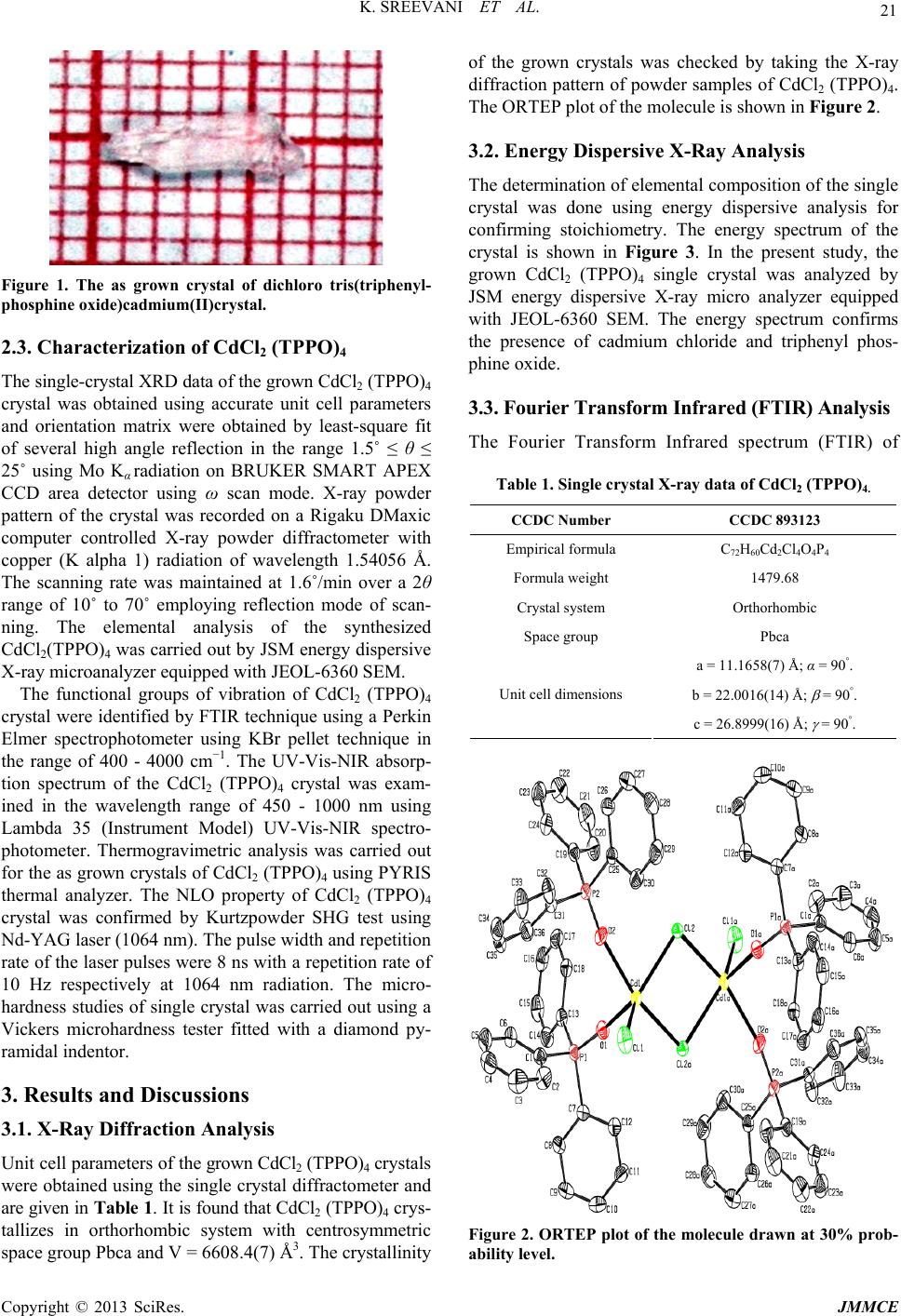 K. SREEVANI ET AL. 21 Figure 1. The as grown crystal of dichloro tris(triphenyl- phosphine oxide)cadmium(II)crystal. 2.3. Characterization of CdCl2 (TPPO)4 The single-crystal XRD data of the grown CdCl2 (TPPO)4 crystal was obtained using accurate unit cell parameters and orientation matrix were obtained by least-square fit of several high angle reflection in the range 1.5˚ ≤ θ ≤ 25˚ using Mo Kα radiation on BRUKER SMART APEX CCD area detector using ω scan mode. X-ray powder pattern of the crystal was recorded on a Rigaku DMaxic computer controlled X-ray powder diffractometer with copper (K alpha 1) radiation of wavelength 1.54056 Å. The scanning rate was maintained at 1.6˚/min over a 2θ range of 10˚ to 70˚ employing reflection mode of scan- ning. The elemental analysis of the synthesized CdCl2(TPPO)4 was carried out by JSM energy dispersive X-ray microanalyzer equipped with JEOL-6360 SEM. The functional groups of vibration of CdCl2 (TPPO)4 crystal were identified by FTIR technique using a Perkin Elmer spectrophotometer using KBr pellet technique in the range of 400 - 4000 cm−1. The UV-Vis-NIR absorp- tion spectrum of the CdCl2 (TPPO)4 crystal was exam- ined in the wavelength range of 450 - 1000 nm using Lambda 35 (Instrument Model) UV-Vis-NIR spectro- photometer. Thermogravimetric analysis was carried out for the as grown crystals of CdCl2 (TPPO)4 using PYRIS thermal analyzer. The NLO property of CdCl2 (TPPO)4 crystal was confirmed by Kurtzpowder SHG test using Nd-YAG laser (1064 nm). The pulse width and repetition rate of the laser pulses were 8 ns with a repetition rate of 10 Hz respectively at 1064 nm radiation. The micro- hardness studies of single crystal was carried out using a Vickers microhardness tester fitted with a diamond py- ramidal indentor. 3. Results and Discussions 3.1. X-Ray Diffraction Analysis Unit cell parameters of the grown CdCl2 (TPPO)4 crystals were obtained using the single crystal diffractometer and are given in Table 1. It is found that CdCl2 (TPPO)4 crys- tallizes in orthorhombic system with centrosymmetric space group Pbca and V = 6608.4(7) Å3. The crystallinity of the grown crystals was checked by taking the X-ray diffraction pattern of powder samples of CdCl2 (TPPO)4. The ORTEP plot of the molecule is shown in Figure 2. 3.2. Energy Dispersive X-Ray Analysis The determination of elemental composition of the single crystal was done using energy dispersive analysis for confirming stoichiometry. The energy spectrum of the crystal is shown in Figure 3. In the present study, the grown CdCl2 (TPPO)4 single crystal was analyzed by JSM energy dispersive X-ray micro analyzer equipped with JEOL-6360 SEM. The energy spectrum confirms the presence of cadmium chloride and triphenyl phos- phine oxide. 3.3. Fourier Transform Infrared (FTIR) Analysis The Fourier Transform Infrared spectrum (FTIR) of Table 1. Single crystal X-ray data of CdCl2 (TPPO)4. CCDC Number CCDC 893123 Empirical formula C72H60Cd2Cl4O4P4 Formula weight 1479.68 Crystal system Orthorhombic Space group Pbca a = 11.1658(7) Å; α = 90°. b = 22.0016(14) Å; = 90°. Unit cell dimensions c = 26.8999(16) Å; = 90°. Figure 2. ORTEP plot of the molecule drawn at 30% prob- ability level. Copyright © 2013 SciRes. JMMCE 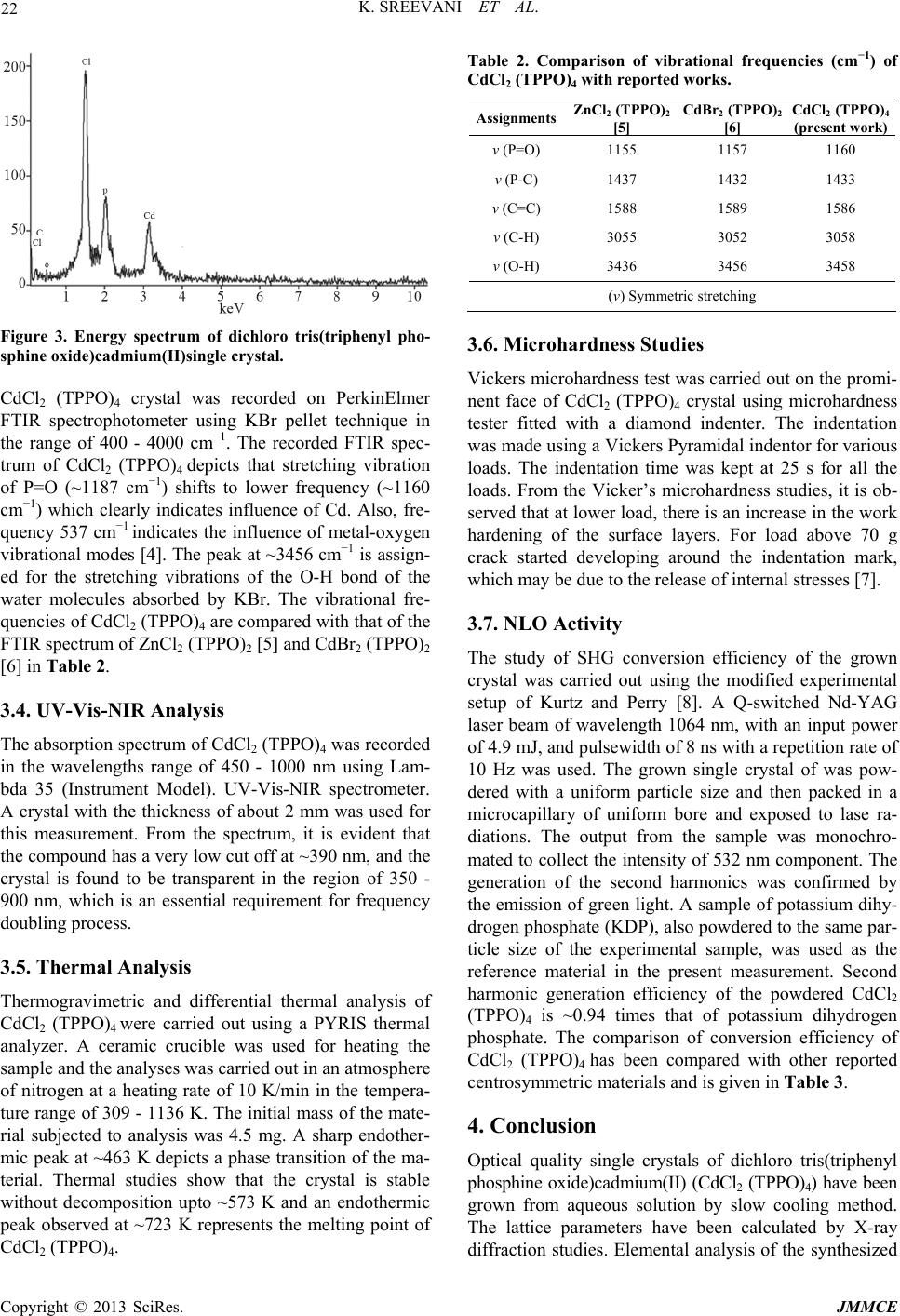 K. SREEVANI ET AL. 22 Figure 3. Energy spectrum of dichloro tris(triphenyl pho- sphine oxide)cadmium(II)single crystal. CdCl2 (TPPO)4 crystal was recorded on PerkinElmer FTIR spectrophotometer using KBr pellet technique in the range of 400 - 4000 cm−1. The recorded FTIR spec- trum of CdCl2 (TPPO)4 depicts that stretching vibration of P=O (~1187 cm−1) shifts to lower frequency (~1160 cm−1) which clearly indicates influence of Cd. Also, fre- quency 537 cm−1 indicates the influence of metal-oxygen vibrational modes [4]. The peak at ~3456 cm−1 is assign- ed for the stretching vibrations of the O-H bond of the water molecules absorbed by KBr. The vibrational fre- quencies of CdCl2 (TPPO)4 are compared with that of the FTIR spectrum of ZnCl2 (TPPO)2 [5] and CdBr2 (TPPO)2 [6] in Table 2. 3.4. UV-Vis-NIR Analysis The absorption spectrum of CdCl2 (TPPO)4 was recorded in the wavelengths range of 450 - 1000 nm using Lam- bda 35 (Instrument Model). UV-Vis-NIR spectrometer. A crystal with the thickness of about 2 mm was used for this measurement. From the spectrum, it is evident that the compound has a very low cut off at ~390 nm, and the crystal is found to be transparent in the region of 350 - 900 nm, which is an essential requirement for frequency doubling process. 3.5. Thermal Analysis Thermogravimetric and differential thermal analysis of CdCl2 (TPPO)4 were carried out using a PYRIS thermal analyzer. A ceramic crucible was used for heating the sample and the analyses was carried out in an atmosphere of nitrogen at a heating rate of 10 K/min in the tempera- ture range of 309 - 1136 K. The initial mass of the mate- rial subjected to analysis was 4.5 mg. A sharp endother- mic peak at ~463 K depicts a phase transition of the ma- terial. Thermal studies show that the crystal is stable without decomposition upto ~573 K and an endothermic peak observed at ~723 K represents the melting point of CdCl2 (TPPO)4. Table 2. Comparison of vibrational frequencies (cm−1) of CdCl2 (TPPO)4 with reported works. Assignments ZnCl2 (TPPO)2 [5] CdBr2 (TPPO)2 [6] CdCl2 (TPPO)4 (present work) ν (P=O) 1155 1157 1160 ν (P-C) 1437 1432 1433 ν (C=C) 1588 1589 1586 ν (C-H) 3055 3052 3058 ν (O-H) 3436 3456 3458 (ν) Symmetric stretching 3.6. Microhardness Studies Vickers microhardness test was carried out on the promi- nent face of CdCl2 (TPPO)4 crystal using microhardness tester fitted with a diamond indenter. The indentation was made using a Vickers Pyramidal indentor for various loads. The indentation time was kept at 25 s for all the loads. From the Vicker’s microhardness studies, it is ob- served that at lower load, there is an increase in the work hardening of the surface layers. For load above 70 g crack started developing around the indentation mark, which may be due to the release of internal stresses [7]. 3.7. NLO Activity The study of SHG conversion efficiency of the grown crystal was carried out using the modified experimental setup of Kurtz and Perry [8]. A Q-switched Nd-YAG laser beam of wavelength 1064 nm, with an input power of 4.9 mJ, and pulsewidth of 8 ns with a repetition rate of 10 Hz was used. The grown single crystal of was pow- dered with a uniform particle size and then packed in a microcapillary of uniform bore and exposed to lase ra- diations. The output from the sample was monochro- mated to collect the intensity of 532 nm component. The generation of the second harmonics was confirmed by the emission of green light. A sample of potassium dihy- drogen phosphate (KDP), also powdered to the same par- ticle size of the experimental sample, was used as the reference material in the present measurement. Second harmonic generation efficiency of the powdered CdCl2 (TPPO)4 is ~0.94 times that of potassium dihydrogen phosphate. The comparison of conversion efficiency of CdCl2 (TPPO)4 has been compared with other reported centrosymmetric materials and is given in Table 3. 4. Conclusion Optical quality single crystals of dichloro tris(triphenyl phosphine oxide)cadmium(II) (CdCl2 (TPPO)4) have been grown from aqueous solution by slow cooling method. The lattice parameters have been calculated by X-ray diffraction studies. Elemental analysis of the synthesized Copyright © 2013 SciRes. JMMCE 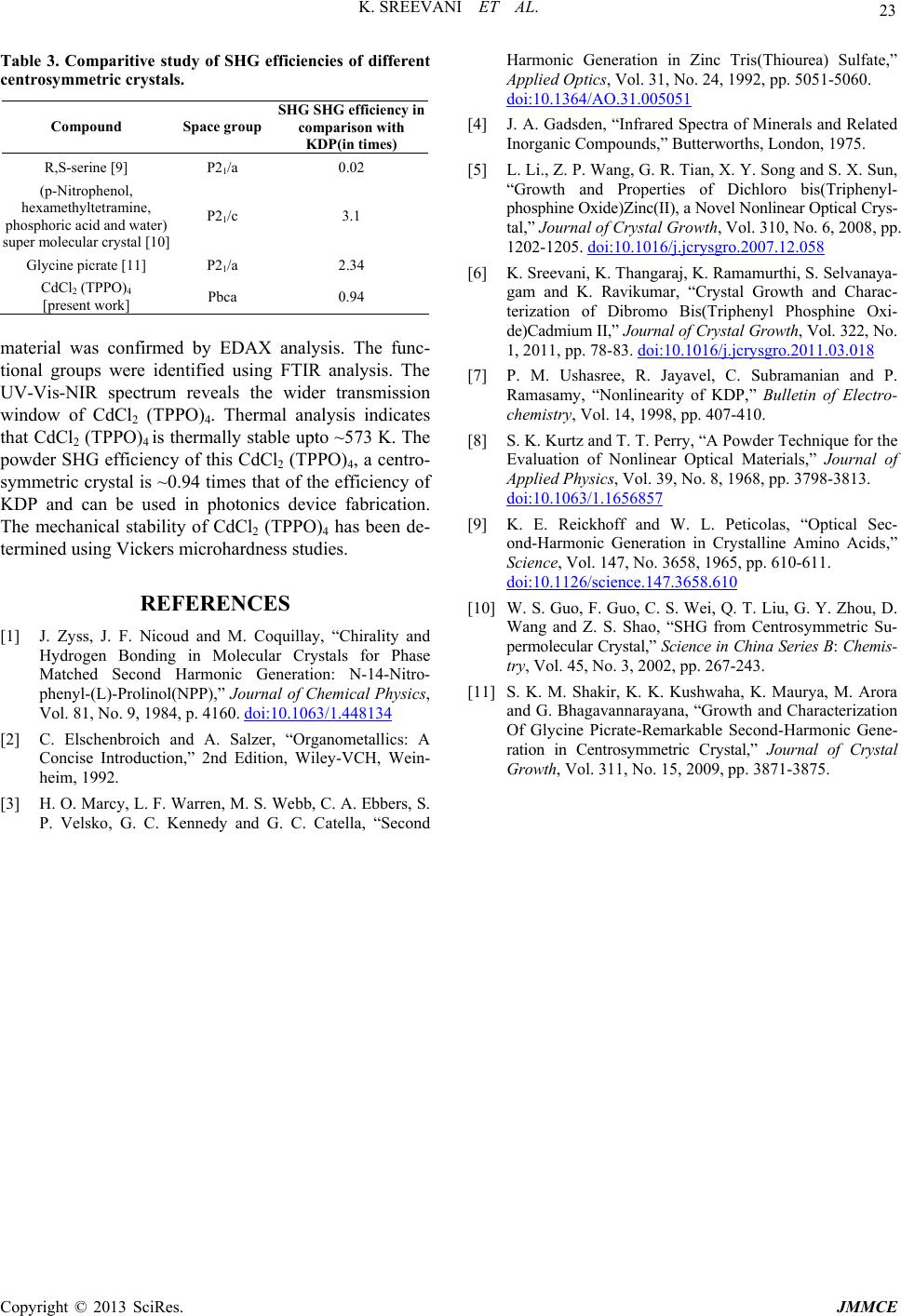 K. SREEVANI ET AL. Copyright © 2013 SciRes. JMMCE 23 Table 3. Comparitive study of SHG efficiencies of different centrosymmetric crystals. Compound Space group SHG SHG efficiency in comparison with KDP(in times) R,S-serine [9] P21/a 0.02 (p-Nitrophenol, hexamethyltetramine, phosphoric acid and water) super molecular crystal [10] P21/c 3.1 Glycine picrate [11] P21/a 2.34 CdCl2 (TPPO)4 [present work] Pbca 0.94 material was confirmed by EDAX analysis. The func- tional groups were identified using FTIR analysis. The UV-Vis-NIR spectrum reveals the wider transmission window of CdCl2 (TPPO)4. Thermal analysis indicates that CdCl2 (TPPO)4 is thermally stable upto ~573 K. The powder SHG efficiency of this CdCl2 (TPPO)4, a centro- symmetric crystal is ~0.94 times that of the efficiency of KDP and can be used in photonics device fabrication. The mechanical stability of CdCl2 (TPPO)4 has been de- termined using Vickers microhardness studies. REFERENCES [1] J. Zyss, J. F. Nicoud and M. Coquillay, “Chirality and Hydrogen Bonding in Molecular Crystals for Phase Matched Second Harmonic Generation: N-14-Nitro- phenyl-(L)-Prolinol(NPP),” Journal of Chemical Physics, Vol. 81, No. 9, 1984, p. 4160. doi:10.1063/1.448134 [2] C. Elschenbroich and A. Salzer, “Organometallics: A Concise Introduction,” 2nd Edition, Wiley-VCH, Wein- heim, 1992. [3] H. O. Marcy, L. F. Warren, M. S. Webb, C. A. Ebbers, S. P. Velsko, G. C. Kennedy and G. C. Catella, “Second Harmonic Generation in Zinc Tris(Thiourea) Sulfate,” Applied Optics, Vol. 31, No. 24, 1992, pp. 5051-5060. doi:10.1364/AO.31.005051 [4] J. A. Gadsden, “Infrared Spectra of Minerals and Related Inorganic Compounds,” Butterworths, London, 1975. [5] L. Li., Z. P. Wang, G. R. Tian, X. Y. Song and S. X. Sun, “Growth and Properties of Dichloro bis(Triphenyl- phosphine Oxide)Zinc(II), a Novel Nonlinear Optical Crys- tal,” Journal of Crystal Growth, Vol. 310, No. 6, 2008, pp. 1202-1205. doi:10.1016/j.jcrysgro.2007.12.058 [6] K. Sreevani, K. Thangaraj, K. Ramamurthi, S. Selvanaya- gam and K. Ravikumar, “Crystal Growth and Charac- terization of Dibromo Bis(Triphenyl Phosphine Oxi- de)Cadmium II,” Journal of Crystal Growth, Vol. 322, No. 1, 2011, pp. 78-83. doi:10.1016/j.jcrysgro.2011.03.018 [7] P. M. Ushasree, R. Jayavel, C. Subramanian and P. Ramasamy, “Nonlinearity of KDP,” Bulletin of Electro- chemistry, Vol. 14, 1998, pp. 407-410. [8] S. K. Kurtz and T. T. Perry, “A Powder Technique for the Evaluation of Nonlinear Optical Materials,” Journal of Applied Physics, Vol. 39, No. 8, 1968, pp. 3798-3813. doi:10.1063/1.1656857 [9] K. E. Reickhoff and W. L. Peticolas, “Optical Sec- ond-Harmonic Generation in Crystalline Amino Acids,” Science, Vol. 147, No. 3658, 1965, pp. 610-611. doi:10.1126/science.147.3658.610 [10] W. S. Guo, F. Guo, C. S. Wei, Q. T. Liu, G. Y. Zhou, D. Wang and Z. S. Shao, “SHG from Centrosymmetric Su- permolecular Crystal,” Science in China Series B: Chemis- try, Vol. 45, No. 3, 2002, pp. 267-243. [11] S. K. M. Shakir, K. K. Kushwaha, K. Maurya, M. Arora and G. Bhagavannarayana, “Growth and Characterization Of Glycine Picrate-Remarkable Second-Harmonic Gene- ration in Centrosymmetric Crystal,” Journal of Crystal Growth, Vol. 311, No. 15, 2009, pp. 3871-3875. |