

Paper Menu >>
Journal Menu >>
 Journal of Minerals and Materials Characterization and Engineering, 2013, 1, 15-19 http://dx.doi.org/10.4236/jmmce.2013.11003 Published Online January 2013 (http://www.scirp.org/journal/jmmce) Corrosion Behaviour of Al6061-Frit Particulate Metal Matrix Composites in Sodium Chloride Solution Dasappa Ramesh1*, Ragera Parameshwarappa Swamy2, Tumkur Krishnamurthy Chandrashekar3 1Sri Siddhartha Institute of Technology, Kamataka, India 2Department of Studies in Mechanical E ngineering , University B.D.T. College of Engineering, Kamataka, India 3Department of Mechanical Engineering, Sri Siddhartha Institute of Technology, Kamataka, India Email: *[email protected] Received July 5, 2012; revised September 5, 2012; accepted September 20, 2012 ABSTRACT In this investigation, an attempt has been made to develop Al6061-Frit particulate metal matrix composites through stir casting technique using metal molds and to study the corrosion behaviour. Pre heated frit particles were added to matrix as reinforcement. Al6061 containing 2 wt% to 8 wt% in steps of 2 wt% of frit particulate composites were prepared. Corrosion tests were conducted by using Potentiostat model SEP238C where 3.5% NaCl solution was used as corrodent. The corrosion rate of metal matrix composites was lower than that of matrix material Al6061 under the corrosive at- mosphere for both un-heat treated and heat treated conditions. Keywords: Al6061 Alloy; Frit; Stir Casting; Potentiostat; Corrosion Rate (mmpy) 1. Introduction The literature survey on metal matrix composites indicate that much published information is not available on de- velopment, and corrosion behaviour of Al6061-Frit par- ticulate metal matrix composites. From the literature sur- vey, it is reported by many researchers have reported that melting and casting technique is the most economical way of producing Discontinuous Reinforced Metal Matrix Composite (DRMMCs) [1-5]. Al alloy based particulate reinforced composites have a large potential for a wide number of engineering appli- cations. Attraction in reinforcing of ceramic particles in Al alloy matrix materials is mainly due to low density, low co-efficient of thermal expansion and high strength of reinforcements and also their availability. Among available various useful aluminium alloys, Al6061 is ty- pically characterized by several advantages and proper- ties such as excellent casting properties, reasonable strength, fluidity, corrosion resistance, high strength to weight ratio and heat treatable. Al6061 has been com- monly used as base metal for aluminium metal matrix composites (AMCs) reinforced with a variety of rein- forcements [6-8]. Corrosion is the disintegration of an engineered material into its constituent atoms due to chemical reactions with its surroundings. Corrosion means in common elec- trochemical oxidation of metals in reaction with an oxi- dant such as oxygen. Formation of an oxide of iron due to oxidation of the iron atoms in solid solution is a well- known example of electrochemical corrosion (rusting). This type of damage typically produces oxides and/or salts of the original metal. Corrosion can also occur in materials other than metals and alloys, such as ceramics or polymers. S. Samala et al. studied the corrosion behaviour in 3.4% NaCl-solution, which is similar to marine environ- ment and stated that both the yield strength and tensile strength decreases with increasing corrosion rate. In acidic environment yield is directly proportional to corrosion rate and tensile strength inversely proportional corrosion rate [9]. An aggressive marine environment was simulated by preparing 3.5 wt% NaCl, NaOH and H2SO4 solution by K. K. Alaneme et al. [10] and studied the corrosion be- havior of AA6063/Al2O3p composite in NaCl, NaOH and H2SO4 was investigated. They observed that Al(6063)— Al2O3 composites exhibited excellent corrosion resistance in NaCl medium than in the NaOH and H2SO4 med ia. M. A. Bodude et al., in their research work they have identified austempering heat-treatment is an effective technique for improving the corrosive wear resistance of ST60Mn steel in cassava juice [11]. The aim of this present research is to study the corro- sion behaviour of Al6061 alloy reinforced with frit par- ticulates. Acid medium was selected to study the corro- sion behaviour of this alloy and Al6061-Frit particulate *Corresponding author. C opyright © 2013 SciRes. JMMCE 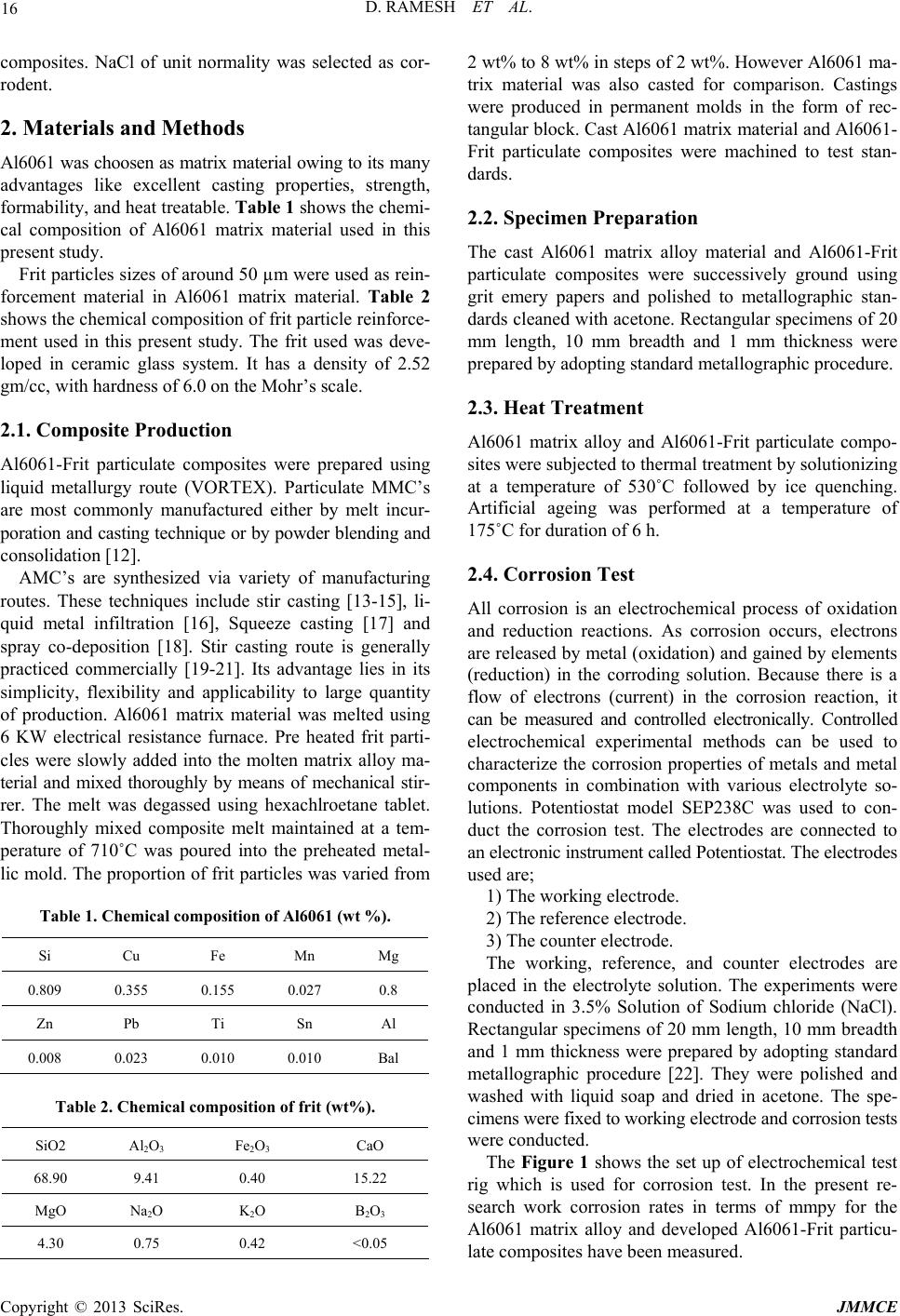 D. RAMESH ET AL. 16 composites. NaCl of unit normality was selected as cor- rodent. 2. Materials and Methods Al6061 was choosen as matrix material owing to its many advantages like excellent casting properties, strength, formability, and heat treatable. Table 1 shows the chemi- cal composition of Al6061 matrix material used in this present study. Frit particles sizes of around 50 µm were used as rein- forcement material in Al6061 matrix material. Table 2 shows the chemical co mposition of frit particle reinforce- ment used in this present study. The frit used was deve- loped in ceramic glass system. It has a density of 2.52 gm/cc, with hardness of 6.0 on the Mohr’s scale. 2.1. Composite Production Al6061-Frit particulate composites were prepared using liquid metallurgy route (VORTEX). Particulate MMC’s are most commonly manufactured either by melt incur- poration and casting technique or by powder blending and consolidation [12]. AMC’s are synthesized via variety of manufacturing routes. These techniques include stir casting [13-15], li- quid metal infiltration [16], Squeeze casting [17] and spray co-deposition [18]. Stir casting route is generally practiced commercially [19-21]. Its advantage lies in its simplicity, flexibility and applicability to large quantity of production. Al6061 matrix material was melted using 6 KW electrical resistance furnace. Pre heated frit parti- cles were slowly added into the molten matrix alloy ma- terial and mixed thoroughly by means of mechanical stir- rer. The melt was degassed using hexachlroetane tablet. Thoroughly mixed composite melt maintained at a tem- perature of 710˚C was poured into the preheated metal- lic mold. The proportion of frit particles was varied from Table 1. Chemical composition of Al6061 (wt %). Si Cu Fe Mn Mg 0.809 0.355 0.155 0.027 0.8 Zn Pb Ti Sn Al 0.008 0.023 0.010 0.010 Bal Table 2. Chemical composition of frit (wt%). SiO2 Al2O3 Fe2O3 CaO 68.90 9.41 0.40 15.22 MgO Na2O K2O B2O3 4.30 0.75 0.42 <0.05 2 wt% to 8 wt% in steps of 2 wt%. However Al6061 ma- trix material was also casted for comparison. Castings were produced in permanent molds in the form of rec- tangular block. Cast Al6061 matrix materia l and Al6061- Frit particulate composites were machined to test stan- dards. 2.2. Specimen Preparation The cast Al6061 matrix alloy material and Al6061-Frit particulate composites were successively ground using grit emery papers and polished to metallographic stan- dards cleaned with acetone. Rectangular specimens of 20 mm length, 10 mm breadth and 1 mm thickness were prepared by adopting standard metallographic procedure. 2.3. Heat Treatment Al6061 matrix alloy and Al6061-Frit particulate compo- sites were subjected to thermal treatment by solu tionizing at a temperature of 530˚C followed by ice quenching. Artificial ageing was performed at a temperature of 175˚C for duration of 6 h. 2.4. Corrosion Test All corrosion is an electrochemical process of oxidation and reduction reactions. As corrosion occurs, electrons are released by metal (oxidation) and gained by elements (reduction) in the corroding solution. Because there is a flow of electrons (current) in the corrosion reaction, it can be measured and controlled electronically. Controlled electrochemical experimental methods can be used to characterize the corrosion properties of metals and metal components in combination with various electrolyte so- lutions. Potentiostat model SEP238C was used to con- duct the corrosion test. The electrodes are connected to an electronic instrument called Potentiostat. The electrodes used are; 1) The working electrode. 2) The reference electrode. 3) The counter electrode. The working, reference, and counter electrodes are placed in the electrolyte solution. The experiments were conducted in 3.5% Solution of Sodium chloride (NaCl). Rectangular specimens of 20 mm length, 10 mm breadth and 1 mm thickness were prepared by adopting standard metallographic procedure [22]. They were polished and washed with liquid soap and dried in acetone. The spe- cimens were fixed to working electrode and corrosion tests were conducted. The Figure 1 shows the set up of electrochemical test rig which is used for corrosion test. In the present re- search work corrosion rates in terms of mmpy for the Al6061 matrix alloy and developed Al6061-Frit particu- late composites have been measured. Copyright © 2013 SciRes. JMMCE 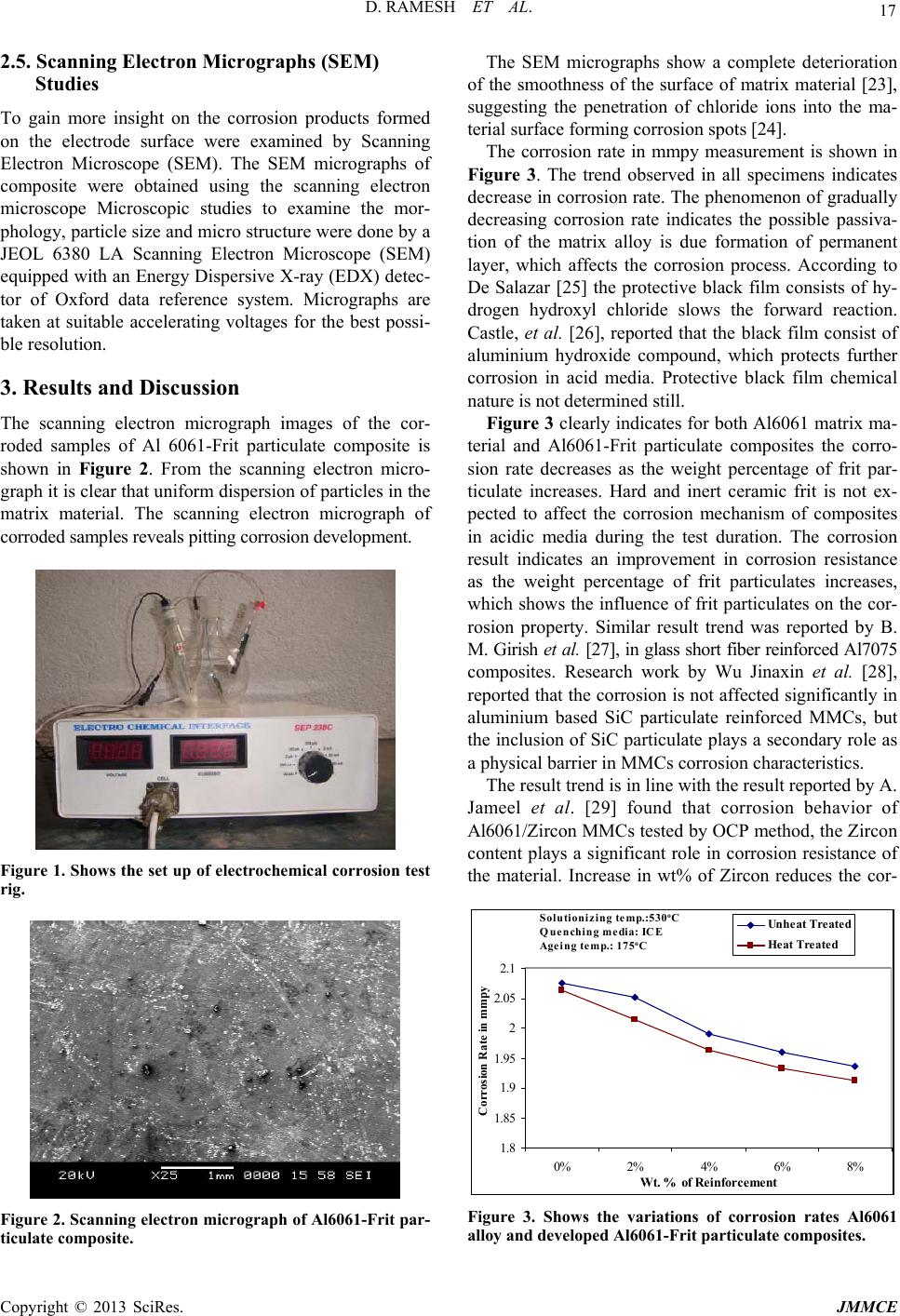 D. RAMESH ET AL. 17 2.5. Scanning Electron Micrographs (SEM) Studies To gain more insight on the corrosion products formed on the electrode surface were examined by Scanning Electron Microscope (SEM). The SEM micrographs of composite were obtained using the scanning electron microscope Microscopic studies to examine the mor- phology, particle size and micro structure were done by a JEOL 6380 LA Scanning Electron Microscope (SEM) equipped with an Energy Dispersive X-ray (EDX) detec- tor of Oxford data reference system. Micrographs are taken at suitable accelerating voltages for the best possi- ble resolution. 3. Results and Discussion The scanning electron micrograph images of the cor- roded samples of Al 6061-Frit particulate composite is shown in Figure 2. From the scanning electron micro- graph it is clear that uniform dispersion of particles in the matrix material. The scanning electron micrograph of corroded samples reveals pitting corrosion development . Figure 1. Shows the set up of electrochemical corrosion test rig. Figure 2. Scanning electron micrograph of Al6061-Frit par- ticulate composite. The SEM micrographs show a complete deterioration of the smoothness of the surface of matrix material [23], suggesting the penetration of chloride ions into the ma- terial surface forming corrosion spots [24]. The corrosion rate in mmpy measurement is shown in Figure 3. The trend observed in all specimens indicates decrease in corrosion rate. The phenomenon of gradually decreasing corrosion rate indicates the possible passiva- tion of the matrix alloy is due formation of permanent layer, which affects the corrosion process. According to De Salazar [25] the protective black film consists of hy- drogen hydroxyl chloride slows the forward reaction. Castle, et al. [26], reported that the black film consist of aluminium hydroxide compound, which protects further corrosion in acid media. Protective black film chemical nature is not determined still. Figure 3 clearly indicates for both Al6061 matrix ma- terial and Al6061-Frit particulate composites the corro- sion rate decreases as the weight percentage of frit par- ticulate increases. Hard and inert ceramic frit is not ex- pected to affect the corrosion mechanism of composites in acidic media during the test duration. The corrosion result indicates an improvement in corrosion resistance as the weight percentage of frit particulates increases, which shows the influence of frit particulates on the cor- rosion property. Similar result trend was reported by B. M. Girish et al. [27], in glass short fiber reinforced Al7075 composites. Research work by Wu Jinaxin et al. [28], reported that the corrosion is not affected significantly in aluminium based SiC particulate reinforced MMCs, but the inclusion of SiC particulate plays a secondary role as a physical barrier in MMCs corrosion characteristics. The result trend is in line with the result reported by A. Jameel et al. [29] found that corrosion behavior of Al6061/Zirc on MMC s te sted by O CP me thod , th e Zi rcon content plays a significant role in corrosion resistance of the material. Increase in wt% of Zircon reduces the cor- 1.8 1.85 1.9 1.95 2 2.05 2.1 0% 2%4% 6% 8% Wt . % o f Rein forcement Corrosion Rate in mmpy Unheat Treated Heat Treated Sol utionizi n g temp.:530 o C Qu enchi ng m edia: IC E Ageing tem p.: 17 5 o C Figure 3. Shows the variations of corrosion rates Al6061 alloy and developed Al6061-Frit particulate composites. Copyright © 2013 SciRes. JMMCE 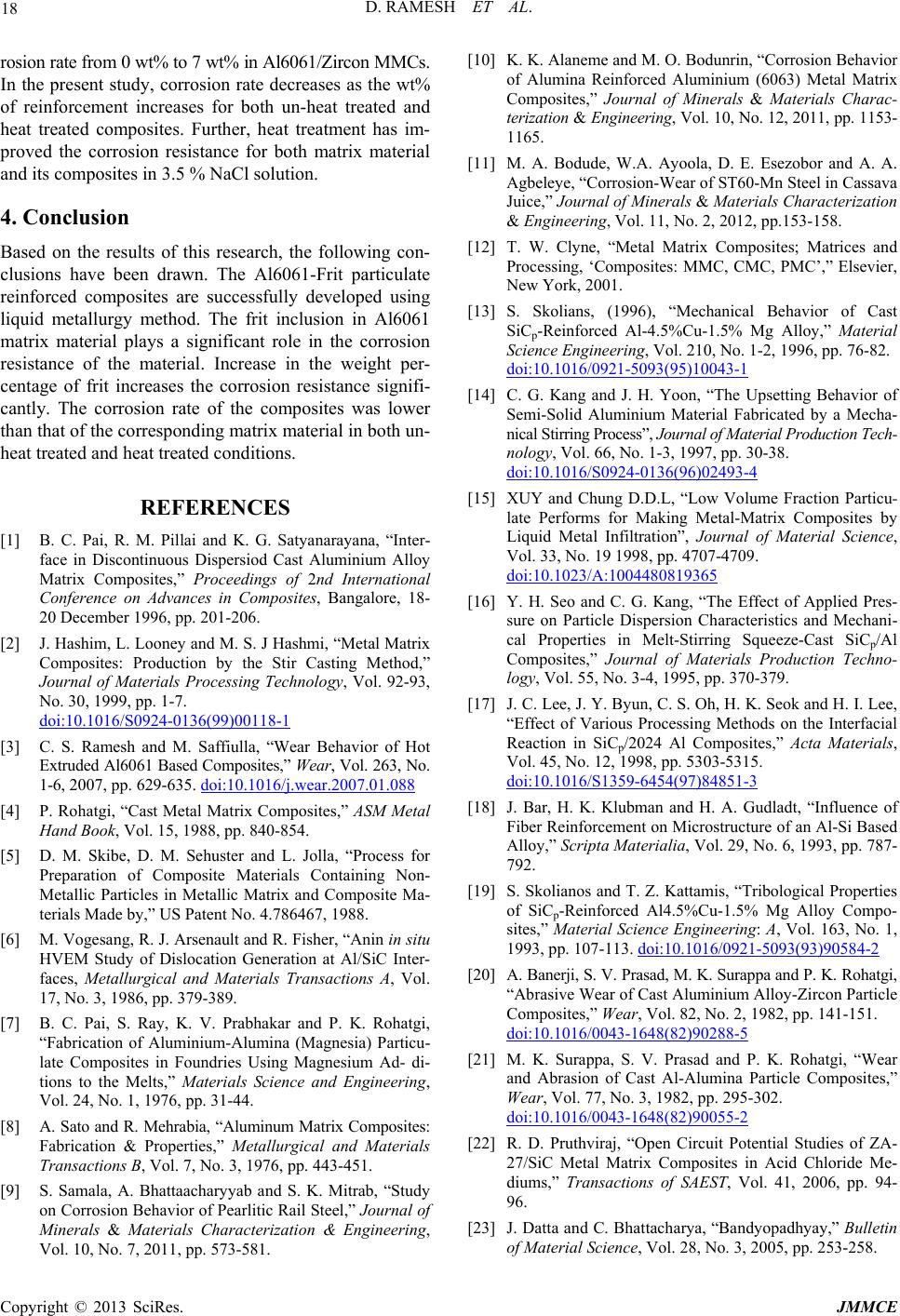 D. RAMESH ET AL. 18 rosion rate from 0 wt% to 7 wt% in Al6061/Zircon MMCs. In the present study, corrosion rate decreases as the wt% of reinforcement increases for both un-heat treated and heat treated composites. Further, heat treatment has im- proved the corrosion resistance for both matrix material and its composites in 3.5 % NaCl solution. 4. Conclusion Based on the results of this research, the following con- clusions have been drawn. The Al6061-Frit particulate reinforced composites are successfully developed using liquid metallurgy method. The frit inclusion in Al6061 matrix material plays a significant role in the corrosion resistance of the material. Increase in the weight per- centage of frit increases the corrosion resistance signifi- cantly. The corrosion rate of the composites was lower than that of the corresp onding matrix material in b o th un- heat treated and heat treated conditions. REFERENCES [1] B. C. Pai, R. M. Pillai and K. G. Satyanarayana, “Inter- face in Discontinuous Dispersiod Cast Aluminium Alloy Matrix Composites,” Proceedings of 2nd International Conference on Advances in Composites, Bangalore, 18- 20 December 1996, pp. 201-206. [2] J. Hashim, L. Looney and M. S. J Hashmi, “Metal Ma trix Composites: Production by the Stir Casting Method,” Journal of Materials Processing Technology, Vol. 92-93, No. 30, 1999, pp. 1-7. doi:10.1016/S0924-0136(99)00118-1 [3] C. S. Ramesh and M. Saffiulla, “Wear Behavior of Hot Extruded Al6061 Based Comp osites,” Wear, Vol. 263, No. 1-6, 2007, pp. 629-635. doi:10.1016/j.wear.2007.01.088 [4] P. Rohatgi, “Cast Metal Matrix Composites,” ASM Metal Hand Book, Vol. 15, 1988, pp. 840-854. [5] D. M. Skibe, D. M. Sehuster and L. Jolla, “Process for Preparation of Composite Materials Containing Non- Metallic Particles in Metallic Matrix and Composite Ma- terials Made by,” US Patent No. 4.786467, 1988. [6] M. Vogesang, R. J. Arsenault and R. Fisher, “Anin in situ HVEM Study of Dislocation Generation at Al/SiC Inter- faces, Metallurgical and Materials Transactions A, Vol. 17, No. 3, 1986, pp. 379-389. [7] B. C. Pai, S. Ray, K. V. Prabhakar and P. K. Rohatgi, “Fabrication of Aluminium-Alumina (Magnesia) Particu- late Composites in Foundries Using Magnesium Ad- di- tions to the Melts,” Materials Science and Engineering, Vol. 24, No. 1, 1976, pp. 31-44. [8] A. Sato and R. Mehrabia, “Aluminum Matrix Composites: Fabrication & Properties,” Metallurgical and Materials Transactions B, Vol. 7, No. 3, 1976, pp. 443-451. [9] S. Samala, A. Bhattaacharyyab and S. K. Mitrab, “Study on Corrosion Behavior of Pearlitic Rail Steel ,” Journal of Minerals & Materials Characterization & Engineering, Vol. 10, No. 7, 2011, pp. 573-581. [10] K. K. Alaneme and M. O. Bodunrin, “Corrosion Behavior of Alumina Reinforced Aluminium (6063) Metal Matrix Composites,” Journal of Minerals & Materials Charac- terization & Engineering, Vol. 10, No. 12, 2011, pp. 1153- 1165. [11] M. A. Bodude, W.A. Ayoola, D. E. Esezobor and A. A. Agbeleye, “Corrosion-Wear of ST60-Mn Steel in Cassava Juice,” Journal of Minerals & Materials Characterization & Engineering, Vol. 11, No. 2, 2012, pp.153-158. [12] T. W. Clyne, “Metal Matrix Composites; Matrices and Processing, ‘Composites: MMC, CMC, PMC’,” Elsevier, New York, 2001. [13] S. Skolians, (1996), “Mechanical Behavior of Cast SiCp-Reinforced Al-4.5%Cu-1.5% Mg Alloy,” Material Science Engineering, Vol. 210, No. 1-2, 1996, pp. 76-82. doi:10.1016/0921-5093(95)10043-1 [14] C. G. Kang and J. H. Yoon, “The Upsetting Behavior of Semi-Solid Aluminium Material Fabricated by a Mecha- nical Stirring Process”, Journal of Materia l Production Tech- nology, Vol. 66, No. 1-3, 1997, pp. 30-38. doi:10.1016/S0924-0136(96)02493-4 [15] XUY and Chung D.D.L, “Low Volume Fraction Particu- late Performs for Making Metal-Matrix Composites by Liquid Metal Infiltration”, Journal of Material Science, Vol. 33, No. 19 1998, pp. 4707-4709. doi:10.1023/A:1004480819365 [16] Y. H. Seo and C. G. Kang, “The Effect of Applied Pres- sure on Particle Dispersion Characteristics and Mechani- cal Properties in Melt-Stirring Squeeze-Cast SiCp/Al Composites,” Journal of Materials Production Techno- logy, Vol. 55, No. 3-4, 1995, pp. 370-379. [17] J. C. Lee, J. Y. Byun, C. S. Oh, H. K. Seok and H. I. Lee, “Effect of Various Processing Methods on the Interfacial Reaction in SiCp/2024 Al Composites,” Acta Materials, Vol. 45, No. 12, 1998, pp. 5303-5315. doi:10.1016/S1359-6454(97)84851-3 [18] J. Bar, H. K. Klubman and H. A. Gudladt, “Influence of Fiber Reinforcement on Microstructure of an Al-Si Based Alloy,” Scripta Materialia, Vol. 29, No. 6, 1993, pp. 787- 792. [19] S. Skolianos and T. Z. Kattamis, “Tribological Properties of SiCp-Reinforced Al4.5%Cu-1.5% Mg Alloy Compo- sites,” Material Science Engineering: A, Vol. 163, No. 1, 1993, pp. 107-113. doi:10.1016/0921-5093(93)90584-2 [20] A. Banerji, S. V. Prasad, M. K. Surappa and P. K. Rohatgi, “Abrasive Wear of Cast Aluminium Alloy-Zircon Particle Composites,” Wear, Vol. 82, No. 2, 1982, pp. 141-151. doi:10.1016/0043-1648(82)90288-5 [21] M. K. Surappa, S. V. Prasad and P. K. Rohatgi, “Wear and Abrasion of Cast Al-Alumina Particle Composites,” Wear, Vol. 77, No. 3, 1982, pp. 295-302. doi:10.1016/0043-1648(82)90055-2 [22] R. D. Pruthviraj, “Open Circuit Potential Studies of ZA- 27/SiC Metal Matrix Composites in Acid Chloride Me- diums,” Transactions of SAEST, Vol. 41, 2006, pp. 94- 96. [23] J. Datta and C. Bhattacharya, “Bandyopadhyay,” Bulletin of Material Science, Vol. 28, No. 3, 2005, pp. 253-258. Copyright © 2013 SciRes. JMMCE  D. RAMESH ET AL. Copyright © 2013 SciRes. JMMCE 19 doi:10.1007/BF02711257 [24] W.A. Badawy, F.M, Al-Kharafi and A.S. El-Azab, “Elec- trochemical Behaviour and Corrosion Inhibition of Al, Al-6061 and Al-Cu in Neutral Aqueous Solutions,” Cor- rosion Science, Vol. 41, No. 4, 1999, pp. 709-727. doi:10.1016/S0010-938X(98)00145-0 [25] J. M. G. DeSalazar, A. Urefia, S. Mazanedo and M. Bar- rens, “Corrosion Behaviour of AA6061 and AA7075 Re- inforced with Al2O3 Particulates in Aerated 3.5% Chlo- ride Solution Potentiodynamic Measurements and Micro- structure Evaluation,” Corrosion Science, Vol. 41, No. 3, 1999, pp. 529-545. doi:10.1016/S0010-938X(98)00135-8 [26] J. E. Castle, L. Sun and H. Yan, “The Use of Scanning Auger Microscopy to Locate Cathodic Centers in SiC/Al6061 MMC and to Determine the Current Density at Which They Operate, ” Corrosion Science, Vol. 36, No. 6, 1994, pp. 1093-1110. doi:10.1016/0010-938X(94)90206-2 [27] B. M. Satish, et.al., “Corrosion Characteristics of ZA-27/ Glass-Fiber Composites,” Corrosion science, Vol. 39, No. 12, 1997, pp. 2143-2150. doi:10.1016/S0010-938X(97)00098-X [28] J. X. Wu, W. Liu P. X. L i an d R. J. Wu, “E ffect of Matrix Alloying Elements on the Corrosion Resistance of C/Al Composites Materials,” Journal of Materials Science Let- ters, Vol. 12, 1993, pp. 1500-1501. [29] A. Jameel, H. P. Nagaswarupa., P. V. Krupakara and K. C. Vijayamma, “Corrosion Characterization of Al6061/Zir- con Metal Matrix Composites in Acid Chloride Mediums by Open Circuit Potential Studies,” International Journal of Applied Chemistry, Vol. 5, No. 1, 2009, pp. 1-10. |