

Paper Menu >>
Journal Menu >>
 Journal of Environmental Protec tion, 2013, 4, 16-22 doi:10.4236/jep.2013.41b004 Published Online January 2013 (http://www.SciRP.org/journal/jep) Copyright © 2013 SciRes. JEP Development of High Efficient and Low Toxic Oil Spill Dispersants Based on Sorbitol Derivants Nonionic Surfactants and Glycolipid Biosurfactants Dandan Song1,2, Shengkang Liang1,2*, Qianqian Zhang1,2, Jiangtao Wang1,2, Limei Yan1,2 1Key Laboratory of Marine Chemistry Theory and Technology, Ministry of Education, Qingdao, China; 2College of Chemistry and Chemical Engineering, Ocean University of China, Qingdao, China. Email: *[email protected] Received 2013 ABSTRACT Dispersant s , usually blending with several surfactants and a solvent, are used to enhance oil spill dispersion as small droplets in water column. Although there is growing acceptance of dispersants as a counter measure to marine oil spills around the world, the two major issues with the dispersants are their toxicity to marine life and dispersion effectiveness (DE) for crude-oil, especially for heavy oil. To develop more efficient and less toxic dispersants, two kinds of sorbitol derivant nonionic surfactant (polysorbate 85 and sorbeth-40 tetraoleate), two kinds of glycolipid biosurfactants (rham- nolipid and sophorolipid) and less toxic solvent ethylene glycol but yl ether were chosen in this study, and two di sper- sant formulations were optimized by uniform design methods. Effects of dispersant-to-oil ratio, temperature, salinity and pH on the performance of the two optimized dispersants were investigated. The two dispersants had hi gh d i spe r sio n effectiveness (DE) for heavy crude oil, while both dispersants keep high DE at the dispersant-to-oil ratio below 1:25 and the temperature above 5˚C. In addition, the two dispersants also performed well in a wide range of salinity and pH values. Finally, toxicity tests revealed that the two dispersan ts showed lo w toxicity to two kinds of fish (Danio rerio and Microgobius gulosus). Keywords: Oil Spill Dispersant; For mula Uniform Design; Ba ffled Flask Test; Ef fectiven e ss; Toxicit y 1. Introduction Increasing exploitation, production, transportation, and storage of oil around the world have caused more oil spills in the oceans [1-3]. When an oil spill occurs, the spills will most likely spread over a large area under gra- vitational, surface tension, and viscous forces if the quick response is not initiated and the environmental and eco- nomic effects can be devastating, such as sensitive shore- lines, local wildlife and plant life [4]. So, careful spill response technologies are needed to minimize the dam- age of oil spills at sea. Except for mechanical response and in situ burning, the application of chemical disper- sants is an efficient mean of reducing the environmental and economic impact of spilled oil [5]. Dispersants are usually sprayed onto oil slicks to ac- celerate the dispersion of oil from the sea surface into the water column. A typical dispersant may consist of three or mor e surfa ctant s and solve nt. S urfacta nts u suall y have oil-soluble hydrocarbon chains and water-soluble groups, are partially soluble in both oil and water, and the free energy of the system is minimized when surfactants are present at the oil-water interface [6]. Surfactant blends show high dispersant effectiveness when compared with individuals, means synergistic agonistic interactions be- tween surfactants [7,8] Nevertheless, not all surfactant compositions are suitable for consisting dispersants to disperse spilled oil effectively, and many of the effective ones have the drawbacks of being toxic and/or non-bio- degradable [9]. During the 1970s and 80s, many coun- tries resisted the use of dispersants. This was mainly be- cause of high toxicity of dispersants, which contains some aromatics compounds in the solvents. For example, the Torrey Canyon spill, in which the use of toxic dis- persant led to subsequent widespread environmental damage and an impression that dispersant use only adds to the problem. [10]. During the course of years, the chemical compositions of dispersants have been chang- ing from especially toxic ones to not so toxic products. Man y o f mo d er n d isp e rsants a r e ve r y lo w i n toxi city – an order of ma gnitude lo wer than man y common house hold products, which could be related use of nonionic surfac- tant and solvents such as the glycol ethers and water in- *Corresponding author. 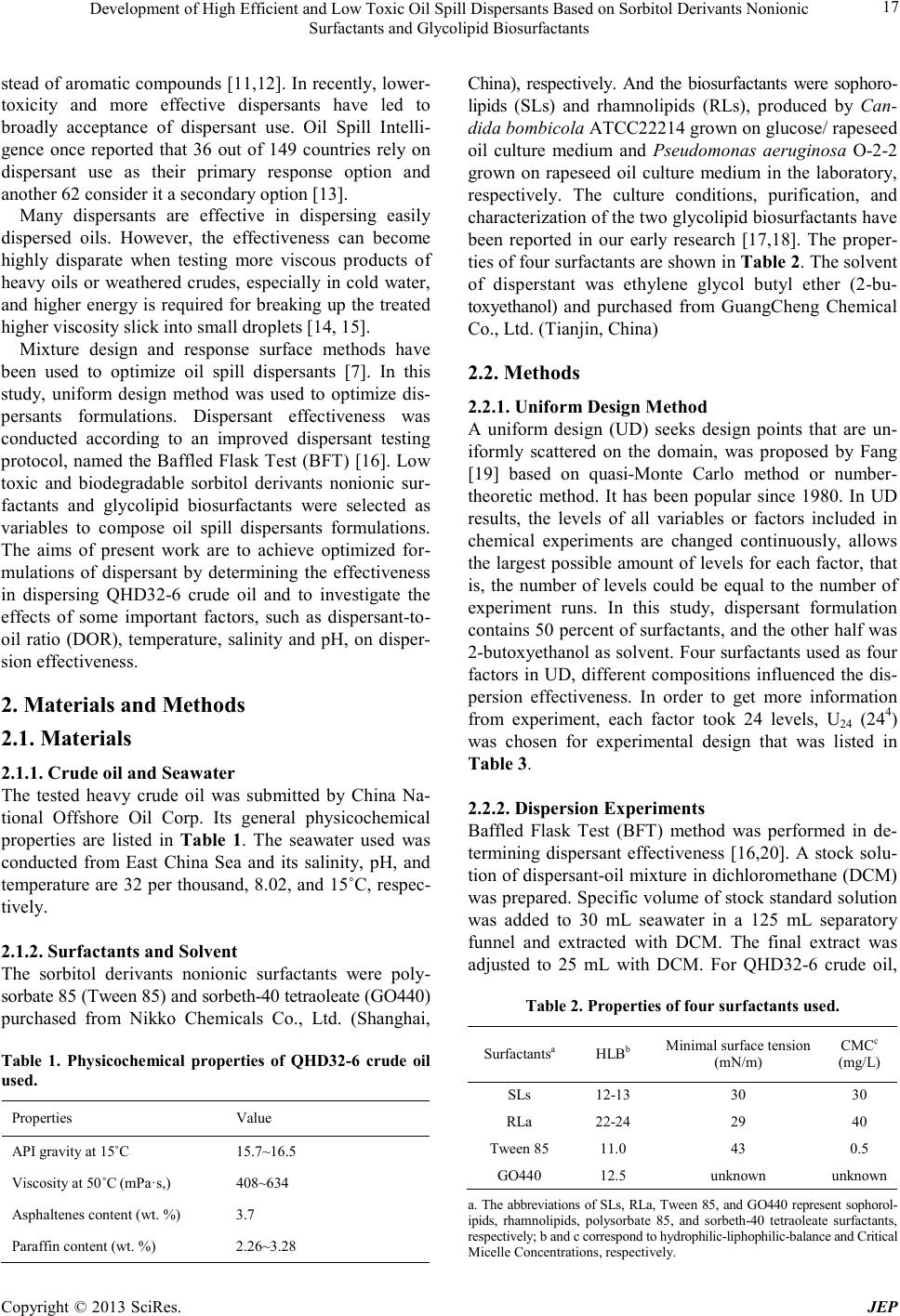 Development of High Efficient and Low Toxic Oil Spill Dispersants Based on Sorbitol Derivants Nonionic Surfactants and Glycolipid Biosurfactants Copyright © 2013 SciRes. JEP 17 stead of aromatic compounds [11,12]. In recently, lower- toxicity and more effective dispersants have led to broadly acceptance of dispersant use. Oil Spill Intelli- gence once reported that 36 out of 149 countries rely on dispersant use as their primary response option and another 62 consider it a secondary option [13]. Many dispersants are effective in dispersing easily dispersed oils. However, the effectiveness can become highly disparate when testing more viscous products of heavy oils or weathered crudes, especially in cold water, and higher energy is required for breaking up the treated higher vi scosity slick into small drople ts [ 14, 15]. Mixture design and response surface methods have been used to optimize oil spill dispersants [7]. In this study, uniform design method was used to optimize dis- persants formulations. Dispersant effectiveness was conducted according to an improved dispersant testing protocol, named the Baffled Flask Test (BFT) [16]. Low toxic and biodegradable sorbitol derivants nonionic sur- factants and glycolipid biosurfactants were selected as variables to compose oil spill dispersants formulations. The aims of present work are to achieve optimized for- mulations of dispersant by determining the effectiveness in dispersing QHD32-6 crude oil and to investigate the effects of some important factors, such as dispersant-to- oil ratio (DOR), temperature, salinity and pH, on disper- sion effec tiveness. 2. Materials and Methods 2.1. Material s 2.1.1. Crude oil and Seawater The tested heavy crude oil was submitted by China Na- tional Offshore Oil Corp. Its general physicochemical properties are listed in Table 1. The seawater used was conducted from East China Sea and its salinity, pH, and temperature are 32 per thousand, 8.02, and 15˚C, respec- tively. 2.1.2. Surfactants and Solvent The sorbitol derivants nonionic surfactants were poly- sorbate 85 (Tween 85) and sorbeth-40 tetraoleate (GO440) purchased from Nikko Chemicals Co., Ltd. (Shanghai, Table 1. Physicochemical properties of QHD32 -6 crude oil used. Properties Value API gravity at 15˚C 15.7~16.5 Viscosity at 50˚C (mPa·s,) 408~634 Asphaltenes content (wt. %) 3.7 Paraffin cont ent (wt. %) 2.26~3.28 China), respectively. And the biosurfactants were sophoro- lipid s (SLs) and rhamnolipids (RLs), produced by Can- dida bombicola ATCC22214 grown on glucose/ rapeseed oil culture medium and Pseudomonas aeruginosa O-2-2 grown on rapeseed oil culture medium in the laboratory, respectively. The culture conditions, purification, and characterization of the two glycolipid biosurfactant s ha ve been reported in our early research [17,18]. The proper- ties o f fo ur s u rfactants are shown in Ta ble 2 . T he s ol ve nt of disperstant was ethylene glycol butyl ether (2-bu- toxyethanol) and purchased from GuangCheng Chemical Co., Ltd. (Tianjin, China) 2.2. Methods 2.2.1. Uniform Design Method A uniform design (UD) seeks design points that are un- iformly scattered on the domain, was proposed by Fang [19] based on quasi-Monte Carlo method or number - theoretic method. It has been popular since 1980. In UD results, the levels of all variables or factors included in chemical experiments are changed continuously, allows the largest po ssible a mount of le vels for ea ch factor, that is, the number of levels could be equal to the number of experiment runs. In this study, dispersant formulation contains 50 percent of surfactants, and the other half was 2-buto xyetha nol a s solve nt. F our sur facta nts use d as four factors in UD, different compositions influenced the dis- persion effectiveness. In order to get more information from experiment, each factor took 24 levels, U24 (244) was chosen for experimental design that was listed in Table 3. 2.2.2. Dispersion Experiments Baffled Flask Test (BFT) method was performed in de- termining dispersant effectiveness [16,20]. A stock solu- tion of dispersant-oil mixt ure i n dichlo romet hane ( DCM) was prepared. Specific volume of stock standard solution was added to 30 mL seawater in a 125 mL separatory funnel and extracted with DCM. The final extract was adjusted to 25 mL with DCM. For QHD32-6 crude oil, Table 2. Propert ies of four surfactants used. Surfactan tsa HLBb Min imal surf ace t ension (mN/m) CMCc (m g /L) S Ls 12-13 30 30 R La 22-24 29 40 Tween 85 11.0 43 0.5 GO440 12.5 unkn own unknown a. The abbreviations of SLs, RLa, Tween 85, and GO440 represent sophorol- ipids, rhamnolipids, polysorbate 85, and sorbeth-40 tetraoleate surfactants, respectively; b and c corres pond to hydrophilic-liphophilic-balance and Critical Micelle Concentrations, respectively. 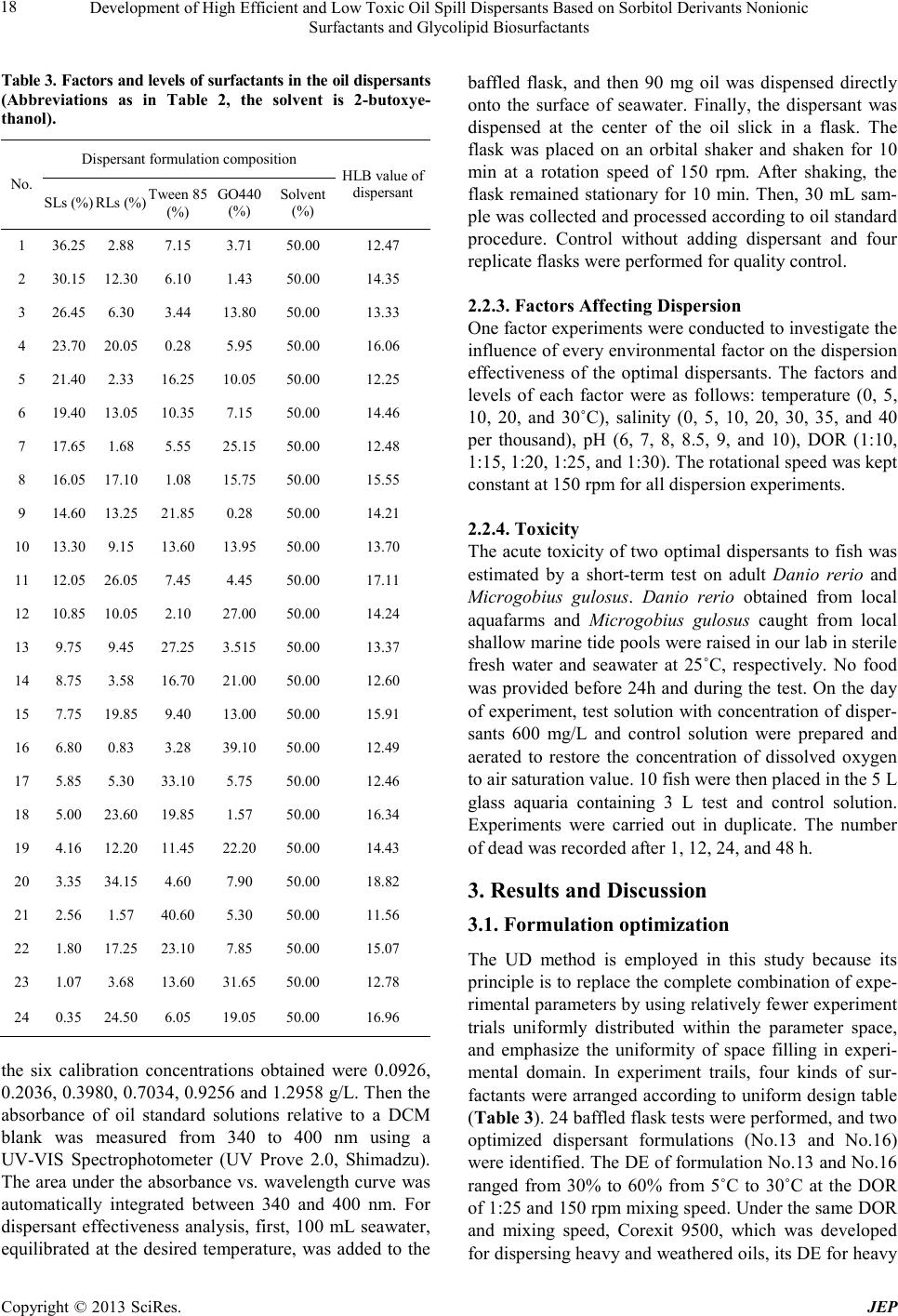 Development of High Efficient and Low Toxic Oil Spill Dispersants Based on Sorbitol Derivants Nonionic Surfactants and Glycolipid Biosurfactants Copyright © 2013 SciRes. JEP 18 Table 3. Factors and levels of surfactants in the oil dispersants (Abbreviations as in Table 2, the solvent is 2-butoxye- thanol). No. Disp ers ant formulati on composition HLB value of dispersant SLs (%) R Ls (%) Tween 85 (%) GO440 (%) Solvent (%) 1 36.25 2.88 7.15 3.71 50.00 12.47 2 30.15 12.30 6.10 1.43 50.00 14.35 3 26.45 6.30 3.44 13.80 50.00 13.33 4 23.70 20.05 0.28 5.95 50.00 16.06 5 21.40 2.33 16.25 10. 05 50.00 12.25 6 19.40 13.05 10.35 7.15 50.00 14.46 7 17.65 1.68 5.55 25.15 50.00 12.48 8 16.05 17.10 1.08 15.75 50.00 15.55 9 14.60 13.25 21.85 0.28 50.00 14.21 10 13.30 9.15 13.60 13.95 50.00 13.70 11 12.05 26.05 7.45 4.45 50.00 17.11 12 10.85 10.05 2.10 27.00 50.00 14.24 13 9.75 9.45 27.25 3.515 50.00 13.37 14 8.75 3.58 16.70 21.00 50.00 12.60 15 7.75 19.85 9.40 13.00 50.00 15.91 16 6.80 0.83 3.28 39.10 5 0.00 12.49 17 5.85 5.30 33.10 5.75 50.00 12.46 18 5.00 23.60 19.85 1.57 50.00 16.34 19 4.16 12.20 11.45 22.20 50.00 14.43 20 3.35 34.15 4.60 7.90 50.00 18.82 21 2.56 1.57 40.60 5.30 50.00 11.56 22 1.80 17.25 23.10 7.85 50.00 15.07 23 1.07 3.68 13.60 31.65 50.00 12.78 24 0.35 24.50 6.05 19.05 50.00 16.96 the six calibration concentrations obtained were 0.0926, 0.2036, 0.3980, 0.7034, 0.9256 and 1.2958 g/L. Then the absorbance of oil standard solutions relative to a DCM blank was measured from 340 to 400 nm using a UV-VIS Spectrophotometer (UV Prove 2.0, Shimadzu). The area under the abso rbance vs. wavele ngth cur ve was automatically integrated between 340 and 400 nm. For dispersant effectiveness analysis, first, 100 mL seawater, equilibrated at the desired temperature, was added to the baffled flask, and then 90 mg oil was dispensed directly onto the surface of seawater. Finally, the dispersant was dispensed at the center of the oil slick in a flask. The flask was placed on an orbital shaker and shaken for 10 min at a rotation speed of 150 rpm. After shaking, the flask remained stationary for 10 min. Then, 30 mL sam- ple was collected and processed according to oil standard procedure. Control without adding dispersant and four replicate flasks were performed for quality control. 2.2.3. Factors Affecting Dispersion One factor experiments were conducted to investigate the influence of every environmental factor on the dispersion effectiveness of the optimal dispersants. The factors and levels of each factor were as follows: temperature (0, 5, 10, 20, and 30˚C), salinity (0, 5, 10, 20, 30, 35, and 40 per thousand), pH (6, 7, 8, 8.5, 9, and 10), DOR (1:10, 1:15, 1:20, 1:25, and 1:30). The rotational speed was kept constant at 150 rpm for all dispersion experiments. 2.2.4. Toxicity The acute toxicity of two optimal dispersa nts to fish was estimated by a short-term test on adult Danio rerio and Microgobius gulosus. Danio rerio obtained from local aquafarms and Microgobius gulosus caught from local shallow mari ne tide p oo ls wer e r aised in o ur lab in ster ile fresh water and seawater at 25˚C, respectively. No food was provided before 24h and during the test. On the day of experiment, test sol ution with concentration o f disper- sants 600 mg/L and control solution were prepared and aerated to restore the concentration of dissolved oxygen to air saturation value. 10 fish were then placed in the 5 L glass aquaria containing 3 L test and control solution. Experiments were carried out in duplicate. The number of dead was recorded after 1, 12, 24, and 48 h. 3. Results and Discussion 3.1. Formulation optimization The UD method is employed in this study because its principle is to replace the complete combination of expe- rimental parameters by using relatively fewer experiment trials uniformly distributed within the parameter space, and emphasize the uniformity of space filling in experi- mental domain. In experiment trails, four kinds of sur- factants were arranged according to uniform design table (Table 3 ). 24 baffled flask tests were performed, and two optimized dispersant formulations (No.13 and No.16) were identified. The DE of formulation No.13 and No.16 ranged from 30% to 60% from 5˚C to 30˚C at the DOR of 1:25 and 150 rpm mixing speed. Under the same DOR and mixing speed, Corexit 9500, which was developed for dispersing heavy and weathered oils, its DE for heavy 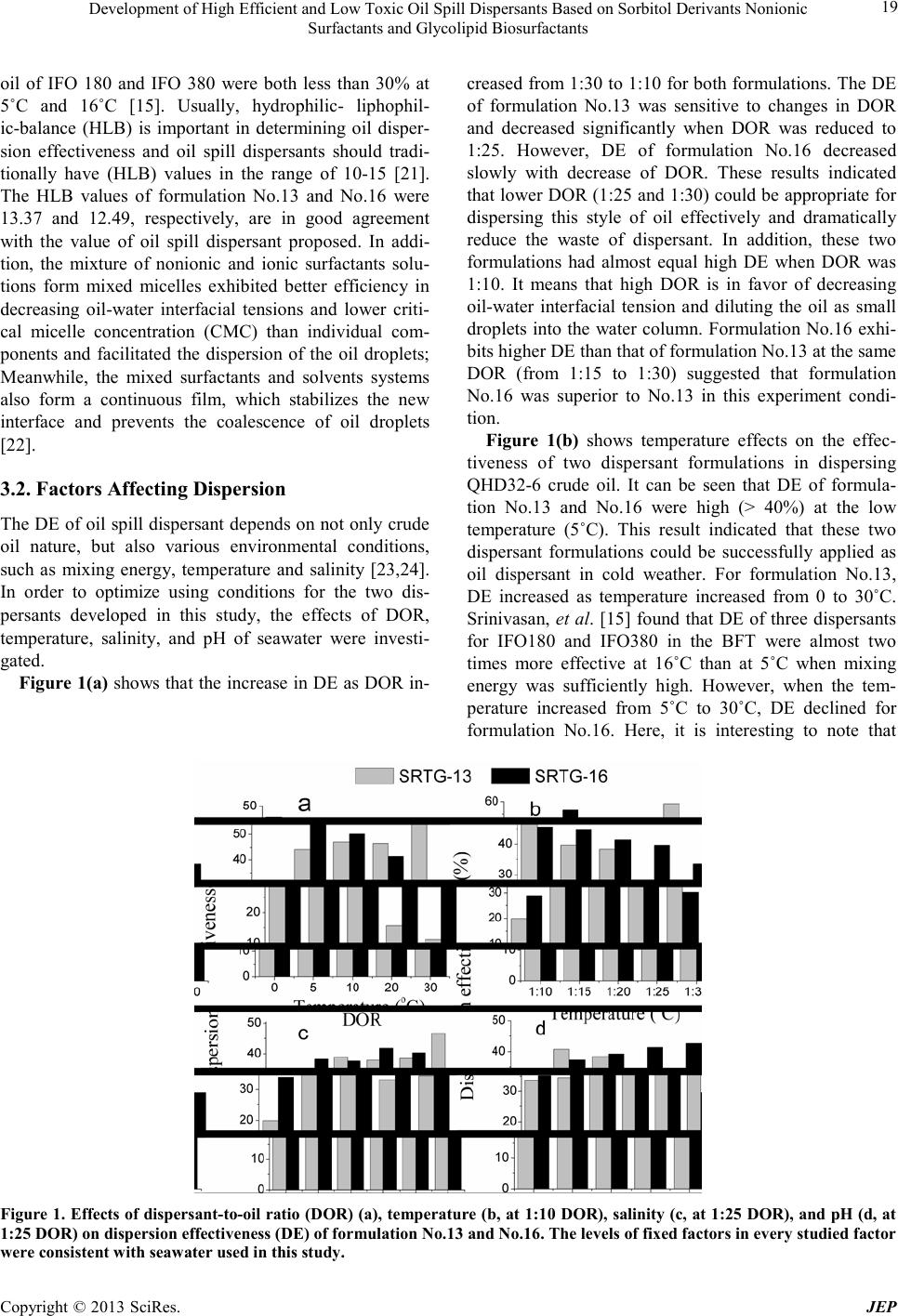 Development of High Efficient and Low Toxic Oil Spill Dispersants Based on Sorbitol Derivants Nonionic Surfactants and Glycolipid Biosurfactants Copyright © 2013 SciRes. JEP 19 oil of IFO 180 and IFO 380 were both less than 30% at 5˚C and 16˚C [15]. Usually, hydrophilic- liphophil- ic-balance (HLB) is important in determining oil disper- sion effectiveness and oil spill dispersants should tradi- tionally have (HLB) values in the range of 10-15 [21]. The HLB values of formulation No.13 and No.16 were 13.37 and 12.49, respectively, are in good agreement with the value of oil spill dispersant proposed. In addi- tion, the mixture of nonionic and ionic surfactants solu- tions form mixed micelles exhibited better efficiency in decreasing oil-water interfacial tensions and lower criti- cal micelle concentration (CMC) than individual com- ponents and facilitated the dispersion of the oil droplets; Meanwhile, the mixed surfactants and solvents systems also form a continuous film, which stabilizes the new interface and prevents the coalescence of oil droplets [22]. 3.2. Factors Affecting Dispersion The DE of oil spill dispersant depends on not only crude oil nature, but also various environmental conditions, such as mixing energy, temperature and salinity [23,24]. In order to optimize using conditions for the two dis- persants developed in this study, the effects of DOR, temperature, salinity, and pH of seawater were investi- gated. Figure 1(a) shows that the increase in DE as DOR in- creased from 1:30 to 1:10 for both formulatio ns. The D E of formulation No.13 was sensitive to changes in DOR and decreased significantly when DOR was reduced to 1:25. However, DE of formulation No.16 decreased slowly with decrease of DOR. These results indicated that lower DOR (1:25 and 1:30) could be appropriate for dispersing this style of oil effectively and dramatically reduce the waste of dispersant. In addition, these two formulations had almost equal high DE when DOR was 1:10. It means that high DOR is in favor of decreasing oil-water interfacial tension and diluting the oil as small droplets into the water column. Formulation No.16 exhi- bits higher DE than that of for mu la tion No.13 a t the same DOR (from 1:15 to 1:30) suggested that formulation No.16 was superior to No.13 in this experiment condi- tion. Figure 1(b) shows temperature effects on the effec- tiveness of two dispersant formulations in dispersing QHD32-6 crude oil. It can be seen that DE of formula- tion No.13 and No.16 were high (> 40%) at the low temperature (5˚C). This result indicated that these two dispersant formulations could be successfully applied as oil dispersant in cold weather. For formulation No.13, DE increased as temperature increased from 0 to 30˚C. Srinivasan, et al. [15] found that DE of three dispersants for IFO180 and IFO380 in the BFT were almost two times more effective at 16˚C than at 5˚C when mixing energy was sufficiently high. However, when the tem- perature increased from 5˚C to 30˚C, DE declined for formulation No.16. Here, it is interesting to note that Figure 1. Effect s of dispers ant-to-oil ratio (DOR) (a), temperature (b, at 1:10 DOR), salinity (c, at 1:25 DOR), and pH (d, at 1:25 DOR) on dispersi on effective ness (DE ) of f ormulation No.13 and No.16. The levels of f ix ed factors in every studied factor were consi stent with seawat er used in this study.  Development of High Efficient and Low Toxic Oil Spill Dispersants Based on Sorbitol Derivants Nonionic Surfactants and Glycolipid Biosurfactants Copyright © 2013 SciRes. JEP 20 high temperature exhibited negative effect on DE. The conflicting trends i n DE with the increase in te mperature have been observed by previous researchers [25,26]. It can be concluded that temperature may play a double role here: on the one hand, it decreases viscosity of the crude oil and thereby causes an increase in dispersion; on the other hand, it may change the physical properties of dispersants, which results the decrease of DE. A further study of the effect of temperature on DE should be per- formed to obtain clearer understanding the influencing mechanism. Figure 1(c) shows that DE increased with a slowly in- crease in salinity from 10 to 40 per thousand for formula- tion No.13. As mentioned earlier, higher salinity in- creased the effectiveness of dispersants by preventing surfactant molecules from migrating into the water phase, equivalent to a salting-out effect for the surfactant from the saline solution [27]. This salting-out effect can pro- mote association of surfactant molecules with oil at oil- water interfaces, which is important for lowering oil- water interfacial surface tensions in the oil-dispersant mixture [38]. For formulation No.16, results exhibited minimum DE when salinity was 40 per thousand, which may be caused by salting-in effect. Overall, salinity was not a significant factor affected DE of two formulations. Combined with the results of no detectable toxic effect of No.13 and No.16 on freshwater fish and saltwater fish, it can be concluded that these two dispersants are suitable for remediation of oil spill not only in fresh water but also in seawater. The result in Figure 1(d) shows that DE of two for- mulations were both high when pH was in the range of 7-10, whic h cove red the values of most sea regions. 3.3. Dispersant Toxicity Improvements in dispersant formulation mean that it is not only the increase of dispersion capability but also the decrease of toxicity. It was found that the landings of crustaceans had no any apparent reduction after spraying dispersant in Sea Empress incident off the coast of South Wales [29]. The field trials indicated that the use of dis- persant was unlikely to have acute toxic effects on the marine environment. In this study, Danio rerio (fresh- water fish) and Microgobius gulosus (saltwater fish) were used to study the acute toxicity of formulation No.13 and No.16. When these two types of fish were exposed in dispersant solution, lethality rates for Danio rerio at the end of 48 hours was 0 and for Microgobius gulosus, lethality rates was also 0 at the end of 24 hours. However, lethality rates for Danio rerio reached 60% after exposed in one chemical dispersant (named GM) solution at the end of 12 hours. The toxicity results indi- cated that these two optimized dispersants formulations had lower toxicity and were in accordance with Chinese national standard [30], which requests lethality rates of these two types of fish to be no more than 50 percent at the end of 24 hours wit h the s ame exposure conc entrati on of dispersant. 4. Conclusion In this study, formula uniform design was successfully used t o optimize d ispersant formulatio ns by arr anging t he levels of four surfactants continuously. Two optimized formulations were obtained in view of high dispersion effectiveness and low toxicity. The effects of environ- ment factors on dispersant effectiveness were as below: First, the variation trend of DE increased with the in- crease of DOR was found for both of two optimized formulations. DE was still high when the formulation No.16 was used at low DOR. Using the d ispersa nt at low DOR can save the usage amount of dispersant and reduce the possible damage of dispersant to environment. These two dispersant formulations could be also effective in response of oil spill in cold weather. Secondly, salting- out effect of salinity lowered oil-water interfacial surface tensions and promoted the dispersion o f oil, but t he effect was not significant. Similarly, pH was not a significant factor affected DE of two formulations, which were both high when pH was in the range of 7-10. Finally, these two optimized dispersants formulations had lower toxic- ity towards two kinds of fish (Danio rerio and Microgo- bius gulosus). Nonetheless, whether the two optimized dispersant formulations could be introduced to apply in oil spill response requires a further field test to better understand the effects of oil properties, interaction of environmental factors and d e tailed toxicity. 5. Acknowledge The authors wish to acknowledge the insightful com- ments and suggestions from the anonymous reviewers and editors for improving the content of this manuscript. The research was funded by China Offshore Environ- mental Service Ltd. (2010098). REFERENCES [1] J. Haapkylal, F. Ramade and B. Salvat, “Oil Pollution on Coral Reefs: A Review of the State of Knowledge and Manage ment Needs,” Life and Environment, Vol. 57, No. 1-2, 2007, pp. 91–107. [2] E. M. Chuvilin and E. S. Miklyaeva, “An Experimental Investigation of the Influence of Salinity and Cryogenic Structure on the Dispersion of Oil and Oil Products in Frozen Soils,” Cold Regions Science and Technology, Vol. 37, N o. 2, 20 03, pp. 89–95. doi:10.1016/S0165-232X(03)00063-6  Development of High Efficient and Low Toxic Oil Spill Dispersants Based on Sorbitol Derivants Nonionic Surfactants and Glycolipid Biosurfactants Copyright © 2013 SciRes. JEP 21 [3] J. S. Poland, M. J. Riddle and B. A. Zeeb, “Contaminants in the Arctic and the Antarctic: A Comparison of Sources, Impacts, and Remediation Options,” Polar Record, Vol. 39, No. 4, 20 03, pp. 369-383. doi:10.1017/S0032247403002985 [4] D. P. Hoult, “Oil Spreading on the Sea,” Annual Review of Fluid Mechanics, Vol. 4, No. 1, 1972, pp. 341-368. doi:10.1146/annurev.fl.04.010172.002013 [5] P. S. Daling, I. Singsaas, M. Reed and O. Hansen, “ Expe- riences in Dispersant Treatment of Experimental Oil Spills,” Spill Science & Technology Bulletin, Vol. 7, No. 5-6, 2002, pp. 201-213. doi:10.1016/S1353-2561(02)00061-0 [6] A. Lewis, B. Ken Trudel, R. C. Belore and J. V. Mullin, “Large-scale Dispersant Leaching and Effectiveness Ex- periments with Oils on Calm Water,” Marine Pollution Bulletin, Vol. 60, No. 2, 2010, pp. 244-254. doi:10.1016/j.marpolbul.2009.09.019 [7] P. J. Brandvik and P. S. Daling, “Optimisation of Oil Spill Dispersant Composition by Mixture Design and Response Surface Methods,” Chemometrics and Intelli- gent Laboratory Systems, Vol. 42, No. 1-2, 1998, pp. 63-72. doi:10.1016/S0169-7439(98)00009-4 [8] A. M . Al -Sabagh, S. H. El-Hamouly, A. M. Atta, M. R. N. El-Din and M. M. Gabr, “Synthesis of Some Oil Spill Dispersants Based on Sorbitol Esters and Their Capability to Disperse Crude Oil on Seawater to Alleviate Its Ac- cumulation and Environmental Impact,” Journal of Dis- persion Science and Technology, Vol. 28, No. 5, 2007, pp. 661-670. doi:10.1080/01932690701341751 [9] N. P. Ventikos, E. Vergetis, H. N. Psaraftis and G. Trian- tafyllou, “A High-level Synthesis of Oil Spill Response Equipment and Countermeasures,” Journal of Hazardous Materials, Vol. 107, No. 1-2, 2004, pp. 51-58. doi:10.1016/j.jhazmat.2003.11.009 [10] R. R. Lessard and G. Demarco, “The Significance of Oil Spill Dispersants,” Spill Science & Technology Bulletin, Vol. 6, No. 1, 2000, p p. 59-68. doi:10.1016/S1353-2561(99)00061-4 [11] R. Stakėnienė and K. Jokšas, “Dispersants and Their In- fluence on Oil Spread in Water Bodies,” Environmental research, engineering and management, Vol. 4, No. 34, 2004, pp . 61-67. [12] M. M. Singer, S. George, S. Jacobson, I. Lee, L. L. Weetman, R. S. Tjeerdema and M. L. Sowby, “Acute Toxicity of the Oil Dispersant Corexit 9554 to Marine Organisms,” Ecotoxicology and Environmental Safety, Vol. 32, N o. 1, 19 95, pp. 81-86. doi:10.1006/eesa.1995.1088 [13] Cutter Information Corp., “The Dispersant Use Deci- sion-making Process,” In: Oil Spill Intelligence Report, White Paper Seri es , April, 1998. [14] Fiocco, R.J, P.S. Daling, G. DeMarco, R.R. Lessard and G.P.Canevari. 1999b. Chemical Dispersibility Study of Heavy Bunker Fuel Oil. Proc. 22nd Arctic and Marine Oilspill Program, Environment Canada, Ottawa, Canada, pp 173-186. [15] R. Srinivasan, Q. Lu, G. A. Sorial, A. D. Venosa and J. Mullin, “Dispersant Effectiveness of Heavy Fuel Oils Using Baffled Flask Test,” Environmental Engineering Scien ce, Vol. 24, N o. 9, 2007, pp. 1307-1320. doi:10.1089/ees.2006.0251 [16] A. D. Venosa, D. W. King and G. A. Sorial, “The Baffled Flask Test for Dispersant Effectiveness: A Round Robin Evaluation of Reproducibility and Repeatability,” Spill Science & Technology Bulletin, Vo l. 7 , No . 5–6, 2 002, p p. 299–308. doi:10.1016/S1353-2561(02)00072-5 [17] X. Wang, L. Gong, S. Liang, X. Han, C. Zhu and Y. Li, “Algicidal Activity of Rhamnolipid Biosurfactants Pro- duced by Pseudomonas aeruginosa,” Harmf ul Algae, Vo l. 4, N o. 2, 2005, pp. 433-443. doi:10.1016/j.hal.2004.06.001 [18] D. Song, S . Liang and J. Wang, “St ructu r e C haracterization and Physic-chemical Properties of Sophorolipid Biosur- factants,” Environ mental chemistry (in Chinese with Eng- lish abst r a c t) , V ol . 30, No. 8, 201 1, pp. 1474- 1479. [19] K. T. Fang, “The Uniform Design: Application of Num- ber-theoretic Methods in Experimental Design,” Acta Mathematicae Applicatae Sinica, Vol. 3, 1980, pp. 363-372. [20] S. Chandrasekar, G. A. Sorial and J. W. Weaver, “Dis- persant Effectiveness on Three Oils under Various Simu- lated Environmental Conditions,” Environmental Engi- neering Science, Vol. 22, No. 3, 2005, pp. 324-336. doi:10.1089/ees.2005.22.324 [21] P. Riley, “Compositions and Methods for Dispersing and Biodegrading Spilled Petroleum Oils and Fuels,” Petro- Tech, Patent num be r : 5753127, 1998. [22] S. A. Mahmouda and T. M. Abd El-Rahmanb, “A New Family of Oil Spill Dispersants: Part 1. The Effect of Structural Variation on the Oil Spill Dispersant Efficien- cy,” Petroleum Science and Technology, Vol. 28, No. 14, 2010, pp . 1394-1406. doi:10.1080/10916460802637585 [23] B. Mukherjee and B. A. Wrenn, “Influence of Dynamic Mixing Energy on Dispersant Performance: Role of Mix- ing Systems,” En vironmental Engineering Science, Vol. 26, No. 12, 2009, pp. 1725-1737. doi:10.1089/ees.2009.0159 [24] B. Mukherjee and B. A. Wrenn, “Effects of Physical Properties and Dispersion Conditions on the Chemical Dispersion of Crude Oil,” Environmental Engineering Scien ce, Vol. 28, N o. 4, 2011, pp. 263-273. doi:10.1089/ees.2010.0131 [25] D. C. Byford, P. J. Green and A. Lewis, “Factors Influen- cing the Performance and Selection of Low-temperature Dispersants,” P roceedings of the Sixth Arctic Marine Oil Spill Program, Edmonton, Canada, 1983. [26] M. F. Fingas, “Dispersants: A Review of Effectiveness Measures and Laboratory Physical Studies,” Ottawa, On- tario: Environmental Emergencies Technology Division, Envir onment Ca na da , 1991. [27] D Mackay, A. Chau, K. Hossain and M. Bobra, “Mea- surement and Prediction of the Effectiveness of Oil Spill  Development of High Efficient and Low Toxic Oil Spill Dispersants Based on Sorbitol Derivants Nonionic Surfactants and Glycolipid Biosurfactants Copyright © 2013 SciRes. JEP 22 Chemical D isp ersan ts, ” In Oil Spill Chemical Dispersants, Research, Experience and Recommendations, STP 840. Tom E. Allen, Ed., American Society for Testing and Materials, Philadelphia , 1984, pp. 38-54. [28] S. Chandrasekar, G. A. Sorial and J. W. Weaver, “Dis- persant Effectiveness on Oil Spills - impact of Salinity,” ICES Journal of Marine Science, Vol. 63, No. 8, 2006, pp. 1418-1430. doi:10.1016/j.icesjms.2006.04.019 [29] H. Chapman, K. Purnell, R. J. Law and M. F. Kirby, “The Use of Chemical Dispersants to Combat Oil Spills at Sea: A review of practice and research needs in Europe,” Ma- rine Pollution Bulletin, Vol. 54, No. 7, 2007, pp. 827-838. doi:10.1016/j.marpolbul.2007.03.012 [30] GB 18188.1-2000, Oil Spill Dispersant-Technical Regu- lations (in Chinese). |