

Paper Menu >>
Journal Menu >>
 A Journal of Software Engineering and Applications, 2012, 5, 113-116 doi:10.4236/jsea.2012.512b022 Published Online December 2012 (http://www.scirp.org/journal/jsea) Copyright © 2012SciRes. JSEA Multi-Sensor Ensemble Classifier for Activit y Recognitio n Lingfei Mo1, Shaopeng Liu2, Robert X. Gao2*, Patty S. Freedson3 1School of Instrument Science and Engineering, Southeast University, Nanjing, China; 2Department of Mechanical Engineering, University of Connecticut, Storrs, CT, USA; 3Department of Kinesio l ogy, University of Massachusetts, Amherst, MA, USA. Email: [email protected] Received 2012. ABSTRACT This pap er presents a multi-sensor ensemb le classifier (MSEC) for phys ical activity (P A) pattern recognition of human subjects. The MSEC, developed for a wearable multi-sensor integrate measurement system (IMS),combines multiple classifiers based on different sensor feature sets to improve the accuracy of P A type id ent ificatio n.Expe rimenta l e va lua- tion of 56 subjects has sho wn that the MSECi s mo re effectivein a ssessing activities o f varying intensitiestha n the tradi- tional homogeneous classifiers. It is able to correctly recognize 6 PA types with an accuracy of 93.50%, which is 7% higher tha n the non-ensemble support vector machine method . Furt hermo re, the MSECi s effe ctive in red ucing the s ub- ject-to-subject variabilityin activity recognition. Keywords:Physical Activit y Assessment;Multi-Sensor Ensemble;Support Vector Machine. 1. Introduction Physical activity ( PA), d efined as bodi ly mo vement gen- erated by skeletal muscles [1]such as walki ng, jog gingor sport activities, is important for maintaining health and preventing cardiovasc ular diseases, diabetes, and obesity. Accurate monitoring and assessment of PA under free- living conditions provides information on the type and intensity of activitie s that the pe rson has been engage d in, thus is of significant interest to the research community [1] and commercial co mpanies. The goal of PA assessment is to recognize the type, dura tio n, and i nte ns i t y of a b roa d ra nge o f physical activ- ities and quantify the energy expenditureof the test sub- jectdur ing his/her d aily life, as illustrated in Figure 1. In recent years, multi-sensor systems have been increasing- ly inve sti gated for PA assessment. For example, multiple accelerometers have been placed at different loc ations on the bodyof test subjects [3]or combined with other types of sensors, such as respiratory sensor or GPS [4] for PA measurement. Combining advanced computational tech- niques such as machine learning and sensor fusi o n [3,4], differentiation of various activities has shown to be im- proved. For example, a multi-sensor integrate measure- ment system (IMS) was developed with two accelero- meters and one ventilation sensor to measure and assess the physical act ivity [5]. Rec en tly , ens em bl e lea rn ing has been in cre as ing ly inve st- tigated for pattern recognition [6]. An ensemble learning method co mbines multiple individual clas sifier s to ob tain better predictive performance than that obtained by any of the constituent classifiers [7]. T his is a technique that usually combines a number of weak classifiers together to produce a strong classifiers. Through combination of decisions from multiple classifiers or multiple sensors, recognition accuracy has shown to be improved effect- tively [6]. For example, Ravi et al. combined multiple different clas sifiers to identify eight common activities of two subjects with a single tri-axial accelerometer [8]. These classifiers used the same four-feature (Mean, Standard Deviation, Energy and Correlation) datasets, and had obtained good recognition accuracies, especially by means ofMajority Voting. Lester et al. used AdaBoost [9] to select features and combined multiple weak classi- fiers, each of which accepting only a single feature as Figure 1. Physical activit y assessment. 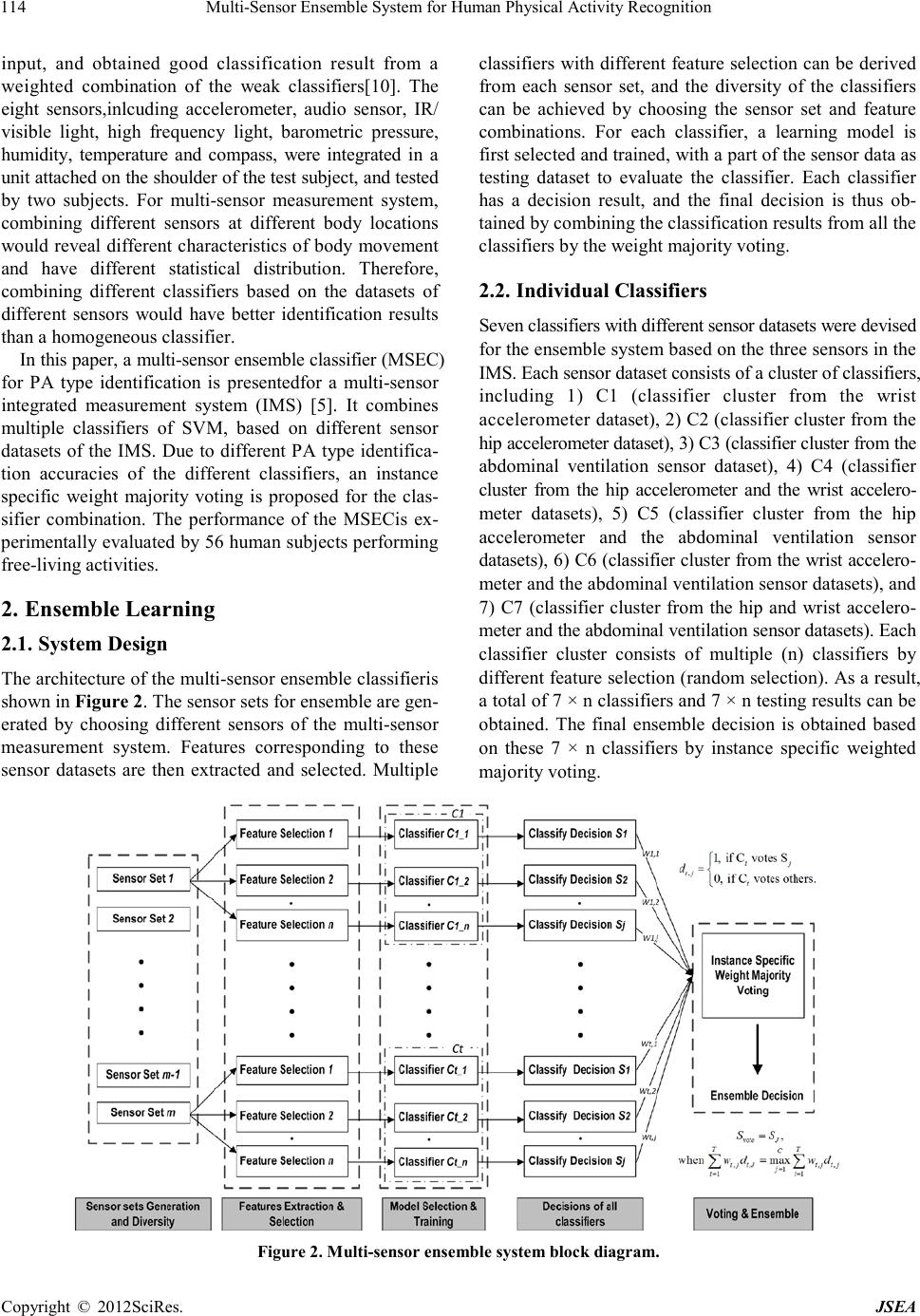 Multi-Sensor Ensemble System for Human Physical Activity Recognition Copyright © 2012SciR es. JSEA 114 input, and obtained good classification result from a weighted combination of the weak classifiers[10]. The eight sensors,inlcuding accelerometer, audio sensor, IR/ visible light, high frequency light, barometric pressure, humidity, temperature and compass, were integrated in a unit a t ta c hed on t he shoulde r of the test subject, a nd te sted by two subjects. For multi-sensor measurement system, combining different sensors at different body locations would reveal different characteristics of body movement and have different statistical distribution. Therefore, combining different classifiers based on the datasets of different sensors would have better identification results than a homogeneous classifier. In this paper , a multi -senso r en se mble classifier (MSEC) for PA type identification is presentedfor a multi-sensor integrated measurement system (IMS) [5]. It combines multiple classifiers of SVM, based on different sensor datasets of the IMS. Due to different PA type identifica- tion accuracies of the different classifiers, an instance specific weight majority voting is proposed for the clas- sifier combination. The performance of the MSECis ex- perimentally evaluated by 56 human subjects performing free-living acti vities. 2. Ensemble Learning 2.1. System Design The architecture of the multi-sensor ensemble classifieris sho wn in Figure 2. The sensor sets for ense mble are gen- erated by choosing different sensors of the multi-sensor measurement system. Features corresponding to these sensor datasets are then extracted and selected. Multiple classifiers with different feature selection can be derived from each sensor set, and the diversity of the classifiers can be achieved by choosing the sensor set and feature combinations. For each classifier, a learning model is first selected and trained, with a part of the sensor data as testing dataset to evaluate the classifier. Each classifier has a decision result, and the final decision is thus ob- tained b y combining the classification results from all the classifiers by the weight majority voting. 2.2. Individual Classifiers Seven clas sifiers with di f f e r en t sens o r d a tasets were devised for the e nsemble system based on the three sensors in the IMS. Each sensor data set consists of a cluster of classi fiers, including 1) C1 (classifier cluster from the wrist accelerometer dataset), 2) C2 (classifier cluster fro m the hip accele ro meter da ta set), 3) C 3 (clas sifier cluster fro m the abdominal ventilation sensor dataset), 4) C4 (classifier cluster from the hip accelerometer and the wrist accelero- meter datasets), 5) C5 (classifier cluster from the hip accelerometer and the abdominal ventilation sensor datasets), 6) C6 (classifier cluster fro m the wrist accelero - meter and the abdominal ventilation sensor datasets), and 7) C7 (classifier cluster from the hip and wrist accelero- meter and the ab d ominal ve ntilation sensor datasets). Each classifier cluster consists of multiple (n) classifiers by different feature selection (random selection). As a result, a total of 7 × n classifiers and 7 × n testing res ult s can b e obtained. The final ensemble decision is obtained based on these 7 × n classifiers by instance specific weighted majo r it y voti ng. Figure 2. Multi -sensor ensemble system block diagram. 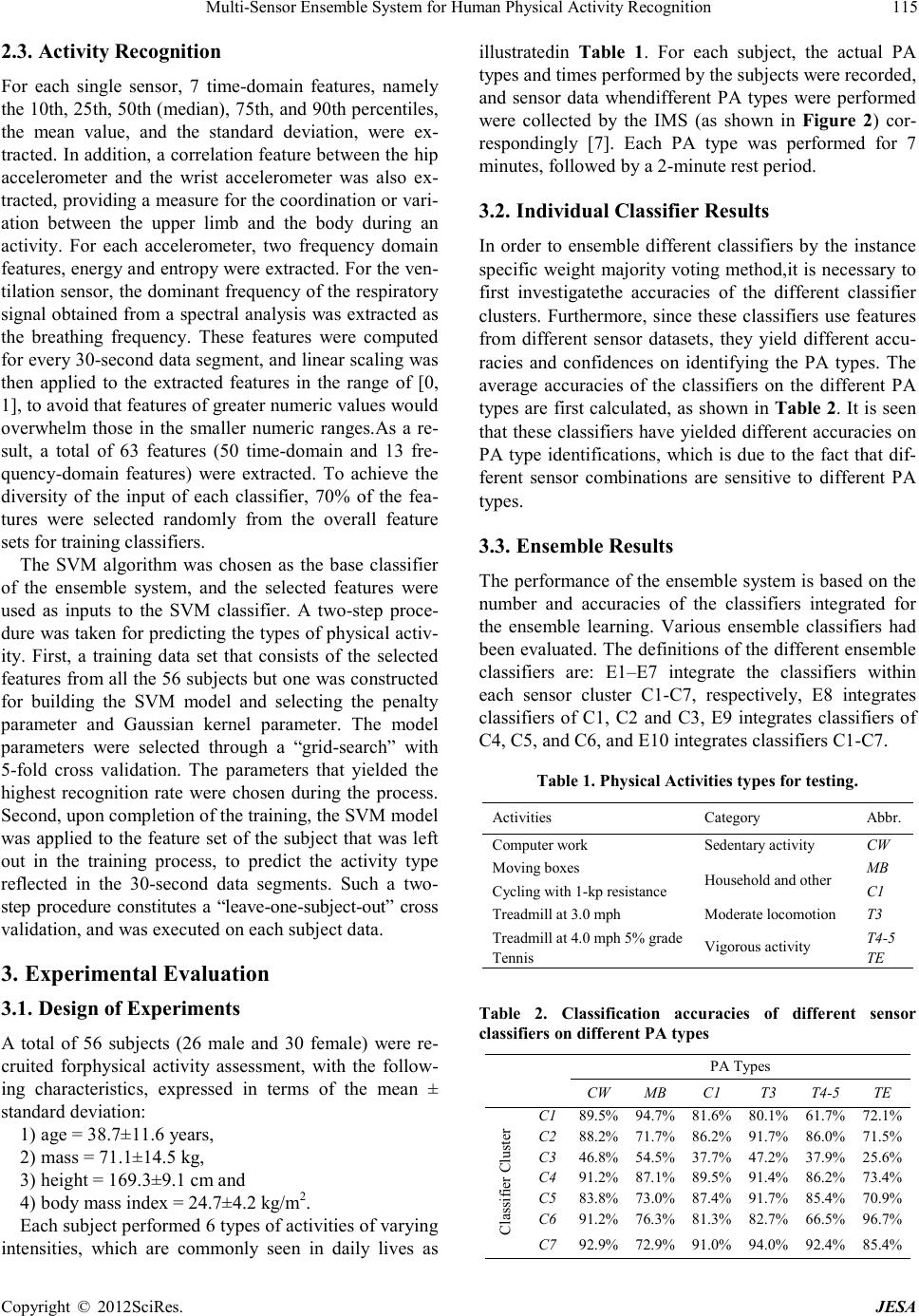 Multi-Sensor Ensemble System for Human Physical Activity Recognition Copyright © 2012SciR es. JESA 115 2.3. Activity Recognition For each single sensor, 7 time-domain features, namely the 10th, 25th, 50th (median), 75th, and 90th per centiles, the mean value, and the standard deviation, were ex- tracted. In additio n, a correlation feature between the hip accelerometer and the wrist accelerometer was also ex- tracted, providing a measure for the coordination or vari- ation between the upper limb and the body during an activity. For each accelerometer, two frequency domain features, energy and entrop y were extracted. For the ven- tilation senso r, the dominant f requency of the resp iratory signal obtained from a spectral analysis was extracted as the breathing frequency. These features were computed for every 30-second data segment, and linear scaling was then applied to the extracted features in the range of [0, 1], to avoid that features of greater numeric values would overwhelm those in the smaller numeric ranges.As a re- sult, a total of 63 features (50 time-domain and 13 fre- quency-domain features) were extracted. To achieve the diversity of the input of each classifier, 70% of the fea- tures were selected randomly from the overall feature sets for training classifiers. The SVM algorithm was chosen as the base classifier of the ensemble system, and the selected features were used as inputs to the SVM classifier. A two-step proce- dure was taken for pr edicting the types of physical activ- ity. First, a training data set that consists of the selected features from all the 56 subjects but one was constructed for building the SVM model and selecting the penalty parameter and Gaussian kernel parameter. The model parameters were selected through a “grid-search” with 5-fold cross validation. The parameters that yielded the highest recognition rate were chosen during the process. Second, upon completion of the training, the SVM model was applied to the feature set of the subject that was left out in the training process, to predict the activity type reflected in the 30-second data segments. Such a two- step procedure constitutes a “leave-one -subject-out” cross validation, and was executed on each subject data. 3. Experimental Evaluation 3.1. Design of Experiments A total of 56 subjects (26 male and 30 female) were re- cruited forphysical activity assessment, with the follo w - ing characteristics, expressed in terms of the mean ± standard de viation: 1) age = 38.7±11.6 years, 2) mass = 71.1±14.5 kg, 3) height = 169.3±9.1 cm and 4) body mass index = 24.7±4.2 kg/m2. Each subject performed 6 types of activities of varying intensities, which are commonly seen in daily lives as illustratedin Table 1. For each subject, the actual PA types and times performed by the subjects were recorded, and sensor data whendifferent PA types were performed were collected by the IMS (as shown in Figure 2) cor- respondingly [7]. Each PA type was performed for 7 minutes, followed b y a 2-minute rest period. 3.2. Individual Classifier Results In order to ensemble different classifiers by the instance specific weight majority voting method,it is necessary to first investigatethe accuracies of the different classifier clusters. Furthermore, since these classifiers use features from different sensor datasets, they yield different accu- racies and confidences on identifying the PA types. The average accuracies of the classifiers on the different PA types are first calculated, as s hown in Table 2. It i s seen that these classifiers have yielded different accuracies on PA type identifications, which is due to the fact that dif- ferent sensor combinations are sensitive to different PA t yp e s. 3.3. Ensemble Results The performance of the ensemble system is based on the number and accuracies of the classifiers integrated for the ensemble learning. Various ensemble classifiers had been evaluated. T he definitions of the different ensemble classifiers are: E1–E7 integrate the classifiers within each sensor cluster C1-C7, respectively, E8 integrates classifiers of C1, C2 and C3, E9 integrates classifiers of C4, C5 , and C6, and E10 integrates classifiers C1-C7. Table 1. Physical Activities types for testing. Activities Category Abbr. Computer work Sedentary activity CW Moving boxes Household and other MB Cycling with 1-kp resistance C1 Treadmill a t 3.0 mph Moderate locomotion T3 Treadmill at 4.0 mph 5% grade Vigorous activity T4-5 Tennis TE Table 2. Classification accuracies of different sensor classifiers on differ ent PA types PA T ypes CW MB C1 T3 T4-5 TE Classifier Cluster C1 89.5% 94.7% 81.6% 80.1% 61.7% 72.1% C2 88.2% 71.7% 86.2% 91.7% 86.0% 71.5% C3 46.8% 54.5% 37.7% 47.2% 37.9% 25.6% C4 91.2% 87.1% 89.5% 91.4% 86.2% 73.4% C5 83.8% 73.0% 87.4% 91.7% 85.4% 70.9% C6 91.2% 76.3% 81.3% 82.7% 66.5% 96.7% C7 92.9% 72.9% 91.0% 94.0% 92.4% 85.4% 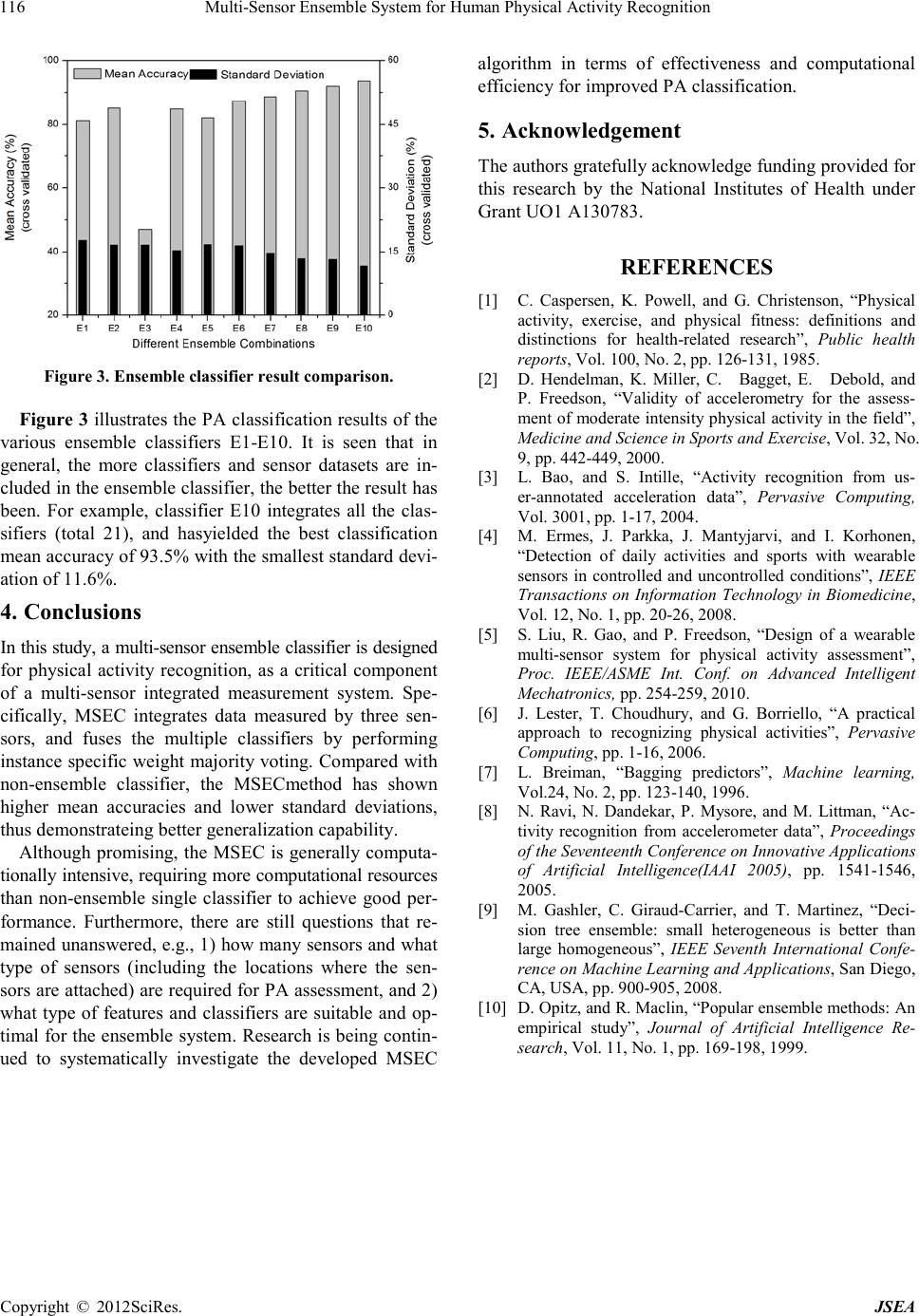 Multi-Sensor Ensemble System for Human Physical Activity Recognition Copyright © 2012SciR es. JSEA 116 Figure 3. E nsemble classifier result comparison. Figure 3 illustrates t he P A classi ficatio n results of the various ensemble classifiers E1-E10. It is seen that in general, the more classifiers and sensor datasets are in- cluded in the ense mble classifier, the better the result has been. For example, classifier E10 integrates all the clas- sifiers (total 21), and hasyielded the best classification mean accuracy of 93.5% with the smallest standard devi- ation of 11.6%. 4. Conclusions In this study, a multi-sensor ensemble classi fier is designed for physical activity recognition, as a critical component of a multi-sensor integrated measurement system. Spe- cifically, MSEC integrates data measured by three sen- sors, and fuses the multiple classifiers by performing instance specific weight majority voting. Compared with non-ensemble classifier, the MSECmethod has shown higher mean accuracies and lower standard deviations, thus d emonstrateing better ge ner a liz a tion capabilit y. Altho ugh promising, the MSEC is generally computa- tional ly int ensi ve, r eq uir ing more computational resourc es than non-ensemble single classifier to achieve good per- formance. Furthermore, there are still questions that re- maine d unans wered , e.g. , 1) ho w many se nsor s and wha t type of sensors (including the locations where the sen- sors are attached) are required for PA assessment, and 2) what type of features and classifiers are suitable and op- timal for the e nsemble system. Research is being contin- ued to systematically investigate the developed MSEC algorithm in terms of effectiveness and computational efficiency for improved PA classification. 5. Acknowledgement The aut hor s gr at ef ull y ackno wl ed ge fu nd in g p r ovi de d for this research by the National Institutes of Health under Grant UO1 A130783. REFERENCES [1] C. Caspersen, K. Powell, and G. Christenson, “Physical activity, exercise, and physical fitness: definitions and distinctions for health-related research”, Public health reports, Vol. 100, No. 2, pp. 126-131, 1985. [2] D. Hendelman, K. Miller, C. Bagget, E. Debold, and P. Freedson, “Validity of accelerometry for the assess- ment of moderate intensity physical activity in the field”, Medicine and Science in Sports and Exercise, Vol. 32, No. 9, pp. 442-449, 2000 . [3] L. Bao, and S. Intille, “Activity recognition from us- er-annotated acceleration data”, Pervasive Computing, Vol. 3001, pp. 1-17, 2004. [4] M. Ermes, J. Parkka, J. Mantyjarvi, and I. Korhonen, “Detection of daily activities and sports with wearable sensors in controlled and uncontrolled conditions”, IEEE Transa ctions on Information Technology in Biomedicine, Vol. 12, No. 1, pp. 20-26, 2008. [5] S. Liu, R. Gao, and P. Freedson, “Design of a wearable multi-sensor system for physical activity assessment”, Proc. IEEE/ASME Int. Conf. on Advanced Intelligent Mechatronics, pp. 254-259, 20 10. [6] J. Lester, T. Choudhury, and G. Borriello, “A practical approach to recognizing physical activities”, Pervasive Computing, pp. 1-16, 2006. [7] L. Breiman, “Bagging predictors”, Machine learning, Vol.2 4, N o. 2, pp. 123-140, 19 96. [8] N. Ravi, N. Dandekar, P. Mysore, and M. Littman, “Ac- tivity recognition from accelerometer data”, Proceedings of the Seventeenth Conference on Innovative Applications of Artificial Intelligence(IAAI 2005), pp. 1541-1546, 2005. [9] M. Gashler, C. Giraud-Carrier, and T. Martinez, “Deci- sion tree ensemble: small heterogeneous is better than large homogeneous”, IEEE Seventh International Confe- rence on Machine Learning and Applications, San Diego , CA, USA, pp. 900-905, 2008. [10] D. Opitz, and R. Macli n, “Popular ensemble metho ds: An empirical study”, Journal of Artificial Intelligence Re- search, Vol. 11, No. 1, pp. 169-198, 19 99. |