

Paper Menu >>
Journal Menu >>
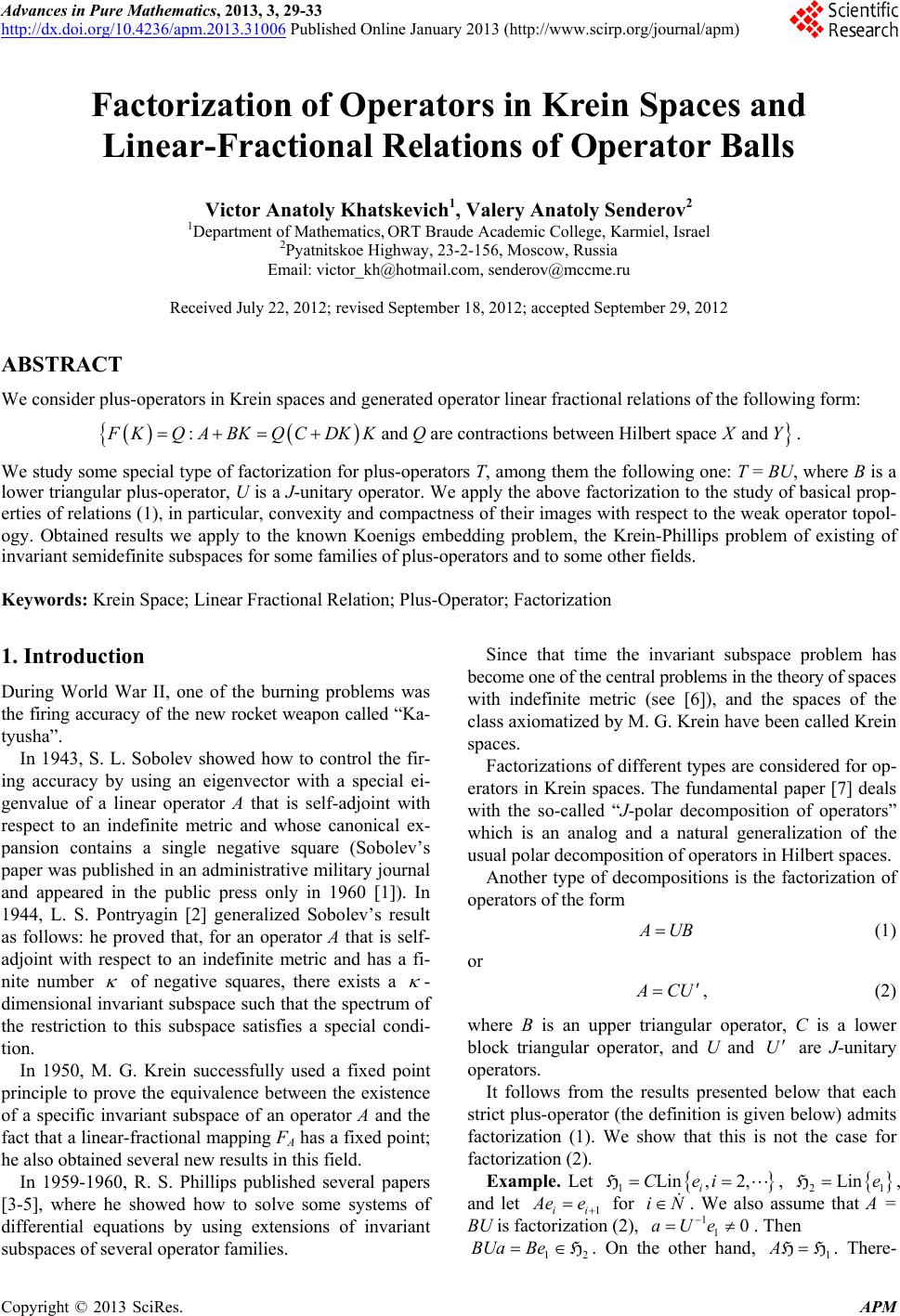 Advances in Pure Mathematics, 2013, 3, 29-33 http://dx.doi.org/10.4236/apm.2013.31006 Published Online January 2013 (http://www.scirp.org/journal/apm) Factorization of Operators in Krein Spaces and Linear-Fractional Relations of Operator Balls Victor Anatoly Khatskevich1, Valery Anatoly Senderov2 1Department of Mathematics, ORT Braude Academic College, Karmiel, Israel 2Pyatnitskoe Highway, 23-2-156, Moscow, Russia Email: victor_kh@hotmail.com, [email protected] Received July 22, 2012; revised September 18, 2012; accepted September 29, 2012 ABSTRACT We consider plus-operators in Krein spaces and generated operator linear fractional relations of the following form: :andare contractions between Hilbert spaceand F KQABKQCDKK QXY . We study some special type of factorization for plus-operators T, among them the following one: T = BU, where B is a lower triangular plus-operator, U is a J-unitary operator. We apply the above factorization to the study of basical prop- erties of relations (1), in particular, convexity and compactness of their images with respect to the weak operator topol- ogy. Obtained results we apply to the known Koenigs embedding problem, the Krein-Phillips problem of existing of invariant semidefinite subspaces for some families of plus-operators and to some other fields. Keywords: Krein Space; Linear Fractional Relation; Plus-Operator; Factorization 1. Introduction Since that time the invariant subspace problem has become one of the central problems in the theory of spaces with indefinite metric (see [6]), and the spaces of the class axiomatized by M. G. Krein have been called Krein spaces. During World War II, one of the burning problems was the firing accuracy of the new rocket weapon called “Ka- tyusha”. In 1943, S. L. Sobolev showed how to control the fir- ing accuracy by using an eigenvector with a special ei- genvalue of a linear operator A that is self-adjoint with respect to an indefinite metric and whose canonical ex- pansion contains a single negative square (Sobolev’s paper was published in an administrative military journal and appeared in the public press only in 1960 [1]). In 1944, L. S. Pontryagin [2] generalized Sobolev’s result as follows: he proved that, for an operator A that is self- adjoint with respect to an indefinite metric and has a fi- nite number of negative squares, there exists a Factorizations of different types are considered for op- erators in Krein spaces. The fundamental paper [7] deals with the so-called “J-polar decomposition of operators” which is an analog and a natural generalization of the usual polar decomposition of operators in Hilbert spaces. Another type of decompositions is the factorization of operators of the form (1) A UB or - dimensional invariant subspace such that the spectrum of the restriction to this subspace satisfies a special condi- tion. CU A , (2) where B is an upper triangular operator, C is a lower block triangular operator, and U and are J-unitary operators. U Lin ,2,CeiH In 1950, M. G. Krein successfully used a fixed point principle to prove the equivalence between the existence of a specific invariant subspace of an operator A and the fact that a linear-fractional mapping FA has a fixed point; he also obtained several new results in this field. It follows from the results presented below that each strict plus-operator (the definition is given below) admits factorization (1). We show that this is not the case for factorization (2). Example. Let 1i, Lin eH21 , and let 1ii In 1959-1960, R. S. Phillips published several papers [3-5], where he showed how to solve some systems of differential equations by using extensions of invariant subspaces of several operator families. A ee for iN 10aUe . We also assume that A = BU is factorization (2), 1 12 BUa Be. Then H1 AHH. On the other hand, . There- C opyright © 2013 SciRes. APM 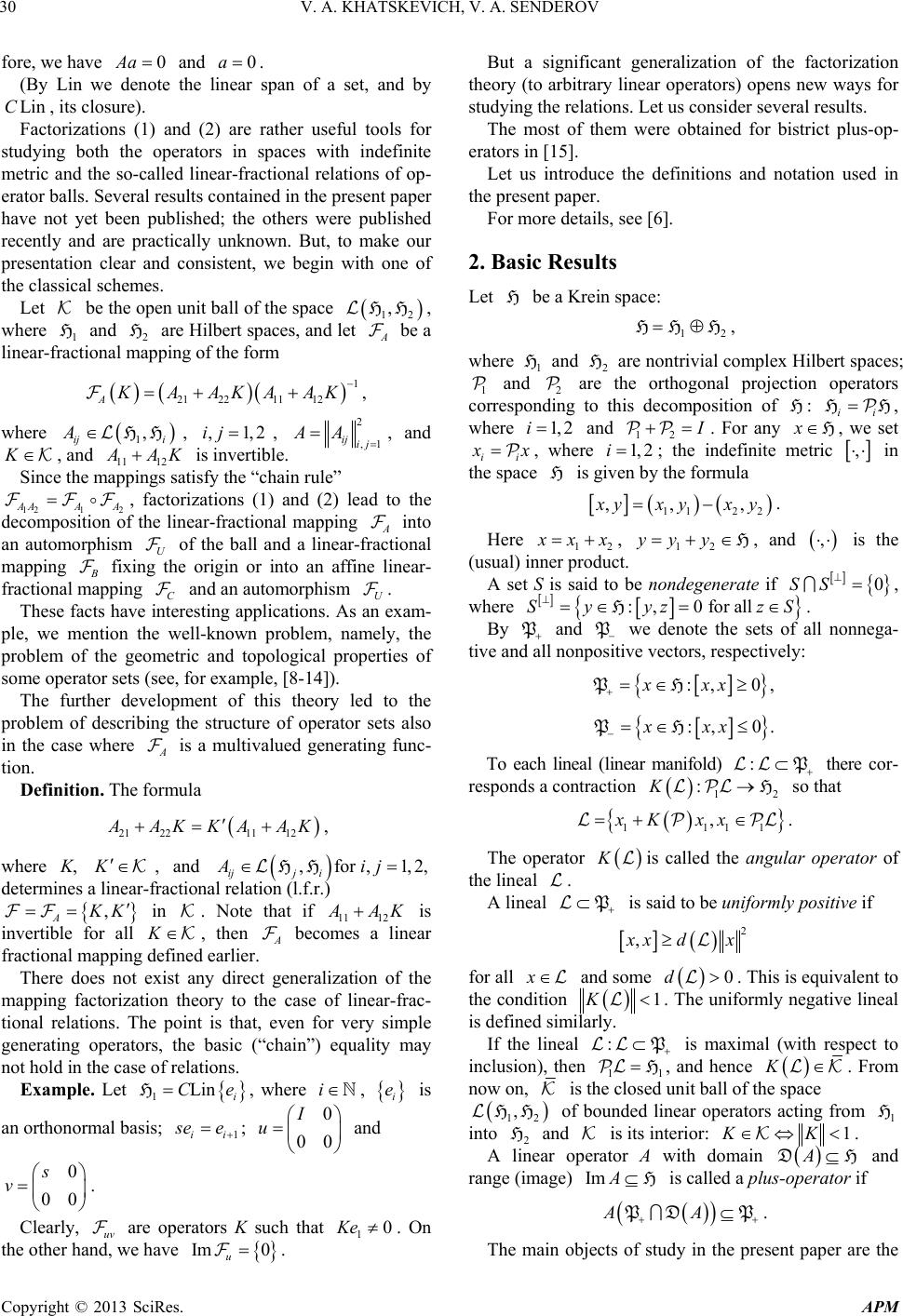 V. A. KHATSKEVICH, V. A. SENDEROV 30 fore, we have and 0 0aAa . But a significant generalization of the factorization theory (to arbitrary linear operators) opens new ways for studying the relations. Let us consider several results. (By Lin we denote the linear span of a set, and by , its closure). LinC Factorizations (1) and (2) are rather useful tools for studying both the operators in spaces with indefinite metric and the so-called linear-fractional relations of op- erator balls. Several results contained in the present paper have not yet been published; the others were published recently and are practically unknown. But, to make our presentation clear and consistent, we begin with one of the classical schemes. The most of them were obtained for bistrict plus-op- erators in [15]. Let us introduce the definitions and notation used in the present paper. For more details, see [6]. 2. Basic Results Let be the open unit ball of the space 1 ,HH A 1 11 12 2 , where 1 and 2 are Hilbert spaces, and let be a linear-fractional mapping of the form H H 21 22A K AAKAAK , where ij, i 1,HHA,1,2ij , 2 ,1 ij ij AA , and , and K11 12 A A K is invertible. Since the mappings satisfy the “chain rule” 121 2 AAAA , factorizations (1) and (2) lead to the decomposition of the linear-fractional mapping A into an automorphism U of the ball and a linear-fractional mapping B A fixing the origin or into an affine linear- fractional mapping and an automorphism . C U These facts have interesting applications. As an exam- ple, we mention the well-known problem, namely, the problem of the geometric and topological properties of some operator sets (see, for example, [8-14]). The further development of this theory led to the problem of describing the structure of operator sets also in the case where is a multivalued generating func- tion. Definition. The formula 11 122122 A AK KAAK K,for,1,2,ij , where K, , and determines a linear-fractional relation (l.f.r.) A , ijj i AHH K K in . Note that if 11 12 A AK is invertible for all , then becomes a linear fractional mapping defined earlier. K 1 H A There does not exist any direct generalization of the mapping factorization theory to the case of linear-frac- tional relations. The point is that, even for very simple generating operators, the basic (“chain”) equality may not hold in the case of relations. Example. Let , where , ni eLiCi i e is an orthonormal basis; 1ii s ee ; and . 0 00 u 10Ke I 0 00 s v Clearly, uv are operators K such that . On the other hand, we have . 0 uIm H 12 Let be a Krein space: HH H H H , where 1 and 2 H are nontrivial complex Hilbert spaces; 1 and 2 are the orthogonal projection operators corresponding to this decomposition of : ii HH 1, 2i, where and 12 I xH. For any , we set ii x x 1, 2, where i ; the indefinite metric , H in the space is given by the formula 1122 ,, , x yxy xy . Here 12 x xx12 yyy, H , , and 0SS is the (usual) inner product. A set S is said to be nondegenerate if , where :,0 for all Sy yzzS H. By P and P we denote the sets of all nonnega- tive and all nonpositive vectors, respectively: :, 0,xxx PH :, 0.xxx PH :P To each lineal (linear manifold) there cor- responds a contraction 12 :KH so that 1111 ,xKxx . The operator K is called the angular operator of the lineal . A lineal P is said to be uniformly positive if 2 , x xd x for all x and some 0.d This is equivalent to the condition K1 e uniformly negative lineal is defined similarly. . Th : If the lineal P is maximal (with respect to inclusion), then 11 H , and hence K . From now on, is the closed unit ball of the space 1 ,HH1 H H 2 of bounded linear operators acting from into and is its interior: 21KK AH Im AH . A linear operator A with domain D and range (image) is called a plus-operator if AA PDP. The main objects of study in the present paper are the Copyright © 2013 SciRes. APM 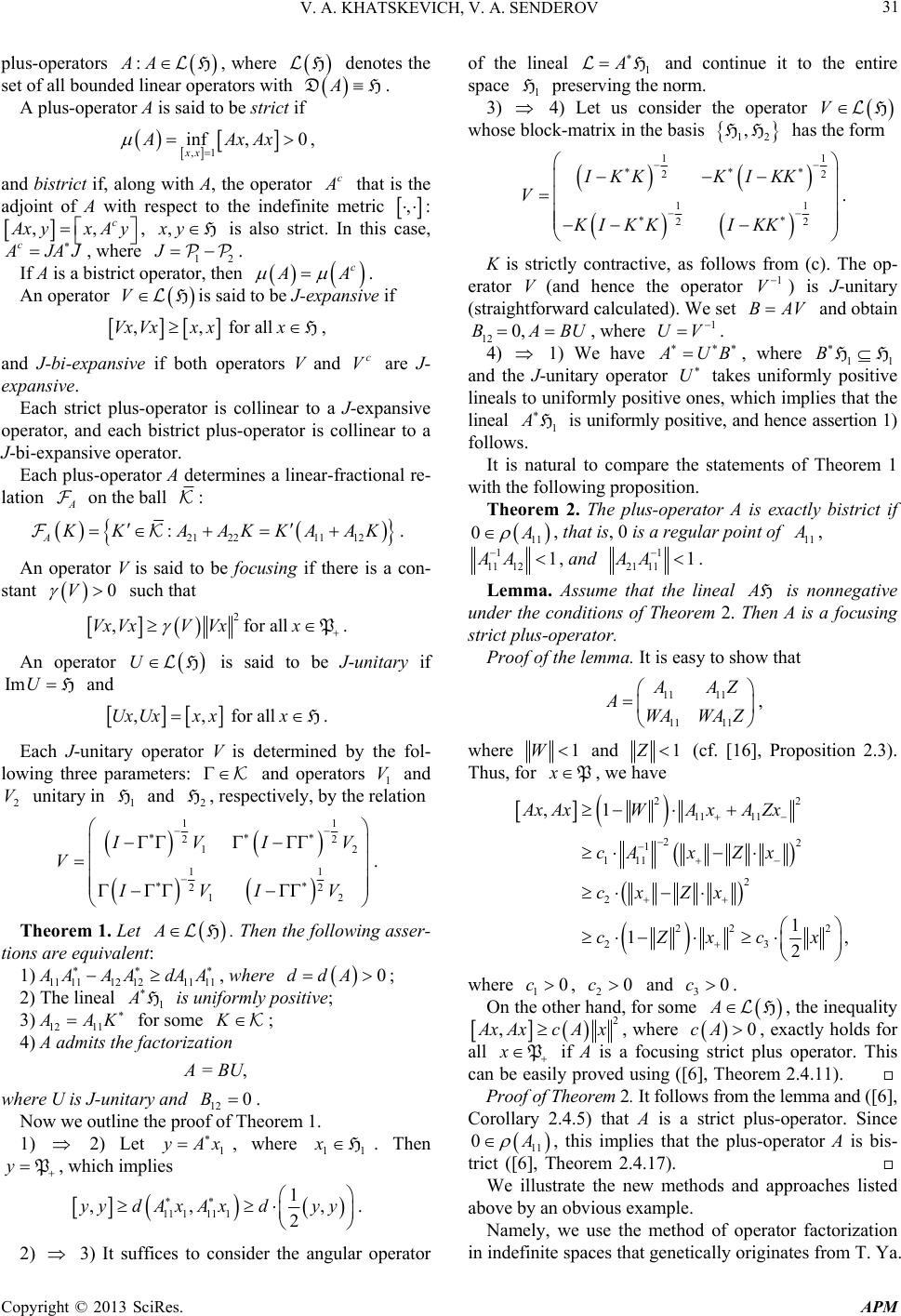 V. A. KHATSKEVICH, V. A. SENDEROV 31 plus-operators , where denotes the set of all bounded linear operators with H:AA H A DH . A plus-operator A is said to be strict if ,1 , 0AAxAx c inf xx , and bistrict if, along with A, the operator A that is the adjoint of A with respect to the indefinite metric , : ,c , A xy cxAy ,xy , is also strict. In this case, H A JA J , where . 12 If A is a bistrict operator, then J c A A V . An operator is said to be J-expansive if H , ,Vx Vxxx for all xH c V , and J-bi-expansive if both operators V and are J- expansive. Each strict plus-operator is collinear to a J-expansive operator, and each bistrict plus-operator is collinear to a J-bi-expansive operator. Each plus-operator A determines a linear-fractional re- lation on the ball A: 11 12 21 22 : A K KAAK KAAK 0V . An operator V is said to be focusing if there is a con- stant such that 2 ,Vx VxVVx for all x P H Im . An operator U is said to be J-unitary if and UH , ,Ux Uxxx for all xH V 2 . Each J-unitary operator V is determined by the fol- lowing three parameters: and operators 1 and unitary in and H, respectively, by the relation 2 V1 H 11 22 12 11 22 12 I VI V IV V IV AH 12 . Theorem 1. Let . Then th e following asser- tions are equivalent: 1) 11 111211 11 A AAA 0ddA AH dAA , where ; 2) The lineal is uniformly positive; 1 3) 12 11 A AK K for some 0B ; 4) A admits the factorization A = BU, where U is J-unitary and 12 . Now we outline the proof of Theorem 1. 1) 2) Let 1 y Ax 11 xH yP , where . Then , which implies 1, 2 11 111 1 ,, y ydAxAx d yy A H 1 H . 2) 3) It suffices to consider the angular operator of the lineal 1 and continue it to the entire space preserving the norm. 3) 4) Let us consider the operator H 12 ,HH V whose block-matrix in the basis has the form 11 22 11 22 IKKKIKK V KI KKI KK 1 BAV 12 0,BABU . K is strictly contractive, as follows from (c). The op- erator V (and hence the operator V) is J-unitary (straightforward calculated). We set and obtain 1 UV , where . A UB 4) 1) We have BHH U 1 AH , where 11 and the J-unitary operator takes uniformly positive lineals to uniformly positive ones, which implies that the lineal is uniformly positive, and hence assertion 1) follows. It is natural to compare the statements of Theorem 1 with the following proposition. Theorem 2. The plus-operator A is exactly bistrict if 11 0 A 11 , that is, 0 is a regular point of A , 1 11 121AA 1 21 111AA , and . Lemma. Assume that the lineal A H 11 11 11 11 is nonnegative under the conditions of Theorem 2. Then A is a focusing strict plus-operator. Proof of the lemma. It is easy to show that A AZ AWAWA Z , where 1W and 1Z (cf. [16], Proposition 2.3). Thus, for x P , we have 22 11 11 22 1 111 2 2 22 2 23 ,1 1 1, 2 Ax AxWAxAZx cAx Zx cx Zx cZxcx 0c0c0 AH where , and c. 1 23 On the other hand, for some , the inequality 2 , A xAxcA x 0cA x, where , exactly holds for all P if A is a focusing strict plus operator. This can be easily proved using ([6], Theorem 2.4.11). Proof of Theorem 2. It follows from the lemma and ([6], Corollary 2.4.5) that A is a strict plus-operator. Since 011 A , this implies that the plus-operator A is bis- trict ([6], Theorem 2.4.17). We illustrate the new methods and approaches listed above by an obvious example. Namely, we use the method of operator factorization in indefinite spaces that genetically originates from T. Ya. Copyright © 2013 SciRes. APM 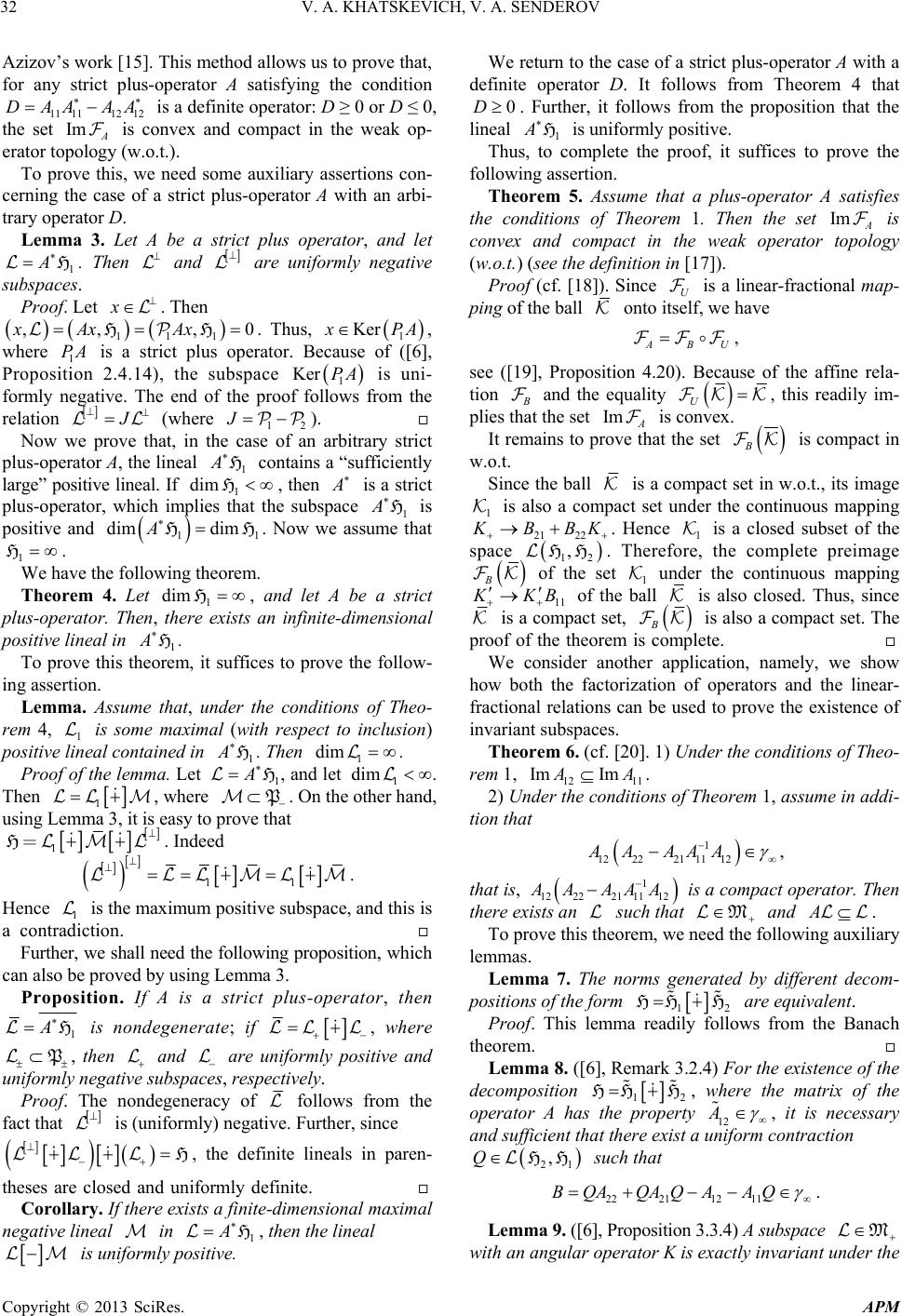 V. A. KHATSKEVICH, V. A. SENDEROV 32 Azizov’s work [15]. This method allows us to prove that, for any strict plus-operator A satisfying the condition 1112 is a definite operator: D ≥ 0 or D ≤ 0, the set A is convex and compact in the weak op- erator topology (w.o.t.). 11 12 A AA Im DA To prove this, we need some auxiliary assertions con- cerning the case of a strict plus-operator A with an arbi- trary operator D. Lemma 3. Let A be a strict plus operator, and let 1. Then and A H are uniformly negative subspaces. Proof. Let . Then x A ,,xAxH ,0xH 111 . Thus, Ker 1 x PA PA , where 1 is a strict plus operator. Because of ([6], Proposition 2.4.14), the subspace 1 is uni- formly negative. The end of the proof follows from the relation PA Ker J (where ). 12 Now we prove that, in the case of an arbitrary strict plus-operator A, the lineal contains a “sufficiently large” positive lineal. If 1, then J AH dim 1 H A AH 1 dH dim H H 1 dim is a strict plus-operator, which implies that the subspace 1 is positive and . Now we assume that . 1 Hdim imA 1 We have the following theorem. H Theorem 4. Let 1, and let A be a strict plus-operator. Then, there exists an infinite-dimensional positive lineal in . 1 To prove this theorem, it suffices to prove the follow- ing assertion. A Lemma. Assume that, under the conditions of Theo- rem 4, 1 is some maximal (with respect to inclusion) positive lineal contained in . Then 1 AH . Proof of the lemma. Let 1 A H, and let 1 dim . Then 1, where . On the other hand, using Lemma 3, it is easy to prove that P 1 H= . Indeed 11 . Hence 1 is the maximum positive subspace, and this is a contradiction. Further, we shall need the following proposition, which can also be proved by using Lemma 3. Proposition. If A is a strict plus-operator, then 1 A H is nondegenerate; if P , where , then and are uniformly positive and uniformly negative subspaces, respectively. Proof. The nondegeneracy of H 1 A H follows from the fact that is (uniformly) negative. Further, since , the definite lineals in paren- theses are closed and uniformly definite. Corollary. If there exists a finite-dimensional maximal negative lineal in , then the lineal 0DAH Im is uniformly positive. We return to the case of a strict plus-operator A with a definite operator D. It follows from Theorem 4 that . Further, it follows from the proposition that the lineal is uniformly positive. 1 Thus, to complete the proof, it suffices to prove the following assertion. Theorem 5. Assume that a plus-operator A satisfies the conditions of Theorem 1. Then the set A is convex and compact in the weak operator topology (w.o.t.) (see the definition in [17]). Proof (cf. [18]). Since U is a linear-fractional map- ping of the ball ABU onto itself, we have , see ([19], Proposition 4.20). Because of the affine rela- tion B and the equality U, this readily im- plies that the set is convex. Im A It remains to prove that the set B is compact in w.o.t. Since the ball 1 21 22 is a compact set in w.o.t., its image is also a compact set under the continuous mapping K BBK . Hence 1 is a closed subset of the space ,HH12 . Therefore, the complete preimage B of the set 1 under the continuous mapping 11 K KB of the ball is also closed. Thus, since is a compact set, Im Im B is also a compact set. The proof of the theorem is complete. We consider another application, namely, we show how both the factorization of operators and the linear- fractional relations can be used to prove the existence of invariant subspaces. Theorem 6. (cf. [20]. 1) Under the conditions of Theo- rem 1, 1211 A A. 2) Under the conditions of Theorem 1, assume in addi- tion that 1 122221 1112 AA AAA , 1 122221 1112 that is, A AAAA MA is a compact operator. Then there exists an such that and . To prove this theorem, we need the following auxiliary lemmas. Lemma 7. The norms generated by different decom- positions of the form 12 Proof. This lemma readily follows from the Banach theorem. HH H are equivalent. Lemma 8. ([6], Remark 3.2.4) For the existence of the decomposition 12 , where the matrix of the operator A has the property 12 HHH A , it is necessary and sufficient that there exist a uniform contraction 21 ,QHH 222112 11 BQAQAQA AQ such that . Lemma 9. ([6], Proposition 3.3.4) A subspace M with an angular operator K is exactly invariant under the Copyright © 2013 SciRes. APM 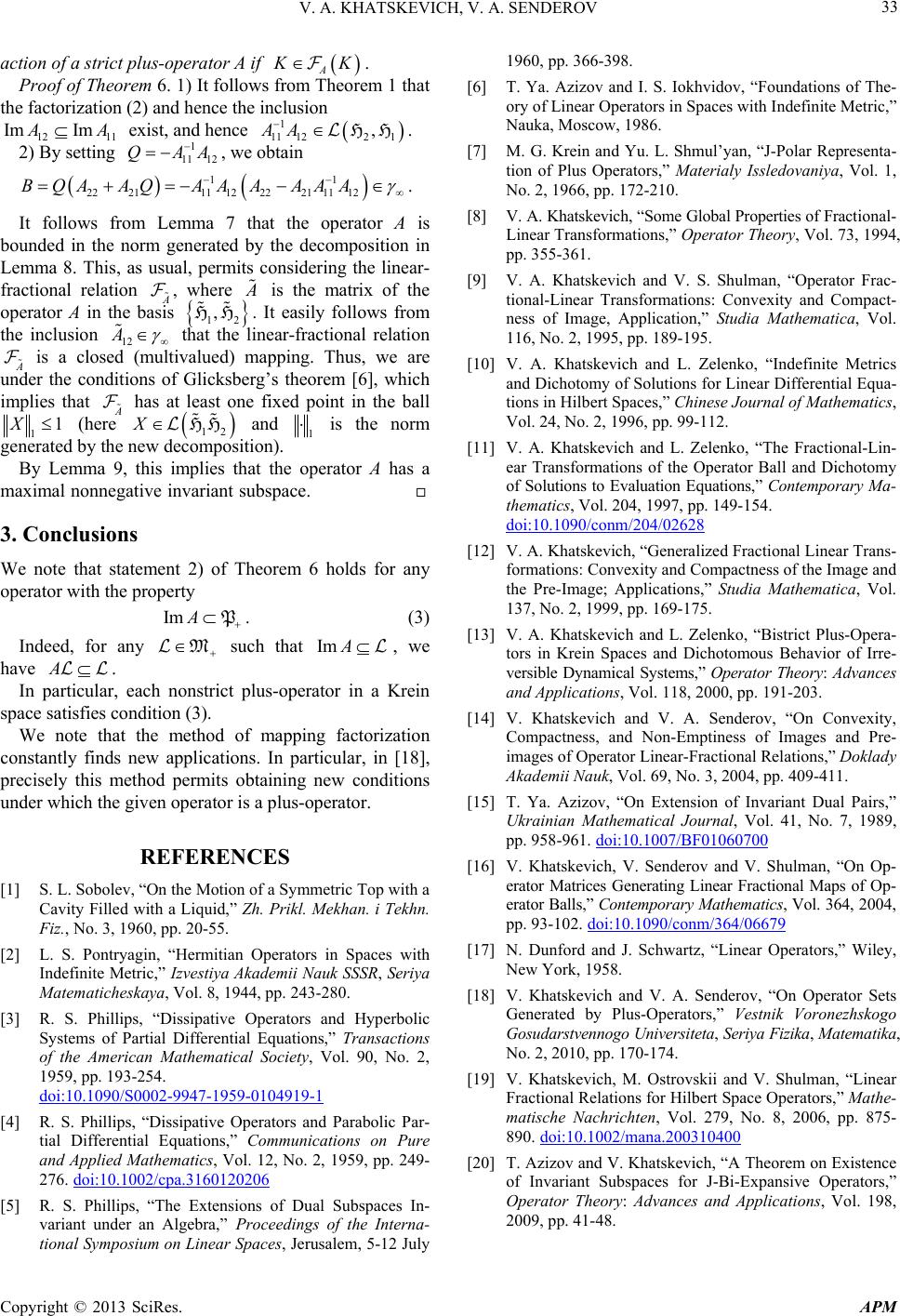 V. A. KHATSKEVICH, V. A. SENDEROV Copyright © 2013 Sci APM 33 Res. action of a strict plus-operator A if K AK Im . Proof of Theorem 6. 1) It follows from Theorem 1 that the factorization (2) and hence the inclusion 12 11 A 2 1 ,HH 11 11 12 AA exist, and hence . 1 11 12 AA Im A 2) By setting , we obtain 1 11 12 QAA 11 12 AA 22 2122 21 BQA AQAA . It follows from Lemma 7 that the operator A is bounded in the norm generated by the decomposition in Lemma 8. This, as usual, permits considering the linear- fractional relation A , where A 12 , HH is the matrix of the operator A in the basis . It easily follows from the inclusion 12 A that the linear-fractional relation A is a closed (multivalued) mapping. Thus, we are under the conditions of Glicksberg’s theorem [6], which implies that A has at least one fixed point in the ball 11X (here and 12 HHX1 is the norm generated by the new decomposition). By Lemma 9, this implies that the operator A has a maximal nonnegative invariant subspace. 3. Conclusions We note that statement 2) of Theorem 6 holds for any operator with the property Im A P M . (3) Indeed, for any such that , we have . Im A A In particular, each nonstrict plus-operator in a Krein space satisfies condition (3). We note that the method of mapping factorization constantly finds new applications. In particular, in [18], precisely this method permits obtaining new conditions under which the given operator is a plus-operator. REFERENCES [1] S. L. Sobolev, “On the Motion of a Symmetric Top with a Cavity Filled with a Liquid,” Zh. Prikl. Mekhan. i Tekhn. Fiz., No. 3, 1960, pp. 20-55. [2] L. S. Pontryagin, “Hermitian Operators in Spaces with Indefinite Metric,” Izvestiya Akademii Nauk SSSR, Seriya Matematicheskaya, Vol. 8, 1944, pp. 243-280. [3] R. S. Phillips, “Dissipative Operators and Hyperbolic Systems of Partial Differential Equations,” Transactions of the American Mathematical Society, Vol. 90, No. 2, 1959, pp. 193-254. doi:10.1090/S0002-9947-1959-0104919-1 [4] R. S. Phillips, “Dissipative Operators and Parabolic Par- tial Differential Equations,” Communications on Pure and Applied Mathematics, Vol. 12, No. 2, 1959, pp. 249- 276. doi:10.1002/cpa.3160120206 [5] R. S. Phillips, “The Extensions of Dual Subspaces In- variant under an Algebra,” Proceedings of the Interna- tional Symposium on Linear Spaces, Jerusalem, 5-12 July 1960, pp. 366-398. [6] T. Ya. Azizov and I. S. Iokhvidov, “Foundations of The- ory of Linear Operators in Spaces with Indefinite Metric,” Nauka, Moscow, 1986. [7] M. G. Krein and Yu. L. Shmul’yan, “J-Polar Representa- tion of Plus Operators,” Materialy Issledovaniya, Vol. 1, No. 2, 1966, pp. 172-210. [8] V. A. Khatskevich, “Some Global Properties of Fractional- Linear Transformations,” Operator Theory, Vol. 73, 1994, pp. 355-361. [9] V. A. Khatskevich and V. S. Shulman, “Operator Frac- tional-Linear Transformations: Convexity and Compact- ness of Image, Application,” Studia Mathematica, Vol. 116, No. 2, 1995, pp. 189-195. [10] V. A. Khatskevich and L. Zelenko, “Indefinite Metrics and Dichotomy of Solutions for Linear Differential Equa- tions in Hilbert Spaces,” Chinese Journal of Mathematics, Vol. 24, No. 2, 1996, pp. 99-112. [11] V. A. Khatskevich and L. Zelenko, “The Fractional-Lin- ear Transformations of the Operator Ball and Dichotomy of Solutions to Evaluation Equations,” Contemporary Ma- thematics, Vol. 204, 1997, pp. 149-154. doi:10.1090/conm/204/02628 [12] V. A. Khatskevich, “Generalized Fractional Linear Trans- formations: Convexity and Compactness of the Image and the Pre-Image; Applications,” Studia Mathematica, Vol. 137, No. 2, 1999, pp. 169-175. [13] V. A. Khatskevich and L. Zelenko, “Bistrict Plus-Opera- tors in Krein Spaces and Dichotomous Behavior of Irre- versible Dynamical Systems,” Operator Theory: Advances and Applications, Vol. 118, 2000, pp. 191-203. [14] V. Khatskevich and V. A. Senderov, “On Convexity, Compactness, and Non-Emptiness of Images and Pre- images of Operator Linear-Fractional Relations,” Doklady Akademii Nauk, Vol. 69, No. 3, 2004, pp. 409-411. [15] T. Ya. Azizov, “On Extension of Invariant Dual Pairs,” Ukrainian Mathematical Journal, Vol. 41, No. 7, 1989, pp. 958-961. doi:10.1007/BF01060700 [16] V. Khatskevich, V. Senderov and V. Shulman, “On Op- erator Matrices Generating Linear Fractional Maps of Op- erator Balls,” Contemporary Mathematics, Vol. 364, 2004, pp. 93-102. doi:10.1090/conm/364/06679 [17] N. Dunford and J. Schwartz, “Linear Operators,” Wiley, New York, 1958. [18] V. Khatskevich and V. A. Senderov, “On Operator Sets Generated by Plus-Operators,” Vestnik Voronezhskogo Gosudarstvennogo Universiteta, Seriya Fizika, Matematika, No. 2, 2010, pp. 170-174. [19] V. Khatskevich, M. Ostrovskii and V. Shulman, “Linear Fractional Relations for Hilbert Space Operators,” Mathe- matische Nachrichten, Vol. 279, No. 8, 2006, pp. 875- 890. doi:10.1002/mana.200310400 [20] T. Azizov and V. Khatskevich, “A Theorem on Existence of Invariant Subspaces for J-Bi-Expansive Operators,” Operator Theory: Advances and Applications, Vol. 198, 2009, pp. 41-48. |