

Paper Menu >>
Journal Menu >>
 Circuits and Systems, 2013, 4, 6-10 http://dx.doi.org/10.4236/cs.2013.41002 Published Online January 2013 (http://www.scirp.org/journal/cs) An Adaptive Howling Canceller Using 2-Tap Linear Predictor Akira Sogami, Yosuke Sugiura, Arata Kawamura*, Youji Iiguni Department of Systems Innovation, Graduate School of Engineering Science, Osaka University, Toyonaka, Japan Email: *[email protected] Received October 1, 2012; revised November 1, 2012; accepted November 8, 2012 ABSTRACT This paper proposes an adaptive howling canceller using notch filter and 2-tap linear predictor, where howling consists of a single sinusoidal signal whose magnitude is much greater than other frequency’s magnitudes. The employed 2-tap linear predictor can quickly detect howling due to its high convergence speed. Although the output signal of the 2-tap linear predictor cannot be directly used as one of a howling canceller, we can obtain the frequency of howling from the filter coefficient. We utilize the filter coefficient of the 2-tap linear predictor to design a notch filter which achieves a very narrow elimination band. The designed notch filter removes only howling and retains other desired signals. Simu- lation results show that the proposed adaptive howling canceller can quickly detect and effectively remove howling. Keywords: Howling Canceller; Linear Predictor; Notch Filter; Single Sinusoidal Signal; Convergence Speed 1. Introduction Howling is an annoying and persistence problem which is mainly caused in public address system. The public address system amplifies a signal observed at a micro- phone and transmits the amplified signal with a loud- speaker. Then, there exists a feedback path from the loudspeaker to the microphone. This feedback path forms an acoustical closed loop. When a frequency amplitude response of the closed loop is greater than 1 and its phase response is 2π, howling is caused, i.e., a single sinusoidal signal rapidly becomes large. In this case, audience can- not avoid perception of this unpleasant sound, and also it is difficult to receive a desired signal. Moreover, the public address system often breaks down due to howling. To avoid this undesired phenomenon, many approaches have been studied. One of the most famous and effective methods is an echo canceller [1]. The echo canceller adaptively estimates the acoustical impulse response from the loudspeaker to the microphone, and provides a replica of the feedback signal. When the echo canceller perfectly estimates the feedback impulse response, sub- tracting the replica of the feedback signal from the ob- served signal gives perfect suppression of the feedback signal and thus howling is not caused. Since the acousti- cal impulse response is time-variant, the echo canceller is required to achieve both of high estimation accuracy and high convergence speed. Unfortunately, a tread-off exists between the convergence speed and the estimation accu- racy. Actually, in many practical environments, the echo canceller cannot work well and hence it often causes degradation of sound quality, echo, or howling. Sogami et al. have proposed a simple howling canceller [2-3] which estimates howling by utilizing only the distance information between the loudspeaker and the microphone. This method can estimate the frequency of howling faster than the conventional echo canceller, under the assump- tion that howling is depending only on the direct distance from the loudspeaker to the microphone. Although howl- ing often depends on the direct distance, the above as- sumption cannot hold for howling which depends on the distance including reflections. Actually, all the distances including reflections cannot be calculated. These con- ventional researches imply that the occurrence of howl- ing may not be avoided and thus we have to prepare an- other howling canceller which adaptively removes howl- ing as fast as possible after it is caused. To remove howling after its occurrence, adaptive notch filter techniques are useful [4-10]. They achieve very narrow elimination bandwidth, and automatically estimate and remove a single sinusoidal signal like howl- ing. Unfortunately, it also has a trade-off problem be- tween the convergence speed and the estimation accuracy. Efficient notch filters which can solve the trade-off problem have been proposed [11-13]. Their main idea is to employ two or more notch filters, where one notch filter achieves high estimation accuracy at an expense of convergence speed, and the other notch filter has high convergence speed with low estimation accuracy. In such *Corresponding author. C opyright © 2013 SciRes. CS 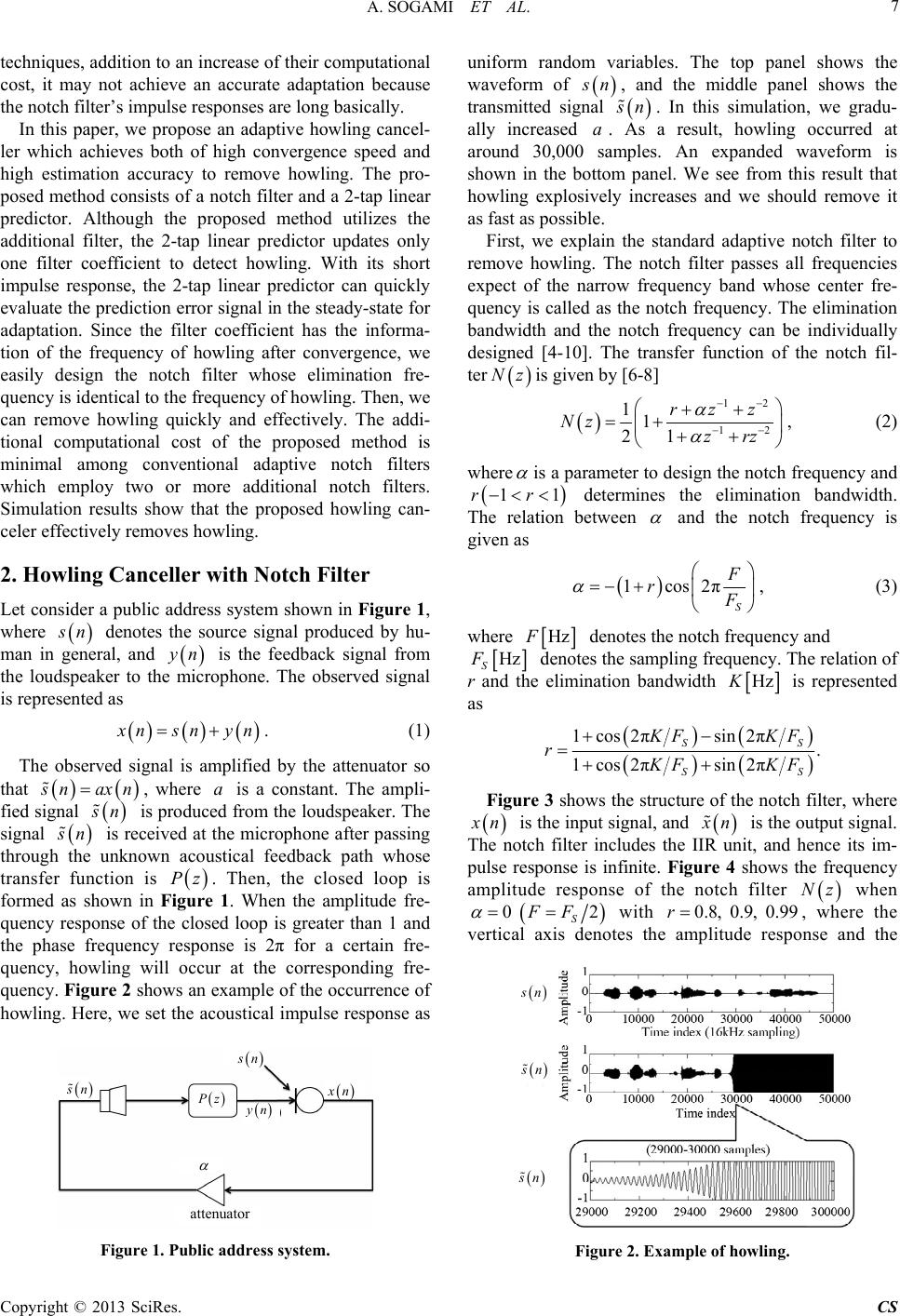 A. SOGAMI ET AL. 7 techniques, addition to an increase of their computational cost, it may not achieve an accurate adaptation because the notch filter’s impulse responses are long basically. In this paper, we propose an adaptive howling cancel- ler which achieves both of high convergence speed and high estimation accuracy to remove howling. The pro- posed method consists of a notch filter and a 2-tap linear predictor. Although the proposed method utilizes the additional filter, the 2-tap linear predictor updates only one filter coefficient to detect howling. With its short impulse response, the 2-tap linear predictor can quickly evaluate the prediction error signal in the steady-state for adaptation. Since the filter coefficient has the informa- tion of the frequency of howling after convergence, we easily design the notch filter whose elimination fre- quency is identical to the frequency of howling. Then, we can remove howling quickly and effectively. The addi- tional computational cost of the proposed method is minimal among conventional adaptive notch filters which employ two or more additional notch filters. Simulation results show that the proposed howling can- celer effectively removes howling. 2. Howling Canceller with Notch Filter Let consider a public address system shown in Figure 1, where s n denotes the source signal produced by hu- man in general, and y n is the feedback signal from the loudspeaker to the microphone. The observed signal is represented as x nsnyn . (1) The observed signal is amplified by the attenuator so that s nan a x , where is a constant. The ampli- fied signal s n is produced from the loudspeaker. The signal s n Pz is received at the microphone after passing through the unknown acoustical feedback path whose transfer function is . Then, the closed loop is formed as shown in Figure 1. When the amplitude fre- quency response of the closed loop is greater than 1 and the phase frequency response is 2π for a certain fre- quency, howling will occur at the corresponding fre- quency. Figure 2 shows an example of the occurrence of howling. Here, we set the acoustical impulse response as Pz yn x n s n s n attenuator Figure 1. Public address system. uniform random variables. The top panel shows the waveform of s n, and the middle panel shows the transmitted signal s n . In this simulation, we gradu- ally increased a. As a result, howling occurred at around 30,000 samples. An expanded waveform is shown in the bottom panel. We see from this result that howling explosively increases and we should remove it as fast as possible. First, we explain the standard adaptive notch filter to remove howling. The notch filter passes all frequencies expect of the narrow frequency band whose center fre- quency is called as the notch frequency. The elimination bandwidth and the notch frequency can be individually designed [4-10]. The transfer function of the notch fil- ter Nz is given by [6-8] 12 12 11 21 rzz Nz zrz , (2) is a parameter to design the notch frequency and where 11rr determines the elimination bandwidth. The relation between and the notch frequency is given as 1cos2π S F r F , (3) HzF denotes the notch frequency and where HzF S denotes the sampling frequency. The relation of r and the elimination bandwidth HzK is represented as 1cos2πsin 2π . 1cos2πsin 2π SS SS K FKF r K FKF Figure 3 shows the structure of the notch filter, where n is the input signal, and x x n is the output signal. The notch filter includes the IIR unit, and hence its im- pulse response is infinite. Figure 4 shows the frequency amplitude response of the notch filter Nz when 0 2FF 0.8, 0.9, 0.99 S with r, where the vertical axis denotes the amplitude response and the s n s n s n Figure 2. Example of howling. Copyright © 2013 SciRes. CS 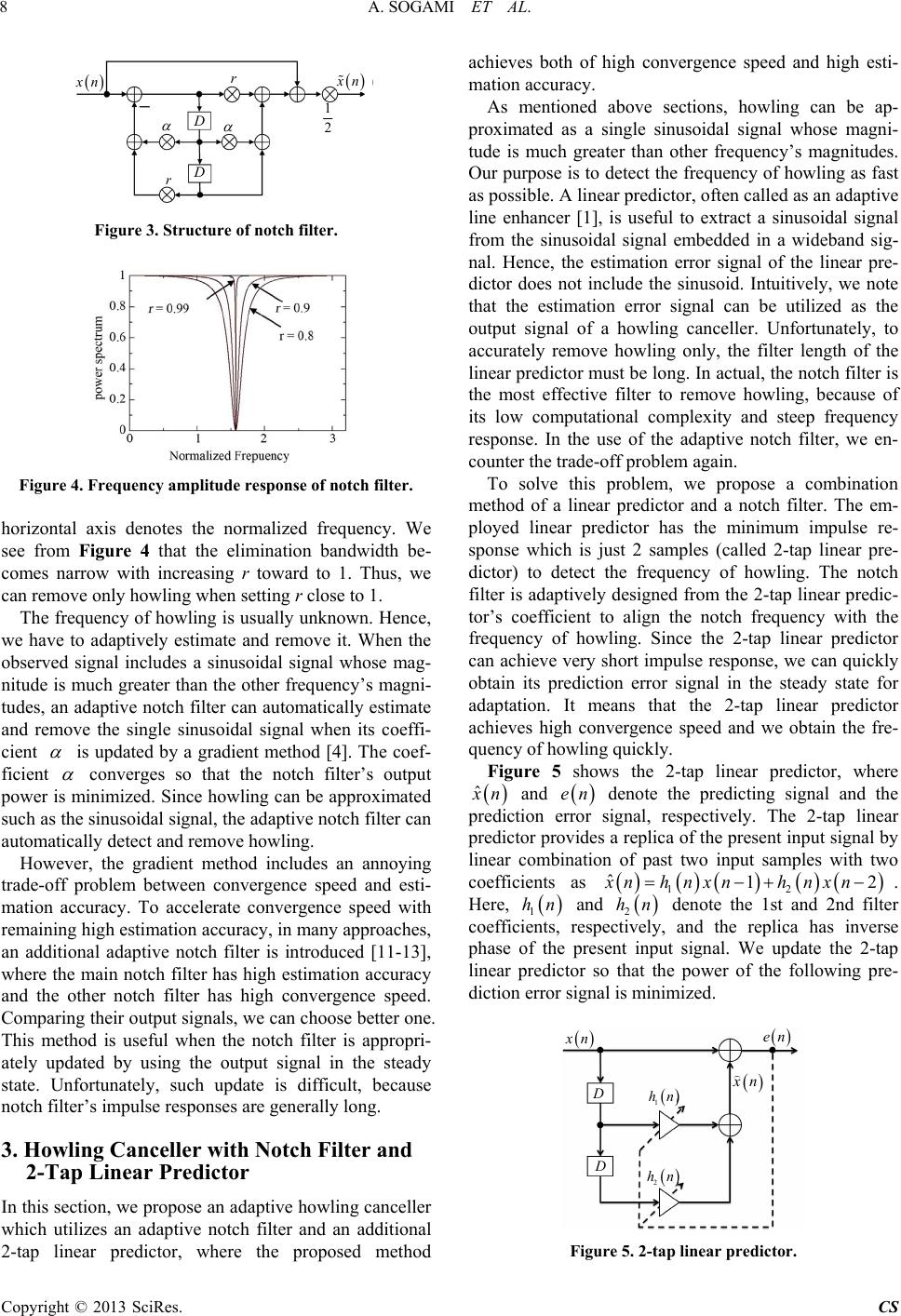 A. SOGAMI ET AL. 8 r x n D D r x n 1 2 Figure 3. Structure of notch filter. Figure 4. Frequency amplitude response of notc h filte r. horizontal axis denotes the normalized frequency. We see from Figure 4 that the elimination bandwidth be- comes narrow with increasing r toward to 1. Thus, we can remove only howling when setting r close to 1. The frequency of howling is usually unknown. Hence, we have to adaptively estimate and remove it. When the observed signal includes a sinusoidal signal whose mag- nitude is much greater than the other frequency’s magni- tudes, an adaptive notch filter can automatically estimate and remove the single sinusoidal signal when its coeffi- cient is updated by a gradient method [4]. The coef- ficient converges so that the notch filter’s output power is minimized. Since howling can be approximated such as the sinusoidal signal, the adaptive notch filter can automatically detect and remove howling. However, the gradient method includes an annoying trade-off problem between convergence speed and esti- mation accuracy. To accelerate convergence speed with remaining high estimation accuracy, in many approaches, an additional adaptive notch filter is introduced [11-13], where the main notch filter has high estimation accuracy and the other notch filter has high convergence speed. Comparing their output signals, we can choose better one. This method is useful when the notch filter is appropri- ately updated by using the output signal in the steady state. Unfortunately, such update is difficult, because notch filter’s impulse responses are generally long. 3. Howling Canceller with Notch Filter and 2-Tap Linear Predictor In this section, we propose an adaptive howling canceller which utilizes an adaptive notch filter and an additional 2-tap linear predictor, where the proposed method achieves both of high convergence speed and high esti- mation accuracy. As mentioned above sections, howling can be ap- proximated as a single sinusoidal signal whose magni- tude is much greater than other frequency’s magnitudes. Our purpose is to detect the frequency of howling as fast as possible. A linear predictor, often called as an adaptive line enhancer [1], is useful to extract a sinusoidal signal from the sinusoidal signal embedded in a wideband sig- nal. Hence, the estimation error signal of the linear pre- dictor does not include the sinusoid. Intuitively, we note that the estimation error signal can be utilized as the output signal of a howling canceller. Unfortunately, to accurately remove howling only, the filter length of the linear predictor must be long. In actual, the notch filter is the most effective filter to remove howling, because of its low computational complexity and steep frequency response. In the use of the adaptive notch filter, we en- counter the trade-off problem again. To solve this problem, we propose a combination method of a linear predictor and a notch filter. The em- ployed linear predictor has the minimum impulse re- sponse which is just 2 samples (called 2-tap linear pre- dictor) to detect the frequency of howling. The notch filter is adaptively designed from the 2-tap linear predic- tor’s coefficient to align the notch frequency with the frequency of howling. Since the 2-tap linear predictor can achieve very short impulse response, we can quickly obtain its prediction error signal in the steady state for adaptation. It means that the 2-tap linear predictor achieves high convergence speed and we obtain the fre- quency of howling quickly. Figure 5 shows the 2-tap linear predictor, where ˆ x n and en denote the predicting signal and the prediction error signal, respectively. The 2-tap linear predictor provides a replica of the present input signal by linear combination of past two input samples with two coefficients as ˆ12xnh nxnhnxn 12 . Here, hn 1 and 2 h denote the 1st and 2nd filter coefficients, respectively, and the replica has inverse phase of the present input signal. We update the 2-tap linear predictor so that the power of the following pre- diction error signal is minimized. n en x n D D 1 hn x n 2 hn Figure 5. 2-tap linear predictor. Copyright © 2013 SciRes. CS 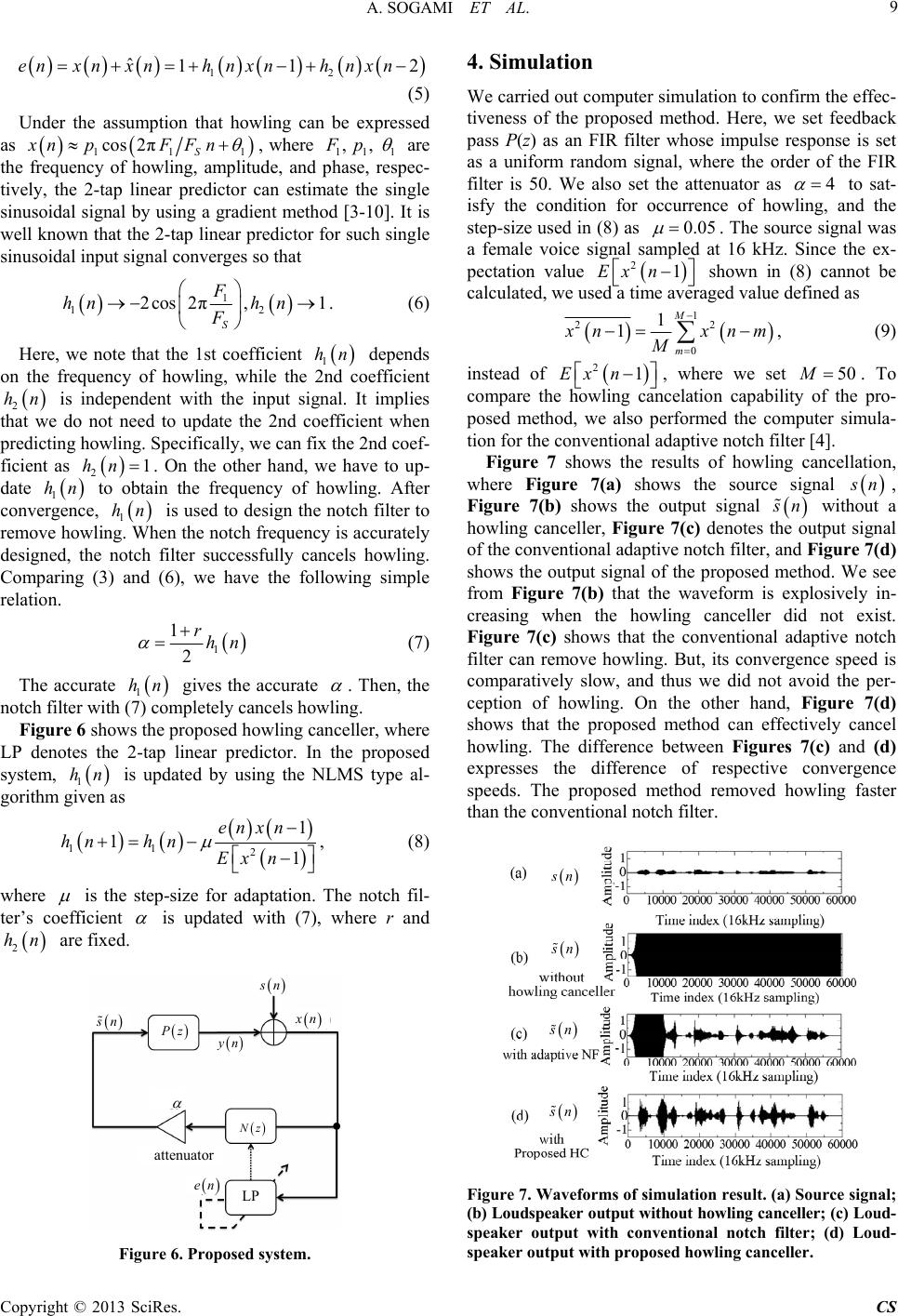 A. SOGAMI ET AL. 9 2n xn 12 ˆ11enxnxnh nxnh (5) Under the assumption that howling can be expressed as n 111S cos 2πxnpF F , where 111 , , Fp are the frequency of howling, amplitude, and phase, respec- tively, the 2-tap linear predictor can estimate the single sinusoidal signal by using a gradient method [3-10]. It is well known that the 2-tap linear predictor for such single sinusoidal input signal converges so that 12 ,1 hn hn 1 2cos 2π S F hn F . (6) Here, we note that the 1st coefficient 1 depends on the frequency of howling, while the 2nd coefficient 2 is independent with the input signal. It implies that we do not need to update the 2nd coefficient when predicting howling. Specifically, we can fix the 2nd coef- ficient as 2. On the other hand, we have to up- date 1 to obtain the frequency of howling. After convergence, 1 is used to design the notch filter to remove howling. When the notch frequency is accurately designed, the notch filter successfully cancels howling. Comparing (3) and (6), we have the following simple relation. hn 1hn hn hn 1 1 2 rhn hn (7) The accurate 1 gives the accurate . Then, the notch filter with (7) completely cancels howling. Figure 6 shows the proposed howling canceller, where LP denotes the 2-tap linear predictor. In the proposed system, 1 is updated by using the NLMS type al- gorithm given as hn 11 1hn hn 2 1 1 enxn Ex n , (8) where is the step-size for adaptation. The notch fil- ter’s coefficient is updated with (7), where r and are fixed. n 2 h s n s n x n yn Pz Nz en attenuator LP Figure 6. Proposed system. puter simulation to confirm the effec- 4. Simulatio We carried out com n tiveness of the proposed method. Here, we set feedback pass P(z) as an FIR filter whose impulse response is set as a uniform random signal, where the order of the FIR filter is 50. We also set the attenuator as 4 to sat- isfy the condition for occurrence of howand the step-size used in (8) as 0.05 ling, . The source signal was a female voice signal sa 16 kHz. Since the ex- pectation value mpled at 21Ex n shown in (8) cannot be calculated, we useraged value defined as d a time ave 0 1 m 1 22 1M nxnm M x , (9) instead of 21Ex n , where we set 50M . To howling can of the llation, w compare the celation capability pro- posed method, we also performed the computer simula- tion for the conventional adaptive notch filter [4]. Figure 7 shows the results of howling cance here Figure 7(a) shows the source signal s n, Figure 7(b) shows the output signal s n witha howling canceller, Figure 7(c) denotes tutput signal of the conventional adaptive notch filter, and Figure 7(d) shows the output signal of the proposed method. We see from Figure 7(b) that the waveform is explosively in- creasing when the howling canceller did not exist. Figure 7(c) shows that the conventional adaptive notch filter can remove howling. But, its convergence speed is comparatively slow, and thus we did not avoid the per- ception of howling. On the other hand, Figure 7(d) shows that the proposed method can effectively cancel howling. The difference between Figures 7(c) and (d) expresses the difference of respective convergence speeds. The proposed method removed howling faster than the conventional notch filter. out he o s n s n s n s n Figure 7. Waveforms of simulation result. (a) Source signal; (b) Loudspeaker output without howling canceller; (c) Loud- speaker output with conventional notch filter; (d) Loud- speaker output with proposed howling canceller. Copyright © 2013 SciRes. CS  A. SOGAMI ET AL. Copyright © 2013 SciRes. CS 10 posed a howling canceller which em- [1] S. Haykin, “Inilters,” Macmillan i, “Improvement mura and Y. Iiguni, “A High e Notch Filter for 5. Conclusion This paper has pro ploys a 2-tap linear predictor and a notch filter. The 2-tap linear predictor is for estimating the frequency of howl- ing, and the notch filter is for eliminating howling. Since the coefficient of the 2-tap linear predictor is simply transformed to the coefficient of the notch filter, we can easily update the notch filter according to the linear pre- dictor. The simulation result showed the effectiveness of the proposed method. REFERENCES troduction to Adaptive F Publishing Company, New York, 1984. [2] A. Sogami, A. Kawamura and Y. Iigun of Speech Quality in Distance-Based Howling Canceller,” IEICE Transactions on Fundamentals, Vol. 92, No. 4, 2009, pp. 1039-1046. [3] A. Soagami, A. Kawa Speech Quality Distance-Based Howling Canceller with Adaptive Cascade Notch Filter and Silent Pilot Signal,” IEICE Transactions on Fundamentals, Vol. 94, No. 11, 2011, pp. 2306-2314. [4] S. Nishimura, “An Improved Adaptiv Detection of Multiple Sinusoids,” IEICE Transactions on Fundamentals, Vol. 77, No. 6, 1994, pp. 950-955. [5] A. Nehorai, “A Minimal Parameter Adaptive Notch Filter with Constrained Poles and Zeros,” IEEE Transactions on Acoustics, Speech and Signal Processing, Vol. 33, No. 4, 1985, pp. 983-996. doi:10.1109/TASSP.1985.1164643 [6] H. C. Chong and U. L. Sang, “Adaptive Line Enhance- ment by Using an IIR Lattice Notch Filter,” IEEE Trans- ac tions on Ac oust ics , Speech and Signal Processing, Vol. 37, No. 4, 1989, pp. 585-589. doi:10.1109/29.17543 [7] C. C. Tseng and S. C. Pei, “IIR Multiple Notch Filter nalytical Two- y, “Design of IIR Multiple Filter . Zou and N. Zheng, “A Piloted Adaptive Design Based on Allpass Filter,” IEEE Transactions on Circuits and Systems II: Analog and Digital Signal Proc- essing, Vol. 44, No. 2, 1997, pp. 133-136. [8] S. C. Pei, W. S. Lu and C. C. Tseng, “A Dimensional IIR Notch Filter Design Using Outer Prod- uct Expansion,” IEEE Transactions on Circuits and Sys- tems II: Analog and Digital Signal Processing, Vol. 44, No. 9, 1997, pp. 765-768. [9] Y. V. Joshi and S. C. D. Ro Notch Filters Based on All-Pass Filters,” IEEE Transac- tions on Circuits and Systems II: Analog and Digital Sig- nal Processing, Vol. 46, No. 2, 1999, pp. 134-138. [10] V. DeBrunner, “An Adaptive, High-Order, Notch Using All Pass Sections,” IEEE International Conference on Acoustics, Speech and Signal Processing, Vol. 3, 1998, pp. 1477-1480. [11] Y. C. Lim, Y. X Notch Filter,” IEEE Transactions on Signal Processing, Vol. 53, No. 4, 2005, pp. 1310-1323. doi:10.1109/TSP.2005.843742 [12] A. Kawamura, Y. Itoh, J. Okello, M. Kobayashi and Y. go- Fukui, “Parallel Composition Based Adaptive Notch Fil- ter: Performance and Analysis,” IEICE Transactions on Fundamentals, Vol. 87, No. 7, 2004, pp. 1747-1755. [13] A. Kawamura, Y. Iiguni and Y. Itoh, “An Adaptive Al rithm with Variable Step-Size for Parallel Notch Filter,” IEICE Transactions on Fundamentals, Vol. 89, No. 2, 2006, pp. 511-519. |