

Paper Menu >>
Journal Menu >>
 Technology and Investment, 2013, 4, 31-35 Published Online Febr uary 2013 (http://www.SciRP.org/journal/ti) Copyright © 2013 SciRes. TI Retail Pricing under Contract Self-Selection: An Empirical Exploration Yuanfang Lin, Lianhua Li School of Business, University of Alberta, Edmonton, Canada Email: Yuanfang.lin@ ualberta.ca, lianh [email protected] Received 2012 ABSTRACT Using cross-sectional survey data on prices, station and market characteristics for 730 gasoline stations in the Greater Saint Louis area, we estimate a switching regression model of station decisions. We employ a binary probit choice model to study a station’s decision to enter a contract relationship with greater control from the upstream refinery, or a contract relationship with greater degree of independence, as a function of market and station characteristics. We then estimate stations’ pricing decisions with self-selecti vity corrections for the station’s contract decision. We show that incorrect inferences about retail gasoline station’s pricing behavior would result if the endogeneity in the choice of con- tract type were treated as exogenous condition in the estimation. Keywords: Retail Gasoline Markets; Marketing Channel; Pricing Strategy; Selection Bias; Switching Regression 1. Introduction As a channel intermediary, a retailer obtains product from manufacturers and resell to the end consumers in the market. When selecting a certain contract relationship with the upstream manufacturer, a retailer considers and compares the benefits versus the levels of control from the manufacturer on its marketing activities, associated with different types of contract relationship. If a retailer agrees to become a lower level division or a franchise of the manufacturer, the retailer’s marketing activities in terms of daily prices, promotional events, etc will be largely controlled by the manufacturer. On the other hand, if the retailer maintains its independence by only paying wholesale prices to get product from manufacturer, the above mentioned marketing activities can then be largely determined by the retailer itself or least with greater de- gree of flexibility. This paper examines a retailer gasoline station’s pric- ing decision after accounting for its endogenous, compa- ratively longer-term decision on the contract relationship with upstream refinery. The model and analysis pre- sented here are inspired by work done by Iyer and See- th ar ama n (2003) which examines a firm’s incentive to price discriminate after self selecting the product offering. We model a gasoline station’s decision to be in a more “controlled” or “independent” relationship with upstream refinery as a function of the market and station characte- ristics. We then model the retail price set by the gasoline station conditional on its prior endogenous contract deci- sion. The study allows us to explicitly and comprehen- sively investigate the interaction between two important Marketing “4Ps”, namely, price and place (channel) in the retail gasoline industry. 2. Literature Background When it comes to the marketing “4Ps” about a retail gas- oline station, the “Price” and “Place” (including both geographic location and contract choice) have been of strong interests in existing economic studies.1 Slade (1996) argues that when there is a high degree of The fol- lowing we briefly review a few key references before stating the contribution of this paper. Shepard (1993) argues that gasoline refiners will choose contractual forms with strong performance incen- tives, i.e., lessee-dealerships or open dealerships, at gaso- line stations where unobservable effort is more important (e.g. auto repair, full service), and contractual forms, i.e. company-owned, that allow more direct control but offer weaker performance incentives, at stations where ob- servable effort is more important (e.g. convenient store). Pricing regression using cross-sectional data on contrac- tual forms and other characteristics from 1,527 gasoline stations in Eastern Massachusetts showed that compa- ny-owned stations indeed have lower prices than other stations, all else being equal. 1 Interested readers are referred to Lin and Seetharaman (2012) for details. 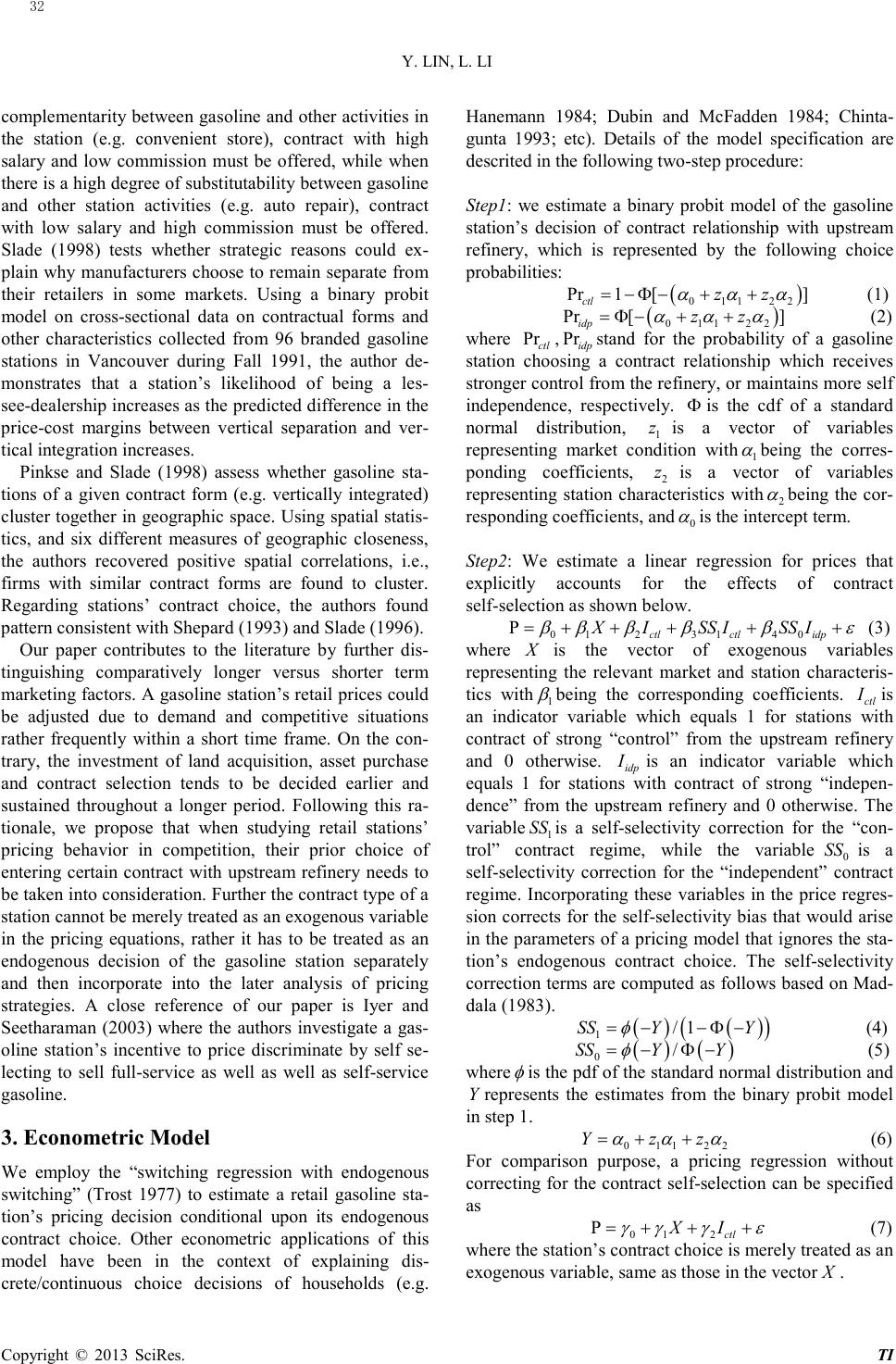 Y. LIN, L. LI Copyright © 2013 SciRes. TI complementarity between gasoline and other activities in the station (e.g. convenient store), contract with high salary and low commission must be offered, while when there is a high degree of substitutability between gasoline and other station activities (e.g. auto repair), contract with low salary and high commission must be offered. Slade (1998) tests whether strategic reasons could ex- plain why manufacturers choose to remain separate from their retailers in some markets. Using a binary probit model on cross-sectional data on contractual forms and other characteristics collected from 96 branded gasoline stations in Vancouver during Fall 1991, the author de- monstrates that a station’s likelihood of being a les- see-dealership increases as the predicted difference in the price-cost margins between vertical separation and ver- tical integration increases. Pinkse and Slade (1998) assess whether gasoline sta- tions of a given contract form (e.g. vertically integrated) cluster together in geographic space. Using spatial statis- tics, and six different measures of geographic closeness, the authors recovered positive spatial correlations, i.e., firms with similar contract forms are found to cluster. Regarding stations’ contract choice, the authors found pattern consistent with Shepard (1993) and Slade (1996). Our paper contributes to the literature by further dis- tinguishing comparatively longer versus shorter term marketing factors. A gasoline station’s retail prices could be adjusted due to demand and competitive situations rather frequently within a short time frame. On the con- trary, the investment of land acquisition, asset purchase and contract selection tends to be decided earlier and sustained throughout a longer period. Following this ra- tionale, we propose that when studying retail stations’ pricing behavior in competition, their prior choice of entering certain contract with upstream refinery needs to be taken into consideration. Further the contract type of a station cannot be merely treated as an exogenous variable in the pricing equations, rather it has to be treated as an endogenous decision of the gasoline station separately and then incorporate into the later analysis of pricing strategies. A close reference of our paper is Iyer and Seetharaman (2003) where the authors investigate a gas- oline station’s incentive to price discriminate by self se- lecting to sell full -service as well as well as self-service gasoline. 3. Econometric Model We employ the “switching regression with endogenous switching” (Trost 1977) to estimate a retail gasoline sta- tion’s pricing decision conditional upon its endogenous contract choice. Other econometric applications of this model have been in the context of explaining dis- crete/continuous choice decisions of households (e.g. Hanemann 1984; Dubin and McFadden 1984; Chinta- gunta 1993; etc). Details of the model specification are descrited in the following two-step procedure: Step 1: we estimate a binary probit model of the gasoline station’s decision of contract relationship with upstream refinery, which is represented by the following choice probabilities: ( ) 0112 2 Pr1 [] ctl zz ααα =−Φ −++ (1) ( ) 0112 2 Pr [] idp zz ααα =Φ− ++ (2) where Prctl , Pridp stand for the probability of a gasoline station choosing a contract relationship which receives stronger control from the refinery, or maintains more self independence, respectively. Φ is the cdf of a standard normal distribution, 1 z is a vector of variables representing market condition with1 α being the corres- ponding coefficients, 2 zis a vector of variables representing station characteristics with 2 α being the cor- responding coefficients, and0 α is the intercept term. Step2: We estimate a linear regression for prices that explicitly accounts for the effects of contract self-selection as shown below. 012314 0 P ctl ctlidp XISS ISSI ββ βββε =++ +++ (3) where X is the vector of exogenous variables representing the relevant market and station characteris- tics with1 β being the corresponding coefficients. ctl Iis an indicator variable which equals 1 for stations with contract of strong “control” from the upstream refinery and 0 otherwise. idp I is an indicator variable which equals 1 for stations with contract of strong “indepen- dence” from the upstream refinery and 0 otherwise. The variable 1 SS is a self-selectivity correction for the “con- trol” contract regime, while the variable 0 SS is a self-selectivity correction for the “independent” contract regime. Incorporating these variables in the price regres- sion corrects for the self-selectivity bias that would arise in the parameters of a pricing model that ignores the sta- tion’s endogenous contract choice. The self-selectivity correction terms are computed as follows based on Mad- dala (1983). ( )( ) ( ) 1 /1SS YY φ =−−Φ − (4) ( )( ) 0 /SSY Y φ = −Φ− (5) whe re φ is the pdf of the standard normal distribution and Y represents the estimates from the binary probit model in step 1. 0112 2 Y zz ααα =++ (6) For comparison purpose, a pricing regression without correcting for the contract self-selection can be specified as 01 2 P ctl XI γγ γε =++ + (7) where the station’s contract choice is merely treated as an exogenous variable, same as those in the vector X . 32  Y. LIN, L. LI Copyright © 2013 SciRes. TI 4. Data and Estimation We employ a survey data2 9) Mhi, a non-negative continuous variable that cap- , collected during 1999, which covers 730 retail gasoline stations in the Greater Saint Louis area. The survey data contain information on retail prices and various service and local market characteris- tics pertaining to the 730 gasoline stations. We also em- ploy the 2000 U.S. census records and information from the Missouri Census Data Center for demographic cha- racteristics of the local markets where these gasoline stations operate. 4.1. Empirical Measures We use the Type-of-Operation recorded in the station survey to construct the dependent variable for the binary probit model at step 1. Stations in the survey are classi- fied into four different types of operation: 1) owned by refinery; 2) franchise of refinery; 3) independent retailer; and 4) local jobbers. We group the first two types of op- eration (company-owned, franchise) into the “con- trol”-type contract relationship (Ctl), while the remaining two are grouped into the “independent”-type contract relationship (Idp). This practice is consistent with the literature studies on marketing channel coordination (e.g. McGuire and Staelin 1983). Consistent with the literature, we include the following variables in the estimation of contract choice model and pricing regression, which contains station and market characteristics, as well as demographics of the local area where the station is oper- ated. 1) Wash, i.e., a dummy variable that takes the value 1 if the station offers car wash and 0 otherwise. 2) Full, i.e., a dummy variable that takes the value 1 if the station sells full-service gasoline and 0 otherwise. 3) Conv, i.e., a dummy variable that takes the value 1 if the station has convenience store and 0 otherwise. 4) Day, i.e., a dummy variable that takes the value 1 if the station opens 24 hour a day and 0 otherwise. 5) Serv, i.e., a dummy variable that takes the value 1 if the station has service station and 0 otherwise. 6) B rd , i.e., a dummy variable that takes the value 1 if the station is a brand-name station (Amoco, Shell, or Exxo n-Mobil) and 0 otherwise. 7) No z, a discrete variable, whose values range from 2 to 8, that captures the number of pumping nozzles at the gasoline station. 8) Cmp, a non-negative discrete variable that captures the number of gasoline stations (other than the focal one) that operate in the same local market (defined by census track). 2 The survey data was collected by New Image Marketing Ltd. tures the median household income of the census track where the station operates. 10) Pop, a non-negative discrete variable that captures the size of population for the census track where the sta- tion operates. The station survey includes, for each gasoline station, the prices of three grades – 87, 89 and 93 octane levels. Since 87-octane level is the most commonly sold grade of gasoline in retail gasoline markets, and is available at all the stations in our dataset, we operationalize the de- pendent variable (Rup) for the pricing regression at step 2 using the observed (posted) price of self-service gasoline in cents per gallon. And the following variables are in- cluded in the pricing regression to assess the potential impact from local demand and competitive condition. 11) Cvis, a dummy variable that takes the value 1 if there is another station visible from the location of the focal station and 0 otherwise. 12) Neaf, a dummy variable that takes the value 1 if the station is within 1 mile distance from a highway en- trance and 0 otherwise. 13) Neac, a dummy variable that takes the value 1 if the station is near a business entity (e.g. grocery store, shopping plaza, etc). Table 1 reports the descriptive statistics for all the va- riables. Table 1. Descriptive Statistics Variable Mean Std Dev Min Max Ctl 0.34 0.48 0 1 Wash 0.22 0.42 0 1 Full 0.12 0.33 0 1 Conv 0.91 0.29 0 1 Day 0.69 0.46 0 1 Serv 0.20 0.40 0 1 Brd 0.42 0.49 0 1 Noz 16.56 9.46 1 66 Cmp 3.22 3.11 0 17 Mhi 45255.00 21444.00 0 200001 Pop 1635.00 1058.00 0 7667 RUP 960.32 54.04 19 1159 Cvis 0.36 0.48 0 1 Nea f 0.21 0.41 0 1 Nea c 0.20 0.40 0 1 4.2. Contract Choice Results Table 2 reports the probit model estimation results from step 1. Stations are more likely to choose a “con- trol”-type contract with a major brand refinery. Stations are also likely to be in a “control”-type contract if offer- ing car wash or full-service gasoline product. Also longer opening hours and greater number of pumping nozzles are both more likely associated with a “control”-type contract. Consistent with the literature (e.g. Shepard 33  Y. LIN, L. LI Copyright © 2013 SciRes. TI 1993), stations are more likely to be in a “independent”- type contract if offering auto repair service where unob- servable effort is more important. Different from the li- terature, we did not find significant impact on the “con- trol”-type contract from the presence of convenience store, which could be explained by the increasing co-existence of convenience stores inside gasoline station in recent years. Stations are less likely to choose a “con- trol”-type contract when operating in a local area with higher medium household income. Finally the presence of competing stations in the same local area marginally reduces a station’s likelihood of choosing a “con- trol”-type contract as reaming independence would help the station react more promptly in competitive situation such as promotional decisions. Table 2. Probit Model Results Variable Coeff Std. Error T-Stat P-Value Cons t -1.098 0.245 -4.489 0.000 Wash 0.301 0.144 2.093 0.036 Full 0.827 0.191 4.321 0.000 Conv -0.190 0.194 -0.978 0.328 Day 0.415 0.147 2.827 0.005 Serv -0.017 0.182 -0.093 0.926 Brd 0.949 0.123 7.689 0.000 Noz 2.501 0.383 6.534 0.000 Cmp -0.028 0.018 -1.588 0.112 Mhi -0.881 0.513 -1. 718 0.086 Pop -0.482 0.471 -1.023 0.306 4.3. Pricing Regression Results Table 3 reports the estimation results of the pricing re- gression from Step 2. Table 3. Pricing Model Results Variable Coeff Std. Error T-Stat P-Value Cons t 0.000 0.007 -0.018 0.985 Day -0.020 0.007 -3.085 0.002 Brd 0.007 0.014 0.535 0.592 Mhi 0.033 0.021 1.569 0.107 Pop -0.023 0.021 -1.125 0.261 Cvis 0.003 0.007 0.402 0.687 Nea c -0.014 0.006 -2.513 0.012 Nea f -0.006 0.006 -0.969 0.333 Ctl 0.045 0.037 1.221 0.222 SS1 -0.080 0.046 -1.750 0.080 SS0 0.023 0.050 0.468 0.640 The visibility of another station does not seem to sig- nificantly impact the focal station’s pricing decision, a finding prompts us to further consider a better measure of the competitive intensity in the local market. Among all the variables indicating the potential demand from local market, closeness to another business entity (e.g. grocery store, shopping plaza) has the most significant impact. In particular, a retail station tends to lower its gasoline price in order to attract traffics likely going to the nearby business locations. The covariance between the “control”-type contract choice and the pricing ( 3 β ) is significantly negative, i.e., if a station is more likely to be in a “control”-type contract relationship with upstream refinery, it is also more likely to charge a lower price. 4.4. Effect of Endogeneity Correction The main objective of this paper is to demonstrate the importance of incorporating a gasoline station’s endo- genous contract choice when studying its pricing strategy. For this purpose, we also separate estimate the pricing equation specified in Equation 7 and the results are re- ported in the following Table 4. Table 4. Pricing without Contract Self-Selection Variable Coeff Std. Error T-Stat P-Value Cons t 0.008 0.005 1.508 0.132 Day -0.018 0.006 -3.186 0.001 Brd 0.021 0.007 3.157 0.002 Mhi 0.024 0.019 1.267 0.205 Pop -0.025 0.019 -1.294 0.196 Cvis 0.002 0.007 0.295 0.768 Neac -0.014 0.006 -2.545 0.011 Neaf -0.006 0.006 -0.974 0.330 Ctl -0.001 0.006 -0.076 0.939 When a station’s contract type (Ctl) is merely treated as an exogenous variable in the pricing regression, the estimate coefficient is statistically insignificant, which implies that there is no covariance between a station’s contract relationship with upstream refinery and its pric- ing decision. This is different from the result of step 2 pricing regression as reported in Table 3. A likelih- ood-ratio test is further conducted with the null hypothe- sis being the pricing model with contract self-selection correction (Table 3) and the alternative hypothesis being the pricing model without contract self-selection correc- tion (Table 4). Test statistics favors the self-selection correction model with high significance (P<.001). 5. Conclusion This paper investigates a gasoline station’s endogenous decision to choose a specific contract relationship with upstream refinery and the corresponding pricing decision. We find that a pricing regression that does not endogen- ize the gasoline station’s contract decision to station and 34  Y. LIN, L. LI Copyright © 2013 SciRes. TI local market characteristics leads to incorrect inferences in the pricing estimation. The most interesting direction to further expand the current study is to identify other station decisions that are also endogenously set. One such factor would likely be the geographic location of the station where a potential study will then involve a three -stage decision sequence where stations choose geographic location first, followed by contract decision with upstream refinery, and finally the competitive pric- ing behavior in the local market. 6. Acknowledgements We thank the Social Sciences and Humanities Research Council of Canada for funding that supports this research project. REFERENCES [1] A. Shepard, “Contractual Form, Retail Price, and Asset Characteristics in Gasoline Retailing,” The RAND Jour- nal of Economics, Vol. 24, No. 1, 1993, pp58-77. [2] G. Iyer and P.B. Seetharaman, “To Price Discriminate or Not: Product Choice and the Selection Bias Problem,” Quantitative Marketing and Economics, Vol. 1, 2003, pp155-178. [3] G.S. Maddala, “Limited-Dependent and Qualitative Va- riables in Econometrics,” Cambridge University Press, 1983. [4] J. A. Dubin and D.L. McFadden, “An Econometric Anal- ysis of Residential Appliance Holdings and Consump- tion,” Economet rica, Vol. 52, No. 2, 1984, pp345-362. [5] J. Pinkse and M. E. Slade, “Contracting in Space: An Application of Spatial Statistics to Discrete-Choice Mod- els,” Journal of Econo metrics, Vol. 85, No. 1, 1998, pp125-154. [6] M. E. Slade, “Multitask Agency and Contract Choice: An Empirical Exploration,” International Economic Review, Vol. 37, No. 2, 1996, pp465-486. [7] M. E. Slade, “Strategic Motives for Vertical Separation: Evidence from Retail Gasoline Market,” Journal of Law, Economics and Organization, Vol. 14, No. 1, 1998, pp84-113. [8] M.W. Hanemann, “Discrete/Continuous Models of Con- sumer Demand,” Econometrica, Vol. 52, No. 3, 1984, pp541-562. [9] P. K. Chintagunta, “Investigating Purchase Incidence, Brand Choice and Purchase Quantity Decisions of Households,” Marketing Science, Vol. 12, No. 2, 1993, pp184-208. [10] R.P. Trost, “Demand for Housing: A Model Based on Inter-Related Choices between Owing and Renting,” Un- published Ph.D dissertation, University of Florida, 1977. [11] T. McGuire and R. Staelin, “An Industry Equilibrium Analysis of Downstream Vertical Integration,” Marketing Scien ce, 2 (Spring), 161-192. [12] Y. Lin and P.B. Seetharaman, “The Gasoline Industry: A Review for Marketing Research,” The Marketing Review, forthcoming, 2012. 35 |