

Paper Menu >>
Journal Menu >>
 Engineering, 2013, 5, 132-136 doi:10.4236/eng.2013.51b024 Published Online January 2013 (http://www.SciRP.org/journal/eng) Copyright © 2013 SciRes. ENG Energy Saving Potential Due to Refurbishment of Federal Public Housing in the UAE Wafa AlAwadhi1, Athari AlNaqbi1, Abeer Manneh1, Ayoub Kazim2, Bassam Abu-Hijleh1 1Faculty of Engineering & I T, The British Universit y in Dubai, D ubai -U AE 2Duba i Inte rnational Academic City, Education Cluster, TECOM Investments, Dubai-U AE Email: bassa [email protected] Received 2013 Abstract This paper, computer energy modeling is used to estimate the potential energy savings of refurbishing existing public federal housing in the United Arab Emirates. Suc h houses are built by the UAE Ministry of P ublic Works (MoPW) in five of the seven emirates that make up the UAE federation. T he energy modeling was performed using the Integrated Environmental Solutions-Virtual Environment (IES-VE) commercial software. The study covered representative MoPW houses built in the period of 1974-2012. The results indicate po tential ener g y savings upto 30.8% for the case of model 717 when refurbished to 2 Pearls standards compared to the as built configuration. T he results sho wed little ben- efit in going from 1 Pearl to 2 Pearls refurbishment level. Thus 1 Pearl seems to be the most practical. This shows the high potential for energy, and thus environmental, savings should refurbishment be carried out on the homes built by the MoPW. Keywords: en ergy m odeling, energy savings , refurbis hment, UAE 1. Introduction Sustainability features prominently in the UAE’s 2021 vision. T his incl ude s increased det er mina tio n in t he U A E to reduce CO2 emissions as part of the global effort to reduce greenhouse gases and mitigate global warming effects. Although the focus has been on developing and expanding the use of renewable energy resources, reduc- ing energy consumption per capita is also an important aspect. The built environment has been identified as one of the highest energy consumption sectors in the UAE, and thus CO2 producers. The focus until now has b een on regulations for new buildings. As a young country, UAE compulsory building regulations relating to energy savings and conservation were introduced only in the past decade (2003 in Dubai and 2007 in Abu Dhabi). This means that e ven if all ne w build ings are to ad here to significantly high energy conservation standards, the UAE will still have a large stock of buildings, some just completed, which have excessive cooling loads and thus are not environmentally friendly. This can be seen from the data that shows the UAE to have one of the highest electricity consumption per capita in the world. This re- flects negatively on the CO2 emissions as the UAE has the 2nd hi g he st CO2 emi ssions per capita in the world. If the UAE is to significantly reduce its CO2 footprint the inefficiencies of the existing building stock needs to be addr essed. This paper presents the result of a computer energy mod- eling study designed to assess the potential energy sav- ings of refurbishing existing buildings in the UAE. In particular, public housing buildings built by the UAE Mini stry of P ub li c W o rks (M oP W ) . The M oP W ha s b ee n build ing suc h public housing since 1974 and until today. The existence of detailed data regarding the number and the construc tion detail s of suc h b uildings mad e them idea for this study. The study will look at the energy con- sumption of a representative building in each decade and see the level of energy reduction that can be achieved using different refurbishment practices, e.g. extra insula- tion and changing the gl az ing. 2. Literature Review The built environment is responsible for approximately 40% of the total primary energy consumption [1]. Al- though most of the new regulations focus on new build- ings to be constructed, these new buildings add around 0.5-2% to the total building stock, depending on the type and the regional economic conditions [2 and 3]. This means that even if all new buildings have zero CO2  W. ALAWADHI ET AL. Copyright © 2013 SciRes. ENG 133 emissions, the older inefficient building stock will cause the CO2 emission levels to remain unacceptably high. Thus r efurb ish me nt of e xisti ng build ings see ms to be the most practical way of reducing CO2 emissions in the short to medium term [4]. T he matur ity of refurbishment technologies, practices and relatively low costs, makes refurbishment a better choice for reducing CO2 emis- sions compared to using more active, and expensive, renewable energy strategies to meet the high demand of inefficient build ings. Ma ny studies have b een conducted, in different countries, to assess the potential and needs for refurbishment of existing buildings [3, 5-8]. The scope of these studies covered the environmental, social and economic aspects of the refurbishment process. In all cases, the results clearly showed the benefits of refur- bishing older buildings. The scope of the refurbishment process is strongly dependent on the age of the building, building technologies employed in the original build, building materials used as well as the local climatic con- ditions and e nvironmental regulation s. As a young country, the UAE has been late in imple- menting energy conservation regulations for buildings. These regulations started with the 2003 Decree 66 in which Dubai Municipality started enforcing the use of energy saving practices, i.e. thermal insulation materials and glazing. Similar regulations were also decreed in Sharjah in the same year, i.e. 2003. It was not until 2010 that building regulations were decreed in Abu Dhabi. That is when the Abu Dhabi Urban Planning Council (UPC) produced the ESTIDAMA building regulations which included several energy saving requirements. Form this it is clear that the majority of the buildings in the UAE were co nstructed with little or no consideration to energy savings. This is especially true for investment buildings built by developers for sale rather than rent. In such situations initial cost savings were the dominate concern for the developers resulting in cost/corner cut- ting me as ur es. As a r es ult s uc h b ui ld in gs te nd ed to s u ffer from high energy operating costs. It is interesting to note that until 2012 there are no federal building regulations designed to promote ener gy savi ngs in federal buildings. This includes all the federally build public houses start- ing fro m 19 74 until to da y. T he har sh cli mate o f the U AE coupled with poor thermal characteristics of buildings in the UAE resulted in very high cooling loads. The highes t electrical load comes from HVAC equipment which ac- counts for an average of 40% of the total year around electrical load and up to 60% of the peak electrical load during the summer time [9]. Based on this the current study will focus on the energy saving potential of refur- bishing exiting buildings in the UAE due to refurbish- ment of the building envelop in order to improve its thermal characteristics. Several federal public housing villas will be studied in this research to assess the energy saving potential due to refurb ishment. These federal buildings were chosen due to the availability of detailed data describing the build- ings construction characteristics as well as numbers and years of built. Five different villa models were chosen for this study. The models were chosen were the most popular model built by the MoPW in each of the past 5 decades, i.e. from 1974 until 2012. . Table 1 shows a summary of the main data for these villas. The new ES- TIDAMA thermal insulation and glazing requirements are used to guide the level of refurbishment applied for the different villas. ESTIDAM has five certification le- vels ranging from 1-5 Pearls [10]. Two refurbishment levels will be used in the current study, those corres- ponding to 1 and 2 Pearls. Table 2 lists the minimum ESTIDAMA thermal requirements for 1 and 2 Pearls certification. Table 1. S ummary data of the five villa modles used in the curr ent study. Model number Decade built Villa Configuration Total floor area (m2) Window/wall ratio (% ) C73 1970s G 108 B74 1980s G 114 3.7 670 1990s G 351 6.7 717 2000s G+1 394 11.5 762 2010s G+1 472 11.1 Table 2. Mi nimum ESTIDAMA thermal requirements for 1 and 2 Pearls certificat ion. 1 Pearl 2 Pearls Wall U-value (W/m C o ) 0.32 0.29 Roof U-value (W/m Co) 0.14 0.12 Glazing U-va l ue (W/m2 Co) 2.2 1.9 Glazing Solar Heat Gain Coefficient (S HGC) 0.4 0.3 Maximum Window/Wa ll area rati o (%) 15% 10% 3. Methodology Computer modeling has proven to be a powerful tool among building professionals and researchers, whether they are used for drawing, rendering, evaluating or opti- mization. A Computer simulation modeling program si- mula te s a n abstr a ct mo d el o f a p ar ticular building a nd ca n be used to explore and gain new design ideas, technolo- gical products and verdicts. Computer energy modeling is a subset of this category and is used to enhance buildi ngs’ desi gns and systems through a ssessing and estimating the performance of a building and its integrated systems. 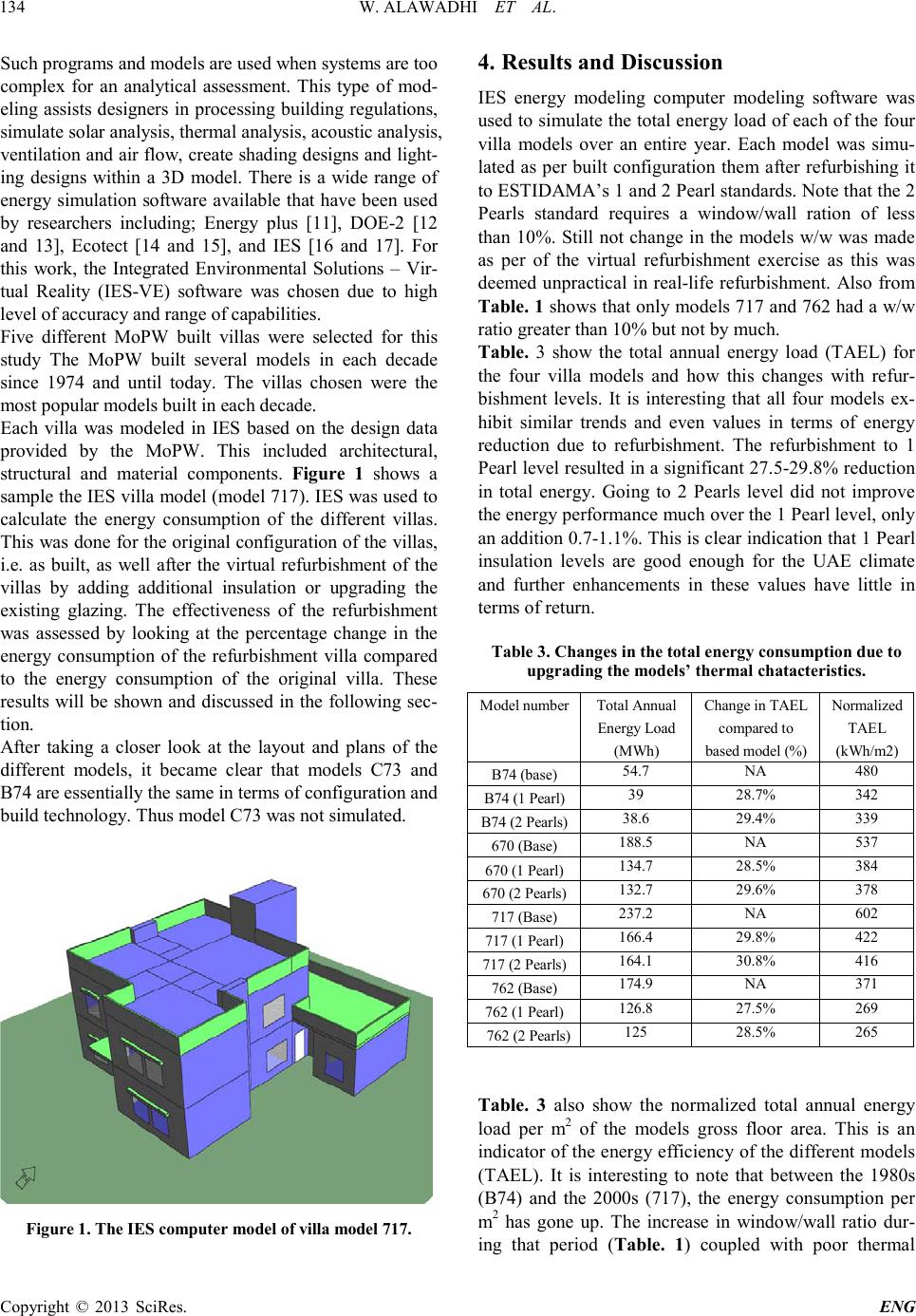 W. ALAWADHI ET AL. Copyright © 2013 SciRes. ENG 134 Such p rogra ms and models are used when systems are too complex for an analytical assessment. This type of mod- eling assists designers in processing building regulations, simulate solar analysis, thermal analysis, acoustic analysis, ventila tion and air flow, create shading designs and light- ing designs within a 3D model. There is a wide range of energy simulation software available that have been used by researchers including; Energy plus [11], DOE-2 [12 and 13], Ecotect [14 and 15], and IES [16 and 17]. For this work, the Integrated Environmental Solutions – Vir- tual Reality (IES-VE) software was chosen due to high level of accuracy and ran ge of capa bil i ties. Five different MoPW built villas were selected for this study The MoPW built several models in each decade since 1974 and until today. The villas chosen were the most popular models built in each decade. Each villa was modeled in IES based on the design data provided by the MoPW. This included architectural, structural and material components. Figure 1 shows a sample t he IE S villa model ( model 717). IE S was used to calculate the energy consumption of the different villas. This was done for the ori ginal configuration of the villas, i.e. as built, as well after the virtual refurbishment of the villas by adding additional insulation or upgrading the existing glazing. The effectiveness of the refurbishment was assessed by looking at the percentage change in the energy consumption of the refurbishment villa compared to the energy consumption of the original villa. These results will be shown and discussed in the following sec- tion. After taking a closer look at the layout and plans of the different models, it became clear that models C73 and B74 are es s entially the same in t erms of configuration and build technology. Thus model C73 was not simulate d. Figur e 1. T he IES co mpute r model of villa model 717. 4. Results and Discussion IES energy modeling computer modeling software was used to simulate the total energy load of each of the four villa models over an entire year. Each model was simu- lated as per built configuratio n them after refurbishing it to EST IDAMA’s 1 and 2 Pear l standards. Note that the 2 Pearls standard requires a window/wall ration of less than 10%. Still not change in the models w/w was made as per of the virtual refurbishment exercise as this was deemed unpractical in real-life refurbishment. Also fro m Table. 1 shows that only models 717 and 762 had a w/w ratio greater than 10% but not by much. Table. 3 show the total annual energy load (TAEL) for the four villa models and how this changes with refur- bishment levels. It is interesting that all four models ex- hibit similar trends and even values in terms of energy reduction due to refurbishment. The refurbishment to 1 Pearl level r esulted in a significant 27. 5-29.8% reduction in total energy. Going to 2 Pearls level did not improve the ener g y performance much over the 1 Pearl level, only an addition 0.7-1.1%. This is clear indica tion that 1 P earl insulation levels are good enough for the UAE climate and further enhancements in these values have little in terms of return. Table 3. Cha nges in the total energy consumption d ue to upgrading the models’ ther mal chatacteristics . Mo de l n umbe r Total Annual Energy Load (MWh) Change in TAEL compared to based model (%) Normalized TAEL (kWh/m2) B74 (base) 54.7 NA 480 B74 (1 Pearl) 39 28.7% 342 B74 (2 Pearls) 38.6 29.4% 339 670 (Base) 188.5 NA 537 670 (1 Pearl) 134.7 28.5% 384 670 (2 Pearls) 132.7 29.6% 378 717 (Base) 237.2 NA 602 717 (1 Pearl) 166.4 29.8% 422 717 (2 Pearls) 164.1 30.8% 416 762 (Base) 174.9 NA 371 762 (1 Pearl) 126.8 27.5% 269 762 (2 Pearls) 125 28.5% 265 Table. 3 also show the normalized total annual energy load per m2 of the models gross floor area. This is an indic ator of the e nerg y effi cienc y of t he di fferent models (TAEL). It is interesting to note that between the 1980s (B74) and the 2000s (717), the energy consumption per m2 has gone up. The increase in window/wall ratio dur- ing that period (Table. 1) coupled with poor thermal 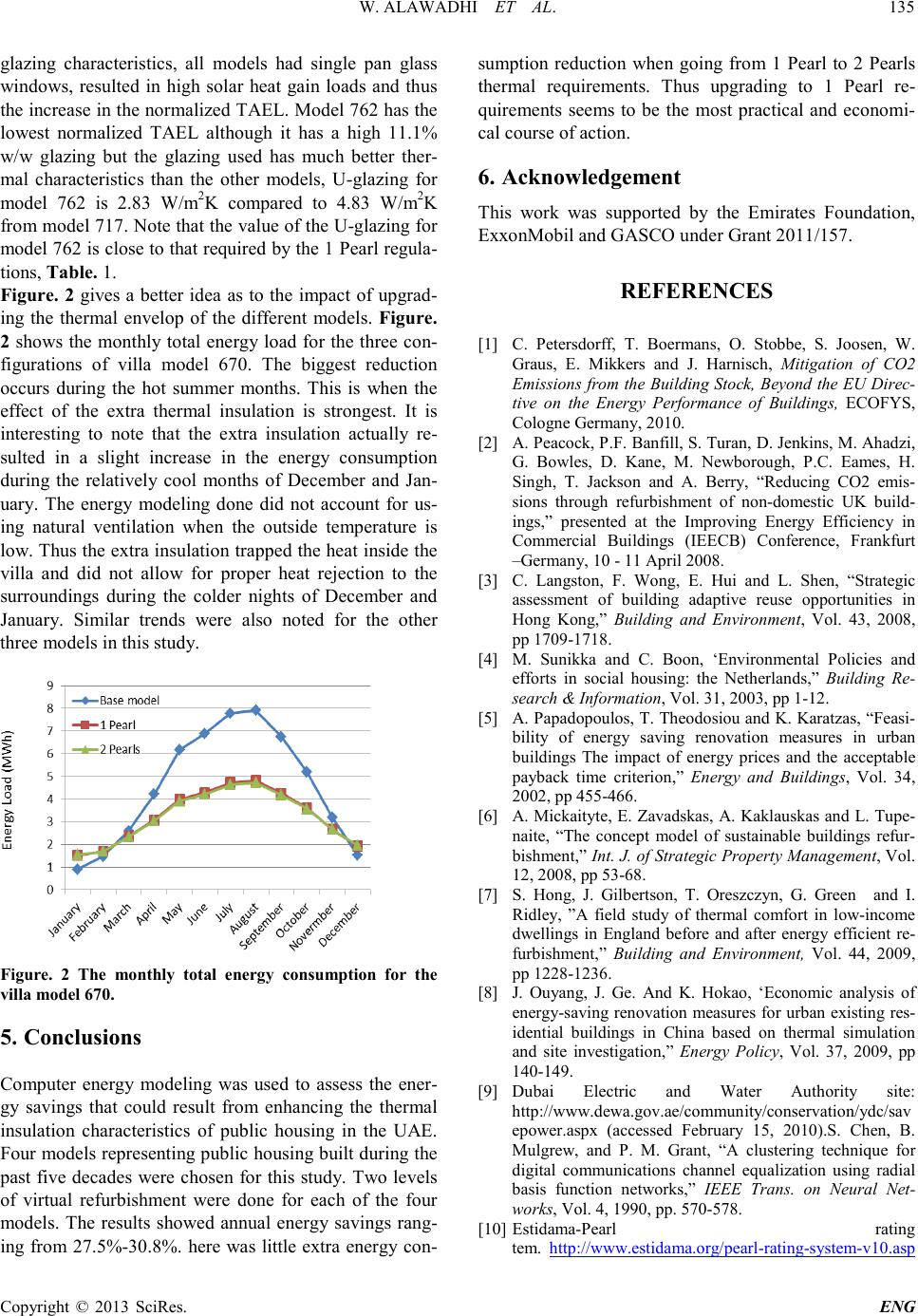 W. ALAWADHI ET AL. Copyright © 2013 SciRes. ENG 135 glazing characteristics, all models had single pan glass windows, resulted in high solar heat gain loads and thus the increase in the normalized TAEL. Model 762 has the lowest normalized TAEL although it has a high 11.1% w/w glazing but the glazing used has much better ther- mal characteristics than the other models, U-glazing for model 762 is 2.83 W/m2K compared to 4.83 W/m2K from model 717. Note that the val ue o f t he U-glazing for model 762 is close to that required by the 1 Pearl regula- tions, Table. 1. Figure. 2 gives a better idea as to the impact of upgrad- ing the thermal envelop of the different models. Figure. 2 shows the monthly total energy load for the three con- figurations of villa model 670. The biggest reduction occurs during the hot summer months. This is when the effect of the extra thermal insulation is strongest. It is interesting to note that the extra insulation actually re- sulted in a slight increase in the energy consumption during the relatively cool months of December and Jan- uary. The energy modeling done did not account for us- ing natural ventilation when the outside temperature is low. T hus the extra insul atio n tra pped the heat insi de the villa and did not allow for proper heat rejection to the surroundings during the colder nights of December and January. Similar trends were also noted for the other three models i n th is study. Figure. 2 The monthly total energy consumption for the villa model 670. 5. Conclusions Computer energy modeling was used to assess the ener- gy savings that could result from enhancing the thermal insulation characteristics of public housing in the UAE. Four models repr esenti ng publ ic housi ng buil t duri ng the past five decades were chosen for this study. Two levels of virtual refurbishment were done for each of the four models. T he results sho wed annual energy savings rang- ing from 27.5%-30.8%. here was little extra energy con- sumption reduction when going from 1 Pearl to 2 Pearls thermal requirements. Thus upgrading to 1 Pearl re- quirements seems to be the most practical and economi- cal course of action. 6. Acknowledgemen t This work was supported by the Emirates Foundation, ExxonMobil and GASCO under Grant 2011/157. REFERENCES [1] C. Petersdorff, T. Boermans, O. Stobbe, S. Joosen, W. Graus, E. Mikkers and J. Harnisch, Mitigation of CO2 Emissions from the Building Stock, Beyond the EU Direc- tive on the Energy Performance of Buildings, ECOFYS, Cologne Germany, 2010. [2] A. P eacock, P. F. Banfill , S. Turan, D. Jen kins, M. Ahadzi , G. Bowles, D. Kane, M. Newborough, P.C. Eames, H. Singh, T. Jackson and A. Berry, “Reducing CO2 emis- sions through refurbishment of non-domestic UK build- ings,” presented at the Improving Energy Efficiency in Commercial Buildings (IEECB) Conference, Frankfurt –German y, 1 0 - 11 April 2008. [3] C. Langston, F. Wong, E. Hui and L. Shen, “Strategic assessment of building adaptive reuse opportunities in Hong Kong,” Building and Environment, Vol. 43, 2008, pp 1709-1718. [4] M. Sunikka and C. Boon, ‘Environmental Policies and efforts in social housing: the Netherlands,” Building Re- search & Information, Vol. 31, 2003, pp 1-12. [5] A. Papadopoulos, T. Theodosiou and K. Karatzas, “F easi- bility of energy saving renovation measures in urban buildings The impact of energy prices and the acceptable payback time criterion,” Energy and Buildings, Vol. 34, 2002, pp 455-466. [6] A. Mickaityte, E. Zavadskas, A. Kaklauskas and L. Tupe- naite, “The concept model of sustainable buildings refur- bishment,” Int. J. of Strategic Property Management, Vol. 12, 2008, pp 53-68. [7] S. Hong, J. Gilbertson, T. Oreszczyn, G. Green and I. Ridley, ”A field study of thermal comfort in low-income dwellings in England before and after energy efficient re- furbishment,” Building and Environment, Vol. 44, 2009, pp 1228-1236. [8] J. Ouyang, J. Ge. And K. Hokao, ‘Economic analysis of energy-saving renovation measures for urban existing res- idential buildings in China based on thermal simulation and site investigation,” Energy Policy, Vol. 37, 2009, pp 140-149. [9] Dubai Electric and Water Authority site: http://www.dewa.gov.ae/co mmunity/conservation/ydc/sav epower.aspx (accessed February 15, 2010).S. Chen, B. Mulgrew, and P. M. Grant, “A clustering technique for digital communications channel equalization using radial basis function networks,” IEEE Trans. on Neural Net- works, Vol. 4, 1990, pp. 570-578. [10] Estidama-Pearl rating tem. http ://www.estidama.org/pearl-rating-syst em-v10.asp  W. ALAWADHI ET AL. Copyright © 2013 SciRes. ENG 136 x?lang=en-US [11] N. Fumo, P. Mago & R. Luck. Methodology to estimate building energy consumption using EnergyPlus Bench- mark Models. Energy and Buildings, Vol. 42, 2010, pp. 2331-2337. , accessed Oct ober 2012. [12] S. Cho & S. Haberl. Integrating Solar Thermal and Pho- tovoltaic Systems in Whole Building Energy Simulation. Fourth National Conference of IBPSA-USA, New York City, New York, August 11 – 13, 2010, pp. 344-351 [13] J. Lam, K. Wan, D. Liu & C. Tsang. 2010. Multiple re- gression models for energy use in air-conditioned office buildings in different climates. Energy Conversion and Manage ment , Vol. 51, 2010, pp. 2692-2697. [14] D. Raia, B. Sodagarb, R. Fieldsonc & X. Hud 2011. As- sessment of CO2 emissions reduction in a distribution warehouse Energy, Vol. 36, 2011, pp. 2271-2277. [15] Y. Saadah & B. AbuHijleh. 2010. Decreasing CO2 Emis- sions and Embodied Energy during the Construc-tion Phase Using Sustainable Building Materials. International Journal of Sustainable Building Technology and Urban Development, Vol. 1, 2010, pp. 115-120. [16] S. Azhar, W. Carlton, D. Olsen & I. Ahmad. Building information modeling for sustainable design and LEED® rating analysis. Energy and Buildings, Vol. 42, 2010, pp. 1888-1895 [17] N. Al-Masri and B. Abu-Hijleh, ”Courtyard Hous- ing in Midrise Buildings - An Environmental Assessment in Hot-Arid Climate,” Renewable & Sustainable Energy Reviews, Vol. 16, 2012, pp. 1892-1898. |