

Paper Menu >>
Journal Menu >>
 Engineering, 2013, 5, 66-68 doi:10.4236/eng.2013.51b012 Published Online January 2013 (http://www.SciRP.org/journal/eng) Copyright © 2013 SciRes. ENG Mechanical Stress Analysis of a 600M W Supercritical Boi- ler Superheater Outlet Header Dongyi Li, Zhongguang Fu, Qiang Zhang, Ting He School of Energy,Power and Mechanical Engineering;North China Electric Power University;Beijing,China Email: aiolos-[email protected]m Received 2013 ABSTRACT The mechanical stre ss distribution and the stress concentrations of the superheater outlet header of a 600MW supercrit- ical boiler we r e analyzed by the finite element method. The results showed that the stress concentrated at the inside conjunction area between the pipe and the header cylinder , and the value of the maximum mechanical stress concentra- tion factor is 2.51. Keywords: Superheater Outlet header; Finite Element Method; Stress Concentration 1. Introduction With t he d evel opment of economy and the rapid increase of electricity demand, large-capacity high-parameter thermal power generating unit takes part in the peak load operation. Since the boiler load changes greatly during the peak load operating process, the stress of the bearing pressure parts changes rapidly. Because of that, the stress of the boiler load section changes drastically which eventually shorten the ori ginal operating time very muc h 1,2]. Therefore, the stress analysis of the bearing com- ponents becomes essential for operating the power plant safely and economically. The total stress is mainly impacted by the internal pressure on the basis of previous studies[3,4].This paper takes a superheater outlet header of a 600MW boiler as the research object to analyze the distribution and varia- tion law of mechanical stress with the finite element analysis software-ANSYS. Besides, the pressure data during the process of load pick-up is passed as boundary conditions. 2. Model and Boundary Conditions 2.1. Structure of Header Figure 1 shows the structure of the superheater outlet header of a 600MW supercritical boiler. This research considers the header as a thick walled cylinder which diameter and wall thickness are 635mm and 136mm. On the cylinder, 68 rows of nozzles are evenly distributed with 304.8mm between each two rows. The diameter and wall thickness for each nozzle are 45mm and 11mm. The metal material of the header is T92/P92[5,6] . Three hypotheses are proposed for the following anal- ysis: (1) all physical parameters of the cylinder are iso- tropic; (2) a half part of the cylinder and the inserted nozzles was taken by the model because of the symme- trical structure of the cylinder; (3) One nozzle was ran- domly taken by the model because all nozzles are evenly distributed on the whole cylinder. The model which con- tains 52994 units and 79843 nods is analyzed by an algo- rithm of free mesh SOLID98 element in this research. Check the mod el on F ig ure 2. 2.2. Load and boundary conditions The right cr oss-section(B-surface) on Y-axi s shifti ng and the two longitudinal section(A-surface) on X-axis shift- ing needs to be constrained. At the same time, restrain the shifting of the Z-axis on a critical point-D. When load i ng the inte rnal-p re s sur e o n the i nne r wal l, the t e nsi l e load also needs to be loaded on the left cross-section and five nozzle cross-section surfaces in the meantime. The equations to calculate the tensile load are shown below [7]. Figure 1 . The structure of header. 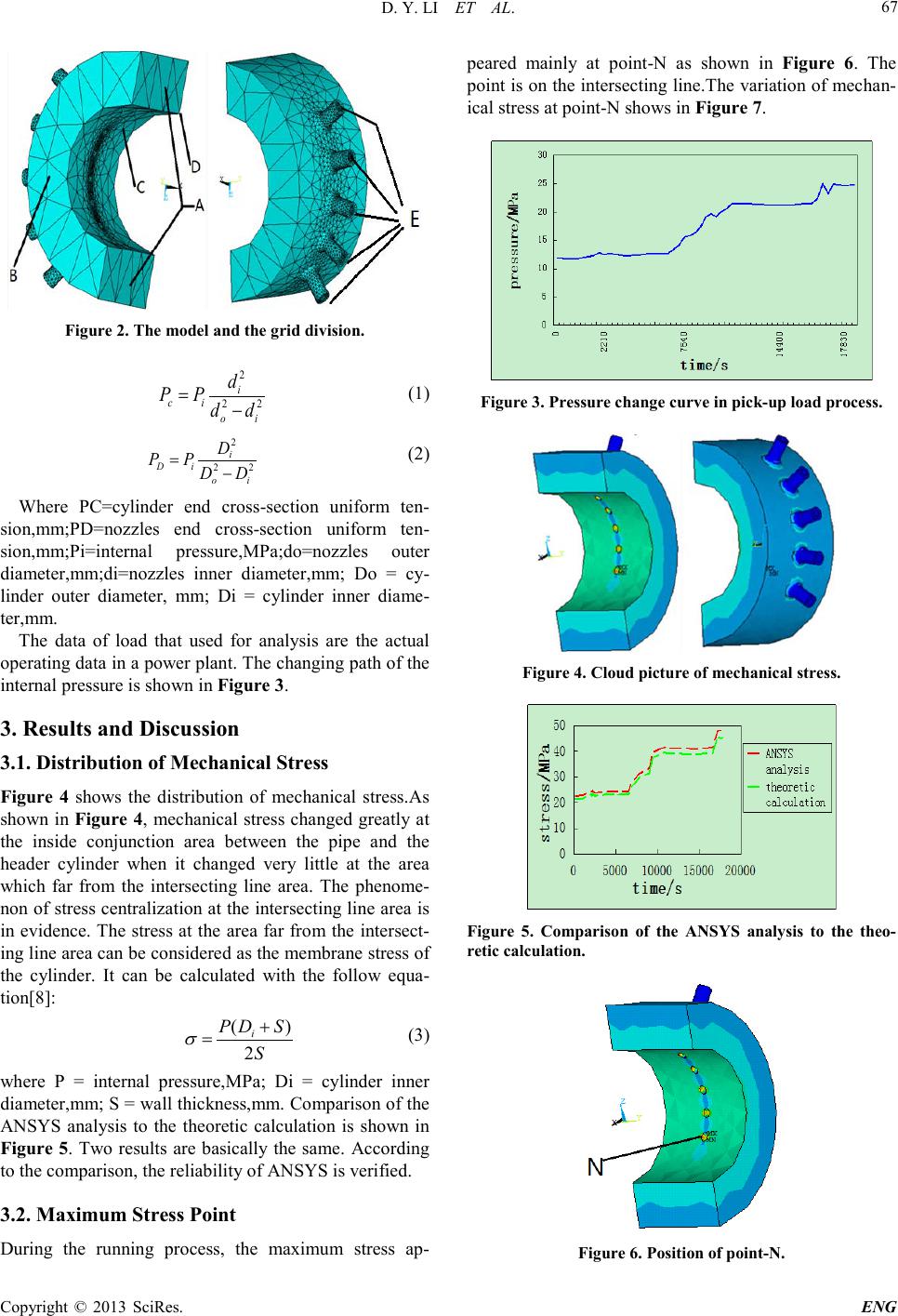 D. Y. LI ET AL. Copyright © 2013 SciRes. ENG 67 Figure 2. T he model and the grid divis ion. 22 2 io i ic dd d PP − = (1) 22 2 io i iD DD D PP − = (2) Where PC=cylinder end cross-section uniform ten- sion,mm;PD=nozzles end cross-section uniform ten- sion,mm;Pi=internal pressure,MPa;do=nozzles outer diameter,mm;di=nozzles inner diameter,mm; Do = cy- linder outer diameter, mm; Di = cylinder inner diame- te r ,mm. The data of load that used for analysis are the actual ope rat ing da ta in a po wer pl ant . The c hangi ng p ath o f the inter nal pressure i s shown in Figure 3. 3. Results and Discussion 3.1. Distribution of Mechanical Stress Figure 4 shows the distribution of mechanical stress.As shown in Figure 4, mechanical stress changed greatly at the inside conjunction area between the pipe and the header cylinder when it changed very little at the area which far from the intersecting line area. The phenome- non of stress centralization at the intersecting line area is in evidence. The stress at the area far from the intersect- ing line area can be considered as the membrane stress of the cylinder. It can be calculated with the follow equa- tion[8]: S SDP i 2 )( + = σ (3) where P = internal pressure,MPa; Di = cylinder inner dia meter, mm; S = wa ll t hic kne ss, mm. Co mpa riso n of the ANSYS analysis to the theoretic calculation is shown in Figure 5. Two results are basically the same. According to the co mparison, the reliab ility of ANSYS is verified. 3.2. Maxi mum Stre ss Poi nt During the running process, the maximum stress ap- peared mainly at point-N as shown in Figure 6. The point is on the intersectin g line.The variation of mechan- ical stress at point-N sho ws in Figure 7. Figure 3 . Pressure change curve in pick-up l oa d process . Figure 4 . Cloud picture of mech anical stress. Figure 5. Comparison of the ANSYS analysis to the theo- retic calculat ion. Figure 6 . Position of p oint-N. 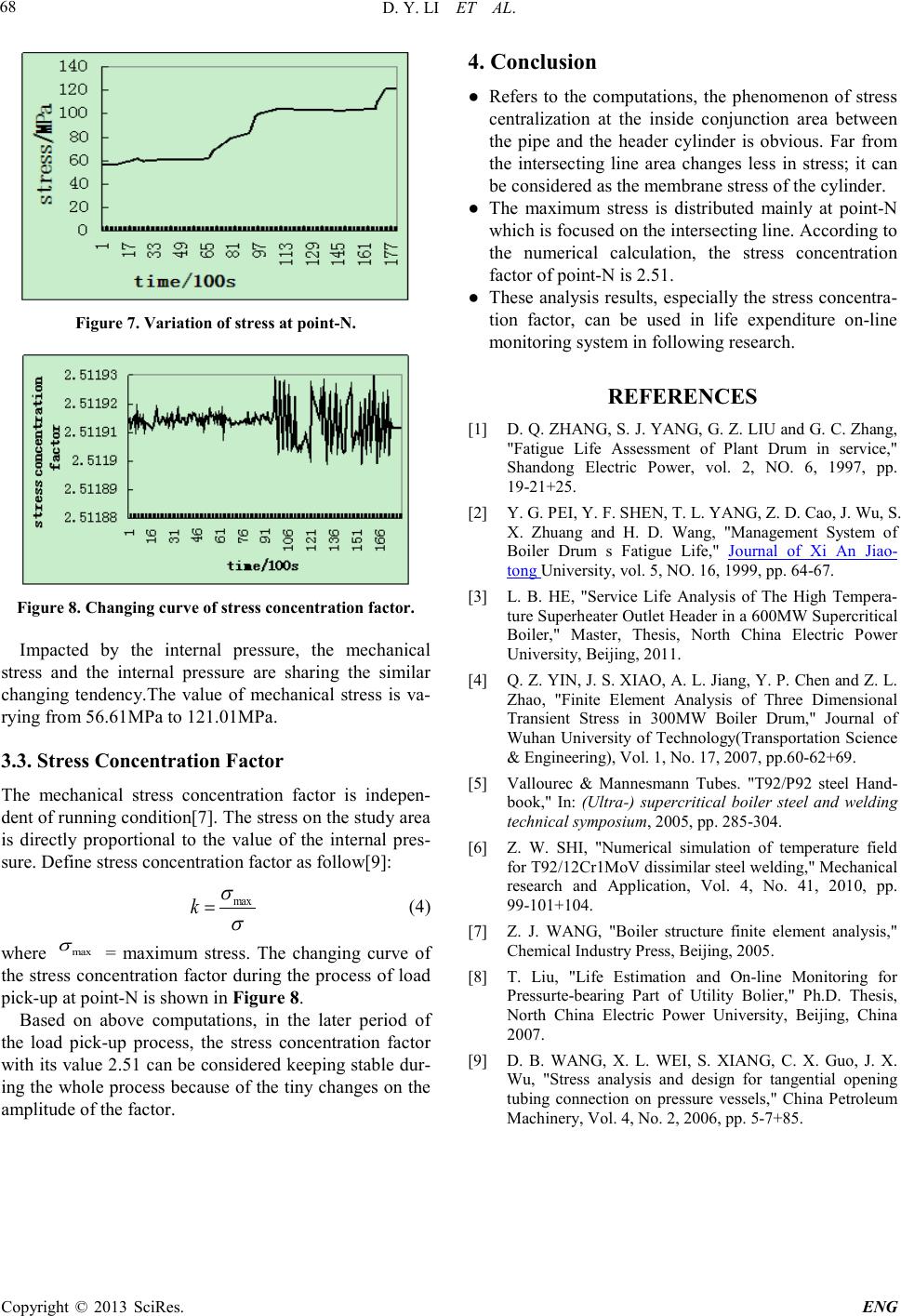 D. Y. LI ET AL. Copyright © 2013 SciRes. ENG 68 Figure 7. Variat ion of s tres s at point-N. Figure 8 . Changing c urve of stress concentr ation fact or. Impacted by the internal pressure, the mechanical stress and the internal pressure are sharing the similar changing tendency.The value of mechanical stress is va- rying from 56.61MPa to 121.01MPa. 3.3. Stress Concent ration Factor The mechanical stress concentration factor is indepen- dent of ru nni n g co nd it ion[ 7] . T he str ess o n t he s tudy a re a is directly proportional to the value of the internal pres- sure. Define stress concentration factor as follow[9]: σ σ max =k (4) where max σ = maximum stress. The changing curve of the stress concentration factor during the process of load pick-up at point-N is shown i n Figure 8. Based on above computations, in the later period of the load pick-up process, the stress concentration factor with its value 2.51 can be considered keeping stable dur- ing the whole process because of the tiny changes on the amplitude o f the factor. 4. Conclusion ● Refers to the computations, the phenomenon of stress centralization at the inside conjunction area between the pipe and the header cylinder is obvious. Far from the intersecting line area changes less in stress; it can be considered as the membrane stress of the cylinder. ● The maximum stress is distributed mainly at point-N which is focu sed o n the inters ectin g line. Accor din g to the numerical calculation, the stress concentration factor of point-N is 2.51. ● These analysis results, especially the stress concentra- tion factor, can be used in life expenditure on-line monitoring system in following research. REFERENCES [1] D. Q. ZHANG, S. J. YANG, G. Z. LIU and G. C. Zhang, "Fatigue Life Assessment of Plant Drum in service," Shandong Electric Power, vol. 2, NO. 6, 1997, pp. 19-21+25. [2] Y. G. PEI, Y. F. SHEN, T. L. YANG, Z. D. Cao, J. Wu, S. X. Zhuang and H. D. Wang, "Management System of Boiler Drum s Fatigue Life," Journal of Xi An Jiao- tong University, vol. 5, NO. 16, 1999, pp. 64-67. [3] L. B. HE, "Service Life Analysis of The High Tempera- ture S uperheat er Outlet Header in a 6 00MW Su percrit ical Boiler," Master, Thesis, North China Electric Power University, Beijing, 2011. [4] Q. Z. YIN, J. S. XIAO, A. L. Jiang, Y. P. Chen and Z. L. Zhao, "Finite Element Analysis of Three Dimensional Transient Stress in 300MW Boiler Drum," Journal of Wuhan University of Technology(Transportation Science & Engineering), Vol. 1, No. 17, 2007, pp.60-62+69. [5] Vallourec & Mannesmann Tubes. "T92/P92 steel Hand- book," In: (Ultra-) supercritical boiler steel and welding technical symposium, 2005, pp. 285-304. [6] Z. W. SHI, "Numerical simulation of temperature field for T92/12Cr1MoV dissimilar steel welding," Mechanical research and Application, Vol. 4, No. 41, 2010, pp. 99-101+104. [7] Z. J. WANG, "Boiler structure finite element analysis," Chemical Industry Press, Beijing, 2005. [8] T. Liu, "Life Estimation and On-line Monitoring for Pressu rt e-bearing Part of Utility Bolier," Ph.D. Thesis, North China Electric Power University, Beijing, China 2007. [9] D. B. WANG, X. L. WEI, S. XIANG, C. X. Guo, J. X. Wu, "Stress analysis and design for tangential opening tubing connection on pressure vessels," China Petroleum Machinery, Vol. 4, No. 2, 2006, pp. 5-7+85. |