

Paper Menu >>
Journal Menu >>
 Vol.5, No.1, 24-29 (2013) Health http://dx.doi.org/10.4236/health.2013.51004 Overweight, obesity and associated factors among secondary school students in a northern city of Vietnam in 2011* Huong Thi Le1#†, Nga Thi Thu Vu1#†, Doan Thi Thu Huyen1†, Nguyen Van Toan2 1Institute for Preventive medicine and Public Health, Hanoi Medical University, Hanoi, Vietnam; #Corresponding Author: [email protected], [email protected] 2Bac Giang Secondary School of Nursing No1, Hanoi, Vietnam; [email protected] Received 30 August 2012; revised 30 September 2012; accepted 6 October 2013 ABSTRACT Overweight and obesity is an emerging public health problem among school-aged children in Bac Giang city in the Northen part of Vietnam recently. This study aims to identify overw eight- obesity prevalence of se condary school childre n in this city and it’s associated factors. The study was a nested case control in a cross-sectional study design in 1528 secondary students se- lected from 4 secondary schools in 2 inner communes and 2 suburban communes of Bac Giang city, Vietnam. Result: Overweight preva- lence among secondary school students in Bac Giang was 6.7%, the prevalence of obesity was 2.0%. Overweight and obesity is more preva- lence in male students, inner communes and students from family have higher income and higher food expense. Overweight and obesity was associated with higher energy intake, more fat consumption, having supplement meals and bedtime-meal, increased physical activities and increased sleep duration. Conclusion: Educa- tion campaign targeting reducing overweight and obesity should target both parents about dietary adequacy and balance and children about more physical activities. Keyw ords: Overweight; Obesity; Secondary Students; Vietnam 1. BACKGROUND Overweight and obesity are defined as abnormal or excessive fat accumulation that may impair health and becoming a trendy public health problem worldwide [1-6]. In Vietnam, thanks to the improvement of socio- economic status in recent years, there has been a chang- ing of eating habit from a cereal based diets to diets with more meat, fish, dairy products, sugar, soft drinks, con- fectionary and processed food. Concurrently, emerging increase of overweight and obesity is occurring across the country among children and adolescent, especially in big cities. Studies in Vietnam have shown that over- weight and obesity prevalence has been steadily upward across the country during the past decade. In the biggest city of Vietnam, the number of people overweight and obesity doubled from 21.4% and 36.8% during 3 years from 2002 to 2005. The number of obesity boys also increased three times from 6.9% in 2002 to 22.5% in 2005 [7-14]. Studies in Vietnam and elsewhere also found out that diets with high energy, more fat and pro- tein, high level of sweet, confectionary, soft drinks con- sumption with low physical activities and spen ding more time for watching TV and playing games on computers were associated with obesity and overweight [10,11, 15-19]. In Bac Giang city in the Northern part of Viet- nam, as according to the City Health Department, over- weight and obesity has been increasing in recent years. However, full understanding of the prevalence and its associated factors are unknown; hence, scientific-based evidence for intervention formulation is absence. There- fore, we conduct this study in order to: 1) Identify the prevalence of overweight and obesity among secondary students in Bac Giang city of Vietnam in 2011. 2) Describe associated factors of overweight and obe- sity in secondary students in Bac Giang in 2011. *All the authors of this article declare that there is no competing o f interest regarding the publication of this article. †HT Le, NTT Vu and TTH Doan were responsible for all aspects o f p rotocol development, study coordination, data collection, data analysis and report writing. 2. STUDY POPULATION AND DESIGN 2.1. Study Location Bac Giang city, located 60 kilometers far from Hanoi Copyright © 2013 SciRes. OPEN A CCESS  H. T. Le et al. / Health 5 (2013) 24-29 25 in the north. This is the provincial city and the socio- economic and administrative hub of Bac Giang province. The city has over 102 thousand people; live in 7 inner communes and 9 suburban communes. Each commune has one primary school, one secondary school and all children of relevant age, who have permanent living status at this commune, are all enrolled in these schools. 2.2. Study Population The study population is secondary students enrolled in grade 6 to grade 9 with age ranging from 11 years old (grade 6) to 14 years old (grade 9) and a few with older age from total 16 secondary schools across the city. 2.3. Time of Study From January to September of 2011. 2.4. Design 2.4.1. Study Design This is a nested case control study in a cross sectional study. The first phase is a cross-sectional study when all study subjects were measured height and weight to iden- tify the point prevalence of overweight and obesity. In the second phase, all subjects who were identified as overweight or obesity were paired with other none-cases subjects in the study to explore the associated factors of overweight and obesity. 2.4.2. Sample Size and Sampling Method Phase 1: Multi-stage cluster was applied to recruit study’s subjects. First, the list of 7 secondary schools in the inner communes and the list of other 9 schools in the suburban communes in Bac Giang city were collected from the City’s Department of education. Next, 2 schools in the inner communes and 2 schools in the suburban communes were randomly selected fro m these lists. Then, in each school, each grade is regarded as a cluster and 3 classes from each cluster were randomly selected into the study. All students in these classes were recruited into study and were measured their height and weight. The calculation of sample size for this phase based on the prevalence of overweight, obesity of 8.3% from a recent study in an area in Vietnam that has similar socio- economic status as compared to Bac Giang city [11], with the level of confidence at 95%, margin of error at 0.02% and design effect is 2. Minimum sample size needed is 1462 students; however, in fact, 1528 students were recruited into the study. Phase 2: All overweight, obesity students detected in the first phase will be recruited as cases and were paired with one control. The controls were students with the same age, gender and study at the same schools of cases and have normal BMI for age. Controls were selected from study subjects. Subjects in the phase 2 will be in- terviewed about their demographic information, eating habit, 24 h dietary, frequency of food consumption dur- ing the last week, physical activities and static activities. Parents or direct caregivers of these students were inter- viewed about their family’s socio-economic status. 2.4.3. Dat a Collection Student’s height was measured by Microtoise height meter with the precision of 0, 1 centimeter. The meter was tested and placed in a stable location and adjusted to 0 value before each measument; students were asked to take out shoes and hat and were instructed to stand straightly in the meter. Height was recorded as meter with one decimal digit. Weight was measured by elec- tronic SECA weigh ter with the precision of 0, 1 k ilogr am. The weighter was tested and placed in a stable location; students were asked to take out all of their shoes and coats and were instructed to straightly stand in the mid- dle of weighter. Weight was recorded as kilogram with one decimal digit. Demographic, eating behaviors and other information of students were collected by a pre- designed, piloted questionnaire via face-to-face inter- views. Questions regarding eating habit, 24 h-dietary and frequency of food consumption in the last week were adapted from conventional questions which are used widely in other studies in Vietnam. Socio-economic sta tus of students’ family was gathered via telephone-based interviews with their parents. Anthrometric measurement and interviews were per- formed by experienced interviewers from Hanoi Medical University. Before fieldwork, all interviewers were well trained about the standard operation procedures to meas- ure weight, height and administer interviews. All children and their parents were carefully explained about the purpose of the study and orally accepted to participated to the study befo re data collection. 2.4.4. Dat a Analysis Obesity and overweight identification. Overweight and obesity was determined using body mass index per age per gender (BMI) (a measure of weight adjusted for height, calculated as weight in kilogram divided by the square of height in meter (kg/m2) and WHO Reference 2007 for 5 - 19 years to monitor the growth of school-age children and adolescents [20]. Overweight:+1SDBMI per age2SD Obesity:2SDBMI per age3SD Nutrition need and diet’s balance asses smen t and analysis were calculated based on the Recommended Nutrition Need for Vietnamese, published by Vietnam National Institute of Nutrition [21]. Converting from Copyright © 2013 SciRes. OPEN A CCESS 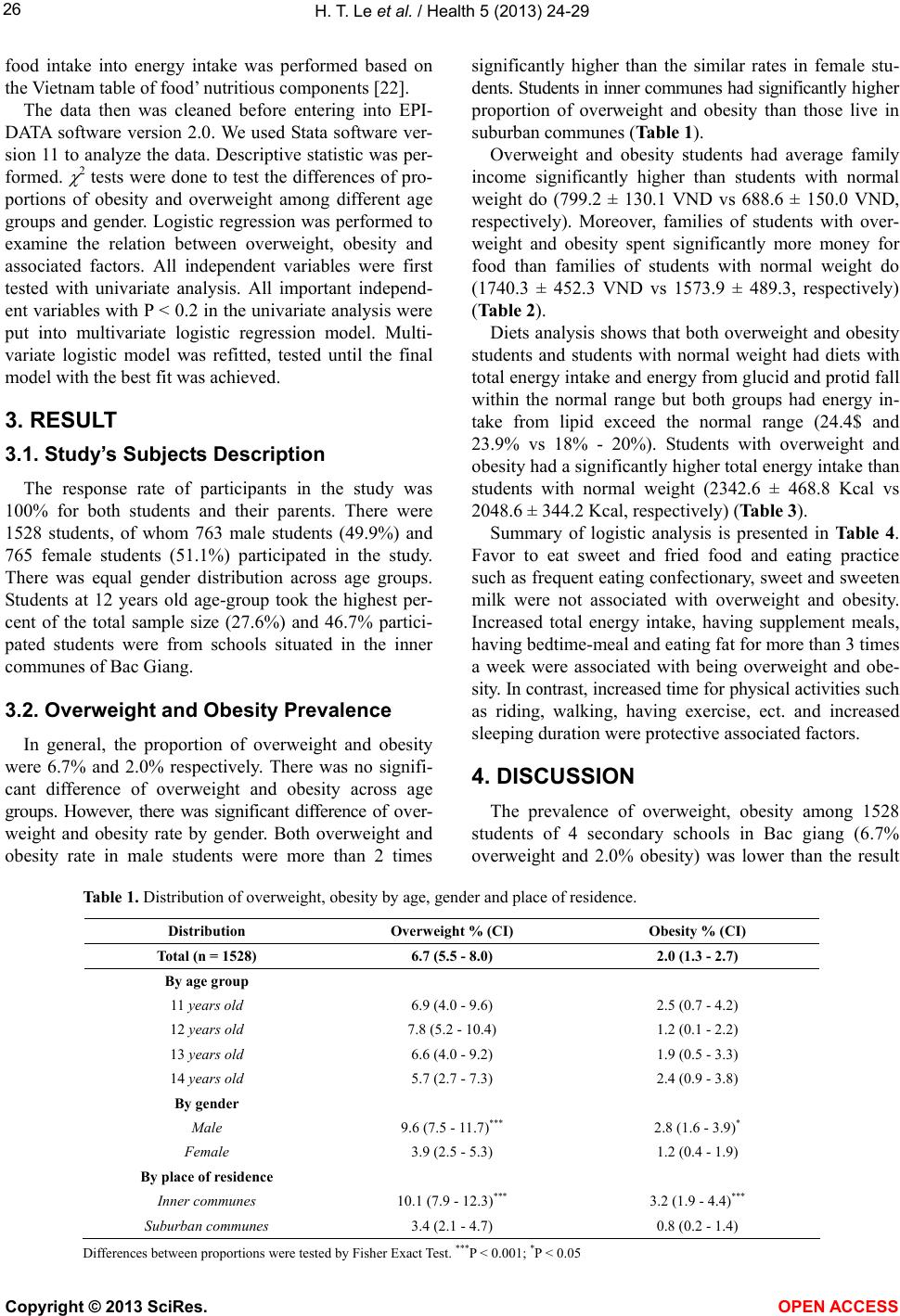 H. T. Le et al. / Health 5 (2013) 24-29 Copyright © 2013 SciRes. OPEN A CCESS 26 food intake into energy intake was performed based on the Vietnam table of food’ nutritious components [22]. The data then was cleaned before entering into EPI- DATA software version 2.0. We used Stata software ver- sion 11 to analyze the data. Descriptive statistic was per- formed. 2 tests were done to test the differences of pro- portions of obesity and overweight among different age groups and gender. Logistic regression was performed to examine the relation between overweight, obesity and associated factors. All independent variables were first tested with univariate analysis. All important independ- ent variables with P < 0.2 in the univariate analysis were put into multivariate logistic regression model. Multi- variate logistic model was refitted, tested until the final model with the best fit was achieved. 3. RESULT 3.1. Study’s Subjects Description The response rate of participants in the study was 100% for both students and their parents. There were 1528 students, of whom 763 male students (49.9%) and 765 female students (51.1%) participated in the study. There was equal gender distribution across age groups. Students at 12 years old age-group took the highest per- cent of the total sample size (27.6%) and 46.7% partici- pated students were from schools situated in the inner communes of Bac Giang. 3.2. Overweight and Obesity Prevalence In general, the proportion of overweight and obesity were 6.7% and 2.0% respectively. There was no signifi- cant difference of overweight and obesity across age groups. However, there was significant difference of over- weight and obesity rate by gender. Both overweight and obesity rate in male students were more than 2 times significantly higher than the similar rates in female stu- dents. Students in inner communes had significantly h ig he r proportion of overweight and obesity than those live in suburban communes (Table 1). Overweight and obesity students had average family income significantly higher than students with normal weight do (799.2 ± 130.1 VND vs 688.6 ± 150.0 VND, respectively). Moreover, families of students with over- weight and obesity spent significantly more money for food than families of students with normal weight do (1740.3 ± 452.3 VND vs 1573.9 ± 489.3, respectively) (Table 2). Diets analysis shows that both overweight and obesity students and students with normal weight had diets with total energy intake and energy from glucid and protid fall within the normal range but both groups had energy in- take from lipid exceed the normal range (24.4$ and 23.9% vs 18% - 20%). Students with overweight and obesity had a significantly higher total energy intake than students with normal weight (2342.6 ± 468.8 Kcal vs 2048.6 ± 344.2 Kcal, respectively) (Table 3). Summary of logistic analysis is presented in Ta b l e 4. Favor to eat sweet and fried food and eating practice such as frequent eating confectionary, sweet and sweeten milk were not associated with overweight and obesity. Increased total energy intake, having supplement meals, having bedtime-meal and eating fat for more than 3 times a week were associated with being overweight and obe- sity. In contrast, increased time for physical activities s uc h as riding, walking, having exercise, ect. and increased sleeping duration were protective associated factors. 4. DISCUSSION The prevalence of overweight, obesity among 1528 students of 4 secondary schools in Bac giang (6.7% overweight and 2.0% obesity) was lower than the result Table 1. Distribution of overweight, obesity by age, gender and place of residence. Distribution Overweight % (CI) Obesity % (CI) Total (n = 1528) 6.7 (5.5 - 8.0) 2.0 (1.3 - 2.7) By age group 11 years old 6.9 (4.0 - 9.6) 2.5 (0.7 - 4.2) 12 years old 7.8 (5.2 - 10.4) 1.2 (0.1 - 2.2) 13 years old 6.6 (4.0 - 9.2) 1.9 (0.5 - 3.3) 14 years old 5.7 (2.7 - 7.3) 2.4 (0.9 - 3.8) By gender Male 9.6 (7.5 - 11.7)*** 2.8 (1.6 - 3.9)* Female 3.9 (2.5 - 5.3) 1.2 (0.4 - 1.9) By place of residence Inner communes 10.1 (7.9 - 12.3)*** 3.2 (1.9 - 4.4)*** Suburban communes 3.4 (2.1 - 4.7) 0.8 (0.2 - 1.4) Differences between proportions were tested by Fisher Exact Test. ***P < 0.001; *P < 0.05 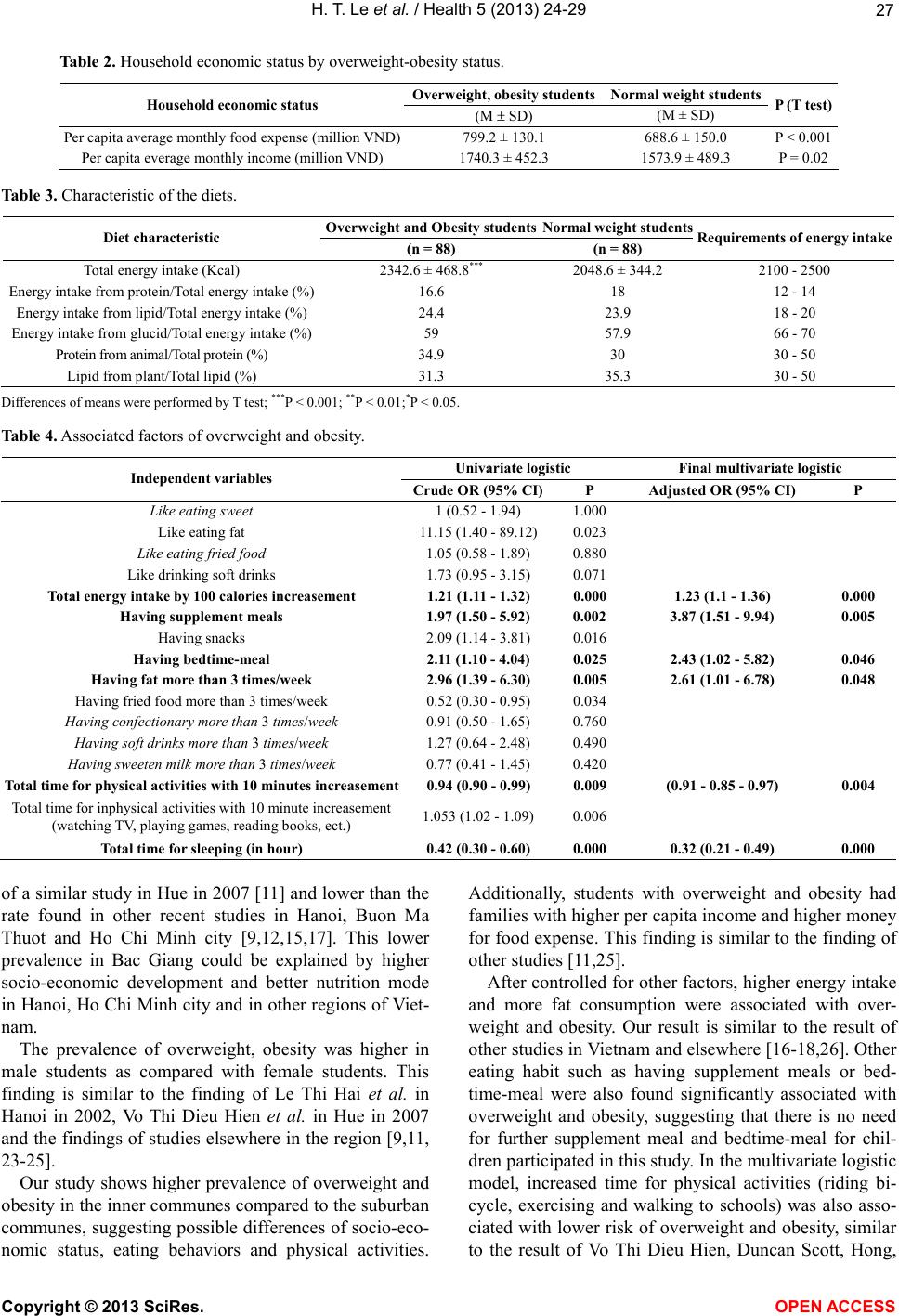 H. T. Le et al. / Health 5 (2013) 24-29 27 Table 2. Household economic status by overweight-obesity status. Overweight, obesity studentsNormal weight students Household economic status SD (M ± SD) P (T test) Per capita average monthly food expense (million VND)799.2 ± 130.1 688.6 ± 150.0 P < 0.001 Per capita everage monthly income (million VND) 1740.3 ± 452.3 1573.9 ± 489.3 P = 0.02 Table 3. Characteristic of the diets. Overweight and Obesity studentsNormal weight students Diet characteristic (n = 88) (n = 88) Requirements of energy intake Total energy intake (Kcal) 2342.6 ± 468.8*** 2048.6 ± 344.2 2100 - 2500 Energy intake from protein/Total energy intake (%) 16.6 18 12 - 14 Energy intake from lipid/Total energy intake (%) 24.4 23.9 18 - 20 Energy intake from glucid/Total energy intake (%) 59 57.9 66 - 70 Pr o t e i n f r o m a ni m a l / To t a l pr o t e i n (% ) 34. 9 30 30 - 50 Lipid from plant/Total lipid (%) 31.3 35.3 30 - 50 Differences of means were performed by T test; ***P < 0.001; **P < 0.01;*P < 0.05. Table 4. Associated factors of overweight and obesity. Univariate logistic Final multivariate logistic Independent variables Crude OR (95% CI)P Adjusted OR (95% CI) P Like eating sweet 1 (0.52 - 1.94) 1.000 Like eating fat 11.15 (1.40 - 89.12) 0.023 Like eating fried food 1.05 (0.58 - 1.89) 0.880 Like drinking soft drinks 1.73 (0.95 - 3.15) 0.071 Total energy intake by 100 calories increasement 1.21 (1.11 - 1.32) 0.000 1.23 (1.1 - 1.36) 0.000 Having supplement meals 1.97 (1.50 - 5.92) 0.002 3.87 (1.51 - 9.94) 0.005 Having snacks 2.09 (1.14 - 3.81) 0.016 Having bedtime-meal 2.11 (1.10 - 4.04) 0.025 2.43 (1.02 - 5.82) 0.046 Having fat more than 3 times/week 2.96 (1.39 - 6.30) 0.005 2.61 (1.01 - 6.78) 0.048 Having fried food more than 3 times/week 0.52 (0.30 - 0.95) 0.034 Having confectionary more than 3 times/week 0.91 (0.50 - 1.65) 0.760 Having soft drinks more than 3 times/week 1.27 (0.64 - 2.48) 0.490 Having sweeten milk more than 3 times/week 0.77 (0.41 - 1.45) 0.420 Total time for physical activities with 10 minutes increasement0.94 (0.90 - 0.99) 0.009 (0.91 - 0.85 - 0.97) 0.004 Total time for inphysical activities with 10 minute increasement (watching TV, playing games, reading books, ect.) 1.053 (1.02 - 1.09) 0.006 Total time for sleeping (in hour) 0.42 (0.30 - 0.60) 0.000 0.32 (0.21 - 0.49) 0.000 of a similar study in Hue in 2007 [11] and lower than the rate found in other recent studies in Hanoi, Buon Ma Thuot and Ho Chi Minh city [9,12,15,17]. This lower prevalence in Bac Giang could be explained by higher socio-economic development and better nutrition mode in Hanoi, Ho Chi Minh city and in other regions of Viet- nam. The prevalence of overweight, obesity was higher in male students as compared with female students. This finding is similar to the finding of Le Thi Hai et al. in Hanoi in 2002, Vo Thi Dieu Hien et al. in Hue in 2007 and the findings of studies elsewhere in the region [9,11, 23-25]. Our study shows higher prevalence of overweight and obesity in the inn er communes compared to the suburb an communes, suggesting possible differences of socio-eco- nomic status, eating behaviors and physical activities. Additionally, students with overweight and obesity had families with higher per capita income and higher money for food expense. This finding is similar to the finding of other studies [11,25]. After controlled for other factors, higher energy intake and more fat consumption were associated with over- weight and obesity. Our result is similar to the result of other studies in Vietnam and elsewhere [16-18,26]. Other eating habit such as having supplement meals or bed- time-meal were also found significantly associated with overweight and obesity, suggesting that there is no need for further supplement meal and bedtime-meal for chil- dren participated in this study. In the multivariate logistic model, increased time for physical activities (riding bi- cycle, exercising and walking to schools) was also asso- ciated with lower risk of overweight and obesity, similar to the result of Vo Thi Dieu Hien, Duncan Scott, Hong, Copyright © 2013 SciRes. OPEN A CCESS 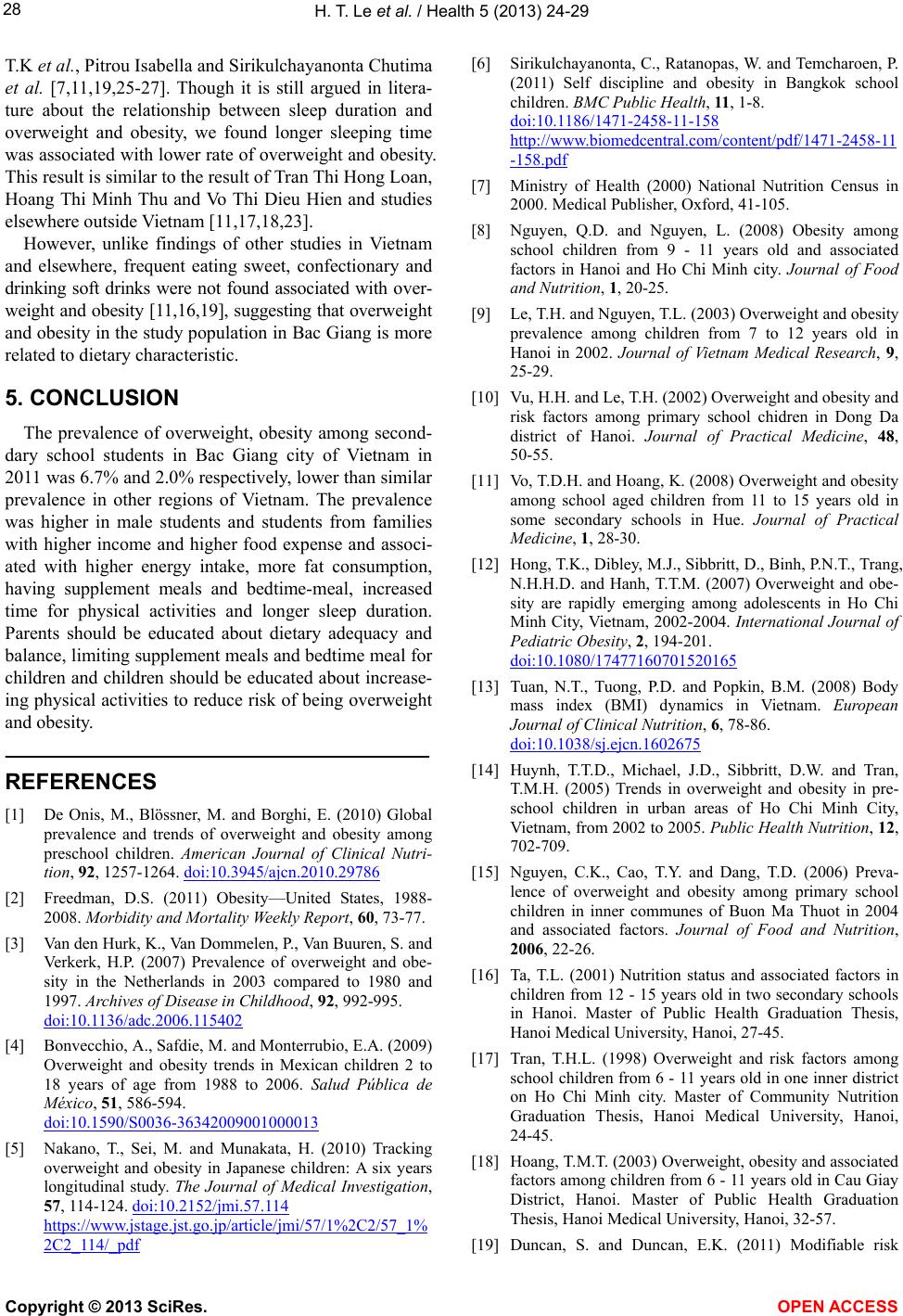 H. T. Le et al. / Health 5 (2013) 24-29 28 T.K et al., Pitrou Isabella and Sirikulchayanonta Chutima et al. [7,11,19,25-27]. Though it is still argued in litera- ture about the relationship between sleep duration and overweight and obesity, we found longer sleeping time was associated with lower rate of overweight and obesity. This result is similar to the result of Tran Thi Hong Loan, Hoang Thi Minh Thu and Vo Thi Dieu Hien and studies elsewhere outsi de Vietnam [11,17,18,23]. However, unlike findings of other studies in Vietnam and elsewhere, frequent eating sweet, confectionary and drinking soft drinks were not found associated with over- weight and obesity [11,16,19], suggesting that overweigh t and obesity in the study population in Bac Giang is more related to dietary characteristic. 5. CONCLUSION The prevalence of overweight, obesity among second- dary school students in Bac Giang city of Vietnam in 2011 was 6.7% and 2.0% respectively, lower than similar prevalence in other regions of Vietnam. The prevalence was higher in male students and students from families with higher income and higher food expense and associ- ated with higher energy intake, more fat consumption, having supplement meals and bedtime-meal, increased time for physical activities and longer sleep duration. Parents should be educated about dietary adequacy and balance, limiting supplement meals and bedtime meal for children and children should be educated about increase- ing physical activities to reduce risk of being overweight and obesity. REFERENCES [1] De Onis, M., Blössner, M. and Borghi, E. (2010) Global prevalence and trends of overweight and obesity among preschool children. American Journal of Clinical Nutri- tion, 92, 1257-1264. doi:10.3945/ajcn.2010.29786 [2] Freedman, D.S. (2011) Obesity—United States, 1988- 2008. Morbidity and Mortality Weekly Report, 60, 73-77. [3] Van den Hurk, K., Van Dommelen, P., Van Buuren, S. and Verkerk, H.P. (2007) Prevalence of overweight and obe- sity in the Netherlands in 2003 compared to 1980 and 1997. Archives of Disease in Childhood, 92, 992-995. doi:10.1136/adc.2006.115402 [4] Bonvecchio, A., Safdie, M. and Monterrubio, E.A. (2009) Overweight and obesity trends in Mexican children 2 to 18 years of age from 1988 to 2006. Salud Pública de México, 51, 586-594. doi:10.1590/S0036-36342009001000013 [5] Nakano, T., Sei, M. and Munakata, H. (2010) Tracking overweight and obesity in Japanese children: A six years longitudinal study. The Journal of Medical Investigation, 57, 114-124. doi:10.2152/jmi.57.114 https://www.jstage.jst.go.jp/article/jmi/57/1%2C2/57_1% 2C2_114/_pdf [6] Sirikulchayanonta, C., Ratanopas, W. and Temcharoen, P. (2011) Self discipline and obesity in Bangkok school children. BMC Public Health, 11, 1-8. doi:10.1186/1471-2458-11-158 http://www.biomedcentral.com/content/pdf/1471-2458-11 -158.pdf [7] Ministry of Health (2000) National Nutrition Census in 2000. Medical Publisher, Oxford, 41-105. [8] Nguyen, Q.D. and Nguyen, L. (2008) Obesity among school children from 9 - 11 years old and associated factors in Hanoi and Ho Chi Minh city. Journal of Food and Nutrition, 1, 20-25. [9] Le, T.H. and Nguyen, T.L. (2003) Overweight and obesity prevalence among children from 7 to 12 years old in Hanoi in 2002. Journal of Vietnam Medical Research, 9, 25-29. [10] Vu, H.H. and Le, T.H. (2002) Overweight and obesity and risk factors among primary school chidren in Dong Da district of Hanoi. Journal of Practical Medicine, 48, 50-55. [11] Vo, T.D.H. and Hoang, K. (2008) Overweight and obesity among school aged children from 11 to 15 years old in some secondary schools in Hue. Journal of Practical Medicine, 1, 28-30. [12] Hong, T.K., Dibley, M.J., Sibbritt, D., Binh, P.N.T., Trang, N.H.H.D. and Hanh, T.T.M. (2007) Overweight and obe- sity are rapidly emerging among adolescents in Ho Chi Minh City, Vietnam, 2002-2004. International Journal of Pediatric Obesity, 2, 194-201. doi:10.1080/17477160701520165 [13] Tuan, N.T., Tuong, P.D. and Popkin, B.M. (2008) Body mass index (BMI) dynamics in Vietnam. European Journal of Clinical Nutrition, 6, 78-86. doi:10.1038/sj.ejcn.1602675 [14] Huynh, T.T.D., Michael, J.D., Sibbritt, D.W. and Tran, T.M.H. (2005) Trends in overweight and obesity in pre- school children in urban areas of Ho Chi Minh City, Vietnam, from 2002 to 2005. Public Health Nutrition, 12, 702-709. [15] Nguyen, C.K., Cao, T.Y. and Dang, T.D. (2006) Preva- lence of overweight and obesity among primary school children in inner communes of Buon Ma Thuot in 2004 and associated factors. Journal of Food and Nutrition, 2006, 22-26. [16] Ta, T.L. (2001) Nutrition status and associated factors in children from 12 - 15 years old in two secondary schools in Hanoi. Master of Public Health Graduation Thesis, Hanoi Medical University, Hanoi, 27-45. [17] Tran, T.H.L. (1998) Overweight and risk factors among school children from 6 - 11 years old in one inner district on Ho Chi Minh city. Master of Community Nutrition Graduation Thesis, Hanoi Medical University, Hanoi, 24-45. [18] Hoang, T.M.T. (2003) Overweight, obesity and associated factors among children from 6 - 11 years old in Cau Giay District, Hanoi. Master of Public Health Graduation Thesis, Hanoi Medical University, Hanoi, 32-57. [19] Duncan, S. and Duncan, E.K. (2011) Modifiable risk Copyright © 2013 SciRes. OPEN A CCESS  H. T. Le et al. / Health 5 (2013) 24-29 Copyright © 2013 SciRes. OPEN A CCESS 29 factors for overweight and obesity in children and ado- lescents from São Paulo, Brazil. BMC Public Health, 585, 1-9. [20] World Health Organization (2007) Development of a WHO growth reference for school-aged children and adolescents. http://www.who.int/growthref/growthref_who_bull/en [21] Ministry of Health—National Nutrition Institute (2003) Recommended nutrition need for Vietnamese people. Medical Publisher, Oxford, 10-19. [22] Ministry of Health—National Institute of Nutrition (2000) Vietnam table of food’s nutritious component. Medical Publisher, Oxford, 2000. [23] Shi, Z., Taylor, A.W., Gill, T.K. and Martin, J. (2010) Short sleep duration and obesity among Australian chil- dren. BMC Public Health, 10, 1-6. doi:10.1186/1471-2458-10-609 [24] Mak, K.-K., Ho, S.-Y. and Lo, W.-S. (2010) Health- related physical fitness and weight status in Hong Kong adolescents. BMC Public Health, 10, 1-5. doi:10.1186/1471-2458-10-88 [25] Hong, T.K., Rang, N.H.H.D., Dibley, M.J., Sibbritt, D.W., Binh, P.N.T. and Hanh, T.T.M. (2010) Factors associated with adolescent overweight/obesity in Ho Chi Minh city. International Journal of Pediatric Obesity, 5, 396-403. doi:10.3109/17477160903540735 [26] Li, Y., Zhai, F., Yang, X., Schouten, E.G., Hu, X., He, Y., Luan, D. and Ma, G. (2007) Determinants of childhood overweight and obesity in China. British Journal of Nutrition, 97, 210-215. doi:10.1017/S0007114507280559 [27] Pitrou, I. and Shojaei, T. (2010) Child overweight, associated psychopathology, and social functioning: A French school-based survey in 6- to 11-year-old children. Obesity (Silver Spring), 18, 809-817. doi:10.1038/oby.2009.278 |