

Paper Menu >>
Journal Menu >>
 Journal of Financial Risk Management 2012. Vol.1, No.4, 68-74 Published Online December 2012 in SciRes (http://www.SciRP.org/journal/jfrm) http://dx.doi.org/10.4236/jfrm.2012.14012 Copyright © 2012 SciRes. 68 Determinants of IPOs Initial Return: Extreme Analysis of Indian Market Rohit Bansal, Ashu Khanna Institute of Technology, Roorkee Uttrakhand, India Email: [email protected], [email protected] Received July 2nd, 2012; revised August 17th, 2012; accepted September 14th, 2012 This paper attempts to design and test empirical models, which integrate theoretical, institutional, and other factors, which interact to explain ownership structure. Ex-ante information at the level of under- pricing succeeds the Indian stock market crunch. The study is based on IPO that listed at Bombay stock exchange given that April 2000 to December 2011. Multiple linear regressions are used to distinguish the relationship between various independent variables with the dependent variable, i.e. level of underpricing. The outcomes of multiple regressions reveal that, firm’s age, IPO years, book building pricing mechanism, ownership structure, issue size, & market capitalization explained 44% of the variation in issuer under- pricing, Durbin Watson’s value subsisted 1.58, which indicates that, there is a positive sequential rela- tionship between variables. Number of share offered, issue size, market capitalization, subscription offer timing, book building mechanism and IPO years 2006, 2009 & 2011 are constructed to have important effect on the level of underpricing after the Indian market crisis. Nevertheless, firm’s age, IPOs year 2008, private issuing firms, non institutional promoters, Indian promoters and non institutional non promoters contain no significant difference in the level of underpricing after-market crisis. Keywords: IPOs; Post Market Crisis; Ownership Structure; Share Holding Pattern; BSE; Underpricing; Firm Specific Factors; Market Related Variables Introduction Undoubtedly, initial public offerings (IPOs) have generated an enormous amount of public interest and are one of the most researched areas in finance. Common empiricisms have shown that IPOs are subject to three well documented anomalies, namely, the short-term underpricing of IPOs, the hot issue mar- ket phenomenon and the long-run performance of IPOs. With regard to short-term underpricing, issuers offer shares to inves- tors at prices considerably below the subsequently revealed market value. The underpricing of IPOs is anomalous in the sense that it appears to contradict the efficient market’s hypo- thesis. In particular, one would expect the underpricing of IPOs to disappear over time as the devastating majority of investors will recognize the implied profit opportunities and make good use of them. However, the underpricing of IPOs seems to be persistent in most markets. Furthermore, it would be difficult to rationally justify the behavior of living owners to sell shares to outsiders at discounted prices. The fact that these anomalies exist in numerous developed and developing markets makes them even more difficult to explain. There are a number of theoretical explanations and models underpinning this IPO underpricing. The popular justifications for this observed phenomenon rest upon the possible existence of information asymmetries, mainly in the form of ex ante un- certainties about share prices. Also, according to (Welch, 1989), (Grinblatt & Hwang, 1989) and other similar studies, there exists a signaling mechanism where firms send signals to the market by underpricing their IPOs. Moreover, there are other possible explanations such as underwriter reputation theories, investor sentiment theories and prospect theories to explain the degree of underpricing in the IPO market. Role of BSE in Book Building Process BSE offers the book building services through the book building software that runs on the BSE private network. This system is one of the largest electronic book building networks anywhere spanning over 350 Indian cities through over 7000 trader work stations via leased lines, VSATs and campus LANS. The software is operated through book-runners of the issue and by the syndicate member brokers. Through this book, the syndicate member brokers on behalf of themselves or their clients’ place orders. Bids are placed electronically through syndicate members, and the information is collected on line real-time until the bid date ends. In order to maintain transpar- ency, the software gives visual graphs displaying price v/s quantity on the terminals. Theories and Models of Underpricing Therefore, a number of competing theoretical models have been developed to explain the initial underpricing of stocks. The main theories found in the IPO literature are the winner’s curse hypothesis, bookbuilding theories, and the principal-agent hypothesis, signaling theories, the law-suit avoidance hypothe- sis, the ownership and control hypothesis and the investor sen- timent theory. One of the most important models of underpric- ing is the one developed by (Rock, 1986) based on the winner’s curse hypothesis. Rock distinguishes between informed and uninformed investors. If the issues are underpriced, IPOs will be oversubscribed by informed investors, resulting in a limited number of shares being available to uninformed investors. If the issues are overpriced, IPOs will be sold exclusively to unin- formed investors who will earn negative initial returns. Thus,  R. BANSAL, A. KHANNA uninformed investors will be winning the entire issue but at an unfavorable price, creating a situation termed the winner’s curse. In order to keep uninformed investors in the IPO market, securities are offered at a discount from their expected after market prices. Thus, according to the winner’s curse theory, IPO underpricing should decrease if the information asymmetry between informed and uninformed investors is reduced. Empirical studies have found evidence that the underpricing for IPOs of financial institutions is related to proxies for asym- metric information. Signaling (Allen & Faulhaber, 1989) asym- metric information (Ibbotson, 1975) Offer size (Megginson & Weiss, 1991) age of the firm (Muscarella & Vetsuypens, 1989) market capitalization, (McDonald & Fisher, 1972), (Baker & Wurgler, 2007), Pricing mechanism (Bansal & Khanna, 2012) determinants of IPO underpricing at BSE (Bansal & Khanna, 2012). (Leite, 2007), generalized the informational assumptions of the (Rock, 1986) to address empirical evidence and conjectures that the standard model based on informed and uninformed investors is unable to address. They showed that high (low) market returns induce the issuer to price the issue more conser- vatively (aggressively) to create a negative relation between the public signal and the quality of the marginal investor, and in turn a positive relation between market returns and underpric- ing. (Dolvin & Jordon, 2008), addressed the question of whether or not periods of high underpricing adversely affect pre-existing shareholders. They found that high levels of underpricing are associated with increased share retention, which effectively off- sets much of the potential cost. Overall, the percentage of share- holder wealth lost is stable over time, unlike underpricing itself. Also many factors known to be related to underpricing are not significant determinants of the cost of going public to pre-ex- isting owners. (Kumar, 2010) examines the efficiency of IPO issuing me- chanisms using a sample of Indian IPOs that tapped the primary market during 2003-2007 by taking into thoughtfulness the total costs the issuers have to face i.e., including both direct as well as indirect costs. He finds that from a total cost point of view the issuers fare neither better nor worse using either book building or the fixed price offers. Their results also indicated that the issue expenses associated with book building are more than those associated with fixed price offers after controlling for issue size and firm specific characteristics. (Bansal & Khanna, 2012), analyzes that whatever there is any significant difference in the magnitude of level of under- pricing of IPOs that priced through the book build with those are priced through the fixed price option. They found that the magnitude of underpricing is concerned; the book-build and fixed price option gave different results. They found significant difference in level of magnitude of underpricing in IPOs that priced during the book build with those that are priced through the fixed price option. Objectives 1) To measure the IPOs initial performance on first trading day. 2) Does ownership structure of Indian stock market affect the level of the underpricing? 3) Do Ex-ante uncertainty variables impact the degree of un- derpricing in Bombay stock market? Research Methodology Sample and Data Col lec tion Meth o ds The sample used in this study consists of all Indian firms which went public on the official market of the Stock Exchange of Bombay for the period April 2000 until 2011. Presume the limited number of firms, we have included those that were de- listed during the sample period. The prospectus is used to col- lect data prior to listing. These include the offer price, issue de- tails, dates and amounts, the sponsoring stockbroker, the audi- tor, and financial information from balance sheets and income statements. Notwithstanding, for some firms, there is no pro- spectus and in such cases the annual reports before the year of listing are used to collect ex-ante information. Furthermore, information on the issue details of such firms is manually col- lected from the Registrar of Companies, which keeps files for all private and public companies in Mauritius. Furthermore, the SEBI Handbook, which provides a 5-year summary of income statements and balance sheets for all listed companies, is also consulted. Moreover, the SEBI Fact book, an annual publica- tion issued by the SEBI to disseminate information to investors, is used to collect information on the main market indicators as well as information pertaining to rights issues and bonus issues by listed companies. In addition, regular price histories were collected for each sample firm through the period 1999-2011. In particular, daily share price data for all sample firms from the listing date up to three years subsequent to listing are ob- tained from the (SEBI’s) own quotes as well as from different stock broking companies. Measure of Underpricing Consistent with the standard methodology, underpricing is calculated as the percentage changing from the offer price to the closing price in the secondary market. Equation 1 Log underpricinglnP1P0P0100 (1) where P0 = Offer price of the IPOs offered to public, P1= First day closing price of IPOs listed at stock exchange. Log UnderpricinglnP1P0P0100 is used to deter- mine the level of underpricing and to make standard practice and to avoid hetroscadisticity. We have market adjusted returns on securities (MAARO). Firstly, we calculate the return on i security, where we used RiP1 P0 P0 in which, Ri = return on i security, P1 = Price of i security on first listing day, P0 = offer price of i secu- rity. RiP1P0P0 ys, Equation 2 (2) Secondly, we calculate index return on corresponding da where we used MiIiI0 I0 in which, Mi = market re- turn on ith day, ex at listing day, I0= closing index at offer day. Equation 3 Ii = closing ind MiIiI0I0 (3) e highly volatile ch If markets arsuch that there is a major ange in the price of most stocks during the IPO period, then initial returns should be market adjusted. To compute the first day market adjusted return, the return of the market index is initially calculated as is the closing value of the market index on the issue date corresponding to the offering by firm i and Mi Copyright © 2012 SciRes. 69  R. BANSAL, A. KHANNA is the value of the market index corresponding to the offering price of the firm i. The market adjusted return abnormal return for each IPO on the first trading day is therefore computed as: MAARO. Finally, we calculate market adjusted return on secu- rity, where we take Ri from Equation (2) and Mi from Equation (3). Equation 4 Maaro1001 Ri1Mi1 (4) e measure in Equation (4) rests upon the as- su is multiple re : H0: There is no significant difference be- tw Measure of Year of IPOs (Dummy Variables) ifferent years (2 e is a positive significant relationship between the ye Measures of Ownership Structure any comprises of a distri- bu is a positive significant relationship between In- di en intuitional non pr intuitional non pro- m Measure of Number of Share Offered y the total quantity of sh re of Measure of Firm’s Age n years as the difference between the ye irm’s age an Measure of Issue size (Total Amount to Be Raised) hares of- fe significant connection between issue si Measure of Market Capitalization d as the total number of sh t relationship between market capi- ta Measure of Subscription ed as the total number of shares ac ationship between subscription and le Measure of Pricing Mechanism (Dummy Variable) niques th link between book build pricing m Measure of Private Issuing Firms (Dummy Variable) types i.e e is a negative link between book build pricing me- ch Measure of Offer Timing (Difference between Offer Date of of their IPOs be ming leads to more level of underpricing. However, th mption that the systematic risk of the IPOs under considera- tion is the same as that of the index. Indeed, it is highly unlikely that the betas of the IPOs average to unity, as a number of studies (e.g., Ibbotson, 1975; Affleck-Graves et al., 1996) have shown that the average betas of the newly listed firms are sys- tematically higher than one. As such, the MAARO may be upwardly biased in the sense that a higher initial performance of the IPO relative to the market could be observed. Underpricing is used as dependent variable in th gression model. Null Hypothesis een several independent variables with the level of under- pricing. For the measures of IPOs year, we used d 008), (2009), (2010) and (2011) as a dummy variable. Dum- my variable is used to indicate the years of IPOs issued during IPOs underpricing. The presence of more IPOs underpricing (In terms of percentage) years showed with value equal to 1 and 0 otherwise. H1: Ther ars of IPOs i.e., 2011 and degree of underpricing. The ownership structure of a comp tion of the size of investor shareholdings. Applying a single measure in the form of a proportion is to be sufficient to deline- ate distributions with varying shapes. Numbers of shares are held by promoters and non promoters. We have also taken the total percentage of their shares holding in the ownership struc- ture. Afterwards we have converted it into the natural loga- rithms to make standardized value and to remove the hetro- scadisticity. H2: There an promoters and degree of underpricing. H3: There is a positive relationship betwe omoters and the level of underpricing. H4: There is a positive link between non oters and level of underpricing. Number of share offered is measured b ares that issuing firm has offered to their investors. After- wards we have transformed it into the natural logarithms to make standardized value and to remove the hetroscadisticity. H5: There is a positive relationship between number of sha fered and degree of underpricing. Firm age is measured i ar of IPO and the year of incorporation of the firm. H6: There is no significant relationship between f d degree of underpricing. The issue size is measured as the total number of s red multiplied by the offer price. However, the total amount of IPOs (in Crores) rose by the company. Again, the natural logarithm of this value is used as a standard practice and to remove hetroscadisticity. H7: There is a negative ze and level of underpricing. The market capitalization is measure ares multiplied by the market price per share. Again, the na- tural logarithm of this value is used as a standard practice and to remove hetroscadisticity. H8: There is no significan lizations and less underpricing. The subscription is measur quired by several investors on the day of offering. Again, the natural logarithm of this value is used as a standard practice and to remove hetroscadisticity. H9: There is a positive rel vel of underpricing. In Indian primary market, there are two pricing tech at are used to determine the nature of IPOs i.e. book build pricing mechanism and fixed price option. For the pricing mechanism again a dummy variable is used to indicate the presence of book build in IPO underpricing. The presence of book build pricing mechanism in IPOs is shown with value equal to 1 and 0 otherwise. H10: There is a negative echanism and level of underpricing. Past data revealed that IPOs issuing company is in two . some are government companies and some are private com- panies. Therefore, to analyze the difference between IPOs un- derpricing and the nature of company types, we used measures of types of firms as a variable in our model. For the measures of the firm’s types, again a dummy variable is used to indicate the presence of private firms in IPOs underpricing. The presence of private firms in IPOs is shown with value equal to 1 and 0 oth- erwise. H11: Ther anism and level of underpricing. an IPOs & First Day Listing Date of an IPOs) Sometime company decides the short period tween offer date and the listing date on different stock ex- change. Nevertheless, sometime they decided that offer timing is measured in days as the difference between the IPOs offer date, finalized by the issuing firm’s first day listing of the IPOs at stock exchange. H12: More offer ti Copyright © 2012 SciRes. 70 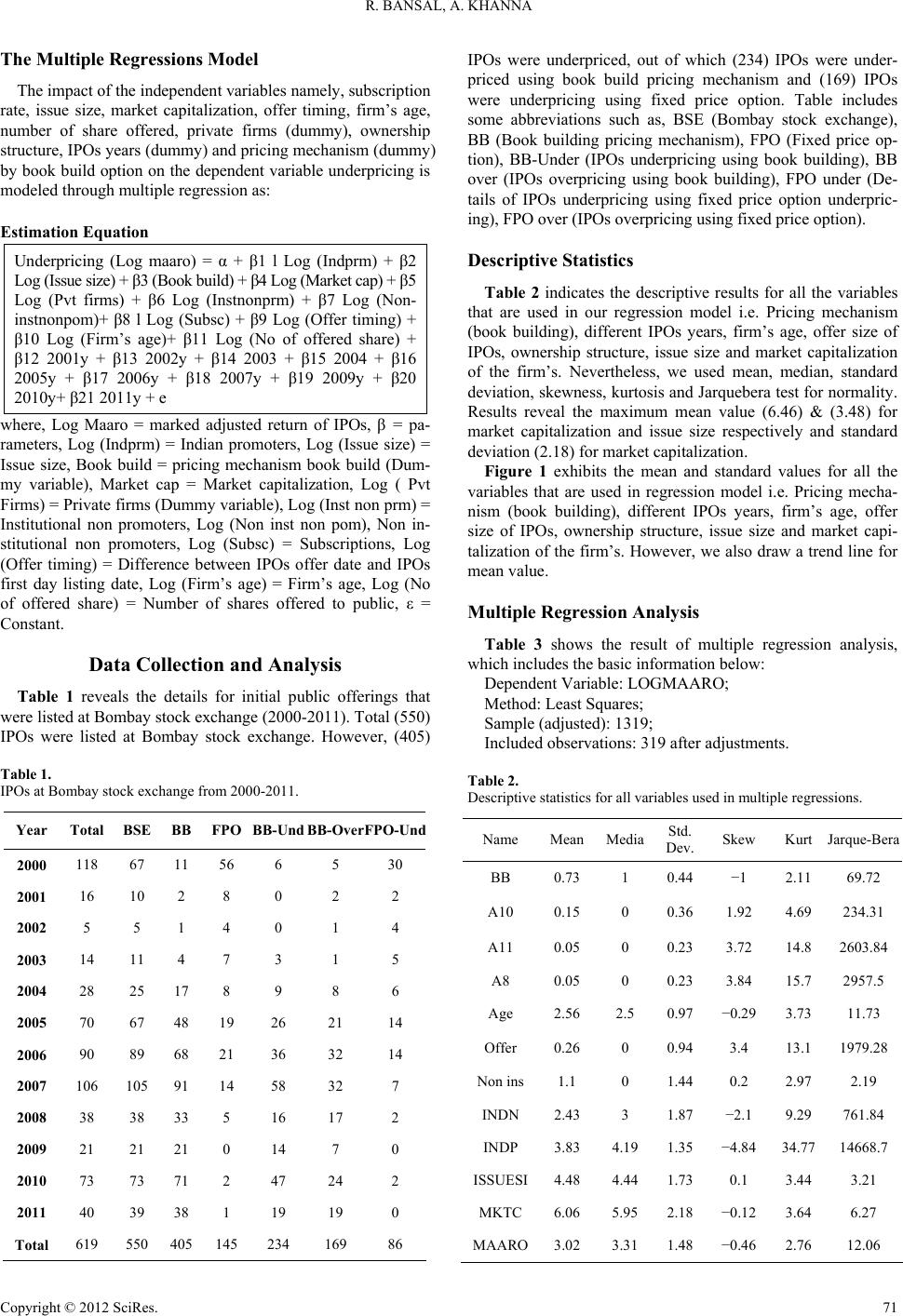 R. BANSAL, A. KHANNA T s namely, subscription fer timing, firm’s age, nu aaro) = α + β1 l Log (Indprm) + β2 Book build) + β4 Log (Market cap) + β5 he Multiple Regressions Model IPOs were underpriced, out of priced using book build pricing mechanism and (169) IPOs were undeinginece n.le ines les sion model i.e. Pricing mechanism IPOs years, firm’s age, offer size of IP m’s age, offer hows the result of multiple regression analysis, n below: O; T Degressions. Mean MediaStd. Skew KurtJarque-Bera The impact of the independent variable rate, issue size, market capitalization, of mber of share offered, private firms (dummy), ownership structure, IPOs years (dummy) and pricing mechanism (dummy) by book build option on the dependent variable underpricing is modeled through multiple regression as: Estimation Equation Underpricing (Log m Log (Issue size) + β3 ( Log (Pvt firms) + β6 Log (Instnonprm) + β7 Log (Non- instnonpom)+ β8 l Log (Subsc) + β9 Log (Offer timing) + β10 Log (Firm’s age)+ β11 Log (No of offered share) + β12 2001y + β13 2002y + β14 2003 + β15 2004 + β16 2005y + β17 2006y + β18 2007y + β19 2009y + β20 2010y+ β21 2011y + e w- ra Indian promoters, Log (Issue size) = Data Collection and Analysis Table 1 rferings that were listed a Total (550) IP BB-OverFPO-Und here, Log Maaro = marked adjusted return of IPOs, β = pa meters, Log (Indprm) = Issue size, Book build = pricing mechanism book build (Dum- my variable), Market cap = Market capitalization, Log ( Pvt Firms) = Private firms (Dummy variable), Log (Inst non prm) = Institutional non promoters, Log (Non inst non pom), Non in- stitutional non promoters, Log (Subsc) = Subscriptions, Log (Offer timing) = Difference between IPOs offer date and IPOs first day listing date, Log (Firm’s age) = Firm’s age, Log (No of offered share) = Number of shares offered to public, ε = Constant. eveals the details for initial public of t Bombay stock exchange (2000-2011). Os were listed at Bombay stock exchange. However, (405) Table 1. IPs at Bombay stock exchange from 2000-2011. O Year Total BSE BB FPO BB-Und 2000 118 67 11 56 6 5 30 2001 16 10 2 8 0 2 2 2002 5 5 1 4 0 1 4 2003 14 11 4 7 3 1 5 2004 28 25 17 8 9 8 6 2005 70 67 48 19 26 21 14 2006 90 89 68 21 36 32 14 2007 106 105 91 14 58 32 7 2008 38 38 33 5 16 17 2 2009 21 21 21 0 14 7 0 2010 73 73 71 2 47 24 2 2011 40 39 38 1 19 19 0 which (234) IPOs were under- rpric usg fixd prioptio Tabclud some abbreviations such as, BSE (Bombay stock exchange), BB (Book building pricing mechanism), FPO (Fixed price op- tion), BB-Under (IPOs underpricing using book building), BB over (IPOs overpricing using book building), FPO under (De- tails of IPOs underpricing using fixed price option underpric- ing), FPO over (IPOs overpricing using fixed price option). Descriptive Statistics Table 2 indicates the descriptive results for all the variab that are used in our regres (book building), different Os, ownership structure, issue size and market capitalization of the firm’s. Nevertheless, we used mean, median, standard deviation, skewness, kurtosis and Jarquebera test for normality. Results reveal the maximum mean value (6.46) & (3.48) for market capitalization and issue size respectively and standard deviation (2.18) for market capitalization. Figure 1 exhibits the mean and standard values for all the variables that are used in regression model i.e. Pricing mecha- nism (book building), different IPOs years, fir size of IPOs, ownership structure, issue size and market capi- talization of the firm’s. However, we also draw a trend line for mean value. Multiple Regression Analysis Table 3 s which includes the basic informatio Dependent Variable: LOGMAAR Method: Least Squares; Sample (adjusted): 1319; tments. Included observations: 319 after adjus able 2. escriptive statistics for all variables used in multiple r Name Dev. BB 0.73 1 0.44 −1 2.1169.72 A10 0.15 0 0.36 1.92 4.69234.31 A11 0.05 0 0.23 3.72 14.82 O Non ins 4. − 1 I4 − 603.84 A8 0.05 0 0.23 3.84 15.72957.5 Age 2.56 2.5 0.97 −0.29 3.7311.73 ffer 0.26 0 0.94 3.4 13.11979.28 1.1 0 1.44 0.2 2.972.19 INDN 2.43 3 1.87 −2.1 9.29761.84 INDP 3.83 191.35 4.84 34.774668.7 SSUESI4.48 .441.73 0.1 3.443.21 MKTC 6.06 5.95 2.18 −0.12 3.646.27 MAARO3.02 3.31 1.48 0.46 2.7612.06 Total 619 550 405 145234 169 86 Copyright © 2012 SciRes. 71 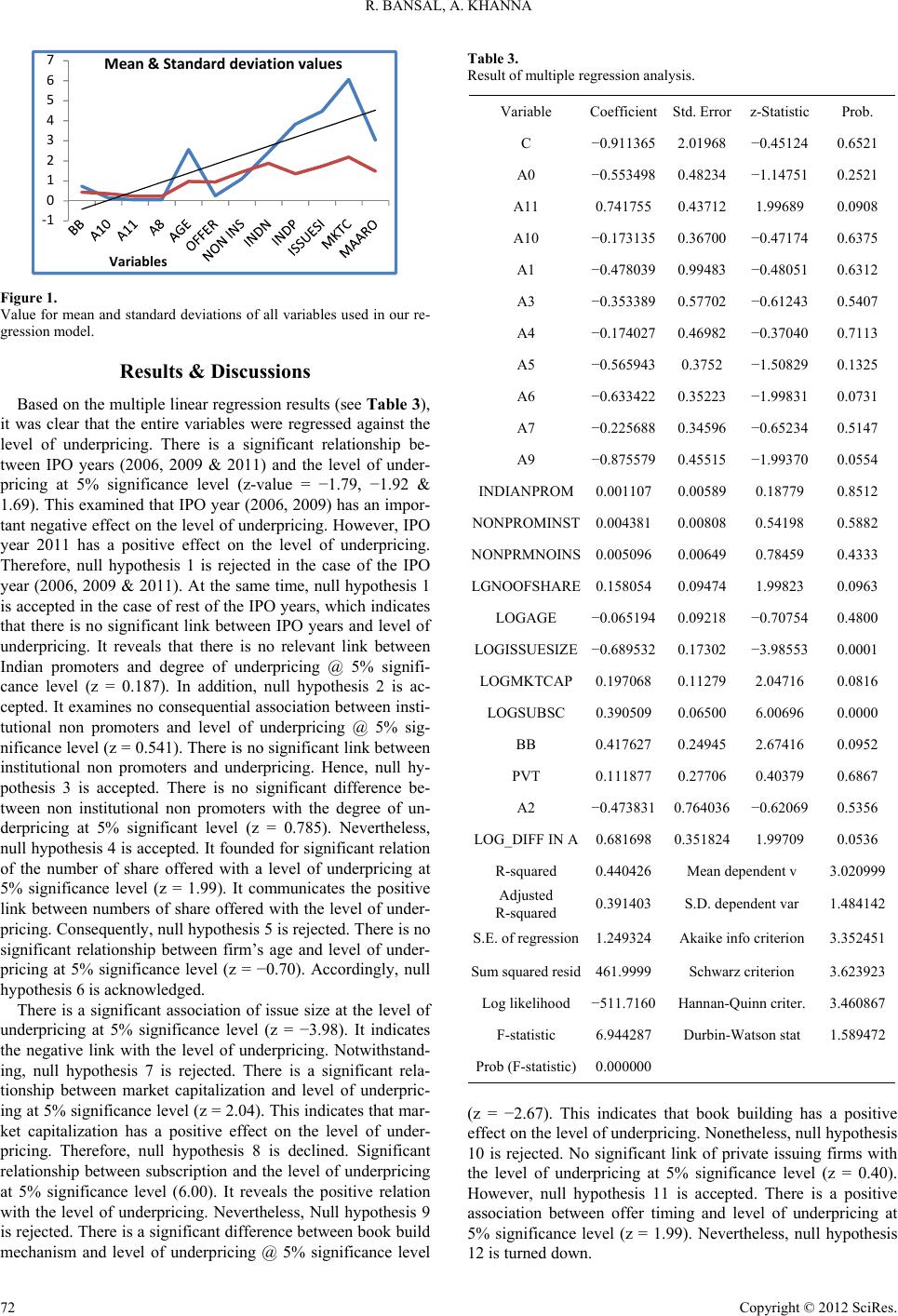 R. BANSAL, A. KHANNA -1 0 1 2 3 4 5 6 7 Variables anndevvaMe & Stadard iation lues Figure 1. Value for mean and standard deviations of all variables used in our re- gression model. multiple linear regression results (see Table 3), it was clear that ssed against the level of underprelationship be- tw Results & Discussions Based on the the entire variables were regre icing. There is a significant r een IPO years (2006, 2009 & 2011) and the level of under- pricing at 5% significance level (z-value = −1.79, −1.92 & 1.69). This examined that IPO year (2006, 2009) has an impor- tant negative effect on the level of underpricing. However, IPO year 2011 has a positive effect on the level of underpricing. Therefore, null hypothesis 1 is rejected in the case of the IPO year (2006, 2009 & 2011). At the same time, null hypothesis 1 is accepted in the case of rest of the IPO years, which indicates that there is no significant link between IPO years and level of underpricing. It reveals that there is no relevant link between Indian promoters and degree of underpricing @ 5% signifi- cance level (z = 0.187). In addition, null hypothesis 2 is ac- cepted. It examines no consequential association between insti- tutional non promoters and level of underpricing @ 5% sig- nificance level (z = 0.541). There is no significant link between institutional non promoters and underpricing. Hence, null hy- pothesis 3 is accepted. There is no significant difference be- tween non institutional non promoters with the degree of un- derpricing at 5% significant level (z = 0.785). Nevertheless, null hypothesis 4 is accepted. It founded for significant relation of the number of share offered with a level of underpricing at 5% significance level (z = 1.99). It communicates the positive link between numbers of share offered with the level of under- pricing. Consequently, null hypothesis 5 is rejected. There is no significant relationship between firm’s age and level of under- pricing at 5% significance level (z = −0.70). Accordingly, null hypothesis 6 is acknowledged. There is a significant association of issue size at the level of underpricing at 5% significance level (z = −3.98). It indicates the negative link with the level of underpricing. Notwithstand- ing, null hypothesis 7 is rejected. There is a significant rela- tionship between market capitalization and level of underpric- ing at 5% significance level (z = 2.04). This indicates that mar- ket capitalization has a positive effect on the level of under- pricing. Therefore, null hypothesis 8 is declined. Significant relationship between subscription and the level of underpricing at 5% significance level (6.00). It reveals the positive relation with the level of underpricing. Nevertheless, Null hypothesis 9 is rejected. There is a significant difference between book build mechanism and level of underpricing @ 5% significance level Table 3. Result of multiple regression analysis. Variable CoefficientStd. Error z-Statistic Prob. C −0.9113652.01968 −0.45124 0.6521 A0 −0.5534980.48234 −1.14751 0.2521 0. A10 − − 0 INDIANPROM NONPROST NONPRMNOINS L − − − − L −0− LOG_DIFF IN A0. R-ed 3. Adjusted 0.391403S.D. dependent var 1.484142 S.EAkaike info cr Sum sid L−511.7160Hannan-Quinn criter. 3.460867 F-statistic 6.944287Durbin-Watson stat 1.589472 Prob (F-statistic)0.000000 A11 0.7417550.43712 1.99689 0908 −0.1731350.36700 −0.47174 0.6375 A1 −0.4780390.99483 −0.48051 0.6312 A3 0.3533890.57702 0.61243 0.5407 A4 −0.1740270.46982 −0.37040 0.7113 A5 −0.5659430.3752 −1.50829 0.1325 A6 −0.6334220.35223 −1.99831 0.0731 A7 −0.2256880.34596 −0.65234 0.5147 A9 −0.875579.45515 −1.99370 0.0554 0.0011070.00589 0.18779 0.8512 MIN0.004381 0.00808 0.54198 0.5882 0.0050960.00649 0.78459 0.4333 GNOOFSHARE0.1580540.09474 1.99823 0.0963 LOGAGE 0.0651940.09218 0.70754 0.4800 LOGISSUESIZE 0.6895320.17302 3.98553 0.0001 LOGMKTCAP0.1970680.11279 2.04716 0.0816 OGSUBSC 0.3905090.06500 6.00696 0.0000 BB 0.4176270.24945 2.67416 0.0952 PVT 0.1118770.27706 0.40379 0.6867 A2 0.473831.764036 0.62069 0.5356 0.681698351824 1.99709 0.0536 squar0.440426Mean dependent v 020999 R-squared . of regression1.249324iterion 3.352451 squared re og likelihood 461.9999Schwarz criterion 3.623923 (z =is thas e effect onel oficing. Nonetheless, null hypothesis 1olink of private uing firmith the level of underpricing at 5% significance level (z = 0.40). 12 is turned down. −2.67). Th indicatesat book building ha positiv the lev 0 is rejected. N underpr significant isss w However, null hypothesis 11 is accepted. There is a positive association between offer timing and level of underpricing at 5% significance level (z = 1.99). Nevertheless, null hypothesis Copyright © 2012 SciRes. 72 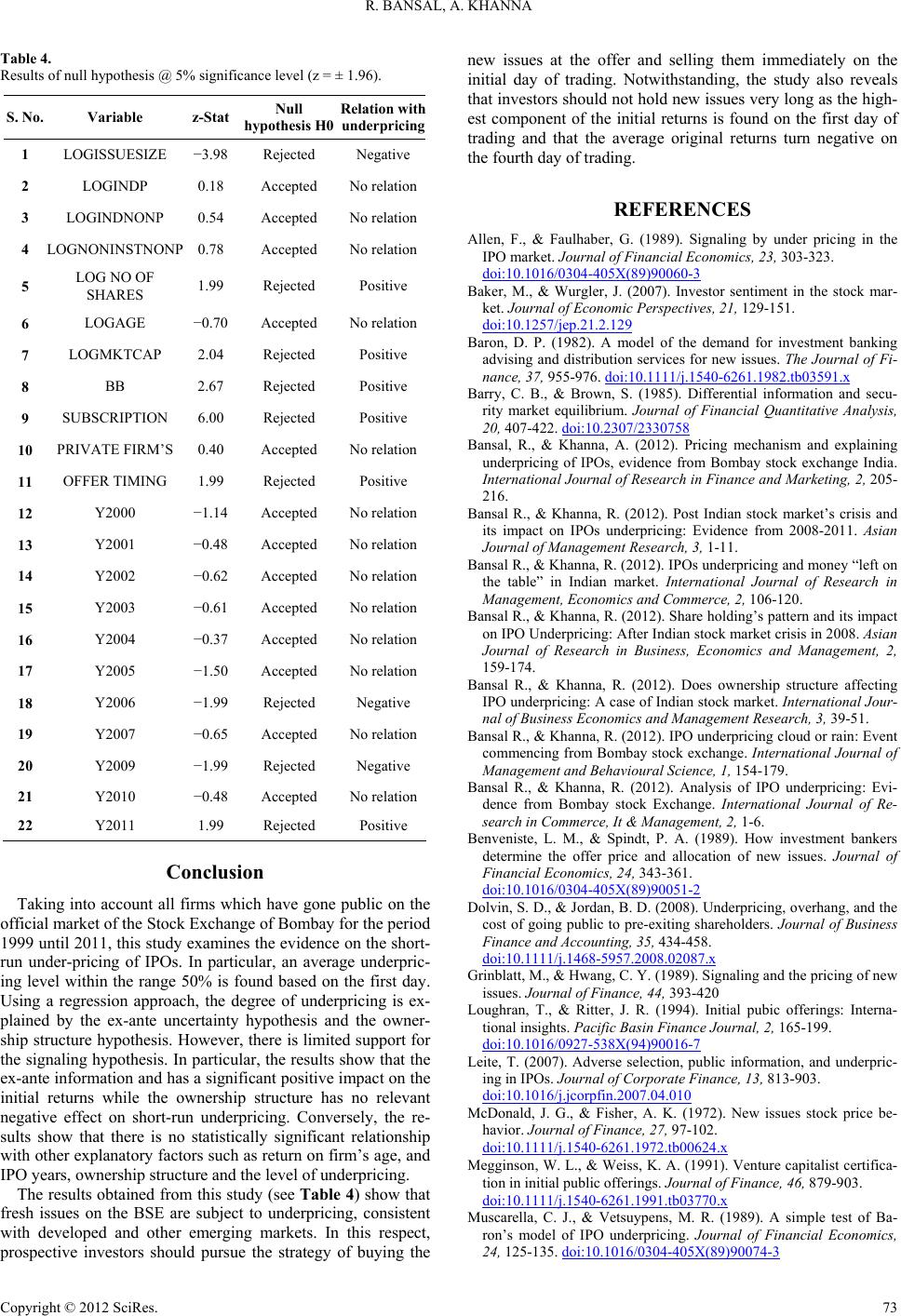 R. BANSAL, A. KHANNA Table 4. Results of null hypothesis @ 5% significance level (z = ± 1.96). S. No. Variable z-StatNull hypothesis H0 Relation with underpricing 1 LOGISSUESIZE −3.98Rejected Negative 2 LOGINDP 0.18Accepted No relation 3 LOP LOP SUN P No relation OFFER TIMING N N GINDNON0.54Accepted No relation 4 GNONINSTNON0.78Accepted No relation 5 LOG NO OF SHARES 1.99Rejected Positive 6 LOGAGE −0.70Accepted No relation 7 LOGMKTCAP 2.04Rejected Positive 8 BB 2.67Rejected Positive 9 BSCRIPTIO6.00Rejected Positive 10 RIVATE FIRM’S0.40Accepted 11 1.99Rejected Positive 12 Y2000 −1.14 Accepted o relation 13 Y2001 −0.48 Accepted No relation 14 Y2002 −0.62 Accepted o relation 15 Y2003 −0.61 Accepted No relation 16 Y2004 −0.37 Accepted No relation 17 Y2005 −1.50 Accepted No relation 18 Y2006 −1.99Rejected Negative 19 Y2007 −0.65 Accepted No relation 20 Y2009 −1.99Rejected Negative 21 Y2010 −0.48 Accepted No relation 22 Y2011 1.99Rejected Positive Co ion ing intot all fihiche pe of marke Stock Enge y fo 1999 until 2011, this study examines the evidence on the short- run under-pricing of IP an average underpric- ing level within the range 50% is found based on the first day. U prospective investors should pursue the strategy of buying the th )90060-3 nclus Tak accounrms w have gonublic on th ficialt of thexchaof Bombar the period Os. In particular, sing a regression approach, the degree of underpricing is ex- plained by the ex-ante uncertainty hypothesis and the owner- ship structure hypothesis. However, there is limited support for the signaling hypothesis. In particular, the results show that the ex-ante information and has a significant positive impact on the initial returns while the ownership structure has no relevant negative effect on short-run underpricing. Conversely, the re- sults show that there is no statistically significant relationship with other explanatory factors such as return on firm’s age, and IPO years, ownership structure and the level of underpricing. The results obtained from this study (see Table 4) show that fresh issues on the BSE are subject to underpricing, consistent with developed and other emerging markets. In this respect, new issues at the offer and selling them immediately on the initial day of trading. Notwithstanding, the study also reveals at investors should not hold new issues very long as the high- est component of the initial returns is found on the first day of trading and that the average original returns turn negative on the fourth day of trading. REFERENCES Allen, F., & Faulhaber, G. (1989). Signaling by under pricing in the IPO market. Journal of Financial Economics, 23, 303-323. doi:10.1016/0304-405X(89 Baker, M., & Wurgler, J. (2007). Investor sentiment in the stock mar- ket. Journal of Economic P151. doi:10.1257/jep.21.2. erspectives, 21, 129- 129 Baron, D. P. (1982). A model of the demand for investment banking advising and distribution services for new issues. The Journal of Fi- nance, 37, 955-976. doi:10.1111/j.1540-6261.1982.tb03591.x Bferential information and secu- rity market equilibrium. Journal of Financial Quantitative Analysis, 20, 407-422. arry, C. B., & Brown, S. (1985). Dif doi:10.2307/2330758 ansal, R., & Khanna, A. (B2012). Pricing mechanism and explaining underpricing of IPOs, evidence from Bombay stock exchange India. International Journal of Research in Finance and Marketing, 2, 205- 216. Bansal R., & Khanna, R. (2012). Post Indian stock market’s crisis and its impact on IPOs underpricing: Evidence from 2008-2011. Asian Journal of Management Research, 3, 1-11. Bansal R., & Khanna, R. (2012). IPOs underpricing and money “left on the table” in Indian market. International Journal of Research in Management, Economics and Commerce, 2, 106-120. Bansal R., & Khanna, R. (2012). Share holding’s pattern and its impact on IPO Underpricing: After Indian stock market crisis in 2008. Asian Journal of Research in Business, Economics and Management, 2, 159-174. Bansal R., & Khanna, R. (2012). Does ownership structure affecting IPO underpricing: A case of Indian stock market. International Jour- nal of Business Economics and Management Research, 3, 39-51. Bansal R., & Khanna, R. (2012). IPO underpricing cloud or rain: Event commencing from Bombay stock exchange. International Journal of Management and Behavioural Science, 1, 154-179. ansal R., &B Khanna, R. (2012). Analysis of IPO underpricing: Evi- dence from Bombay stock Exchange. International Journal of Re- search in Commerce, It & Management, 2, 1-6. enveniste, L. M., & Spindt, P. A. (1989). How investment bankBers determine the offer price and allocation of new issues. Journal of Financial Economics, 2 4, 343-361. doi:10.1016/0304-405X(89)90051-2 Dolvin, S. D., & Jordan, B. D. (2008). Underpricing, overhang, and the cost of going public to pre-exiting shareholders. Journal of Business Finance and Accounting, 35, 434-458. doi:10.1111/j.1468-5957.2008.02087.x inblatt, M., & Hwang, C. Y. (1989). Signaling and the pricing of new issues. Journal of Finance, 44, 393-42 oughran, T., & Ritter, J. R. (1994). Initial Gr 0 L pubic offerings: Interna- tional insights. Pacific Basin Finance Journal, 2, 165-199. doi:10.1016/0927-538X(94)90016-7 eite, T. (2007). Adverse selection, public ing in IPOs. Journal of Corp orate Finan Linformation, and underpric- ce, 13, 813-903. doi:10.1016/j.jcorpfin.2007.04.010 cDonald, J. G., & Fisher, A. K. (1972).M New issues stock price be- havior. Journal of Finance, 27, 97-102. doi:10.1111/j.1540-6261.1972.tb00624.x egginson, W. L., & Weiss, K. A. (199M1). Venture capitalist certifica- tion in initial public offerings. Journ al of Finance, 46, 879-903. doi:10.1111/j.1540-6261.1991.tb03770.x uscarella, C. J., & Vetsuypens, M. R. (M1989). A simple test of Ba- ron’s model of IPO underpricing. Journal of Financial Economics, 24, 125-135. doi:10.1016/0304-405X(89)90074-3 Copyright © 2012 SciRes. 73  R. BANSAL, A. KHANNA Copyright © 2012 SciRes. 74 Rpriced? Journal of Finan- ock, K. (1986). Why new issues are under cial Economics, 15, 187-212. doi:10.1016/0304-405X(86)90054-1 itter, J. R. (1991). The long run performance of initial public offeri The Journal of Finance, 46, 3-27. Rngs. Wg 6.x elch, I. (1989). Seasoned offerings, imitation costs and the under pricin of initial public offerings. Journal of Finance, 47, 695-732. doi:10.1111/j.1540-6261.1992.tb0440 |