

Paper Menu >>
Journal Menu >>
 Crystal Structure Theory and Applications, 2012, 1, 121-127 http://dx.doi.org/10.4236/csta.2012.13022 Published Online December 2012 (http://www.SciRP.org/journal/csta) Crystal Structure and Solution Structural Dynamic Feature of 1,8-Dibenzoyl-2,7-Dimethoxynaphthalene Akiko Okamoto, Shoji Watanabe, Kosuke Nakaema, Noriyuki Yonezawa Department of Organic and Polymer Materials Chemistry, Tokyo University of Agriculture and Technology, Tokyo, Japan Email: [email protected] Received October 26, 2012; revised November 30, 2012; accepted December 8, 2012 ABSTRACT The crystal structure and the dynamic feature of molecular structure in solution for 1,8-dibenzoyl-2,7-dimethoxynaph- thalene are revealed by X-ray crystallographic analysis and VT-NMR measurements. In crystal, the molecule of the title compound is located on a twofold rotation axis. The two benzoyl groups are situated in an opposite direction. The dihe- dral angle between the mean planes of the phenyl ring and the naphthalene ring system is 80.25(6)˚. The benzene ring and carbonyl moiety in each benzoyl group are almost coplanar. The molecular packing is stabilized by weak C–H…O hydrogen bonds and a π-π stacking interaction between the benzene rings [centroid-centroid and interplanar distances of 3.6383(10) and 3.294 Å, respectively]. In solution, the temperature-dependent rotation behavior of the C–C bond be- tween the benzene ring and the ketonic carbonyl group has been observed by 1H VT-NMR measurements. Furthermore, comparison of the C–C bond rotation behavior between the benzene ring and the carbonyl group with 1-ben- zoyl-2,7-dimethoxynaphthalene has clarified that the C–C bond between the ketonic carbonyl group and the naphtha- lene ring rotates slower than the 1,8-dibenzoylated homologue. Keywords: Non-Coplanarly Accumulated Aromatic Rings Molecules; Crystal Structural Features; Bond Rotation Behavior in Solution; X-Ray Crystallography; VT-NMR Spectroscopy 1. Introduction Non-coplanarly accumulated aromatic rings molecules, such as binaphthyl and biphenyl compounds, have at- tracted significant attention because of their characteris- tic properties, unique shapes, and various applications [1-7]. Peri-substituted naphthalenes have also received much attention as unique structured aromatic core com- pounds for variety of the functional materials [8-12]. Therefore, the structural analyses have been actively per- formed [13-15]. Recently, the authors’ group has re- vealed that diaroylation at 1,8-positions of 2,7-dimeth- oxynaphthalene smoothly proceeds [16,17]. According to X-ray crystal structural study, the obtained 1,8-diaroyl- naphthalene has unique non-coplanar alignment of aro- matic rings [18]. The curious reversible aroylation be- havior of the naphthalene derivative [16] and chemo- specific and regioselective ethereal alkyl-oxygen bond cleavage reaction of aroylated naphthalenes [19] can be explained on the basis of the structural features of the aroylated naphthalenes. Under these circumstances, the authors have undertaken the structural studies of the aroylnaphthalne compounds [20-26] with investigation of the formation and the related reaction behaviors. In this article, the crystallographical structural charac- teristics and the dynamic feature in solution structure of a 1,8-diaroylated naphthalene derivative having two me- thoxy groups at the 2,7-positions are described as the most simple homologue of monoaroylated derivative. 2. Experimental All reagents were of commercial quality and were used as received. Solvents were dried and purified using stan- dard techniques. Pentoxide-methanesulfonic acid (P2O5- MsOH) was prepared according to literature [27]. 2.1. Measurements 1H NMR spectra were recorded on a JEOL JNM-AL300 spectrometer (300 MHz) and a JEOL ECX400 spec- trometer (400 MHz). Chemical shifts are expressed in ppm relative to internal standard of Me4Si (δ 0.00). 13C NMR spectra were recorded on a JEOL JNM-AL300 spectrometer (75 MHz). Chemical shifts are expressed in ppm relative to internal standard of CDCl3 (δ 77.0). IR spectra were recorded on a JASCO FT/IR-4100 spec- trometer. High-resolution FAB mass spectra were re- corded on a JEOL MStation (MS700) ion trap mass spectrometer in positive ion mode. C opyright © 2012 SciRes. CSTA 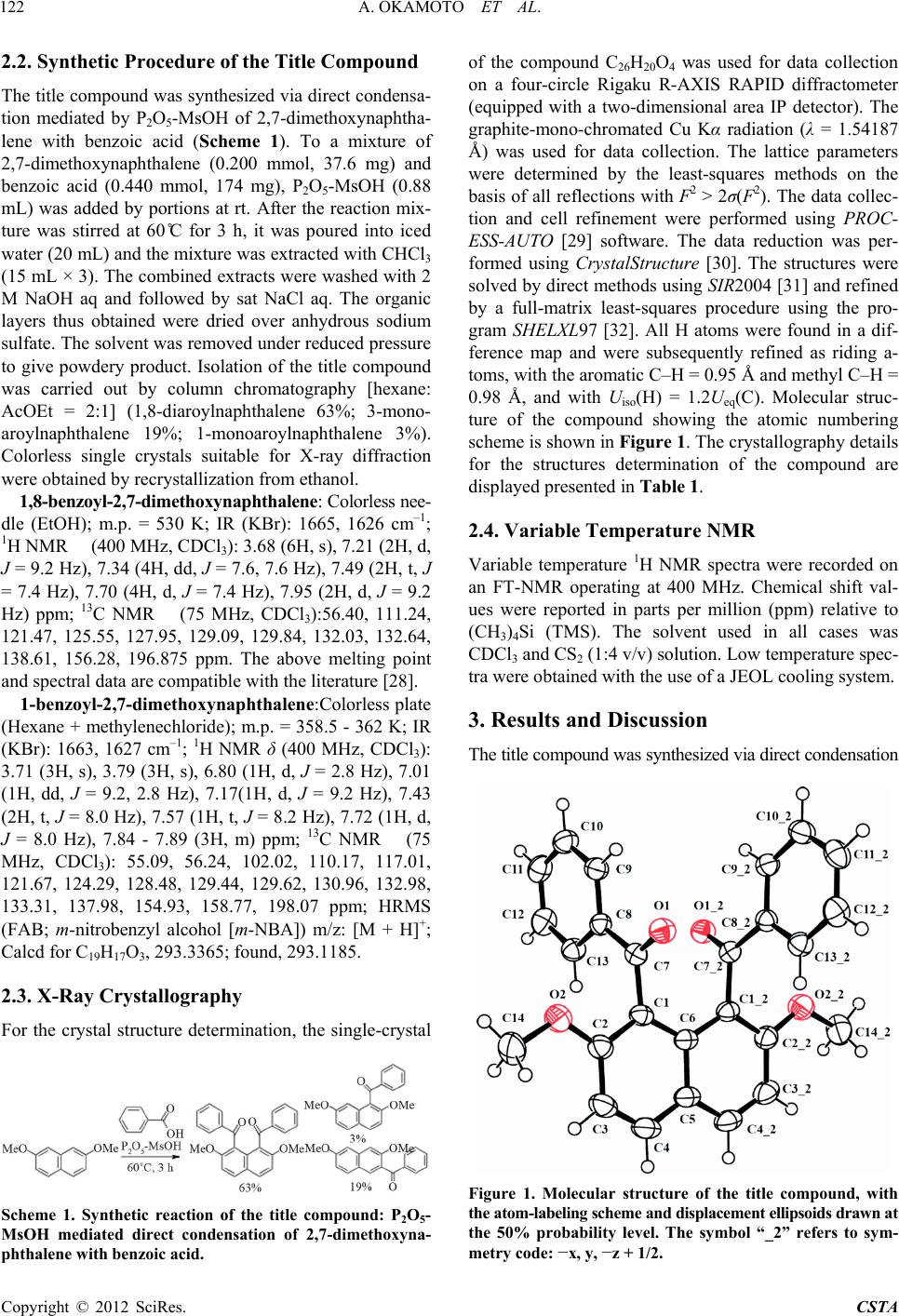 A. OKAMOTO ET AL. 122 2.2. Synthetic Procedure of the Title Compound The title compound was synthesized via direct condensa- tion mediated by P2O5-MsOH of 2,7-dimethoxynaphtha- lene with benzoic acid (Scheme 1). To a mixture of 2,7-dimethoxynaphthalene (0.200 mmol, 37.6 mg) and benzoic acid (0.440 mmol, 174 mg), P2O5-MsOH (0.88 mL) was added by portions at rt. After the reaction mix- ture was stirred at 60 ̊C for 3 h, it was poured into iced water (20 mL) and the mixture was extracted with CHCl3 (15 mL × 3). The combined extracts were washed with 2 M NaOH aq and followed by sat NaCl aq. The organic layers thus obtained were dried over anhydrous sodium sulfate. The solvent was removed under reduced pressure to give powdery product. Isolation of the title compound was carried out by column chromatography [hexane: AcOEt = 2:1] (1,8-diaroylnaphthalene 63%; 3-mono- aroylnaphthalene 19%; 1-monoaroylnaphthalene 3%). Colorless single crystals suitable for X-ray diffraction were obtained by recrystallization from ethanol. 1,8-benzoyl-2,7-dimethoxynaphthalene: Colorless nee- dle (EtOH); m.p. = 530 K; IR (KBr): 1665, 1626 cm–1; 1H NMR (400 MHz, CDCl3): 3.68 (6H, s), 7.21 (2H, d, J = 9.2 Hz), 7.34 (4H, dd, J = 7.6, 7.6 Hz), 7.49 (2H, t, J = 7.4 Hz), 7.70 (4H, d, J = 7.4 Hz), 7.95 (2H, d, J = 9.2 Hz) ppm; 13C NMR (75 MHz, CDCl3):56.40, 111.24, 121.47, 125.55, 127.95, 129.09, 129.84, 132.03, 132.64, 138.61, 156.28, 196.875 ppm. The above melting point and spectral data are compatible with the literature [28]. 1-benzoy l-2,7-dimetho xynapht halene:Colorless plate (Hexane + methylenechloride); m.p. = 358.5 - 362 K; IR (KBr): 1663, 1627 cm–1; 1H NMR δ (400 MHz, CDCl3): 3.71 (3H, s), 3.79 (3H, s), 6.80 (1H, d, J = 2.8 Hz), 7.01 (1H, dd, J = 9.2, 2.8 Hz), 7.17(1H, d, J = 9.2 Hz), 7.43 (2H, t, J = 8.0 Hz), 7.57 (1H, t, J = 8.2 Hz), 7.72 (1H, d, J = 8.0 Hz), 7.84 - 7.89 (3H, m) ppm; 13C NMR (75 MHz, CDCl3): 55.09, 56.24, 102.02, 110.17, 117.01, 121.67, 124.29, 128.48, 129.44, 129.62, 130.96, 132.98, 133.31, 137.98, 154.93, 158.77, 198.07 ppm; HRMS (FAB; m-nitrobenzyl alcohol [m-NBA]) m/z: [M + H]+; Calcd for C19H17O3, 293.3365; found, 293.1185. 2.3. X-Ray Crystallography For the crystal structure determination, the single-crystal Scheme 1. Synthetic reaction of the title compound: P2O5- MsOH mediated direct condensation of 2,7-dimethoxyna- phthalene with benzoic acid. of the compound C26H20O4 was used for data collection on a four-circle Rigaku R-AXIS RAPID diffractometer (equipped with a two-dimensional area IP detector). The graphite-mono-chromated Cu Kα radiation (λ = 1.54187 Å) was used for data collection. The lattice parameters were determined by the least-squares methods on the basis of all reflections with F2 > 2σ(F2). The data collec- tion and cell refinement were performed using PROC- ESS-AUTO [29] software. The data reduction was per- formed using CrystalStructure [30]. The structures were solved by direct methods using SIR2004 [31] and refined by a full-matrix least-squares procedure using the pro- gram SHELXL97 [32]. All H atoms were found in a dif- ference map and were subsequently refined as riding a- toms, with the aromatic C–H = 0.95 Å and methyl C–H = 0.98 Å, and with Uiso(H) = 1.2Ueq(C). Molecular struc- ture of the compound showing the atomic numbering scheme is shown in Figure 1. The crystallography details for the structures determination of the compound are displayed presented in Table 1. 2.4. Variable Temperature NMR Variable temperature 1H NMR spectra were recorded on an FT-NMR operating at 400 MHz. Chemical shift val- ues were reported in parts per million (ppm) relative to (CH3)4Si (TMS). The solvent used in all cases was CDCl3 and CS2 (1:4 v/v) solution. Low temperature spec- tra were obtained with the use of a JEOL cooling system. 3. Results and Discussion The title compound was synthesized via direct condensation Figure 1. Molecular structure of the title compound, with the atom-labeling scheme and displacement ellipsoids drawn at the 50% probability level. The symbol “_2” refers to sym- metry code: −x, y, −z + 1/2. Copyright © 2012 SciRes. CSTA 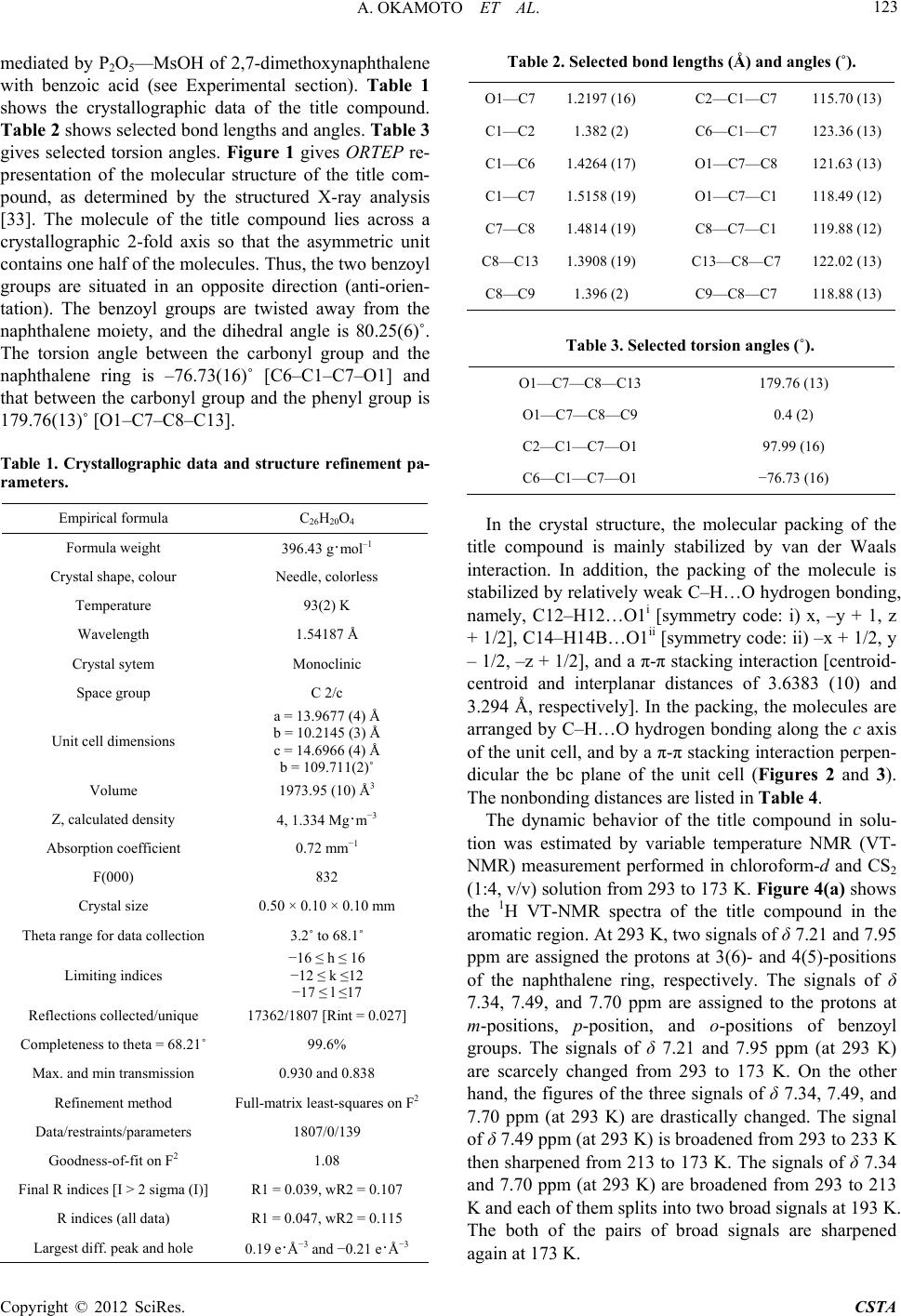 A. OKAMOTO ET AL. 123 mediated by P2O5—MsOH of 2,7-dimethoxynaphthalene with benzoic acid (see Experimental section). Table 1 shows the crystallographic data of the title compound. Table 2 shows selected bond lengths and angles. Table 3 gives selected torsion angles. Figure 1 gives ORTEP re- presentation of the molecular structure of the title com- pound, as determined by the structured X-ray analysis [33]. The molecule of the title compound lies across a crystallographic 2-fold axis so that the asymmetric unit contains one half of the molecules. Thus, the two benzoyl groups are situated in an opposite direction (anti-orien- tation). The benzoyl groups are twisted away from the naphthalene moiety, and the dihedral angle is 80.25(6)˚. The torsion angle between the carbonyl group and the naphthalene ring is –76.73(16)˚ [C6–C1–C7–O1] and that between the carbonyl group and the phenyl group is 179.76(13)˚ [O1–C7–C8–C13]. Table 1. Crystallographic data and structure refinement pa- rameters. Empirical formula C26H20O4 Formula weight 396.43 g·mol–1 Crystal shape, colour Needle, colorless Temperature 93(2) K Wavelength 1.54187 Å Crystal sytem Monoclinic Space group C 2/c Unit cell dimensions a = 13.9677 (4) Å b = 10.2145 (3) Å c = 14.6966 (4) Å b = 109.711(2)˚ Volume 1973.95 (10) Å3 Z, calculated density 4, 1.334 Mg·m−3 Absorption coefficient 0.72 mm−1 F(000) 832 Crystal size 0.50 × 0.10 × 0.10 mm Theta range for data collection 3.2˚ to 68.1˚ Limiting indices −16 ≤ h ≤ 16 −12 ≤ k ≤12 −17 ≤ l ≤17 Reflections collected/unique 17362/1807 [Rint = 0.027] Completeness to theta = 68.21˚ 99.6% Max. and min transmission 0.930 and 0.838 Refinement method Full-matrix least-squares on F2 Data/restraints/parameters 1807/0/139 Goodness-of-fit on F2 1.08 Final R indices [I > 2 sigma (I)] R1 = 0.039, wR2 = 0.107 R indices (all data) R1 = 0.047, wR2 = 0.115 Largest diff. peak and hole 0.19 e·Å−3 and −0.21 e·Å−3 Table 2. Selected bond lengths (Å) and angles (˚). O1—C7 1.2197 (16)C2—C1—C7 115.70 (13) C1—C2 1.382 (2) C6—C1—C7 123.36 (13) C1—C6 1.4264 (17)O1—C7—C8 121.63 (13) C1—C7 1.5158 (19)O1—C7—C1 118.49 (12) C7—C8 1.4814 (19)C8—C7—C1 119.88 (12) C8—C131.3908 (19)C13—C8—C7 122.02 (13) C8—C9 1.396 (2) C9—C8—C7 118.88 (13) Table 3. Selected torsion angles (˚). O1—C7—C8—C13 179.76 (13) O1—C7—C8—C9 0.4 (2) C2—C1—C7—O1 97.99 (16) C6—C1—C7—O1 −76.73 (16) In the crystal structure, the molecular packing of the title compound is mainly stabilized by van der Waals interaction. In addition, the packing of the molecule is stabilized by relatively weak C–H…O hydrogen bonding, namely, C12–H12…O1i [symmetry code: i) x, –y + 1, z + 1/2], C14–H14B…O1ii [symmetry code: ii) –x + 1/2, y – 1/2, –z + 1/2], and a π-π stacking interaction [centroid- centroid and interplanar distances of 3.6383 (10) and 3.294 Å, respectively]. In the packing, the molecules are arranged by C–H…O hydrogen bonding along the c axis of the unit cell, and by a π-π stacking interaction perpen- dicular the bc plane of the unit cell (Figures 2 and 3). The nonbonding distances are listed in Table 4. The dynamic behavior of the title compound in solu- tion was estimated by variable temperature NMR (VT- NMR) measurement performed in chloroform-d and CS2 (1:4, v/v) solution from 293 to 173 K. Figure 4(a) shows the 1H VT-NMR spectra of the title compound in the aromatic region. At 293 K, two signals of δ 7.21 and 7.95 ppm are assigned the protons at 3(6)- and 4(5)-positions of the naphthalene ring, respectively. The signals of δ 7.34, 7.49, and 7.70 ppm are assigned to the protons at m-positions, p-position, and o-positions of benzoyl groups. The signals of δ 7.21 and 7.95 ppm (at 293 K) are scarcely changed from 293 to 173 K. On the other hand, the figures of the three signals of δ 7.34, 7.49, and 7.70 ppm (at 293 K) are drastically changed. The signal of δ 7.49 ppm (at 293 K) is broadened from 293 to 233 K then sharpened from 213 to 173 K. The signals of δ 7.34 and 7.70 ppm (at 293 K) are broadened from 293 to 213 K and each of them splits into two broad signals at 193 K. The both of the pairs of broad signals are sharpened again at 173 K. Copyright © 2012 SciRes. CSTA 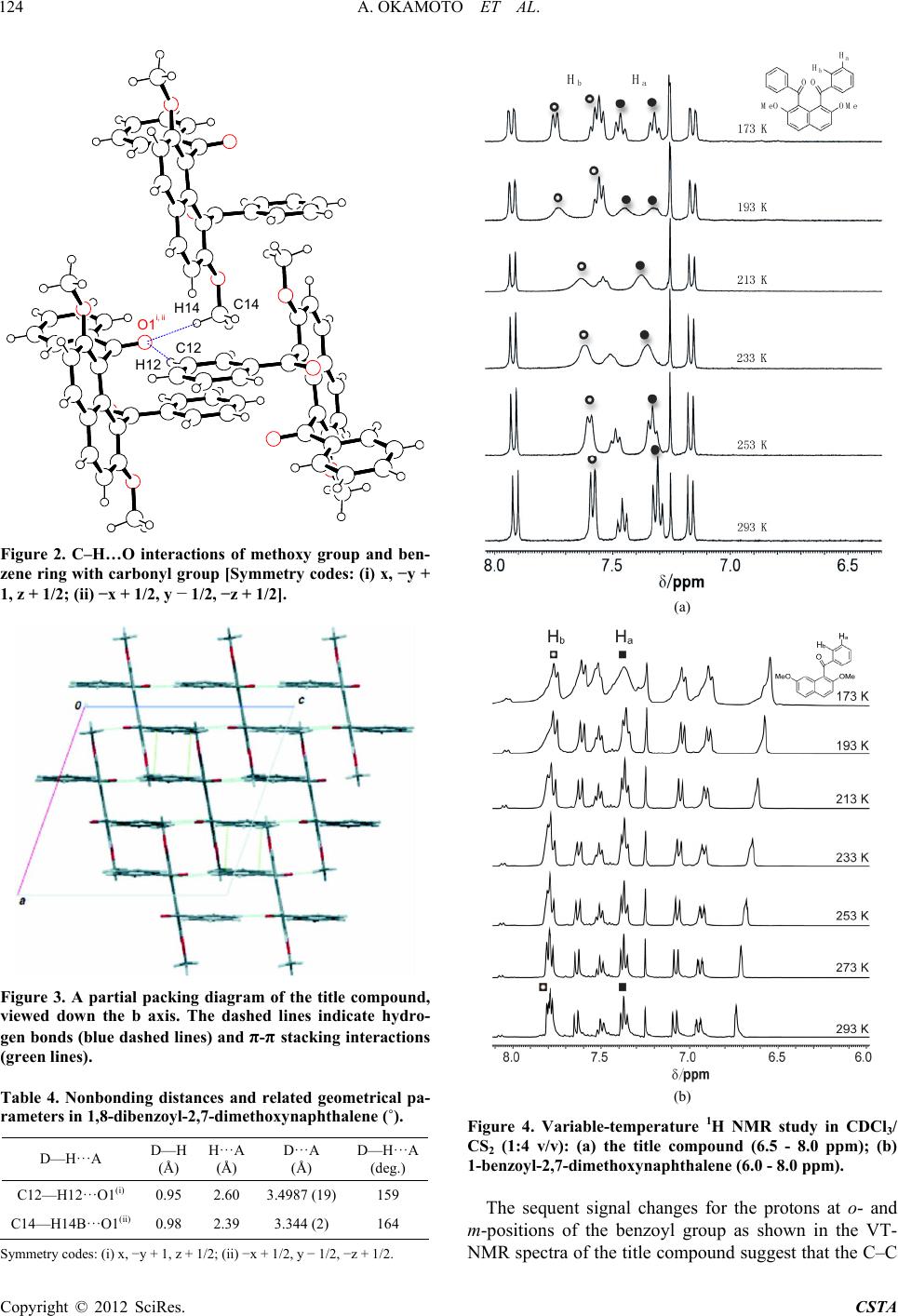 A. OKAMOTO ET AL. 124 O1 H14 C14 H12 i, ii C12 Figure 2. C–H…O interactions of methoxy group and ben- zene ring with carbonyl group [Symmetry codes: (i) x, −y + 1, z + 1/2; (ii) −x + 1/2, y − 1/2, −z + 1/2]. Figure 3. A partial packing diagram of the title compound, viewed down the b axis. The dashed lines indicate hydro- gen bonds (blue dashed lines) and π-π stacking interactions (green lines). Table 4. Nonbonding distances and related geometrical pa- rameters in 1,8-dibenzoyl-2,7-dimethoxynaphthalene (˚). D—H···A D—H (Å) H···A (Å) D···A (Å) D—H···A (deg.) C12—H12···O1(i) 0.95 2.60 3.4987 (19) 159 C14—H14B···O1(ii) 0.98 2.39 3.344 (2) 164 Symmetry codes: (i) x, −y + 1, z + 1/2; (ii) −x + 1/2, y − 1/2, −z + 1/2. (a) (b) Figure 4. Variable-temperature 1H NMR study in CDCl3/ CS2 (1:4 v/v): (a) the title compound (6.5 - 8.0 ppm); (b) 1-benzoyl-2,7-dimethoxynaphthalene (6.0 - 8.0 ppm). The sequent signal changes for the protons at o- and m-positions of the benzoyl group as shown in the VT- NMR spectra of the title compound suggest that the C–C Copyright © 2012 SciRes. CSTA 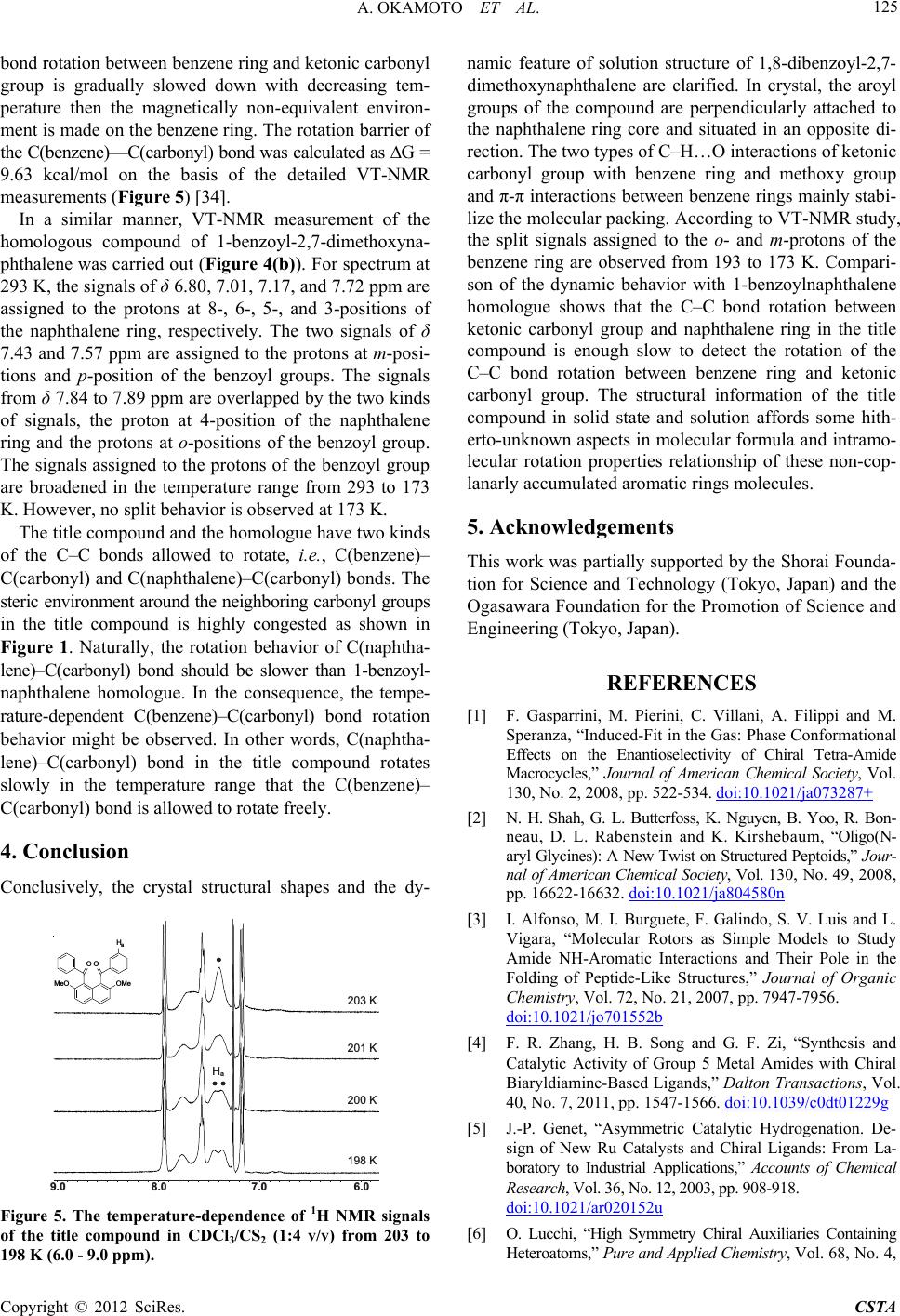 A. OKAMOTO ET AL. 125 bond rotation between benzene ring and ketonic carbonyl group is gradually slowed down with decreasing tem- perature then the magnetically non-equivalent environ- ment is made on the benzene ring. The rotation barrier of the C(benzene)—C(carbonyl) bond was calculated as ∆G = 9.63 kcal/mol on the basis of the detailed VT-NMR measurements (Figure 5) [34]. In a similar manner, VT-NMR measurement of the homologous compound of 1-benzoyl-2,7-dimethoxyna- phthalene was carried out (Figure 4(b)). For spectrum at 293 K, the signals of δ 6.80, 7.01, 7.17, and 7.72 ppm are assigned to the protons at 8-, 6-, 5-, and 3-positions of the naphthalene ring, respectively. The two signals of δ 7.43 and 7.57 ppm are assigned to the protons at m-posi- tions and p-position of the benzoyl groups. The signals from δ 7.84 to 7.89 ppm are overlapped by the two kinds of signals, the proton at 4-position of the naphthalene ring and the protons at o-positions of the benzoyl group. The signals assigned to the protons of the benzoyl group are broadened in the temperature range from 293 to 173 K. However, no split behavior is observed at 173 K. The title compound and the homologue have two kinds of the C–C bonds allowed to rotate, i.e., C(benzene)– C(carbonyl) and C(naphthalene)–C(carbonyl) bonds. The steric environment around the neighboring carbonyl groups in the title compound is highly congested as shown in Figure 1. Naturally, the rotation behavior of C(naphtha- lene)–C(carbonyl) bond should be slower than 1-benzoyl- naphthalene homologue. In the consequence, the tempe- rature-dependent C(benzene)–C(carbonyl) bond rotation behavior might be observed. In other words, C(naphtha- lene)–C(carbonyl) bond in the title compound rotates slowly in the temperature range that the C(benzene)– C(carbonyl) bond is allowed to rotate freely. 4. Conclusion Conclusively, the crystal structural shapes and the dy- 9.08.0 7.06.0 203 K 201 K 200 K 198 K H a OMeMeO OO Ha Figure 5. The temperature-dependence of 1H NMR signals of the title compound in CDCl3/CS2 (1:4 v/v) from 203 to 198 K (6.0 - 9.0 ppm). namic feature of solution structure of 1,8-dibenzoyl-2,7- dimethoxynaphthalene are clarified. In crystal, the aroyl groups of the compound are perpendicularly attached to the naphthalene ring core and situated in an opposite di- rection. The two types of C–H…O interactions of ketonic carbonyl group with benzene ring and methoxy group and π-π interactions between benzene rings mainly stabi- lize the molecular packing. According to VT-NMR study, the split signals assigned to the o- and m-protons of the benzene ring are observed from 193 to 173 K. Compari- son of the dynamic behavior with 1-benzoylnaphthalene homologue shows that the C–C bond rotation between ketonic carbonyl group and naphthalene ring in the title compound is enough slow to detect the rotation of the C–C bond rotation between benzene ring and ketonic carbonyl group. The structural information of the title compound in solid state and solution affords some hith- erto-unknown aspects in molecular formula and intramo- lecular rotation properties relationship of these non-cop- lanarly accumulated aromatic rings molecules. 5. Acknowledgements This work was partially supported by the Shorai Founda- tion for Science and Technology (Tokyo, Japan) and the Ogasawara Foundation for the Promotion of Science and Engineering (Tokyo, Japan). REFERENCES [1] F. Gasparrini, M. Pierini, C. Villani, A. Filippi and M. Speranza, “Induced-Fit in the Gas: Phase Conformational Effects on the Enantioselectivity of Chiral Tetra-Amide Macrocycles,” Journal of American Chemical Society, Vol. 130, No. 2, 2008, pp. 522-534. doi:10.1021/ja073287+ [2] N. H. Shah, G. L. Butterfoss, K. Nguyen, B. Yoo, R. Bon- neau, D. L. Rabenstein and K. Kirshebaum, “Oligo(N- aryl Glycines): A New Twist on Structured Peptoids,” Jour- nal of American Chemical Society, Vol. 130, No. 49, 2008, pp. 16622-16632. doi:10.1021/ja804580n [3] I. Alfonso, M. I. Burguete, F. Galindo, S. V. Luis and L. Vigara, “Molecular Rotors as Simple Models to Study Amide NH-Aromatic Interactions and Their Pole in the Folding of Peptide-Like Structures,” Journal of Organic Chemistry, Vol. 72, No. 21, 2007, pp. 7947-7956. doi:10.1021/jo701552b [4] F. R. Zhang, H. B. Song and G. F. Zi, “Synthesis and Catalytic Activity of Group 5 Metal Amides with Chiral Biaryldiamine-Based Ligands,” Dalton Transactions, Vol. 40, No. 7, 2011, pp. 1547-1566. doi:10.1039/c0dt01229g [5] J.-P. Genet, “Asymmetric Catalytic Hydrogenation. De- sign of New Ru Catalysts and Chiral Ligands: From La- boratory to Industrial Applications,” Accounts of Chemical Research, Vol. 36, No. 12, 2003, pp. 908-918. doi:10.1021/ar020152u [6] O. Lucchi, “High Symmetry Chiral Auxiliaries Containing Heteroatoms,” Pure and Applied Chemistry, Vol. 68, No. 4, Copyright © 2012 SciRes. CSTA 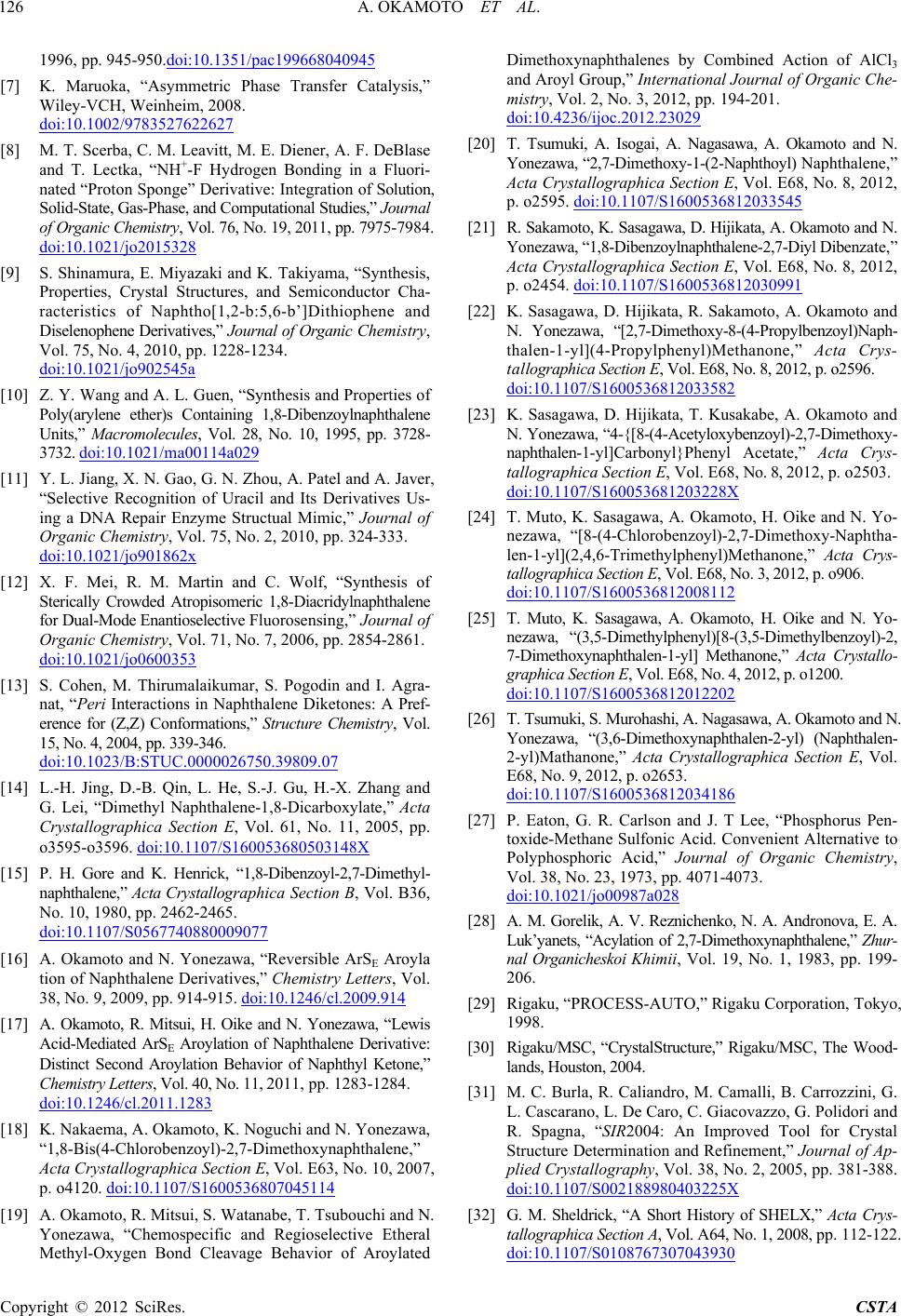 A. OKAMOTO ET AL. 126 1996, pp. 945-950.doi:10.1351/pac199668040945 [7] K. Maruoka, “Asymmetric Phase Transfer Catalysis,” Wiley-VCH, Weinheim, 2008. doi:10.1002/9783527622627 [8] M. T. Scerba, C. M. Leavitt, M. E. Diener, A. F. DeBlase and T. Lectka, “NH+-F Hydrogen Bonding in a Fluori- nated “Proton Sponge” Derivative: Integration of Solution, Solid-State, Gas-Phase, and Computational Studies,” Journal of Organic Chemistry, Vol. 76, No. 19, 2011, pp. 7975-7984. doi:10.1021/jo2015328 [9] S. Shinamura, E. Miyazaki and K. Takiyama, “Synthesis, Properties, Crystal Structures, and Semiconductor Cha- racteristics of Naphtho[1,2-b:5,6-b’]Dithiophene and Diselenophene Derivatives,” Journal of Organic Chemistry, Vol. 75, No. 4, 2010, pp. 1228-1234. doi:10.1021/jo902545a [10] Z. Y. Wang and A. L. Guen, “Synthesis and Properties of Poly(arylene ether)s Containing 1,8-Dibenzoylnaphthalene Units,” Macromolecules, Vol. 28, No. 10, 1995, pp. 3728- 3732. doi:10.1021/ma00114a029 [11] Y. L. Jiang, X. N. Gao, G. N. Zhou, A. Patel and A. Javer, “Selective Recognition of Uracil and Its Derivatives Us- ing a DNA Repair Enzyme Structual Mimic,” Journal of Organic Chemistry, Vol. 75, No. 2, 2010, pp. 324-333. doi:10.1021/jo901862x [12] X. F. Mei, R. M. Martin and C. Wolf, “Synthesis of Sterically Crowded Atropisomeric 1,8-Diacridylnaphthalene for Dual-Mode Enantioselective Fluorosensing,” Journal of Organic Chemistry, Vol. 71, No. 7, 2006, pp. 2854-2861. doi:10.1021/jo0600353 [13] S. Cohen, M. Thirumalaikumar, S. Pogodin and I. Agra- nat, “Peri Interactions in Naphthalene Diketones: A Pref- erence for (Z,Z) Conformations,” Structure Chemistry, Vol. 15, No. 4, 2004, pp. 339-346. doi:10.1023/B:STUC.0000026750.39809.07 [14] L.-H. Jing, D.-B. Qin, L. He, S.-J. Gu, H.-X. Zhang and G. Lei, “Dimethyl Naphthalene-1,8-Dicarboxylate,” Acta Crystallographica Section E, Vol. 61, No. 11, 2005, pp. o3595-o3596. doi:10.1107/S160053680503148X [15] P. H. Gore and K. Henrick, “1,8-Dibenzoyl-2,7-Dimethyl- naphthalene,” Acta Crystallographica Section B, Vol. B36, No. 10, 1980, pp. 2462-2465. doi:10.1107/S0567740880009077 [16] A. Okamoto and N. Yonezawa, “Reversible ArSE Aroyla tion of Naphthalene Derivatives,” Chemistry Letters, Vol. 38, No. 9, 2009, pp. 914-915. doi:10.1246/cl.2009.914 [17] A. Okamoto, R. Mitsui, H. Oike and N. Yonezawa, “Lewis Acid-Mediated ArSE Aroylation of Naphthalene Derivative: Distinct Second Aroylation Behavior of Naphthyl Ketone,” Chemistry Letters, Vol. 40, No. 11, 2011, pp. 1283-1284. doi:10.1246/cl.2011.1283 [18] K. Nakaema, A. Okamoto, K. Noguchi and N. Yonezawa, “1,8-Bis(4-Chlorobenzoyl)-2,7-Dimethoxynaphthalene,” Acta Crystallographica Section E, Vol. E63, No. 10, 2007, p. o4120. doi:10.1107/S1600536807045114 [19] A. Okamoto, R. Mitsui, S. Watanabe, T. Tsubouchi and N. Yonezawa, “Chemospecific and Regioselective Etheral Methyl-Oxygen Bond Cleavage Behavior of Aroylated Dimethoxynaphthalenes by Combined Action of AlCl3 and Aroyl Group,” International Journal of Organic Che- mistry, Vol. 2, No. 3, 2012, pp. 194-201. doi:10.4236/ijoc.2012.23029 [20] T. Tsumuki, A. Isogai, A. Nagasawa, A. Okamoto and N. Yonezawa, “2,7-Dimethoxy-1-(2-Naphthoyl) Naphthalene,” Acta Crystallographica Section E, Vol. E68, No. 8, 2012, p. o2595. doi:10.1107/S1600536812033545 [21] R. Sakamoto, K. Sasagawa, D. Hijikata, A. Okamoto and N. Yonezawa, “1,8-Dibenzoylnaphthalene-2,7-Diyl Dibenzate,” Acta Crystallographica Section E, Vol. E68, No. 8, 2012, p. o2454. doi:10.1107/S1600536812030991 [22] K. Sasagawa, D. Hijikata, R. Sakamoto, A. Okamoto and N. Yonezawa, “[2,7-Dimethoxy-8-(4-Propylbenzoyl)Naph- thalen-1-yl](4-Propylphenyl)Methanone,” Acta Crys- tallographica Section E, Vol. E68, No. 8, 2012, p. o2596. doi:10.1107/S1600536812033582 [23] K. Sasagawa, D. Hijikata, T. Kusakabe, A. Okamoto and N. Yonezawa, “4-{[8-(4-Acetyloxybenzoyl)-2,7-Dimethoxy- naphthalen-1-yl]Carbonyl}Phenyl Acetate,” Acta Crys- tallographica Section E, Vol. E68, No. 8, 2012, p. o2503. doi:10.1107/S160053681203228X [24] T. Muto, K. Sasagawa, A. Okamoto, H. Oike and N. Yo- nezawa, “[8-(4-Chlorobenzoyl)-2,7-Dimethoxy-Naphtha- len-1-yl](2,4,6-Trimethylphenyl)Methanone,” Acta Crys- tallographica Section E, Vol. E68, No. 3, 2012, p. o906. doi:10.1107/S1600536812008112 [25] T. Muto, K. Sasagawa, A. Okamoto, H. Oike and N. Yo- nezawa, “(3,5-Dimethylphenyl)[8-(3,5-Dimethylbenzoyl)-2, 7-Dimethoxynaphthalen-1-yl] Methanone,” Acta Crystallo- graphica Section E, Vol. E68, No. 4, 2012, p. o1200. doi:10.1107/S1600536812012202 [26] T. Tsumuki, S. Murohashi, A. Nagasawa, A. Okamoto and N. Yonezawa, “(3,6-Dimethoxynaphthalen-2-yl) (Naphthalen- 2-yl)Mathanone,” Acta Crystallographica Section E, Vol. E68, No. 9, 2012, p. o2653. doi:10.1107/S1600536812034186 [27] P. Eaton, G. R. Carlson and J. T Lee, “Phosphorus Pen- toxide-Methane Sulfonic Acid. Convenient Alternative to Polyphosphoric Acid,” Journal of Organic Chemistry, Vol. 38, No. 23, 1973, pp. 4071-4073. doi:10.1021/jo00987a028 [28] A. M. Gorelik, A. V. Reznichenko, N. A. Andronova, E. A. Luk’yanets, “Acylation of 2,7-Dimethoxynaphthalene,” Zhur- nal Organicheskoi Khimii, Vol. 19, No. 1, 1983, pp. 199- 206. [29] Rigaku, “PROCESS-AUTO,” Rigaku Corporation, Tokyo, 1998. [30] Rigaku/MSC, “CrystalStructure,” Rigaku/MSC, The Wood- lands, Houston, 2004. [31] M. C. Burla, R. Caliandro, M. Camalli, B. Carrozzini, G. L. Cascarano, L. De Caro, C. Giacovazzo, G. Polidori and R. Spagna, “SIR2004: An Improved Tool for Crystal Structure Determination and Refinement,” Journal of Ap- plied Crystallography, Vol. 38, No. 2, 2005, pp. 381-388. doi:10.1107/S002188980403225X [32] G. M. Sheldrick, “A Short History of SHELX,” Acta Crys- tallographica Section A, Vol. A64, No. 1, 2008, pp. 112-122. doi:10.1107/S0108767307043930 Copyright © 2012 SciRes. CSTA  A. OKAMOTO ET AL. Copyright © 2012 SciRes. CSTA 127 [33] K. Nakaema, S. Watanabe, A. Okamoto, K. Noguchi and N. Yonezawa, “1,8-Dibenzoyl-2,7-Dimethoxy-Naphthalene,” Acta Crystallographica Section E, Vol. E64, No. 5, 2008, p. o807. doi:10.1107/S1600536808007009 [34] H. S. Gutowsky and C. H. Holm, “Rate Processes and Nuclear Magnetic Resonance Spectra II. Hindered Inter- nal Rotation of Amides,” Journal of Chemical Physics, Vol. 25, 1956, pp. 1228-1234. |