

Paper Menu >>
Journal Menu >>
 Psychology 2012. Vol.3, No.12A, 1259-1263 Published Online December 2012 in SciRes (http://www.SciRP.org/journal/psych) http://dx.doi.org/10.4236/psych.2012.312A187 Copyright © 2012 SciRes. 1259 Protective Factors for Violence Risk: The Value for Clinical Practice Michiel de Vries Robbé, Vivienne de Vogel, Jeantine Stam Van der Hoeven Kliniek, Utrecht, The Netherlands Email: [email protected] Received October 11th, 2012; revised November 9th, 2012; accepted December 5th, 2012 Violence risk assessment tools in forensic psychiatry have traditionally solely been focused on risk factors. Recently, positive psychology inspired a more strengths-based approach to treatment and sparked an in- novation in the assessment of violence risk: the introduction of protective factors. The Structured Assess- ment of Protective Factors for Violence Risk (SAPROF) was developed to complement violence risk as- sessment with an assessment of protective factors. In this article, clinical experiences with the use of pro- tective factors in forensic practice are described and empirical findings on incorporating protective factors in the risk assessment procedure are discussed. The results of this study underline the value of protective factors for a balanced and more accurate violence risk assessment and exemplify their potential in guiding treatment planning, evaluating treatment progress and improving positive risk management strategies. Keywords: Protective Factors; Violence Risk Assessment; SAPROF; Strengths-Based; Positive Introduction Positive psychology has inspired an innovative direction for treatment not only in general psychiatry but also in forensic psychiatry. Encouragement of the healthy aspects of mentally disordered patients and their environment can provide a valu- able contribution to the treatment and reintegration process. Therefore, treatment aimed at reducing violent recidivism should not only be focused on diminishing risk factors, but also on reinforcing protective factors (De Ruiter & Nicholls, 2011; Ullrich & Coid, 2009). Strengths-based approaches are eagerly being adopted by clinicians seeking hopeful and positive alter- natives for the gloomy vision of the risk-only approach. In- spired by this new direction in (forensic) psychology, over the past decade clinicians and researchers in forensic psychiatry have increasingly focused on positive and changeable treatment related issues. As such, treatment approaches have more and more adopted positive strategies and strengths-based interven- tions (see for example the Good Lives Model; Ward & Brown, 2004). Although positive factors have traditionally been ad- dressed in most treatment efforts, the notion that these positive factors can indeed act as protective factors for violence risk in forensic psychiatric patients is relatively new. Moreover, link- ing this positive preventive approach to a structured evaluation of personal and situational strengths in risk assessment was virtually non-existing before the turn of the century. Rogers (2000) stated that most assessments were risk-only evaluations, which were inherently inaccurate and implicitly biased. Ac- cording to Miller (2006), the mere focus on risk factors in most risk assessment instruments likely results in pessimism among therapists and over-prediction of recidivism, possibly leading to the wrongful, lengthy detention of forensic psychiatric patients, which is costly both for the patients, in terms of loss of personal liberties, and for society, in terms of financial burden. Many researchers now agree that by focusing solely on risk factors, important information concerning the other side of the violence risk equation, the possible risk reducing effect of pro- tective factors, is wrongfully ignored and that a balanced risk assessments including both risk- and protective factors is vital for an accurate appraisal of the risk of relapse into violence (e.g., DeMatteo, Heilbrun, & Marczyk, 2005; Gagliardi, Lovell, Peterson, & Jemelka, 2004; Haggård-Grann, 2005; Salekin & Lochman, 2008). However, as of yet the specific assessment of protective factors remains understudied and the concept of pro- tective factors is still ambiguous (Braithwaite, Charrette, Crocker, & Reyes, 2010; De Vogel, De Ruiter, Bouman, & De Vries Robbé, 2011). Protective factors can be personal factors or situational factors. They are defined as: any characteristic of a person, his or her environment or situation which reduces the risk of future violent behavior (De Vogel, De Ruiter, Bouman, & De Vries Robbé, 2009, 2012). If protective factors are dy- namic in nature, they make for promising positive targets for violence risk reduction by providing positive goals for treat- ment programming and risk management planning (Douglas & Skeem, 2005). In recent years, many researchers and clinicians in forensic treatment have started to acknowledge the value of protective factors for accurate risk assessment and effective violence prevention (Fougere & Daffern, 2011; Lösel & Far- rington, 2012; Ullrich & Coid, 2009; Webster, Martin, Brink, Nicholls, & Desmarais, 2009). In this article protective factors for violence risk will be investigated and a tool for the struc- tured assessment of protective factors will be introduced. The benefits of protective factors for the risk assessment and treat- ment of forensic psychiatric patients will be described. Assessment Tools for Protective Factors Many risk assessment tools in forensic clinical practice fol- low the Structured Professional Judgment (SPJ; see Douglas, 2009) approach. SPJ tools are checklists containing empirically derived risk related factors. After coding the items in the tool, the assessor interprets and integrates the evidence to come to an  M. DE V. ROBBÉ ET AL. overall final judgment on the level of risk or protection present. Integrating empirical knowledge with clinical expertise ensures a well-informed risk judgment. Moreover, the SPJ approach provides valuable insights into possible risk scenarios and is able to guide treatment planning and risk management. Very few structured violence risk assessment tools include a specific focus on strengths. Only three SPJ tools have been developed which include protective factors. The Structured Assessment for Violence Risk in Youth (SAVRY; Borum, Bartel, & Forth, 2006) is a checklist for violence risk assessment in youth containing six protective factors in addition to 24 risk factors (e.g., Proso- cial involvement, Resilient personality traits). Several studies on the SAVRY found that the protective factors in the SAVRY are good predictors of reduced violence and that they have ad- ditional value to risk factors (Lodewijks, De Ruiter, & Dorelei- jers, 2010; Rennie & Dolan, 2010). The Short-Term Assessment of Risk and Treatability (START; Webster et al., 2009) is a clinical guideline for the dynamic assessment of short-term risks. The 20 dynamic items have to be simultaneously coded on two three-point scales: first as strength, then as risk. In other words, risks and strengths are regarded as opposing ends of the same variable rather than being unique concepts. The START is intended to be used for short-term assessments of acute risk and is repeated bimonthly. In recent studies the START strengths- scale (the total score of the strength side of all items) showed to be predictive of less violence in the short-term and of success- ful community reintegration (Braithwaite et al., 2010; Nonstad et al., 2010; Viljoen, Nicholls, Greaves, De Ruiter, & Brink, 2011; Wilson, Desmarais, Nicholls, & Brink, 2010). The SAPROF Given the lack of a suitable protective factors assessment tool which could be used in accordance with the most com- monly used forensic assessment tools for risk factors with a medium-term time-frame (i.e., the Historical Clinical Risk management-20 (HCR-20); Webster, Douglas, Eaves, & Hart, 1997), the SAPROF was developed. The tool was inspired by findings from positive treatment aspects in clinical practice and by a strong whish from clinicians for a more strengths-based yet empirically sound approach. Through extensive literature reviews on protective and contextual factors, qualitative studies on the working positive aspects of forensic clinical treatment and pilot studies among several Dutch forensic psychiatric in- stitutions, in 2007 the Structured Assessment of Protective Factors for violence risk (SAPROF; De Vogel, De Ruiter, Bouman, & De Vries Robbé, 2007; English version 2009) was developed in the Netherlands. The SAPROF was designed as a SPJ checklist. It was intended as a positive dynamic addition to structured risk assessment in forensic clinical practice and thus to be used in combination with a SPJ risk evaluation instrument, like the HCR-20 or the Historical Clinical Risk management: Version 3 (HCR:V3; Douglas, Hart, Webster, Belfrage, & Eaves, in preparation). Since the publication of the English manual in 2009, the SAPROF was subsequently translated in 10 different languages and was quickly adopted by forensic psychiatric institutions in various countries. The SAPROF consists of two static and fifteen dynamic pro- tective factors organized within three scales according to their general background: the Internal factors (e.g., Coping, Self- control), the Motivational factors (e.g., Work, Attitudes towards authority) and the External factors (e.g., Social network, Pro- fessional care). Appendix 1 shows the coding sheet with an overview of all protective factors in the SAPROF. The factors are rated on a three-point scale (0-2), reflecting the extent to which they are present as a protective factor for violence risk for a given patient in a specific situation. Additionally, factors can be indicated as particularly important for the individual in two ways. Factors that provide much protection at the time of assessment can be marked as key factors, while factors that are seen as potential targets for treatment intervention can be marked as goal factors. In clinical practice, the indication of key factors and goal factors sharpens the view on the impor- tance of specific protective factors for the individual, which can be useful for the development of risk management plans and treatment intervention strategies. Following the SPJ approach, the SAPROF concludes with a final judgment on the overall protection that is present to counterbalance violence risk in the assessed situation (low, moderate, or high). Like with all SPJ tools, the final judgment is composed by interpreting, weighing and integrating the factors that are present. Finally, this Final Protection Judgment is combined with the risk factors from a SPJ risk tool to come to an integrative and balanced Final Risk Judgment for future violent behavior. In De Vogel et al. (2011) the background and content of the SAPROF is explained fur- ther and its protective factors are discussed in more detail. The Benefits of a Positive Approach Clinical The predominantly dynamic protective factors in the SAP- ROF aim to inform treatment with positive and attainable goals for interventions. By doing so, the assessment of protective factors can offer valuable guidance in narrowing the gap be- tween risk assessment and risk management. In 2007, the SAPROF was implemented into general risk assessment prac- tice for violent and sexually violent offenders in the Van der Hoeven Kliniek, a forensic psychiatric hospital in The Nether- lands, to complement traditional risk assessment with risk-only tools like the HCR-20 and the Sexual Violence Risk-20 (SVR-20; Boer, Hart, Kropp, & Webster, 1997). Mental health professionals, clinical psychologists and researchers in Dutch forensic psychiatry state that they appreciate the usefulness of the assessment of protective factors for the atonement of treat- ment plans and implementation of feasible and effective risk management strategies (Van den Broek & De Vries Robbé, 2008). For example, clinicians value the use of key-factors and goal-factors when assessing and reporting patient strengths in relation to treatment progress. In turn, this supports well-in- formed decision making regarding treatment phasing. More- over, the use of a positive tool with a focus on the healthy as- pects and strengths of a patient and his or her environment en- courages positive communication between staff and patients and enhances treatment motivation in both patients and clini- cians. The value of these positive changes for treatment pro- gress has also been recognized in the therapeutic assessment approach by Finn and colleagues (see Finn, 2007). Although this collaborative assessment procedure revolves much more around patient involvement, the primary goals is very similar: facilitating positive change in people. Empirical In order to provide more insight into the nature of the rela- tionship between positive factors and a reduced likelihood of Copyright © 2012 SciRes. 1260  M. DE V. ROBBÉ ET AL. recidivism, several validation studies were carried out on the SAPROF protective factors. Although the greatest supplemen- tal value of the SAPROF is its importance for guiding treatment evaluation and planning, proper examination of its predictive validity for violent recidivism, both retrospectively and pro- spectively, is essential. Two retrospective file studies were carried out in order to assess the psychometric qualities of the SAPROF and evaluate the additional value of using the SAPROF alongside traditional risk only evaluations in clinical practice with: 1) violent of- fenders; and 2) sexually violent offenders. The first validation study (De Vries Robbé & De Vogel, 2012; De Vries Robbé, De Vogel, & De Spa, 2011) included 105 male violent offenders discharged from forensic psychiatric treatment after intensive clinical and outpatient treatment (mean treatment duration 5.5 years). Interrater reliability was good for the total SAPROF item scores (intraclass correlation coefficient (ICC) = .88). Predictive validities for non-recidivism with violent offenses after treatment within three different follow-up periods, one year, three year and long-term (M = 8 year), after treatment were excellent. Patients with more protective factors at dis- charge recidivated significantly less often and less quickly than patients with lower protective factors scores (area under curve value (AUC) = .85 at one year; .74 at three year; and .71 at long-term follow-up). The predictive validity of the protective factors in the SAPROF and the risk factors in the HCR-20 combined significantly outperformed the risk-only evaluation. In addition to ratings at the time of discharge, for part of the sample data were also collected on ratings at the time of admis- sion to assess the progress made by patients during their foren- sic psychiatric treatment. A comparison between the pre- and post-treatment ratings showed significant improvements in protective factors scores during treatment, providing evidence for the changeability of the dynamic protective factors in the SAPROF and their potential usefulness for positive treatment progress evaluation and risk management planning. A subsequent study (De Vries Robbé & De Vogel, 2012; De Vries Robbé, De Vogel, Koster, & Bogaerts, submitted for publication) investigated the value of the SAPROF protective factors for sexual offenders. The study included 83 discharged sexually violent male offenders (mean treatment duration 5.4 years). As was found for the violent offender sample, the inter- rater reliability of the SAPROF protective factors was good for the sexual offenders (ICC = .85). Predictive validity results were high as well for the sexual offender sample: the SAPROF showed good predictive validity at different follow-up times of 1 year, 3 year and long-term (M = 15 year) both for non-re- cidivism in sexual violence (AUC = .83; .77; .74, respectively) and for non-recidivism in general violence (AUC = .93; .76; .71, respectively). Again, adding the SAPROF protective factors produced significantly more accurate assessments than assess- ments with the risk-only HCR-20 or SVR-20 alone. Compari- son of pre- and post-treatment ratings showed very similar ef- fects for the sexual offender sample as for the violent offender sample: significant positive changes on the SAPROF factors during treatment. These treatment changes in themselves were predictive of less recidivism, meaning that those patients who showed the most progress on their protective factors during treatment, also recidivated the least after treatment. Although the results from these studies were equally good for violent and sexual offenders, analyses revealed different protective factors that were most predictive of no future (sexual) violence for the two offender groups: Self-control, Work and Financial man- agement for the violent offenders; Coping, Self-control, Moti- vation for treatment and Attitudes towards authority for the sexual offenders (De Vries Robbé & De Vogel, 2012). In order to assess the usefulness of protective factors for the assessment of inpatient aggression, a prospective study was carried out within clinical practice (De Vries Robbé, De Vogel, Wever, Douglas, & Nijman, submitted for publication). The study included data on 315 assessments, which had been carried out during different stages of clinical treatment at a Dutch fo- rensic psychiatric hospital. Predictive validity analyses for no inpatient aggression within the year following the assessment showed good results for the protective factors in the SAPROF for different groups of patients including male violent offenders (AUC = .77), male sexual offenders (AUC = .81) and female offenders (AUC = .70). Overall, similar to the findings in the retrospective file studies, combining the protective factors with the risk factors showed to provide the most accurate predictions. When patients at different stages during their treatment were compared, the presence of dynamic protective factors showed to increase as treatment progressed, while the presence of dy- namic risk factors showed to decrease over time. Together the improved protective factors and the diminished risk factors resulted in an overall reduction in violence risk and conse- quently less inpatient aggression. It was found that there were far fewer incidents of violence at the later stages in treatment and that protective factors were particularly useful later on in treatment, when patients had been able to use their increased protective factors to their advantage outside the hospital walls. Conclusion Although protective factors inevitably have always been part of clinical practice, their true potential for positive treatment outcome has long been underestimated and wrongfully received little acknowledgement. In order for treatment programs aimed at increasing protective factors to be meaningful it is essential to be able to evaluate the presence of protective factors that are empirically related to reductions in violence risk. Structurally assessing the positive characteristics of offenders and their environment offers a valuable additional starting point for ef- fective and achievable positive treatment interventions. Com- plementing the risk-only focus with protective factors brings forth a more balanced assessment of future violence risk and consequently leads to better informed risk management. Vali- dation studies to date on the SAPROF as a tool for the struc- tured assessment of protective factors have provided support for a strong relationship between the presence of protective factors and the reduced likelihood of future violence. Moreover, the changeability of dynamic protective factors makes them valu- able positive treatment targets and provides clinicians with a tool to evaluate treatment progress and guide interventions. Focusing on strengthening these dynamic protective factors provides clinicians in forensic psychiatry with a promising improvement in the prevention of violent recidivism. REFERENCES Boer, D. P., Hart, S. D., Kropp, P. R., & Webster, C. D. (1997). Manual for the Sexual Violence Risk-20. Professional guidelines for assess- ing risk of sexual violence. Vancouver: Institute against Family Vio- lence. Copyright © 2012 SciRes. 1261  M. DE V. ROBBÉ ET AL. Copyright © 2012 SciRes. 1262 Borum, R., Bartel, P., & Forth, A. (2006). Manual for the Structured Assessment for Violence Risk in Youth (SAVRY). Odessa, FL: Psy- chological Assessment Resources. Braithwaite, E., Charrette, Y., Crocker, A., & Reyes, A. (2010). The predictive validity of clinical ratings of the Short-Term Assessment of Risk and Treatability (START). International Journal of Forensic Mental Health, 9, 271-281. doi:10.1080/14999013.2010.534378 De Ruiter, C., & Nicholls, T. L. (2011). Protective factors in forensic mental health: A new frontier. International Journal of Forensic Mental Health, 10, 160-170. doi:10.1080/14999013.2011.600602 De Vogel, V., de Ruiter, C., Bouman, Y., & de Vries Robbé, M. (2007). SAPROF manual. Structured assessment of protective factors for violence risk. Version 1. Utrecht: Forum Educatief. De Vogel, V., de Ruiter, C., Bouman, Y., & de Vries Robbé, M. (2009). SAPROF. Guidelines for the assessment of protective factors for vio- lence risk. English version. Utrecht: Forum Educatief. De Vogel, V., de Ruiter, C., Bouman, Y., & de Vries Robbé, M. (2012). SAPROF. Guidelines for the assessment of protective factors for vio- lence risk (2nd ed.). Utrecht: De Forensische Zorgspecialisten. De Vogel, V., de Vries Robbé, M., de Ruiter, C., & Bouman, Y. H. A. (2011). Assessing protective factors in forensic psychiatric practice. Introducing the SAPROF. International Journal of Forensic Mental Health, 10, 171-177. doi:10.1080/14999013.2011.600230 De Vries Robbé, M., & de Vogel, V. (2012). SAPROF 2nd edition manual updated Research chapter. Utrecht: Van der Hoeven Kliniek. De Vries Robbé, M., de Vogel, V., & de Spa, E. (2011). Protective factors for violence risk in forensic psychiatric patients. A retrospec- tive validation study of the SAPROF. International Journal of Fo- rensic Mental Health, 10, 178-186. doi:10.1080/14999013.2011.600232 De Vries Robbé, M., de Vogel, V., Koster, K., & Bogaerts, S. (submitted for publication). Protective factors for sexually violent offenders: A retrospective validation study of the SAPROF. De Vries Robbé, M., de Vogel, V., Wever, E. C., Douglas, K. S., & Nijman, H. L. I. (submitted for publication). Risk and protective fac- tors in clinical practic e : Measuring change in high-risk offenders. DeMatteo, D., Heilbrun, K., & Marczyk, G. (2005). Psychopathy, risk of violence, and protective factors in a noninstitutionalized and non- criminal sample. International Journal of Forensic Mental Health, 4, 147-157. doi:10.1080/14999013.2005.10471220 Douglas, K. S. (2009). Expert opinion. Assessing risk for violence using structured professional judgment. American Psychology-Law Society News, 29, 12-15. Douglas, K. S., Hart, S. D., Webster, C. D., Belfrage, H., & Eaves, D. (in preparation). HCR:V3 historical, clinical, risk management (Ver- sion 3): Assessing risk for violence. Vancouver: Mental Health, Law, and Policy Institute, Simon Fraser University. Douglas, K. S., & Skeem, J. L. (2005). Violence risk assessment: Get- ting specific about being dynamic. Psychology, Public Policy, and Law, 11, 347-383. doi:10.1037/1076-8971.11.3.347 Finn, S. E. (2007). In our clients’ shoes: Theory and techniques of Therapeutic Assessment. Mahwah, NJ: Erlbaum. Fougere, A., & Daffern, M. (2011). Resilience in youth offenders. International Journa l of Forensic Mental Health, 10, 244-253. doi:10.1080/14999013.2011.598602 Gagliardi, G. J., Lovell, D., Peterson, P. D., & Jemelka, R. (2004). Forecasting recidivism in mentally ill offenders released from prison. Law and Human Behavior, 28, 133-155. doi:10.1023/B:LAHU.0000022319.03637.45 Haggård-Grann, U. (2005). Violence among mentally disordered of- fenders: Risk and protective factors. Stockholm: Edita Norstedts Tryckeri. Lodewijks, H. P. B., de Ruiter, C., & Doreleijers, Th. A. H. (2010). The impact of protective factors in desistance from violent reoffending: A study in three samples of adolescent offenders. Journal of Interper- sonal Violence, 25, 568-587. doi:10.1177/0886260509334403 Lösel, F., & Farrington, D. P. (2012). Direct protective and buffering protective factors in the development of youth violence. American Journal of Preventive Medicine, 43, 8-23. doi:10.1016/j.amepre.2012.04.029 Miller, H. A. (2006). A dynamic assessment of offender risk, needs, and strengths in a sample of general offenders. Behavioral Sciences and the Law, 24, 767-782. doi:10.1002/bsl.728 Nonstad, K., Nesset, M. B., Kroppan, E., Pedersen, T. W., Nøttestad, J. A., Almvik, R., & Palmstierna, T. (2010). Predictive validity and other psychometric properties of the Short-Term Assessment of Risk and Treatability (START) in a Norwegian high secure hospital. In- ternational Journal of Forensic Mental Health, 9, 294-299. doi:10.1080/14999013.2010.534958 Rennie, C. E., & Dolan, M. C. (2010). The significance of protective factors in the assessment of risk. Criminal Behaviour and Mental Health, 20, 8-22. doi:10.1002/cbm.750 Rogers, R. (2000). The uncritical acceptance of risk assessment in forensic practice. Law and Human Behavior, 24, 595-605. doi:10.1023/A:1005575113507 Salekin, R. T., & Lochman, J. E. (2008). Child and adolescent psy- chopathy. The search for protective factors. Criminal Justice and Behavior, 35, 159-172. doi:10.1177/0093854807311330 Ullrich, S., & Coid, J, (2011). Protective factors for violence among released prisoners—Effects over time and interactions with static risk. Journal of Consulting and Clin ic al Psychology, 79, 381-390. doi:10.1037/a0023613 van den Broek, E., & de Vries Robbé, M. (2008). The supplemental value of the SAPROF from a treatment perspective: A counterbal- ance to risk? 8th Conference of the International Association of Fo- rensic Mental Health Services, Vienna, 14-16 July 2008. Viljoen, S., Nicholls, T., Greaves, C., de Ruiter, C., & Brink, J. (2011). Resilience and successful community reintegration among female forensic psychiatric patients: A preliminary investigation. Behavioral Sciences and the Law, 29, 752-770. doi:10.1002/bsl.1001 Ward, T., & Brown, M. (2004). The good lives model and conceptual issues in offender rehabilitation. Psychology, Crime & Law, 10, 243- 257. doi:10.1080/10683160410001662744 Webster, C. D., Douglas, K. S., Eaves, D., & Hart, S. D. (1997). HCR-20. Assessing the risk of violence. Version 2. Burnaby: Simon Fraser University and Forensic Psychiatric Services Commission of British Columbia. Webster, C. D., Martin, M., Brink, J., Nicholls, T. L., & Desmarais, S. L. (2009). Short-Term Assessment of Risk and Treatability (START). Clinical guide for evaluation risk and recovery. Version 1.1. Ontario: St. Joseph’s Healthcare Hamilton. Wilson, C., Desmarais, S. L., Nicholls, T. L., & Brink, J. (2010). The role of client strengths in assessments of violence risk using the Short-Term Assessment of Risk and Treatability (START). Inter- national Journal of Foren si c M en ta l Health, 9, 282-293. doi:10.1080/14999013.2010.534694 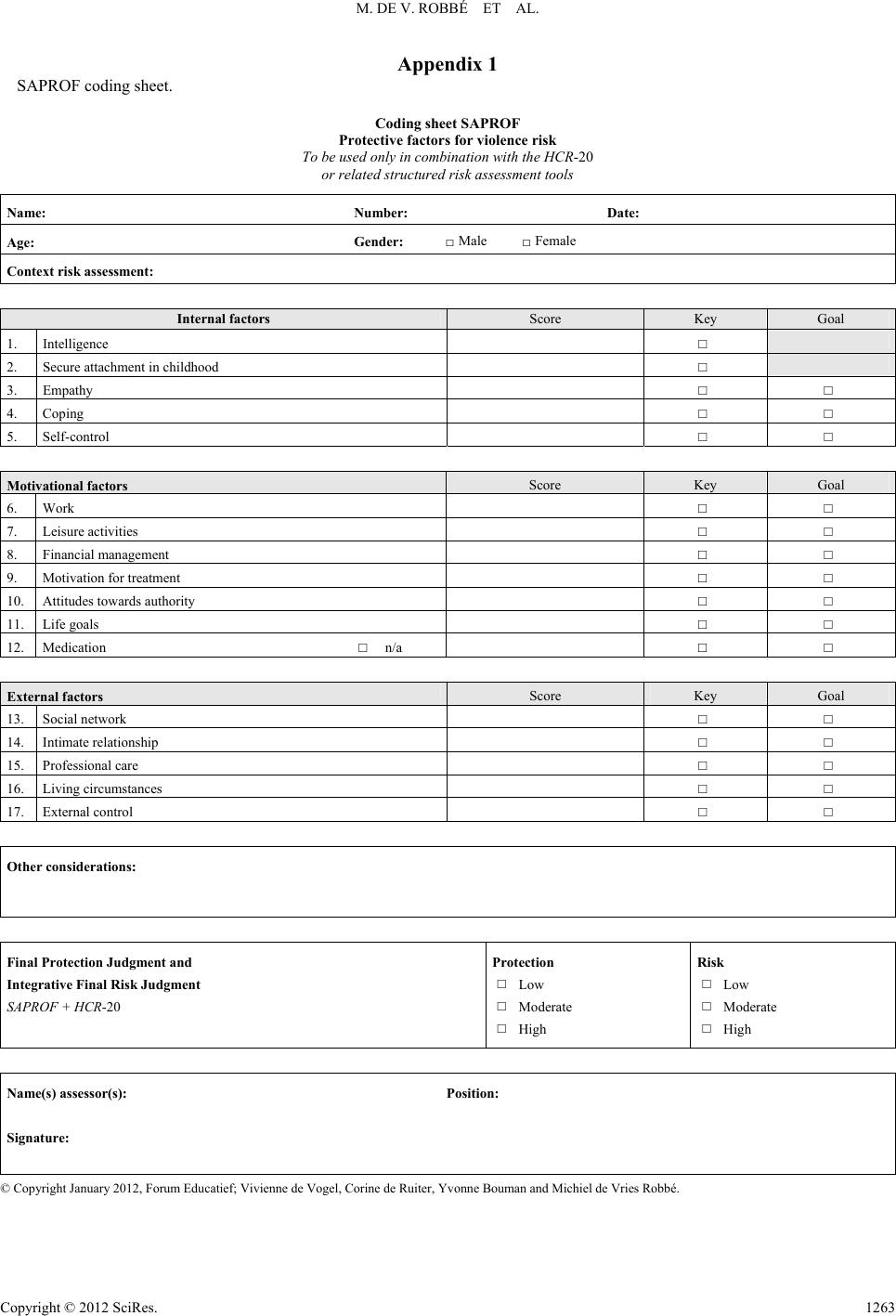 M. DE V. ROBBÉ ET AL. Appendix 1 SAPROF coding sheet. Coding sheet SAPROF Protective factors for violence risk To be used only in combination with the HCR-20 or related structur ed risk assessment tools Name: Number: Date: Age: Gender: □ Male □ Female Context risk assessment: Internal factors Score Key Goal 1. Intelligence □ 2. Secure attachment in childhood □ 3. Empathy □ □ 4. Coping □ □ 5. Self-control □ □ Motivational fac tors Score Key Goal 6. Work □ □ 7. Leisure activities □ □ 8. Financial management □ □ 9. Motivation for treatment □ □ 10. Attitudes towards authority □ □ 11. Life goals □ □ 12. Medication □ n/a □ □ External factors Score Key Goal 13. Social network □ □ 14. Intimate relationship □ □ 15. Professional care □ □ 16. Living circumstances □ □ 17. External control □ □ Other considerations: Final Prote ction Judgment and Integrative Final Risk Judgment SAPROF + HCR-20 Protection □ Low □ Moderate □ High Risk □ Low □ Moderate □ High Name(s) assessor(s): Signature: Position: © Copyright January 2012, Forum Educatief; Vivienne de Vogel, Corine de Ruiter, Yvonne Bouman and Michiel de Vries Robbé. Copyright © 2012 SciRes. 1263 |