

Paper Menu >>
Journal Menu >>
 Psychology 2012. Vol.3, No.12A, 1254-1258 Published Online December 2012 in SciRes (http://www.SciRP.org/journal/psych) http://dx.doi.org/10.4236/psych.2012.312A186 Copyright © 2012 SciRes. 1254 Relations between Positive and Negative Attributional Styles and Sales Performance as Moderated by Length of Insurance Sales Experience among Japanese Life Insurance Sales Agents Yukie Tsuzuki1, Tamao Matsui2, Takashi Kakuyama3 1Seijo University, Tokyo, Japan 2Surugadai University, Saitama, Japan 3Tokyo Future University, Tokyo, Japan Email: [email protected] Received August 10th, 2012; revised September 9th, 2012; accepted October 5th, 2012 Past studies have shown that a sales agent’s attributional style for positive and negative events is related to sales performance. The aim of the present study was to examine an agent’s length of sales experience as a moderator of the relation between sales performance and attributional style for positive/negative events. 360 Japanese life insurance sales agents were assessed with attributional styles for positive and negative events (would be referred to as positive attributional style and negative attributional style, re- spectively), sales performance and their lengths of sales experience. It was found that relationship be- tween sales performance and the two types of attributional styles was largely different depending upon length of an agent’s insurance sales experience. Among “novices” (n = 183) whose lengths of insurance sales experience were less than three years, sales performance was related significantly to negative at- tributional style, whereas it was not related to positive attributional style. By contrast, among “veterans” (n = 177) whose lengths of insurance sales experience were three years or more, sales performance was related significantly to positive attributional style, whereas it was not related to negative attributional style. Theoretical and practical implications are discussed. Keywords: Attributional Style; Sales Performance; Japan Introduction Attributional style is a cognitive personality variable that re- fers to the habitual ways people explain their positive and nega- tive life experiences (Abramson, Seligman, & Teasdale, 1978). Abramson et al. suggested that the three attributional dimen- sions of internality, stability and globality are crucial for ex- plaining human helplessness and depression. The internal-external dimension refers to the extent to which an individual sees his or her life experiences being caused by something about himself or herself (internal attributions), as opposed to something about the situation (external attributions). The stable-unstable attribution refers to the extent to which an individual perceives his or her life experiences being caused by nontransient factors (stable attributions), as opposed to transient ones (unstable attributions). The global-specific dimension refers to the extent to which an individual sees cause of his or her life experience as being present in a variety of situations (global attributions), as opposed to more circumscribed (spe- cific attributions) (Peterson, Semmel, Baeyer, Abrahamson, Metalsky, & Seligman, 1982). It was also suggested that depression-prone individuals tend to attribute negative life experiences to internal, stable, and global factors and to attribute positive life experiences to ex- ternal, unstable and specific factors (Abramson et al., 1978). Seligman et al. (1979) examined attributional styles for de- pressed and non-depressed individuals and found that depressed individuals make attributions systematically different from non-depressed individuals on all of the three attributional di- mensions. Specifically, relative to non-depressed individuals, depressed individuals attributed positive life events to external, unstable, and specific causes, and negative life events to inter- nal, stable and global causes. Seligman (1990) defined optimistic attributional style as the tendency to attribute positive events to internal, stable and global factors and negative events to external, unstable and specific factors. Pessimistic attributional style, on the other hand, was defined as the tendency to attribute positive events to external, unstable and specific factors and negative events to internal, stable and global factors. Individuals with an optimis- tic attributional style are more resilient when faced with unfa- vorable events than individuals with a pessimistic attributional style (Abramson, Seligman, & Teasdale, 1978). Past studies have found that an individual’s attributional style is also linked to work-related outcomes such as work per- formance and turnover. In their study of attributions made by newly recruited US insurance sales agents, Seligman and Schulman (1986) reported that attributional style for negative events (would be referred to as “negative attributional style”, hereafter) correlated significantly with sales performance. Spe- cifically, tendency to explain negative events with internal, stable, and global causes predicted lower sales performance. Agents who scored in the good (optimistic) half of negative attributional style sold 29% more insurance in their first year and sold 130% more insurance in their second year than did agents who scored in the bad (pessimistic) half of negative attributional style.  Y. TSUZUKI ET AL. Corr and Gray (1996) examined the relationship of attribu- tional style and work performance among 130 senior male sales agents in a leading UK insurance company. In their study, it was attributional style for positive events (would be referred to as “positive attributional style”, hereafter), rather than attribu- tional style for negative events, which was related to sales per- formance. Specifically, tendency to explain positive events with internal, stable, and global causes predicted higher sales per- formance. Proudfoot, Corr, Guest, & Gray (2001) reported that positive attributional style was more strongly related to job motivation, intention to quit, learned resourcefulness and psychological strain, than was the negative attributional style. Furnham, Sadka, & Brewin (1992) found that positive attributional style was related to job motivation and satisfaction, whereas negative attributional style was related neither to job motivation nor to satisfaction. Using job-rated outcomes as events, Silvester, Patterson, & Ferguson (2003) reported that positive attribu- tional style was a better predictor of performance ratings and job satisfaction than was negative attributional style. Xenikou (2005) administered the Occupational Attributional Style Questionnaire (Furnham, Sadka, & Brewin, 1992) to em- ployees of various organizations such as banks, hospitals, in- surance companies, and examined the relation between attribu- tional style and job motivation. It was found that not only the two attributional styles, but their interaction also was a predic- tor of job motivation. It was also suggested that length of ex- perience at a given organization had an impact on the relation- ship between attributional style and job motivation. Specifically, only in the case of employees with more than four years of experience at their organization, negative attributional style was related to lower levels of job motivation. Xenikou suggested that becoming a “veteran” employee in an organization was likely to make people more vulnerable to the negative effect of the pessimistic negative attributional style on job motivation. In summary, results of past studies have been inconsistent in whether attributional style for positive events or that for nega- tive events is more critical in predicting sales performance. Whereas Seligman & Schulman (1986) found a good (optimis- tic) attributional style for “negative” events to be implicated in successful insurance sales, other studies (e.g., Corr & Gray, 1996) suggested that a good (optimistic) attributional style for “positive” events was most predictive of high sales perform- ance. This inconsistency may suggest an existence of a mod- erator variable, where in some situations having a good attribu- tional style for positive events is critical and in others having a good attributional style for negative events is critical. The present study was aimed to explore the impact of an agent’s length of sales experience on the relation between posi- tive/negative attributional styles and work performance among Japanese life insurance sales agents. It was hypothesized that an agent’s length of sales experience would moderate the rela- tionship between attributional style and sales performance. Specifically, among novices with a relatively short experience in insurance sales, negative attributional style would be more strongly related to sales performance than positive attributional style would. Among veterans with a relatively long experience in insurance sales, positive attributional style would be more strongly related to sales performance than negative attributional style would. The reason for these hypotheses is as follows. By contrast to Xenikou’s observation, in Japan’s life insur- ance sales, being a new sales agent would be more vulnerable to the impact of negative attributional style. Novice sales agents are new in the field and do not have “regulars”, and thus are destined to repeatedly encounter failure, rejection, and indif- ference from prospective clients. Reflecting these situations, the turnover rate among life insurance sales agents in an early pe- riod of employment is very high in Japan. About 80% of the life insurance sales agents hired in Japan quit within two years of sales experience, and only less than 10% remain in 10 years. Under these circumstances, new sales agents whose work life tends to be full of rejection and failure are likely to be more vulnerable to the impact of attributional style for negative events. Thus, for novices to survive in life insurance sales, having a pessimistic negative attributional style puts them at a vast disadvantage in terms of their work performance. There- fore, among novices, work performance would be related pre- dominantly to negative, but not positive, attributional style. Situations are different for Japan’s veteran sales agents. Typically, veterans do not have to encounter as frequent fail- ures and rejections as novices do. Veterans tend to have their own regular customers. Those regulars refer their sales agents to their friends and acquaintances. Therefore, veterans may obtain new clients through introduction by their old customers. This reduces their chances to feel hurt and rejected by prospec- tive customers. In addition, veterans usually have a thorough knowledge of insurance commodities they sell and can offer commodities that meet their customers’ needs, thereby resulting in higher sales performance in general. Attributional style for positive events would influence the degree to which they savor their success. Thus, positive attributional style, rather than negative attributional style, would be more relevant to the con- tinuation of their success as veterans. Therefore, among veter- ans, their performance would be related predominantly to their positive, but not negative, attributional style. In summary, the present study examines an agent’s length of experience as a moderator of the relation between sales per- formance and positive/negative attributional styles. More spe- cifically, it was hypothesized that positive and negative attribu- tional styles would differentially affect sales performance de- pending on an agent’s length of experience in insurance sales. Method Participants Participants of this study consisted of 360 Japanese female life insurance route sales agents of a nation-wide life insurance company. Participants worked on a complex commission sys- tem that was basically determined by their performance but is complicated by changes in the rate of conversion based on the number and value sold by the participants over the last three months. Participants ranged in age from 22 to 78 years with a mean of 47.2 years (SD = 11.09). The length of sales experi- ence on their present jobs ranged from 1 to 40 years with a mean of 8.6 years. About 80% of participants were married, the remainder being unmarried or widowed. Measures Attributional style measure. Based on the Attributional Style Questionnaire (ASQ; Peterson, Semmel, Von Baeyer, Abram- son, Metalsky & Seligman, 1982), a Japanese version of at- tributional style questionnaire was developed by the authors (A written permission of Dr. Seligman was obtained). Majority of Copyright © 2012 SciRes. 1255 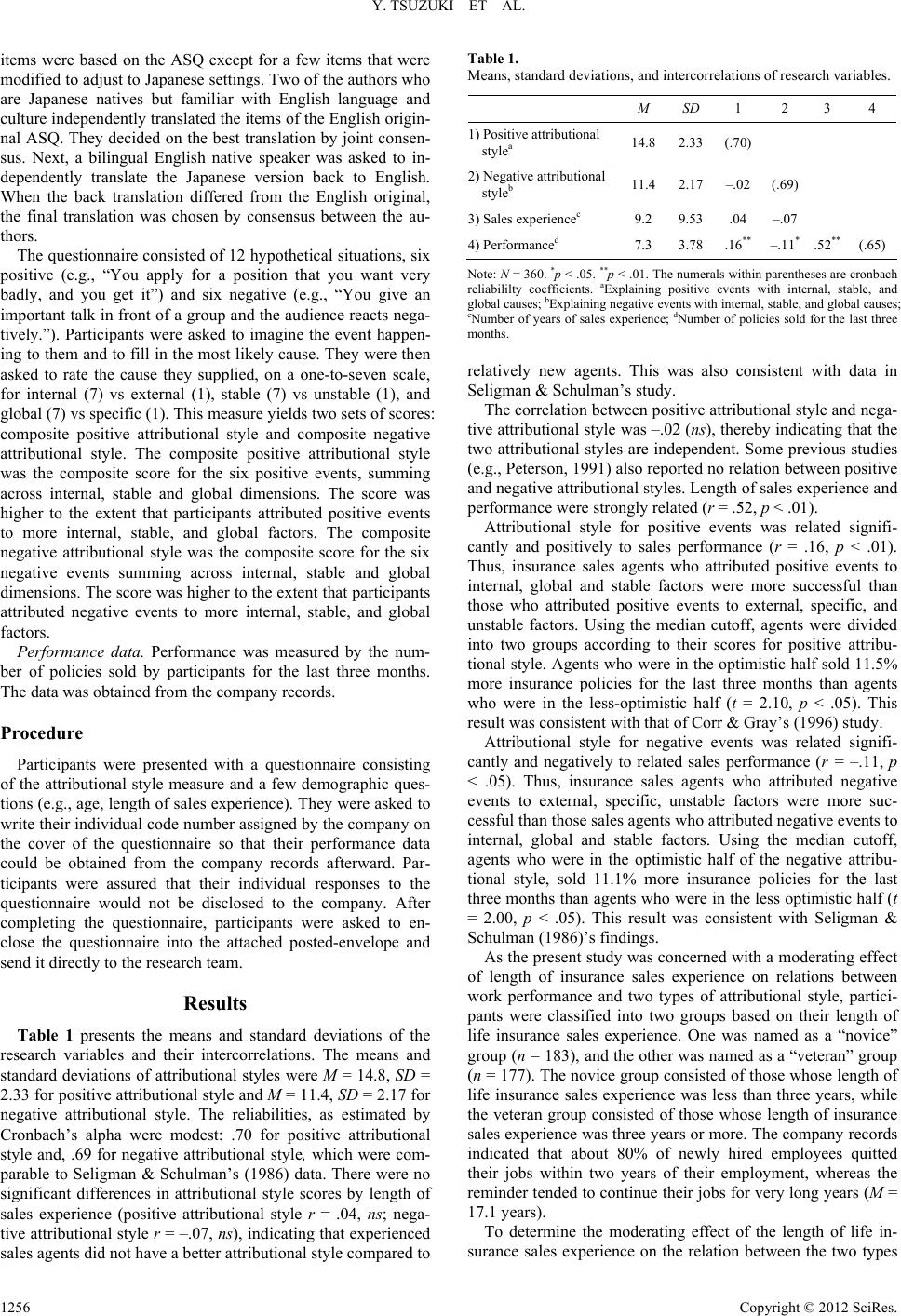 Y. TSUZUKI ET AL. items were based on the ASQ except for a few items that were modified to adjust to Japanese settings. Two of the authors who are Japanese natives but familiar with English language and culture independently translated the items of the English origin- nal ASQ. They decided on the best translation by joint consen- sus. Next, a bilingual English native speaker was asked to in- dependently translate the Japanese version back to English. When the back translation differed from the English original, the final translation was chosen by consensus between the au- thors. The questionnaire consisted of 12 hypothetical situations, six positive (e.g., “You apply for a position that you want very badly, and you get it”) and six negative (e.g., “You give an important talk in front of a group and the audience reacts nega- tively.”). Participants were asked to imagine the event happen- ing to them and to fill in the most likely cause. They were then asked to rate the cause they supplied, on a one-to-seven scale, for internal (7) vs external (1), stable (7) vs unstable (1), and global (7) vs specific (1). This measure yields two sets of scores: composite positive attributional style and composite negative attributional style. The composite positive attributional style was the composite score for the six positive events, summing across internal, stable and global dimensions. The score was higher to the extent that participants attributed positive events to more internal, stable, and global factors. The composite negative attributional style was the composite score for the six negative events summing across internal, stable and global dimensions. The score was higher to the extent that participants attributed negative events to more internal, stable, and global factors. Performance data. Performance was measured by the num- ber of policies sold by participants for the last three months. The data was obtained from the company records. Procedure Participants were presented with a questionnaire consisting of the attributional style measure and a few demographic ques- tions (e.g., age, length of sales experience). They were asked to write their individual code number assigned by the company on the cover of the questionnaire so that their performance data could be obtained from the company records afterward. Par- ticipants were assured that their individual responses to the questionnaire would not be disclosed to the company. After completing the questionnaire, participants were asked to en- close the questionnaire into the attached posted-envelope and send it directly to the research team. Results Table 1 presents the means and standard deviations of the research variables and their intercorrelations. The means and standard deviations of attributional styles were M = 14.8, SD = 2.33 for positive attributional style and M = 11.4, SD = 2.17 for negative attributional style. The reliabilities, as estimated by Cronbach’s alpha were modest: .70 for positive attributional style and, .69 for negative attributional style, which were com- parable to Seligman & Schulman’s (1986) data. There were no significant differences in attributional style scores by length of sales experience (positive attributional style r = .04, ns; nega- tive attributional style r = –.07, ns), indicating that experienced sales agents did not have a better attributional style compared to Table 1. Means, standard deviations, and intercorrelations of research variables. M SD 1 2 3 4 1) Positive attributional stylea 14.82.33 (.70) 2) Negative attributional styleb 11.4 2.17 –.02 (.69) 3) Sales experiencec 9.2 9.53 .04 –.07 4) Performanced 7.3 3.78 .16** –.11* .52** (.65) Note: N = 360. *p < .05. **p < .01. The numerals within parentheses are cronbach reliabililty coefficients. aExplaining positive events with internal, stable, and global causes; bExplaining negative events with internal, stable, and global causes; cNumber of years of sales experience; dNumber of policies sold for the last three months. relatively new agents. This was also consistent with data in Seligman & Schulman’s study. The correlation between positive attributional style and nega- tive attributional style was –.02 (ns), thereby indicating that the two attributional styles are independent. Some previous studies (e.g., Peterson, 1991) also reported no relation between positive and negative attributional styles. Length of sales experience and performance were strongly related (r = .52, p < .01). Attributional style for positive events was related signifi- cantly and positively to sales performance (r = .16, p < .01). Thus, insurance sales agents who attributed positive events to internal, global and stable factors were more successful than those who attributed positive events to external, specific, and unstable factors. Using the median cutoff, agents were divided into two groups according to their scores for positive attribu- tional style. Agents who were in the optimistic half sold 11.5% more insurance policies for the last three months than agents who were in the less-optimistic half (t = 2.10, p < .05). This result was consistent with that of Corr & Gray’s (1996) study. Attributional style for negative events was related signifi- cantly and negatively to related sales performance (r = –.11, p < .05). Thus, insurance sales agents who attributed negative events to external, specific, unstable factors were more suc- cessful than those sales agents who attributed negative events to internal, global and stable factors. Using the median cutoff, agents who were in the optimistic half of the negative attribu- tional style, sold 11.1% more insurance policies for the last three months than agents who were in the less optimistic half (t = 2.00, p < .05). This result was consistent with Seligman & Schulman (1986)’s findings. As the present study was concerned with a moderating effect of length of insurance sales experience on relations between work performance and two types of attributional style, partici- pants were classified into two groups based on their length of life insurance sales experience. One was named as a “novice” group (n = 183), and the other was named as a “veteran” group (n = 177). The novice group consisted of those whose length of life insurance sales experience was less than three years, while the veteran group consisted of those whose length of insurance sales experience was three years or more. The company records indicated that about 80% of newly hired employees quitted their jobs within two years of their employment, whereas the reminder tended to continue their jobs for very long years (M = 17.1 years). To determine the moderating effect of the length of life in- surance sales experience on the relation between the two types Copyright © 2012 SciRes. 1256 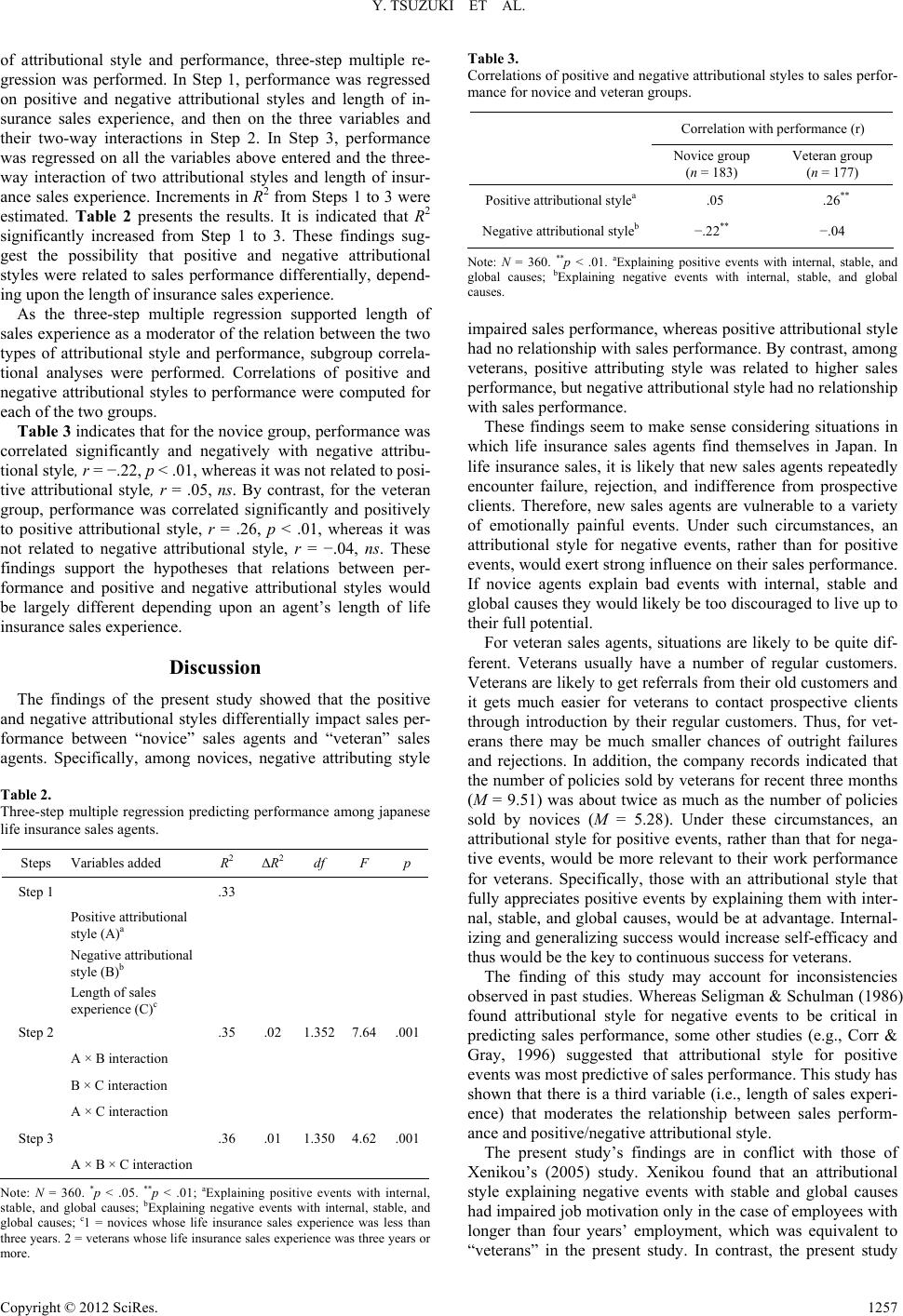 Y. TSUZUKI ET AL. of attributional style and performance, three-step multiple re- gression was performed. In Step 1, performance was regressed on positive and negative attributional styles and length of in- surance sales experience, and then on the three variables and their two-way interactions in Step 2. In Step 3, performance was regressed on all the variables above entered and the three- way interaction of two attributional styles and length of insur- ance sales experience. Increments in R2 from Steps 1 to 3 were estimated. Table 2 presents the results. It is indicated that R2 significantly increased from Step 1 to 3. These findings sug- gest the possibility that positive and negative attributional styles were related to sales performance differentially, depend- ing upon the length of insurance sales experience. As the three-step multiple regression supported length of sales experience as a moderator of the relation between the two types of attributional style and performance, subgroup correla- tional analyses were performed. Correlations of positive and negative attributional styles to performance were computed for each of the two groups. Table 3 indicates that for the novice group, performance was correlated significantly and negatively with negative attribu- tional style, r = −.22, p < .01, whereas it was not related to posi- tive attributional style, r = .05, ns. By contrast, for the veteran group, performance was correlated significantly and positively to positive attributional style, r = .26, p < .01, whereas it was not related to negative attributional style, r = −.04, ns. These findings support the hypotheses that relations between per- formance and positive and negative attributional styles would be largely different depending upon an agent’s length of life insurance sales experience. Discussion The findings of the present study showed that the positive and negative attributional styles differentially impact sales per- formance between “novice” sales agents and “veteran” sales agents. Specifically, among novices, negative attributing style Table 2. Three-step multiple regression predicting performance among japanese life insurance sales agents. Steps Variables added R2 ΔR2 df F p Step 1 .33 Positive attributional style (A)a Negative attributional style (B)b Length of sales experience (C)c Step 2 .35.02 1.352 7.64.001 A × B interaction B × C interaction A × C interaction Step 3 .36.01 1.350 4.62.001 A × B × C interaction Note: N = 360. *p < .05. **p < .01; aExplaining positive events with internal, stable, and global causes; bExplaining negative events with internal, stable, and global causes; c1 = novices whose life insurance sales experience was less than three years. 2 = veterans whose life insurance sales experience was three years or more. Table 3. Correlations of positive and negative attributional styles to sales perfor- mance for novice and veteran groups. Correlation with performance (r) Novice group (n = 183) Veteran group (n = 177) Positive attributional stylea .05 .26** Negative attributional styleb−.22** −.04 Note: N = 360. **p < .01. aExplaining positive events with internal, stable, and global causes; bExplaining negative events with internal, stable, and global causes. impaired sales performance, whereas positive attributional style had no relationship with sales performance. By contrast, among veterans, positive attributing style was related to higher sales performance, but negative attributional style had no relationship with sales performance. These findings seem to make sense considering situations in which life insurance sales agents find themselves in Japan. In life insurance sales, it is likely that new sales agents repeatedly encounter failure, rejection, and indifference from prospective clients. Therefore, new sales agents are vulnerable to a variety of emotionally painful events. Under such circumstances, an attributional style for negative events, rather than for positive events, would exert strong influence on their sales performance. If novice agents explain bad events with internal, stable and global causes they would likely be too discouraged to live up to their full potential. For veteran sales agents, situations are likely to be quite dif- ferent. Veterans usually have a number of regular customers. Veterans are likely to get referrals from their old customers and it gets much easier for veterans to contact prospective clients through introduction by their regular customers. Thus, for vet- erans there may be much smaller chances of outright failures and rejections. In addition, the company records indicated that the number of policies sold by veterans for recent three months (M = 9.51) was about twice as much as the number of policies sold by novices (M = 5.28). Under these circumstances, an attributional style for positive events, rather than that for nega- tive events, would be more relevant to their work performance for veterans. Specifically, those with an attributional style that fully appreciates positive events by explaining them with inter- nal, stable, and global causes, would be at advantage. Internal- izing and generalizing success would increase self-efficacy and thus would be the key to continuous success for veterans. The finding of this study may account for inconsistencies observed in past studies. Whereas Seligman & Schulman (1986) found attributional style for negative events to be critical in predicting sales performance, some other studies (e.g., Corr & Gray, 1996) suggested that attributional style for positive events was most predictive of sales performance. This study has shown that there is a third variable (i.e., length of sales experi- ence) that moderates the relationship between sales perform- ance and positive/negative attributional style. The present study’s findings are in conflict with those of Xenikou’s (2005) study. Xenikou found that an attributional style explaining negative events with stable and global causes had impaired job motivation only in the case of employees with longer than four years’ employment, which was equivalent to “veterans” in the present study. In contrast, the present study Copyright © 2012 SciRes. 1257  Y. TSUZUKI ET AL. Copyright © 2012 SciRes. 1258 found that an attributional style internalizing and generalizing negative events impaired sales performance only in the case of novices with less than three years employment. Although it is difficult to determine the exact cause of these conflicting findings, at least two points should be taken into consideration. First, there are differences in participants’ occu- pations between the two studies. Participants of Xenikou’s study were employees from various organizations such as banks, hospitals, and insurance company, presumably including nurses and office workers. The participants of the present study were all female life insurance sales agents. Thus, work situations of the participants are likely to be vastly different between Xenikou’s study and the present study. For example, Xenikou suggests that the longer employees work at the same organiza- tion, the more difficult and harsh their challenges and obstacles posed on them tend to become. By contrast, the longer Japanese sales agents work, the less harsh their work tends to become as they have already obtained their own regular customers. An- other point to be considered is the difference in criterion mea- sures used between Xenikou’s and the present study. Xenikou (2005) used seven-item self-ratings of “intrinsic job motive- tion,” whereas the present study used “the number of policies actually sold” by agents for recent three months. The result of the present study seems to suggest the impor- tance of distinguishing attributional style for positive and nega- tive events when applying the concept of attributional style in real-life contexts. As positive and negative attributional styles are not significantly correlated, they are relatively independent dimensions. Thus, having an optimistic attributional style about positive events does not necessarily mean having an optimistic attributional style in terms of negative events. Someone who thinks and acts like an optimist when he or she is in normal and decent life conditions, may fall apart and start to think like a total pessimist when he or she finds him/herself in difficult situations. Thus, managers should not assume that someone is either an optimist or pessimist. People’s attributional style can change depending on their situations. For novice life insurance sales agents, having a pessimistic attributional style about nega- tive events has a detrimental effect on their work performance, as their work life is likely to challenge them with many inci- dents of failures and rejections. It is advisable that managers should carefully monitor how their subordinates are attributing their sales experiences, success or failure, and pay special at- tention to their subordinates’ attributional style about negative events. For those subordinates who tend to attribute their fail- ures with internal, stable and global causes, managers should encourage them to examine if their attribution is realistic and if their attributional style can be changed into a more adaptive, optimistic one. For veteran workers, it is advisable that manag- ers encourage them to “own” and savor their success by attri- buting their achievement with internal, stable and global causes. REFERENCES Abramsom, L. Y., Seligman, M. E. P., & Teasdale, J. (1978). Learned helplessness in humans: Critique and reformulation. Journal of Ab- normal Psychology, 87, 49-74. doi:10.1037/0021-843X.87.1.49 Corr, P. J., & Gray, J. A. (1996). Attributional style as a personality factor in insurance sales performance in the UK. Journal of Occupa- tional and Organizational Psychology, 69, 83-87. doi:10.1111/j.2044-8325.1996.tb00601.x Furnham, A., Sadka, V., & Brewin, C. R. (1992). The development of an occupational attributional style questionnaire. Journal of Organ- izational Behavior, 13, 27-39. doi:10.1002/job.4030130104 Peterson, C. (1991). The meaning and measurement of explanatory style. Psychological Inquiry, 2, 1-10. doi:10.1207/s15327965pli0201_1 Peterson, C., Semmel, A., Von Baeyer, C., Abramson, L. Y., Metalsky, G. I., & Seligman, M. E. P. (1982). The attributional style question- naire. Cognitive Therapy and Research, 6, 287-300. doi:10.1007/BF01173577 Proudfoot, J. G., Corr, P. J., Guest, D. E., & Gray, J. A. (2001). The development and evaluation of a scale to measure occupational at- tributional style in the financial services sector. Personality and In- dividual Differences, 30, 259-270. doi:10.1016/S0191-8869(00)00043-X Seligman, M. E. P. (1990). Learned optimism. New York: Knopf. Seligman, M. E. P., Abramson, L. Y., Semmel, A., & Von Baeyer, C. (1979). Depressive attributional style. Journal of Abnormal Psy- chology, 88, 242-247. doi:10.1037/0021-843X.88.3.242 Seligman, M. E. P., & Schulman, P. (1986). Explanatory style as a predictor of productivity and quitting among life insurance sales agents. Journal of Personality a n d Social Psychology, 50, 832-838. doi:10.1037/0022-3514.50.4.832 Silvester, J., Patterson, F., & Ferguson, E. (2003). Comparing two attributional models of job performance in retail sales: A field study. Journal of Occupational and Organizational Psychology, 76, 115- 132. doi:10.1348/096317903321208916 Xenikou, A. (2005). The interactive effect of positive and negative occupational attributional styles on job motivation. European Jour- nal of work and organizational psycho logy, 14, 43-58. doi:10.1080/13594320444000218 |