

Paper Menu >>
Journal Menu >>
 Crystal Structure Theory and Applications, 2012, 1, 107-113 http://dx.doi.org/10.4236/csta.2012.13020 Published Online December 2012 (http://www.SciRP.org/journal/csta) Crystal and Molecular Structure of N-[2-(6-Methoxy-2-oxo-2H-Chromen-4-yl-Benzofuran-3-yl]- Benzamide G. Anuradha1, G. Vasuki1*, Imtiyaz Ahmed Khan2, Manohar V. Kulkarni2 1Department of Physics, Kunthavai Naachiar Government Arts College, Thanjavur, India 2Department of Chemistry, Karnatak University, Dharwad, India Email: *[email protected] Received October 28, 2012; revised November 25, 2012; accepted December 3, 2012 ABSTRACT The crystal structure of the potential active N-[2-(6-Methoxy-2-oxo-2H-chromen-4-yl)-benzofuran-3-yl]-benzamide (C25H17NO5) (I) has been determined from single crystal X-ray diffraction data. The title compound crystallizes in the monoclinic space group P 21/n, with a = 12.0551(11), b = 9.7853(8), c = 16.6517(16) Å, β = 90.092(4)˚, V = 1964.28(3) Å3, Dcalc = 1.391 Mg/m3, Z = 4. In the structure, intermolecular H-bonds lead to the formation of a centrosymmetric dimer of the molecule. There is an intramolecular C7—H7…N1 hydrogen bond forming a closed seven membered ring. There are also intramolecular π-π interactions presented between the 3,6-Dihydro-2H-pyran ring of the chromen moiety [Cg2…Cg2 distance = 3.5812(13) Å]. The packing structure is stabilized by these C—H…N, N—H…O hydrogen bonds, C—H… π and π…π interactions. Keywords: Benzamide; Benzofuran; 2H-Chromen; Single Crystal Structure; X-Ray Diffraction 1. Introduction The amide and sulfonamide moieties are the constituents of many biologically important compounds [1]. Cou- marin derivatives are known to be an interesting class of natural or synthetic compounds, whose biological activ- ity varies according to the substitutes on the benzopyran ring. Their antibacterial, antifungal, antitumor, anti-HIV and anti-inflammatory and analgesic activities have been published [2]. Benzamide derivatives, known for their anti-inflammatory and immunomodulatory, anti-tumoral, antipsychotic and antiallergic activities, are drugs widely used in medicine [3]. Benzanilides and benzamides ex- hibit wide range of biological activity and are extensively used in organic synthesis. Various N-substituted benza- mides exhibit potent antiemetic activity [4]. The benzani- lide core is presented in compounds with such a wide range of biological activities that it has been called a privileged structure. Benzanilides have established their efficacy as centroid elements of ligands that bind to a wide variety of receptor types. Thus benzanilides con- taining aminoalkyl groups originally designed as a pep- tidomimetic, have been incorporated in an Arg-Gly-Asp cyclic peptide yielding a high affinity GΠIb/IIIa ligand. Imatinib is an ATP-site binding kinase inhibitor and platelet-derived growth factor receptor kinases. Pyridyl- methyl containing benzanilide are vascular endothelial growth factor receptor and tyrosine kinase inhibitor. Fur- thermore, benzamides have been reported to have acti- vities as acetyl-CoA carboxylase and farnesyl transferase inhibitors [5]. N-substituted benzamides are well known anticancer compounds and the mechanism of action for N-substituted benzamide-induced apoptosis has been studied, using declopramide as a lead compound. N-sub- stituted benzamides inhibit the activity of nuclear factor- B and nuclear factor of activated T cells activity while inducing activator protein 1 activity in T lymphocytes. Various N-substituted benzamides exhibit potent antie- metic activity, while heterocyclic analogs of benzanilide derivatives are potassium channel activators. O-Aryloxy- lation of N-substituted benzamides induced by the copper (II)/trimethylamine N-oxide system has been studied. N-Alkylated 2-nitrobenzamides are intermediates in the synthesis of dibenzo[b,e] [1,4] diazepines and N-Acyl- 2-nitrobenzamides are precursors of 2,3-disubstitued 3H- quinazoline-4-ones. A one-pot conversion of 2-nitro-n- arylbenzamides to 2,3-dihydro-1H-quinazoline-4-ones has also been reported [6]. As a part of studying the ring and side-chain substitutions on the crystal structures of che- mically and biologically important class of compounds such as benzanilides, we report herein the crystal struc- *Corresponding author. C opyright © 2012 SciRes. CSTA 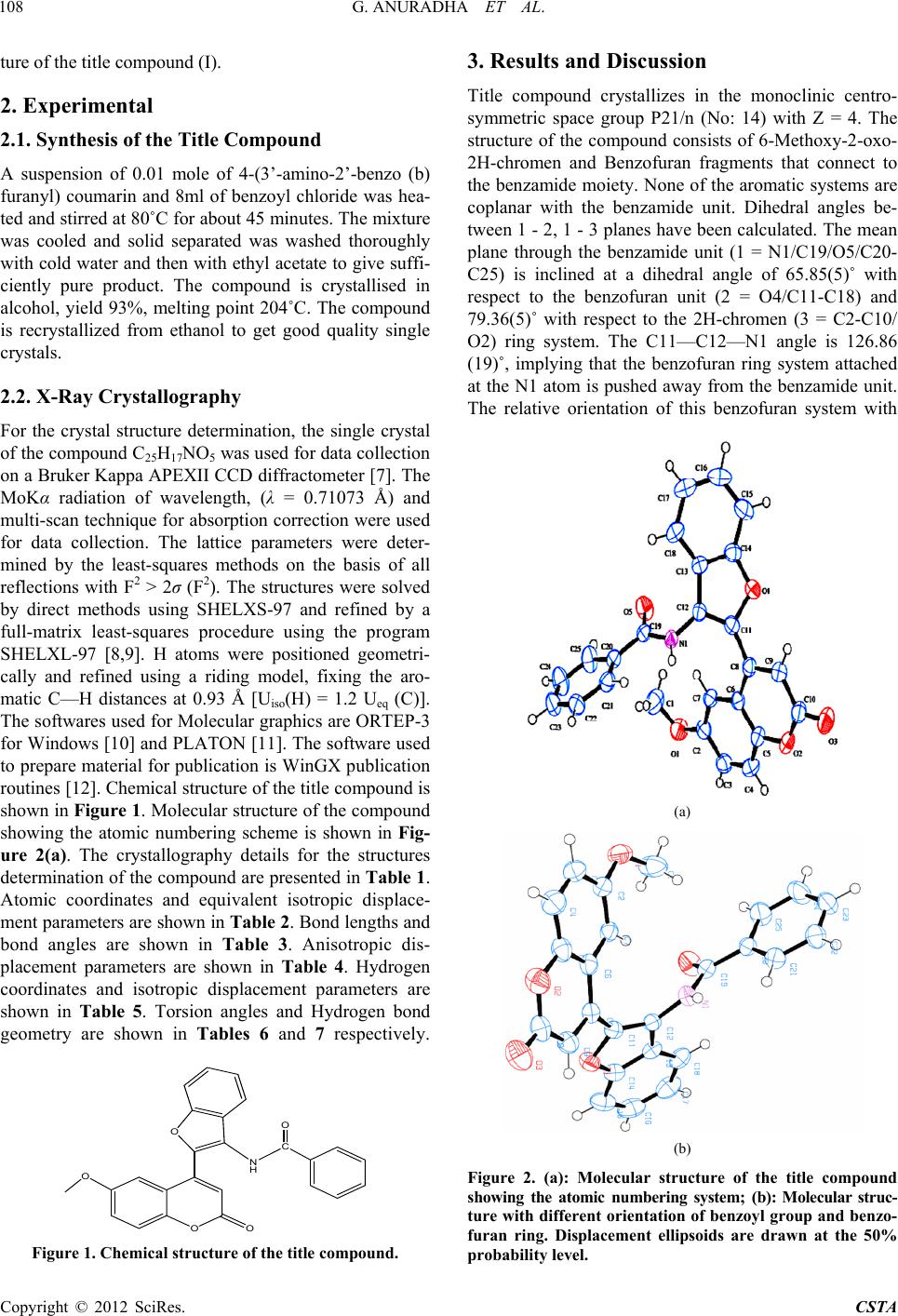 G. ANURADHA ET AL. 108 ture of the title compound (I). 2. Experimental 2.1. Synthesis of the Title Compound A suspension of 0.01 mole of 4-(3’-amino-2’-benzo (b) furanyl) coumarin and 8ml of benzoyl chloride was hea- ted and stirred at 80˚C for about 45 minutes. The mixture was cooled and solid separated was washed thoroughly with cold water and then with ethyl acetate to give suffi- ciently pure product. The compound is crystallised in alcohol, yield 93%, melting point 204˚C. The compound is recrystallized from ethanol to get good quality single crystals. 2.2. X-Ray Crystallography For the crystal structure determination, the single crystal of the compound C25H17NO5 was used for data collection on a Bruker Kappa APEXII CCD diffractometer [7]. The MoKα radiation of wavelength, (λ = 0.71073 Å) and multi-scan technique for absorption correction were used for data collection. The lattice parameters were deter- mined by the least-squares methods on the basis of all reflections with F2 > 2σ (F2). The structures were solved by direct methods using SHELXS-97 and refined by a full-matrix least-squares procedure using the program SHELXL-97 [8,9]. H atoms were positioned geometri- cally and refined using a riding model, fixing the aro- matic C—H distances at 0.93 Å [Uiso(H) = 1.2 Ueq (C)]. The softwares used for Molecular graphics are ORTEP-3 for Windows [10] and PLATON [11]. The software used to prepare material for publication is WinGX publication routines [12]. Chemical structure of the title compound is shown in Figure 1. Molecular structure of the compound showing the atomic numbering scheme is shown in Fig- ure 2(a). The crystallography details for the structures determination of the compound are presented in Table 1. Atomic coordinates and equivalent isotropic displace- ment parameters are shown in Table 2. Bond lengths and bond angles are shown in Table 3. Anisotropic dis- placement parameters are shown in Table 4. Hydrogen coordinates and isotropic displacement parameters are shown in Table 5. Torsion angles and Hydrogen bond geometry are shown in Tables 6 and 7 respectively. O O N H C O O O Figure 1. Chemical structure of the title compound. 3. Results and Discussion Title compound crystallizes in the monoclinic centro- symmetric space group P21/n (No: 14) with Z = 4. The structure of the compound consists of 6-Methoxy-2-oxo- 2H-chromen and Benzofuran fragments that connect to the benzamide moiety. None of the aromatic systems are coplanar with the benzamide unit. Dihedral angles be- tween 1 - 2, 1 - 3 planes have been calculated. The mean plane through the benzamide unit (1 = N1/C19/O5/C20- C25) is inclined at a dihedral angle of 65.85(5)˚ with respect to the benzofuran unit (2 = O4/C11-C18) and 79.36(5)˚ with respect to the 2H-chromen (3 = C2-C10/ O2) ring system. The C11—C12—N1 angle is 126.86 (19)˚, implying that the benzofuran ring system attached at the N1 atom is pushed away from the benzamide unit. The relative orientation of this benzofuran system with (a) (b) Figure 2. (a): Molecular structure of the title compound showing the atomic numbering system; (b): Molecular struc- ture with different orientation of benzoyl group and benzo- furan ring. Displacement ellipsoids are drawn at the 50% probability level. Copyright © 2012 SciRes. CSTA 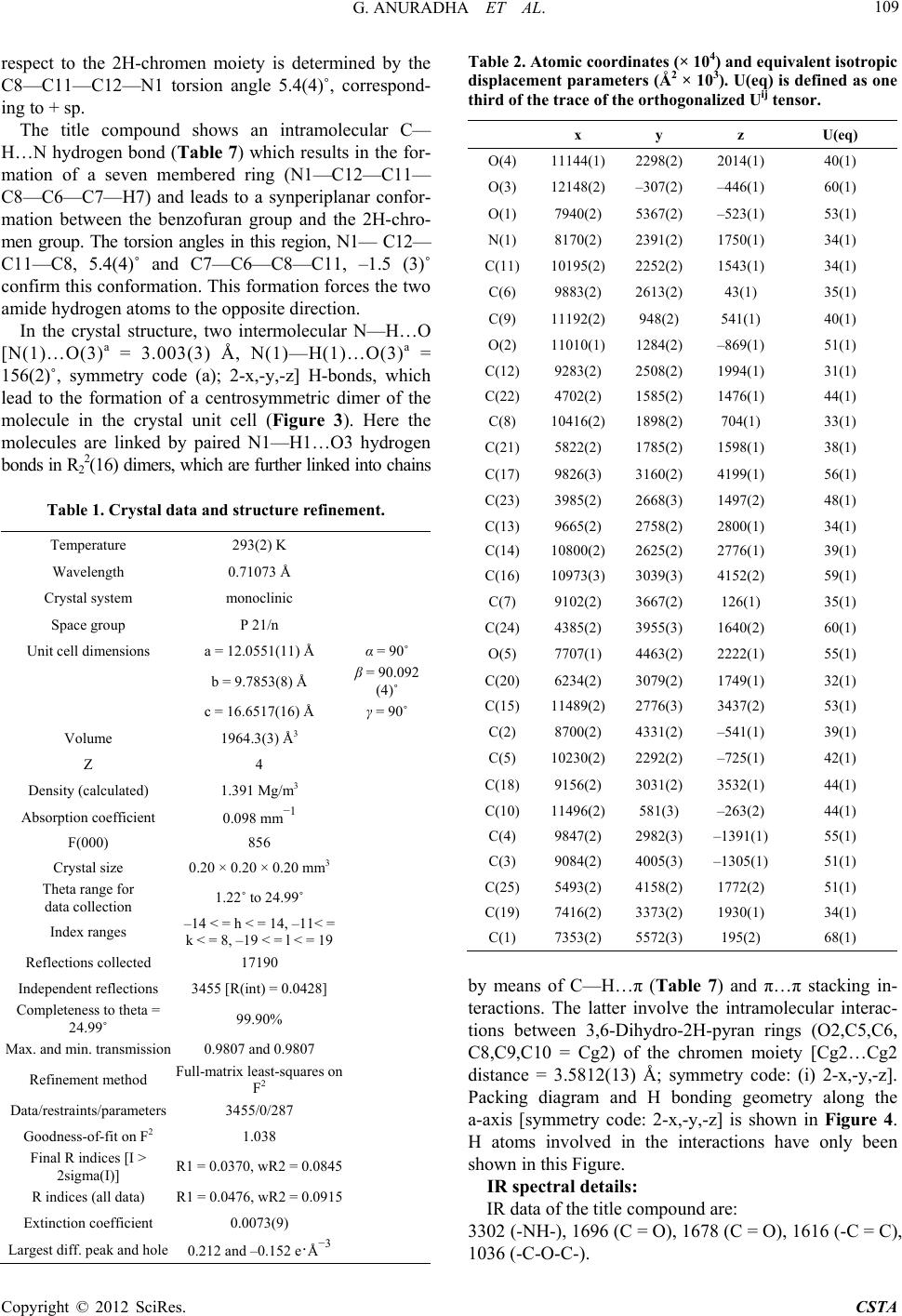 G. ANURADHA ET AL. 109 respect to the 2H-chromen moiety is determined by the C8—C11—C12—N1 torsion angle 5.4(4)˚, correspond- ing to + sp. The title compound shows an intramolecular C— H…N hydrogen bond (Table 7) which results in the for- mation of a seven membered ring (N1—C12—C11— C8—C6—C7—H7) and leads to a synperiplanar confor- mation between the benzofuran group and the 2H-chro- men group. The torsion angles in this region, N1— C12— C11—C8, 5.4(4)˚ and C7—C6—C8—C11, –1.5 (3)˚ confirm this conformation. This formation forces the two amide hydrogen atoms to the opposite direction. In the crystal structure, two intermolecular N—H…O [N(1)…O(3)a = 3.003(3) Å, N(1)—H(1)…O(3)a = 156(2)˚, symmetry code (a); 2-x,-y,-z] H-bonds, which lead to the formation of a centrosymmetric dimer of the molecule in the crystal unit cell (Figure 3). Here the molecules are linked by paired N1—H1…O3 hydrogen bonds in R22(16) dimers, which are further linked into chains Table 1. Crystal data and structure refinement. Temperature 293(2) K Wavelength 0.71073 Å Crystal system monoclinic Space group P 21/n Unit cell dimensions a = 12.0551(11) Å α = 90˚ b = 9.7853(8) Å β = 90.092 (4)˚ c = 16.6517(16) Å γ = 90˚ Volume 1964.3(3) Å3 Z 4 Density (calculated) 1.391 Mg/m3 Absorption coefficient 0.098 mm−1 F(000) 856 Crystal size 0.20 × 0.20 × 0.20 mm3 Theta range for data collection 1.22˚ to 24.99˚ Index ranges –14 < = h < = 14, –11< = k < = 8, –19 < = l < = 19 Reflections collected 17190 Independent reflections 3455 [R(int) = 0.0428] Completeness to theta = 24.99˚ 99.90% Max. and min. transmission 0.9807 and 0.9807 Refinement method Full-matrix least-squares on F2 Data/restraints/parameters 3455/0/287 Goodness-of-fit on F2 1.038 Final R indices [I > 2sigma(I)] R1 = 0.0370, wR2 = 0.0845 R indices (all data) R1 = 0.0476, wR2 = 0.0915 Extinction coefficient 0.0073(9) Largest diff. peak and hole 0.212 and –0.152 e·Å−3 Table 2. Atomic coordinates (× 104) and equivalent isotropic displacement parameters (Å2 × 10³). U(eq) is defined as one third of the trace of the orthogonalized Uij tensor. x y z U(eq) O(4) 11144(1)2298(2) 2014(1) 40(1) O(3) 12148(2)–307(2) –446(1) 60(1) O(1) 7940(2) 5367(2) –523(1) 53(1) N(1) 8170(2) 2391(2) 1750(1) 34(1) C(11) 10195(2)2252(2) 1543(1) 34(1) C(6) 9883(2) 2613(2) 43(1) 35(1) C(9) 11192(2)948(2) 541(1) 40(1) O(2) 11010(1)1284(2) –869(1) 51(1) C(12) 9283(2) 2508(2) 1994(1) 31(1) C(22) 4702(2) 1585(2) 1476(1) 44(1) C(8) 10416(2)1898(2) 704(1) 33(1) C(21) 5822(2) 1785(2) 1598(1) 38(1) C(17) 9826(3) 3160(2) 4199(1) 56(1) C(23) 3985(2) 2668(3) 1497(2) 48(1) C(13) 9665(2) 2758(2) 2800(1) 34(1) C(14) 10800(2)2625(2) 2776(1) 39(1) C(16) 10973(3)3039(3) 4152(2) 59(1) C(7) 9102(2) 3667(2) 126(1) 35(1) C(24) 4385(2) 3955(3) 1640(2) 60(1) O(5) 7707(1) 4463(2) 2222(1) 55(1) C(20) 6234(2) 3079(2) 1749(1) 32(1) C(15) 11489(2)2776(3) 3437(2) 53(1) C(2) 8700(2) 4331(2) –541(1) 39(1) C(5) 10230(2)2292(2) –725(1) 42(1) C(18) 9156(2) 3031(2) 3532(1) 44(1) C(10) 11496(2)581(3) –263(2) 44(1) C(4) 9847(2) 2982(3) –1391(1) 55(1) C(3) 9084(2) 4005(3) –1305(1) 51(1) C(25) 5493(2) 4158(2) 1772(2) 51(1) C(19) 7416(2) 3373(2) 1930(1) 34(1) C(1) 7353(2) 5572(3) 195(2) 68(1) by means of C—H…π (Table 7) and π…π stacking in- teractions. The latter involve the intramolecular interac- tions between 3,6-Dihydro-2H-pyran rings (O2,C5,C6, C8,C9,C10 = Cg2) of the chromen moiety [Cg2…Cg2 distance = 3.5812(13) Å; symmetry code: (i) 2-x,-y,-z]. Packing diagram and H bonding geometry along the a-axis [symmetry code: 2-x,-y,-z] is shown in Figure 4. H atoms involved in the interactions have only been shown in this Figure. IR spectral details: IR data of the title compound are: 3302 (-NH-), 1696 (C = O), 1678 (C = O), 1616 (-C = C), 1036 (-C-O-C-). Copyright © 2012 SciRes. CSTA 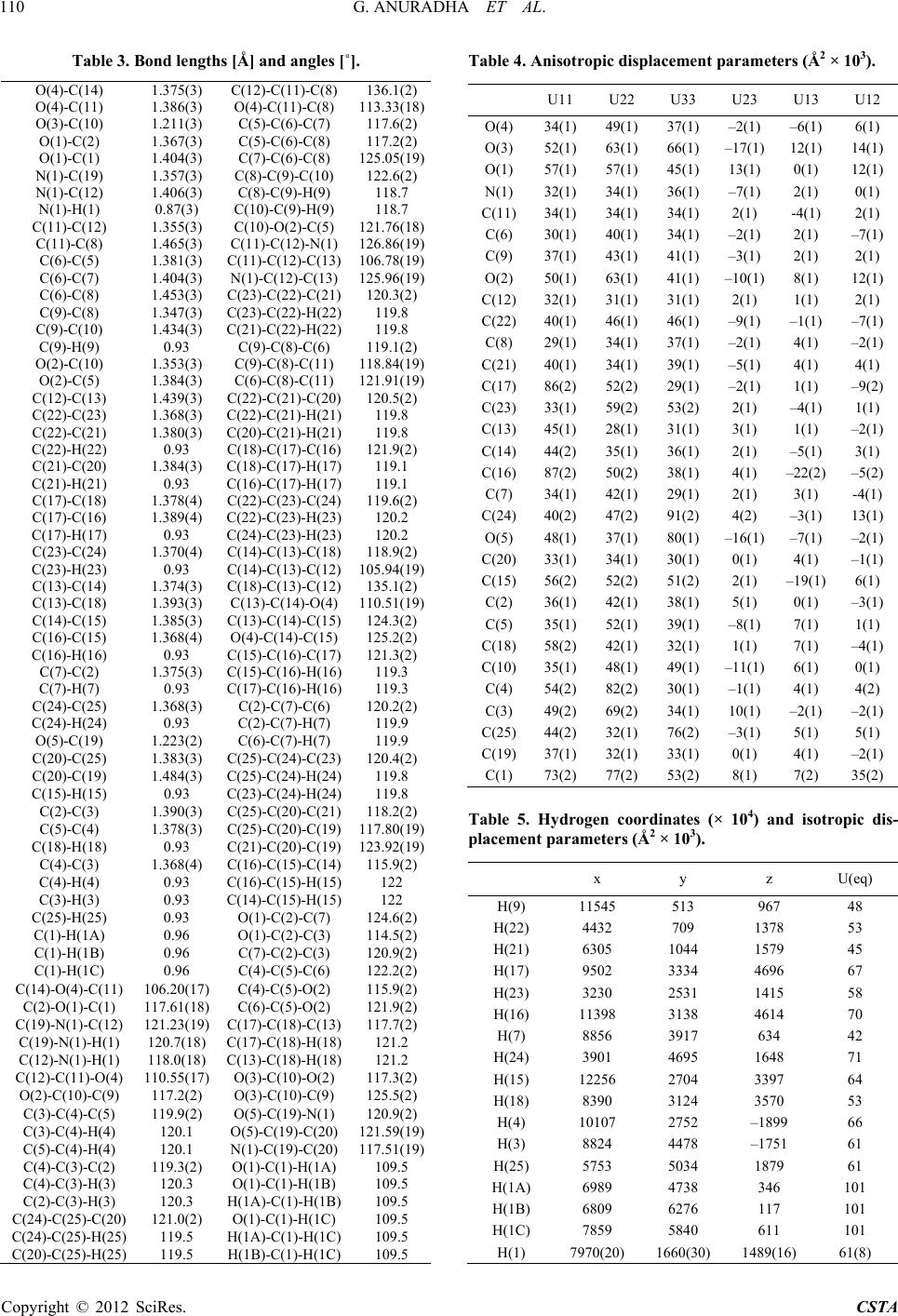 G. ANURADHA ET AL. 110 Table 3. Bond lengths [Å] and angles [˚]. O(4)-C(14) 1.375(3) C(12)-C(11)-C(8) 136.1(2) O(4)-C(11) 1.386(3) O(4)-C(11)-C(8) 113.33(18) O(3)-C(10) 1.211(3) C(5)-C(6)-C(7) 117.6(2) O(1)-C(2) 1.367(3) C(5)-C(6)-C(8) 117.2(2) O(1)-C(1) 1.404(3) C(7)-C(6)-C(8) 125.05(19) N(1)-C(19) 1.357(3) C(8)-C(9)-C(10) 122.6(2) N(1)-C(12) 1.406(3) C(8)-C(9)-H(9) 118.7 N(1)-H(1) 0.87(3) C(10)-C(9)-H(9) 118.7 C(11)-C(12) 1.355(3) C(10)-O(2)-C(5) 121.76(18) C(11)-C(8) 1.465(3) C(11)-C(12)-N(1) 126.86(19) C(6)-C(5) 1.381(3) C(11)-C(12)-C(13) 106.78(19) C(6)-C(7) 1.404(3) N(1)-C(12)-C(13) 125.96(19) C(6)-C(8) 1.453(3) C(23)-C(22)-C(21) 120.3(2) C(9)-C(8) 1.347(3) C(23)-C(22)-H(22) 119.8 C(9)-C(10) 1.434(3) C(21)-C(22)-H(22) 119.8 C(9)-H(9) 0.93 C(9)-C(8)-C(6) 119.1(2) O(2)-C(10) 1.353(3) C(9)-C(8)-C(11) 118.84(19) O(2)-C(5) 1.384(3) C(6)-C(8)-C(11) 121.91(19) C(12)-C(13) 1.439(3) C(22)-C(21)-C(20) 120.5(2) C(22)-C(23) 1.368(3) C(22)-C(21)-H(21) 119.8 C(22)-C(21) 1.380(3) C(20)-C(21)-H(21) 119.8 C(22)-H(22) 0.93 C(18)-C(17)-C(16) 121.9(2) C(21)-C(20) 1.384(3) C(18)-C(17)-H(17) 119.1 C(21)-H(21) 0.93 C(16)-C(17)-H(17) 119.1 C(17)-C(18) 1.378(4) C(22)-C(23)-C(24) 119.6(2) C(17)-C(16) 1.389(4) C(22)-C(23)-H(23) 120.2 C(17)-H(17) 0.93 C(24)-C(23)-H(23) 120.2 C(23)-C(24) 1.370(4) C(14)-C(13)-C(18) 118.9(2) C(23)-H(23) 0.93 C(14)-C(13)-C(12) 105.94(19) C(13)-C(14) 1.374(3) C(18)-C(13)-C(12) 135.1(2) C(13)-C(18) 1.393(3) C(13)-C(14)-O(4) 110.51(19) C(14)-C(15) 1.385(3) C(13)-C(14)-C(15) 124.3(2) C(16)-C(15) 1.368(4) O(4)-C(14)-C(15) 125.2(2) C(16)-H(16) 0.93 C(15)-C(16)-C(17) 121.3(2) C(7)-C(2) 1.375(3) C(15)-C(16)-H(16) 119.3 C(7)-H(7) 0.93 C(17)-C(16)-H(16) 119.3 C(24)-C(25) 1.368(3) C(2)-C(7)-C(6) 120.2(2) C(24)-H(24) 0.93 C(2)-C(7)-H(7) 119.9 O(5)-C(19) 1.223(2) C(6)-C(7)-H(7) 119.9 C(20)-C(25) 1.383(3) C(25)-C(24)-C(23) 120.4(2) C(20)-C(19) 1.484(3) C(25)-C(24)-H(24) 119.8 C(15)-H(15) 0.93 C(23)-C(24)-H(24) 119.8 C(2)-C(3) 1.390(3) C(25)-C(20)-C(21) 118.2(2) C(5)-C(4) 1.378(3) C(25)-C(20)-C(19) 117.80(19) C(18)-H(18) 0.93 C(21)-C(20)-C(19) 123.92(19) C(4)-C(3) 1.368(4) C(16)-C(15)-C(14) 115.9(2) C(4)-H(4) 0.93 C(16)-C(15)-H(15) 122 C(3)-H(3) 0.93 C(14)-C(15)-H(15) 122 C(25)-H(25) 0.93 O(1)-C(2)-C(7) 124.6(2) C(1)-H(1A) 0.96 O(1)-C(2)-C(3) 114.5(2) C(1)-H(1B) 0.96 C(7)-C(2)-C(3) 120.9(2) C(1)-H(1C) 0.96 C(4)-C(5)-C(6) 122.2(2) C(14)-O(4)-C(11) 106.20(17) C(4)-C(5)-O(2) 115.9(2) C(2)-O(1)-C(1) 117.61(18) C(6)-C(5)-O(2) 121.9(2) C(19)-N(1)-C(12) 121.23(19) C(17)-C(18)-C(13) 117.7(2) C(19)-N(1)-H(1) 120.7(18) C(17)-C(18)-H(18) 121.2 C(12)-N(1)-H(1) 118.0(18) C(13)-C(18)-H(18) 121.2 C(12)-C(11)-O(4) 110.55(17) O(3)-C(10)-O(2) 117.3(2) O(2)-C(10)-C(9) 117.2(2) O(3)-C(10)-C(9) 125.5(2) C(3)-C(4)-C(5) 119.9(2) O(5)-C(19)-N(1) 120.9(2) C(3)-C(4)-H(4) 120.1 O(5)-C(19)-C(20) 121.59(19) C(5)-C(4)-H(4) 120.1 N(1)-C(19)-C(20) 117.51(19) C(4)-C(3)-C(2) 119.3(2) O(1)-C(1)-H(1A) 109.5 C(4)-C(3)-H(3) 120.3 O(1)-C(1)-H(1B) 109.5 C(2)-C(3)-H(3) 120.3 H(1A)-C(1)-H(1B) 109.5 C(24)-C(25)-C(20) 121.0(2) O(1)-C(1)-H(1C) 109.5 C(24)-C(25)-H(25) 119.5 H(1A)-C(1)-H(1C) 109.5 C(20)-C(25)-H(25) 119.5 H(1B)-C(1)-H(1C) 109.5 Table 4. Anisotropic displacement parameters (Å2 × 10³). U11 U22 U33 U23 U13 U12 O(4) 34(1) 49(1)37(1) –2(1) –6(1)6(1) O(3) 52(1)63(1)66(1) –17(1) 12(1)14(1) O(1) 57(1)57(1)45(1) 13(1) 0(1) 12(1) N(1) 32(1)34(1)36(1) –7(1) 2(1) 0(1) C(11)34(1)34(1)34(1) 2(1) -4(1) 2(1) C(6) 30(1)40(1)34(1) –2(1) 2(1) –7(1) C(9) 37(1)43(1)41(1) –3(1) 2(1) 2(1) O(2) 50(1)63(1)41(1) –10(1) 8(1) 12(1) C(12)32(1)31(1)31(1) 2(1) 1(1) 2(1) C(22)40(1) 46(1) 46(1) –9(1) –1(1) –7(1) C(8) 29(1)34(1)37(1) –2(1) 4(1) –2(1) C(21)40(1) 34(1) 39(1) –5(1) 4(1) 4(1) C(17)86(2) 52(2) 29(1) –2(1) 1(1) –9(2) C(23)33(1)59(2)53(2) 2(1) –4(1) 1(1) C(13)45(1)28(1)31(1) 3(1) 1(1) –2(1) C(14)44(2)35(1)36(1) 2(1) –5(1) 3(1) C(16)87(2)50(2)38(1) 4(1) –22(2)–5(2) C(7) 34(1)42(1)29(1) 2(1) 3(1) -4(1) C(24)40(2)47(2)91(2) 4(2) –3(1)13(1) O(5) 48(1)37(1)80(1) –16(1) –7(1)–2(1) C(20)33(1)34(1)30(1) 0(1) 4(1) –1(1) C(15)56(2)52(2)51(2) 2(1) –19(1)6(1) C(2) 36(1)42(1)38(1) 5(1) 0(1) –3(1) C(5) 35(1)52(1)39(1) –8(1) 7(1) 1(1) C(18)58(2)42(1)32(1) 1(1) 7(1) –4(1) C(10)35(1)48(1)49(1) –11(1) 6(1) 0(1) C(4) 54(2)82(2)30(1) –1(1) 4(1) 4(2) C(3) 49(2) 69(2) 34(1) 10(1) –2(1) –2(1) C(25)44(2) 32(1) 76(2) –3(1) 5(1) 5(1) C(19)37(1)32(1)33(1) 0(1) 4(1) –2(1) C(1) 73(2)77(2)53(2) 8(1) 7(2) 35(2) Table 5. Hydrogen coordinates (× 104) and isotropic dis- placement parameters (Å2 × 10³). x y z U(eq) H(9) 11545 513 967 48 H(22) 4432 709 1378 53 H(21) 6305 1044 1579 45 H(17) 9502 3334 4696 67 H(23) 3230 2531 1415 58 H(16) 11398 3138 4614 70 H(7) 8856 3917 634 42 H(24) 3901 4695 1648 71 H(15) 12256 2704 3397 64 H(18) 8390 3124 3570 53 H(4) 10107 2752 –1899 66 H(3) 8824 4478 –1751 61 H(25) 5753 5034 1879 61 H(1A) 6989 4738 346 101 H(1B) 6809 6276 117 101 H(1C) 7859 5840 611 101 H(1) 7970(20) 1660(30) 1489(16) 61(8) Copyright © 2012 SciRes. CSTA 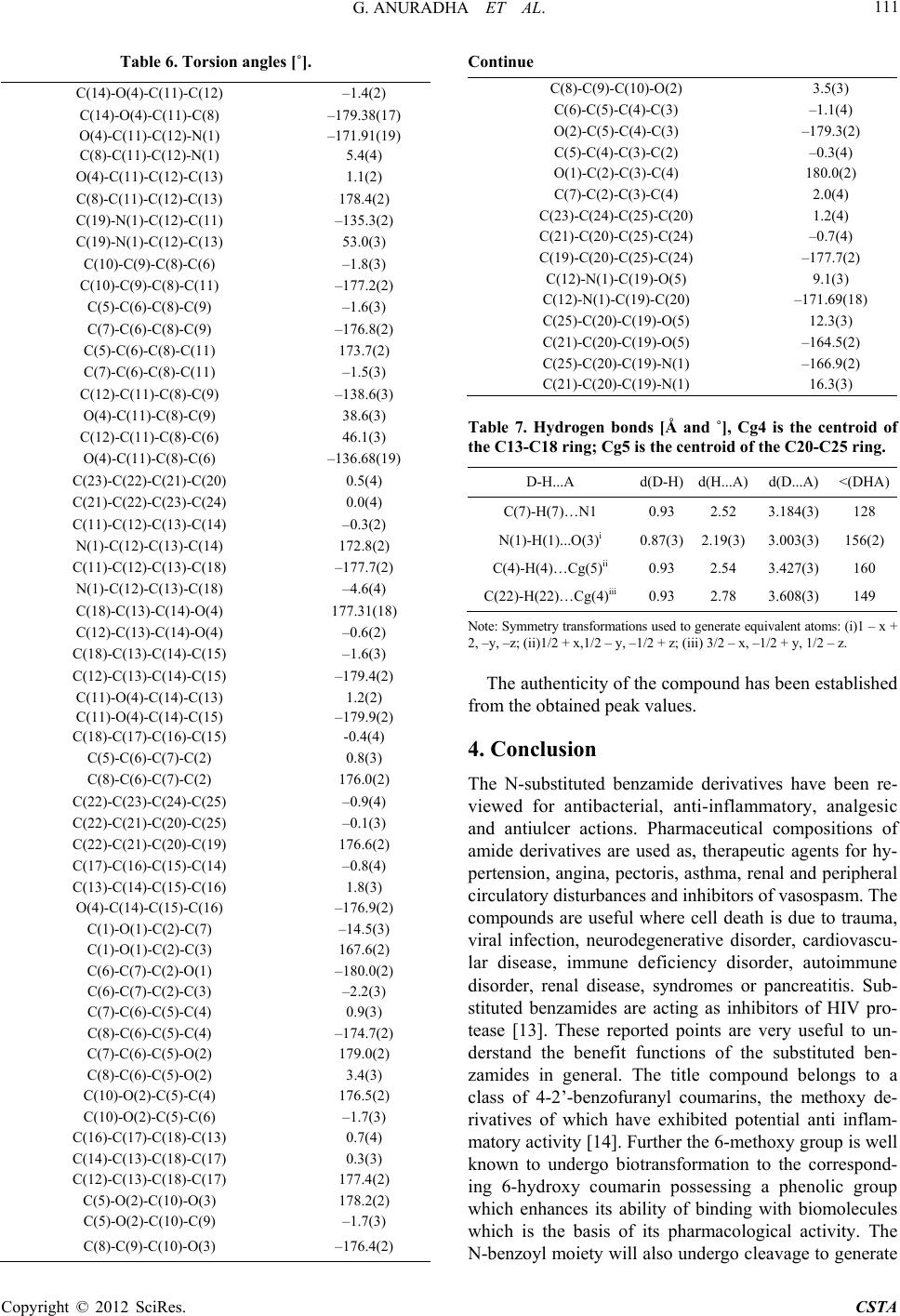 G. ANURADHA ET AL. 111 Table 6. Torsion angles [˚]. C(14)-O(4)-C(11)-C(12) –1.4(2) C(14)-O(4)-C(11)-C(8) –179.38(17) O(4)-C(11)-C(12)-N(1) –171.91(19) C(8)-C(11)-C(12)-N(1) 5.4(4) O(4)-C(11)-C(12)-C(13) 1.1(2) C(8)-C(11)-C(12)-C(13) 178.4(2) C(19)-N(1)-C(12)-C(11) –135.3(2) C(19)-N(1)-C(12)-C(13) 53.0(3) C(10)-C(9)-C(8)-C(6) –1.8(3) C(10)-C(9)-C(8)-C(11) –177.2(2) C(5)-C(6)-C(8)-C(9) –1.6(3) C(7)-C(6)-C(8)-C(9) –176.8(2) C(5)-C(6)-C(8)-C(11) 173.7(2) C(7)-C(6)-C(8)-C(11) –1.5(3) C(12)-C(11)-C(8)-C(9) –138.6(3) O(4)-C(11)-C(8)-C(9) 38.6(3) C(12)-C(11)-C(8)-C(6) 46.1(3) O(4)-C(11)-C(8)-C(6) –136.68(19) C(23)-C(22)-C(21)-C(20) 0.5(4) C(21)-C(22)-C(23)-C(24) 0.0(4) C(11)-C(12)-C(13)-C(14) –0.3(2) N(1)-C(12)-C(13)-C(14) 172.8(2) C(11)-C(12)-C(13)-C(18) –177.7(2) N(1)-C(12)-C(13)-C(18) –4.6(4) C(18)-C(13)-C(14)-O(4) 177.31(18) C(12)-C(13)-C(14)-O(4) –0.6(2) C(18)-C(13)-C(14)-C(15) –1.6(3) C(12)-C(13)-C(14)-C(15) –179.4(2) C(11)-O(4)-C(14)-C(13) 1.2(2) C(11)-O(4)-C(14)-C(15) –179.9(2) C(18)-C(17)-C(16)-C(15) -0.4(4) C(5)-C(6)-C(7)-C(2) 0.8(3) C(8)-C(6)-C(7)-C(2) 176.0(2) C(22)-C(23)-C(24)-C(25) –0.9(4) C(22)-C(21)-C(20)-C(25) –0.1(3) C(22)-C(21)-C(20)-C(19) 176.6(2) C(17)-C(16)-C(15)-C(14) –0.8(4) C(13)-C(14)-C(15)-C(16) 1.8(3) O(4)-C(14)-C(15)-C(16) –176.9(2) C(1)-O(1)-C(2)-C(7) –14.5(3) C(1)-O(1)-C(2)-C(3) 167.6(2) C(6)-C(7)-C(2)-O(1) –180.0(2) C(6)-C(7)-C(2)-C(3) –2.2(3) C(7)-C(6)-C(5)-C(4) 0.9(3) C(8)-C(6)-C(5)-C(4) –174.7(2) C(7)-C(6)-C(5)-O(2) 179.0(2) C(8)-C(6)-C(5)-O(2) 3.4(3) C(10)-O(2)-C(5)-C(4) 176.5(2) C(10)-O(2)-C(5)-C(6) –1.7(3) C(16)-C(17)-C(18)-C(13) 0.7(4) C(14)-C(13)-C(18)-C(17) 0.3(3) C(12)-C(13)-C(18)-C(17) 177.4(2) C(5)-O(2)-C(10)-O(3) 178.2(2) C(5)-O(2)-C(10)-C(9) –1.7(3) C(8)-C(9)-C(10)-O(3) –176.4(2) Continue C(8)-C(9)-C(10)-O(2) 3.5(3) C(6)-C(5)-C(4)-C(3) –1.1(4) O(2)-C(5)-C(4)-C(3) –179.3(2) C(5)-C(4)-C(3)-C(2) –0.3(4) O(1)-C(2)-C(3)-C(4) 180.0(2) C(7)-C(2)-C(3)-C(4) 2.0(4) C(23)-C(24)-C(25)-C(20) 1.2(4) C(21)-C(20)-C(25)-C(24) –0.7(4) C(19)-C(20)-C(25)-C(24) –177.7(2) C(12)-N(1)-C(19)-O(5) 9.1(3) C(12)-N(1)-C(19)-C(20) –171.69(18) C(25)-C(20)-C(19)-O(5) 12.3(3) C(21)-C(20)-C(19)-O(5) –164.5(2) C(25)-C(20)-C(19)-N(1) –166.9(2) C(21)-C(20)-C(19)-N(1) 16.3(3) Table 7. Hydrogen bonds [Å and ˚], Cg4 is the centroid of the C13-C18 ring; Cg5 is the centroid of the C20-C25 ring. D-H...A d(D-H) d(H...A) d(D...A)<(DHA) C(7)-H(7)…N1 0.93 2.52 3.184(3)128 N(1)-H(1)...O (3)i 0.87(3) 2.19(3) 3.003(3)156(2) C(4)-H(4)…Cg(5)ii 0.93 2.54 3.427(3)160 C(22)-H(22)…Cg(4)iii 0.93 2.78 3.608(3)149 Note: Symmetry transformations used to generate equivalent atoms: (i)1 – x + 2, –y, –z; (ii)1/2 + x,1/2 – y, –1/2 + z; (iii) 3/2 – x, –1/2 + y, 1/2 – z. The authenticity of the compound has been established from the obtained peak values. 4. Conclusion The N-substituted benzamide derivatives have been re- viewed for antibacterial, anti-inflammatory, analgesic and antiulcer actions. Pharmaceutical compositions of amide derivatives are used as, therapeutic agents for hy- pertension, angina, pectoris, asthma, renal and peripheral circulatory disturbances and inhibitors of vasospasm. The compounds are useful where cell death is due to trauma, viral infection, neurodegenerative disorder, cardiovascu- lar disease, immune deficiency disorder, autoimmune disorder, renal disease, syndromes or pancreatitis. Sub- stituted benzamides are acting as inhibitors of HIV pro- tease [13]. These reported points are very useful to un- derstand the benefit functions of the substituted ben- zamides in general. The title compound belongs to a class of 4-2’-benzofuranyl coumarins, the methoxy de- rivatives of which have exhibited potential anti inflam- matory activity [14]. Further the 6-methoxy group is well known to undergo biotransformation to the correspond- ing 6-hydroxy coumarin possessing a phenolic group which enhances its ability of binding with biomolecules which is the basis of its pharmacological activity. The N-benzoyl moiety will also undergo cleavage to generate Copyright © 2012 SciRes. CSTA 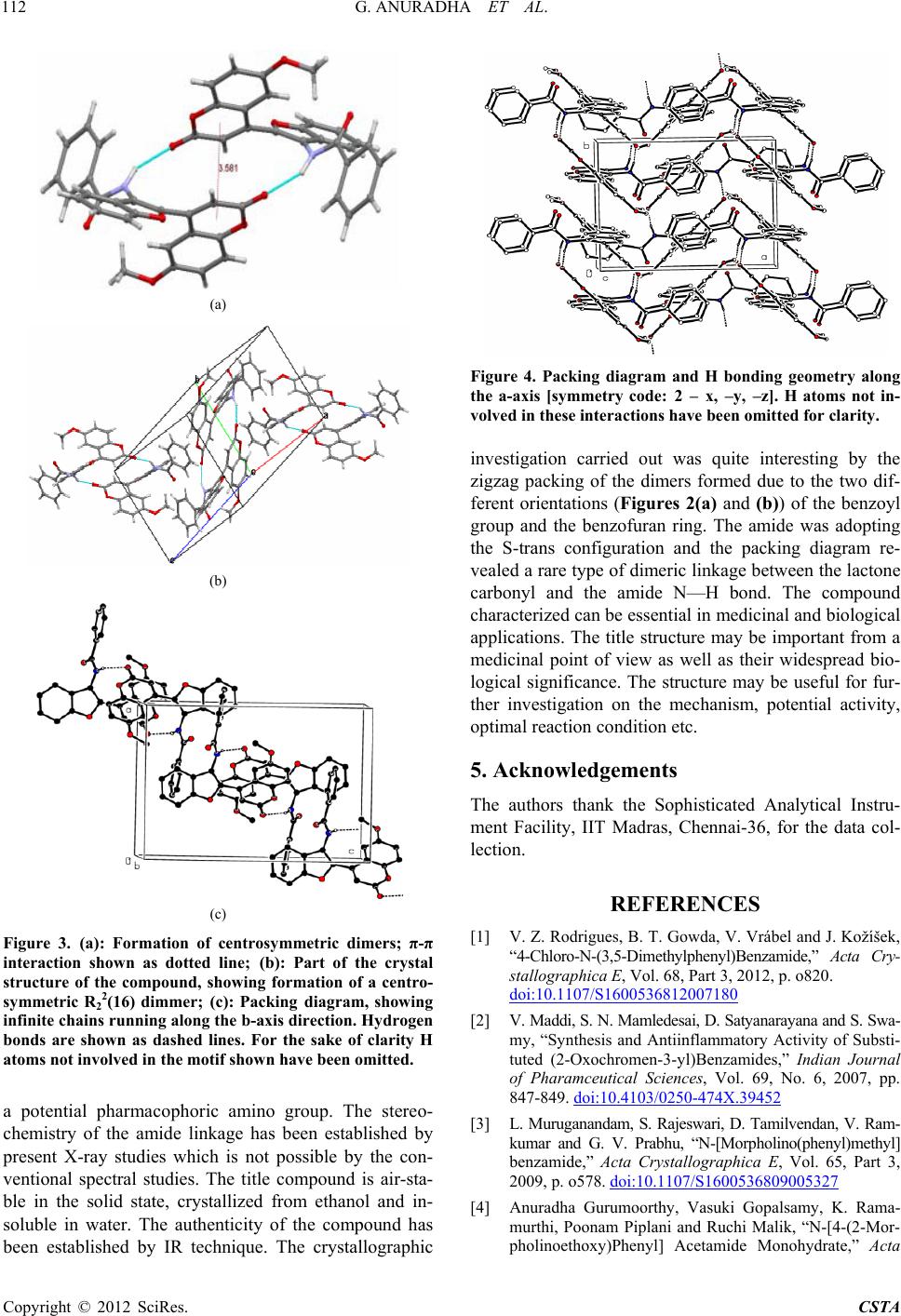 G. ANURADHA ET AL. 112 (a) (b) (c) Figure 3. (a): Formation of centrosymmetric dimers; π-π interaction shown as dotted line; (b): Part of the crystal structure of the compound, showing formation of a centro- symmetric R22(16) dimmer; (c): Packing diagram, showing infinite chains running along the b-axis direction. Hydrogen bonds are shown as dashed lines. For the sake of clarity H atoms not involved in the motif shown have been omitted. a potential pharmacophoric amino group. The stereo- chemistry of the amide linkage has been established by present X-ray studies which is not possible by the con- ventional spectral studies. The title compound is air-sta- ble in the solid state, crystallized from ethanol and in- soluble in water. The authenticity of the compound has been established by IR technique. The crystallographic Figure 4. Packing diagram and H bonding geometry along the a-axis [symmetry code: 2 – x, –y, –z]. H atoms not in- volved in these interactions have been omitted for clarity. investigation carried out was quite interesting by the zigzag packing of the dimers formed due to the two dif- ferent orientations (Figures 2(a) and (b)) of the benzoyl group and the benzofuran ring. The amide was adopting the S-trans configuration and the packing diagram re- vealed a rare type of dimeric linkage between the lactone carbonyl and the amide N—H bond. The compound characterized can be essential in medicinal and biological applications. The title structure may be important from a medicinal point of view as well as their widespread bio- logical significance. The structure may be useful for fur- ther investigation on the mechanism, potential activity, optimal reaction condition etc. 5. Acknowledgements The authors thank the Sophisticated Analytical Instru- ment Facility, IIT Madras, Chennai-36, for the data col- lection. REFERENCES [1] V. Z. Rodrigues, B. T. Gowda, V. Vrábel and J. Kožíšek, “4-Chloro-N-(3,5-Dimethylphenyl)Benzamide,” Acta Cry- stallographica E, Vol. 68, Part 3, 2012, p. o820. doi:10.1107/S1600536812007180 [2] V. Maddi, S. N. Mamledesai, D. Satyanarayana and S. Swa- my, “Synthesis and Antiinflammatory Activity of Substi- tuted (2-Oxochromen-3-yl)Benzamides,” Indian Journal of Pharamceutical Sciences, Vol. 69, No. 6, 2007, pp. 847-849. doi:10.4103/0250-474X.39452 [3] L. Muruganandam, S. Rajeswari, D. Tamilvendan, V. Ram- kumar and G. V. Prabhu, “N-[Morpholino(phenyl)methyl] benzamide,” Acta Crystallographica E, Vol. 65, Part 3, 2009, p. o578. doi:10.1107/S1600536809005327 [4] Anuradha Gurumoorthy, Vasuki Gopalsamy, K. Rama- murthi, Poonam Piplani and Ruchi Malik, “N-[4-(2-Mor- pholinoethoxy)Phenyl] Acetamide Monohydrate,” Acta Copyright © 2012 SciRes. CSTA 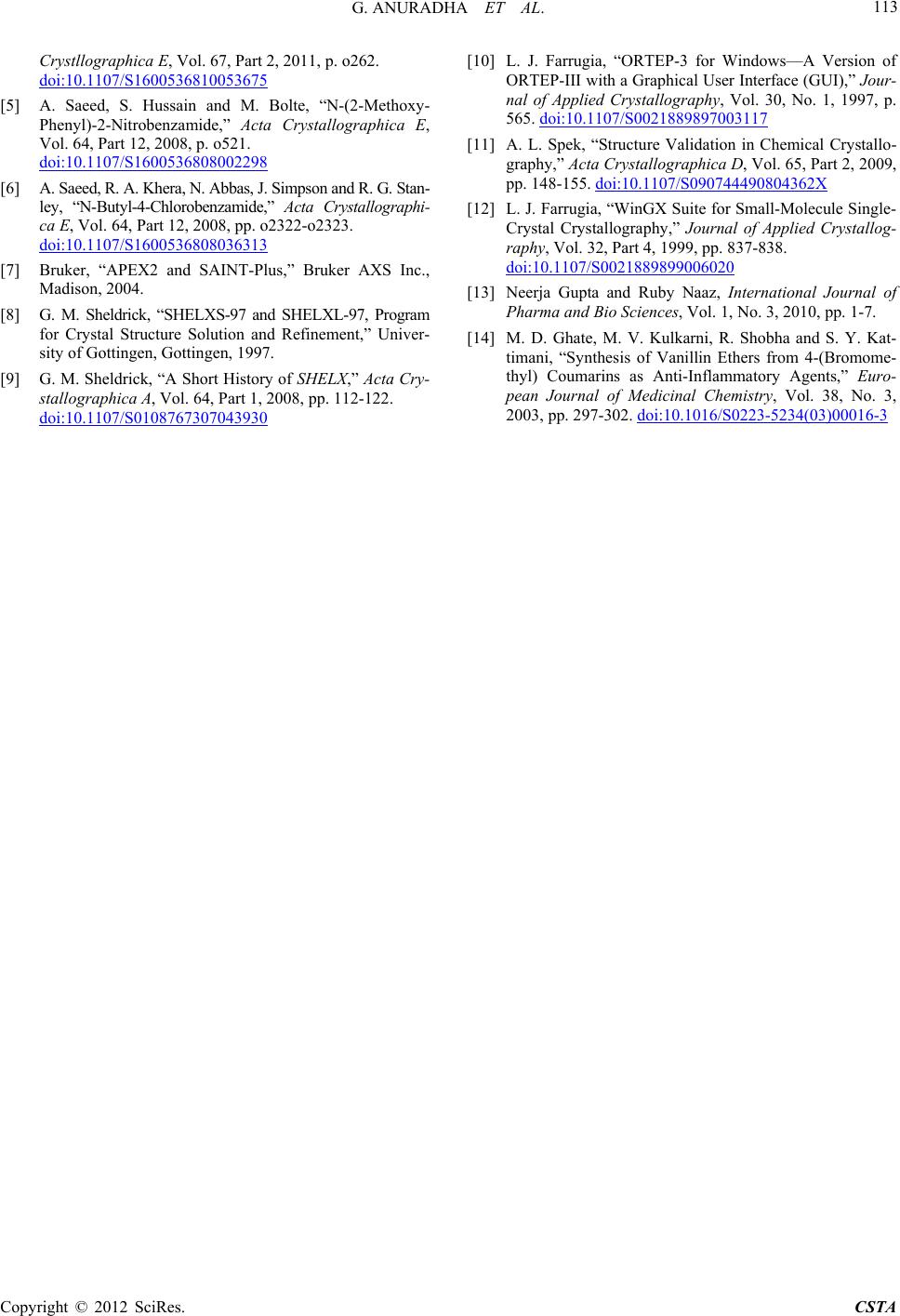 G. ANURADHA ET AL. Copyright © 2012 SciRes. CSTA 113 Crystllographica E, Vol. 67, Part 2, 2011, p. o262. doi:10.1107/S1600536810053675 [5] A. Saeed, S. Hussain and M. Bolte, “N-(2-Methoxy- Phenyl)-2-Nitrobenzamide,” Acta Crystallographica E, Vol. 64, Part 12, 2008, p. o521. doi:10.1107/S1600536808002298 [6] A. Saeed, R. A. Khera, N. Abbas, J. Simpson and R. G. Stan- ley, “N-Butyl-4-Chlorobenzamide,” Acta Crystallographi- ca E, Vol. 64, Part 12, 2008, pp. o2322-o2323. doi:10.1107/S1600536808036313 [7] Bruker, “APEX2 and SAINT-Plus,” Bruker AXS Inc., Madison, 2004. [8] G. M. Sheldrick, “SHELXS-97 and SHELXL-97, Program for Crystal Structure Solution and Refinement,” Univer- sity of Gottingen, Gottingen, 1997. [9] G. M. Sheldrick, “A Short History of SHELX,” Acta Cry- stallographica A, Vol. 64, Part 1, 2008, pp. 112-122. doi:10.1107/S0108767307043930 [10] L. J. Farrugia, “ORTEP-3 for Windows—A Version of ORTEP-III with a Graphical User Interface (GUI),” Jour- nal of Applied Crystallography, Vol. 30, No. 1, 1997, p. 565. doi:10.1107/S0021889897003117 [11] A. L. Spek, “Structure Validation in Chemical Crystallo- graphy,” Acta Crystallographica D, Vol. 65, Part 2, 2009, pp. 148-155. doi:10.1107/S090744490804362X [12] L. J. Farrugia, “WinGX Suite for Small-Molecule Single- Crystal Crystallography,” Journal of Applied Crystallog- raphy, Vol. 32, Part 4, 1999, pp. 837-838. doi:10.1107/S0021889899006020 [13] Neerja Gupta and Ruby Naaz, International Journal of Pharma and Bio Sciences, Vol. 1, No. 3, 2010, pp. 1-7. [14] M. D. Ghate, M. V. Kulkarni, R. Shobha and S. Y. Kat- timani, “Synthesis of Vanillin Ethers from 4-(Bromome- thyl) Coumarins as Anti-Inflammatory Agents,” Euro- pean Journal of Medicinal Chemistry, Vol. 38, No. 3, 2003, pp. 297-302. doi:10.1016/S0223-5234(03)00016-3 |