

Paper Menu >>
Journal Menu >>
 Crystal Structure Theory and Applications, 2012, 1, 97-99 http://dx.doi.org/10.4236/csta.2012.13018 Published Online December 2012 (http://www.SciRP.org/journal/csta) Characterization, XPS and Toxicological Study of Organothallium (III) Compounds with Schiff Base Ligands Gyanendra Kumar Gaur1*, Shekhar Srivastava2 1Scientific Officer, Forensic Science Laboratory, Gwalior, India 2Reader in Chemistry, University of Allahabad, Allahabad, India Email: *[email protected] Received October 23, 2012; revised November 21, 2012; accepted November 29, 2012 ABSTRACT Many Organothallium Compounds have been used in medicine, industry and antibacterial activity. Optical properties are among the most fascinating and useful properties of many complexes and have been extensively studied using a variety of optical spectroscopic techniques. A basic understanding of the optical properties and related spectroscopic techniques is essential for characterization about semiconductors, insulators or metal. Optical properties are related to other properties and functionalities (e.g. electronic, magnetic, and thermal) that are of fundamental importance to many technological applications, such as energy conversion, chemical analysis, biomedicine, opto-electronics, communication, and radiation detection. The fundamental importance of Thallium is the ability to accept electrons due to empty d-orbi- tals and thus establish additional bonds (σ bond and π bond) in chemistry. The Thallium metal, which has outer elec- tronic configuration 6 s2, 6 p1 shows oxidation states of Thallium (III) and Thallium (I). This research paper explains that Thallium (III) and Thallium (I) accepts lone pairs from various bi-dentate tetra-dentate Schiff base ligands due to p-orbital and vacant d-orbital. This research paper explains the Characterization, XPS and Toxicological Study of Or- ganothallium (III) Compounds with Schiff base ligands by physiochemical technique. X-Ray photoelectron spectrogra- phy (XPS) study of Thallium (III) complexes with Schiff Base ligands also reported in this paper. XPS study shows a single symmetrical peak without any splitting in photoelectron peak, which confirms diamagnetic nature of all prepared molecular adducts. All prepared complexes with Schiff base ligands show toxicological effect. Keywords: Oxidation; Ligand; Diamagnetic; Organothallium Compound; Molecular Adducts 1. Introduction The organometallic chemistry has developed rapidly in III-B group of metals like gallium, indium and thallium during few years. The organometallic compounds of these metals have found useful applications in the production of metal carbonyls [1], metal cyclo-pentadiencyls [2-4] and ultra pure metals [5,6]. Some important applications of organometallic compounds of the metals are used as lubricants [7], antiknock reagents [8] and polymerization catalysts for olefins [9-11]. Poisoned food technique and Toxicological study has been recently employed to de- termine the fungicidal activity of these compounds. Pre- liminary evaluation of biocidal activity of some compounds against tomato seedlings has indicated that organometa- llic compounds of these metals are potential fungicides [12]. 2. Experimental Details The physicochemical technique was used for synthesized organothallium (III) in present work. The elemental analysis was determined on a semimicro scale at Central Drug Research Institute, Lucknow, India. Molar conduc- tance of all complexes was measured at room tempera- ture in Acetone by Digisun Electronics Conductivity Bridge. The X-ray photoelectron spectra (XPS) were recorded by VG Scientific ESCA-3MK II electron spec- trometer at National Chemical Laboratory, Poona-6. The MgKα X-ray line (1253.6 eV) was used for photo excita- tion. The Cu2p3/2 (B.E. = 932.8 ± 0.2 eV) and Au4f7/2 (B.E. = 368.2 eV) was used for cross-checking. All the spectra were recorded using the same spectrometer pa- rameters of 50 eV pass energy and 4 mm slit width. The reduced full width at half maximum (FWHM) at the Au4f7/2 (B.E. = 83.8 eV) level under these conditions was 1.2 eV [13]. 3. Chemical Analysis The powdered sample was mixed with high purity silver powder to reduce the charging effect. A thin layer of such a sample was pressed on a gold metal gauge which *Corresponding author. C opyright © 2012 SciRes. CSTA 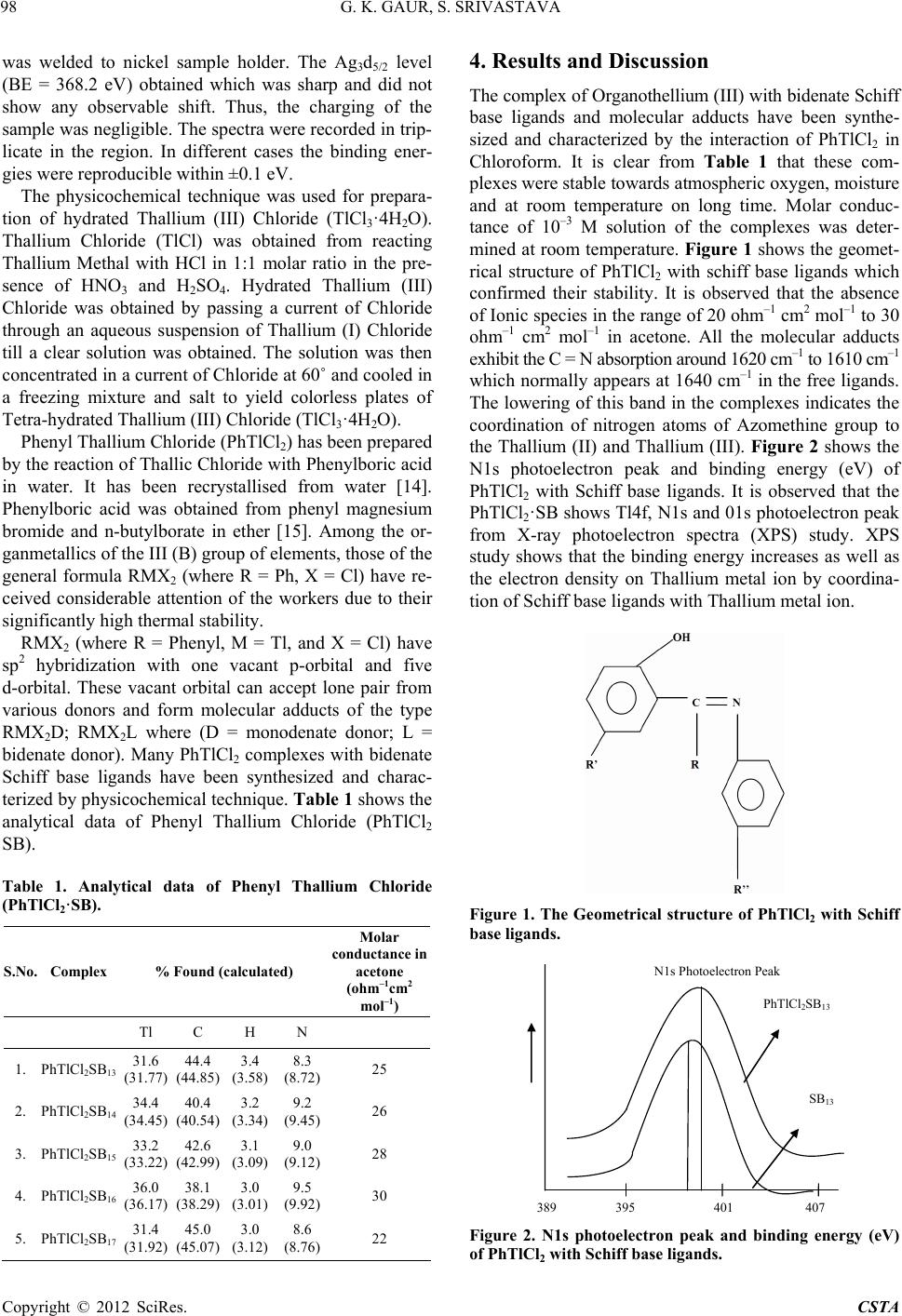 G. K. GAUR, S. SRIVASTAVA 98 was welded to nickel sample holder. The Ag3d5/2 level (BE = 368.2 eV) obtained which was sharp and did not show any observable shift. Thus, the charging of the sample was negligible. The spectra were recorded in trip- licate in the region. In different cases the binding ener- gies were reproducible within ±0.1 eV. The physicochemical technique was used for prepara- tion of hydrated Thallium (III) Chloride (TlCl3·4H2O). Thallium Chloride (TlCl) was obtained from reacting Thallium Methal with HCl in 1:1 molar ratio in the pre- sence of HNO3 and H2SO4. Hydrated Thallium (III) Chloride was obtained by passing a current of Chloride through an aqueous suspension of Thallium (I) Chloride till a clear solution was obtained. The solution was then concentrated in a current of Chloride at 60˚ and cooled in a freezing mixture and salt to yield colorless plates of Tetra-hydrated Thallium (III) Chloride (TlCl3·4H2O). Phenyl Thallium Chloride (PhTlCl2) has been prepared by the reaction of Thallic Chloride with Phenylboric acid in water. It has been recrystallised from water [14]. Phenylboric acid was obtained from phenyl magnesium bromide and n-butylborate in ether [15]. Among the or- ganmetallics of the III (B) group of elements, those of the general formula RMX2 (where R = Ph, X = Cl) have re- ceived considerable attention of the workers due to their significantly high thermal stability. RMX2 (where R = Phenyl, M = Tl, and X = Cl) have sp2 hybridization with one vacant p-orbital and five d-orbital. These vacant orbital can accept lone pair from various donors and form molecular adducts of the type RMX2D; RMX2L where (D = monodenate donor; L = bidenate donor). Many PhTlCl2 complexes with bidenate Schiff base ligands have been synthesized and charac- terized by physicochemical technique. Table 1 shows the analytical data of Phenyl Thallium Chloride (PhTlCl2 SB). Table 1. Analytical data of Phenyl Thallium Chloride (PhTlCl2·SB). S.No. Complex % Found (calculated) Molar conductance in acetone (ohm–1cm2 mol–1) Tl C H N 1. PhTlCl2SB13 31.6 (31.77) 44.4 (44.85) 3.4 (3.58) 8.3 (8.72) 25 2. PhTlCl2SB14 34.4 (34.45) 40.4 (40.54) 3.2 (3.34) 9.2 (9.45) 26 3. PhTlCl2SB15 33.2 (33.22) 42.6 (42.99) 3.1 (3.09) 9.0 (9.12) 28 4. PhTlCl2SB16 36.0 (36.17) 38.1 (38.29) 3.0 (3.01) 9.5 (9.92) 30 5. PhTlCl2SB17 31.4 (31.92) 45.0 (45.07) 3.0 (3.12) 8.6 (8.76) 22 4. Results and Discussion The complex of Organothellium (III) with bidenate Schiff base ligands and molecular adducts have been synthe- sized and characterized by the interaction of PhTlCl2 in Chloroform. It is clear from Table 1 that these com- plexes were stable towards atmospheric oxygen, moisture and at room temperature on long time. Molar conduc- tance of 10–3 M solution of the complexes was deter- mined at room temperature. Figure 1 shows the geomet- rical structure of PhTlCl2 with schiff base ligands which confirmed their stability. It is observed that the absence of Ionic species in the range of 20 ohm–1 cm2 mol–1 to 30 ohm–1 cm2 mol–1 in acetone. All the molecular adducts exhibit the C = N absorption around 1620 cm–1 to 1610 cm–1 which normally appears at 1640 cm–1 in the free ligands. The lowering of this band in the complexes indicates the coordination of nitrogen atoms of Azomethine group to the Thallium (II) and Thallium (III). Figure 2 shows the N1s photoelectron peak and binding energy (eV) of PhTlCl2 with Schiff base ligands. It is observed that the PhTlCl2·SB shows Tl4f, N1s and 01s photoelectron peak from X-ray photoelectron spectra (XPS) study. XPS study shows that the binding energy increases as well as the electron density on Thallium metal ion by coordina- tion of Schiff base ligands with Thallium metal ion. Figure 1. The Geometrical structure of PhTlCl2 with Schiff base ligands. PhTlCl 2 SB 1 3 SB 13 389 395 401 407 N1s Photoelectron Peak Figure 2. N1s photoelectron peak and binding energy (eV) of PhTlCl2 with Schiff base ligands. Copyright © 2012 SciRes. CSTA  G. K. GAUR, S. SRIVASTAVA Copyright © 2012 SciRes. CSTA 99 5. Conclusion It is clear that the photoelectron peaks towards higher binding energy side due to L → M charge transfer from XPS Study. All prepared complexes are stable under at- mospheric conditions at room temperature and it is con- firmed through their geometrical structure. XPS study shows a single symmetrical peak without any splitting in photoelectron peak, which confirms diamagnetic nature of all prepared molecular adducts. Toxicological study of these complexes found very prominent. 6. Acknowledgements I am thankful to the Central Drug Research Institute, Lucknow, India for elemental analysis of Thallium (III) and National Chemical Laboratory, Poona-6 for X-ray photoelectron spectra (XPS). REFERENCES [1] H. E. Podall and H. Shapire, “The Organmetallic Chem- istry of the Transition Metals,” Wiley, Chichester, 1960. [2] C. C. Hant and J. R. Doyle, “Synthesis of Cyclopentadi- enide Derivatives,” Inorganic and Nuclear Chemistry Letters, Vol. 2, No. 10, 1966, pp. 283-288. doi:10.1016/0020-1650(66)80043-0 [3] A. N. Nesmeyanov, R. B. Materikova, N. S. Kochetkova and R. V. Luk’yanova, “Preparation of Diphenylnickel with Cyclopentadienylthallium,” Bulletin of the Academy of Sciences of the USSR, Division of Chemical Science, Vol. 18, No. 4, 1969, p. 896. [4] R. B. King and M. B. Bisnette, “Initial Examples of the Synthesis of Cp*-Metal Complexes,” Journal of Organo- metallic Chemistry, Vol. 8, 1967, pp. 287-297. [5] C. Seamus, X. G. Ji, I. C. Douqlas and P. Michael, “Proc- ess for the Production of Ultra Pure Metals from Oxide and Their Cold Rolling to Ultra Thin Foils for Use as Par- ticle Accelerator Targets and Reference Materials,” Spe- cial Issue of Nuclear Instruments and Methods in Physics Research, 2000. http://publications.jrc.ec.europa.eu/repository/handle/111 111111/11716 [6] R. Detzer, “Hochreine Metalle Durch Elektroraffination in Metallorganischen Komplexsalzschmelzen,” Chemie Ingenieur Technik, Vol. 36, No. 6, 1964, pp. 616-637. doi:10.1002/cite.330360606 [7] M. Antler, “Materials, Coatings and Platings, in Electrical Contacts: Principles and Applications,” Marcel Dekker, New York, 1999. [8] S. Samson and G. R. Stephenson, “Pentacarbonyliron,” In: L. Paquette, Ed., Encyclopedia of Reagents for Organic Synthesis, John Wiley & Sons, New York, 2004. [9] R. Hoff and R. T. Mathers, “Handbook of Transition Me- tal Polymerization Catalysts,” John Wiley & Sons, New York, 2010. [10] G. J. P. Britovsek, V. C. Gibson and D. F. Wass, “The Search for New-Generation Olefin Polymerization Cata- lysts: Life beyond Metallocenes,” Angewandte Chemie International Edition, Vol. 38, No. 4, 1999, pp. 428-447. doi:10.1002/(SICI)1521-3773(19990215)38:4<428::AID- ANIE428>3.0.CO;2-3 [11] M. Bochmann and I. Organometallics, “Complexes with Transition Metal-Carbon σ-Bonds,” Oxford University Press, New York, 1994. [12] T. N. Srivastava and K. K. Bajpai, Journal of Organome- tallic Chemistry, Vol. 31, No. 1, 1971, pp. 1-3. doi:10.1016/s0022-328x(00)87457-4 [13] S. Srivastava, “ESCA Studies of Metal Complexes,” Ap- plied Spectroscopy Reviews, Vol. 22, No. 4, 1986, pp. 401-535. doi:10.1080/05704928608060441 [14] F. Challenger and B. Parker, “CXCIX—A Method for the Preparation of Some New Organo-Thallium Halides,” Journal of the Chemical Society, 1931, pp. 1462-1467. doi:10.1039/jr9310001462 [15] F. R. Bean and J. R. Johnson, “Derivatives of Phenylboric Acid, Their Preparation and Action upon Bacteria. II. Hydroxyphenylboric Acids,” Journal of the Chemical So- ciety, Vol. 54, No. 11, 1932, pp. 4415-4425. doi:10.1021/ja01350a045 |