

Paper Menu >>
Journal Menu >>
 Psychology 2012. Vol.3, No.12A, 1196-1201 Published Online December 2012 in SciRes (http://www.SciRP.org/journal/psych) http://dx.doi.org/10.4236/psych.2012.312A177 Copyright © 2012 SciRes. 1196 Sustainable Happiness and Well-Being: Future Directions for Positive Psychology Catherine O’Brien Cape Breton University, Sydne y, Canada Email: [email protected] Received September 25th, 2012; revised October 20th, 2012; accept e d N o v e mber 23rd, 2012 Positive psychology has influenced many disciplines in a very short span of time. This paper argues that positive psychology will realize its most significant and far reaching impact when it is applied to sustain- ability efforts, locally, nationally and internationally. Such application may accelerate shifts in attitudes, policies, practice and behavior. Specifically, opportunities for integrating positive psychology with sus- tainability education are discussed including work in the area of sustainable happiness, Education for Sustainable Development (ESD) and positive education. Sustainable happiness underscores the interrela- tionship between human flourishing and ecological resilience. Thus sustainable happiness and well-being are integral to building sustainable futures, and positive psychology could be increasingly influential in leading research and education that heralds a new era of understanding and political will to embrace sus- tainability. Keywords: Sustainable Happiness; Well-Being; Sustainability; Education; Positive Psychology; Positive Education Introduction Tracking the progression of publications about positive psy- chology and happiness studies over the past ten years is akin to watching the movement of a weather pattern, as positive psy- chology has made inroads into numerous disciplines. The busi- ness sector was an early and eager adopter of the teachings from positive psychology, and interest has continued to bur- geon. For instance, the January/February 2012 cover of the Harvard Business Review proclaimed, “The Value of Happi- ness: How Employee Well-Being Drives Profits.” Economists are investigating national policies and indicators for happiness (Diener, Lucas, Schimmack, & Helliwell, 2009; Diener & Seligman, 2004; Layard, 2005; Stutz, 2006). Furthermore, population health research is revealing the benefits of happiness to our physical and mental health (Davidson, Mostofsky, & Whang, 2010; Diener & Chan, 2011; Steptoe, Wardle, & Mar- mot, 2005; Veenhoven, 2008). Additionally, the education sec- tor is beginning to develop new curricula resources that pro- mote “positive schools” (Boniwell & Ryan, 2012; Morrison and Morrison, 2010; New Brunswick Department of Wellness, Culture and Sport, 2011; O’Brien, 2010b) and positive educa- tion (Seligman, 2011). Potential applications of positive psy- chology to education are extensive (e.g., Gilman et al., 2009) with the breadth of possibilities yet to be realized—particularly with respect to sustainability education. One of the most promising directions is the application of positive psychology research for sustainability. The business example above is a case in point. While increasing employee well-being is an important goal for businesses, the resulting increase in worker productivity may not always be consistent with sustainability. In the absence of corporate social and envi- ronmental responsibility, increasing efficiencies may have an adverse impact on community or environmental well-being. Additionally, it would be beneficial to expand research that examines the relationship between environmental sustainability, quality of life, and life satisfaction. A small, but growing, body of literature is establishing the merits of decoupling happiness and life satisfaction from over consumption. Kasser (2006) explored materialism and the good life. The New Economics Foundation (Marks et al., 2006) created the Happy Planet Index (HPI) to answer such questions as, “does happiness have to cost the earth?” In other words, can we live long and happy lives within the resource capacity of the planet? The first HPI incor- porated national life satisfaction and life expectancy scores along with the Ecological Footprint of nations. Countries with high life satisfaction and life expectancy while maintaining a low Ecological Footprint were ranked at the top. The second HPI (Abdallah et al., 2009) determined that Costa Rica had the highest number of happy life years, nearly achieving a footprint referred to as “one-planet living,” that is, using the country’s fair share of the earth’s resources as opposed to consuming resources as if there is access to more than one planet. By the third HPI, Costa Rica remained at the top of the charts, while the USA’s high Ecological Footprint brought it to 105 out of 151 countries. Importantly, the HPI illuminated that if every country had a similar Ecological Footprint to the USA, it would require four planets to meet this level of consumption. A unique approach to national well-being indicators predates the HPI. In 1972, the King of Bhutan proclaimed that Gross National Happiness (GNH) was a more relevant indicator of the country’s well-being than Gross National Product (Ura, Alkire, & Zangmo, 2012). The indicators used to calculate GNH in- corporate environmental well-being domains such as ecological diversity and resilience. There is considerable weight given to social indicators such as health, education, time use, cultural diversity and community vitality that intersect with the GNH domain of psychological well-being. Bhutan became the first  C. O’BRIEN country to overtly combine these kinds of indicators, establish- ing happiness and well-being as a national goal. After nearly three decades of tracking GNH, Bhutan proposed a resolution to the United Nations (UN), recommending that member states give greater attention to happiness and well-being in their eco- nomic and social development policies (UN, 2011). This reso- lution was adopted by all of the 193 UN member states (Thinley, 2012), and aligns with globally agreed targets known as the Millennium Development Goals (MDGs). Building on the UN resolution, Bhutan’s Prime Minister, Thinley, hosted a high level meeting at the United Nations in New York on April 2nd, 2012. Seven hundred delegates were convened to discuss the next steps required for achieving the intent of the UN resolution—a new economic paradigm for realizing a world of sustainable well-being and happiness (Royal Government of Bhutan, 2012). Thinley (2012) under- scored the need for considering the links between sustainability and happiness: “Sustainability is the essential basis and precon- dition of such a sane economic system. An economy exists not for mere survival but to provide the enabling conditions for human happiness and the well-being of all life forms” (p. 64). This meeting was particularly significant because it brought sustainability experts together with positive psychologists and other academics researching happiness and well-being. In addi- tion, The World Happiness Report was launched, highlighting the relevance of happiness studies for sustainability as well as the broad benefits of realigning economic activity to contribute to well-being, sustainably (Sachs, 2012). Bridging the Gap between Sustainability and Positive Psychology Whereas sustainability research is often interdisciplinary, the field has not yet effectively capitalized on the wealth of infor- mation from positive psychology and happiness studies1; nor has positive psychology engaged sustainability as a core theo- retical tenet. Consider, for example, the rankings of the happiest countries and happiest cities. These measures provide useful information, but fall short of raising awareness that life satis- faction declines with over consumption of natural resources or inequitable trade practices (Royal Government of Bhutan, 2012) and may convey incomplete information. As demonstrated through the HPI, a country’s high life satisfaction may also be accompanied by a high Ecological Footprint, though this isn’t the development model to emulate. A further rationale for ad- dressing the relationship between happiness and consumption is that our planet is already in a state referred to as “ecological overshoot”. By 2007, humanity’s Ecological Footprint had already exceeded the earth’s biocapacity by 50% (Moran & Wackernagel, 2012). We continue to use the earth’s resources faster than they can be replenished. Academics working in the area of sustainability who have neglected to incorporate findings from positive psychology and happiness studies may have dismissed the relevance of these fields. In a world where global warming has begun (Intergov- ernmental Panel on Climate Change [IPCC], 2007) and climate scientists are investigating both mitigation measures and adap- tations measures, a focus on happiness could appear to be in- consequential. Those who are deeply entrenched in efforts to foster a more sustainable trajectory are aware of the dire straits that human activity has set in motion in this Anthropocene age in which the world’s population of 7 billion is having signifi- cant, and sometimes irreversible impact on the physical envi- ronment (Sachs, 2012). Orr (2012) suggests that we will soon face the “perfect storm” with the convergence of more severe climate change, deforestation, water shortages, species loss, and the acidification of oceans to name just some of the environ- mental challenges. He is also skeptical whether the political and individual will to change this scenario will coalesce in time to avoid the destruction of the human race. “We have good reason to believe that this will be the closest of close calls, but we must hope that humankind will emerge someday from what biologist E.O. Wilson calls ‘the bottleneck’ chastened but im- proved” (Orr, 2012: p. 48). The timeline to resolve the imminent challenges of our global community is shrinking. It’s been twenty-five years since the Brundtland Commission published Our Common Future, defining the term “sustainable development” (World Commission on Environment and Development, 1987). In 1992, world leaders gathered in Rio de Janeiro at the Earth Summit for the first United Nations conference that addressed issues of environment and development together. Most recently in June 2012, a UN conference on sustainable development (“The Fu- ture We Want”—often referred to as Rio +20) reviewed the progress made since 1992. Although some encouraging achie- vements have been attained, including a reduction of extreme poverty, sustainable access to drinking water, and equal en- rollment in primary education for girls (UN, 2012a), more is required. The Rio +20 report explains that “sustainable devel- opment remains a generally agreed concept, rather than a day- to-day, on-the-ground, practical reality” (UN, 2012b: p. 4). Many believe that the lack of substantial progress to date war- rants much firmer and aggressive international commitments than the agreements that emerged from Rio +20 (Black, 2012). There is a major role for positive psychology to play in building further political will and bringing sustainability prin- ciples into everyday life. Discussions of happiness and well- being are an ideal entry point for fostering sustainable lifestyles and policies for sustainable happiness and well-being. Happi- ness is at the heart of who we are and what we do, but in a consumer society where consumption and happiness are often entangled, individuals confuse the “path to the ‘good life’ as the ‘goods life’” (Kasser, 2006: p. 200). The lifestyles and con- sumption in the wealthiest nations are leading to environmental degradation that has the greatest impact on less affluent coun- tries (Sachs, 2012). The HPI indicates that many of the wealthiest countries are exerting extensive pressure on natural resources and consuming more than their fair share of resources (Abdallah et al., 2009, 2012). Moreover, affluent societies do not always represent ideal models of sustainable development. The rising level of obesity in affluent countries is just one ex- ample of “disorders of development” (Sachs, 2012). Our unbri- dled pursuit of happiness is at the expense of ourselves, other people and the natural environment. In short, we have con- sumer societies that tend to reinforce individual lifestyles that are unsustainable and less likely to lead to sustainable happi- ness and overall life satisfaction. Harnessing the power of positive psychology with goals for sustainability could potentially accelerate progress, uncover new solutions, and enhance sustainable happiness and well- being. There is an unprecedented need for ramping up sustain- ability efforts locally, nationally and internationally—and it is vital that work on happiness and well-being embraces sustain- 1The previously mentioned HPI stands out as an exception. Copyright © 2012 SciRes. 1197  C. O’BRIEN ability (Canadian Index of Wellbeing, 2009). Individuals and nations do not flourish in isolation. Sustainable Happiness and Well-Being Sustainable happiness underscores the inter-relationships be- tween happiness, well-being and sustainability. It has been defined as “happiness that contributes to individual, community, and/or global well-being without exploiting other people, the environment, or future generations” (O’Brien, 2010a) thus dif- ferentiating it from “sustaining happiness” or “sustainable in- creases in happiness” (Lyubomirsky, 2007). The concept of sustainable happiness within the field of posi- tive psychology can be applied to foster sustainable behavior in addition to well-being in the broadest meaning of well-being, i.e. physical, emotional, social, spiritual, ecological well-being. Whereas we all have a natural desire for happiness, we are likely to lead more sustainable lives by becoming more aware that our well-being and pursuit of happiness is associated with the well-being of others and the natural environment (O’Brien, 2010a). Sustainable happiness disputes a common misconcep- tion that living sustainably will lower our quality of life (Brown and Kasser, 2005) Rather, sustainable happiness invites oppor- tunities to enhance our quality of life and contribute to individ- ual, community, and global well-being (O’Brien, 2010a). For example, looking at the commuting patterns of children and adults demonstrates how sustainable modes of transporta- tion can contribute to positive emotions and well-being. Parents who walk to school with their children report positive emotions like feeling happy and relaxed more frequently than parents who drive their children. Moreover, children who actively commute to school also report positive emotions more often than children who are transported by car or school bus (Rama- nathan et al., 2012). A Statistics Canada study found that peo- ple who walk or cycle to work are more likely to enjoy com- muting than those who use motorized transportation (Turcotte, 2006). These happy, active commuters are contributing to their well-being and modeling sustainable behavior. They are also reducing adverse impacts on human and environmental health if their decision to walk or cycle replaces a trip that would other- wise be made by motorized transportation. Building on these transportation examples, it is evident that there are numerous decision points throughout each day when individuals can make choices that contribute to individual, community or global well-being. Reflecting on the conditions under which our clothes are manufactured, how far our food is transported, whether the food was produced with care for the environment, and how we relate to one another represent daily opportunities to contribute to, or detract from, individual, com- munity and global well-being. This has become a primary focus of an undergraduate course in sustainable happiness at Cape Breton University where students apply sustainable happiness to everyday life (O’Brien, 2010a). Sustainable happiness is a natural bridge between positive psychology and sustainability. Education for Sustainable Happiness and Well-Being How can positive psychology contribute to a more resilient and sustainable future? While there are numerous directions that could be discussed, this section focuses on the role of formal education and oppor- tunities for applying positive psychology to sustainability edu- cation. Sustainability education is a term that includes Educa- tion for Sustainable Development (ESD) (UNESCO, 2005), environmental education, and education about sustainability in general. Positive psychology and sustainability education have several challenges and opportunities in common: 1) demon- strated benefits for students, teachers and society; 2) a lack of substantial presence in formal education; and 3) the potential to extensively accelerate progress towards individual, community and global well-being. Gardner (2006) acknowledges that the education sector is very conservative and slow to change. This can be both a strength and a barrier to progressive transformation. As educa- tors, we would not serve society nor our students well if we adopted every new proposed educational trend. The drawback, of course, is that education systems are not very adaptive and are rarely leading social change. Incorporating sustainability into formal education strains the status quo, as conventional approaches to education are still very much mired in the educa- tion style and goals of the Industrial age (Howard, 2011; Senge, 2012). Likewise, introducing positive psychology is thwarted by a lack of teacher training in positive psychology and the need to justify how it intersects with approved curricular goals. However, if we are to radically move societies towards a more sustainable trajectory in which people and the planet flourish, the education sector will need to incorporate both sustainability education and positive psychology. Who/What Is Teaching Us about Happiness? A considerable impediment for sustainability education is to move beyond raising individual awareness and toward fostering sustainable behavior. This is particularly difficult in industrial- ized countries, where students and educators live in a social and cultural milieu of the consumer society with economic systems that are not sustainable. It is compounded by the fact that many students are spending more hours on the three screens (smart- phone, computer and television) than they are in school (Leatherdale & Ahmed, 2011; Rideout et al., 2010) and media messages are likely to reinforce over consumption. Additionally, the tradition in environmental education has been to focus on “doom and gloom” messages. However, the aim of frightening the public into choosing more environmentally-friendly behav- iors has not succeeded in shifting our unsustainable trajectory (Kelsey & O’Brien, 2011). While the formal education sector has not traditionally taught “happiness” it has gradually started to embrace positive psy- chology with recommendations for creating “positive schools” (Joint Consortium for School Health, 2008; Morrison & Mor- rison, 2010) and “positive education” (Seligman, 2011). How- ever, positive psychology and happiness research have not been integrated into public school curricula or teacher training de- spite the considerable merits of doing so (Conoley & Conoley, 2009; Seligman, 2011). A notable exception is the sustainable happiness course offered to education students at Cape Breton University in Canada (O’Brien, 2010a, 2012). Student teachers explore ways to enhance their own happiness and well-being while investigating how to contribute to the well-being of other people and the natural environment, sustainably. The course leads student teachers through applications of sustainable hap- piness both personally and professionally. This approach could Copyright © 2012 SciRes. 1198 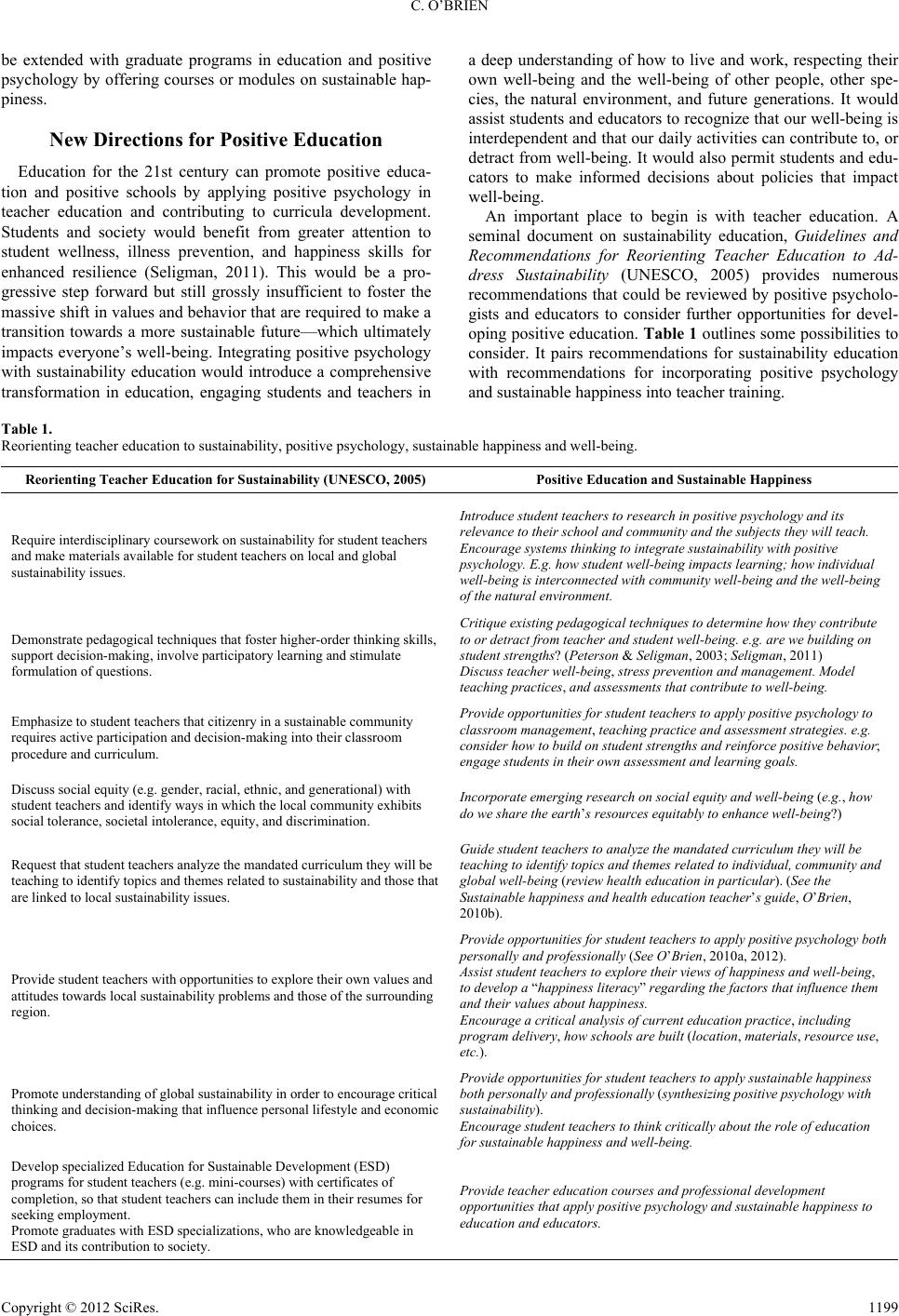 C. O’BRIEN Copyright © 2012 SciRes. 1199 be extended with graduate programs in education and positive psychology by offering courses or modules on sustainable hap- piness. New Directions for Positive Education Education for the 21st century can promote positive educa- tion and positive schools by applying positive psychology in teacher education and contributing to curricula development. Students and society would benefit from greater attention to student wellness, illness prevention, and happiness skills for enhanced resilience (Seligman, 2011). This would be a pro- gressive step forward but still grossly insufficient to foster the massive shift in values and behavior that are required to make a transition towards a more sustainable future—which ultimately impacts everyone’s well-being. Integrating positive psychology with sustainability education would introduce a comprehensive transformation in education, engaging students and teachers in a deep understanding of how to live and work, respecting their own well-being and the well-being of other people, other spe- cies, the natural environment, and future generations. It would assist students and educators to recognize that our well-being is interdependent and that our daily activities can contribute to, or detract from well-being. It would also permit students and edu- cators to make informed decisions about policies that impact well-being. An important place to begin is with teacher education. A seminal document on sustainability education, Guidelines and Recommendations for Reorienting Teacher Education to Ad- dress Sustainability (UNESCO, 2005) provides numerous recommendations that could be reviewed by positive psycholo- gists and educators to consider further opportunities for devel- oping positive education. Table 1 outlines some possibilities to consider. It pairs recommendations for sustainability education with recommendations for incorporating positive psychology and sustainable happiness into teacher training. Table 1. Reorienting teacher e ducation to sustainability, positive psychology, sustainable happiness and well-being. Reorientin g Teacher Education for Sustainability (UNESCO, 2005) Positive E du cation and Sustainable Happiness Require interdisciplinary coursework on sustainability for student teachers and make materials available for student teachers on local and global sustainability issues. Introduce student teachers to research in positive psycholo gy and its relevance to their school and community and the subjects they will teach. Encourage systems thinking to integrate sustainability with p ositive psychology. E.g. how student well-being impac t s l earning; how individ ual well-being is interconnected with community well-being and the well-being of the natural environment. Demonstrate pedagogical techniques that foster higher-order thinking skills, support decision-making, involve participatory learning and stimulat e formulation of questions. Critique ex i sting pedagogical techniques to determine how they contribute to or detract from teacher and student well-being. e.g. are we bu il ding on student strengths? (Peterson & Seligman, 2003; Seligman, 2011) Discuss teacher w ell-being, stress prevention and management. Model teaching practices, and assessments that contribute to we ll-being. Emphasize to student teachers that citizenry in a sustainable community requires active participation and decision-making into their classroom procedure and curriculum. Provide opportunities for student teachers to apply positive psychology to classroom management, teaching practice and assessment strategies. e .g. consider how to build on student strengths and reinforce positive behavior; engage students in the i r own assessme nt and learning goals. Discuss social equity (e.g. gender, racial, ethnic, and generational) with student teachers and identify ways in which the local community exhibits social tolerance, societal intolerance, equity, and discrimination. Incorporate emerging r esearch on social equity and well-being (e.g., how do we share the earth’s res ources equitably to enhance well-being?) Request that student teachers analyze the mandated curriculum they will be teaching to identify topics and themes related to sustainability and those that are linked to local sustainability issues. Guide student teac hers to analyze the mandated curric u lum they will be teaching to identify topics and themes related to individual, community and global well-be ing (review health education in particu l ar). (See the Sustainable happiness and health education teacher’s guide, O’Brien, 2010b). Provide student teachers with opportu n ities to explore their own values and attitudes towards local sustainability problems and those of the surrounding region. Provide opportunities for student teacher s to apply positive psychology both personally and professionally (See O’Brien, 20 10a, 2012). Assist student teachers to explore their views of happiness and well-being, to develop a “happiness literacy” regarding the factors that influence them and their values about happiness. Encourage a critical analysis of current education practice, incl uding program delivery, how schoo l s are built (location, materials, resource use, etc.). Promote unde rstanding of gl obal sustainability in order to encourage critical thinking and decision-making that influence personal lifestyle and econo mic choices. Provide opportunities for student teachers to apply sustainable happiness both personally and professionally (synt hesizing pos it ive psychology with sustainability). Encourage student teachers to think critically about the role of education for sustainable happiness and well-b eing. Develop specialized Education for Sustainable Development (ESD) programs for student teachers (e.g. mini-courses) with certificates of completion, so that student teachers can include them in their resumes for seeking employment. Promote grad u ates with ESD specializations, who are knowledgeable in ESD and its contribution to society. Provide teacher education courses and professional development opportunities that apply positive p sychology and sustainable happiness to education and educators. 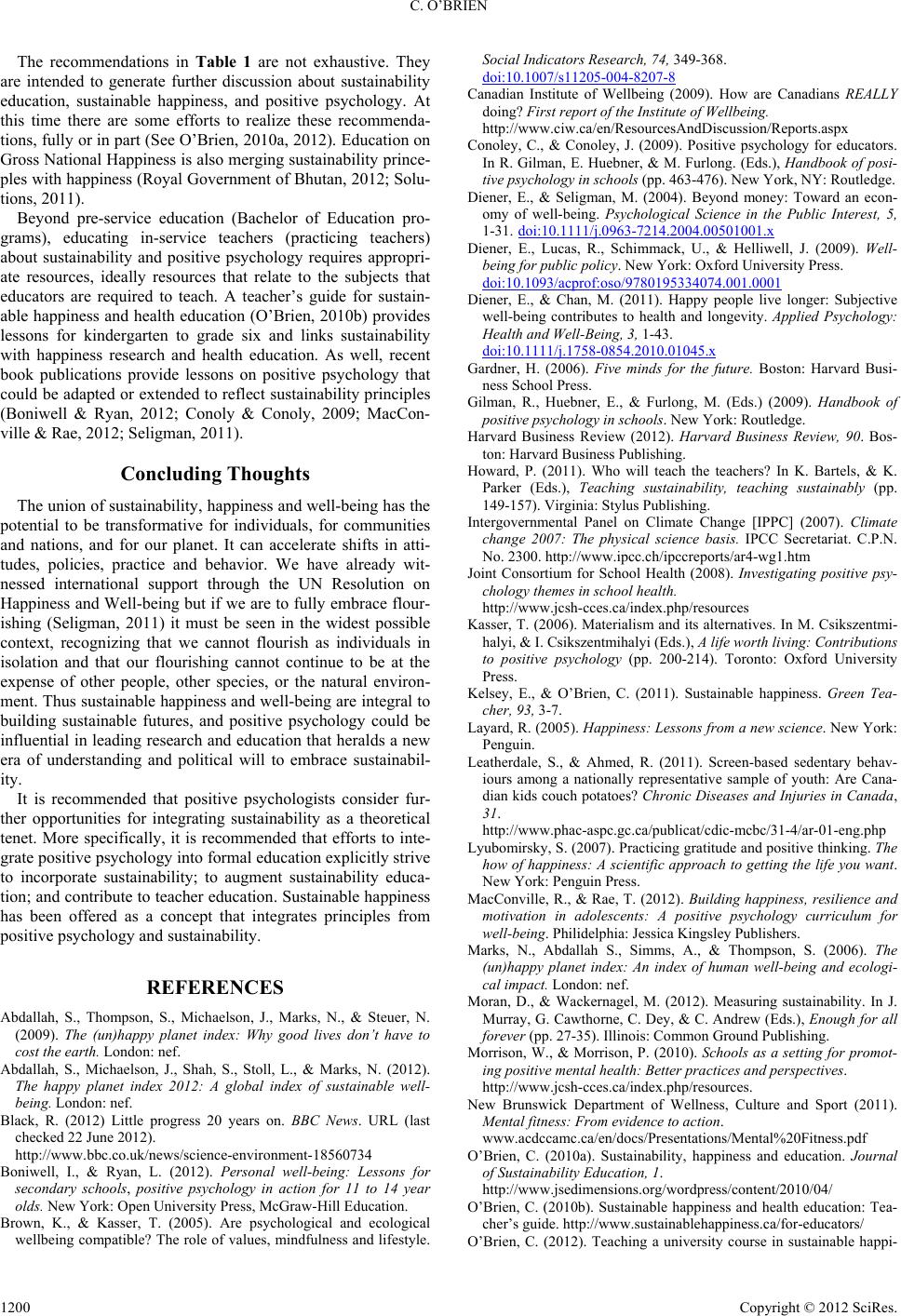 C. O’BRIEN The recommendations in Table 1 are not exhaustive. They are intended to generate further discussion about sustainability education, sustainable happiness, and positive psychology. At this time there are some efforts to realize these recommenda- tions, fully or in part (See O’Brien, 2010a, 2012). Education on Gross National Happiness is also merging sustainability prince- ples with happiness (Royal Government of Bhutan, 2012; Solu- tions, 2011). Beyond pre-service education (Bachelor of Education pro- grams), educating in-service teachers (practicing teachers) about sustainability and positive psychology requires appropri- ate resources, ideally resources that relate to the subjects that educators are required to teach. A teacher’s guide for sustain- able happiness and health education (O’Brien, 2010b) provides lessons for kindergarten to grade six and links sustainability with happiness research and health education. As well, recent book publications provide lessons on positive psychology that could be adapted or extended to reflect sustainability principles (Boniwell & Ryan, 2012; Conoly & Conoly, 2009; MacCon- ville & Rae, 2012; Seligman, 2011). Concluding Thoughts The union of sustainability, happiness and well-being has the potential to be transformative for individuals, for communities and nations, and for our planet. It can accelerate shifts in atti- tudes, policies, practice and behavior. We have already wit- nessed international support through the UN Resolution on Happiness and Well-being but if we are to fully embrace flour- ishing (Seligman, 2011) it must be seen in the widest possible context, recognizing that we cannot flourish as individuals in isolation and that our flourishing cannot continue to be at the expense of other people, other species, or the natural environ- ment. Thus sustainable happiness and well-being ar e integral to building sustainable futures, and positive psychology could be influential in leading research and education that heralds a new era of understanding and political will to embrace sustainabil- ity. It is recommended that positive psychologists consider fur- ther opportunities for integrating sustainability as a theoretical tenet. More specifically, it is recommended that efforts to inte- grate positive psychology into formal education explicitly strive to incorporate sustainability; to augment sustainability educa- tion; and contribute to teacher education. Sustainable happiness has been offered as a concept that integrates principles from positive psychology and sustainability. REFERENCES Abdallah, S., Thompson, S., Michaelson, J., Marks, N., & Steuer, N. (2009). The (un)happy planet index: Why good lives don’t have to cost the earth. London: nef. Abdallah, S., Michaelson, J., Shah, S., Stoll, L., & Marks, N. (2012). The happy planet index 2012: A global index of sustainable well- being. London: nef. Black, R. (2012) Little progress 20 years on. BBC News. URL (last checked 22 June 2012). http://www.bbc.co.uk/news/science-environment-18560734 Boniwell, I., & Ryan, L. (2012). Personal well-being: Lessons for secondary schools, positive psychology in action for 11 to 14 year olds. New York: Open University Press, McGraw-Hill Education. Brown, K., & Kasser, T. (2005). Are psychological and ecological wellbeing compatible? The role of values, mindfulness and lifestyle. Social Indicators Resea rc h, 74, 349-368. doi:10.1007/s11205-004-8207-8 Canadian Institute of Wellbeing (2009). How are Canadians REALLY doing? First report of the Institute of Wellbeing. http://www.ciw.ca/en/ResourcesAndDiscussion/Reports.aspx Conoley, C., & Conoley, J. (2009). Positive psychology for educators. In R. Gilman, E. Huebner, & M. Furlong. (Eds.), Handbook of posi- tive psychology in schools (pp. 463-476). New York, NY: Routledge. Diener, E., & Seligman, M. (2004). Beyond money: Toward an econ- omy of well-being. Psychological Science in the Public Interest, 5, 1-31. doi:10.1111/j.0963-7214.2004.00501001.x Diener, E., Lucas, R., Schimmack, U., & Helliwell, J. (2009). Well- being for public policy. New York: Oxford University Press. doi:10.1093/acprof:oso/9780195334074.001.0001 Diener, E., & Chan, M. (2011). Happy people live longer: Subjective well-being contributes to health and longevity. Applied Psychology: Health and Well-Being, 3, 1-43. doi:10.1111/j.1758-0854.2010.01045.x Gardner, H. (2006). Five minds for the future. Boston: Harvard Busi- ness School Press. Gilman, R., Huebner, E., & Furlong, M. (Eds.) (2009). Handbook of positive psychology in sch o o ls. New York: Routledge. Harvard Business Review (2012). Harvard Business Review, 90. Bos- ton: Harvard Business Publishing . Howard, P. (2011). Who will teach the teachers? In K. Bartels, & K. Parker (Eds.), Teaching sustainability, teaching sustainably (pp. 149-157). Virginia: Stylus Publishing. Intergovernmental Panel on Climate Change [IPPC] (2007). Climate change 2007: The physical science basis. IPCC Secretariat. C.P.N. No. 2300. http://www.ipcc.ch/ipccreports/ar4-wg1.htm Joint Consortium for School Health (2008). Investigating positive psy- chology themes in school health. http://www.jcsh-cces.ca/index.php/resources Kasser, T. (2006). Materialism and its alternatives. In M. Csikszentmi- halyi, & I. Csikszentmihalyi (Eds.), A life worth living: Contributions to positive psychology (pp. 200-214). Toronto: Oxford University Press. Kelsey, E., & O’Brien, C. (2011). Sustainable happiness. Green Tea- cher, 93, 3-7. Layard, R. (2005). Happiness: Lessons from a new science. New York: Penguin. Leatherdale, S., & Ahmed, R. (2011). Screen-based sedentary behav- iours among a nationally representative sample of youth: Are Cana- dian kids couch potatoes? Chronic Diseases and Injuries in Canada, 31. http://www.phac-aspc.gc.ca/publicat/cdic-mcbc/31-4/ar-01-eng.php Lyubomirsky, S. (2007). Practicing gratitude and positive thinking. The how of happiness: A scientific approach to getting the life you want. New York: Penguin Press. MacConville, R., & Rae, T. (2012). Building happiness, resilience and motivation in adolescents: A positive psychology curriculum for well-being. Philidelphia: Jessica Kingsley Publishers. Marks, N., Abdallah S., Simms, A., & Thompson, S. (2006). The (un)happy planet index: An index of human well-being and ecologi- cal impact. London: nef. Moran, D., & Wackernagel, M. (2012). Measuring sustainability. In J. Murray, G. Cawtho rne, C. Dey, & C. Andrew (Eds.), Enough for all forever (pp. 27-35). Illinois: Common Ground Publishing. Morrison, W., & Morrison, P. (2010). Schools as a setting for promot- ing positive mental health: Better practices and perspectives. http://www.jcsh-cces.ca/index.php/resources. New Brunswick Department of Wellness, Culture and Sport (2011). Mental fitness: From evidence to action. www.acdccamc.ca/en/docs/Presentations/Mental%20Fitness.pdf O’Brien, C. (2010a). Sustainability, happiness and education. Journal of Sustainability Edu cation, 1. http://www.jsedimensions.org/wordpress/content/2010/04/ O’Brien, C. (2010b). Sustainable happiness and health education: Tea- cher’s guide. http://www.sustainableha ppiness.ca/for-educators/ O’Brien, C. (2012). Teaching a university course in sustainable happi- Copyright © 2012 SciRes. 1200  C. O’BRIEN ness. Solutions, 3. http://www.thesolutionsjournal.com/node/1108 Orr, D. W. (2012). Can we avoid the perfect storm? Solutions, 3. http://www.thesolutionsjournal.com/node/1124 Peterson, C., & Seligman, M. (Eds.), (2003). Values in action (VIA): Classification of strengths and virtues. Cincinnati, OH: Oxford Uni- versity Press. Ramanathan, S., O'Brien, C., Stone, M. R., Faulkner, G., & Cook, L. (2012). Canadian school travel planning: Well-being and the school journey. Canadian Public Health Association Annual Conference, Edmonton. Rideout, V., Foehr, U., & Roberts, D. (2010). Generation M2: Media in the lives of 8- to 18-year-olds. Kaiser Family Foundation Stud y. http://www.kff.org/entmedia/8010.cfm Royal Government of Bhutan (2012). The report of the high-level meeting on wellbeing and happiness: Defining a new economic paradigm. New York: The Permanent Mission of the Kingdom of Bhutan to the United Nations. Thimphu: Office of the Prime Minister. http://www.2apr.gov.bt/ Sachs, J. (2012). Chapter 1: Introduction. In J. F. Helliwell, R. Layard, & J. Sachs (Eds.), World happiness report (pp. 2-9). New York: The Earth Institute, Columbia University. http://www.earth.columbia.edu/sitefiles/file/Sachs%20Writing/2012/ World%20Happiness%20Report.pdf Seligman, M. (2011). Flourish. Toronto: Free Press. Senge, P. (2012). Creating the schools of the future: Education for a sustainable society. Solutions, 3. http://www.thesolutionsjournal.com/node/1116 Solutions (2011). Teaching happiness: The Prime minister of Bhutan takes on education. http://www.thesolutionsjournal.com/node/934 Steptoe, A., Wardle, J., & Marmot, M. (2005). Positive affect and health-related neuroendocrine, cardiovascular, and inflammatory pro- cess. Proceedings of the National Academy of Sciences, 102, 6508- 6512. doi:10.1073/pnas.0409174102 Stutz, J. (2006). The role of well-being in a great transition. GTI Paper Series No. 10, Tellus Institute. https://www.gtinitiative.org/documents/PDFFINALS/10WellBeing.p df Thinley, J. Y. (2012). Sustainability and happiness: A development philosophy for Bhutan and the world, Solutions, 3. http://www.thesolutionsjournal.com/node/1121 Turcotte, M. (2006). Like commuting? Workers’ perceptions of their daily commute, Canadian Social Trends, Statistics Canada. http://www.statcan.gc.ca/pub/11-008-x/2006004/9516-eng.htm United Nations (2011). Happiness should have a greater role in devel- opment policy—UN Member States. UN News Centre. http://www.un.org/apps/news/story.asp?NewsID=39084 United Nations (2012a). The millennium development goals report. New York: United Nations. http://www.un.org/en/development/desa/publications/mdg-report-20 12.html UN (2012b). United Nations Secretary-General’s High-Level Panel on Global Sustainability. Resilient people, resilient planet: A future worth choosing, Overview. New York: United Nations. http://www.un.org/gsp/report UNESCO. (2005). Guidelines and recommendations for reorienting teacher education to address sustainability. Education for sustain- able development in action. Technical paper No. 2. http://unesdoc.unesco.org/images/0014/001433/143370E.pdf Ura, K., Alkire, S., & Zangmo, T. (2012). Case Study: Bhutan Gross National Happiness and the GNH Index. In J. F. Helliwell, R. Layard, & J. Sachs (Eds.), World Happiness Report (pp. 108-148). New York: The Earth Institute, Columbia University. http://www.earth.columbia.edu/sitefiles/file/Sachs%20Writing/2012/ World%20Happiness%20Report.pdf Veenhoven, R. (2008). Healthy happiness: Effects of happiness on physical health and the consequences for preventive health care. Journal of Happiness Studie s, 9, 449-469. World Commission on Environment and Development (1987). Our common future. Toronto: Oxford Universit y Press. Copyright © 2012 SciRes. 1201 |