

Paper Menu >>
Journal Menu >>
 Crystal Structure Theory and Applications, 2012, 1, 79-83 http://dx.doi.org/10.4236/csta.2012.13015 Published Online December 2012 (http://www.SciRP.org/journal/csta) Mechanical and Dielectric Properties of InTe Crystals Teena Mathew1, Ayyappacharuparambil Gopalanachary Kunjomana1*, Keelapattu Munirathnam1, Kunnath Appukuttan Chandrasekharan1, Muthukrishnan Meena2, Chelliah Kamalakshiammal Mahadevan2 1Research Centre, Department of Physics, Christ University, Bangalore, India 2Physics Research Centre, S. T. Hindu College, Nagercoil, India Email: *[email protected] Received October 15, 2012; revised November 17, 2012; accepted November 26, 2012 ABSTRACT The mechanical properties of indium telluride (InTe) crystals grown by the Bridgman technique were investigated at room temperature using a Vickers hardness tester. The microhardness is observed to vary nonlinearly with the applied load, 10 - 100 g. The cleaved ingots are found to have high value of microhardness (222.44 kg/mm2 at a load of 25 g), which reflects an appreciable degree of strength due to their covalent bonding and homogeneity. The studies revealed that the dislocations in the grown crystals offered a resistance to fresh dislocations due to interaction. At higher loads, plastic deformation induces by slip, exhibiting a decrease in hardness from the peak value. The dielectric constant and dielectric loss of indium telluride crystals were evaluated in the frequency range, 1 kHz - 1 MHz for different tempera- tures (35˚C - 140˚C). The frequency dependence of AC conductivity was analyzed as a function of temperature. The effect of temperature and frequency on the dielectric response of InTe crystals has been assessed on their cleavage faces and the obtained results are discussed. Keywords: Indium Telluride; Bridgman Technique; Microhardness; Dielectric Constant; Dielectric Loss; AC Conductivity 1. Introduction Indium telluride (InTe), a prominent semiconducting III- VI compound, finds potential application in the fabrica- tion of switching devices and has been used in semicon- ductor hetero-structures [1,2]. Among all the mechanical properties, hardness is a key factor governing the quality of such structures. Hence, considerable literature [3-6] exists on the microhardness studies of compound semi- conducting crystals. The anisotropy of mechanical pro- perties is associated with structural defects, chemical bonding, plastic deformation and their tendency towards crack formation and cleavage. Kunjomana and Chand- rasekharan [3] have carried out the microindentation analysis on the prism faces of GaTe whiskers. The effect of annealing on the microhardness of zone-melted InxBi2−xTe3 (x = 0.1 to 0.5 at% In) was studied by Pandya et al. [4]. The mechanical properties of pure and doped InP have also been investigated [5]. It is reported that impurity hardening is much more pronounced at high temperatures than at room temperature. Arivuoli et al. [6] have described the growth and microhardness studies of arsenic, antimony and bismuth chalcogenides. However, the microindentation analysis of indium monotelluride crystals has not been reported so far. Under controlled conditions, InTe crystallizes in a layer structure with the space group I4/mcm as described by Chattopadhyay et al. [7]. There exists strong covalent bonding within the layer planes with weak van der Waals bonding perpendicular to them, resulting in easy clea- vage. The studies on the dielectric behaviour of chalco- genide materials are advantageous for understanding their conduction mechanism and the origin of dielectric losses [8]. The AC conductivity and dielectric properties of Sb2Te3 thin films have been investigated in the fre- quency range, 0.4 - 100 kHz as a function of temperature [9]. Hegab et al. [10] have evaluated the dielectric pro- perties and frequency dependence of AC conductivity of amorphous Ge15Se60X25 (X = As or Sn) thin films depo- sited by thermal evaporation. Bose and Purkayastha [11] have determined the dielectric constants of In2Te3 crys- tals grown by the Bridgman method. But, InTe, being a member of III-VI family, is less investigated, as far as its dielectric properties are concerned. In view of the above considerations, the present report aims to investigate the mechanical and dielectric properties of indium monotel- luride crystals. *Corresponding author. C opyright © 2012 SciRes. CSTA 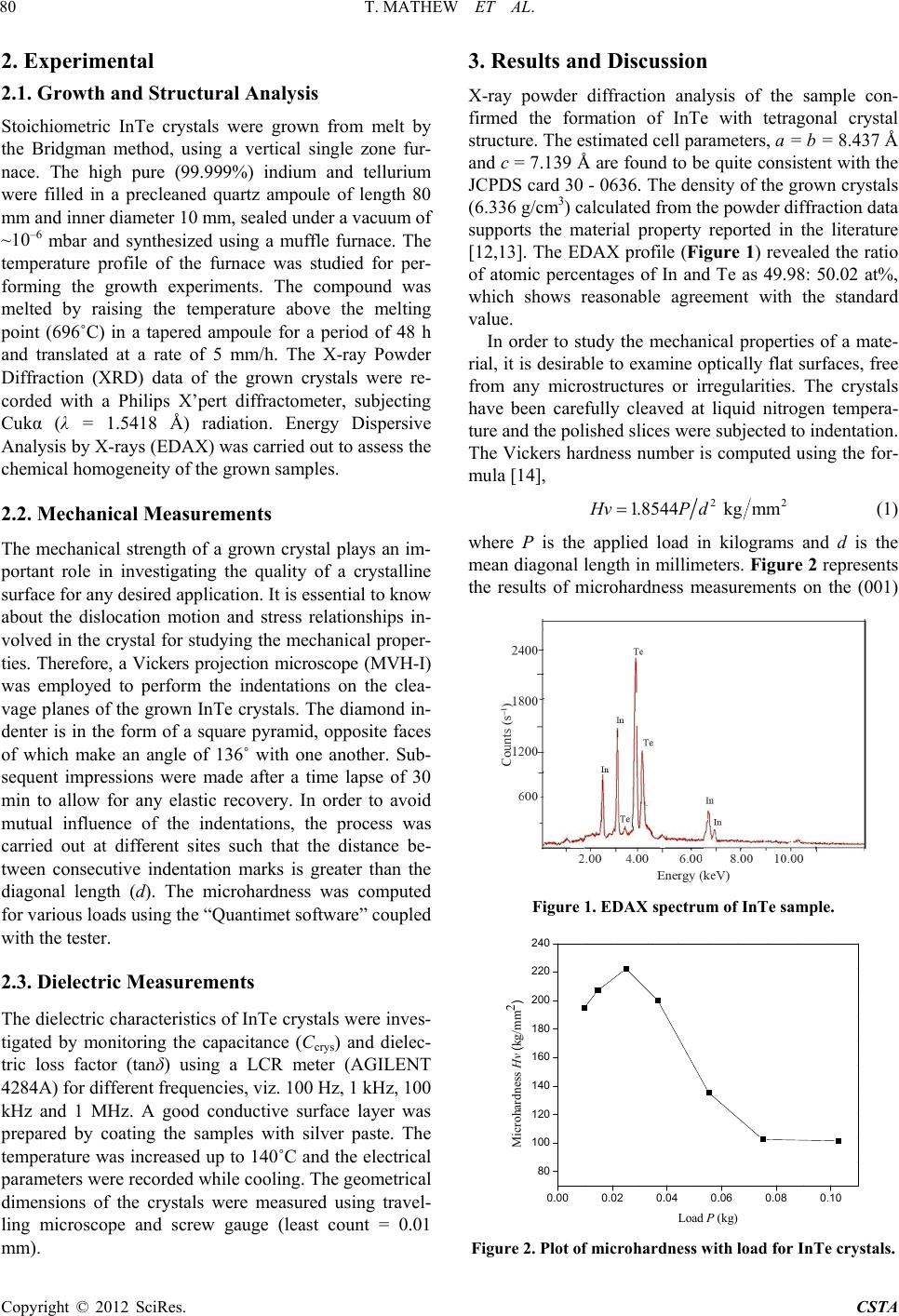 T. MATHEW ET AL. 80 2. Experimental 2.1. Growth and Structural Analysis Stoichiometric InTe crystals were grown from melt by the Bridgman method, using a vertical single zone fur- nace. The high pure (99.999%) indium and tellurium were filled in a precleaned quartz ampoule of length 80 mm and inner diameter 10 mm, sealed under a vacuum of ~10–6 mbar and synthesized using a muffle furnace. The temperature profile of the furnace was studied for per- forming the growth experiments. The compound was melted by raising the temperature above the melting point (696˚C) in a tapered ampoule for a period of 48 h and translated at a rate of 5 mm/h. The X-ray Powder Diffraction (XRD) data of the grown crystals were re- corded with a Philips X’pert diffractometer, subjecting Cukα (λ = 1.5418 Å) radiation. Energy Dispersive Analysis by X-rays (EDAX) was carried out to assess the chemical homogeneity of the grown samples. 2.2. Mechanical Measurements The mechanical strength of a grown crystal plays an im- portant role in investigating the quality of a crystalline surface for any desired application. It is essential to know about the dislocation motion and stress relationships in- volved in the crystal for studying the mechanical proper- ties. Therefore, a Vickers projection microscope (MVH-I) was employed to perform the indentations on the clea- vage planes of the grown InTe crystals. The diamond in- denter is in the form of a square pyramid, opposite faces of which make an angle of 136˚ with one another. Sub- sequent impressions were made after a time lapse of 30 min to allow for any elastic recovery. In order to avoid mutual influence of the indentations, the process was carried out at different sites such that the distance be- tween consecutive indentation marks is greater than the diagonal length (d). The microhardness was computed for various loads using the “Quantimet software” coupled with the tester. 2.3. Dielectric Measurements The dielectric characteristics of InTe crystals were inves- tigated by monitoring the capacitance (Ccrys) and dielec- tric loss factor (tanδ) using a LCR meter (AGILENT 4284A) for different frequencies, viz. 100 Hz, 1 kHz, 100 kHz and 1 MHz. A good conductive surface layer was prepared by coating the samples with silver paste. The temperature was increased up to 140˚C and the electrical parameters were recorded while cooling. The geometrical dimensions of the crystals were measured using travel- ling microscope and screw gauge (least count = 0.01 mm). 3. Results and Discussion X-ray powder diffraction analysis of the sample con- firmed the formation of InTe with tetragonal crystal structure. The estimated cell parameters, a = b = 8.437 Å and c = 7.139 Å are found to be quite consistent with the JCPDS card 30 - 0636. The density of the grown crystals (6.336 g/cm3) calculated from the powder diffraction data supports the material property reported in the literature [12,13]. The EDAX profile (Figure 1) revealed the ratio of atomic percentages of In and Te as 49.98: 50.02 at%, which shows reasonable agreement with the standard value. In order to study the mechanical properties of a mate- rial, it is desirable to examine optically flat surfaces, free from any microstructures or irregularities. The crystals have been carefully cleaved at liquid nitrogen tempera- ture and the polished slices were subjected to indentation. The Vickers hardness number is computed using the for- mula [14], 2 1.8544 kgmmHvP d2 (1) where P is the applied load in kilograms and d is the mean diagonal length in millimeters. Figure 2 represents the results of microhardness measurements on the (001) Figure 1. EDAX spectrum of InTe sample. 0.00 0.02 0.04 0.06 0.08 0.10 80 100 120 140 160 180 200 220 240 Microhardness Hv (kg/mm2) Load P (kg) Figure 2. Plot of microhardness with load for InTe crystals. Copyright © 2012 SciRes. CSTA 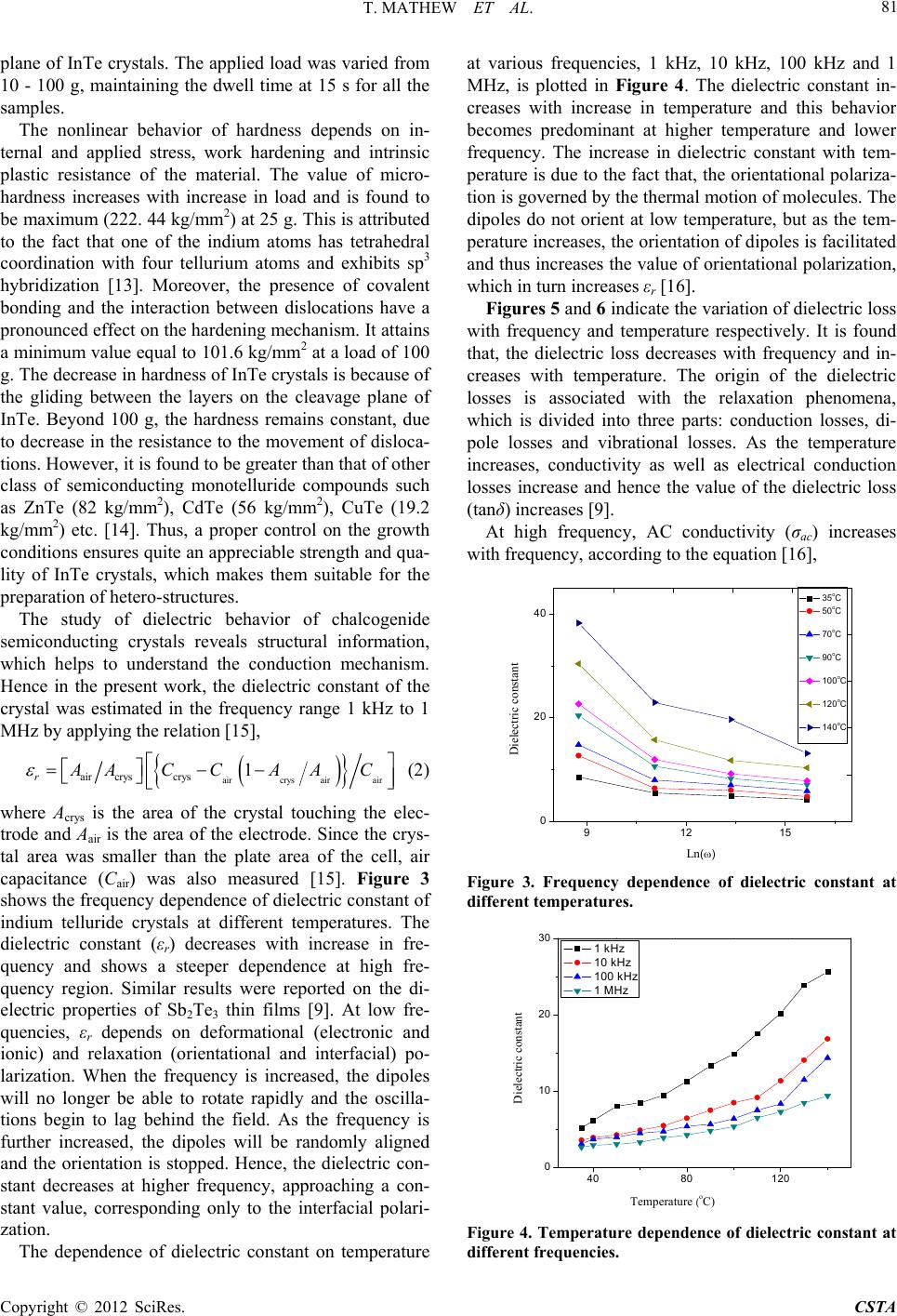 T. MATHEW ET AL. 81 plane of InTe crystals. The applied load was varied from 10 - 100 g, maintaining the dwell time at 15 s for all the samples. The nonlinear behavior of hardness depends on in- ternal and applied stress, work hardening and intrinsic plastic resistance of the material. The value of micro- hardness increases with increase in load and is found to be maximum (222. 44 kg/mm2) at 25 g. This is attributed to the fact that one of the indium atoms has tetrahedral coordination with four tellurium atoms and exhibits sp3 hybridization [13]. Moreover, the presence of covalent bonding and the interaction between dislocations have a pronounced effect on the hardening mechanism. It attains a minimum value equal to 101.6 kg/mm2 at a load of 100 g. The decrease in hardness of InTe crystals is because of the gliding between the layers on the cleavage plane of InTe. Beyond 100 g, the hardness remains constant, due to decrease in the resistance to the movement of disloca- tions. However, it is found to be greater than that of other class of semiconducting monotelluride compounds such as ZnTe (82 kg/mm2), CdTe (56 kg/mm2), CuTe (19.2 kg/mm2) etc. [14]. Thus, a proper control on the growth conditions ensures quite an appreciable strength and qua- lity of InTe crystals, which makes them suitable for the preparation of hetero-structures. The study of dielectric behavior of chalcogenide semiconducting crystals reveals structural information, which helps to understand the conduction mechanism. Hence in the present work, the dielectric constant of the crystal was estimated in the frequency range 1 kHz to 1 MHz by applying the relation [15], aircrys airair air cryscrys1 rAACCA AC (2) where Acrys is the area of the crystal touching the elec- trode and Aair is the area of the electrode. Since the crys- tal area was smaller than the plate area of the cell, air capacitance (Cair) was also measured [15]. Figure 3 shows the frequency dependence of dielectric constant of indium telluride crystals at different temperatures. The dielectric constant (εr) decreases with increase in fre- quency and shows a steeper dependence at high fre- quency region. Similar results were reported on the di- electric properties of Sb2Te3 thin films [9]. At low fre- quencies, εr depends on deformational (electronic and ionic) and relaxation (orientational and interfacial) po- larization. When the frequency is increased, the dipoles will no longer be able to rotate rapidly and the oscilla- tions begin to lag behind the field. As the frequency is further increased, the dipoles will be randomly aligned and the orientation is stopped. Hence, the dielectric con- stant decreases at higher frequency, approaching a con- stant value, corresponding only to the interfacial polari- zation. The dependence of dielectric constant on temperature at various frequencies, 1 kHz, 10 kHz, 100 kHz and 1 MHz, is plotted in Figure 4. The dielectric constant in- creases with increase in temperature and this behavior becomes predominant at higher temperature and lower frequency. The increase in dielectric constant with tem- perature is due to the fact that, the orientational polariza- tion is governed by the thermal motion of molecules. The dipoles do not orient at low temperature, but as the tem- perature increases, the orientation of dipoles is facilitated and thus increases the value of orientational polarization, which in turn increases εr [16]. Figures 5 and 6 indicate the variation of dielectric loss with frequency and temperature respectively. It is found that, the dielectric loss decreases with frequency and in- creases with temperature. The origin of the dielectric losses is associated with the relaxation phenomena, which is divided into three parts: conduction losses, di- pole losses and vibrational losses. As the temperature increases, conductivity as well as electrical conduction losses increase and hence the value of the dielectric loss (tanδ) increases [9]. At high frequency, AC conductivity (σac) increases with frequency, according to the equation [16], 91215 0 20 40 Dielectric constant Ln() 35oC 50oC 70oC 90oC 100oC 120oC 140oC Figure 3. Frequency dependence of dielectric constant at different temperatures. 4080 120 0 10 20 30 Temperature (oC) Dielectric constant 1 kHz 10 kHz 100 kHz 1 MHz Figure 4. Temperature dependence of dielectric constant at different frequencies. Copyright © 2012 SciRes. CSTA 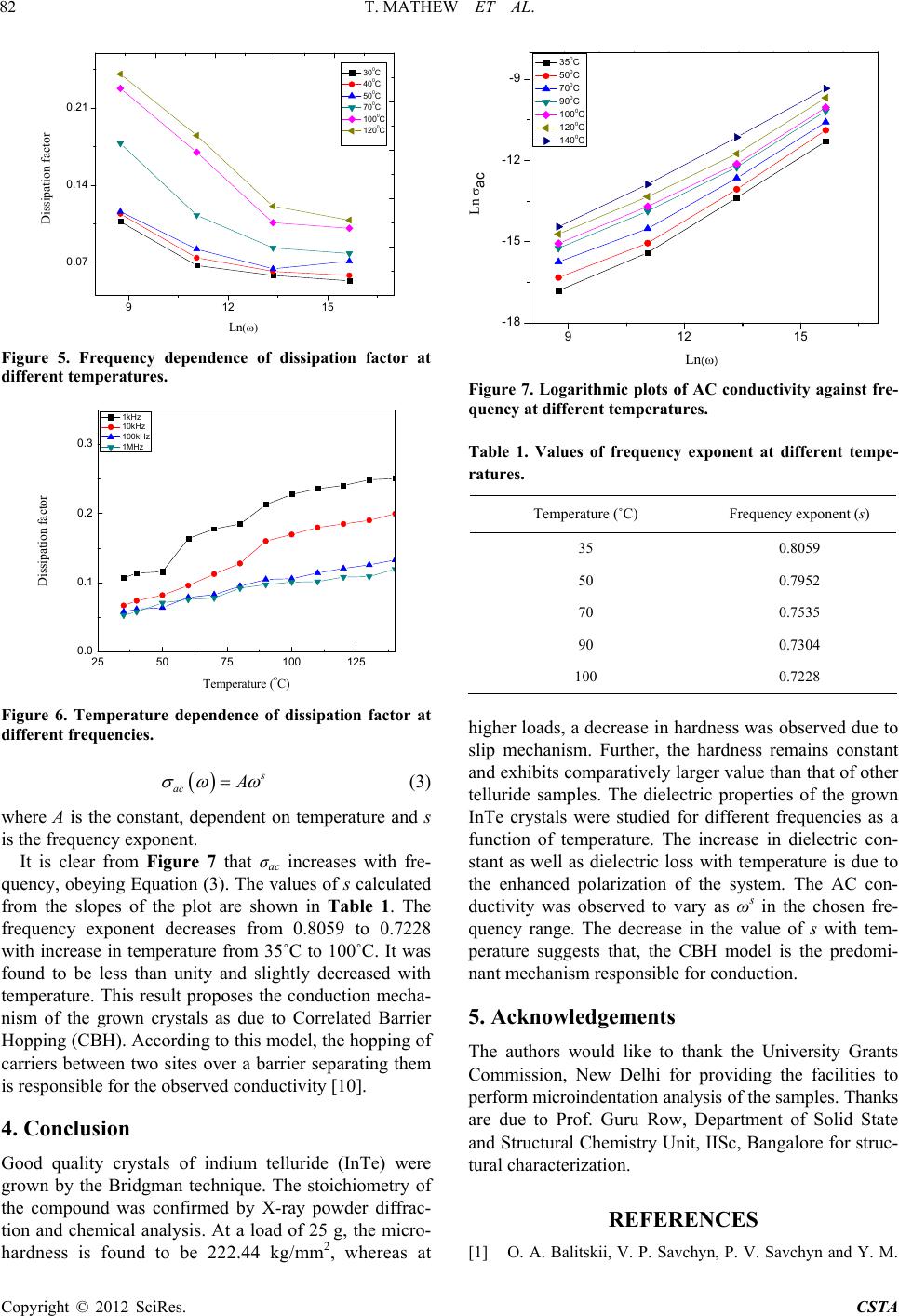 T. MATHEW ET AL. 82 91215 0.07 0.14 0.21 300C 400C 500C 700C 1000C 1200C Dissipation factor Ln Figure 5. Frequency dependence of dissipation factor at different temperatures. 255075100 125 0.0 0.1 0.2 0.3 Dissipation facto r Temperature (oC) 1kHz 10kHz 100kHz 1MHz Figure 6. Temperature dependence of dissipation factor at different frequencies. s ac A (3) where A is the constant, dependent on temperature and s is the frequency exponent. It is clear from Figure 7 that σac increases with fre- quency, obeying Equation (3). The values of s calculated from the slopes of the plot are shown in Table 1. The frequency exponent decreases from 0.8059 to 0.7228 with increase in temperature from 35˚C to 100˚C. It was found to be less than unity and slightly decreased with temperature. This result proposes the conduction mecha- nism of the grown crystals as due to Correlated Barrier Hopping (CBH). According to this model, the hopping of carriers between two sites over a barrier separating them is responsible for the observed conductivity [10]. 4. Conclusion Good quality crystals of indium telluride (InTe) were grown by the Bridgman technique. The stoichiometry of the compound was confirmed by X-ray powder diffrac- tion and chemical analysis. At a load of 25 g, the micro- hardness is found to be 222.44 kg/mm2, whereas at 91215 -18 -15 -12 -9 Ln ac Ln() 350C 500C 700C 900C 1000C 1200C 1400C Figure 7. Logarithmic plots of AC conductivity against fre- quency at different te mper atures. Table 1. Values of frequency exponent at different tempe- ratures. Temperature (˚C) Frequency exponent (s) 35 0.8059 50 0.7952 70 0.7535 90 0.7304 100 0.7228 higher loads, a decrease in hardness was observed due to slip mechanism. Further, the hardness remains constant and exhibits comparatively larger value than that of other telluride samples. The dielectric properties of the grown InTe crystals were studied for different frequencies as a function of temperature. The increase in dielectric con- stant as well as dielectric loss with temperature is due to the enhanced polarization of the system. The AC con- ductivity was observed to vary as ωs in the chosen fre- quency range. The decrease in the value of s with tem- perature suggests that, the CBH model is the predomi- nant mechanism responsible for conduction. 5. Acknowledgements The authors would like to thank the University Grants Commission, New Delhi for providing the facilities to perform microindentation analysis of the samples. Thanks are due to Prof. Guru Row, Department of Solid State and Structural Chemistry Unit, IISc, Bangalore for struc- tural characterization. REFERENCES [1] O. A. Balitskii, V. P. Savchyn, P. V. Savchyn and Y. M. Copyright © 2012 SciRes. CSTA  T. MATHEW ET AL. Copyright © 2012 SciRes. CSTA 83 Fiyala, “Phase Formation in Surface Layers of GaTe and InTe Single Crystals during Thermal Oxidation in Air,” Functional Materials, Vol. 12, No. 2, 2005, pp. 206-211. [2] M. M. Nassary, S. A. Hussein, A. E. Belal and H. A. El-Shalkh, “Investigation of the Switching Phenomena in Indium Monotelluride Single Crystals,” Physica Status Solidi (a), Vol. 145, No. 1, 1994, pp. 151-155. doi:10.1002/pssa.2211450114 [3] A. G. Kunjomana and K. A. Chandrasekharan, “Micro- hardness Studies of GaTe Whiskers,” Crystal Research and Technology, Vol. 40, No. 8, 2005, pp. 782-785. doi:10.1002/crat.200410431 [4] G. R. Pandya, S. R. Bhavsar and P. H. Sony, “Effects of Anisotropy and Annealing on Microhardness of InxBi2-xTe3 (x = 0.1 to 0.5) Single Crystals,” Bulletin of Materials Science, Vol. 22, No. 1, 1999, pp. 15-16. doi:10.1007/BF02745669 [5] Y. S. Boyarskaya, D. Z. Grabko, M. I. Medinskaya and N. A. Palistrant, “Mechanical Properties of Pure and Doped InP Single Crystals Determined under Local Loading,” Semiconductors, Vol. 31, No. 2, 1997, pp. 139-142. doi:10.1134/1.1187095 [6] D. Arivuoli, F. D. Gnanam and P. Ramasamy, “Growth and Microhardness Studies of Chalcogenides of Arsenic, Antimony and Bismuth,” Journal of Materials Science Letters, Vol. 7, No. 7, 1988, pp. 711-713. doi:10.1007/BF00722076 [7] T. Chattopadhyay, R. P. Santandrea and H. G. Von Sch- nering, “Temperature and Pressure Dependence of the Crystal Structure of InTe: A New High Pressure Phase of InTe,” Journal of Physics and Chemistry of Solids, Vol. 46, No. 3, 1985, pp. 351-356. doi:10.1016/0022-3697(85)90178-7 [8] G. K. Solanki, K. D. Patel, N. N. Gosai and B. P. Rahul, “Growth and Dielectric Properties of SnSe0.5Te0.5 Crys- tals,” Research Journal of Chemical Sciences, Vol. 2, No. 10, 2012, pp. 43-48. [9] A. M. Farid, H. E. Atyia and N. A. Hegab, “AC Conduc- tivity and Dielectric Properties of Sb2Te3 Thin Films,” Vacuum, Vol. 80, No. 4, 2005, pp. 284-294. doi:10.1016/j.vacuum.2005.05.003 [10] N. A. Hegab, M. A. Afifi, H. E. Atyia and M. I. Ismael, “AC Conductivity and Dielectric Properties of Amor- phous Ge15Se60X25 (X = As or Sn) Films,” Acta Physica Polonica A, Vol. 119, No. 3, 2001, pp. 416-423. [11] D. N. Bose and S. De Purkayastha, “Dielectric and Photo- conducting Properties of Ga2Te3 and In2Te3 Crystals,” Materials Research Bulletin, Vol. 16, No. 6, 1981, pp. 635-642. doi:10.1016/0025-5408(81)90262-2 [12] S. Pal, D. N. Bose, S. Asokan and E. S. R. Gopal, “Ani- sotropic Properties of the Layered Semiconductor InTe,” Sold State Communications, Vol. 80, No. 9, 1991, pp. 753-756. doi:10.1016/0038-1098(91)90902-8 [13] A. T. Nagat, G. A. Gamal and A. E. Belal, “Experimental Studies on the Thermoelectric Properties of InTe Single Crystals,” Crystal Research and Technology, Vol. 25, No. 4, 1990, pp. 72-77. doi:10.1002/crat.2170250425 [14] V. M. Glazo and V. N. Vigdorovich, “Microhardness of Metals and Semiconductors,” Consultants Bureau, New York, 1971. [15] M. Meena and C. K. Mahadevan, “Effect of Added Impu- rities on the Electrical Properties of L-Arginine Acetate Single Crystals, Archives of Applied Science Research, Vol. 2, No. 6, 2010, pp. 185-199. [16] M. A. M. Seyam, “Dielectric Relaxation in Polycrystal- line Thin Films of In2Te3,” Applied Surface Science, Vol. 181, 2001, pp. 128-138. doi:10.1016/S0169-4332(01)00378-6 |