

Paper Menu >>
Journal Menu >>
 Crystal Structure Theory and Applications, 2012, 1, 68-73 http://dx.doi.org/10.4236/csta.2012.13013 Published Online December 2012 (http://www.SciRP.org/journal/csta) Synthesis, Crystal Structure and Electrical Properties of a New Mixed Compound (Na0.71Ag0.29)2CoP2O7 Riadh Marzouki1, Abderrahmen Guesmi1,2, Mohamed Faouzi Zid1*, Ahmed Driss1 1Département de Chimie, Faculté des Sciences, Université Tunis El Manar, Tunis, Tunisie 2Institut Préparatoire aux Etudes d’Ingénieur, Université Tunis El Manar, Tunis, Tunisie Email: *[email protected] Received October 9, 2012; revised November 15, 2012; accepted November 24, 2012 ABSTRACT A new cobalt diphosphate (Na0.71Ag0.29)2CoP2O7, is synthesized by solid state reaction method and characterized by single-crystal X-ray diffraction. The title material crystallizes in the triclinic space group P-1 with a = 6.4170(3) Å, b = 9.4510(2) Å, c = 10.9350(3) Å, = 115.240(2)˚, = 80.190(3)˚ and = 106.810(2)˚. The structure presents a centro-symmetrical clusters Co4P4O28 consists of two Co2O11 units and two P2O7 pyrophosphate groups. The junction between clusters is assured by two P2O7 groups to form a three-dimensional anionic framework having different inter- connecting tunnels running along [100] and [010]. The former contains the Na+ and Ag+ cations. The conductivity measurements of (Na0.71Ag0.29)2CoP2O7 are studied over a temperature interval from 783 to 903 K using the frequency response analyzer with 0.5 V amplitude signal over the range of 13 MHz - 5 Hz. Keywords: Diphosphate; X-Ray Diffraction; Anionic Framework; Tunnels; Conductivity 1. Introduction Phosphate materials have vast applications in several domains as electric, pyroelectric, ferroelectric, magnetic, catalytic processes, state laser materials, etc. [1-7]. Dur- ing the last years, there have been many studies of the compounds with general formula A2BP2O7 (A = mono- valent cation, B = divalent ion) concerned the structural features and the electrical properties [8-12]. With regard to cobalt phases members, electrical studies were per- formed only for the tetragonal formula Na2CoP2O7 (bidi- mensional) [8]. It shows that the latter is an ionic con- ductor material. We have now prepared a new mixed di- phosphate of the triclinic form. The synthesis, the struc- tural study and the electrical properties of (Na0.71Ag0.29)2CoP2O7 (tridimensional) material are dis- cussed here. 2. Experimental 2.1. Synthesis of the Title Compound A mixture of high-purity reagents (NaNO3/AgN O3, Co(NO3)2·6H2O and NH4H2PO4) as polycrystalline form, with a Na:Ag:Co:P molar ratio of 1:1:1:2, is dissolved in deionised water to give a pink solution. After evaporation to dryness at 70˚C in the oven, the residue, placed in porcelain crucible, is slowly annealed in air to 400˚C for 24 h, in order to eliminate volatile products. In a second step, it was progressively heated at 620˚C for 5 days. The sample was slowly cooled at 5˚C/24 h to 580˚C and fi- nally quenched to room temperature. Purple single crys- tals of the title compound are extracted from the flux matrix with boiling water. A qualitative EDX (energy- dispersive X-ray spectroscopy) analysis (model: Philips XL 30) detected the presence of Na, Ag, Co, P and oxy- gen elements. A polycrystalline powder of (Na0.71Ag0.29)2 CoP2O7 was obtained by treating a stoichiometric mix- ture of the above reagents. The powder X-ray diffraction pattern was in agreement with single-crystal structure. 2.2. Materials and Physical Measurements Impedance spectroscopy measurements were carried out in a Hewlet-Packar 4192-A automatic bridge monitored by a HP microcomputer. Impedance spectra were re- corded in the 13 MHz - 5 Hz frequency range with 0.5 V alternative signal. Pellet was prepared by uniaxial shap- ing followed by isostatic pressing at 2.5 kbar and sinter- ing at 540˚C for 2 h in air with 5 K·min–1 heating and cooling rates. The thickness and surface of pellet were about 0.356 cm and 0.454 cm2 having a geometric factor of e/S = 0.78 cm–1. Platinum electrodes were painted in the two faces of the pellet with a platinum paste to ensure good electric contacts and then painted pellet was carried out at steady-state temperatures in still air. *Corresponding author. C opyright © 2012 SciRes. CSTA 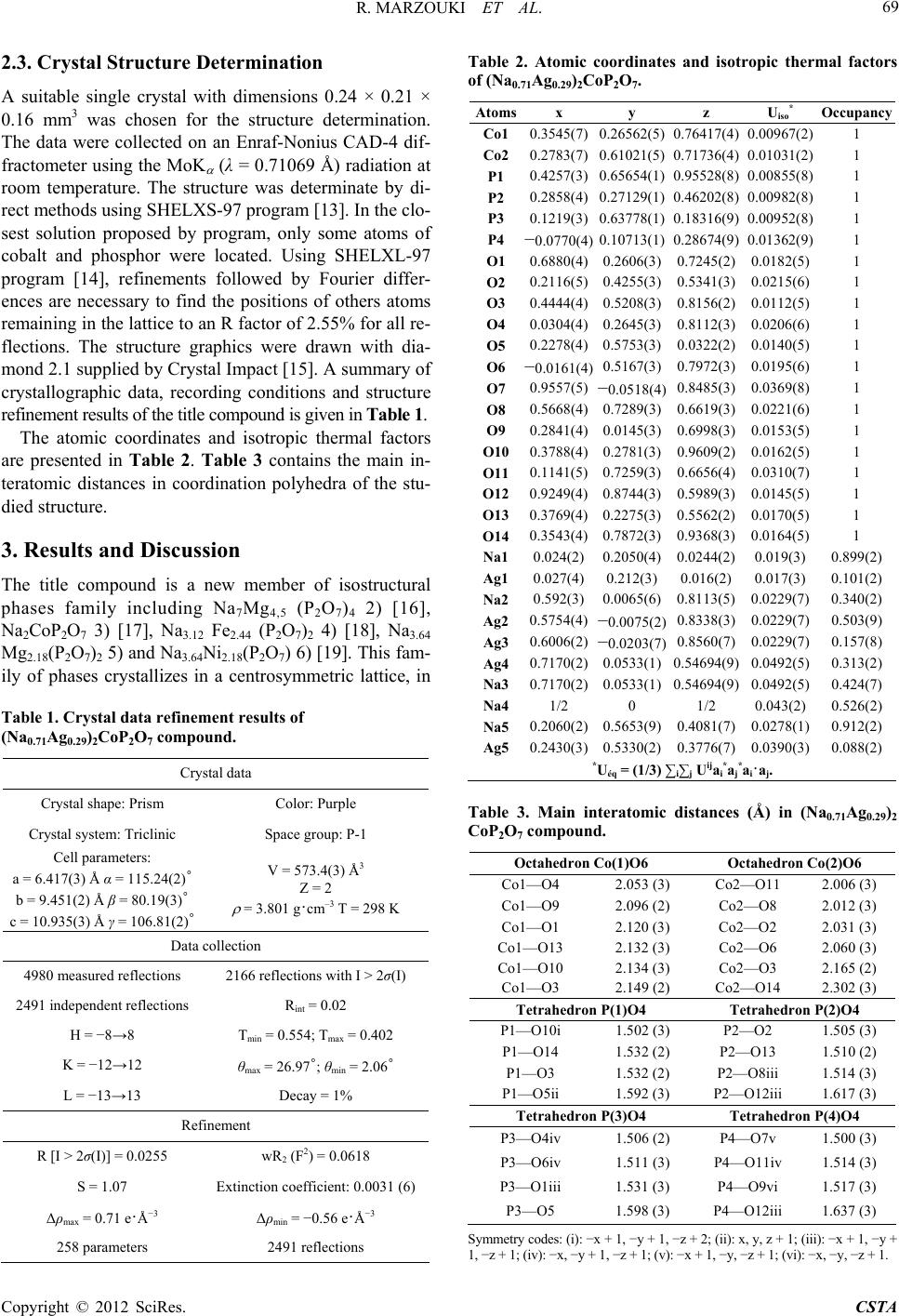 R. MARZOUKI ET AL. 69 2.3. Crystal Structure Determination A suitable single crystal with dimensions 0.24 × 0.21 × 0.16 mm3 was chosen for the structure determination. The data were collected on an Enraf-Nonius CAD-4 dif- fractometer using the MoK (λ = 0.71069 Å) radiation at room temperature. The structure was determinate by di- rect methods using SHELXS-97 program [13]. In the clo- sest solution proposed by program, only some atoms of cobalt and phosphor were located. Using SHELXL-97 program [14], refinements followed by Fourier differ- ences are necessary to find the positions of others atoms remaining in the lattice to an R factor of 2.55% for all re- flections. The structure graphics were drawn with dia- mond 2.1 supplied by Crystal Impact [15]. A summary of crystallographic data, recording conditions and structure refinement results of the title compound is given in Table 1. The atomic coordinates and isotropic thermal factors are presented in Table 2. Table 3 contains the main in- teratomic distances in coordination polyhedra of the stu- died structure. 3. Results and Discussion The title compound is a new member of isostructural phases family including Na7Mg4,5 (P2O7)4 2) [16], Na2CoP2O7 3) [17], Na3.12 Fe2.44 (P2O7)2 4) [18], Na3.64 Mg2.18(P2O7)2 5) and Na3.64Ni2.18(P2O7) 6) [19]. This fam- ily of phases crystallizes in a centrosymmetric lattice, in Table 1. Crystal data refinement results of (Na0.71Ag0.29)2CoP2O7 compound. Crystal data Crystal shape: Prism Color: Purple Crystal system: Triclinic Space group: P-1 Cell parameters: a = 6.417(3) Å α = 115.24(2)˚ b = 9.451(2) Å β = 80.19(3)˚ c = 10.935(3) Å γ = 106.81(2)˚ V = 573.4(3) Å3 Z = 2 = 3.801 g·cm–3 T = 298 K Data collection 4980 measured reflections 2166 reflections with I > 2σ(I) 2491 independent reflections Rint = 0.02 H = −8→8 Tmin = 0.554; Tmax = 0.402 K = −12→12 θmax = 26.97˚; θmin = 2.06˚ L = −13→13 Decay = 1% Refinement R [I > 2σ(I)] = 0.0255 wR2 (F2) = 0.0618 S = 1.07 Extinction coefficient: 0.0031 (6) Δρmax = 0.71 e·Å−3 Δρmin = −0.56 e·Å−3 258 parameters 2491 reflections Table 2. Atomic coordinates and isotropic thermal factors of (Na0.71Ag0.29)2CoP2O7. Atomsx y z Uiso* Occupancy Co1 0.3545(7)0.26562(5)0.76417(4) 0.00967(2)1 Co2 0.2783(7)0.61021(5)0.71736(4) 0.01031(2)1 P1 0.4257(3)0.65654(1)0.95528(8) 0.00855(8)1 P2 0.2858(4)0.27129(1)0.46202(8) 0.00982(8)1 P3 0.1219(3)0.63778(1)0.18316(9) 0.00952(8)1 P4 −0.0770(4)0.10713(1)0.28674(9) 0.01362(9)1 O1 0.6880(4)0.2606(3)0.7245(2) 0.0182(5) 1 O2 0.2116(5)0.4255(3)0.5341(3) 0.0215(6) 1 O3 0.4444(4)0.5208(3)0.8156(2) 0.0112(5) 1 O4 0.0304(4)0.2645(3)0.8112(3) 0.0206(6) 1 O5 0.2278(4)0.5753(3)0.0322(2) 0.0140(5) 1 O6 −0.0161(4)0.5167(3)0.7972(3) 0.0195(6) 1 O7 0.9557(5)−0.0518(4)0.8485(3) 0.0369(8) 1 O8 0.5668(4)0.7289(3)0.6619(3) 0.0221(6) 1 O9 0.2841(4)0.0145(3)0.6998(3) 0.0153(5) 1 O10 0.3788(4)0.2781(3)0.9609(2) 0.0162(5) 1 O11 0.1141(5)0.7259(3)0.6656(4) 0.0310(7) 1 O12 0.9249(4)0.8744(3)0.5989(3) 0.0145(5) 1 O13 0.3769(4)0.2275(3)0.5562(2) 0.0170(5) 1 O14 0.3543(4)0.7872(3)0.9368(3) 0.0164(5) 1 Na1 0.024(2)0.2050(4)0.0244(2) 0.019(3) 0.899(2) Ag1 0.027(4)0.212(3)0.016(2) 0.017(3) 0.101(2) Na2 0.592(3)0.0065(6)0.8113(5) 0.0229(7) 0.340(2) Ag2 0.5754(4) −0.0075(2) 0.8338(3) 0.0229(7) 0.503(9) Ag3 0.6006(2) −0.0203(7) 0.8560(7) 0.0229(7) 0.157(8) Ag4 0.7170(2)0.0533(1)0.54694(9) 0.0492(5) 0.313(2) Na3 0.7170(2)0.0533(1)0.54694(9) 0.0492(5) 0.424(7) Na4 1/2 0 1/2 0.043(2) 0.526(2) Na5 0.2060(2)0.5653(9)0.4081(7) 0.0278(1) 0.912(2) Ag5 0.2430(3)0.5330(2)0.3776(7) 0.0390(3) 0.088(2) *Uéq = (1/3) ∑i∑j Uijai*aj*ai·aj. Table 3. Main interatomic distances (Å) in (Na0.71Ag0.29)2 CoP2O7 compound. Octahedron Co(1)O6 Octahedron Co(2)O6 Co1—O4 2.053 (3) Co2—O11 2.006 (3) Co1—O9 2.096 (2) Co2—O8 2.012 (3) Co1—O1 2.120 (3) Co2—O2 2.031 (3) Co1—O13 2.132 (3) Co2—O6 2.060 (3) Co1—O10 2.134 (3) Co2—O3 2.165 (2) Co1—O3 2.149 (2) Co2—O14 2.302 (3) Tetrahedron P(1)O4 Tetrahedron P(2)O4 P1—O10i 1.502 (3) P2—O2 1.505 (3) P1—O14 1.532 (2) P2—O13 1.510 (2) P1—O3 1.532 (2) P2—O8iii 1.514 (3) P1—O5ii 1.592 (3) P2—O12iii 1.617 (3) Tetrahedron P(3)O4 Tetrahedron P(4)O4 P3—O4iv 1.506 (2) P4—O7v 1.500 (3) P3—O6iv 1.511 (3) P4—O11iv 1.514 (3) P3—O1iii 1.531 (3) P4—O9vi 1.517 (3) P3—O5 1.598 (3) P4—O12iii 1.637 (3) Symmetry codes: (i): −x + 1, −y + 1, −z + 2; (ii): x, y, z + 1; (iii): −x + 1, −y + 1, −z + 1; (iv): −x, −y + 1, −z + 1; (v): −x + 1, −y, −z + 1; (vi): −x, −y, −z + 1. Copyright © 2012 SciRes. CSTA 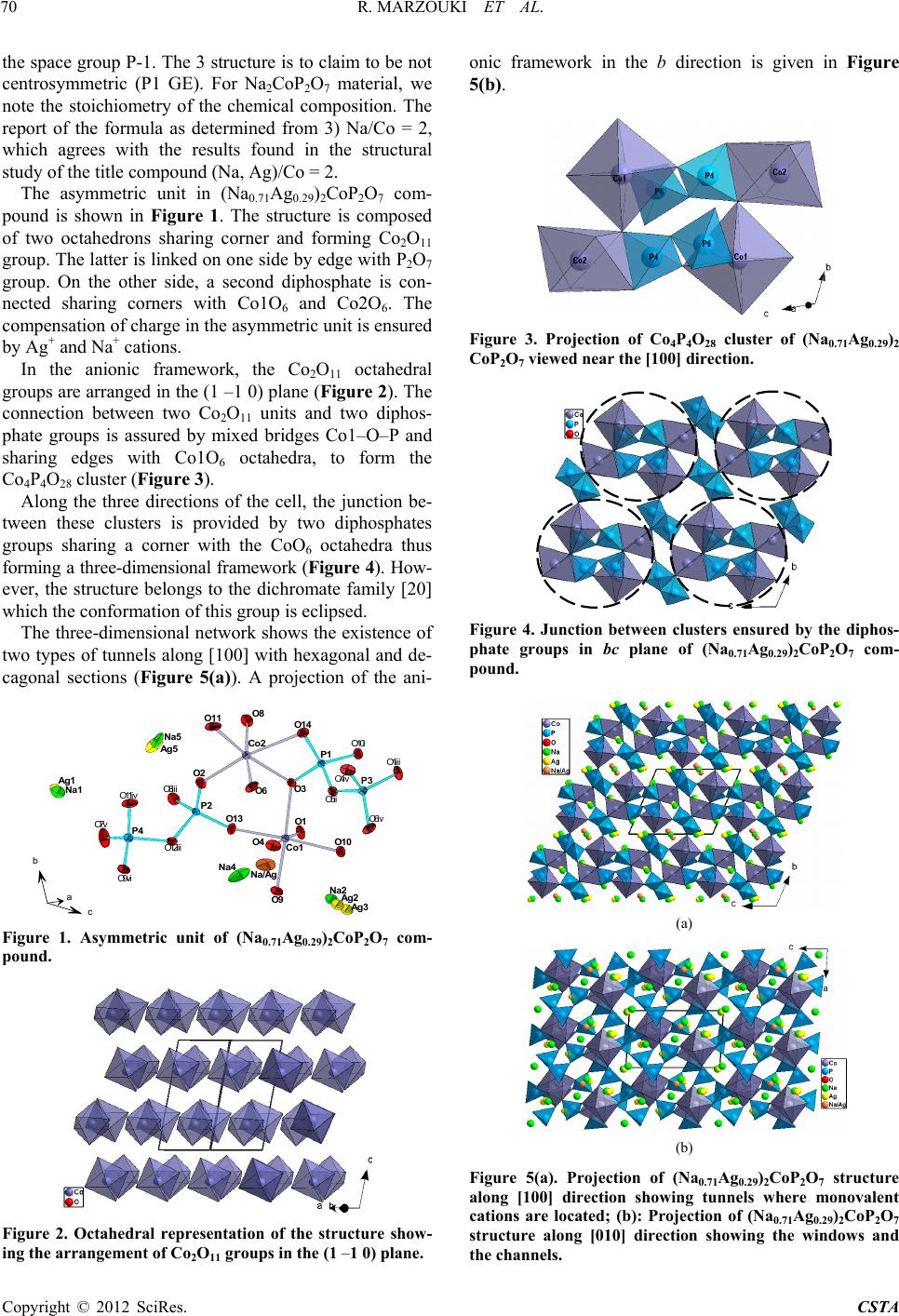 R. MARZOUKI ET AL. 70 the space group P-1. The 3 structure is to claim to be not centrosymmetric (P1 GE). For Na2CoP2O7 material, we note the stoichiometry of the chemical composition. The report of the formula as determined from 3) Na/Co = 2, which agrees with the results found in the structural study of the title compound (Na, Ag)/Co = 2. The asymmetric unit in (Na0.71Ag0.29)2CoP2O7 com- pound is shown in Figure 1. The structure is composed of two octahedrons sharing corner and forming Co2O11 group. The latter is linked on one side by edge with P2O7 group. On the other side, a second diphosphate is con- nected sharing corners with Co1O6 and Co2O6. The compensation of charge in the asymmetric unit is ensured by Ag+ and Na+ cations. In the anionic framework, the Co2O11 octahedral groups are arranged in the (1 –1 0) plane (Figure 2). The connection between two Co2O11 units and two diphos- phate groups is assured by mixed bridges Co1–O–P and sharing edges with Co1O6 octahedra, to form the Co4P4O28 cluster (Figure 3). Along the three directions of the cell, the junction be- tween these clusters is provided by two diphosphates groups sharing a corner with the CoO6 octahedra thus forming a three-dimensional framework (Figure 4). How- ever, the structure belongs to the dichromate family [20] which the conformation of this group is eclipsed. The three-dimensional network shows the existence of two types of tunnels along [100] with hexagonal and de- cagonal sections (Figure 5(a)). A projection of the ani- Na/Ag Na4 O1 Na2 Ag 3 Ag 2 O8i ii O1 3 O9 P2 O7v O8 Ag 1 Na1 Co1 O3 O12iii Ag 5 O10i O1 0 O2 Na5 P4 P1 Co2 O11iv O9vi O1 4 O4 O5ii O1 1 O1i ii O6 P3 O6iv O4i v a b c Figure 1. Asymmetric unit of (Na0.71Ag0.29)2CoP2O7 com- pound. Figure 2. Octahedral representation of the structure show- ing the arrangement of Co2O11 groups in the (1 –1 0) plane. onic framework in the b direction is given in Figure 5(b). Figure 3. Projection of Co4P4O28 cluster of (Na0.71Ag0.29)2 CoP2O7 viewed near the [100] direction. Figure 4. Junction between clusters ensured by the diphos- phate groups in bc plane of (Na0.71Ag0.29)2CoP2O7 com- pound. (a) (b) Figure 5(a). Projection of (Na0.71Ag0.29)2CoP2O7 structure along [100] direction showing tunnels where monovalent cations are located; (b): Projection of (Na0.71Ag0.29)2CoP2O7 structure along [010] direction showing the windows and the channels. Copyright © 2012 SciRes. CSTA 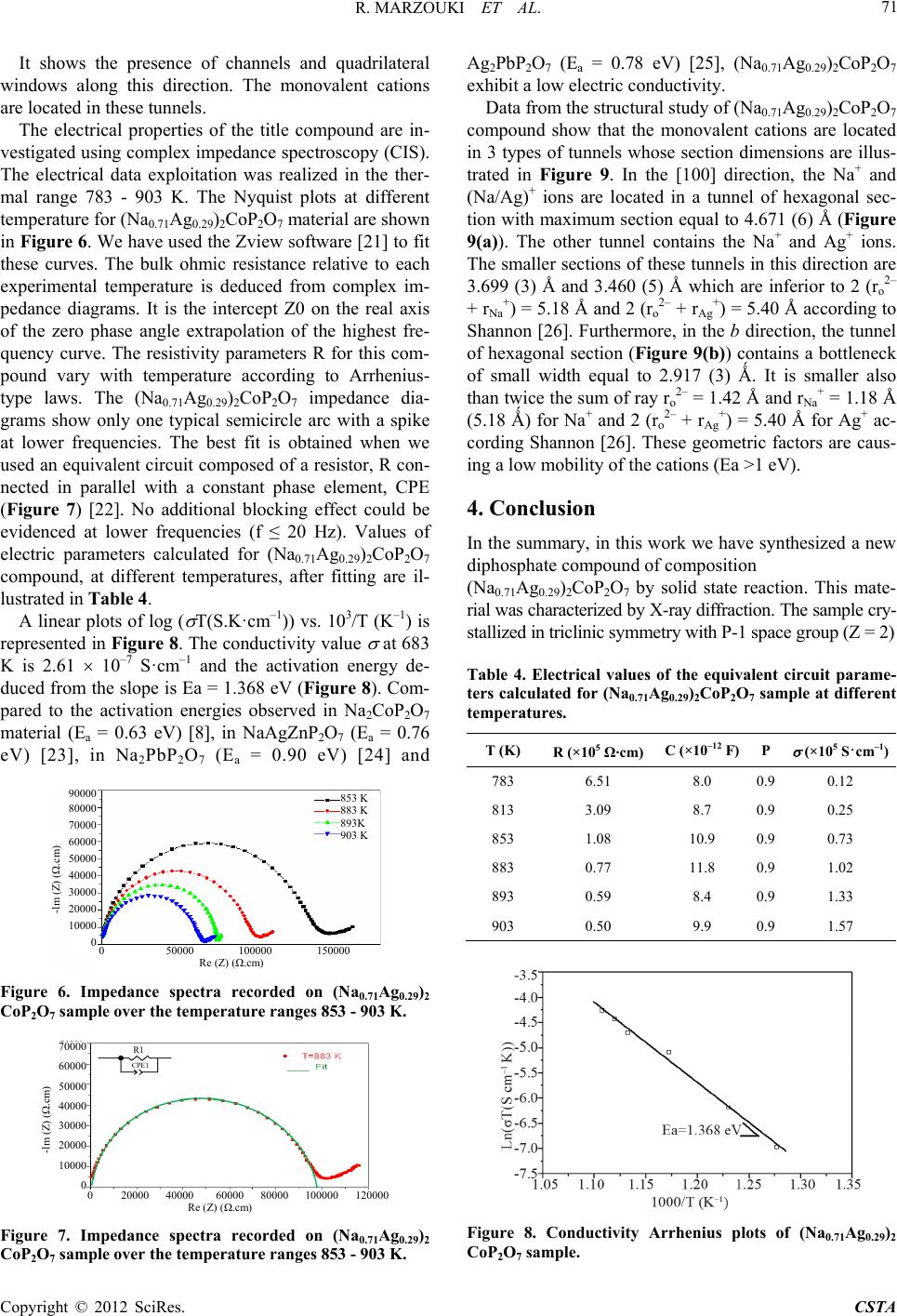 R. MARZOUKI ET AL. 71 It shows the presence of channels and quadrilateral windows along this direction. The monovalent cations are located in these tunnels. The electrical properties of the title compound are in- vestigated using complex impedance spectroscopy (CIS). The electrical data exploitation was realized in the ther- mal range 783 - 903 K. The Nyquist plots at different temperature for (Na0.71Ag0.29)2CoP2O7 material are shown in Figure 6. We have used the Zview software [21] to fit these curves. The bulk ohmic resistance relative to each experimental temperature is deduced from complex im- pedance diagrams. It is the intercept Z0 on the real axis of the zero phase angle extrapolation of the highest fre- quency curve. The resistivity parameters R for this com- pound vary with temperature according to Arrhenius- type laws. The (Na0.71Ag0.29)2CoP2O7 impedance dia- grams show only one typical semicircle arc with a spike at lower frequencies. The best fit is obtained when we used an equivalent circuit composed of a resistor, R con- nected in parallel with a constant phase element, CPE (Figure 7) [22]. No additional blocking effect could be evidenced at lower frequencies (f ≤ 20 Hz). Values of electric parameters calculated for (Na0.71Ag0.29)2CoP2O7 compound, at different temperatures, after fitting are il- lustrated in Table 4. A linear plots of log ( T(S.K·cm–1)) vs. 103/T (K–1) is represented in Figure 8. The conductivity value at 683 K is 2.61 10–7 S·cm–1 and the activation energy de- duced from the slope is Ea = 1.368 eV (Figure 8). Com- pared to the activation energies observed in Na2CoP2O7 material (Ea = 0.63 eV) [8], in NaAgZnP2O7 (Ea = 0.76 eV) [23], in Na2PbP2O7 (Ea = 0.90 eV) [24] and 853 K 883 K 893K 903 K 90000 80000 70000 60000 50000 40000 30000 20000 10000 0 0 50000 100000 150000 Re (Z) (Ω.cm) -lm (Z) (Ω.cm) Figure 6. Impedance spectra recorded on (Na0.71Ag0.29)2 CoP2O7 sample over the temperature ranges 853 - 903 K. R1 0 20000 40000 60000 80000 100000 120000 Re (Z) (Ω.cm) -lm (Z) (Ω.cm) 70000 60000 50000 40000 30000 20000 10000 0 CPE1 Figure 7. Impedance spectra recorded on (Na0.71Ag0.29)2 Ag2PbP2O7 (Ea = 0.78 eV) [25], (Na0.71Ag0.29)2CoP2O CoP2O7 sample over the temperature ranges 853 - 903 K. 7 a0.71Ag0.29)2CoP2O7 co is work we have synthesized a new tion. This mate- able 4. Electrical values of the equivalent circuit parame- T (K) R (×105 Ω.cm) C (×10–12 F) P (×105 S·cm–1) exhibit a low electric conductivity. Data from the structural study of (N mpound show that the monovalent cations are located in 3 types of tunnels whose section dimensions are illus- trated in Figure 9. In the [100] direction, the Na+ and (Na/Ag)+ ions are located in a tunnel of hexagonal sec- tion with maximum section equal to 4.671 (6) Å (Figure 9(a)). The other tunnel contains the Na+ and Ag+ ions. The smaller sections of these tunnels in this direction are 3.699 (3) Å and 3.460 (5) Å which are inferior to 2 (ro2– + rNa+) = 5.18 Å and 2 (ro2– + rAg+) = 5.40 Å according to Shannon [26]. Furthermore, in the b direction, the tunnel of hexagonal section (Figure 9(b)) contains a bottleneck of small width equal to 2.917 (3) Ǻ. It is smaller also than twice the sum of ray ro2– = 1.42 Å and rNa+ = 1.18 Å (5.18 Ǻ) for Na+ and 2 (ro2– + rAg+) = 5.40 Å for Ag+ ac- cording Shannon [26]. These geometric factors are caus- ing a low mobility of the cations (Ea >1 eV). 4. Conclusion In the summary, in th diphosphate compound of composition (Na0.71Ag0.29)2CoP2O7 by solid state reac rial was characterized by X-ray diffraction. The sample cry- stallized in triclinic symmetry with P-1 space group (Z = 2) T ters calculated for (Na0.71Ag0.29)2CoP2O7 sample at different temperatures. 783 6.51 8.0 0.9 0.12 813 3.09 8.7 0.9 0.25 853 1.08 10.9 0.9 0.73 883 0.77 11.8 0.9 1.02 893 0.59 8.4 0.9 1.33 903 0.50 9.9 0.9 1.57 Figure 8. Conductivity Arrhenius plots of (Na0.71Ag 29)2 0. CoP2O7 sample. Copyright © 2012 SciRes. CSTA 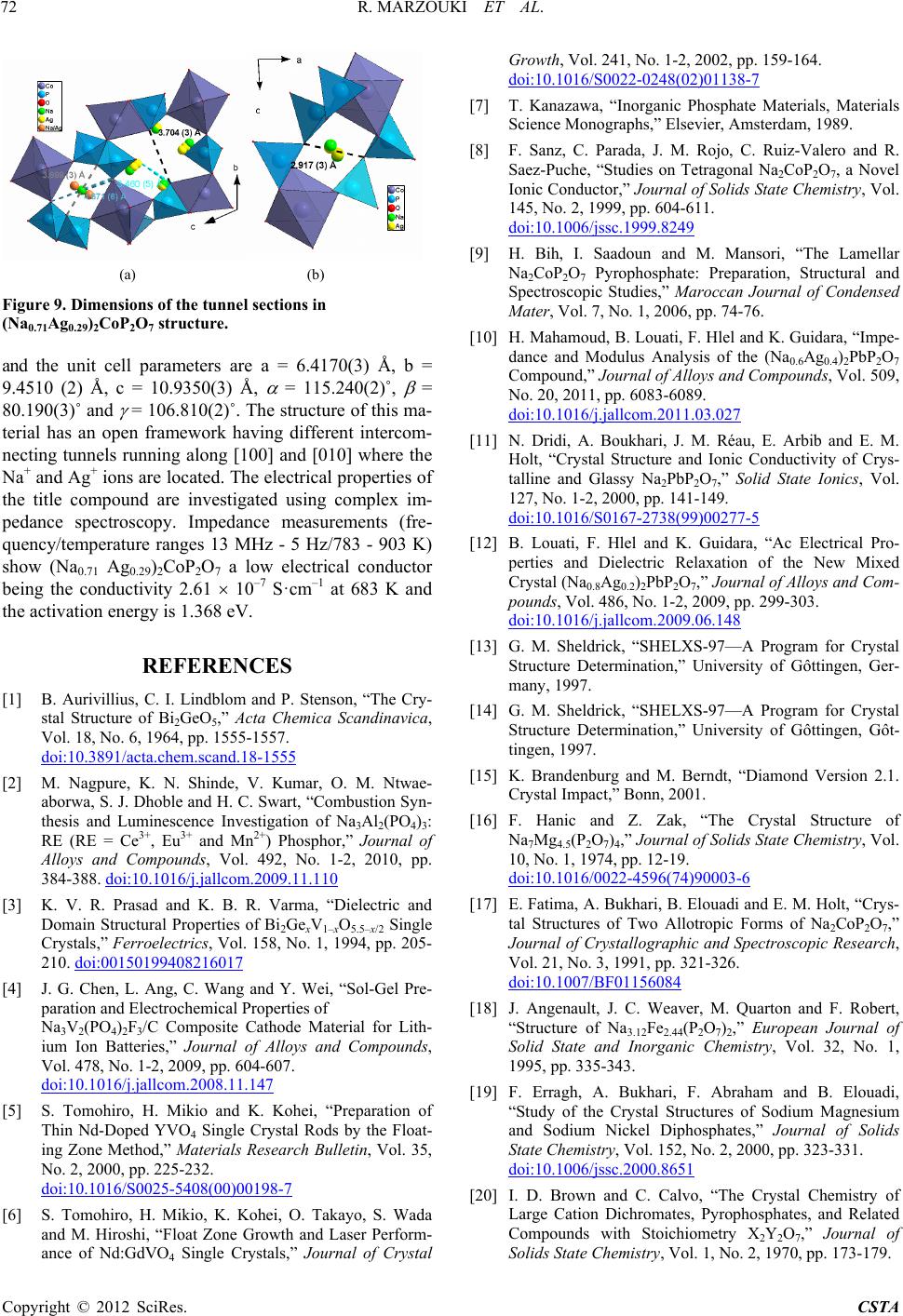 R. MARZOUKI ET AL. 72 (a) (b) Figure 9. Dimen d the unit cell parameters are a = 6.4170(3) Å, REFERENCES [1] B. Aurivillius,tenson, “The Cry- sions of the tunnel sections in (Na0.71Ag0.29)2CoP2O7 structure. anb = 9.4510 (2) Å, c = 10.9350(3) Å, = 115.240(2)˚, = 80.190(3)˚ and = 106.810(2)˚. The structure of this ma- terial has an open framework having different intercom- necting tunnels running along [100] and [010] where the Na+ and Ag+ ions are located. The electrical properties of the title compound are investigated using complex im- pedance spectroscopy. Impedance measurements (fre- quency/temperature ranges 13 MHz - 5 Hz/783 - 903 K) show (Na0.71 Ag0.29)2CoP2O7 a low electrical conductor being the conductivity 2.61 10–7 S·cm–1 at 683 K and the activation energy is 1.368 eV. C. I. Lindblom and P. S stal Structure of Bi2GeO5,” Acta Chemica Scandinavica, Vol. 18, No. 6, 1964, pp. 1555-1557. doi:10.3891/acta.chem.scand.18-1555 [2] M. Nagpure, K. N. Shinde, V. Kumar, O. M. Ntwae- aborwa, S. J. Dhoble and H. C. Swart, “Combustion Syn- thesis and Luminescence Investigation of Na3Al2(PO4)3: RE (RE = Ce3+, Eu3+ and Mn2+) Phosphor,” Journal of Alloys and Compounds, Vol. 492, No. 1-2, 2010, pp. 384-388. doi:10.1016/j.jallcom.2009.11.110 [3] K. V. R. Prasad and K. B. R. Varma, “Dielectric and Domain Structural Properties of Bi2GexV1–xO5.5–x/2 Single Crystals,” Ferroelectrics, Vol. 158, No. 1, 1994, pp. 205- 210. doi:00150199408216017 [4] J. G. Chen, L. Ang, C. Wang and Y. Wei, “Sol-Gel Pre- paration and Electrochemical Properties of Na3V2(PO4)2F3/C Composite Cathode Mater ium Ion Batteries,” Journal of Alloys and Compounds, Vol. 478, No. 1-2, 2009, pp. 604-607. ial for Lith- doi:10.1016/j.jallcom.2008.11.147 [5] S. Tomohiro, H. Mikio and K. Kohei, “Preparation )00198-7 of Thin Nd-Doped YVO4 Single Crystal Rods by the Float- ing Zone Method,” Materials Research Bulletin, Vol. 35, No. 2, 2000, pp. 225-232. doi:10.1016/S0025-5408(00 . Takayo, S. Wada [6] S. Tomohiro, H. Mikio, K. Kohei, O and M. Hiroshi, “Float Zone Growth and Laser Perform- ance of Nd:GdVO4 Single Crystals,” Journal of Crystal Growth, Vol. 241, No. 1-2, 2002, pp. 159-164. doi:10.1016/S0022-0248(02)01138-7 [7] T. Kanazawa, “Inorganic Phosphate Materials, Materials nd R. Science Monographs,” Elsevier, Amsterdam, 1989. [8] F. Sanz, C. Parada, J. M. Rojo, C. Ruiz-Valero a Saez-Puche, “Studies on Tetragonal Na2CoP2O7, a Novel Ionic Conductor,” Journal of Solids State Chemistry, Vol. 145, No. 2, 1999, pp. 604-611. doi:10.1006/jssc.1999.8249 [9] H. Bih, I. Saadoun and M. Mansori, “The Lamellar . Guidara, “Impe- 27 Na2CoP2O7 Pyrophosphate: Preparation, Structural and Spectroscopic Studies,” Maroccan Journal of Condensed Mater, Vol. 7, No. 1, 2006, pp. 74-76. [10] H. Mahamoud, B. Louati, F. Hlel and K dance and Modulus Analysis of the (Na0.6Ag0.4)2PbP2O7 Compound,” Journal of Alloys and Compounds, Vol. 509, No. 20, 2011, pp. 6083-6089. doi:10.1016/j.jallcom.2011.03.0 , E. Arbib and E. M. -5 [11] N. Dridi, A. Boukhari, J. M. Réau Holt, “Crystal Structure and Ionic Conductivity of Crys- talline and Glassy Na2PbP2O7,” Solid State Ionics, Vol. 127, No. 1-2, 2000, pp. 141-149. doi:10.1016/S0167-2738(99)00277 Ac Electrical Pro- [12] B. Louati, F. Hlel and K. Guidara, “ perties and Dielectric Relaxation of the New Mixed Crystal (Na0.8Ag0.2)2PbP2O7,” Journal of Alloys and Com- pounds, Vol. 486, No. 1-2, 2009, pp. 299-303. doi:10.1016/j.jallcom.2009.06.148 [13] G. M. Sheldrick, “SHELXS-97—A Program for Crystal ick, “SHELXS-97—A Program for Crystal rg and M. Berndt, “Diamond Version 2.1. he Crystal Structure of 003-6 Structure Determination,” University of Gôttingen, Ger- many, 1997. [14] G. M. Sheldr Structure Determination,” University of Gôttingen, Gôt- tingen, 1997. [15] K. Brandenbu Crystal Impact,” Bonn, 2001. [16] F. Hanic and Z. Zak, “T Na7Mg4.5(P2O7)4,” Journal of Solids State Chemistry, Vol. 10, No. 1, 1974, pp. 12-19. doi:10.1016/0022-4596(74)90 d E. M. Holt, “Crys-[17] E. Fatima, A. Bukhari, B. Elouadi an tal Structures of Two Allotropic Forms of Na2CoP2O7,” Journal of Crystallographic and Spectroscopic Research, Vol. 21, No. 3, 1991, pp. 321-326. doi:10.1007/BF01156084 [18] J. Angenault, J. C. Weaver, M. Quarton and F. Robert, hari, F. Abraham and B. Elouadi, “Structure of Na3.12Fe2.44(P2O7)2,” European Journal of Solid State and Inorganic Chemistry, Vol. 32, No. 1, 1995, pp. 335-343. [19] F. Erragh, A. Buk “Study of the Crystal Structures of Sodium Magnesium and Sodium Nickel Diphosphates,” Journal of Solids State Chemistry, Vol. 152, No. 2, 2000, pp. 323-331. doi:10.1006/jssc.2000.8651 [20] I. D. Brown and C. Calvo, “The Crystal Chemistry of Large Cation Dichromates, Pyrophosphates, and Related Compounds with Stoichiometry X2Y2O7,” Journal of Solids State Chemistry, Vol. 1, No. 2, 1970, pp. 173-179. Copyright © 2012 SciRes. CSTA  R. MARZOUKI ET AL. Copyright © 2012 SciRes. CSTA 73 doi:10.1016/0022-4596(70)90010-1 [21] D. Johnson, “Zview Version 3.1c,” Scribner Associates The Interpretation of Non-Ideal Diele- Inc., 1990-2007. [22] A. K. Jonscher, “ ctric Admittance and Impedance Diagrams,” Physica Status Solidi (a), Vol. 32, No. 2, 1975, pp. 665-676. doi:10.1002/pssa.2210320241 [23] A. Ben Rhaiem, F. Hlel, K. Guidara and M. Gargouri, “Electrical Conductivity and Dielectric Analysis of Ag- NaZnP2O7 Compound,” Journal of Alloys and Com- pounds, Vol. 485, No. 1-2, 2009, pp. 718-723. doi:10.1016/j.jallcom.2009.06.062 [24] N. Dridi, A. Boukhari, J. M. Réau, E. Arbib and E. M. -5 Holt, “Crystal Structure and Ionic Conductivity of Crys- talline and Glassy Na2PbP2O7,” Solid State Ionics, Vol. 127, No. 1-2, 2000, pp. 141-149. doi:10.1016/S0167-2738(99)00277 and E. M. 00)00237-8 [25] N. Dridi, A. Boukhari, J. M. Réau, E. Arbib Holt, “Structure and Electrical Properties of Crystalline and Glassy Ag2PbP2O7,” Materials Letters, Vol. 47, No. 4-5, 2001, pp. 212-218. doi:10.1016/S0167-577X( nic Radii and Sys- [26] R. D. Shannon, “Revised Effective Io tematic Studies of Interatomic Distances in Halides and Chalcogenides,” Acta Crystallographica A, Vol. 32, 1976, No. 1, pp. 751-764. doi:10.1107/S056773947600155 |