

Paper Menu >>
Journal Menu >>
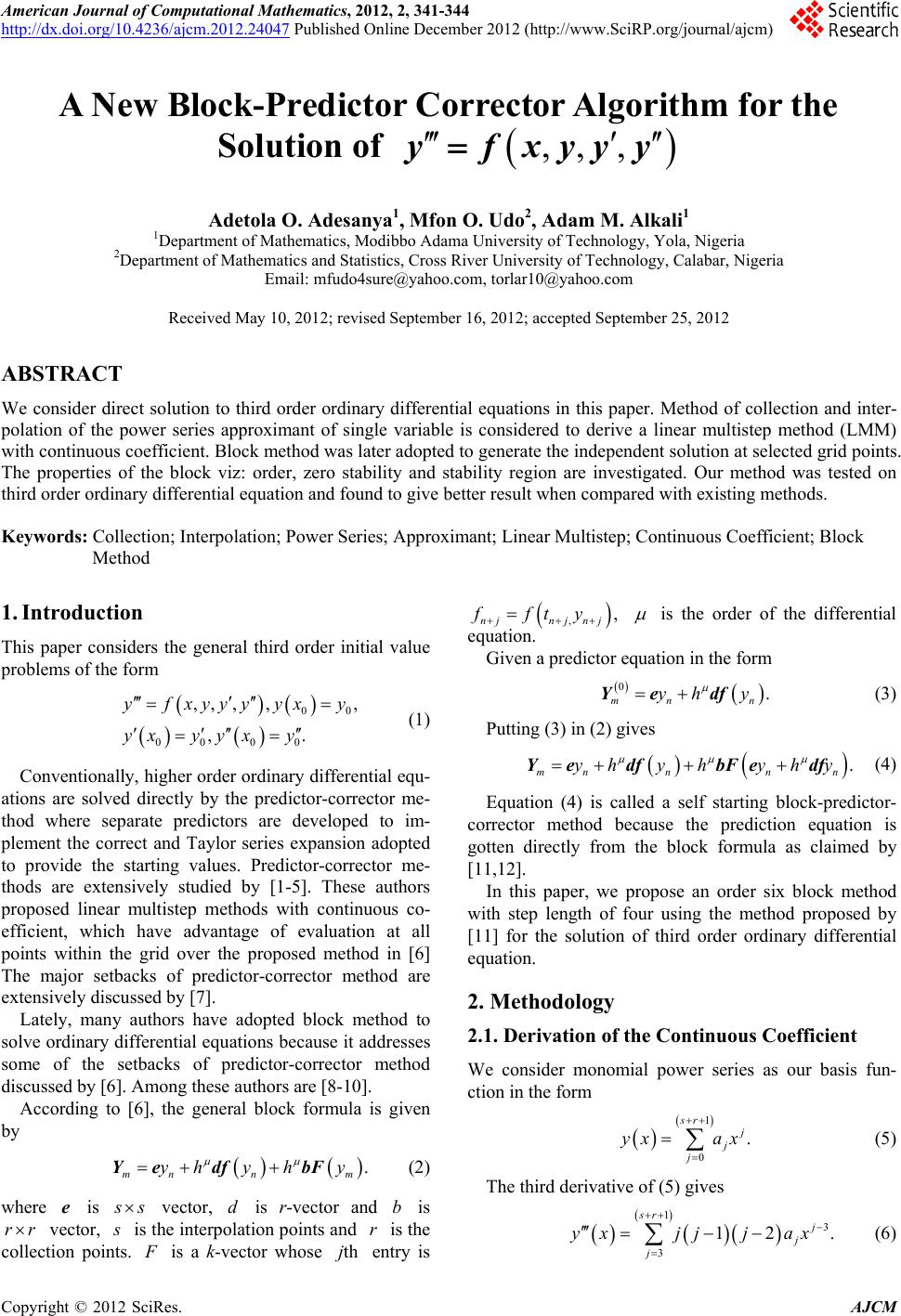 American Journal of Computational Mathematics, 2012, 2, 341-344 http://dx.doi.org/10.4236/ajcm.2012.24047 Published Online December 2012 (http://www.SciRP.org/journal/ajcm) A New Block-Predictor Corrector Algorithm for the Solution of ,, , yf x yy y Adetola O. Adesanya1, Mfon O. Udo2, Adam M. Alkali1 1Department of Mathematics, Modibbo Adama University of Technology, Yola, Nigeria 2Department of Mathematics and Statistics, Cross River University of Technology, Calabar, Nigeria Email: [email protected], [email protected] Received May 10, 2012; revised September 16, 2012; accepted September 25, 2012 ABSTRACT We consider direct solution to third order ordinary differential equations in this paper. Method of collection and inter- polation of the power series approximant of single variable is considered to derive a linear multistep method (LMM) with continuous coefficient. Block method was later adopted to generate the independent solution at selected grid points. The properties of the block viz: order, zero stability and stability region are investigated. Our method was tested on third order ordinary differential equation and found to give better result when compared with existing methods. Keywords: Collection; Interpolation; Power Series; Approximant; Linear Multistep; Continuous Coefficient; Block Method 1. Introduction This paper considers the general third order initial value problems of the form 00 00 00 ,, ,,, ,. yfxyyyyx y yx yyx y (1) Conventionally, higher order ordinary differential equ- ations are solved directly by the predictor-corrector me- thod where separate predictors are developed to im- plement the correct and Taylor series expansion adopted to provide the starting values. Predictor-corrector me- thods are extensively studied by [1-5]. These authors proposed linear multistep methods with continuous co- efficient, which have advantage of evaluation at all points within the grid over the proposed method in [6] The major setbacks of predictor-corrector method are extensively discussed by [7]. Lately, many authors have adopted block method to solve ordinary differential equations because it addresses some of the setbacks of predictor-corrector method discussed by [6]. Among these authors are [8-10]. According to [6], the general block formula is given by . mn nm yhyhy Y edfbF (2) where is e s s vector, is r-vector and is vector, d b rr s is the interpolation points and is the collection points. r F is a k-vector whose entry is thj ,, njnj nj ffty is the order of the differential equation. Given a predictor equation in the form 0 mn n yh y df. (3) Ye Putting (3) in (2) gives . nn n y hyhy bFe df mn yhYe df (4) Equation (4) is called a self starting block-predictor- corrector method because the prediction equation is gotten directly from the block formula as claimed by [11,12]. In this paper, we propose an order six block method with step length of four using the method proposed by [11] for the solution of third order ordinary differential equation. 2. Methodology 2.1. Derivation of the Continuous Coefficient We consider monomial power series as our basis fun- ction in the form 1 0 . sr j j j y xa x . (5) The third derivative of (5) gives yx 1 3 3 12 j j jjj ax sr j (6) C opyright © 2012 SciRes. AJCM 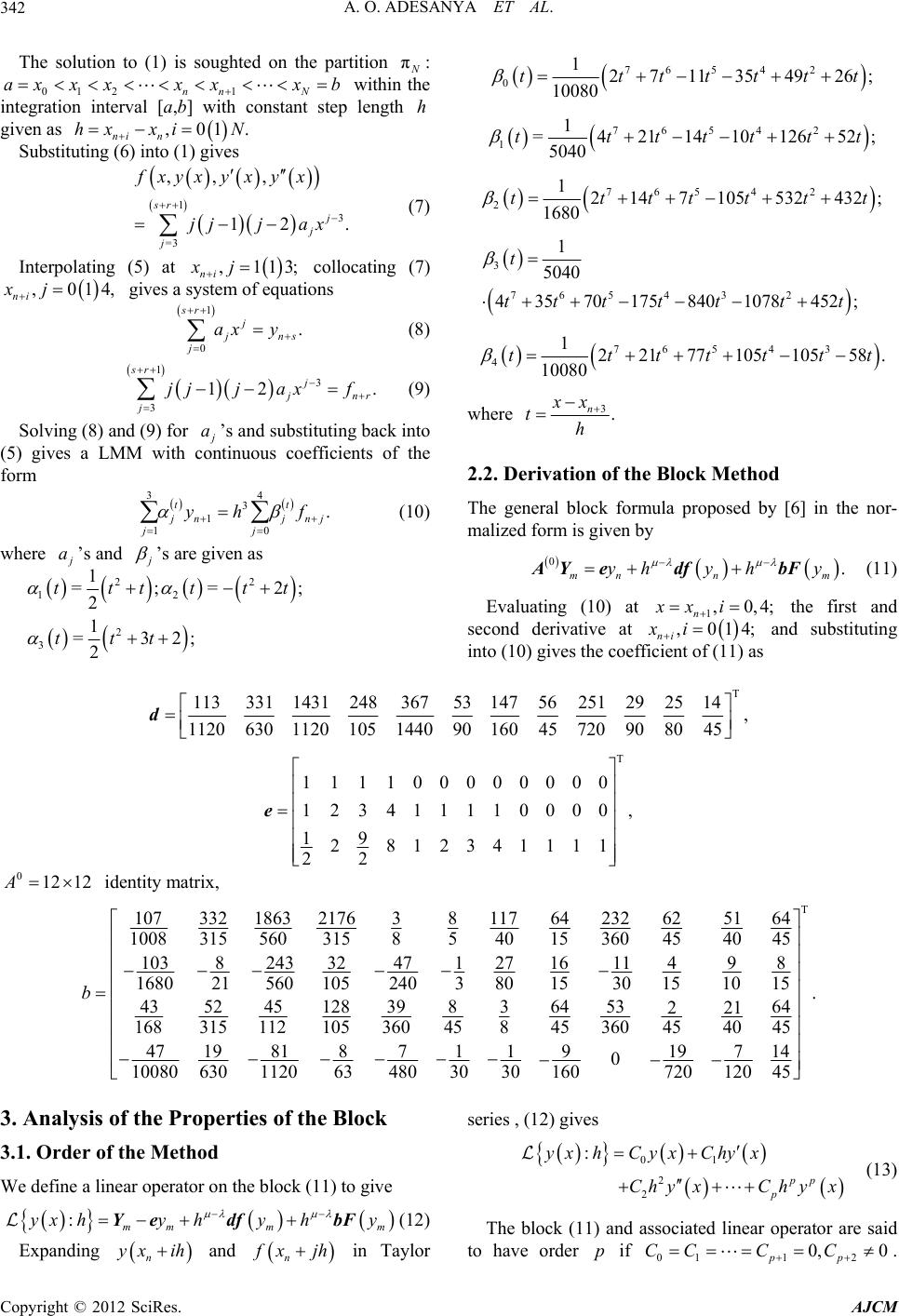 A. O. ADESANYA ET AL. 342 The solution to (1) is soughted on the partition π N : 012 1nnN within the integration interval [a,b] with constant step length given as axx xxxxb ,01. ni n hx xiN h Substituting (6) into (1) gives 1 3 =3 ,, , 12 sr j j j fxyxyx y x jjj ax . ; , (7) Interpolating (5) at collocating (7) gives a system of equations ,113 ni xj 1sr ,014 ni xj 0 . j j ns j ax y (8) 1 3 3 12 sr j. j nr j jjj axf (9) Solving (8) and (9) for j a’s and substituting back into (5) gives a LMM with continuous coefficients of the form 34 3 1 10 . tt j nj jj yh f nj (10) where j a’s and j ’s are given as 22 12 2 3 1 =;= 2 1 =32; 2 tttttt ttt 76 542 0 12 71135 49 26; 10080 t tttttt 7654 2 1 1 =421141012652 ; 5040 tttttt t 765 42 2 12147105532432 ; 1680 tttttt t 3 765 432 1 5040 435701758401078452 ; t ttt tttt 765 4 3 4 1221 77 105105 58. 10080 tttttt t where 3. n xx th 2.2. Derivation of the Block Method The general block formula proposed by [6] in the nor- malized form is given by 0. mn nm yhy hy AY edfbF (11) 2; Evaluating (10) at 1,0,4 n xx i ; ,014; ni xi the first and second derivative at and substituting into (10) gives the coefficient of (11) as T 113331 14312483675314756251292514, 1120 63011201051440 90160 45 720 90 80 45 d T 111100000000 123411110000 , 9 12 812341111 22 e 012 12 A identity matrix, 107332 1863 21763811764232625164 10083155603158540153604540 45 1038243 3247271698 1114 1680215601052403 801530 1510 15 435245128 398364 5364 221 168 31511210536045 845360454045 47 1981871 10080 63011206348030 b T . 9197 11 0 30 160720 12045 4 3. Analysis of the Properties of the Block 3.1. Order of the Method We define a linear operator on the block (11) to give :mm mm yx hyhyhy Ye dfbF(12) Expanding n y xih and n f xjh in Taylor series , (12) gives 01 2 2 : pp p yxhCyxChyx ChyxCh yx (13) The block (11) and associated linear operator are said to have order if p011 2 0, 0 pp CCC C . Copyright © 2012 SciRes. AJCM 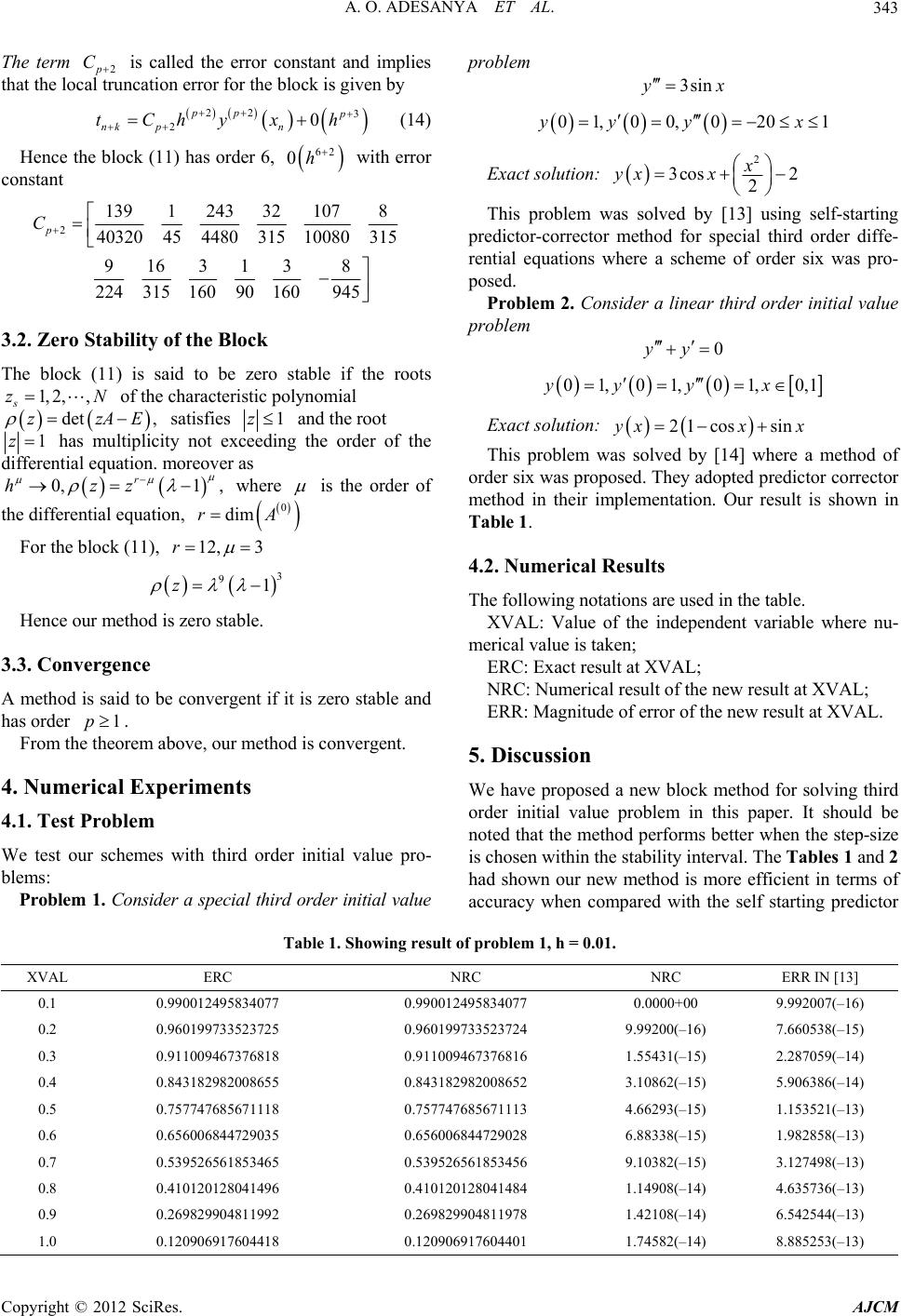 A. O. ADESANYA ET AL. 343 The term 2p is called the error constant and implies that the local truncation error for the block is given by C nk 22 3 20 pp p p n tChyxh (14) Hence the block (11) has order 6, with error constant 62 0h 2 13 40 224 , zz 91243 321078 320 45 448031510080 315 916313 8 315 16090 160945 p C N E 3.2. Zero Stability of the Block The block (11) is said to be zero stable if the roots of the characteristic polynomial satisfies 1, 2, s z det ,A1z and the root 1z has multiplicity not exceeding the order of the differential equation. moreover as hz 0,1 , r z where is the order of the differential equation, 0 dimrA For the block (11), 12,3r 3 91z Hence our method is zero stable. 3.3. Convergence A method is said to be convergent if it is zero stable and has order . 1p From the theorem above, our method is convergent. 4. Numerical Experiments 4.1. Test Problem We test our schemes with third order initial value pro- blems: Problem 1. Consider a special third order initial value problem 3sinyx 01, 0 0,0201 y yy x Exact solution: 2 3cos2 2 x yxx This problem was solved by [13] using self-starting predictor-corrector method for special third order diffe- rential equations where a scheme of order six was pro- posed. Problem 2. Consider a linear third order initial value problem 0yy 01, 01,01,0,1yy yx Exact solution: 21 cossin y xx x This problem was solved by [14] where a method of order six was proposed. They adopted predictor corrector method in their implementation. Our result is shown in Table 1. 4.2. Numerical Results The following notations are used in the table. XVAL: Value of the independent variable where nu- merical value is taken; ERC: Exact result at XVAL; NRC: Numerical result of the new result at XVAL; ERR: Magnitude of error of the new result at XVAL. 5. Discussion We have proposed a new block method for solving third order initial value problem in this paper. It should be noted that the method performs better when the step-size is chosen within the stability interval. The Tabl e s 1 and 2 had shown our new method is more efficient in terms of accuracy when compared with the self starting predictor Table 1. Showing result of pr oble m 1, h = 0.01. XVAL ERC NRC NRC ERR IN [13] 0.1 0.990012495834077 0.990012495834077 0.0000+00 9.992007(–16) 0.2 0.960199733523725 0.960199733523724 9.99200(–16) 7.660538(–15) 0.3 0.911009467376818 0.911009467376816 1.55431(–15) 2.287059(–14) 0.4 0.843182982008655 0.843182982008652 3.10862(–15) 5.906386(–14) 0.5 0.757747685671118 0.757747685671113 4.66293(–15) 1.153521(–13) 0.6 0.656006844729035 0.656006844729028 6.88338(–15) 1.982858(–13) 0.7 0.539526561853465 0.539526561853456 9.10382(–15) 3.127498(–13) 0.8 0.410120128041496 0.410120128041484 1.14908(–14) 4.635736(–13) 0.9 0.269829904811992 0.269829904811978 1.42108(–14) 6.542544(–13) 1.0 0.120906917604418 0.120906917604401 1.74582(–14) 8.885253(–13) Copyright © 2012 SciRes. AJCM 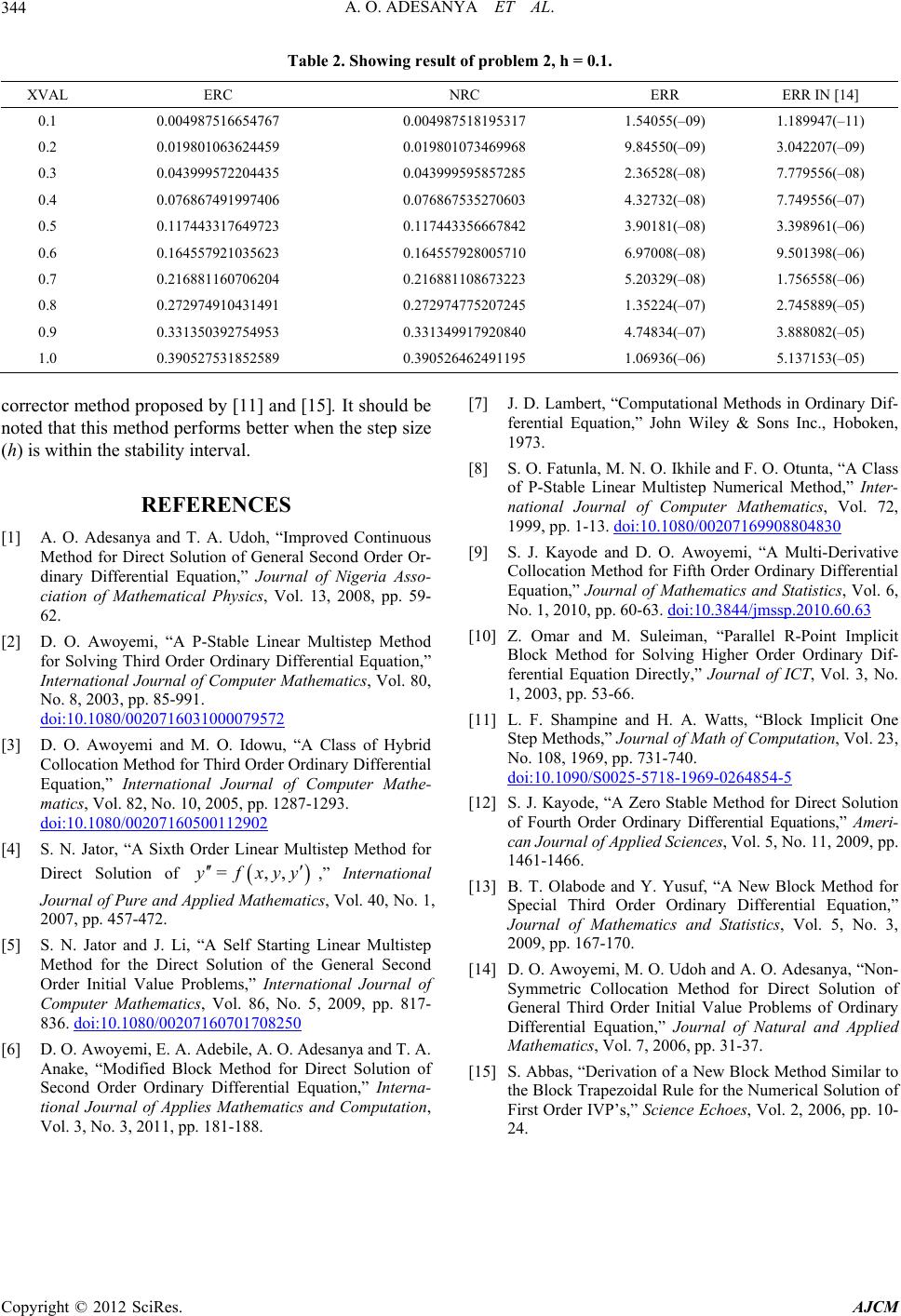 A. O. ADESANYA ET AL. 344 Table 2. Showing result of pr oble m 2, h = 0.1. XVAL ERC NRC ERR ERR IN [14] 0.1 0.004987516654767 0.004987518195317 1.54055(–09) 1.189947(–11) 0.2 0.019801063624459 0.019801073469968 9.84550(–09) 3.042207(–09) 0.3 0.043999572204435 0.043999595857285 2.36528(–08) 7.779556(–08) 0.4 0.076867491997406 0.076867535270603 4.32732(–08) 7.749556(–07) 0.5 0.117443317649723 0.117443356667842 3.90181(–08) 3.398961(–06) 0.6 0.164557921035623 0.164557928005710 6.97008(–08) 9.501398(–06) 0.7 0.216881160706204 0.216881108673223 5.20329(–08) 1.756558(–06) 0.8 0.272974910431491 0.272974775207245 1.35224(–07) 2.745889(–05) 0.9 0.331350392754953 0.331349917920840 4.74834(–07) 3.888082(–05) 1.0 0.390527531852589 0.390526462491195 1.06936(–06) 5.137153(–05) corrector method proposed by [11] and [15]. It should be noted that this method performs better when the step size (h) is within the stability interval. REFERENCES [1] A. O. Adesanya and T. A. Udoh, “Improved Continuous Method for Direct Solution of General Second Order Or- dinary Differential Equation,” Journal of Nigeria Asso- ciation of Mathematical Physics, Vol. 13, 2008, pp. 59- 62. [2] D. O. Awoyemi, “A P-Stable Linear Multistep Method for Solving Third Order Ordinary Differential Equation,” International Journal of Computer Mathematics, Vol. 80, No. 8, 2003, pp. 85-991. doi:10.1080/0020716031000079572 [3] D. O. Awoyemi and M. O. Idowu, “A Class of Hybrid Collocation Method for Third Order Ordinary Differential Equation,” International Journal of Computer Mathe- matics, Vol. 82, No. 10, 2005, pp. 1287-1293. doi:10.1080/00207160500112902 [4] S. N. Jator, “A Sixth Order Linear Multistep Method for Direct Solution of =,, y fxyy ,” International Journal of Pure and Applied Mathematics, Vol. 40, No. 1, 2007, pp. 457-472. [5] S. N. Jator and J. Li, “A Self Starting Linear Multistep Method for the Direct Solution of the General Second Order Initial Value Problems,” International Journal of Computer Mathematics, Vol. 86, No. 5, 2009, pp. 817- 836. doi:10.1080/00207160701708250 [6] D. O. Awoyemi, E. A. Adebile, A. O. Adesanya and T. A. Anake, “Modified Block Method for Direct Solution of Second Order Ordinary Differential Equation,” Interna- tional Journal of Applies Mathematics and Computation, Vol. 3, No. 3, 2011, pp. 181-188. [7] J. D. Lambert, “Computational Methods in Ordinary Dif- ferential Equation,” John Wiley & Sons Inc., Hoboken, 1973. [8] S. O. Fatunla, M. N. O. Ikhile and F. O. Otunta, “A Class of P-Stable Linear Multistep Numerical Method,” Inter- national Journal of Computer Mathematics, Vol. 72, 1999, pp. 1-13. doi:10.1080/00207169908804830 [9] S. J. Kayode and D. O. Awoyemi, “A Multi-Derivative Collocation Method for Fifth Order Ordinary Differential Equation,” Journal of Mathematics and Statistics, Vol. 6, No. 1, 2010, pp. 60-63. doi:10.3844/jmssp.2010.60.63 [10] Z. Omar and M. Suleiman, “Parallel R-Point Implicit Block Method for Solving Higher Order Ordinary Dif- ferential Equation Directly,” Journal of ICT, Vol. 3, No. 1, 2003, pp. 53-66. [11] L. F. Shampine and H. A. Watts, “Block Implicit One Step Methods,” Journal of Math of Computation, Vol. 23, No. 108, 1969, pp. 731-740. doi:10.1090/S0025-5718-1969-0264854-5 [12] S. J. Kayode, “A Zero Stable Method for Direct Solution of Fourth Order Ordinary Differential Equations,” Ameri- can Journal of Applied Sciences, Vol. 5, No. 11, 2009, pp. 1461-1466. [13] B. T. Olabode and Y. Yusuf, “A New Block Method for Special Third Order Ordinary Differential Equation,” Journal of Mathematics and Statistics, Vol. 5, No. 3, 2009, pp. 167-170. [14] D. O. Awoyemi, M. O. Udoh and A. O. Adesanya, “Non- Symmetric Collocation Method for Direct Solution of General Third Order Initial Value Problems of Ordinary Differential Equation,” Journal of Natural and Applied Mathematics, Vol. 7, 2006, pp. 31-37. [15] S. Abbas, “Derivation of a New Block Method Similar to the Block Trapezoidal Rule for the Numerical Solution of First Order IVP’s,” Science Echoes, Vol. 2, 2006, pp. 10- 24. Copyright © 2012 SciRes. AJCM |