

Paper Menu >>
Journal Menu >>
 Journal of Modern Physics, 2012, 3, 1979-1982 http://dx.doi.org/10.4236/jmp.2012.312247 Published Online December 2012 (http://www.SciRP.org/journal/jmp) Dark Neutrinos A. Nicolaidis Theoretical Physics Department, University of Thessaloniki, Thessaloniki, Greece Email: [email protected] Received July 13, 2012; revised October 25, 2012; accepted November 8, 2012 ABSTRACT Solar, atmospheric and reactor neutrino experiments established that neutrinos are massive. It is quite natural then to consider neutrinos as candidate particles for explaining the dark matter in halos around galaxies. We study the gravita- tional clustering of these neutrinos within a model of a massive core and a surrounding spherical neutrino halo. The neutrinos form a degenerate Fermi gas and a loaded polytropic equation is established. We solve the equation and we obtain the neutrino density in a galaxy, the size of the galaxy and the galactic rotational curves. The available data favor a neutrino with a mass around 10 eV. The consequent cosmological implications are examined. Keywords: Neutrinos; Neutrino Mass; Gravitational Clustering; Dark Matter; Polytrope Equation Solar, atmospheric, reactor and accelerator neutrinos have provided compelling evidence for the existence of neu- trino oscillations, implying non-zero neutrino masses [1,2]. Solar neutrino oscillations indicate a mass squared difference while atmospheric neu- trino oscillations suggest ATM Further, attributing the LSND anomaly to neutrino oscillations implies the existence of a fourth neutrino, a sterile one, with a mass above 1 eV [3]. Cosmology offers further insights on the neutrino mass scales [4-7]. It is inevitable that neutrinos have participated in gravitational cluster- ing around massive galaxies, constituting part of the dark matter. Our purpose is to investigate the neutrino clus- tering effect, obtaining information on the cosmological presence of massive neutrinos. 25 610 eV 2 232 210 eV.m 10 12 10 - 10 SOL m The universe today exhibits structure on many scales. Galaxies range in mass, with most bright galaxies having masses of M . The sizes and distributions of present-day galaxies reflect the spectrum of initial den- sity fluctuations, seeded by random motion or cosmic strings [8]. We expect that each galaxy attracts the cos- mological neutrinos in its neighbourhood, creating a neu- trino halo of an average mass 10 310 M M Our idealized galaxy consists of a spherical massive core (of a mass c . M M r and a radius c of few Kpc) surrounded by a spherical neutrino halo. Hydro- static equilibrium prevails 2 1d drP 24π dd GmN rmNr r Nr Pr (1) where is the neutrino density, m is the neutrino mass and is the pressure of the neutrino gas. Considering that the neutrinos form a degenerate Fermi gas we obtain a polytrope rquation 23 2 53 3 4π5 h PN gm 2g (2) with the degeneracy factor (left-handed neutrinos and right-handed antineutrinos). Equations (1) and (2) lead to 2 213 1d1 d dd N rN rr rN (3) 13 53 32 2 34πmg Gh (4) Introducing the (dimensionless) variables p and x through 32 32 2 22 2 6π GMp gm Nr r rqx (5) (6) 23 3 432 1212 3π 42 qgm GM (7) Equation (3) becomes 232 2 d=. d pp x (8) x The variable p is related to the gravitational potential Vr through C opyright © 2012 SciRes. JMP 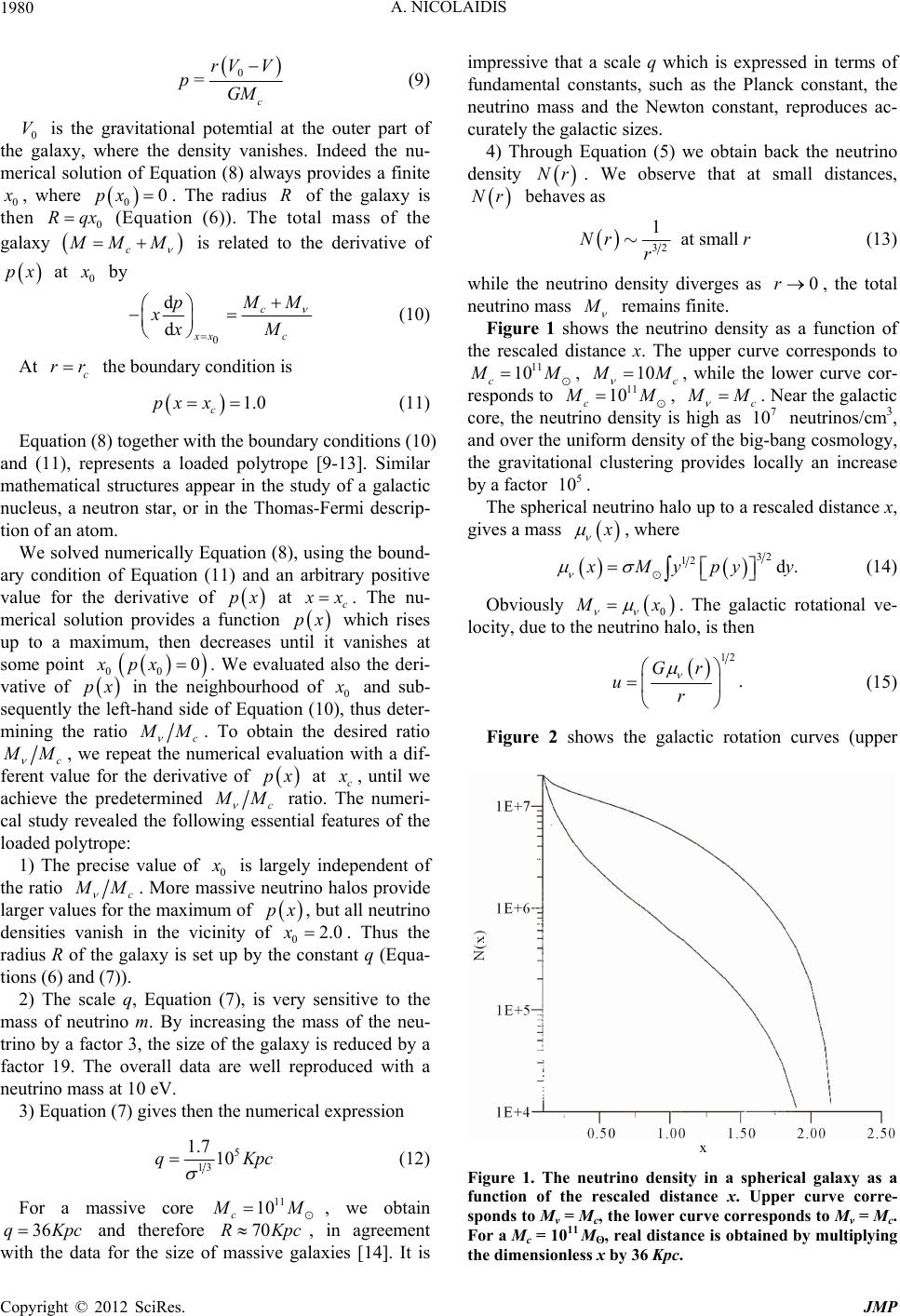 A. NICOLAIDIS 1980 0 = c rV V GM V p (9) 0 is the gravitational potemtial at the outer part of the galaxy, where the density vanishes. Indeed the nu- merical solution of Equation (8) always provides a finite 0 x , where 0. The radius of the galaxy is then (Equation (6)). The total mass of the 0px R 0 Rqx c MM galaxy M 0 is related to the derivative of px at x by 0 c c d dxx M M xM p x c rr 1.0 c px x (10) At the boundary condition is (11) Equation (8) together with the boundary conditions (10) and (11), represents a loaded polytrope [9-13]. Similar mathematical structures appear in the study of a galactic nucleus, a neutron star, or in the Thomas-Fermi descrip- tion of an atom. We solved numerically Equation (8), using the bound- ary condition of Equation (11) and an arbitrary positive value for the derivative of at c px x x px . The nu- merical solution provides a function which rises up to a maximum, then decreases until it vanishes at some point 0 x 0. We evaluated also the deri- vative of in the neighbourhood of 0 0px px x and sub- sequently the left-hand side of Equation (10), thus deter- mining the ratio c M M . To obtain the desired ratio c M M , we repeat the numerical evaluation with a dif- ferent value for the derivative of at c px x , until we achieve the predetermined c M M ratio. The numeri- cal study revealed the following essential features of the loaded polytrope: 1) The precise value of 0 x is largely independent of the ratio c M M px 2.0x . More massive neutrino halos provide larger values for the maximum of , but all neutrino densities vanish in the vicinity of 0. Thus the radius R of the galaxy is set up by the constant q (Equa- tions (6) and (7)). 2) The scale q, Equation (7), is very sensitive to the mass of neutrino m. By increasing the mass of the neu- trino by a factor 3, the size of the galaxy is reduced by a factor 19. The overall data are well reproduced with a neutrino mass at 10 eV. 3) Equation (7) gives then the numerical expression 5 13 1.7 10qKpc 11 10 c (12) For a massive core M M 36qKpc70RKpc , we obtain and therefore , in agreement with the data for the size of massive galaxies [14]. It is impressive that a scale q which is expressed in terms of fundamental constants, such as the Planck constant, the neutrino mass and the Newton constant, reproduces ac- curately the galactic sizes. 4) Through Equation (5) we obtain back the neutrino density Nr . We observe that at small distances, Nr behaves as 32 1at small Nr r r 0r (13) while the neutrino density diverges as , the total neutrino mass M remains finite. Figure 1 shows the neutrino density as a function of the rescaled distance x. The upper curve corresponds to c11 10 M M10, c M M , while the lower curve cor- responds to c11 10 M Mc, M M 7 10 5 10 . Near the galactic core, the neutrino density is high as neutrinos/cm3, and over the uniform density of the big-bang cosmology, the gravitational clustering provides locally an increase by a factor . The spherical neutrino halo up to a rescaled distance x, gives a mass x , where 32 12 d. x My pyy (14) 0 M Obviously x . The galactic rotational ve- locity, due to the neutrino halo, is then 12 Gr ur . (15) Figure 2 shows the galactic rotation curves (upper x Figure 1. The neutrino density in a spherical galaxy as a function of the rescaled distance x. Upper curve corre- sponds to Mv = Mc, the lower curve corresponds to Mv = Mc. For a Mc = 1011 Mʘ, real distance is obtained by multiplying the dimensionless x by 36 Kpc. Copyright © 2012 SciRes. JMP 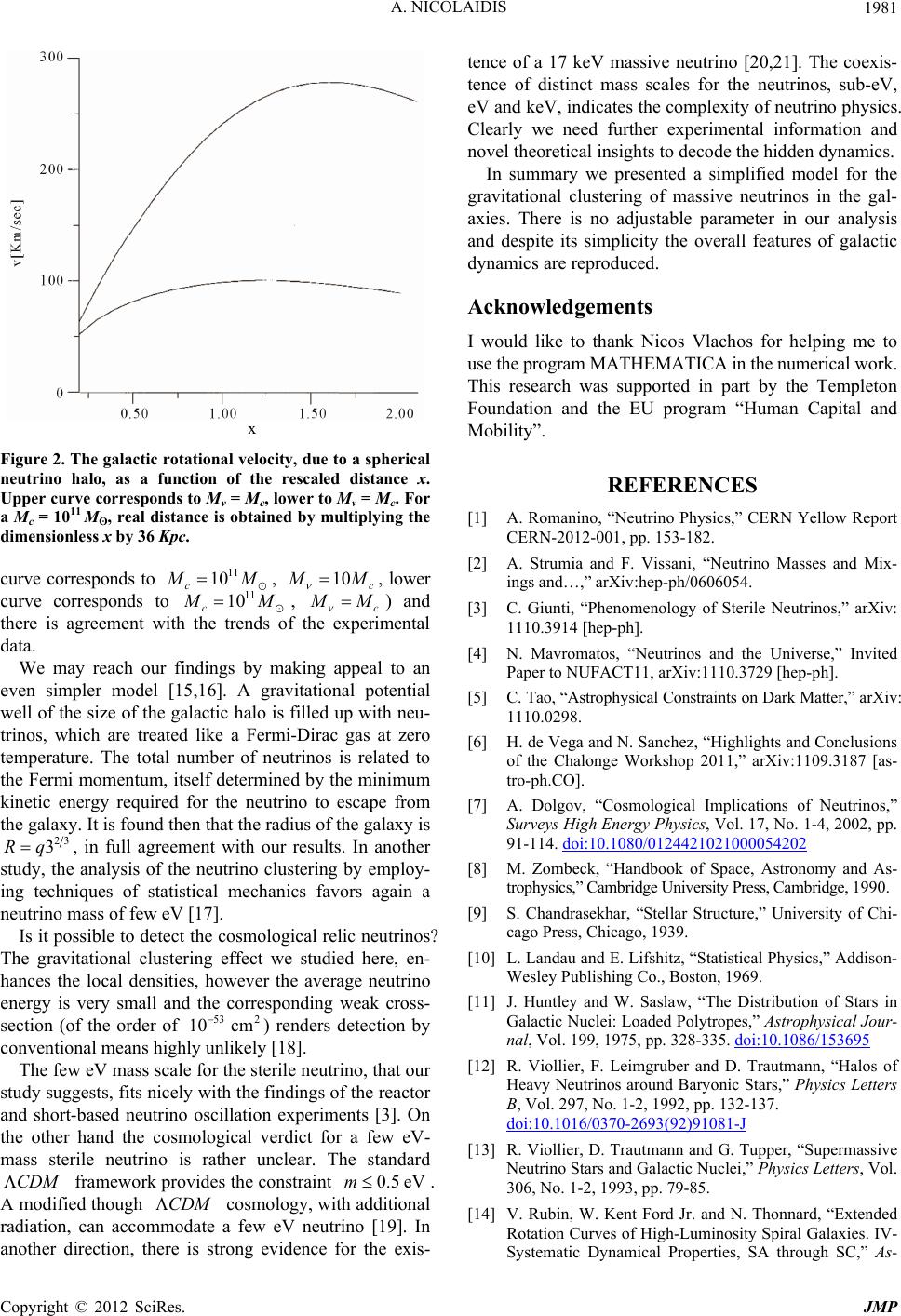 A. NICOLAIDIS 1981 x Figure 2. The galactic rotational velocity, due to a spherical neutrino halo, as a function of the rescaled distance x. Upper curve corresponds to Mv = Mc, lower to Mv = Mc. For a Mc = 1011 Mʘ, real distance is obtained by multiplying the dimensionless x by 36 Kpc. curve corresponds to 11 10 c M M, 10 c M M , lower curve corresponds to 11 10 c M M, c M M ) and there is agreement with the trends of the experimental data. We may reach our findings by making appeal to an even simpler model [15,16]. A gravitational potential well of the size of the galactic halo is filled up with neu- trinos, which are treated like a Fermi-Dirac gas at zero temperature. The total number of neutrinos is related to the Fermi momentum, itself determined by the minimum kinetic energy required for the neutrino to escape from the galaxy. It is found then that the radius of the galaxy is 23 3Rq 53 2 10 cm CDM0.5 eVm , in full agreement with our results. In another study, the analysis of the neutrino clustering by employ- ing techniques of statistical mechanics favors again a neutrino mass of few eV [17]. Is it possible to detect the cosmological relic neutrinos? The gravitational clustering effect we studied here, en- hances the local densities, however the average neutrino energy is very small and the corresponding weak cross- section (of the order of ) renders detection by conventional means highly unlikely [18]. The few eV mass scale for the sterile neutrino, that our study suggests, fits nicely with the findings of the reactor and short-based neutrino oscillation experiments [3]. On the other hand the cosmological verdict for a few eV- mass sterile neutrino is rather unclear. The standard framework provides the constraint . A modified though cosmology, with additional radiation, can accommodate a few eV neutrino [19]. In another direction, there is strong evidence for the exis- tence of a 17 keV massive neutrino [20,21]. The coexis- tence of distinct mass scales for the neutrinos, sub-eV, eV and keV, indicates the complexity of neutrino physics. Clearly we need further experimental information and novel theoretical insights to decode the hidden dynamics. In summary we presented a simplified model for the gravitational clustering of massive neutrinos in the gal- axies. There is no adjustable parameter in our analysis and despite its simplicity the overall features of galactic dynamics are reproduced. Acknowledgements I would like to thank Nicos Vlachos for helping me to use the program MATHEMATICA in the numerical work. This research was supported in part by the Templeton Foundation and the EU program “Human Capital and Mobility”. REFERENCES [1] A. Romanino, “Neutrino Physics,” CERN Yellow Report CERN-2012-001, pp. 153-182. [2] A. Strumia and F. Vissani, “Neutrino Masses and Mix- ings and…,” arXiv:hep-ph/0606054. [3] C. Giunti, “Phenomenology of Sterile Neutrinos,” arXiv: 1110.3914 [hep-ph]. [4] N. Mavromatos, “Neutrinos and the Universe,” Invited Paper to NUFACT11, arXiv:1110.3729 [hep-ph]. [5] C. Tao, “Astrophysical Constraints on Dark Matter,” arXiv: 1110.0298. [6] H. de Vega and N. Sanchez, “Highlights and Conclusions of the Chalonge Workshop 2011,” arXiv:1109.3187 [as- tro-ph.CO]. [7] A. Dolgov, “Cosmological Implications of Neutrinos,” Surveys High Energy Physics, Vol. 17, No. 1-4, 2002, pp. 91-114. doi:10.1080/0124421021000054202 [8] M. Zombeck, “Handbook of Space, Astronomy and As- trophysics,” Cambridge University Press, Cambridge, 1990. [9] S. Chandrasekhar, “Stellar Structure,” University of Chi- cago Press, Chicago, 1939. [10] L. Landau and E. Lifshitz, “Statistical Physics,” Addison- Wesley Publishing Co., Boston, 1969. [11] J. Huntley and W. Saslaw, “The Distribution of Stars in Galactic Nuclei: Loaded Polytropes,” Astrophysical Jour- nal, Vol. 199, 1975, pp. 328-335. doi:10.1086/153695 [12] R. Viollier, F. Leimgruber and D. Trautmann, “Halos of Heavy Neutrinos around Baryonic Stars,” Physics Letters B, Vol. 297, No. 1-2, 1992, pp. 132-137. doi:10.1016/0370-2693(92)91081-J [13] R. Viollier, D. Trautmann and G. Tupper, “Supermassive Neutrino Stars and Galactic Nuclei,” Physics Letters, Vol. 306, No. 1-2, 1993, pp. 79-85. CDM[14] V. Rubin, W. Kent Ford Jr. and N. Thonnard, “Extended Rotation Curves of High-Luminosity Spiral Galaxies. IV- Systematic Dynamical Properties, SA through SC,” As- Copyright © 2012 SciRes. JMP  A. NICOLAIDIS Copyright © 2012 SciRes. JMP 1982 trophysical Journal, Vol. 225, No. 1, 1978, pp. L107- L111. [15] R. Cowsik and J. McClelland, “Gravity of Neutrinos of Nonzero Mass in Astrophysics,” Astrophysical Journal, Vol. 180, 1973, pp. 7-10. doi:10.1086/151937 [16] R. Cowsik, “The Neutrino Hypothesis for Dark Matter in Dwarf Spheroidals,” Journal of Astrophysics and Astron- omy, Vol. 7, No. 1, 1986, pp. 1-6. doi:10.1007/BF02715021 [17] T. Nieuwenhuizen, “Do Non-Relativistic Neutrinos Con- stitute the Dark Matter?” Europhysics Letters, Vol. 86, No. 3, 2009, Article ID: 59001. [18] P. Langacker, J. Leveille and J. Sheiman, “On the Detec- tion of Cosmological Neutrinos by Coherent Scattering,” Physical Review D, Vol. 27, No. 6, 1983, pp. 1228-1242. doi:10.1103/PhysRevD.27.1228 [19] J. Hamann, S. Hannestad, G. Raffelt and Y. Wong, “Ster- ile Neutrinos with eV Masses in Cosmology—How Dis- favoured Exactly?” Journal of Cosmology and Astropar- ticle Physics, No. 9, 2011, arXiv:1108.4136. [20] H. de Vega and N. Sanchez, “Model-Independent Analy- sis of Dark Matter Points to a Particle Mass at the keV Scale,” Monthly Notices of the Royal Astronomical Soci- ety, Vol. 404, No. 2, 2010, pp. 885-894. doi:10.1111/j.1365-2966.2010.16319.x [21] P. Biermann and A. Kusenko, “Relic keV Sterile Neutri- nos and Reionization,” Physical Review Letters, Vol. 96, No. 9, 2006, Article ID: 091301. doi:10.1103/PhysRevLett.96.091301 |