

Paper Menu >>
Journal Menu >>
 Open Journal of Applied Sciences, 2012, 2, 294-297 doi:10.4236/ojapps.2012.24043 Published Online December 2012 (http://www.SciRP.org/journal/ojapps) Port and Shipping Express Management: The Challenges Faced by West and Central Africa in This Century Regine Adele Ngono Fouda Department of Logistics Management, Shanghai Maritime University (SMU), Shanghai, China Email: [email protected] Received September 26, 2012; revised October 26, 2012; accepted November 12, 2012 ABSTRACT Shipping industry has become more capital intensive, technically more demanding and subject to major global regula- tory reforms. As a consequence, the number of African shipping lines has been severely reduced. International trade of the WCA countries remains weak, limited to 30% of their Gross Domestic Product (GDP). The go al of this paper is to provide a comprehensive overview of the port and shipping convey management in the WCA region, and of course to describe what has been achieved since then and what still have to be done to better its infrastructures and port commu- nity. Keywords: WCA; Shippin g Con vey; Port s Sect ors; Ineffectiveness & Dispr o po rt io n; Constraints; Contai neri zat i on; Port Reforms; Competence & Management 1. Introduction Maritime transport is growing at a high pace. In a global context, WCA maritime transport and port sectors face several long-term trends such as: Ship size, (container ships), unstable tariffs, and port infrastructure. The ap- plication of measures to enhance security, by th e Interna- tional Ship and Port Facility Security Code (ISPS) Code, requires continuing attention. Also Poverty reduction mainly depends on economic growth, of which trade ex- pansion is a linchpin. For the past decades, WCA ports remain largely outside several global trends. However, due to current traffic and port efficiency, shipping lines strategies seem legitimate. Africa accounts for less than 1% of world container traffic. Moreover, WCA need to improved links between a port and its hinterland, these are the only solutions for small ports to ensure increased traffic, which will result in decreasing maritime transport tariffs. Otherwise, ports will become increasingly mar- ginalized. These global developments challenge the countries in WCA, but also offer [1] an opportunity to implement overdue reforms like improving areas around ports and better management. 2. Shipping & Port Sectors in WCA: An Amalgamation 2.1. Port Ownership and Management Mainly Public Service Model WCA lags behind in terms of global trends affecting port sector because port concentration is predominantly pub- licly-owned. For example, Lagos, Abidjan, Dakar and Douala. These ports account for almost 30% of the total port traffic in WCA (even though not a single port is ranked in the top 70 ports worldwide) (see Table 1). 2.2. Containerization Lingers Low despite Efforts In Africa, containerization has grown (10% annually) more than three times compared to economic growth. However, containerized rate of traffic remains low and marginal in the world. 2.3. Ports Are Costly for Shippers and Shipping Lines Due to numerous constraints, port charges are high for shippers. Shipping lines face congestion costs (about $5 million) and poor port productivity. So, Delmas calcu- lated 146 days in 2004. 2.4. Shipping Lines Strategies to Cope with Constraints The agreements between shipping companies, known as Conferences in WCA. Changes in such agreements have resulted from mergers and takeovers in shipping lines industry, because of the 1974 Code of Conduct for Liner Conferences and the 40-40-20 rule. UNCTAD [2,3] recommended reforms based on: 1) Liberalization with Copyright © 2012 SciRes. OJAppS 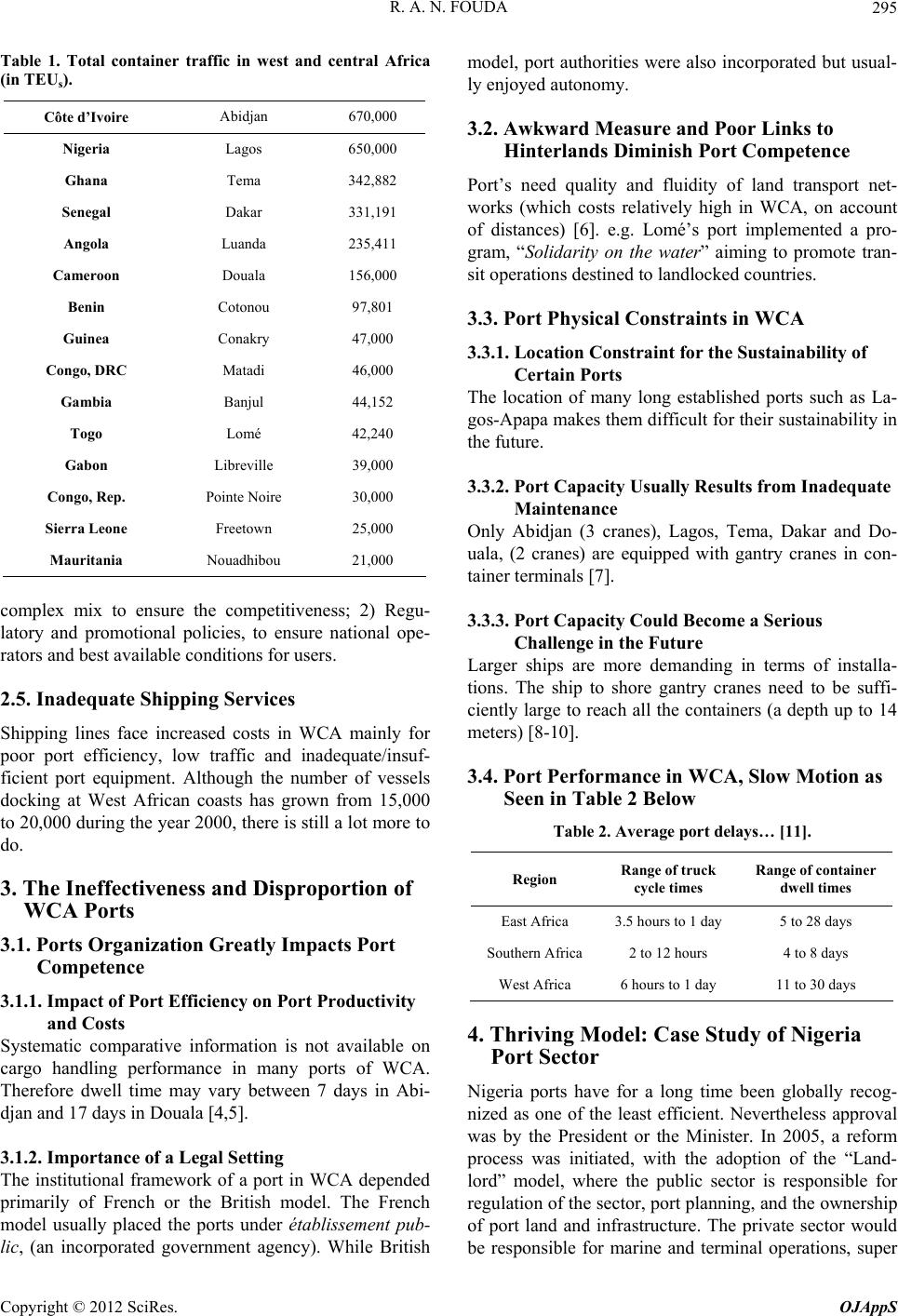 R. A. N. FOUDA 295 Table 1. Total container traffic in west and central Africa (in TEUs). Côte d’Ivoire Abidjan 670,000 Nigeria Lagos 650,000 Ghana Tema 342,882 Senegal Dakar 331,191 Angola Luanda 235,411 Cameroon Douala 156,000 Benin Cotonou 97,801 Guinea Conakry 47,000 Congo, DRC Matadi 46,000 Gambia Banjul 44,152 Togo Lomé 42,240 Gabon Libreville 39,000 Congo, Rep. Pointe Noire 30,000 Sierra Leone Freetown 25,000 Mauritania Nouadhibou 21,000 complex mix to ensure the competitiveness; 2) Regu- latory and promotional policies, to ensure national ope- rators and best available conditions for users. 2.5. Inadequate Shipping Services Shipping lines face increased costs in WCA mainly for poor port efficiency, low traffic and inadequate/insuf- ficient port equipment. Although the number of vessels docking at West African coasts has grown from 15,000 to 20,000 during the year 2000, there is still a lot more to do. 3. The Ineffectiveness and Disproportion of WCA Ports 3.1. Ports Organization Greatly Impacts Port Competence 3.1.1. Impact of Port Efficiency on Port Productivity and Costs Systematic comparative information is not available on cargo handling performance in many ports of WCA. Therefore dwell time may vary between 7 days in Abi- djan and 17 days in Douala [4,5]. 3.1.2. Importance of a Legal Setting The institutional framework of a port in WCA depended primarily of French or the British model. The French model usually placed the ports under établissement pub- lic, (an incorporated government agency). While British model, port authorities were also incorporated but usual- ly enjoyed autonomy. 3.2. Awkward Measure and Poor Links to Hinterlands Diminish Port Competence Port’s need quality and fluidity of land transport net- works (which costs relatively high in WCA, on account of distances) [6]. e.g. Lomé’s port implemented a pro- gram, “Solidarity on the water” aiming to promote tran- sit operations destined to landlocked coun tries. 3.3. Port Physical Constraints in WCA 3.3.1. Location Constraint for the Sustainability of Certain Ports The location of many long established ports such as La- gos-Apapa makes them difficult for their sustainability in the future. 3.3.2. Port Capacit y Usually Results from Inadequate Maintenance Only Abidjan (3 cranes), Lagos, Tema, Dakar and Do- uala, (2 cranes) are equipped with gantry cranes in con- tainer terminals [7]. 3.3.3. Port Capacity Could Become a Serious Challenge in the Future Larger ships are more demanding in terms of installa- tions. The ship to shore gantry cranes need to be suffi- ciently large to reach all the containers (a depth up to 14 meters) [8-10]. 3.4. Port Performance in WCA, Slow Motion as Seen in Table 2 Below Table 2. Average port delays… [11]. Region Range of truck cycle times Range of container dwell times East Africa 3.5 hours to 1 day 5 to 28 days Southern Africa 2 to 12 hours 4 to 8 days West Africa 6 hours to 1 day 11 to 30 days 4. Thriving Model: Case Study of Nigeria Port Sector Nigeria ports have for a long time been globally recog- nized as one of the least efficient. Nevertheless approval was by the President or the Minister. In 2005, a reform process was initiated, with the adoption of the “Land- lord” model, where the public sector is responsible for regulation of the sector, port planning, and the ownership of port land and infrastructure. The private sector would be responsible for marine and terminal operations, super Copyright © 2012 SciRes. OJAppS  R. A. N. FOUDA 296 structure and equipment. The agreed reform included: Creation of two Autonomous Port and Harbor Authori- ties Creation of a National Transport Regulatory Com- mission; limiting the role of the Government, while Pri- vate operators perform operations, reforms as: Legal and regulatory reform and Labor reform. In 2006 the initial concessions became operational. Within a few months of private operation of the Lagos container terminals, pro- ductivity went up. Chronic delays for berthing space had nearly vanished, leading to the reduction of congestion (surcharge from Euro 525 in March 2006 just before concessioning to Euro 75 in January 2007). Therefore reduction in congestion earned Nigerian economy about $200 million annually. As part of a broader program of port reform in early 2006, the Nigerian Ports Authority awarded a concession to APM Terminals to manage, operate, and develop the Apapa container terminal, in- creasing capacity from 220,000 TEUs/year to 1.6 mil- lion TEUs. Within months, shipping lines reduced their congestion, saving their economy $200 million a year. By early 2009, new gantry cranes had been acquired. However, although the port’s equip ment is able to handle more than 500 containers per day for customs examina- tions, the majority are returned to stacking by the end of each day. By January 2009, the port was clogged by un- collected containers, and at the end of February, the Ports Authority announced a temporary suspension of ship entry, lasting until mid-April, to clear “alarming” back- logs. The controller of Customs Service for Apapa blamed the low clearance volume on the need to physi- cally examine every container because of high false dec- laration by importers. However, even cleared containers were not collected. By January, end, out of 9741 con- tainers, only 851 had been cleared by customs, with all charges paid with documentation by agents. Ports Au- thority consequently proposed demurrage charges of $4 per TEU in a bid to force owners to move their contai- ners. In their turn, the containers’ agents blamed a lack of trucks, arguing that many had been booked. (Source: Press reports assembled by C. Bert Kruk, World Bank, ILO) [12]. 5. Strategic Analysis The Nigerian ports as well as WCA ports have not been able to integrate into global trends. Yet, their current challenges may be an opportunity in future development. Due to their new reforms, the Apapa port has witness a lot of progress, which has increased capacity from 220,000 TEU per year as well as the economy to $200 million. Congestion has gradually reduced. This let me evaluate, that the port operation by the public (president or minister) is costly and worthless, while the private operators have made it possible that larger ship can be served, infrastructure consideration, productivity to mini- mize turnaround time and country’s economic stability. Government operators can only appraise administratively, whereas, businessmen see into a future expansion of the port terminals. Though all these notions, more improve- ments are needed. 6. Recommendation and Conclusions In recommendation, eventually in conclusion, the re- cently observed development of larger vessels calling WCA as well as prospect for even larger vessels being used, offers an opportunity for reduction in shipping costs, provided that necessary maritime transport, land transport and port reforms are undertaken. The main ob- jectives of upcoming reforms for Governments should be aimed at: *facilitating procedures and controls in ports, such as procedures affecting turnaround time, dwell time and handling costs [13]: *facilitating trade and land trans- port outside the port on the main trade corridors: * im- proving port access in view to develop multimodal trans- port. Areas around ports are usually cong ested and inves- ting in road infrastructure to improve port access: *fos- tering private sector participation both to provide invest- ment for new installations and equipment: *increasing competition among shipping lines in countries where informal barriers to market entry still prevail: develop ing knowledge sharing between ports and countries on cur- rent port reforms in the region: *carrying out cost-benefit analysis of current port management and efficiency in countries facing very high port charges and high mari- time transport rates. Moreover, there is need to reduce dwell times and handling costs, countries need as well to invest in infor- mation systems, communications technology, and modern customs practices. Customs procedures, in particular, act as a bottleneck to port efficiency when they are out- dated or open to corruption. Also, Striving for efficient ports must be complemented by associated measures to increase transparency and reduce corruption in customs administration [14]. The African ports, like all world ports, must create port community systems not only to improve productivity and efficiency but also to respond to the growing importance of and future obligation in supply chain security. I personally th ink that, if all WCA port follows most of these recommendations (even 50% of it); there will be a drastic charge in their respective ports, which will shoot them at a top world record. REFERENCES [1] B. Slack, C. Comtois and R. McCalla, “Strategic Alli- ances in the Container Shipping Industry: A Global Per- spective,” Maritime Policy and Management, Vol. 29, No. 1, 2002, pp. 65-76. [2] A. K. C. Beresford, B. M. Gardner and S. J. Pettit, “The Copyright © 2012 SciRes. OJAppS  R. A. N. FOUDA Copyright © 2012 SciRes. OJAppS 297 UNCTAD and WORKPORT Models of Port Develop- ment: Evolution or Revolution?” Maritime Policy & Ma- nagement: The Flagship Journal of International Ship- ping and Port Research, Vol. 31, No. 2, 2004, pp. 93- 107. [3] J. Hoffmann, “Maritime Statistics and UNCTAD’s Re- search about Ports,” 2004. [4] C. Ximena, D. David and M. Alejandro, “Port Efficiency, Maritime Transport Costs and Bilateral Trade,” Journal of Development Economics, Vol. 75, No. 2, 2004, pp. 417-450. [5] R. J. Sanchez, J. Hoffmann, A. Micco, G. V. Pizzolitto, M. Sgut and G. Wilmsmeier, “Port Efficiency and Inter- national Trade: Port Efficiency as a Determinant of Mari- time Transport Costs,” Maritime Economics and Logistics, Vol. 5, 2003, pp. 199-218. doi:10.1057/palgrave.mel.9100073 [6] T. Conte, “Shipping Africa—A Special Case in Liner Ship- ping,” Presentation during the 3rd Intermodal Africa 2005, Dar Es Salaam, 2005. [7] T. Vaneslslander, “Cost Structures in Container Handling: How about Economies of Scale?” Presentation at Annual Conference of the International Association of Maritime Economists, Melbourne, 2006. [8] K. Cullinane and M. Khanna, “Economies of Scale in Large Containership: Optimal Size and Geographical Im- placations. Optimal Size and Geographical Implications,” Journal of Transport Geography, Vol. 8, No. 3, 2000, pp. 181-195. [9] Drewry, “Annual Review of Global Container Terminal Operators,” 2006. [10] C. Woodbridge, “Global Operators Consolidate Hold on Terminal Market,” In: M. G. H. Bell and B. Khalid, Eds., Containerization International Handbook: The Port Sec- tor in South Africa: Towards an Integrated Policy and In- stitutional Reform, World Bank, Washington DC, 2007, p. 16. [11] M. G. H. Bell and B. Khalid, “The Port Sector in South Africa: Towards an Integrated Policy and Institutional Reform,” World Bank, Washington DC, 2007. [12] C. B. Kruk, “World Bank, ILO,” Press Reports Assem- bled, 2004. [13] N. Van and C. Henriëtte, “Port Reform and Concession- ing in Developing Countries,” Maritime Economics and Logistics, Vol. 7, 2005, pp. 141-155. doi:10.1057/palgrave.mel.9100129 [14] A. Frémont, “Shipping Lines and Logistics,” Transport Reviews: A Transnational Transdisciplinary Journal, Vol. 29, No. 4, 2006, pp. 537-554. |