

Paper Menu >>
Journal Menu >>
 Journal of Electromagnetic Analysis and Applications, 2012, 4, 481-484 http://dx.doi.org/10.4236/jemaa.2012.412067 Published Online December 2012 (http://www.SciRP.org/journal/jemaa) 481 The Electromagnetic Field Propagation in a Spherical Core Osama M. Abo-Seid1, Ghada M. Sami2 1Mathematic Department, Faculty of Science, Kafr El-Sheikh University, Kafr El-Sheikh, Egypt; 2Mathematic Department, Faculty of Science, Ain shams University, Cairo, Egypt. Email: [email protected]om, [email protected] Received September 15th, 2012; revised October 16th, 2012; accepted October 26th, 2012 ABSTRACT A simple and explicit derivation for the electric and magnetic fields in the ferromagnetic cores has been studied. An improved model for analyzing the distribution of electric and magnetic fields in a toroidal core is given. This leads to a basis system for the theoretical analysis of iron loss in the magnetic cores, so, the theoretical results have been evaluated. A method is used to perform numeric calculations of the magnetic field produced by the eddy current and displacement current due to the electric field which shield the magnetic flux from the inner portion of the core cross section. The re- sults obtained from this work could be used to evaluate the skin effect in the conductors of a winding. Keywords: Electromagnetic Field; Wave Propagation; Magnetic Flux; Magnetic Cores 1. Introduction Considerable interest has been given to the study of elec- tric and magnetic fields distribution in a toroidal core. Some of these studies calculate the core loss theoretically [1]. In their calculation, the magnetic field strength pro- duced by the winding current is assumed the constant around the perimeter of the cross section. Other studies have been applied to measure the magnetic core loss [2]. Also, Abo-Seida et al. [3] gave an explicit derivation for the electromagnetic transient, Abo-Seida et al. [4] de- rived the transient fields of a vertical electric dipole on an M-layered dielectric medium. The transient field of the magnetic dipole on a two-layered conducting earth has also been studied [5,6]. Abo-Seida [7] has studied the far field of a vertical magnetic dipole. Wait [8] derived the electromagnetic fields of a traveling current line source. We noticed that the diameter of the core cross section is very small compared with the innermost radius of the core. In this paper, we calculated the distributions of the electric and magnetic fields in the torodial core with spherical cross section based on Maxwell’s equation as in Figure 1(a) and take the boundary conditions into consideration. The magnetomotive forces are affected by the external current, the eddy and displacement current in the area r < R as in Figure 1(b), but on the boundary r = R, the magnetic field intensity is determined only by the exciting current. The induced eddy current and dis- placement current due to the electric field will shield the flux from the inner portion of the core section resulting in a flux skin effect analogous to the skin effect in the conductors of winding at high frequency. With the in- crease of frequency, this phenomenon becomes more ob- vious. 2. Formulation of the Problem The physical model is illustrated in Figures 1(a) and (b). A frequency domain analysis was performed in this work. It is assumed that all field vectors and all currents and charge densities vary sinusoidally with time at a single angular frequency. Maxwell’s equations are then written as follows: H JjD (1) EjB (2) 0B (3) D (4) Taking the curl of (1) and substituting (2), we obtain 2 H j H (5) where 22 andHKH kj (6) Equation (5) can be written in spherical coordinates ,,r as 2 2 22 2 1d11 1 sin dsin sin 0 H rH rrrr kH 2 (7) Copyright © 2012 SciRes. JEMAA 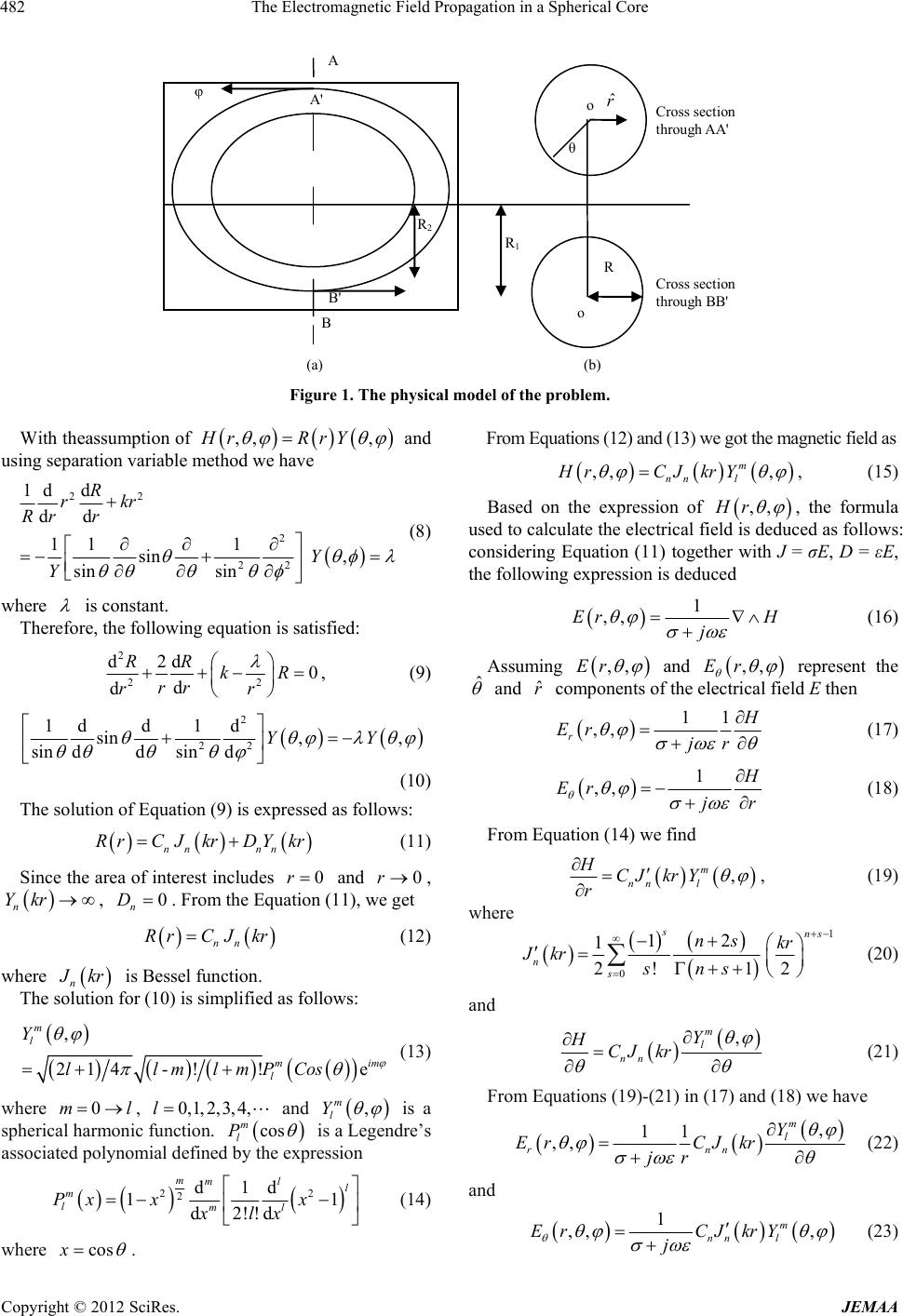 The Electromagnetic Field Propagation in a Spherical Core 482 A B B' A' φ R 2 ˆ r o θ o R R 1 Cross section through BB' Cross section through AA' (a) (b) Figure 1. The physical model of the problem. With theassumption of ,, ,Hr RrY and using separation variable method we have 22 2 22 1d d dd 11 1 sin , sin sin R rkr Rr r Y Y (8) where is constant. Therefore, the following equation is satisfied: 2 22 d2d 0 d d RR kR rr rr , (9) 2 22 1dd1 d sin, , sin ddsindYY (10) The solution of Equation (9) is expressed as follows: nn nn RrCJkrDYkr (11) Since the area of interest includes and , 0r0r n Ykr, . From the Equation (11), we get 0 n D nn RrCJ kr (12) where n J kr is Bessel function. The solution for (10) is simplified as follows: , 214- !!e m l mi l Y llmlmPCos m (13) where , and 0ml 0,1, 2,3, 4,l , m l Y is a spherical harmonic function. cos m l P is a Legendre’s associated polynomial defined by the expression 22 2d1d 11 2! !dd mmll m lml Px xx lxx (14) where cosx . From Equations (12) and (13) we got the magnetic field as ,, , m nn l HrCJ krY , (15) Based on the expression of ,,Hr , the formula used to calculate the electrical field is deduced as follows: considering Equation (11) together with J = σE, D = εE, the following expression is deduced 1 ,, Er H j (16) Assuming ,,Er and ,,Er represent the ˆ and components of the electrical field E then ˆ r 11 ,, r H Er jr (17) 1 ,, H Er jr (18) From Equation (14) we find , m nn l HCJ krY r , (19) where 1 0 12 1 2! 12 sns n s ns kr Jkr sns (20) and , m l nn Y HCJ kr (21) From Equations (19)-(21) in (17) and (18) we have , 11 ,, m l rnn Y Er CJkr jr (22) and 1 ,, , m nn l Er CJkrY j (23) Copyright © 2012 SciRes. JEMAA 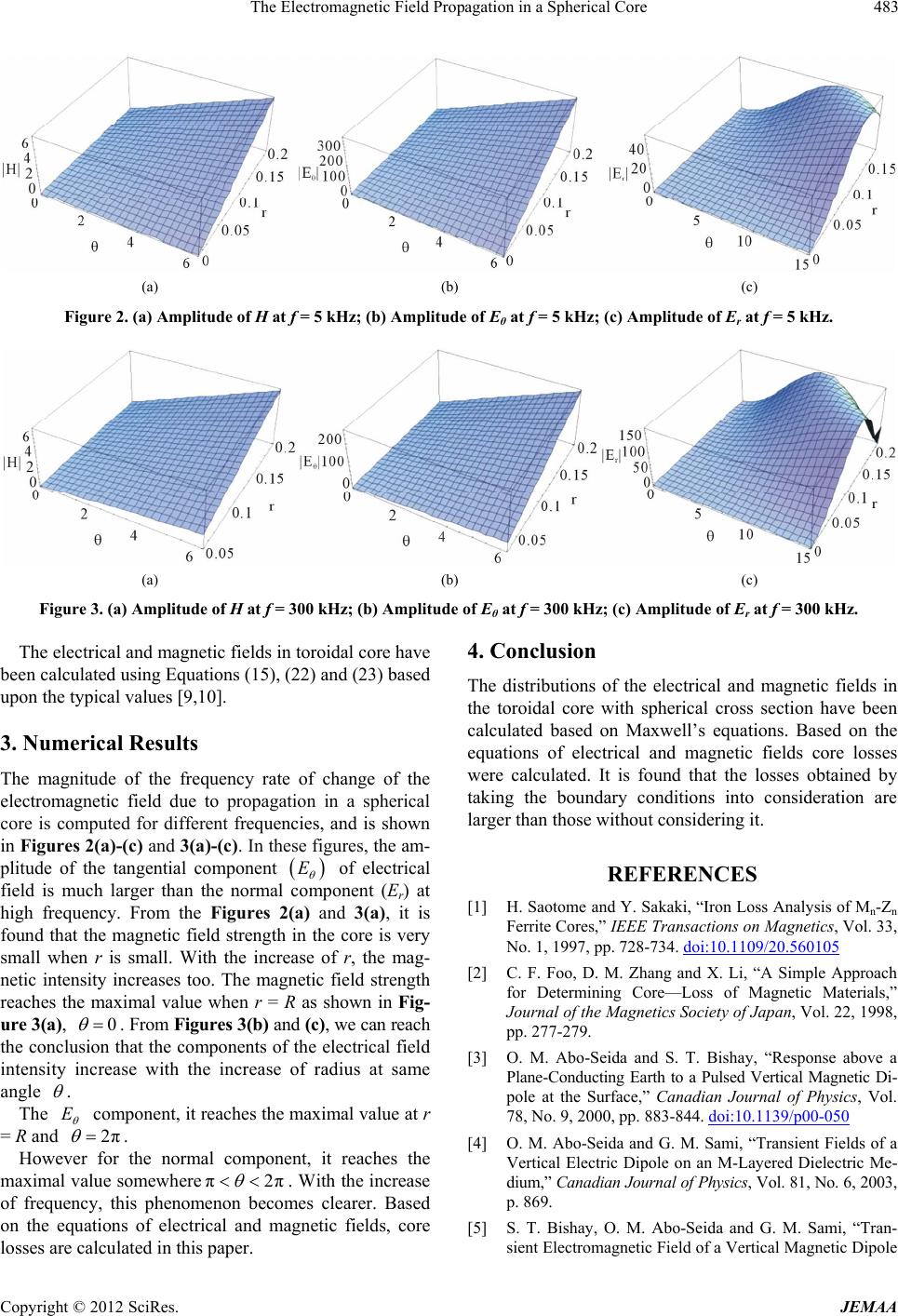 The Electromagnetic Field Propagation in a Spherical Core 483 (a) (b) (c) Figure 2. (a) Amplitude of H at f = 5 kHz; (b) Amplitude of Eθ at f = 5 kHz; (c) Amplitude of Er at f = 5 kHz. (a) (b) (c) Figure 3. (a) Amplitude of H at f = 300 kHz; (b) Amplitude of Eθ at f = 300 kHz; (c) Amplitude of Er at f = 300 kHz. The electrical and magnetic fields in toroidal core have been calculated using Equations (15), (22) and (23) based upon the typical values [9,10]. 3. Numerical Results The magnitude of the frequency rate of change of the electromagnetic field due to propagation in a spherical core is computed for different frequencies, and is shown in Figures 2(a)-(c) and 3(a)-(c). In these figures, the am- plitude of the tangential component E of electrical field is much larger than the normal component (Er) at high frequency. From the Figures 2(a) and 3(a), it is found that the magnetic field strength in the core is very small when r is small. With the increase of r, the mag- netic intensity increases too. The magnetic field strength reaches the maximal value when r = R as shown in Fig- ure 3(a), 0 . From Figures 3(b) and (c), we can reach the conclusion that the components of the electrical field intensity increase with the increase of radius at same angle . The E component, it reaches the maximal value at r = R and 2π . However for the normal component, it reaches the maximal value somewhereπ2π . With the increase of frequency, this phenomenon becomes clearer. Based on the equations of electrical and magnetic fields, core losses are calculated in this paper. 4. Conclusion The distributions of the electrical and magnetic fields in the toroidal core with spherical cross section have been calculated based on Maxwell’s equations. Based on the equations of electrical and magnetic fields core losses were calculated. It is found that the losses obtained by taking the boundary conditions into consideration are larger than those without considering it. REFERENCES [1] H. Saotome and Y. Sakaki, “Iron Loss Analysis of Mn-Zn Ferrite Cores,” IEEE Transactions on Magnetics, Vol. 33, No. 1, 1997, pp. 728-734. doi:10.1109/20.560105 [2] C. F. Foo, D. M. Zhang and X. Li, “A Simple Approach for Determining Core—Loss of Magnetic Materials,” Journal of the Magnetics Society of Japan, Vol. 22, 1998, pp. 277-279. [3] O. M. Abo-Seida and S. T. Bishay, “Response above a Plane-Conducting Earth to a Pulsed Vertical Magnetic Di- pole at the Surface,” Canadian Journal of Physics, Vol. 78, No. 9, 2000, pp. 883-844. doi:10.1139/p00-050 [4] O. M. Abo-Seida and G. M. Sami, “Transient Fields of a Vertical Electric Dipole on an M-Layered Dielectric Me- dium,” Canadian Journal of Physics, Vol. 81, No. 6, 2003, p. 869. [5] S. T. Bishay, O. M. Abo-Seida and G. M. Sami, “Tran- sient Electromagnetic Field of a Vertical Magnetic Dipole Copyright © 2012 SciRes. JEMAA  The Electromagnetic Field Propagation in a Spherical Core 484 on a Two-Layer Conducting Earth,” IEEE Transactions on Geoscience and Remote Sensing, Vol. 39, No. 4, 2001, pp. 894-897. doi:10.1109/36.917919 [6] S. T. Bishay and G. M. Sami, “Time-Domain Study of the Transient Fields for a Thin Circular Loop Antenna,” Ca- nadian Journal of Physics, Vol. 80, No. 9, 2002, pp. 955- 1003. doi:10.1139/p02-049 [7] O. M. Abo-Seida, “Far-Field Due to a Vertical Magnetic Dipole in Sea,” Applied Electromagnetic Waves and Ap- plication, Vol. 20, No. 6, 2006, pp. 707-715. [8] J. R. Wait, “EM Fields of a Phased Line Current over a Conducting Half-Space,” IEEE Electromagnetic Com- patibility Society, Vol. 38, No. 4, 1996, pp. 608-611. doi:10.1109/15.544318 [9] G. R. Skutt and F. C. Lee, “Characterization of Dimen- sional Effects in Ferrite-Core Magnetic Devices,” IEEE Transactions on Magnetics, Vol. 2, 1996, pp. 1435-1440. [10] Y. Sakaki, M. Yoshida and T. Sato, “Formula for Dyna- mic Power Loss in Ferrite Cores Taking into Account Dis- placement Current,” IEEE Transactions on Magnetics, Vol. 29, 1993, pp. 3517-3519. doi:10.1109/20.281215 Copyright © 2012 SciRes. JEMAA |