

Paper Menu >>
Journal Menu >>
 Creative Education 2012. Vol.3, No.8, 1366-1370 Published Online December 2012 in SciRes (http://www.SciRP.org/journal/ce) http://dx.doi.org/10.4236/ce.2012.38199 Copyright © 2012 SciRe s . 1366 Effective Integration of Teaching and Research in a First Year Food and Nutrition Course Russell Keast, Susie Macfarlane, Lynn Riddell School of Exercise and Nutrition Sciences, Deakin University, Victoria, Australia Email: [email protected] Received October 2nd, 2012; revised November 4th, 2012; accepted November 20th, 2012 Previous research has indicated that undergraduate student learning can be enhanced through active in- volvement in research. Furthermore, creating an academic environment where teaching and research are intimately linked can facilitate the induction of students into a community of learners where new knowl- edge is created, explored and critiqued. Scaffolding and supporting student learning via engagement in authentic research experiences can work to ensure graduating students have the capacity to generate and investigate important questions that contributes to the development of new knowledge. This paper pre- sents a case study that outlines curriculum design and pedagogical strategies aimed at integrating teaching and research within the first year of an undergraduate course. First year Food and Nutrition students were asked to partake in a research project where they were asked to complete a series of diet and food related questionnaires, analyse, interpret and critique the resulting data. Students were supported through this learning activity via small group tutorial support and question and answer sessions within the learning management system. Anonymous evaluation of the teaching and learning experience was conducted at the end of the teaching period and the results indicate that the students welcomed the opportunity to engage in an authentic, research based learning activity. Students’ found the assessment tasks were clearly explained to them (88% agreeing), and felt well supported in approaching this research based assessment task. Fur- thermore, the qualitative comments indicated that the students’ found the learning environment to be meaningful and relevant. This case study indicates that it is possible to effectively incorporate authentic research experiences within the curriculum of a first year course. The experiential, inquiry based learning approach used supported the students’ participation in a systematic, rigorous data collection process re- quired in a structured research environment and blended these requirements with authentic learning of discipline specific skills and knowledge. Keywords: Higher Education; Teaching Research Nexus; Student Experience Introduction The Teaching-Research Nexus The teaching-research nexus is a multi-faceted notion that holds various meanings and encompasses a range of activities centred on the interdependence between teaching and research. These activities are enacted at various sites of the university: 1) the research conducted by the teaching staff that forms part of the content of the course. The students’ role here is to act as an “audience to the research carried out by their [teachers]” (Zam- orski, 2002); 2) the teaching and learning activities that include research conducted with and by undergraduate and postgradu- ate students; 3) teaching staff involvement in the scholarship of teaching and learning (Prince, Felder, & Brent, 2007). The pres- sure on universities to increase research output, identify and market their distinctive approaches to teaching and meet com- munity demand for graduates who are prepared for challenging roles in complex workplaces has to lead to a growing focus on enhancing the teaching-research nexus (Zubrick, Reid, & Ros- siter, 2001). Impact of Res e arch on Teaching Q uality The findings regarding the impact of research on teaching quality indicate that at both an institutional level and that of an individual academic, research productivity has no impact on, and in some cases reduces teaching performance. At the level of the institution, a longitudinal study by Astin (as cited in Prince et al., 2007) examining the impact of research on educa- tional outcomes found a significant negative correlation. Stu- dents attending more research-oriented institutions experience higher levels of dissatisfaction and poorer results in most mea- sures of cognitive and affective development. This finding may be explained by a lack of alignment between research and tea- ching activities at an institutional level. Jenkins (2004) observes that within universities, research and teaching are managed se- parately, and that policy changes are required to integrate re- search and teaching goals and activities. Several reviews undertaken of studies on the relationship be- tween the level of research activity conducted by an academic and their teaching effectiveness find no relationship (Feldman, 1987; Hattie & Marsh, 1996; Jenkins, 2004). Research excel- lence and productivity is independent of teaching excellence: some academics are highly productive researchers and skilled teachers, some have mastery in one area and not the other, and others are weak in both. Two explanations for this finding have been proposed. One explanation relates to the institutional con- text: that as eac h activ ity requi res a n almost ful l-time workl oad, the significant demands on academics’ time necessitate the de-  R. KEAST ET AL. cision to focus primarily on either research or teaching (Prince et al., 2007). A second explanation for the lack of association between re- search and teaching excellence is that the skills and attributes required to undertake rigorous research are very different to those required to excel as a university teacher. For example, Coaldrake and Stedman (1999) propose the dichotomy that re- search is the generation of new knowledge while teaching is the transmission of knowledge. However, effective teaching is not a process of transmission, but rather the facilitation of others’ learning and discovery. Traditional teaching approaches in which students attend lectures in which they are expected to passively absorb information then apply this transmitted knowl- edge through essay or examination have little in common with the research process involving developing hypotheses to test open-ended problems characterised by complex, missing or conflicting information, and producing and defending final re- sults (Prince et al., 2007). It is therefore unsurprising that teach- ing approaches consisting of a one-way communication of re- search findings results has little impact on students’ learning. This misalignment between the teaching approaches and the desired learning outcomes may explain the overall lack of evi- dence of the impact of research on teaching. Student Engagement and Learning While there is no evidence that research improves an aca- demics’ teaching, there is a strong body of evidence that stu- dents’ learning is enhanced through their involvement in re- search. Students who undertake research in their undergraduate studies demonstrate improved retention and attainment, satis- faction and self-reported improvement in work readiness (Astin, 1994; cited in Prince, Felder, & Brent, 2007). It is also argued that, with an adequate framework in place, research can im- prove student engagement and enhance the learning environ- ment (Brew, 2010; Krause, Arkoudis, & McCulloch, 2008). Brew (2010), reporting on a two year National Tea ching Fell ow- ship on enhancing undergraduate students’ engagement throug h research states this “engages students meaningfully in higher education and prepares them for a 21st century world of work in which knowing how to create, inquire and critically evaluate knowledge is of increasing importance”. Creating a student ex- perience in which there is integration of teaching and research also facilitates the induction of students into a community of learners outlined by the Boyer Commission. The Boyer com- mission’s view is that a university is an ecosystem made up of communities of learners, and that teaching and learning should be explicitly linked within the environment (Boyer, 2000). The report recommends that universities build a culture that sees students as inquirers undertaking a journey of discovery. Hi gher education is seen as a site of exploration and adve nture in whi ch “every course in an undergraduate curriculum should provide an opportunity for a student to succeed through discovery-based methods” (Boyer, 2000). There is thus a strong imperative to inspire in students the passion and the capacity to generate and investigate important questions that impact on society. It is clear however, that there is a need to explore approaches to achieve this within higher education. In this paper we present a case study that outlines curriculum design and pedagogical strategies aimed at the integration of teaching and research to enhance student engagement and learning. Disciplinary Variation in the Teaching-Research Nexus There is increasing evidence that definitions and understand- ings of the teaching-research nexus varies across disciplines (Jenkins, 2004). This variation is in part determined by disci- pline-specific conceptualisations and practices of research, teach- ing and professional identity, and in the range of views regard- ing the nature of knowledge and ways in which knowledge is constructed. In the discipline of health sciences, the body of disciplinary knowledge is built up over time through peer re- viewed research that critiques, builds on or extends the work of others. To participate in the community of researchers, a health science scholar must develop the tools of critical thinking and scientific analysis. Engaging the student in the research process is one method to enhance the student’s ability to critique and challenge current knowledge. In addition, promoting this link between teaching and research provides students with the opportunity to experi- ence being part of a broader community of learners and resear- chers investigating a body of knowledge. There are clear ad- vantages in integrating research and teaching within the disci- pline of food and nutrition. As Rowland reported, teaching in a discipline area that aims to develop a student’s ability to “cri- tique [of] matters of fundamental concern in the discipline” and “actively engage [ing] in research aimed at applying the disci- pline to a social or technical context” (Rowland, 1996) signifi- cantly enhances the integration of teaching and research. There are three ways to think of the interconnect between research and teaching in the University ecosystem: 1) expert knowledge passed onto the student (Neumann, 1994), 2) researcher and student learn together in a form of reciprocal relationship (Ro- bertson & Bond, 2001) and 3) students learning from the re- search culture of the laboratory or department (Brew & Boud, 1995). In promoting a link between teaching and research, the students are being inducted into this community of practice and are provided with the awareness of and skills for the scholar- ship of discovery and application. This paper follows the recommendations of the Boyer Com- mission whereby research is conceptualised as the Scholarship of Discovery (Boyer, 2000) with a focus on interpretative un- derstanding of phenomena impacting on the population cohort. In addition, given that the case study outlined in this paper oc- curs within an undergraduate food and nutrition program with an applied nature, the research therefore may also be considered to encompass the Scholarship of Application (Boyer, 2000). Teachin g R esearch The incorporation of research into the undergraduate curri- culum should begin early to develop students’ discipline-spe- cific cognitive skills and establish an effective learning environ- ment (Krause et al., 2008). The level of engagement of students in the learning process is a guide to the extent of learning that can be achieved, and an emphasis on research processes and problems may encourage engagement and stimulate learning. Learning can be enhanced by higher order thinking, and An- derson and Krathwohl (Anderson & Krathwohl, 2001) extended Bloom’s taxonomy to six levels of thinking that progress from a surface to a deeper approach: remembering; understanding; applying; analysing; evaluating; creating. In order to promote higher order thinking and therefore enhance learning, students Copyright © 2012 SciRe s . 1367  R. KEAST ET AL. must become active in the learning process, and one potential approach t o enco ura ge hi g her lea rni ng skill s i s to d evel op cur - riculum incorporating research which develops inquiry based learning. First Year Transition to Higher Education Students new to a university environment may have only experienced surface approaches to learning at secondary school, and the transition to deeper learning may be unfamiliar and therefore difficult for some university students. Indeed, one study found that two thirds of students surveyed believed sec- ondary school did not did not prepare them for University learning environment (McInnis, James, & Hartley, 2000). The university environment places more responsibility on the stu- dent to complete assessment tasks, readings, attend lectures and lab se ssions indepe ndent of superv ision. Those who adapt qu ic k ly to the new environment will thrive, while those who fail to adapt may struggle and become disengaged with the University learning environment. One third of first year students were not performing as well as they expected at University, and almost 50% of 1st year students agreed that it was difficult to motivate themselves to study (McInnis et al., 2000). One of the issues for the teacher is to engage students early in the trimester, so they are motivated to undertake independent hours of study required to succeed. The case study outlined in this paper guided food and nutri- tion students to undertake a research project involving the rig- orous collection, analysis and evaluation of scientific data. The relevance and importance of the information was enhanced by designing a task in which students analysed their own diet or food behaviours and then reflected on why, when, where and with whom they eat. Thus the learning environment was imme- diately relevant to them. Given that a student’s approach to learning will be determined by the learning context and as- sessment activity (Laurillard, 1997), this higher order thinking approach to conducting nutritional research is likely to increase learning quality (Anderson & Krathwohl, 2001). This paper outlines the integration of teaching and research within students’ learning experience in a food and nutrition course. The aim of the project is to embed the development of research skills, knowledge and attitudes into the curriculum to enhance student engagement and learning. An experiential, in- quiry based learning approach was implemented, in which stu- dents collected, analysed and interpreted research data using rigorous research methodology and an ethical and scientific ap- proach Method First year University students enrolled in a Food and Nutri- tion course undertake the compulsory unit “Food: Nutrition, Culture and Innovation” in their first trimester. As this is one of the first units completed during their undergraduate degree, students’ knowledge of food and nutrition is assumed to be at a level equivalent to that of a consumer. This unit was designed to provide a basic understanding of what and why we eat and implications for diet-related disease. As part of their assessment for this unit students are asked to complete three dietary re- search questionnaires with themselves as subjects. The ques- tionnaires used in this assessment task are all frequently used in nutrition research and are of appropriate rigor for investigating food related behaviours and dietary intake. The aim of the as- signment was to examine individual diet and food behaviours. Data collection was completed using systematic research tech- niques including 2 day diet diaries, a food behaviours ques- tionnaire, and a food variety score questionnaire (Savige, Hsu- Hage, & Wahlqvist, 1997). During small group teaching ses- sions, each student was taught how to accurately complete the dietary analysis tools, with the tutors modelling the detail a re- searcher provides to a subject participating in research of this kind. This served two purposes, to demonstrate the proper me- thods for completion to ensure students developed a sound grasp of the process of administering dietary tools, and also to ensure the integrity of the data collected. The students then col- lected data on their own diet and eating related behaviours and additional questions were managed through the unit website on the University Learning Management System. To complete the major assignment, students addressed fifteen questions specifically designed to foster an in-depth understand- ing of why they, as individuals, consume the foods they do. In order to answer these questions, students were required to ana- lyse and interpret their own dietary and food behaviours data. The intended outcomes for students of this task were threefold: 1) to understand how to analyse and interpret dietary data 2) to gain self realisation about their own dietary habits, and 3) to provide an authentic the learning experience whereby students gain a practical understanding of the complexity of dietary research methodology, the problems that participants may ex- perience when completing diet diaries, food variety scores and food behaviour questionnaires and the subsequent impact on data analysis and interpretation. Sample questions from the Food Habits Assignment Look at your answers for questions 14 - 22 (Food Behaviour Questionnaire). Of the answers you have given, please explain which ONE has the most influence on your diet. For example, does your ethnicity determine the type of food you eat, or you living arrangements, or your age etc…. Please explain your answer (100 words, 6 marks). Do you think people who identify with a culture other than your own living in Australia would have similar eating patterns to you? Please explain (100 words, 6 marks). The student assignments were graded and handed back to students, at which point students were also provided with a plain language statement and asked if they would consent to allowing their de-identified class data to be utilised for research purposes. Students were aware they could freely choose not to sign the consent form, in which case their data were not used in any research. This study was approved by the University’s Hu- man Research Ethics Committee. Student evaluation of the unit Food: Nutrition, culture and innovation, was carried out by the Deakin University official “Student Evaluation of Teaching and Units’ (SETU) process. All information entered by students was anonymous and group level quantitative data are publically available. Student com- ments were collated and these qualitative data are made avail- able to the Chair of the unit after exam results are released. Re- lease of the qualitative data for this publication has been ap- proved by the University’s Human Research Ethics Committee. Results and Discussion A total of 76 students of 118 (64%) voluntarily completed the anonymous student evaluation of teaching units (SETU) at Copyright © 2012 SciRe s . 1368 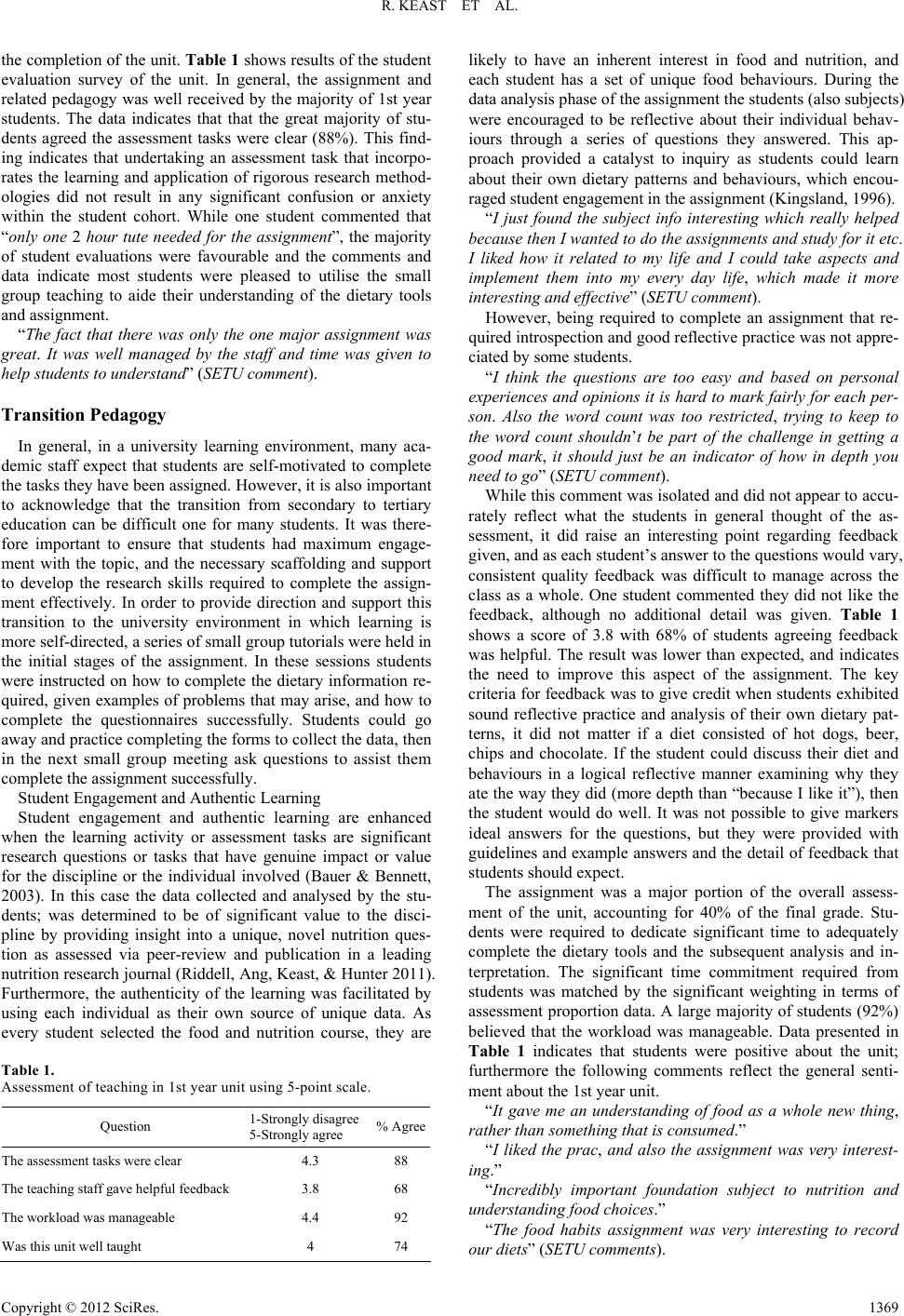 R. KEAST ET AL. the completion of the unit. Table 1 shows results of the student evaluation survey of the unit. In general, the assignment and related pedagogy was well received by the majority of 1st year students. The data indicates that that the great majority of stu- dents agreed the assessment tasks were clear (88%). This find- ing indicates that undertaking an assessment task that incorpo- rates the learning and application of rigorous research method- ologies did not result in any significant confusion or anxiety within the student cohort. While one student commented that “only one 2 hour tute needed for the assignment”, the majority of student evaluations were favourable and the comments and data indicate most students were pleased to utilise the small group teaching to aide their understanding of the dietary tools and assignment. “The fact that there was only the one major assignment was great. It was well managed by the staff and time was given to help students to understand” (SETU comment). Transition Pedagogy In general, in a university learning environment, many aca- demic staff expect that students are self-motivated to complete the tasks they have been assigned. However, it is also important to acknowledge that the transition from secondary to tertiary education can be difficult one for many students. It was there- fore important to ensure that students had maximum engage- ment with the topic, and the necessary scaffolding and support to develop the research skills required to complete the assign- ment effectively. In order to provide direction and support this transition to the university environment in which learning is more self-directed, a series of small group tutorials were held in the initial stages of the assignment. In these sessions students were instructed on how to complete the dietary information re- quired, given examples of problems that may arise, and how to complete the questionnaires successfully. Students could go away and practice completing the forms to collect the data, then in the next small group meeting ask questions to assist them complete the assignment successfully. Student Engagement and Authentic Learning Student engagement and authentic learning are enhanced when the learning activity or assessment tasks are significant research questions or tasks that have genuine impact or value for the discipline or the individual involved (Bauer & Bennett, 2003). In this case the data collected and analysed by the stu- dents; was determined to be of significant value to the disci- pline by providing insight into a unique, novel nutrition ques- tion as assessed via peer-review and publication in a leading nutrition research journal (Riddell, Ang, Keast, & Hunter 2011). Furthermore, the authenticity of the learning was facilitated by using each individual as their own source of unique data. As every student selected the food and nutrition course, they are Table 1. Assessment of teaching in 1st year unit using 5-point scale. Question 1-Strongly disa gree 5-Strongly agree % Agree The assessment tasks were clear 4.3 88 The teaching st aff gave helpful feedba ck 3.8 68 The workload was manageable 4.4 92 Was this unit wel l taught 4 74 likely to have an inherent interest in food and nutrition, and each student has a set of unique food behaviours. During the data analysis phase of the assignment the students (also subjects) were encouraged to be reflective about their individual behav- iours through a series of questions they answered. This ap- proach provided a catalyst to inquiry as students could learn about their own dietary patterns and behaviours, which encou- raged student engagement in the assignment (Kingsland, 1996). “I just found the subject info interesting which really he l ped because then I wanted to do the assignments and study for it etc. I liked how it relate d to my life and I could take aspects and implement them into my every day life, which made it more interesting and effective” (SETU comment). However, being required to complete an assignment that re- quired introspection and good reflective practice was not appre- ciated by some students. “I think the questions are too easy and based on personal experiences and opinions it is hard to mark fairly for each per- son. Al so the word count was too restricted, trying to keep to the word count shouldn’t be part of the challenge in getting a good mark, it should just be an indicator of how in depth you need to go” (SETU comment). While this comment was isolated and did not appear to accu- rately reflect what the students in general thought of the as- sessment, it did raise an interesting point regarding feedback given, and as each student’s answer to the questions would vary, consistent quality feedback was difficult to manage across the class as a whole. One student commented they did not like the feedback, although no additional detail was given. Table 1 shows a score of 3.8 with 68% of students agreeing feedback was helpful. The result was lower than expected, and indicates the need to improve this aspect of the assignment. The key criteria for feedback was to give credit when students exhibited sound reflective practice and analysis of their own dietary pat- terns, it did not matter if a diet consisted of hot dogs, beer, chips and chocolate. If the student could discuss their diet and behaviours in a logical reflective manner examining why they ate the way they di d (more depth than “because I like it”), th en the student would do well. It was not possible to give markers ideal answers for the questions, but they were provided with guidelines and example answers and the detail of feedback that students should expect. The assignment was a major portion of the overall assess- ment of the unit, accounting for 40% of the final grade. Stu- dents were required to dedicate significant time to adequately complete the dietary tools and the subsequent analysis and in- terpretation. The significant time commitment required from students was matched by the significant weighting in terms of assessment proportion data. A large majority of students (92%) believed that the workload was manageable. Data presented in Table 1 indicates that students were positive about the unit; furthermore the following comments reflect the general senti- ment about the 1st year unit. “It gave me an understanding of food as a whole new thing, rather than something that is consumed.” “I liked the prac, and also the assignment was very interest- ing.” “Incredibly important foundation subject to nutrition and understanding food choices.” “The food habits assignment was very interesting to record our diets” (SETU comments). Copyright © 2012 SciRe s . 1369  R. KEAST ET AL. Copyright © 2012 SciRe s . 1370 Academic Outcomes While it was a significant task, it was deemed successful and the framework is in place for subsequent years. “Looking back I still find it hard to believe how successful the project has been. There is a natural fit between teaching and research and one which we can grow over the coming years” (Academic). The results of this project integrating research into the under- graduate curriculum has enriched the research skills and knowl- edge of undergraduate students, and in addition served to induct them into the scientific community. Summary The aim of this project was to effectively integrate disciple- nary teaching and learning with research. This integration was achieved through the combining of students’ roles as both re- search subjects and students in an undergraduate unit. We were able to integrate students’ participation in a systematic, rigorous data collection process required in a structured research envi- ronment with authentic learning of discipline specific skills and knowledge including dietary assessment and understanding why humans choose to eat the foods they do. Discipline specific in- tegration of teaching and research were accomplished by align- ing the learning outcomes with the learning activities associated with addressing a specific research question. Students were mo- tivated and challenged by the process of participating actively in the discovery and generation of knowledge, rather than solely reading other’s knowledge in journals or textbooks. The authenticity of the task was enhanced through the focus of the research being the students themselves, ensuring that both the research processes and the findi ngs were particularly me an ing ful and relevant to the students. This authentic learning supported students’ engagement with and attainment of research skills, culture and practice. The majority of University academics have dual roles con- sisting of both teaching and maintaining an active research pro- gram. For many staff teaching at the undergraduate level, these roles remain quite distinct. Undergraduate students also expe- rience this lack of integration of research practice in their lear- ning, where their only research related activity is to search for and report on the findings of research conducted by others. The undergraduate learning experience outlined in this paper estab- lishes an integrating experience whereby lecturers and students collaborate in authentic, discipline specific enquiry and knowl- edge creation. REFERENCES Anderson, L., & Krathwohl, D. (Eds.) (2001). A taxonomy of learning, teaching, and assessment: A revision of Bloom’s taxonomy of educa- tional objectives. New York: Longman. Bauer, K. W., & Bennett, J. S. (2003). Alumni perceptions used to assess undergraduate research experience. The Journal of Higher Education, 74, 210-230. doi:10.1353/jhe.2003.0011 Boyer, E. (2000). Scholarship reconsidered: Priorities of the profess- soriate: Princeton: The Carnegie Foundation for the Advancement of Teaching. Brew, A. (2010) Enhancing undergraduate engagement through research and enquiry. URL (last c he c ke d 2 O ct ob e r 2012). http://www.olt.gov.au/resource-enhancing-undergraduate-engagemen t-research-enquiry-macquarie-2010 Brew, A., & Boud, D. (1995). Teaching and research: Establishing the vital link with learning. Higher Education, 29, 261-273. doi:10.1007/BF01384493 Coaldrake, P., & Stedman, L. (1999) Academic work in the twenty-first century: Changing roles and policies. Canberra: Department of Edu- cation, Training and Youth Affairs Higher Education Division. Feldman, K. (1987) Research productivity and scholarly accomplish- ment of college teachers as related to their instructional effectiveness: A review and exploration. Research in Higher Education, 26, 227- 298. doi:10.1007/BF00992241 Hattie, J., & Marsh, H. (1996). The relationship between research and teaching—A meta-analysis. Review of Educational Research, 66, 507- 542. Jenkins, A. (2004). A guide to the research evidence on teaching-research relations. Heslington: The Higher Education Academy. Kingsland, A. (1996). Time expenditure, workload and student satisfac- tion in problem based learning. In L. Wilkerson, & W. Gijselaers (Eds.), Bring problem based learning to higher education: Theory and practice (pp. 7 3 -81). San Francisco: Jossey-Bass. Krause, K., Arkoudis, S., & McCulloch, R. (2008). The teaching-re- search nexus: A guide for academics and policy-makers in higher education. URL (last checked 2 October 2012). http://trnexus.edu.au/ Laurillard, D. (1997). Styles and approaches to problem solving. In F. Marton, D. Hounsell, & N. Entwistle (Eds.), The experience of learn- ing. Edinburgh: Scottish Academic Press. McInnis, C., James, R., & Hartley, R. (2000). Trends in the first year experience in Australian universities. Canberra: Department of Edu- cation, Training a nd Youth Affairs. Neumann, R. (1994). The teaching-research nexus: Applying a frame- work to university students’ learning experiences. European Journal of Education, 29, 323-340. doi:10.2307/1503744 Prince, M., Felder, R., & Brent, R. (2007). Does faculty research im- prove undergraduate teaching? An analysis of existing and potential synergies. Journal of Engineering Education, 96, 283-294. Riddell, L., Ang, B., Keast, R., & Hunter, W. (2011) Impact of living arrangements and nationality on food habits and nutrient intakes in young adults. Appetite, 56, 726-731. doi:10.1016/j.appet.2011.02.010 Robertson, J., & Bond, C. (2001). Experiences of the relation between teaching and research: What do academics value? Higher Education Research and Development, 20, 5-20. doi:10.1080/07924360120043612 Rowland, S. (1996). Relationship between teaching and research. Tea- ching in Higher Education, 1, 7-20. doi:10.1080/1356251960010102 Savige, G., Hsu-Hage, B., & Wahlqvist, M. (1997). Food variety as a nutritional therapy. Current Therapeutics, 38, 57-67. Zamorski, B. (2002) Research-led teaching and learning in higher edu- cation: A case. Teaching in Higher Education, 7, 411- 427. doi:10.1080/135625102760553919 Zubrick, A., Reid, I., & Rossiter, P. (2001) Strengthening the nexus between teaching and research. Canberra: Department of Education, Training and Youth Affairs. |