

Paper Menu >>
Journal Menu >>
 Journal of Modern Physics, 2012, 3, 1914-1917 http://dx.doi.org/10.4236/jmp.2012.312241 Published Online December 2012 (http://www.SciRP.org/journal/jmp) Entropy of a Free Qu antum Particle Jian-Ping Peng Department of Physics, Shanghai Jiao Tong University, Shanghai, China Email: [email protected] Received September 30, 2012; revised November 2, 2012; accepted November 10, 2012 ABSTRACT The time-dependent entropy of a single free quantum particle in the non-relativistic regime is studied in detail for the process started from a fully coherent quantum state to thermodynamic equilibrium with its surroundings at a finite tem- perature. It is shown that the entropy at the end of the process converges to a universal constant, as a result of thermal interaction. Keywords: Entropy Generation; Quantum Thermodynamic Systems 1. Introduction It is well-known that entropy, as the measure of “the amount of uncertainty”, can not decrease in any sponta- neous process according to the second law of thermody- namics [1]. In a recent work [2], we studied the thermo- dynamics of a single quasi-free massive quantum particle, by performing statistics directly on the matter wave of the particle. Taking into account the detailed configuration of diffraction in real space and thermal interaction with the surround space at a finite temperature, the complicated behavior of the time-dependent internal energy is studied for the whole process started from a fully coherent quan- tum state to thermodynamic equilibrium with the sur- rounding space. An expression for the entropy of the particle is also shown in [2]. The purpose of the present article is to present the detailed derivation of the expres- sion of the time-dependent entropy for the particle and study in more detail the physics in the irreversible proc- ess. Numerical calculations confirm that the entropy in- creases monotonically with time and the entropy gener- ated in the whole process converges to a universal con- stant. Although the system studied here is the simplest quantum system at a finite temperature, it already shows how a single quantum particle feels the temperature of its surrounding space. In conventional quantum mechanics, entropylike concepts are defined only for statistical de- scription of ensembles of identical quantum systems. Our results here confirm the conclusion that entropy is a physi- cal observable that can be well-defined for each individ- ual quantum system at finite temperatures [3]. 2. Model Calculations The system considered is a structureless quantum particle of mass m and kinetic energy E0 initially at the origin, moving along the x-axis in a space at a nonzero tempera- ture T. The space here may be filled with electromagnetic radiation just as the cosmic background in the universe. In quantum mechanics, the particle is described by a wave-packet sharply peaked at the de Broglie wavelength 12 0 2hmE and the wave-packet propagates at g Vhm group velocity , with h being the Planck’s constant. The matter wave front is assumed to be circular with finite radius a0 which is large compared with the wavelength, so that the shape and linear dimension of the forward-going wave-front remains unchanged. Strictly speaking, the particle is quasi-free in the model calcula- tion, even though there is no interaction with other parti- cles. If the radius a0 tends to be infinitely large, the re- sults reduce to that of a free quantum particle. A point in the central part of the wave-front generates forward-go- ing semi-spherical waves, according to the Huygens prin- ciple. A point at the edge of the wave-front is assumed to generate out-going fully spherical waves and thus the particle undergoes a kind of reflection. The kinetic en- ergy associated with the forward-going wave-packet fol- lows the form [2] 00 exp 2 k Ex ExaL , (1) where x = Vgt representing its central position and L is a temperature dependent parameter of dimension length and is expected to be infinitely large as the temperature tends to zero. This is just the energy for the source to generate out-going fully spherical waves. In general, all energy states are not equally likely. In principle, the par- ticle may be in any of these diffracted states besides the forward-going plane-wave state, i.e., the particle itself constitutes automatically a thermodynamic system as a C opyright © 2012 SciRes. JMP  J.-P. PENG 1915 result of diffraction at the edge of its matter-wave front. Thermal interaction between the particle’s system and the surrounding space becomes possible and the space here acts as the heat reservoir at constant temperature. As time goes on, the probability decreases for the particle in the quantum state described by forward-going wave- packet. At the end of the process, the particle can only be in a series of states diffracted at the edge and moves equally to all directions. The partition function at a given time is written in the form fd Z tZtZt , with 00 00 22 expexpexpexpe r gg tr Vt Vt tE Et aL aL Z (2) f representing contribution from the forward-going wave-front, and 0exp 00 0 expd ee g r Vt Zt dE E0 0 Z Z tPx EdPxx Z (3) from all spherical waves diffracted at the edge, respec- tively. Here the notation 00 2exp2 E Px aLxaL 1B kT is used as usual with kB being the Boltzmann constant. The constant Z0 is defined as the non-zero real solution of the transcend equation 00, and an approximate value Z0 = 1.25643 is used in our numerical calculations. The probability density function is defined as and the step length is chosen to be 00 . The time is scaled as 0 0 2dZaL E rc ttt exp21 0ZZ , where 0c is the temperature dependent characteristic time. 2tmaLh The expectation value of energy of the particle or its internal energy Ux(t) for the coordinate is 20 00000 00 0 0000 00 0 expdexp 4expexp 2 expexpexp2 expexp eee , g rrr Vt xEE gg ttt rr E EdPxEdPx xVtaLEVtaL Zt tZ ZEEtZ Z Zt ZZt 1 Ut Zt ln (4) which evolves depending on the temperature and the particle’s initial energy in a complicated form. In general, a quantum particle absorbs or gives out heat continuously when its initial energy E0 is less or more than kBT/2, in- dicating exchange of energy between the particle and its surrounding space in the whole process. The limiting value of the internal energy for the freedom in the x-di- rection is kBT/2, regardless of its initial energy [2]. The limit is reached within several tc and the overall decay or increase in internal energy does not follow the simple exponential form. We use the well-known definition of entropy of a dis- crete system B ii i Skpp (5) where pi is the probability in the ith state and the sum goes over all states accessible to the system. The defini- tion is perfectly unambiguous for systems of any size and there is no restriction to equilibrium situations: the prob- ability will be time-dependent if the system evolves dy- namically. The entropy of the particle is thus a function of the probability distribution and is not fluctuating since it has nothing to do with the state in which it happens to be. We first assume that the forward-going wave-front representing a single quantum state makes little contribu- tion to the entropy. The entropy is then determined by all those states diffracted at the edge. In quantum mechanics, the spreads in energy and time are related by the uncer- tainty relation 2π.Eth To prepare the original state with energy E0, the uncertainty in time is estimated to be 0 2πth E Vt , corresponding to an uncertainty in position of the particle g . Therefore, waves dif- fracted at the edge should be indistinguishable when the wave-front moves forward within about one wavelength. Please note that the analysis here does not mean the en- tropy is physically related to the principle of uncertainty in quantum mechanics. In fact, as shown below, a dif- ferent choice of the indistinguishable length leads to an unimportant additive constant in entropy. We choose as the shortest step and rewrite the partition function due to diffraction at the edge of the wave-front in discrete form 0 0 e g l Vt Z f dl l Zt Af , (6) where exp l f Al and 0 2 A aL . According to Equation (5), the entropy is then Copyright © 2012 SciRes. JMP 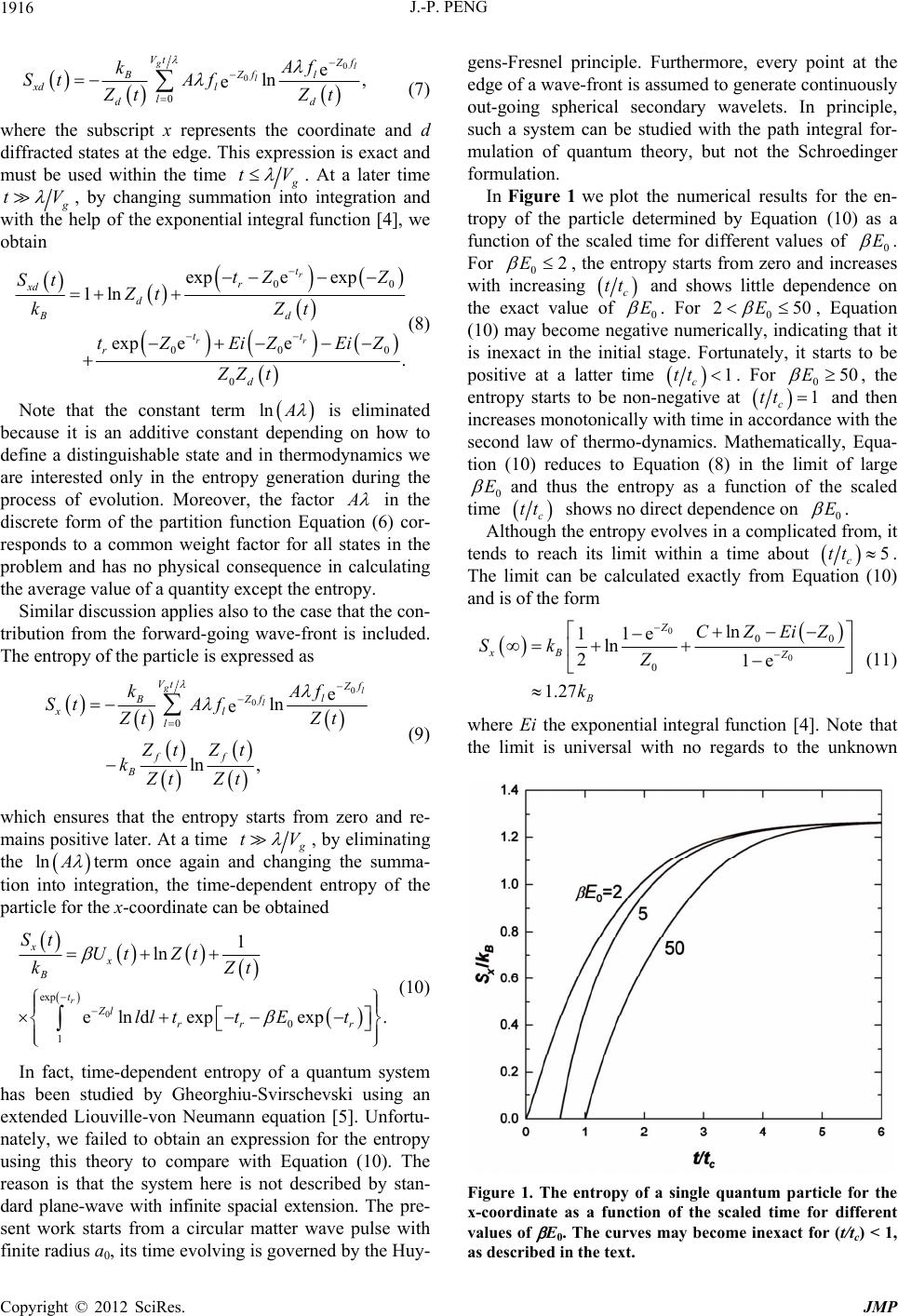 J.-P. PENG 1916 0 0 ln e g l Vt 0 e, l Z f l d Af Zt BZf xd l l d k St Af Zt (7) where the subscript x represents the coordinate and d diffracted states at the edge. This expression is exact and must be used within the time g tV . At a later time g tV , by changing summation into integration and with the help of the exponential integral function [4], we obtain 00 0 exp . d Z Zt EiZ 00 0 exp e 1ln exp ee r rr t r xd d B tt r d tZ St Zt k tZEiZ ZZ t (8) Note that the constant term ln A is eliminated because it is an additive constant depending on how to define a distinguishable state and in thermodynamics we are interested only in the entropy generation during the process of evolution. Moreover, the factor A in the discrete form of the partition function Equation (6) cor- responds to a common weight factor for all states in the problem and has no physical consequence in calculating the average value of a quantity except the entropy. Similar discussion applies also to the case that the con- tribution from the forward-going wave-front is included. The entropy of the particle is expressed as 0 e ln l 0 0 e ln , g l Vt Z f l Af Zt BZf xl l ff B k St Af Zt Zt Zt kZt Zt (9) which ensures that the entropy starts from zero and re- mains positive later. At a time g tV ln , by eliminating the A term once again and changing the summa- tion into integration, the time-dependent entropy of the particle for the x-coordinate can be obtained 0 exp 1 1 ln elnd exp r xx B tZl rr St Ut Zt kZ ll ttE 0exp. r t t E (10) In fact, time-dependent entropy of a quantum system has been studied by Gheorghiu-Svirschevski using an extended Liouville-von Neumann equation [5]. Unfortu- nately, we failed to obtain an expression for the entropy using this theory to compare with Equation (10). The reason is that the system here is not described by stan- dard plane-wave with infinite spacial extension. The pre- sent work starts from a circular matter wave pulse with finite radius a0, its time evolving is governed by the Huy- gens-Fresnel principle. Furthermore, every point at the edge of a wave-front is assumed to generate continuously out-going spherical secondary wavelets. In principle, such a system can be studied with the path integral for- mulation of quantum theory, but not the Schroedinger formulation. In Figure 1 we plot the numerical results for the en- tropy of the particle determined by Equation (10) as a function of the scaled time for different values of 0 . For 02E , the entropy starts from zero and increases with increasing c tt E and shows little dependence on the exact value of 0 . For 0 250E , Equation (10) may become negative numerically, indicating that it is inexact in the initial stage. Fortunately, it starts to be positive at a latter time 1tt 050E c. For , the entropy starts to be non-negative at 1tt E c and then increases monotonically with time in accordance with the second law of thermo-dynamics. Mathematically, Equa- tion (10) reduces to Equation (8) in the limit of large 0 and thus the entropy as a function of the scaled time tt E c0 shows no direct dependence on . Although the entropy evolves in a complicated from, it tends to reach its limit within a time about 5tt c . The limit can be calculated exactly from Equation (10) and is of the form 0 0 00 0 ln 11e ln 21e 1.27 Z xB Z B CZEiZ Sk Z k (11) where Ei the exponential integral function [4]. Note that the limit is universal with no regards to the unknown Figure 1. The entropy of a single quantum particle for the x-coordinate as a function of the scaled time for different values of E0. The curves may become inexact for (t/tc) < 1, as described in the text. Copyright © 2012 SciRes. JMP  J.-P. PENG Copyright © 2012 SciRes. JMP 1917 parameter L, the temperature of the surrounding space and the initial state of the particle. In a textbook of statis- tical physics, it is well-known that the entropy per parti- cle in an ideal gas of N particles in a volume V and at constant temperature T is expressed as the Sackur-Tet- rode formula [6] 2 2π ln B B mk T k h a 53 ln 22 BB SN kk NV , (12) showing dependences on the temperature and the mass of the particle. It should be pointed that Equation (11) is the entropy per freedom generated in the process started from an initial coherent quantum state to final thermo- dynamic equilibrium with its surroundings, before we call it a particle in conventional statistical physics, i.e., it moves equally to all directions. For a real free particle 0 , independent motion is allowed in the perpen- dicular direction. Therefore, the total entropy per particle generated in the whole process of decoherence should be 3Sx() 3.81kB. 3. Conclusion In conclusion, we have derived an expression for the time-dependent entropy of a single non-relativistic quan- tum particle freely moving in a space at constant nonzero temperatures. The entropy increases monotonically with time in accordance with the second law of thermody- namics. Although the initial state of the particle and the temperature of the surrounding space play important roles in the process, the total entropy generated tends to be a universal constant. REFERENCES [1] L. D. Landau and E. M. Lifshitz, “Statistical Physics,” 3rd Edition, Pergamon Press Ltd., Oxford, 1980. [2] J. P. Peng, “Temperature Dependent Motion of a Massive Quantum Particle,” Journal of Modern Physics, Vol. 3, 2012, pp. 610-614. doi:10.4236/jmp.2012.37083 [3] G. P. Beretta, “Entropy and Irreversibility for a Single Isolated Two Level System: New Individual Quantum States and New Nonlinear Equation of Motion,” Interna- tional Journal of Theoretical Physics, Vol. 24, No. 2, 1985, pp. 119-134. doi:10.1007/BF00672647 [4] I. S. Gradshteyn and I. M. Rizhik, “Tables of Integrals, Series, and Products,” 7th Edition, Elservier Inc., London, 2007. [5] S. Gheorghiu-Svirschevski, “Nonlinear Quantum Evolu- tion with Maximal Entropy Production,” Physical Review A, Vol. 63, 2001, Article ID: 022105. [6] M. Plischke and B. Bergersen, “Equilibrium Statistical Physics,” 2nd Edition, World Scientific Publishing Co. Pte. Ltd., 2003. |