

Paper Menu >>
Journal Menu >>
 Journal of Modern Physics, 2012, 3, 1891-1894 http://dx.doi.org/10.4236/jmp.2012.312238 Published Online December 2012 (http://www.SciRP.org/journal/jmp) Ab-Initio Structural Study of SrMoO3 Perovskite Avinash Daga, Smita Sharma Government Dungar College, Bikaner, India Email: avinashdaga2009@gmail.com, [email protected] Received August 10, 2012; revised September 27, 2012; accepted October 10, 2012 ABSTRACT The equilibrium crystal structure parameter and bulk modulus of the SrMoO3 perovskite has been calculated with ab-initio method based on density functional theory (DFT) using both local density approximation (LDA) and general- ized gradient approximation (GGA). The corresponding total free energy along with its various components for SrMoO3 was obtained. The lattice parameter and bulk modulus calculated for SrMoO3 within LDA are 3.99 Å and 143.025 GPa respectively whereas within GGA are 4.04 Å and 146.14 GPa respectively, both agree well with the available experi- mental data. The total energy calculated within LDA and GGA is almost the same however lower results are obtained for GGA. All calculations have been carried out using ABINIT computer code. Keywords: Perovskite; DFT; LDA; GGA; ABINIT 1. Introduction Crystal and electronic structures of solid materials are crucial to understand and improve properties. Many technological applications, including catalysis, micro- electronics, substrates for growth of high Tc supercon- ductors, etc., are based on thin films of ABO3 perovskite. Until recently, 4d transition metal oxides (TMO) have attracted less attention because they had the crystalline defects and having more extended d-orbitals compared to 3d TMO. Yet, numerous studies have shown that this is no longer the case for some promising TMO such as molybdates. These oxides are observed to exhibit un- conventional superconductivity [1] and research is going on to understand the mechanism [2] of this new quantum order due to strong electron-electron interaction. Pseudo gap formation [3], metal-insulator transitions [4,5] and high-voltage applications are the other significant prop- erties which draw a considerable attention to 4d TMO. Some related data were reported by daga et al. [6]. The density functional theory (DFT) is a good ap- proach for the description of ground state properties of metals, semiconductors, and insulators. The success of this technique is that it has allowed us to better under- stand materials and processes. It has deepened the inter- pretation of experimental findings. We have used AB- INIT computer code in order to perform first-principles DFT calculations. This code is open source ab initio elec- tronic structure calculation software and has been under continuous development. In the present study we calculated lattice constant, bulk modulus and total energy along with its components for SrMoO3 perovskite. The chosen perovskite has sim- ple, cubic Pm3m symmetry. 2. Calculation Method There are some approximations existing which permit the calculation of certain physical quantities quite accurately. In physics the most widely used and the simplest ap- proximation is the local-density approximation (LDA). It is based upon exact exchange energy for a uniform elec- tron gas. The unknown part is exchange-correlation part of the total-energy functional and it must be approxi- mated. The functional depends only on the density at the coordinate. Generalized gradient approximations (GGA) are still local but also take into account the gradient of the density at the same coordinate. In this work, LDA and GGA density functionals are considered for computation of lattice parameter, bulk modulus and the total energy. The calculations are carried out using numerical implementation of the formulation of DFT; the ABINIT code, based on the DFT using plane waves and pseudopotentials. Plane waves are used as a basis set for the electronic wave functions. Many input variables are needed to run the ABINIT code for the cal- culations. The main input variables have been listed in Table 1. “Spgroup” defines space group number of the perovskite in the input file. “acell” parameter gives the length scales by which dimensionless primitive transla- tions are to be multiplied and is specified in Bohr atomic units. We include input variables “ntypat” and “znucl”, where “ntypat” gives the number of types of atoms and “znucl” gives nuclear charge Z of the elements in order C opyright © 2012 SciRes. JMP 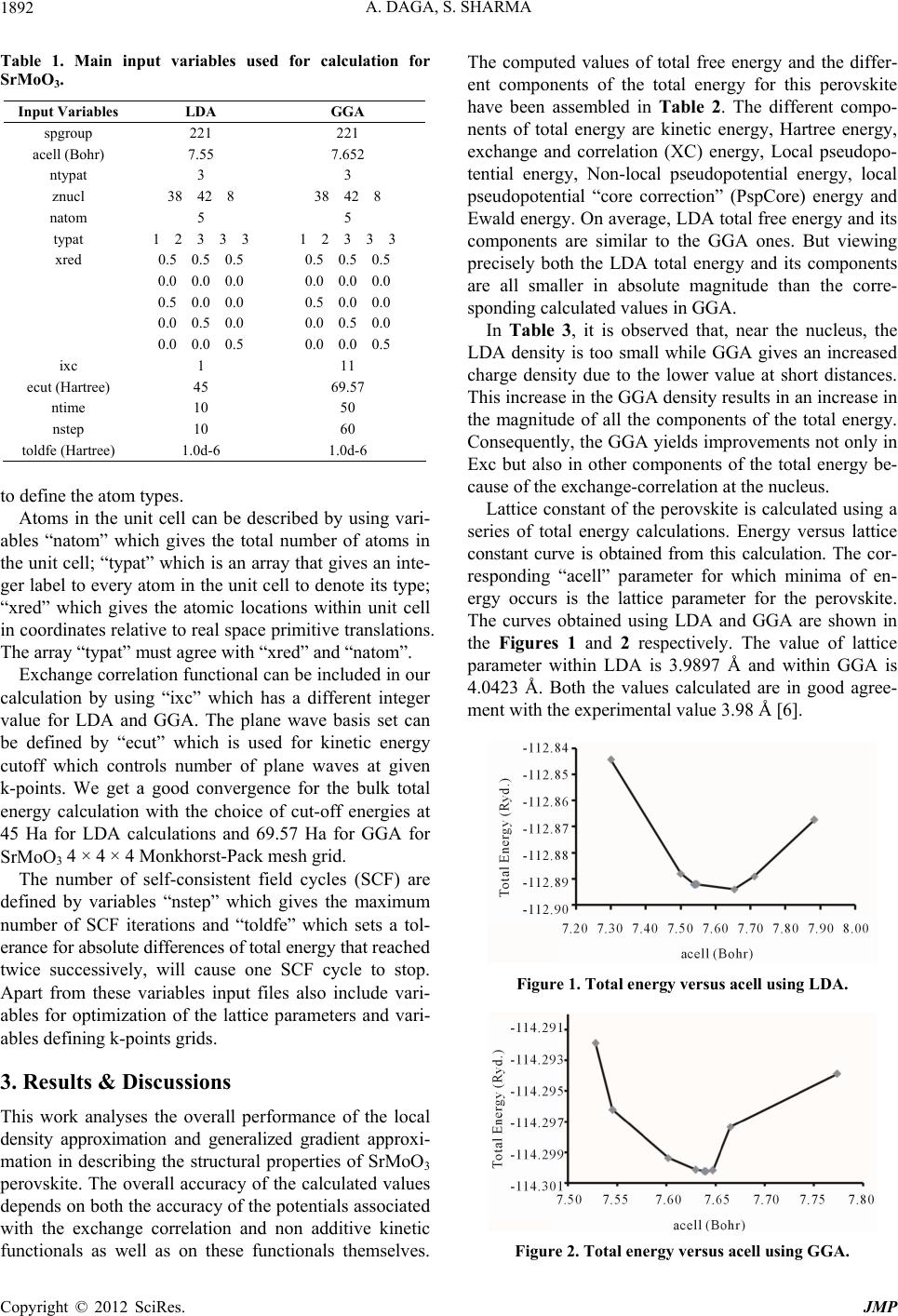 A. DAGA, S. SHARMA 1892 Table 1. Main input variables used for calculation for SrMoO3. Input Variables LDA GGA spgroup 221 221 acell (Bohr) 7.55 7.652 ntypat 3 3 znucl 38 42 8 38 42 8 natom 5 5 typat 1 2 3 3 3 1 2 3 3 3 xred 0.5 0.5 0.5 0.5 0.5 0.5 0.0 0.0 0.0 0.0 0.0 0.0 0.5 0.0 0.0 0.5 0.0 0.0 0.0 0.5 0.0 0.0 0.5 0.0 0.0 0.0 0.5 0.0 0.0 0.5 ixc 1 11 ecut (Hartree) 45 69.57 ntime 10 50 nstep 10 60 toldfe (Hartree) 1.0d-6 1.0d-6 to define the atom types. Atoms in the unit cell can be described by using vari- ables “natom” which gives the total number of atoms in the unit cell; “typat” which is an array that gives an inte- ger label to every atom in the unit cell to denote its type; “xred” which gives the atomic locations within unit cell in coordinates relative to real space primitive translations. The array “typat” must agree with “xred” and “natom”. Exchange correlation functional can be included in our calculation by using “ixc” which has a different integer value for LDA and GGA. The plane wave basis set can be defined by “ecut” which is used for kinetic energy cutoff which controls number of plane waves at given k-points. We get a good convergence for the bulk total energy calculation with the choice of cut-off energies at 45 Ha for LDA calculations and 69.57 Ha for GGA for SrMoO3 4 × 4 × 4 Monkhorst-Pack mesh grid. The number of self-consistent field cycles (SCF) are defined by variables “nstep” which gives the maximum number of SCF iterations and “toldfe” which sets a tol- erance for absolute differences of total energy that reached twice successively, will cause one SCF cycle to stop. Apart from these variables input files also include vari- ables for optimization of the lattice parameters and vari- ables defining k-points grids. 3. Results & Discussions This work analyses the overall performance of the local density approximation and generalized gradient approxi- mation in describing the structural properties of SrMoO3 perovskite. The overall accuracy of the calculated values depends on both the accuracy of the potentials associated with the exchange correlation and non additive kinetic functionals as well as on these functionals themselves. The computed values of total free energy and the differ- ent components of the total energy for this perovskite have been assembled in Table 2. The different compo- nents of total energy are kinetic energy, Hartree energy, exchange and correlation (XC) energy, Local pseudopo- tential energy, Non-local pseudopotential energy, local pseudopotential “core correction” (PspCore) energy and Ewald energy. On average, LDA total free energy and its components are similar to the GGA ones. But viewing precisely both the LDA total energy and its components are all smaller in absolute magnitude than the corre- sponding calculated values in GGA. In Table 3, it is observed that, near the nucleus, the LDA density is too small while GGA gives an increased charge density due to the lower value at short distances. This increase in the GGA density results in an increase in the magnitude of all the components of the total energy. Consequently, the GGA yields improvements not only in Exc but also in other components of the total energy be- cause of the exchange-correlation at the nucleus. Lattice constant of the perovskite is calculated using a series of total energy calculations. Energy versus lattice constant curve is obtained from this calculation. The cor- responding “acell” parameter for which minima of en- ergy occurs is the lattice parameter for the perovskite. The curves obtained using LDA and GGA are shown in the Figures 1 and 2 respectively. The value of lattice parameter within LDA is 3.9897 Å and within GGA is 4.0423 Å. Both the values calculated are in good agree- ment with the experimental value 3.98 Å [6]. Figure 1. Total energy versus acell using LDA. Figure 2. Total energy versus acell using GGA. Copyright © 2012 SciRes. JMP 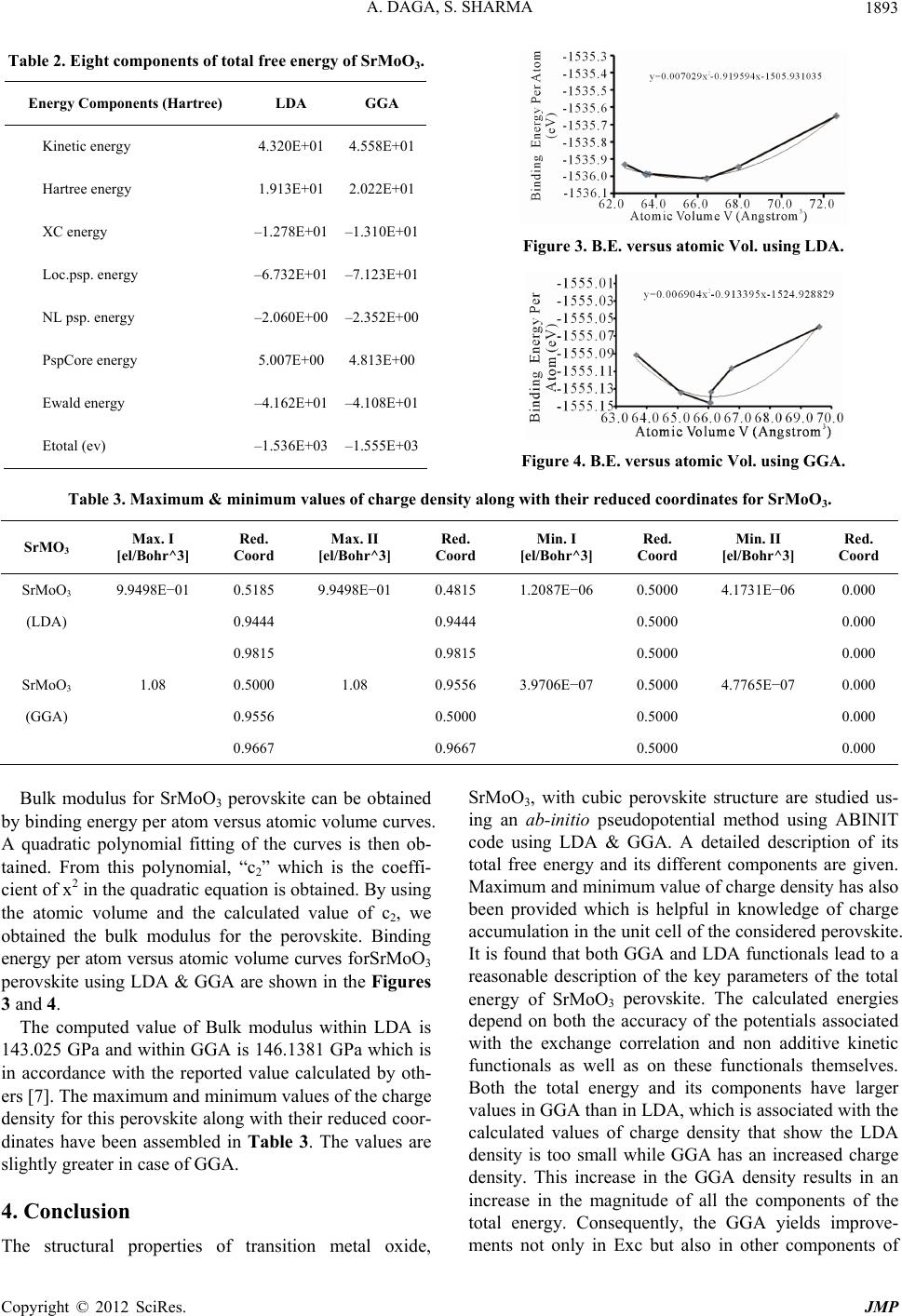 A. DAGA, S. SHARMA Copyright © 2012 SciRes. JMP 1893 Table 2. Eight components of total free energy of SrMoO3. Energy Components (Hartree) LDA GGA Kinetic energy 4.320E+01 4.558E+01 Hartree energy 1.913E+01 2.022E+01 XC energy –1.278E+01 –1.310E+01 Loc.psp. energy –6.732E+01 –7.123E+01 NL psp. energy –2.060E+00 –2.352E+00 PspCore energy 5.007E+00 4.813E+00 Ewald energy –4.162E+01 –4.108E+01 Etotal (ev) –1.536E+03 –1.555E+03 Figure 3. B.E. versus atomic Vol. using LDA. Figure 4. B.E. versus atomic Vol. using GGA. Table 3. Maximum & minimum values of charge density along with their reduced coordinates for SrMoO3. SrMO3 Max. I [el/Bohr^3] Red. Coord Max. II [el/Bohr^3] Red. Coord Min. I [el/Bohr^3] Red. Coord Min. II [el/Bohr^3] Red. Coord SrMoO3 9.9498E−01 0.5185 9.9498E−01 0.4815 1.2087E−06 0.5000 4.1731E−06 0.000 (LDA) 0.9444 0.9444 0.5000 0.000 0.9815 0.9815 0.5000 0.000 SrMoO3 1.08 0.5000 1.08 0.9556 3.9706E−07 0.5000 4.7765E−07 0.000 (GGA) 0.9556 0.5000 0.5000 0.000 0.9667 0.9667 0.5000 0.000 Bulk modulus for SrMoO3 perovskite can be obtained by binding energy per atom versus atomic volume curves. A quadratic polynomial fitting of the curves is then ob- tained. From this polynomial, “c2” which is the coeffi- cient of x2 in the quadratic equation is obtained. By using the atomic volume and the calculated value of c2, we obtained the bulk modulus for the perovskite. Binding energy per atom versus atomic volume curves forSrMoO3 perovskite using LDA & GGA are shown in the Figures 3 and 4. The computed value of Bulk modulus within LDA is 143.025 GPa and within GGA is 146.1381 GPa which is in accordance with the reported value calculated by oth- ers [7]. The maximum and minimum values of the charge density for this perovskite along with their reduced coor- dinates have been assembled in Table 3. The values are slightly greater in case of GGA. 4. Conclusion The structural properties of transition metal oxide, SrMoO3, with cubic perovskite structure are studied us- ing an ab-initio pseudopotential method using ABINIT code using LDA & GGA. A detailed description of its total free energy and its different components are given. Maximum and minimum value of charge density has also been provided which is helpful in knowledge of charge accumulation in the unit cell of the considered perovskite. It is found that both GGA and LDA functionals lead to a reasonable description of the key parameters of the total energy of SrMoO3 perovskite. The calculated energies depend on both the accuracy of the potentials associated with the exchange correlation and non additive kinetic functionals as well as on these functionals themselves. Both the total energy and its components have larger values in GGA than in LDA, which is associated with the calculated values of charge density that show the LDA density is too small while GGA has an increased charge density. This increase in the GGA density results in an increase in the magnitude of all the components of the total energy. Consequently, the GGA yields improve- ments not only in Exc but also in other components of 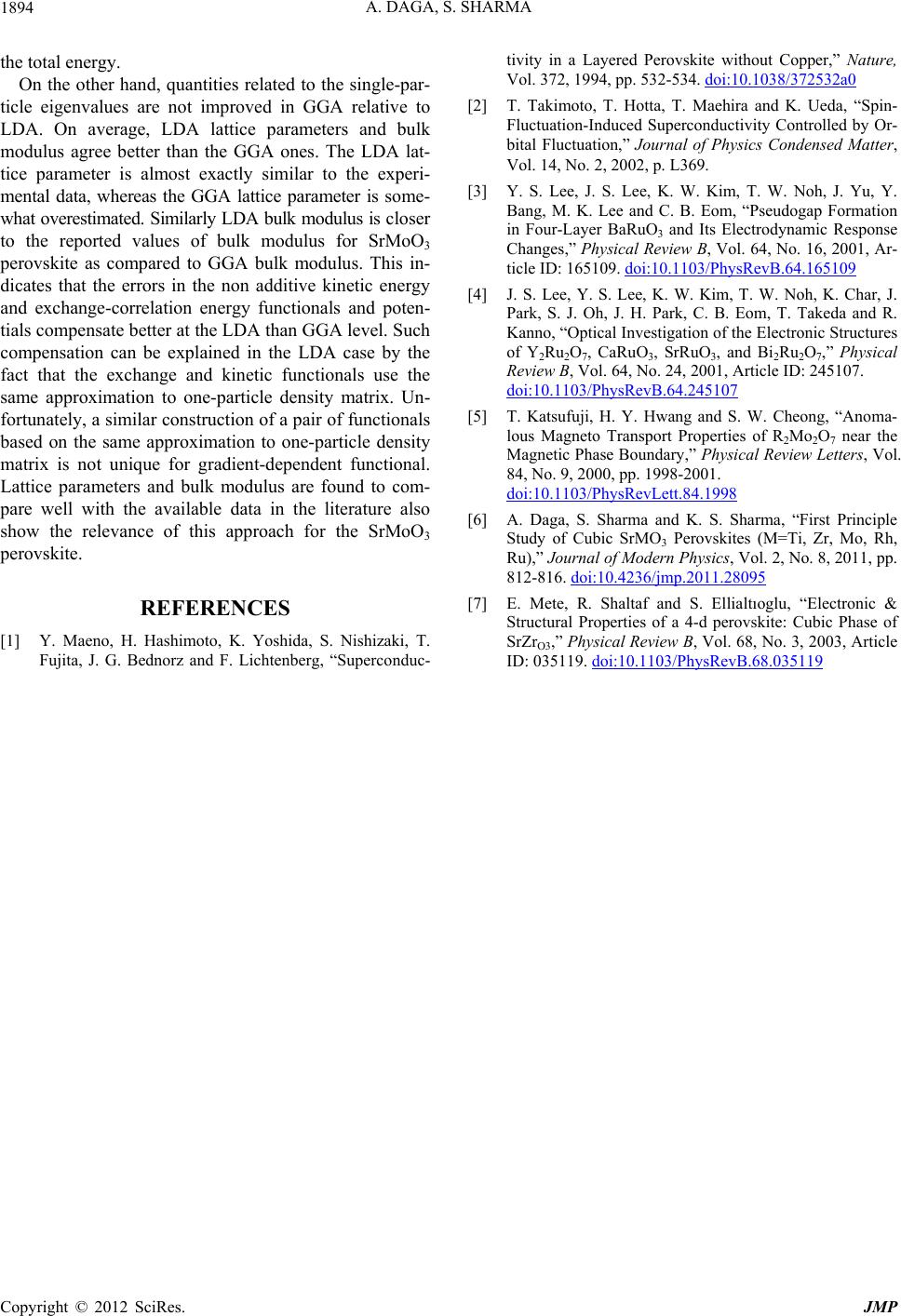 A. DAGA, S. SHARMA 1894 the total energy. On the other hand, quantities related to the single-par- ticle eigenvalues are not improved in GGA relative to LDA. On average, LDA lattice parameters and bulk modulus agree better than the GGA ones. The LDA lat- tice parameter is almost exactly similar to the experi- mental data, whereas the GGA lattice parameter is some- what overestimated. Similarly LDA bulk modulus is closer to the reported values of bulk modulus for SrMoO3 perovskite as compared to GGA bulk modulus. This in- dicates that the errors in the non additive kinetic energy and exchange-correlation energy functionals and poten- tials compensate better at the LDA than GGA level. Such compensation can be explained in the LDA case by the fact that the exchange and kinetic functionals use the same approximation to one-particle density matrix. Un- fortunately, a similar construction of a pair of functionals based on the same approximation to one-particle density matrix is not unique for gradient-dependent functional. Lattice parameters and bulk modulus are found to com- pare well with the available data in the literature also show the relevance of this approach for the SrMoO3 perovskite. REFERENCES [1] Y. Maeno, H. Hashimoto, K. Yoshida, S. Nishizaki, T. Fujita, J. G. Bednorz and F. Lichtenberg, “Superconduc- tivity in a Layered Perovskite without Copper,” Nature, Vol. 372, 1994, pp. 532-534. doi:10.1038/372532a0 [2] T. Takimoto, T. Hotta, T. Maehira and K. Ueda, “Spin- Fluctuation-Induced Superconductivity Controlled by Or- bital Fluctuation,” Journal of Physics Condensed Matter, Vol. 14, No. 2, 2002, p. L369. [3] Y. S. Lee, J. S. Lee, K. W. Kim, T. W. Noh, J. Yu, Y. Bang, M. K. Lee and C. B. Eom, “Pseudogap Formation in Four-Layer BaRuO3 and Its Electrodynamic Response Changes,” Physical Review B, Vol. 64, No. 16, 2001, Ar- ticle ID: 165109. doi:10.1103/PhysRevB.64.165109 [4] J. S. Lee, Y. S. Lee, K. W. Kim, T. W. Noh, K. Char, J. Park, S. J. Oh, J. H. Park, C. B. Eom, T. Takeda and R. Kanno, “Optical Investigation of the Electronic Structures of Y2Ru2O7, CaRuO3, SrRuO3, and Bi2Ru2O7,” Physical Review B, Vol. 64, No. 24, 2001, Article ID: 245107. doi:10.1103/PhysRevB.64.245107 [5] T. Katsufuji, H. Y. Hwang and S. W. Cheong, “Anoma- lous Magneto Transport Properties of R2Mo2O7 near the Magnetic Phase Boundary,” Physical Review Letters, Vol. 84, No. 9, 2000, pp. 1998-2001. doi:10.1103/PhysRevLett.84.1998 [6] A. Daga, S. Sharma and K. S. Sharma, “First Principle Study of Cubic SrMO3 Perovskites (M=Ti, Zr, Mo, Rh, Ru),” Journal of Modern Physics, Vol. 2, No. 8, 2011, pp. 812-816. doi:10.4236/jmp.2011.28095 [7] E. Mete, R. Shaltaf and S. Ellialtıoglu, “Electronic & Structural Properties of a 4-d perovskite: Cubic Phase of SrZrO3,” Physical Review B, Vol. 68, No. 3, 2003, Article ID: 035119. doi:10.1103/PhysRevB.68.035119 Copyright © 2012 SciRes. JMP |