

Paper Menu >>
Journal Menu >>
 Advances in Applied Sociology 2012. Vol.2, No.4, 253-259 Published Online December 2012 in SciRes (http://www.SciRP.org/journal/aasoci) http://dx.doi.org/10.4236/aasoci.2012.24033 Copyright © 2012 SciRes. 253 How Do Network Size, Voluntary Association, and Trust Affect Civic Engagement? Evidence from the Asian Barometer Survey Harris H. Kim Department of Sociology, Ewha Womans University, Seoul, South Korea Email: [email protected] Received August 2nd, 2012; revised September 5th, 2012; accepted September 17th, 2012 This study examines the role of social capital in shaping the individual likelihood of “civic engagement” defined specifically as informal and formal political participation. Based on a subset of the Asian Ba- rometer Survey of Democracy, Governance and Development (2006), a representative cross-national dataset, it examines how and to what extent network size, voluntary association, generalized trust, and particularized trust differentially influence the political behaviors of the survey participants in Korea. The dependent variable is measured in terms of first, discussing political topics in an informal social context and, second, getting together with others in order to raise a political issue or sign a petition. Four inde- pendent variables are measured: 1) the size of egocentric network; 2) the membership in voluntary or- ganizations and formal groups; 3) the degree of trust placed in generalized others (i.e., strangers); and 4) the extent to which survey respondents place their trust in particularized others (those with whom one has a personal relationship). Quantitative analyses show that, ceteris paribus, network size and voluntary as- sociation have a strong causal impact on both outcome variables. Generalized trust is found to be a non-significant factor, however, while particularized trust has a contingent effect. Along with the inter- pretation of statistical results, their broad theoretical implications are also discussed. Keywords: Civic Engagement; Network Size; Social Trust; Voluntary Organization; Asia Introduction Social Capital as Generalized Trust & Voluntary Association What are the social structural conditions under which people make political decisions and take political actions? Like any other type of social action, individual political behavior, both formal and informal types of civic participation, does not take place in a social vacuum. Whether it’s going to the voting booth, participating in a protest, or simply engaging in a casual politi- cal discussion, people’s behaviors are shaped by a number of relevant situational factors, i.e., those in which individual deci- sion-making and actions are socially embedded (cf. Granovetter, 1985). When it comes to this particular empirical question, researchers have made much use of the concept social capital. According to Putnam’s (1993) much-cited work, social capital- broadly cast in terms of interpersonal networks, shared organ- izational membership, mutual trust, and norms of cooperation and reciprocity, serves to increase political participation and can improve democratic governance and accountability. There is a voluminous and growing literature that shows a causal link between social capital and various political outcomes (see e.g., Braithwaite & Levi, 1998; Dekker & Uslaner, 2001; Jamal & Noorudin, 2010; Mishler & Rose, 2005; Paxton, 2002; Roth- stein & Uslaner, 2005; Uslaner, 2002; Newton & Zimerli, 2011; Zmerli & Newton, 2008). The vast majority of the extant scholarship focuses on the role of generalized trust and participation in voluntary associa- tion in facilitating democratic values, support and involvement on the part of individuals (Marsh, 2005; Tavits, 2006; Zmerli & Newton, 2008). Concerning the causal relationship between the propensity to trust others and the likelihood of civic engage- ment, Rothstein and Uslaner (2005: p. 41) write that “at the individual level, people who believe that in general most other people in their society can be trusted are also more inclined to have a positive view of their democratic institutions, to partici- pate more in politics, and to be more active in civic organiza- tions.” Researchers have found a similar causal link connecting voluntary organizational membership and a certain set of values and orientations that are conducive to individual democratic responsibility (Paxton, 2002; Stolle, 2001; Van Egmond et al., 1998). As Putnam (1993) explains, “associations instill in their members habits of cooperation, solidarity, and public-spirited- ness” and that “participation in civic organizations inculcates skills of cooperation as well as a sense of shared responsibility for collective endeavors” (90). Using the World Values Survey data across 43 countries, Inglehart (1997) provides empirical support for this view: that the stability of democracy among different nations is indeed highly correlated with the individual membership in voluntary associations as well as the aggregate levels of social trust. In a case study of Sweden, Teorell (2003) offers further evidence by showing that “organizational in- volvement provides bridging social capital by connecting the individual to a wide range of people” (49). Network Size as Social Capital: A Neglected Variable The preceding discussion serves to highlight two major strands of research in the extant literature: that is, how general- ized trust and voluntary association can lead to greater political interest and participation of individual citizens in democratic societies. While fully recognizing the past research to be em-  H. H. KIM pirically and theoretically important, the current study proposes to examine two additional factors that have been relatively overlooked, namely network size and particularized trust. That the network variable, though causally relevant, has not been investigated fully in the literature is surprising since social capital is typically defined as trust, norms of reciprocity, and social networks (Putnam, 1993; see also Rothstein & Stolle, 2008). Part of the reason for this selective scholarly attention lies with the limited availability of data on interpersonal net- works and political behavior. This study has a twofold purpose. Given the relative scarcity of research findings related to the causal role of social networks, one of its main objectives is to fill this empirical gap in the literature. Network size, though understudied, is indeed a sig- nificant factor driving individual political interest and behavior. According to the empirical investigation carried out by Lake and Heckfeldt (1998), along with political interaction frequency and network expertise, the size of one’s interpersonal network has a powerful influence on the person’s political actions, while controlling for a host of background factors. Theoretically, larger networks are associated with multiple interpersonal sources that can provide access to novel and timely information (Burt, 1992). They can also serve as a communication bridge (cf. Granovetter, 1973). In the case of political participation, being situated in large networks opens up more opportunities to be in touch with others who may be politically interested or active (Huckfeldt et al., 1995). Particularized vs. Generalized Trust Along with network size, the concept of particularized trust has also failed to attract sufficient scholarly attention. A con- ceptual distinction is drawn between “generalized” and “par- ticularized” trust in the literature. Simply put, the former is about trust in unknown others or strangers. It is related to a situation where “a community shares a set of moral values in such a way as to create regular expectations of regular and honest behavior” (Fukuyama, 1995: p. 153) among people who do not know each other personally. This is very different from particularized trust which is based on specific face-to-face in- teractions between concrete individuals (see Bahry et al., 2005; Hardin’s, 2002; Yamagishi & Yamagishi, 1994). The vast ma- jority of the past studies attempting to link social capital and political participation have relied on the concept of generalized, not particularized, trust. A study by Uslaner and Conley (2003) is one important exception, which focuses on the latter concept. They categorize people into two groups: generalized trusters and particularized trusters. According to their definition, the former group tends to engage in broad social interactions and helps to build general social capital that is conducive to the proper workings of democracy. The latter group, on the other hand, is prone to remain disconnected from the mainstream society. The empirical analysis carried out by Uslaner and Conley (2003) is based on a sample of Asian immigrants in the U.S. Their findings reveal that particularized trusters, compared with their counterparts, are indeed less likely to engage in mainstream American politics. As Newton and Zmerli (2011) show, however, the relation- ship between generalized trust and particularized trust may be more nuanced than as described above. The authors challenge the conventional notion that particularized trust is “either harmful or of little importance in modern democracies” (2011: p. 169) and that only generalized trust is instrumental in creat- ing social capital that promotes democratic processes. They contend that depending on the situation the two forms of trust may be mutually exclusive or supportive. In their analysis of the World Values Survey (1995-2007), the authors also demon- strate that both trust types are positively associated with peo- ple’s attitude toward (level of confidence in) political institu- tions across 22 countries. In other words, contrary to the impli- cations of the findings in Uslaner and Conley (2003), they re- port that those who score higher on the particularized trust scale are more likely to hold a positive view of their political leaders and institutions. Based on the above literature review, a fol- lowing set of hypotheses can be formulated concerning the concepts of generalized trust, particularized trust, voluntary associational memberships, and network size, as each relates to the probability of individual political participation. Hypothesis 1: People who are more willing to trust general- ized others are more likely to participate in political activities, ceteris paribus. Hypothesis 2: People who are more active in voluntary asso- ciations are more likely to participate in political activities, ceteris paribus. Hypothesis 3: People who have larger social networks are more likely to participate in political activities, ceteris paribus. Hypothesis 4a: People who have greater particularized trust are more likely to participate in political activities, ceteris paribus. Hypothesis 4b: People who have greater particularized trust are less likely to participate in political activities, ceteris pari- bus. Hypothesis 4 has two opposing versions since, given the contradictory views in the literature, it is debatable whether particularized trust promotes or hinders the likelihood of infor- mal and formal political engagement. The remainder of this paper is devoted to evaluating the validity of these hypotheses through empirical testing. The next section describes the data, the variables, and the methods used for the quantitative analysis, followed by the interpretations of the findings and the broad implications of this study. Data, Model & Variables Data analyzed in this paper were collected by the Asian Ba- rometer Project, which was co-directed by Professors Fu Hu and Yun-han Chu and received major funding support from Taiwan’s Ministry of Education, Academia Sinica and National Taiwan University. This is the second wave of the Asian Ba- rometer Survey (ABS) collected in 2006 covering major politi- cal systems in Asia. This study focuses specifically on the Ko- rean dataset. There have only been a limited number of nation- ally representative studies on Korea, which previously pro- duced conflicting results based on older data (see Kim, 2005; Lee, 2008). The dataset available from the ABS provides more recent information that can be used to shed novel light on the role of social capital in individual political participation in Ko- rea. The survey was conducted during the month of September (2006) by Gallup Korea. The survey population consisted of all citizens aged 19 and older residing in the territory of South Korea at the time it was conducted. The survey, using a multi-stage probability sampling method, was done through face-to-face personal interviewing, which lasted on average 60 minutes. A total of 1212 interviews were completed, with the Copyright © 2012 SciRes. 254  H. H. KIM response rate of 44.9%. Dependent Variable The dependent variable for this study is “political participa- tion”. A number of questions were asked in the survey to tap into the respondents’ levels of political interest and behavior. In this study, the focus will be on one informal and one formal type of political participation. The exact wording for these two questions is as follows: Q.1 When you get together with your family members or friends, how often do you discuss political matters? (Frequently, Occasionally, Never). Q.2 Here is a list of actions that people sometimes take as citizens. Tell me whether you, personally, have never, once, or more than once done any of these things during the past three years. For example, “Got together with others to raise an issue or sign a petition”. The answers for the first question was coded on a 3-point scale (“Frequently” = 3; “Occasionally” = 2; “Never” = 1) to create the first dependent variable (DISC_POL). From the sec- ond question, a variable called SIGN_PETN is constructed by assigning the value of “0” if the answer is never and “1” other- wise. In the sample, 31% stated that they never talk about poli- tics with their friends and families; about 59% said that they do so occasionally, while 10% claimed to do so frequently. When it comes to getting together with others to raise an issue or sign a petition, about 12% gave an affirmative answer. Independent Var iables A number of independent variables are created to test the va- lidity of the hypotheses stated above. The standard question in the literature used to measure generalized trust, as found in the American General Social Survey (GSS) or the World Values Survey (WVS), is typically phrased as: General speaking, would you say that “most people can be trusted” or that “you must be very careful in dealing with people”? The same word- ing was used in the ABS. In the sample, about 33% of the Ko- rean respondents agreed with the question, a figure that is rela- tively lower in comparison with the earlier studies of Europe and North America (see Nannestad, 2008). A variable named GEN_TRUST, coded “1” if answered “yes” to the above state- ment, is used to test the validity of Hypothesis 1. Hypothesis 2 deals with the level of participation in voluntary groups or or- ganizations. Under the subheading of “Social Capital,” the ABS asks subjects to name up to “3 most important organizations or formal groups you belong to”. Based on the individual re- sponses, a variable called VOL_ASSOC is constructed. As discussed above, the variables for generalized trust and voluntary associations are standard measures frequently used in the literature. The two additional variables examined in this study are network size and particularized trust. One of the new questions asked in the ABS is the following, which was not available in the first wave of the survey conducted in 2003: “On average, about how many people do you have contact with in a typical week day? Please include only people you know.” This question is designed to directly tap into the size of the interper- sonal network in which the individual subjects are embedded. It resembles the question in the GSS, which asks for the number of confidants with whom one discusses important matters. The range of answers varies from 1 to 5, with 2.7 being the average network size for the Korean sample. This mean value is higher than that for the Americans, which decreased over time, from 2.94 in 1985 to 2.08 in 2004 (McPherson, Smith-Lovin, & Brashears, 2006). For this study, a variable called NET_SIZE is created to evaluate Hypothesis 3. Lastly, in order to test the validity of Hypothesis 4a and 4b, particularized trust is measured. In addition to generalized trust, the ABS inquires about the extent to which the respondents trust three groups of people whom they know personally, namely “your relatives”, “your neighbors”, and “others you interact with”. Based on the answers given, three separate vari- ables are put together using a 4-point scale (“A great deal of trust” = 1; “Quite a lot of trust” = 3; “Not very much trust” = 2; “None at all” = 1), namely TRUST_REL, TRUST_NEIGHB, TRUST_OTHERS. The mean value for trusting one’s relatives is 3.14, that for trusting one’s neighbors is 2.8, and for trusting others it is 2.4. According to an earlier study done by Gibson (2001), 59.6% of the Russians feel that people they know per- sonally can be “trustful”. In the Korean sample, 59.8% said that they put “quite a lot of trust” in their relatives and 64.4% ex- pressed the same feeling concerning their neighbors, while 40.3% gave the same answer for the third trust category (“oth- ers you interact with”). Control Variables A number of relevant control variables are included in the analysis. According to Newton and Zimerli (2011: p. 183), “a reading of the already voluminous literature on trust suggests a fairly short and consistent list of individual variables associated with it”. In this study, such factors are controlled for—includ- ing income, education, gender, marital status, age, and the level of subjective interest in politics. The age variable (AGE) is a continuous variable with the mean value of 42.7; the income variable (INCOME) is measured as an ordinal one whose scale is divided into quintiles; the level of education (EDUC) is gauged on a 10-point scale (“No formal education” = 1; “Post-graduate degree” = 10); the gender variable (FEMALE) is coded 1 if “female”; the marital status variable (MARRIED) is also dichotomously coded (“married” = 1); and the variable that gauges the degree of interest in politics (INTEREST) is coded using a 4-point scale (“Not at all interested” = 1; “Very interested” = 4). The descriptive information concerning all the variables is summarized in Table 1. Table 2 contains the bivariate correla- tions among the variables. The quantitative results are pre- sented in two separate tables (Tables 3 and 4) since there are two different outcome variables under investigation: discussing political matters (DISC_POL) and signing a petition (SIGN_ PETN). Since the dependent variables are all categorically dis- tributed, nominal logistic regression models are estimated. The following section describes the statistical findings and their interpretations. Results and Discussion For each of the two regression tables, two models are pre- sented. Model 1 contains only the independent variables used to test the hypotheses. Model 2 introduces the control variables, offering a more conservative test of their validity. Table 3 re- ports the findings from regressing DISC_POL on the selected independent and control variables. According to Model 1, coef Copyright © 2012 SciRes. 255 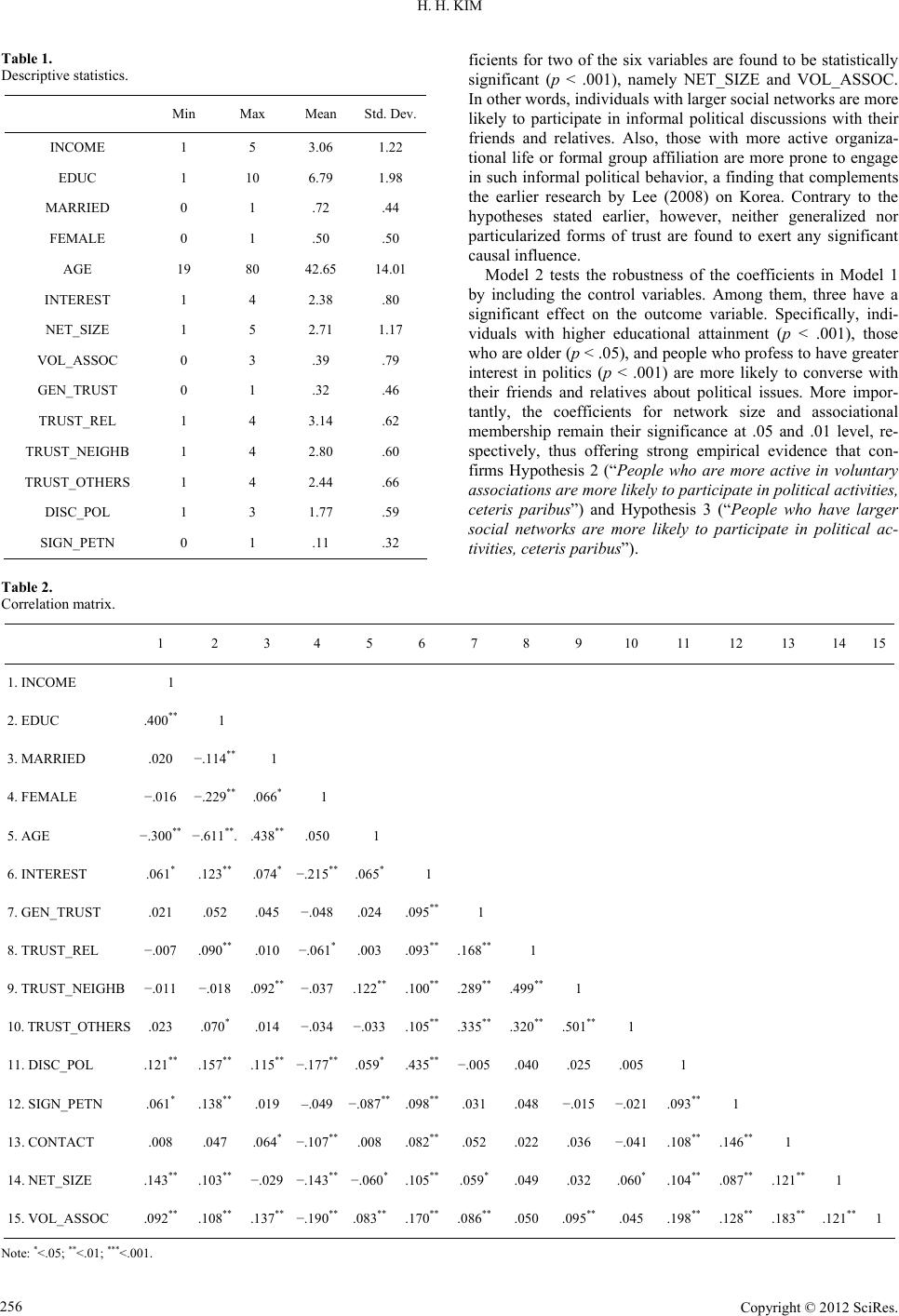 H. H. KIM Copyright © 2012 SciRes. 256 Table 1. Descriptive statistics. Min Max Mean Std. Dev. INCOME 1 5 3.06 1.22 EDUC 1 10 6.79 1.98 MARRIED 0 1 .72 .44 FEMALE 0 1 .50 .50 AGE 19 80 42.65 14.01 INTEREST 1 4 2.38 .80 NET_SIZE 1 5 2.71 1.17 VOL_ASSOC 0 3 .39 .79 GEN_TRUST 0 1 .32 .46 TRUST_REL 1 4 3.14 .62 TRUST_NEIGHB 1 4 2.80 .60 TRUST_OTHERS 1 4 2.44 .66 DISC_POL 1 3 1.77 .59 SIGN_PETN 0 1 .11 .32 ficients for two of the six variables are found to be statistically significant (p < .001), namely NET_SIZE and VOL_ASSOC. In other words, individuals with larger social networks are more likely to participate in informal political discussions with their friends and relatives. Also, those with more active organiza- tional life or formal group affiliation are more prone to engage in such informal political behavior, a finding that complements the earlier research by Lee (2008) on Korea. Contrary to the hypotheses stated earlier, however, neither generalized nor particularized forms of trust are found to exert any significant causal influence. Model 2 tests the robustness of the coefficients in Model 1 by including the control variables. Among them, three have a significant effect on the outcome variable. Specifically, indi- viduals with higher educational attainment (p < .001), those who are older (p < .05), and people who profess to have greater interest in politics (p < .001) are more likely to converse with their friends and relatives about political issues. More impor- tantly, the coefficients for network size and associational membership remain their significance at .05 and .01 level, re- spectively, thus offering strong empirical evidence that con- firms Hypothesis 2 (“People who are more active in voluntary associations are more likely to participate in political activities, ceteris paribus”) and Hypothesis 3 (“People who have larger social networks are more likely to participate in political ac- tivities, ceteris pa ribus”). Table 2. Correlation matrix. 1 2 3 4 5 6 7 8 9 10 11 12 13 14 15 1. INCOME 1 2. EDUC .400** 1 3. MARRIED .020 −.114** 1 4. FEMALE −.016 −.229** .066* 1 5. AGE −.300** −.611**. .438** .050 1 6. INTEREST .061* .123** .074* −.215** .065*1 7. GEN_TRUST .021 .052 .045 −.048 .024 .095** 1 8. TRUST_REL −.007 .090** .010 −.061* .003 .093** .168** 1 9. TRUST_NEIGHB −.011 −.018 .092** −.037 .122** .100** .289** .499** 1 10. TRUST_OTHERS .023 .070* .014 −.034 −.033 .105** .335** .320** .501** 1 11. DISC_POL .121** .157** .115** −.177** .059*.435** −.005.040 .025 .005 1 12. SIGN_PETN .061* .138** .019 –.049 −.087** .098** .031 .048 −.015 −.021 .093** 1 13. CONTACT .008 .047 .064* −.107** .008 .082**.052 .022 .036 −.041 .108** .146** 1 14. NET_SIZE .143** .103** −.029 −.143** −.060*.105**.059*.049 .032 .060*.104** .087** .121** 1 15. VOL_ASSOC .092** .108** .137** −.190** .083** .170** .086** .050 .095** .045 .198** .128** .183** .121**1 Note: *<.05; **<.01; ***<.001. 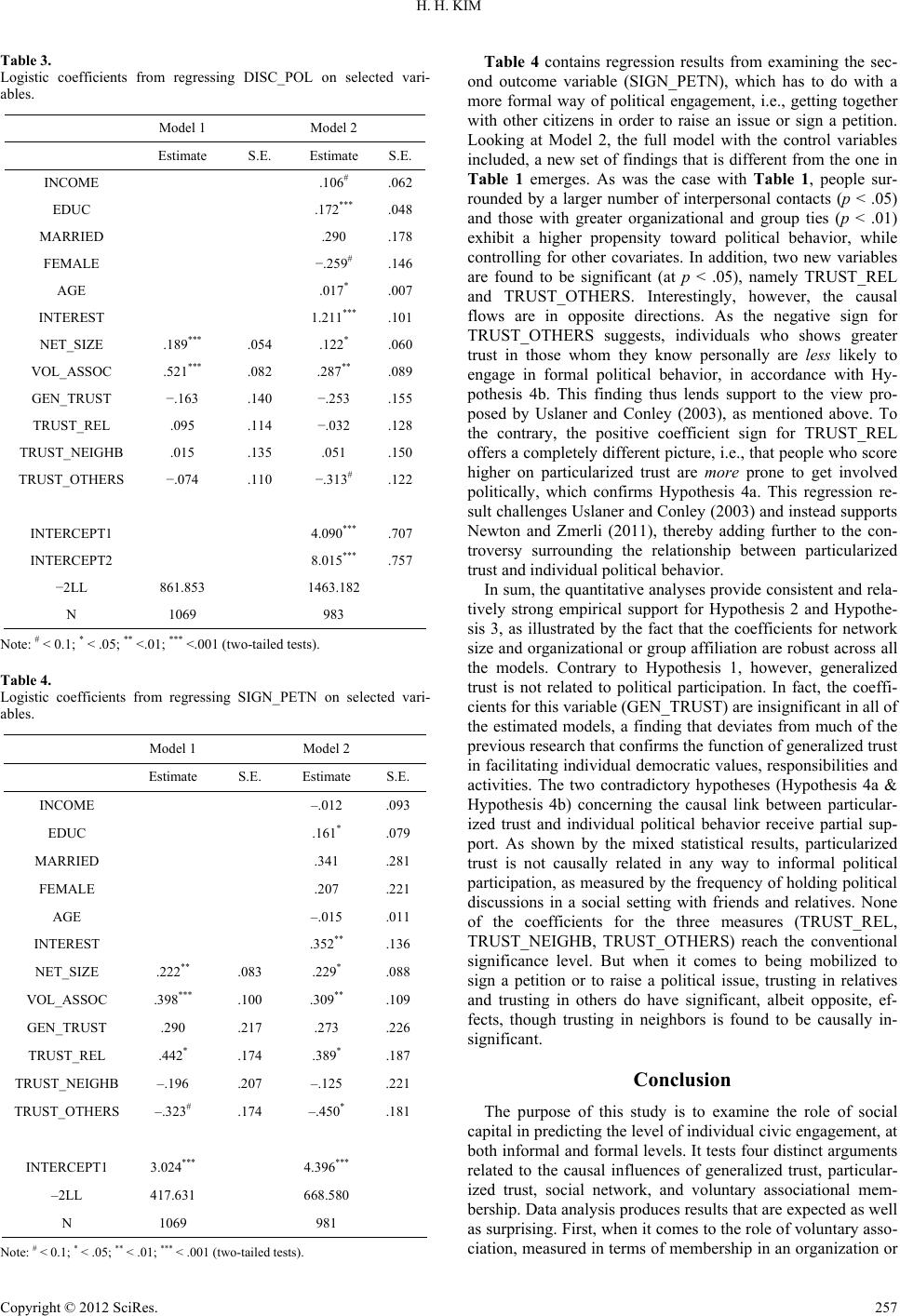 H. H. KIM Table 3. Logistic coefficients from regressing DISC_POL on selected vari- ables. Model 1 Model 2 Estimate S.E. Estimate S.E. INCOME .106# .062 EDUC .172*** .048 MARRIED .290 .178 FEMALE −.259# .146 AGE .017* .007 INTEREST 1.211*** .101 NET_SIZE .189*** .054 .122* .060 VOL_ASSOC .521*** .082 .287** .089 GEN_TRUST −.163 .140 −.253 .155 TRUST_REL .095 .114 −.032 .128 TRUST_NEIGHB .015 .135 .051 .150 TRUST_OTHERS −.074 .110 −.313# .122 INTERCEPT1 4.090*** .707 INTERCEPT2 8.015*** .757 −2LL 861.853 1463.182 N 1069 983 Note: # < 0.1; * < .05; ** <.01; *** <.001 (two-tailed tests). Table 4. Logistic coefficients from regressing SIGN_PETN on selected vari- ables. Model 1 Model 2 Estimate S.E. Estimate S.E. INCOME –.012 .093 EDUC .161* .079 MARRIED .341 .281 FEMALE .207 .221 AGE –.015 .011 INTEREST .352** .136 NET_SIZE .222** .083 .229* .088 VOL_ASSOC .398*** .100 .309** .109 GEN_TRUST .290 .217 .273 .226 TRUST_REL .442* .174 .389* .187 TRUST_NEIGHB –.196 .207 –.125 .221 TRUST_OTHERS –.323# .174 –.450* .181 INTERCEPT1 3.024*** 4.396*** –2LL 417.631 668.580 N 1069 981 Note: # < 0.1; * < .05; ** < .01; *** < .001 (two-tailed tests). Table 4 contains regression results from examining the sec- ond outcome variable (SIGN_PETN), which has to do with a more formal way of political engagement, i.e., getting together with other citizens in order to raise an issue or sign a petition. Looking at Model 2, the full model with the control variables included, a new set of findings that is different from the one in Table 1 emerges. As was the case with Table 1, people sur- rounded by a larger number of interpersonal contacts (p < .05) and those with greater organizational and group ties (p < .01) exhibit a higher propensity toward political behavior, while controlling for other covariates. In addition, two new variables are found to be significant (at p < .05), namely TRUST_REL and TRUST_OTHERS. Interestingly, however, the causal flows are in opposite directions. As the negative sign for TRUST_OTHERS suggests, individuals who shows greater trust in those whom they know personally are less likely to engage in formal political behavior, in accordance with Hy- pothesis 4b. This finding thus lends support to the view pro- posed by Uslaner and Conley (2003), as mentioned above. To the contrary, the positive coefficient sign for TRUST_REL offers a completely different picture, i.e., that people who score higher on particularized trust are more prone to get involved politically, which confirms Hypothesis 4a. This regression re- sult challenges Uslaner and Conley (2003) and instead supports Newton and Zmerli (2011), thereby adding further to the con- troversy surrounding the relationship between particularized trust and individual political behavior. In sum, the quantitative analyses provide consistent and rela- tively strong empirical support for Hypothesis 2 and Hypothe- sis 3, as illustrated by the fact that the coefficients for network size and organizational or group affiliation are robust across all the models. Contrary to Hypothesis 1, however, generalized trust is not related to political participation. In fact, the coeffi- cients for this variable (GEN_TRUST) are insignificant in all of the estimated models, a finding that deviates from much of the previous research that confirms the function of generalized trust in facilitating individual democratic values, responsibilities and activities. The two contradictory hypotheses (Hypothesis 4a & Hypothesis 4b) concerning the causal link between particular- ized trust and individual political behavior receive partial sup- port. As shown by the mixed statistical results, particularized trust is not causally related in any way to informal political participation, as measured by the frequency of holding political discussions in a social setting with friends and relatives. None of the coefficients for the three measures (TRUST_REL, TRUST_NEIGHB, TRUST_OTHERS) reach the conventional significance level. But when it comes to being mobilized to sign a petition or to raise a political issue, trusting in relatives and trusting in others do have significant, albeit opposite, ef- fects, though trusting in neighbors is found to be causally in- significant. Conclusion The purpose of this study is to examine the role of social capital in predicting the level of individual civic engagement, at both informal and formal levels. It tests four distinct arguments related to the causal influences of generalized trust, particular- ized trust, social network, and voluntary associational mem- bership. Data analysis produces results that are expected as well as surprising. First, when it comes to the role of voluntary asso- ciation, measured in terms of membership in an organization or Copyright © 2012 SciRes. 257 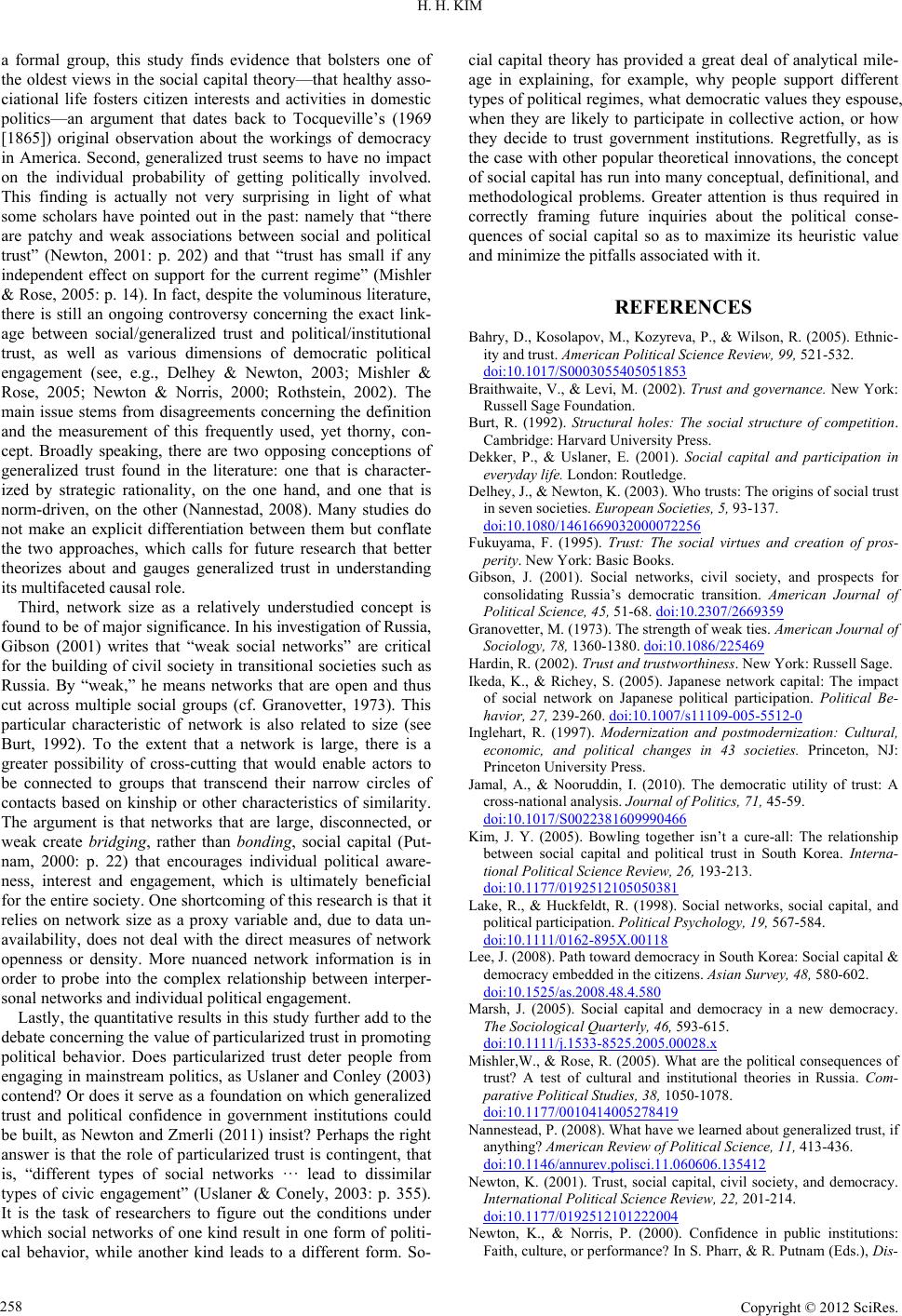 H. H. KIM a formal group, this study finds evidence that bolsters one of the oldest views in the social capital theory—that healthy asso- ciational life fosters citizen interests and activities in domestic politics—an argument that dates back to Tocqueville’s (1969 [1865]) original observation about the workings of democracy in America. Second, generalized trust seems to have no impact on the individual probability of getting politically involved. This finding is actually not very surprising in light of what some scholars have pointed out in the past: namely that “there are patchy and weak associations between social and political trust” (Newton, 2001: p. 202) and that “trust has small if any independent effect on support for the current regime” (Mishler & Rose, 2005: p. 14). In fact, despite the voluminous literature, there is still an ongoing controversy concerning the exact link- age between social/generalized trust and political/institutional trust, as well as various dimensions of democratic political engagement (see, e.g., Delhey & Newton, 2003; Mishler & Rose, 2005; Newton & Norris, 2000; Rothstein, 2002). The main issue stems from disagreements concerning the definition and the measurement of this frequently used, yet thorny, con- cept. Broadly speaking, there are two opposing conceptions of generalized trust found in the literature: one that is character- ized by strategic rationality, on the one hand, and one that is norm-driven, on the other (Nannestad, 2008). Many studies do not make an explicit differentiation between them but conflate the two approaches, which calls for future research that better theorizes about and gauges generalized trust in understanding its multifaceted causal role. Third, network size as a relatively understudied concept is found to be of major significance. In his investigation of Russia, Gibson (2001) writes that “weak social networks” are critical for the building of civil society in transitional societies such as Russia. By “weak,” he means networks that are open and thus cut across multiple social groups (cf. Granovetter, 1973). This particular characteristic of network is also related to size (see Burt, 1992). To the extent that a network is large, there is a greater possibility of cross-cutting that would enable actors to be connected to groups that transcend their narrow circles of contacts based on kinship or other characteristics of similarity. The argument is that networks that are large, disconnected, or weak create bridging, rather than bonding, social capital (Put- nam, 2000: p. 22) that encourages individual political aware- ness, interest and engagement, which is ultimately beneficial for the entire society. One shortcoming of this research is that it relies on network size as a proxy variable and, due to data un- availability, does not deal with the direct measures of network openness or density. More nuanced network information is in order to probe into the complex relationship between interper- sonal networks and individual political engagement. Lastly, the quantitative results in this study further add to the debate concerning the value of particularized trust in promoting political behavior. Does particularized trust deter people from engaging in mainstream politics, as Uslaner and Conley (2003) contend? Or does it serve as a foundation on which generalized trust and political confidence in government institutions could be built, as Newton and Zmerli (2011) insist? Perhaps the right answer is that the role of particularized trust is contingent, that is, “different types of social networks ··· lead to dissimilar types of civic engagement” (Uslaner & Conely, 2003: p. 355). It is the task of researchers to figure out the conditions under which social networks of one kind result in one form of politi- cal behavior, while another kind leads to a different form. So- cial capital theory has provided a great deal of analytical mile- age in explaining, for example, why people support different types of political regimes, what democratic values they espouse, when they are likely to participate in collective action, or how they decide to trust government institutions. Regretfully, as is the case with other popular theoretical innovations, the concept of social capital has run into many conceptual, definitional, and methodological problems. Greater attention is thus required in correctly framing future inquiries about the political conse- quences of social capital so as to maximize its heuristic value and minimize the pitfalls associated with it. REFERENCES Bahry, D., Kosolapov, M., Kozyreva, P., & Wilson, R. (2005). Ethnic- ity and trust. American Political S cience Review, 99, 521-532. doi:10.1017/S0003055405051853 Braithwaite, V., & Levi, M. (2002). Trust and governance. New York: Russell Sage Foundation. Burt, R. (1992). Structural holes: The social structure of competition. Cambridge: Harvard University Press. Dekker, P., & Uslaner, E. (2001). Social capital and participation in everyday life. London: Routledge. Delhey, J., & Newton, K. (2003). Who trusts: The origins of social trust in seven societies. European Societies, 5, 93-137. doi:10.1080/1461669032000072256 Fukuyama, F. (1995). Trust: The social virtues and creation of pros- perity. New York: Basic Books. Gibson, J. (2001). Social networks, civil society, and prospects for consolidating Russia’s democratic transition. American Journal of Political Science, 45, 51-68. doi:10.2307/2669359 Granovetter, M. (1973). The strength of weak ties. American Journal of Sociology, 78, 1360-1380. doi:10.1086/225469 Hardin, R. (2002). Trust and trustworthiness. New York: Russell Sage. Ikeda, K., & Richey, S. (2005). Japanese network capital: The impact of social network on Japanese political participation. Political Be- havior, 27, 239-260. doi:10.1007/s11109-005-5512-0 Inglehart, R. (1997). Modernization and postmodernization: Cultural, economic, and political changes in 43 societies. Princeton, NJ: Princeton University Press. Jamal, A., & Nooruddin, I. (2010). The democratic utility of trust: A cross-national analysis. Journal of Politics, 71, 45-59. doi:10.1017/S0022381609990466 Kim, J. Y. (2005). Bowling together isn’t a cure-all: The relationship between social capital and political trust in South Korea. Interna- tional Political Science Review, 26, 193-213. doi:10.1177/0192512105050381 Lake, R., & Huckfeldt, R. (1998). Social networks, social capital, and political participation. Political Psychology, 19, 567-584. doi:10.1111/0162-895X.00118 Lee, J. (2008). Path toward democracy in South Korea: Social capital & democracy embedded in the citizens. Asian Survey, 48, 580-602. doi:10.1525/as.2008.48.4.580 Marsh, J. (2005). Social capital and democracy in a new democracy. The Sociological Quarterly, 46, 593-615. doi:10.1111/j.1533-8525.2005.00028.x Mishler,W., & Rose, R. (2005). What are the political consequences of trust? A test of cultural and institutional theories in Russia. Com- parative Political Studies, 38, 1050-1078. doi:10.1177/0010414005278419 Nannestead, P. (2008). What have we learned about generalized trust, if anything? American Review of Political Scienc e , 11, 413-436. doi:10.1146/annurev.polisci.11.060606.135412 Newton, K. (2001). Trust, social capital, civil society, and democracy. International Political Science Review, 22, 201-214. doi:10.1177/0192512101222004 Newton, K., & Norris, P. (2000). Confidence in public institutions: Faith, culture, or performance? In S. Pharr, & R. Putnam (Eds.), Dis- Copyright © 2012 SciRes. 258  H. H. KIM Copyright © 2012 SciRes. 259 affected democracies: What’s troubling the trilateral countries? Princeton, NJ: Princeton University Press. Newton, K., & Zimerli, S. (2011). Three forms of trust and their asso- ciation. European Political Sc i e n c e Review, 3 , 169-200. doi:10.1017/S1755773910000330 Paxton, P. (2002). Social capital and democracy: An interdependent relationship. American Sociological Review, 67, 254-277. doi:10.2307/3088895 Putnam, R. (1993). Making democracy work: Civic traditions in mod- ern Italy. Princeton, NJ: Princeton University Press. Putnam, R. (2000). Bowling alone: The collapse and revival of Ameri- can community. New York: Simon and Schuster. Rothstein, B. (2002). Social capital in the social democratic state. In R. Putnam (Ed.), Democracies in flux. The evolution of social capital in contemporary society. Oxford: Oxford University Press. Rothstein, B., & Uslaner, E. (2005). All for all: Equality, corruption, and social trust. World Politics, 58, 41-72. doi:10.1353/wp.2006.0022 Rothstein, B., & Stolle, D. (2008). The state and social capital. Com- parative Politics, 40, 441-459. doi:10.5129/001041508X12911362383354 Stolle, D. (2001). Clubs and congregations: The benefits of joining an association. In K. Cook (Ed.), Trust in society. New York: Russell Sage Foundation. Tavits, M. (2006). Making democracy work more? Exploring the link- age between social capital and government performance. Political Science Quarterly, 59, 211-225. De Tocqueville, A. (1969 [1865]). Democracy in America. New York: Harper Perennial. |