

Paper Menu >>
Journal Menu >>
 Journal of Modern Physics, 2012, 3, 1849-1855 http://dx.doi.org/10.4236/jmp.2012.312232 Published Online December 2012 (http://www.SciRP.org/journal/jmp) Solutions of Schrödinger Equation with Generalized Inverted Hyperbolic Potential Akpan N. Ikot*, Eno J. Ibanga, Oladunjoye A. Awoga, Louis E. Akpabio, Akaninyene D. Antia Theoretical Physics Group, Department of Physics, University of Uyo, Uyo, Nigeria Email: *[email protected] Received May 10, 2012; revised October 3, 2012; accepted October 18, 2012 ABSTRACT The bound state solutions of the Schrödinger equation with generalized inverted hyperbolic potential using the Niki- forov-Uvarov method are reported. We obtain the energy spectrum and the wave functions with this potential for arbi- trary -state. It is shown that the results of this potential reduced to the standard potentials—Rosen-Morse, Poschl- Teller and Scarf potential as special cases. We also discussed the energy equation and the wave function for these spe- cial cases. l Keywords: Schrodinger Equation; Inverted Hyperbolic Potential; Nikiforov-Uvarov Method 1. Introduction The analytical and numerical solutions of the wave equa- tions for both relativistic and non-relativistic cases have taken a great deal of interest recently. In many cases dif- ferent attempts have been developed to solve the energy eigenvalues from the wave equations exactly or numeri- cally for non-zero angular momentum quantum number 0l for a given potential [1-16]. It is well known that these solutions play an essential role in the relativistic and non-relativistic quantum mechanics for some physi- cal potentials of interest, [1,2,12,17-19]. In this paper, we aim to solve the radial Schrödinger equation for quantum mechanical system with inverted generalized hyperbolic potential and show the results for this potential using Nikiforov-Uvarov method (NU), [20]. The present paper is an attempt to carry out the ana- lytical solutions of the Schrodinger equation with the generalized inverted hyperbolic potential using the NU method. The hyperbolic potentials under investigations are commonly used to model inter-atomic and intermolecular forces [10,21]. Among such potentials are Poschl-Teller, Rosen-Morse and Scarf potential, which have been stud- ied extensively in the literatures, [5-8,22-25]. However, some of these hyperbolic potentials are exactly solvable or quasi-exactly solvable and their bound state solutions have been reported, [3,4,11,13,26-28]. We seek to pre- sent and study a generalized hyperbolic potential which other potentials can be deduced as special cases within the framework of Schrödinger equation with mass m and potential V. The paper is organized as follows: Section 2 is devoted to the review of the Nikiforov-Uvarov method. In Sec- tion 3 we present the exact solution of the Schrodinger equation. Discussion and results are presented in Section 4. Finally we give a brief conclusion in Section 5. 2. Review of Nikiforov-Uvarov Method The Nikiforov-Uvarov (NU) method, [20] was proposed and applied to reduce the second order differential equa- tion to the hypergeometric—type equation by an appro- priate co-ordinate transformation S = S(r) as, [15,20]. 20 ss ss s ss (1) where s and s are polynomials at most in the second order, and is a first order polynomial. In or- der to find a particular solution of Equation (1) we use the separation of variables with the transformation s ss (2) It reduces Equation (1) to an equation as hyper- geometric type 0ss sss (3) s and is defined as a logarithmic derivative in the following form and its solution can be obtained from s sπ s s (4) *Corresponding author. C opyright © 2012 SciRes. JMP  A. N. IKOT ET AL. 1850 The other part of the wave formation s is the function whose polynomial solu-hypergeometric type tions are given by Rodriques relations. d d nn n nn B s ss ss (5) where Bn is a normalization constant nction , and the weight fu s must satisfy the condition. d d s s s (6) with 2π s ss nction (7) The fu π s and trameter he pa requires ethod are definfor the NU med as follows: 2 π 22 s k (8) πks On the other hand in order to find the value of k, the expression under the square of polynomia se (9) square root of Equation (8) must be l. Thus, a new eigenvalue for the cond order equation becomes 1 d d2 n nn ns (10) where tvative he derid d s s is neg Equati (10), we obtained the energy eigen- ative. By comparing ons (9) and values. 3. Bound State Solutions of the Schrödinger Equation The Schrödinger equation with mass m and potential V(r) takes the following form, [15] 2 20 m rEVrr (11) where the generalized hyperbolic potential V(r) under investigation is defined as 2 ,,, 01 2 2 coth coth cosech abcd VraV rbVr cVr d (12) Here V0, V1 and V2 are the depth of the potential and a, b, c and d are real numbers. The generalized hyperbolic potential V(r) of Equation (12) has the following special cases: 2 ,0, ,002 coth cosech ac VraV rcVr (13) (i) 2 0,0, ,02cosech c VrcV r (14) (ii) 2 0, ,0,0coth b Vrb r (15) (iii) The potentials (13)-(15) are the Rosen-Morse poten- tial, Poschl-Teller potential and Scarf potential respec- tively. We now perform the transformation [6,7,15] Rr rr (16) on Equation (1) and obtain 22 2 coth cothcosech0RrEaVrbVr cVr dRr (17) where the prime indicates differentiation both respect to r. Now using a new ansaltz for the wave function in the 01 2 h 2m form [3,4,11] 2 e r Rr Fr and including the centrifugal term, reduces Equation (17) into the following differential equat (18) ion, 2 2 22 1 cosech 0 l cVr dFr r (19) 2 2 2 dd2 coth coth d Rr Fm EaVr bV r 01 2 d2 r rh Because of the centrifugal term in Equation (19), this ytically when the angular . Therefore, in order centrifugal term. Thus, when 1r we us proximation scheme [9,29] for the centrifugal te equation cannot be solved anal omentum quantum number 0 to m find the approximate analytical solution of Equation (19) with 0, we must make an approximation for the e the ap- rm, 22 2cosech r 1r get (20) Substituting Equation (20) into Equation (19), we 2 2 22 22 01 2 2 2cothcothcosech1 cosech0 mEaVrbVrcVrllrdFr ) 2 dd dd Fr Fr rr h (21 Copyright © 2012 SciRes. JMP  A. N. IKOT ET AL. 1851 Now making the change of variable coth s r we obtain (22) 22 2 2 01 2 11 1 0 a VsbVscVsllsdFs 2 2 22 2 22 dd 2 d 2 2 FF ss s mE (23) Simplifying Equation (23), we have 2 11 d s s 220ss Fs wmeters have been employed: 2 22 22 22 d2d1 dd 11 FsF ss ss (24) here the following dimensionless para 1d , 22 2 22 2 2 mEcV 2 2,1 , s 20 2maV 22 22 21 m 25) Comparing Equations (1) and (24), we obtain the fol- lowing polynomials, 21 22cV bV ( 22 22 . ss s s (26) Substituting these polynomials into Equation (8), we obtain the π() s s s function as 2222 2 44 44 4 2kss k π 2 1 s The expon in the square r (27) ressioot of Equation (27) must be square of polynomial in respect of the NU method. Therefore, we determine the π s -valu es as uvs u v 2 22 22 2 2 rku v 22 22 ,fo π 2o2 ,f r 2uvs uv s kuv 1uv s uv ) (28 where 2 22 2 1a 2 uV 22 5 nd 2 i . For the polynomial of 2π which has a nega- get tive derivative, we 2 22 22 2 kuv 9) (2 1 π 22 s uvs uv (30) Now using πks , we obtain s and valued as 2 s suvsuv (31) 2 22 22 1 22 s uv (3) uv 2 Another definition of n is as given in Equation (10), thus using values of d s , we get, s an 1 nuuv uu (33) Comparing Equations (32) and (33), we obtain the en- value equation as ergy eigen 21 1 i 42 4 2 111 24 82 82 110 2 niv v ni vivn i 22 2 where (34) 21 2nn 2 . ob Solving the energy eiginvalue equation explicitly, we tain the energy eiginvalues as Copyright © 2012 SciRes. JMP  A. N. IKOT ET AL. 1852 21i 2 2 2 4 2 11 41 11 1 11 11 22 22 82 8282 8 11 22 22 vn i nn ii vv r nv i iVn i 11 4 42 82 82 i vv 2 (35) Now using these quantities of Equation (20) and the definition for and V given as 22 1 22 nn m (36) 2 0 21 22 21 av mcV bV l 2 021 22 21 m Vi aVcVbV (37) for the Schrödinger equa We obtain the energy spectrum of the Equation (35) tion with the generalized in- verted hyperbolic potential as 21 11 n 2 22 222 2 2 11 4 11 4 24 82 82 2 11 11 22 22 82 8282 2 nl ir ii vvv mr m Enn r i v rr cV 4 2 11 22 22 nri r xvivnir v 82 r i 21d We now find the corresponding eigenfunctions. The polynomial solutions of the hyperbolic function (38) n s depend on the determination of weight function s . Thus we determine the s function in Equation (6) as 2 21 1 iv is ss (39) 1is where 2uv , uv and subst Equation (39) in to the Rodriques relation of Equati), we have ituting on (5 1 d nn n sB 22 2i 2 1 d Ni n is lis is s i 2 v 1 nis (40) The polynomial solution of n s can be expressed in terms of Jacobi polynomials which is one of the or- thogonal polynomials, which is 2,2AA n x , where A i , and x is. The other part of the wave Equation (4) as, function is obtain from 22 11 B B is where sis (41) . 2 Bi Combining the Jacobi polynomials of Equations (40) and (41), we obtain the redial wave function of the Schrödinger equation with inverted generalized hyper- bolic potential as 2,2 22 11 BB AA nl nn F SNxx Px Nn i co 2()d 1 n Rss . The total radial wave function is obta tions (18) and (22) as (43) where s a new normalization constant and obeys the ndition in using Equa- 2, 2 2 1icothicoth nl n BAA n rr P (43) 4. Results and D 2 1icoth B N r iscussion The well-known potentials are obtained from th Rr e gener- alized inverted hyperbolic potential if we make appropri- Copyright © 2012 SciRes. JMP 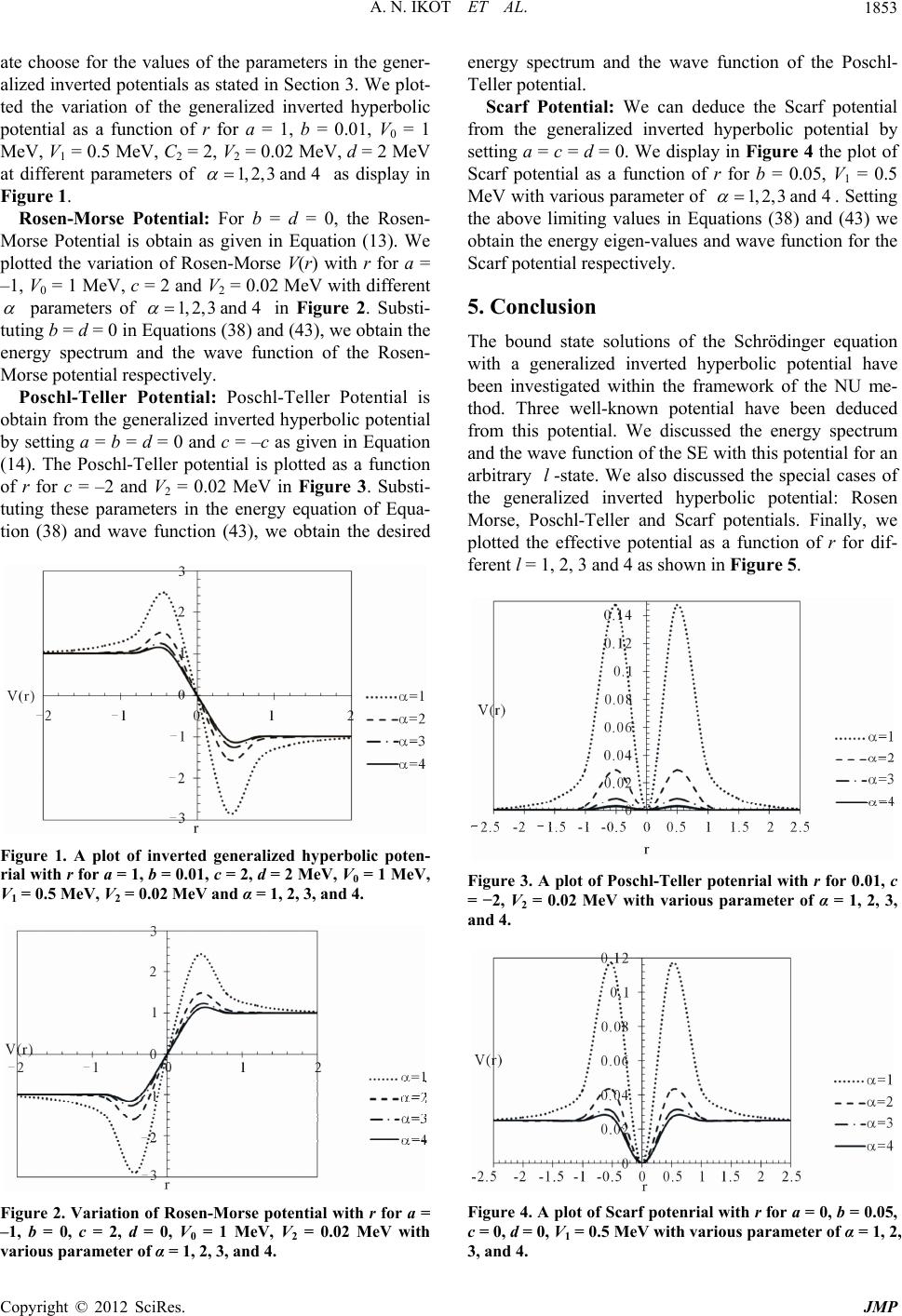 A. N. IKOT ET AL. 1853 ate choose for the values of the parameters in the gener- alized inverted potentials as stated in Section 3. We plot- ted the variation of the generalized inverted hyperbolic po 2 1,2,3and4 as display in Figure 1. Rosen-Morse Potential: For b = d = 0, the Morse Potential is obtain as given in Equation (13). We plotted the variation of Rosen-Morse V(r) with r for a = .02 MeV with different tential as a function of r for a = 1, b = 0.01, V0 = 1 MeV, V1 = 0.5 MeV, C = 2, V = 0.02 MeV, d = 2 MeV at different parameters of 2 Rosen- –1, V0 = 1 MeV, c = 2 and V2 = 0 parameters of 1,2, 3and 4 in Figure 2. Substi- 02 MeV in Fig e parameters in the energy equation of Equa- tio tuting b = d = 0 in Equations (38) and (43), we obtain the energy spectrum and the wave function of the Rosen- Morse potential respectively. Poschl-Teller Potential: Poschl-Teller Potential is obtain from the generalized inverted hyperbolic potential by setting a = b = d = 0 and c = –c as given in Equation (14). The Poschl-Teller potential is plotted as a function of r for c = –2 and V2 = 0.ure 3. Substi- tuting thes n (38) and wave function (43), we obtain the desired Figure 1. A plot of inverted generalized hyperbolic poten- rial with r for a = 1, b = 0.01, c = 2, d = 2 MeV, V0 = 1 MeV, V1 = 0.5 MeV, V2 = 0.02 MeV and α = 1, 2, 3, and 4. Figure 2. Variation of Rosen-Morse potential with r for a = 1, b = 0, c = 2, d = 0, V0 = 1 MeV, V2 = 0.02 MeV with various parameter of α = 1, 2, 3, and 4. energy spectrum and the wave function of the Poschl- Teller potential. Scarf Potential: We can deduce the Scarf potential from the generalized inverted hyperbolic potential by setting a = c = d = 0. We display in Figure 4 the plot of Scarf potential as a function of r for b = 0.05, V1 = 0.5 MeV with various parameter of 1,2, 3and4 . Setting the above limiting values in Equations (38) and (43) we obtain the energy eigen-values and wave function for the Scarf potential respectively. 5. Conclusion – The bound state solutions of the Schrödinger equation with a generalized inverted hyperbolic potential have been investigated within the framework of the NU me- thod. Three well-known potential have been deduced from this potential. We discussed the energy spectrum and the wave function of the SE with this potential for an arbitrary l-state. We also discussed the special cases of the generalized inverted hyperbolic potential: Rosen Morse, Poschl-Teller and Scarf potentials. Finally, we plotted the effective potential as a function of r for dif- ferent l = 1, 2, 3 and 4 as shown in Figure 5. Figure 3. A plot of Poschl-Teller potenrial with r for 0.01, c = −2, V2 = 0.02 MeV with various parameter of α = 1, 2, 3, and 4. Figure 4. A plot of Scarf potenrial with r for a = 0, b = 0.05, c = 0, d = 0, V1 = 0.5 MeV with various parameter of α = 1, 2, 3, and 4. Copyright © 2012 SciRes. JMP 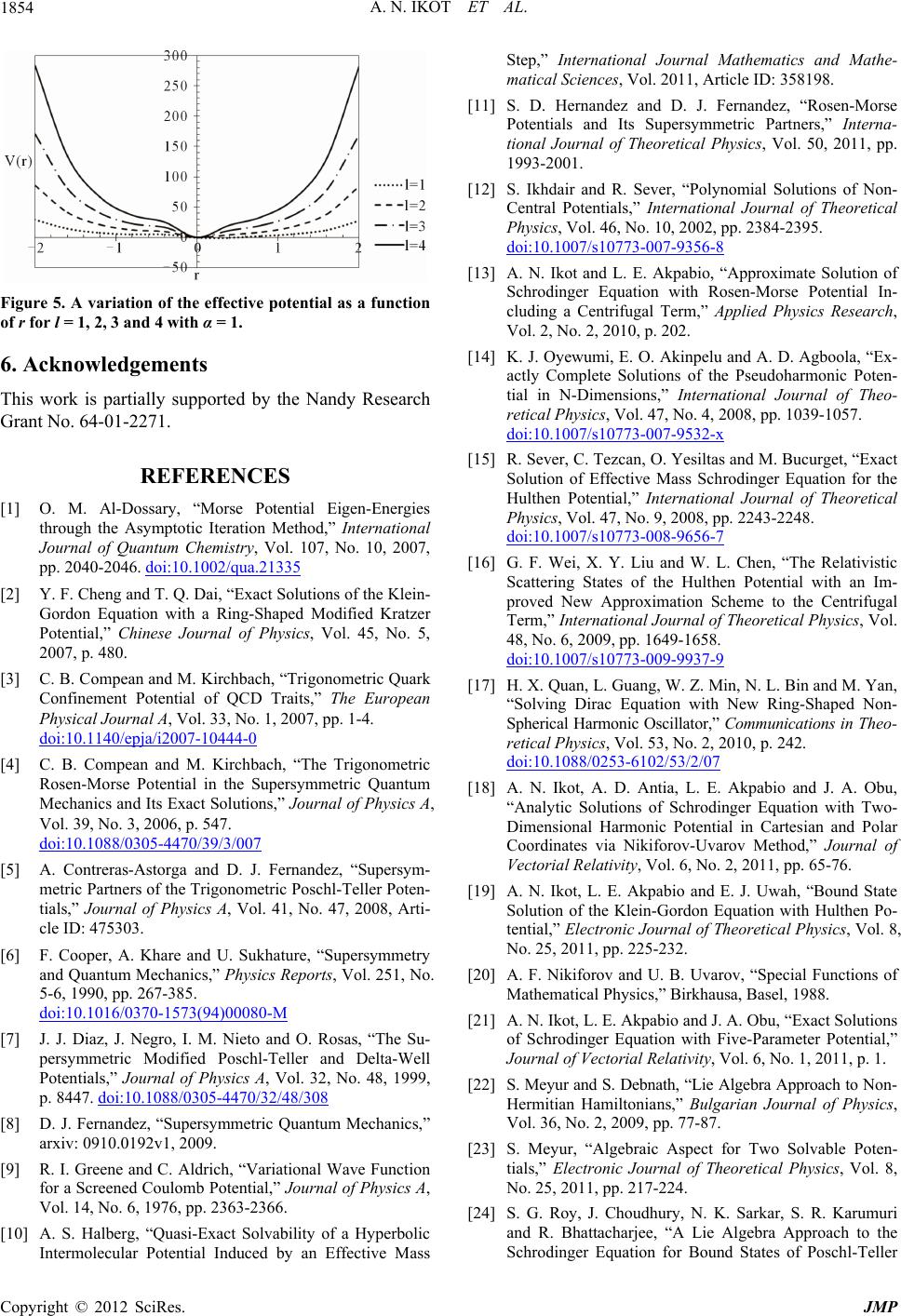 A. N. IKOT ET AL. 1854 Figure 5. A variation of the effective potential as a function of r for l = 1, 2, 3 and 4 with α = 1. k is partially supported by the Nandy Resea Grant No. 64-01-2271. REFERENCES [1] O. M. Al-Dossary, “Morse Potential Eigen-Energies through the Asymptotic Iteration Method,” International Journal of Quantum Chemistry, Vol. 107, No. 10, 2007 pp. 2040-2046. doi:10.1002/qua.21335 6. Acknowledgements This worrch , [2] Y. F. Cheng and T. Q. Dai, “Exact Solutions of the Klein- Gordon Equation with a Ring-Shaped Modified Kratze Potential,” Chinese Journal of Physics, Vol. 45, No. 5, ch, “Trigonometric Quark QCD Traits,” The European 3, No. 1, 2007, pp. 1-4. r 2007, p. 480. [3] C. B. Compean and M. Kirchba Confinement Potential of Physical Journal A, Vol. 3 doi:10.1140/epja/i2007-10444-0 [4] C. B. Compean and M. Kirchbach, “The Trigonometric Rosen-Morse Potential in the Supersymmetric Quantum Mechanics and Its Exact Solutions,” Journal of Physics A Vol. 39, No. 3 doi:10.1088/030 , , 2006, p. 547. 5-4470/39/3/007 [5] A. Contreras-Astorga and D. J. Fernandez, “Supersym- metric Partners of the Trigonometric Poschl-Teller Poten- tials,” Journal of Physics A, Vol. 41, No. 47, 2008, Arti- cle ID: 475303. [6] F. Cooper, A. Khare and U. Sukhature, “Supersymmetry and Quantum Mechanics,” Physics Reports, Vol. 251, No. 5-6, 1990, pp. 267-385. doi:10.1016/0370-1573(94)00080-M , 1999, 2/48/308 [7] J. J. Diaz, J. Negro, I. M. Nieto and O. Rosas, “The Su- persymmetric Modified Poschl-Teller and Delta-Well Potentials,” Journal of Physics A, Vol. 32, No. 48 p. 8447. doi:10.1088/0305-4470/3 ” Journal of Physics A , Article ID: 358198. cal Physics, Vol. 50, 2011, pp. [8] D. J. Fernandez, “Supersymmetric Quantum Mechanics,” arxiv: 0910.0192v1, 2009. [9] R. I. Greene and C. Aldrich, “Variational Wave Function for a Screened Coulomb Potential,, Vol. 14, No. 6, 1976, pp. 2363-2366. [10] A. S. Halberg, “Quasi-Exact Solvability of a Hyperbolic Intermolecular Potential Induced by an Effective Mass Step,” International Journal Mathematics and Mathe- matical Sciences, Vol. 2011 [11] S. D. Hernandez and D. J. Fernandez, “Rosen-Morse Potentials and Its Supersymmetric Partners,” Interna- tional Journal of Theoreti 1993-2001. [12] S. Ikhdair and R. Sever, “Polynomial Solutions of Non- Central Potentials,” International Journal of Theoretical Physics, Vol. 46, No. 10, 2002, pp. 2384-2395. doi:10.1007/s10773-007-9356-8 [13] A. N. Ikot and L. E. Akpabio, “Approximate Solution of Schrodinger Equation with Rosen-Morse Potential In- . D. Agboola, “Ex- cluding a Centrifugal Term,” Applied Physics Research, Vol. 2, No. 2, 2010, p. 202. [14] K. J. Oyewumi, E. O. Akinpelu and A actly Complete Solutions of the Pseudoharmonic Poten- tial in N-Dimensions,” International Journal of Theo- retical Physics, Vol. 47, No. 4, 2008, pp. 1039-1057. doi:10.1007/s10773-007-9532-x [15] R. Sever, C. Tezcan, O. Yesiltas and M. Bucurget, “Exact Solution of Effective Mass Schrodinger Equation for the Hulthen Potential,” International Journal of Theoretical Physics, Vol. 47, No. 9, 2008, pp. 2243-2248. doi:10.1007/s10773-008-9656-7 [16] G. F. Wei, X. Y. Liu and W. L. Chen, “The Relativistic Scattering States of the Hulthen Potential with an Im- proved New Approximation Scheme to the C Term,” International Journal of Tentrifugal heoretical Physics, Vol. 48, No. 6, 2009, pp. 1649-1658. doi:10.1007/s10773-009-9937-9 [17] H. X. Quan, L. Guang, W. Z. Min, N. L. Bin and M. Yan, “Solving Dirac Equation with New Ring-Shaped Non- Spherical Harmonic Oscillator,” Communications in The o- retical Physics, Vol. 53, No. 2, 2010, p. 242. doi:10.1088/0253-6102/53/2/07 [18] A. N. Ikot, A. D. Antia, L. E. Akpabio and J. A. O “Analytic Solutions of Schroding bu, ound State uation with Hulthen Po- Solutions of Physics, o the er Equation with Two- Dimensional Harmonic Potential in Cartesian and Polar Coordinates via Nikiforov-Uvarov Method,” Journal of Vectorial Relativity, Vol. 6, No. 2, 2011, pp. 65-76. [19] A. N. Ikot, L. E. Akpabio and E. J. Uwah, “B Solution of the Klein-Gordon Eq tential,” Electronic Journal of Theoretical Physics, Vol. 8, No. 25, 2011, pp. 225-232. [20] A. F. Nikiforov and U. B. Uvarov, “Special Functions of Mathematical Physics,” Birkhausa, Basel, 1988. [21] A. N. Ikot, L. E. Akpabio and J. A. Obu, “Exact of Schrodinger Equation with Five-Parameter Potential,” Journal of Vectorial Relativity, Vol. 6, No. 1, 2011, p. 1. [22] S. Meyur and S. Debnath, “Lie Algebra Approach to Non- Hermitian Hamiltonians,” Bulgarian Journal Vol. 36, No. 2, 2009, pp. 77-87. [23] S. Meyur, “Algebraic Aspect for Two Solvable Poten- tials,” Electronic Journal of Theoretical Physics, Vol. 8, No. 25, 2011, pp. 217-224. [24] S. G. Roy, J. Choudhury, N. K. Sarkar, S. R. Karumuri and R. Bhattacharjee, “A Lie Algebra Approach t Schrodinger Equation for Bound States of Poschl-Teller Copyright © 2012 SciRes. JMP  A. N. IKOT ET AL. Copyright © 2012 SciRes. JMP 1855 . Cui, “Approximate Analytic pin-Cen- Potential,” Electronic Journal of Theoretical Physics, Vol. 7, No. 24, 2010, pp. 235-240. [25] C. S. Jia, T. Chen and L. G Solutions of the Dirac Equation with the Generalized Poschl-Teller Potential Including the Pseudo-S trifugal Term,” Physics Letters A, Vol. 373, 2009, pp. 1621-1626. doi:10.1016/j.physleta.2009.03.006 [26] K. J. Oyewumi and C. O. Akoshile, “Bound State Solu- tions of the Dirac-Rosen-Morse Potential with Spin and Pseudospin Symmetry,” The European Physical Journal A, Vol. 45, 2010, pp. 311-318. doi:10.1140/epja/i2010-11007-0 [27] K. J. Oyewumi, “Analytic Solution of the Kratzer-Feus Potential in an Arbitrary Number of Dimensions,” Foun- dations of Physics Letters, Vol. 18, No. 75, 2005. [28] W. A. Yahya, K. J. Oyewumi, C. O. Akoshile and T. T. 0, pp. 1-8. roximate Analytical So- Ibrahim, “Bound State Solutions of Relativistic Dirac Equation with Equal Scalar and Vector Eckart Potentials Using the Nikivorov-Uvarov Method,” Journal of Vecto- rial Relativity, Vol. 5, No. 3, 201 [29] Y. Xu, S. He and C. S. Jia, “App lutions of the Klein-Gordon Equation with Poschl-Teller Potential Including the Centrifugal Term,” Physica Scripta, Vol. 81, No. 4, 2010, Article ID: 045001. doi:10.1088/0031-8949/81/04/045001 |