

Paper Menu >>
Journal Menu >>
 Vol.1, No.2, 68-75 (2010) doi:10.4236/as.2010.12010 Copyright © 2010 SciRes. Openly accessi ble at http://www.scirp.org/journal/AS/ Agricultural Sciences Evaluation of wheat ear insects in large scale field in central Germany ——Evaluation o f wh ea t ea r insects in winter wheat scale field Nawal Gaafar*, Christa Volkmar Institute of Agricultural & Nutritional Sciences, Martin-Luther-University Halle-Wittenberg, Halle, Wittenberg, Germany *Corresponding au t h o r s: [email protected] Received 16 June 2010; revised 3 July 2010; accepted 15 July 2010. ABSTRACT Wheat ear insects in large scale winter wheat field in Salzmünde (Saxsony-Anhalt) central Germany were evaluated. The present study aimed at studying the abundance of wheat blossom midges WBM, Sitodoplosis mosellana (Géhin), Contarinia tritici (Kirby) and thrips, Li- mothrips cerealium (Haliday) and Haplothrips tritici (Kurdjumov). Infestation in winter wheat during the growing seasons 2007, 2008 and 2009 was evaluated. Three methods were used to determine population densities and damage of wheat midges and thrips; pheromone traps, inspection of ear insects and water traps. A strong corre l atio n be tween midge’s catches and weather conditions was obtained in field ob- servations. A positive correlation between phe- romone catches and ear infestation levels was recorded; it was higher in 2008 than in 2009. On the other hand, in 2007 there was no synchro- nization; S. mosellana hibernated emerged too late to coincide with the susceptible wheat growth stages. The chemical treatment applied at 2008 for highly infestation; there were sig- nificant differences in thrips and midge num- bers between treated and untreated. Thrips and midge numbers were lo wer in the treated than in control. The high midge populations in water traps w ere recorded at growth stages 77-79 and 83 and the low populations were recorded at GS 75 and 75-77. This gives a reliable base for de- cision making to midges control. Keywords: Winter Wheat; Thrips; Wheat Midges; Population Densities 1. INTRODUCTION Wheat (Triticum aestivum L.) is one of the most impor- tant cereal grain crops in the world and it is cultivated over a wide range of climatic conditions [1]. Yields can be improved if producers take ti me to inspect their fields and control the insect pests during the growing season [2]. Important pests that may reduce wheat yields are wheat blossom midges and thrips. The orange wheat blossom midge Sitodiplosis mosellana (Géhin) and the yellow wheat blossom midge Contarinia tritici (Kirby) (Diptera: Cecidomyiidae), have a very patchy spatial distribution and infestations vary from year to year, be- cause they have the capacity for extended diapauses and only a portion of the larvae in the soil develop and pu- pate each spring, depending on climatic conditions [3]. S. mosellana and C. tritici cause direct damage by the lar- vae feeding on developing grain, and secondary fungal attack by Fusarium graminearium and Septoria nodorum may occur [3]. During the past decade, infestations of wheat midge seriously reduced the yield and quality of wheat in the major wheat-producing provinces in Ger- many [4,5], UK [6] Canada [7] and Finland [8]. The highest wheat midge populations can be found in fields where wheat was grown in previous years and in fields that are next to them. Pheromone traps gave a reliable indication of peak midge emergence, onset of flight and abundance of midges throughout the season. The wheat plants are susceptible growth stages (GS) from the flag leaf sheath opening up to the flowering half complete (GS 47-65), [10]. Also weather conditions have to be favorable for the insect to lay eggs within the florets [6,11,12]. The critical risk factors are the proportion of diapausing midge larvae that might develop in any given season, the coincidence between emergence of adult midges and susceptible stages [13] and the suitability of the weather during adult midge activity coinciding with susceptible  N. Gaafar et al. / Agricultural Sciences 1 (2010) 68-75 Copyright © 2010 SciRes. Openly accessi ble at http://www.scirp.org/journal/AS/ 69 growth stages for flight and oviposition [14,15]. A strong correlation between maximum trap catches and crop infestation levels has resulted in many studies [3,5]. White water traps are often used to sample migrating and flying insects. Larvae are caught in their migrating way from wheat ears to soil at the end of the season. Insects are attracted visually by colour of the traps and are then captured in the water. Studies have demon- strated the preferences of a certain cultivar of insect to a particular coloured trap, as well as weather condition, especially rainfall [16]. Thrips infesting cereals are usually found behind the sheath of the flag leaf, feeding on the stem; however, leaves, and heads also were attacked [17]. Adults and nymphs can cause damage and, if present in large num- bers, may cause the tissue on which they are feeding, to turn into a silver coloration. The stage of growth at the infestation time seems to determine the extent of yield loss [18]. The most important thrips species in the world, damaging wheat and barley heads are Limothrips cere- alium (Haliday) and Haplothrips tritici (Kurdjumov). They are species of wide ecological plasticity, and able to build up populations with notable individual numbers in cooler zones of Europe [19-21]. The objective was to determine the abundance of WBM and thrips infestation in large scale wheat fields through three monitoring method s to establish econo mic thresholds. To address the growers need for monitoring systems against wheat ear insects to prepare an expert system should help wheat farmers in dry region in cen- tral Germany. 2. MATERIAL AND METHODS 2.1. Winter Wheat Fields The winter wheat varieties Tommi, Manager and Im- pression were chosen to cultivate in 2007, 2008 and 2009, respectively. These varieties are commonly culti- vated and with high quality properties [22], they were sown in sandy loam soil in the previous October every year in Salzmünde (Latitude 51°4’N, Longitude 11°55’E) central Germany. The crop rotation in the experiment sites was winter wheat after winter wheat and the plots size was 7.5 hect ar es . 2.1.1. Monitoring WBM Adults Using Pheromone Traps Pheromone monitoring kits were obtained from AgriSen- seTM (UK). Each trap consisted of a pheromone lure; Dispenser: Septa; Material: Natural rubber; Packaging: Individually Sachet Packed; Sachet Material: Foil Lined Laminate [23]. Two traps were set up when winter wheat was at growth stages 45 (flag leaf sheath swollen) and were taken off at GS 77 (late milky) in the stud ied years. The traps were placed at the same height as the wheat ears at a distance of 20 m from field borders and sepa- rated by 10 m [24,25]. Trap catches were recorded twice a week. Trapped WBM adults and debris were removed from the traps; and depending on the density of the caught insects the cards were changed. 2.1.2. Inspection of Thrips and Midges in Wheat Ears Ten ears were collected in method of liner observation [26] at flowering stag e (GS 65) and milky stage (GS 73) [27] when the most larvae are already practically grown up, but still not left the spikes, they transpo rted in sealed bags and stored at –20℃. By mean of a binocular the numbers of larvae per ear was counted and classified as S. mosellana or C. tritici and thrips Limothrips cereal- ium (Haliday) and Haplothrips tritici (Kurdjumov). In addition, kernel damage was registered as reformatted, cherviled or cracked. 2.1.3. Surveying WBM Larv ae Using Water Traps The migrated midge’s larvae from wheat ear were monitored using white water traps as expectation factor for the following years. The traps consisted of white plastic dishes; 12.5 cm diameter and 6.5 cm deep. Two traps were placed on the ground among wheat plants at milky stage (GS 73) and were taken off at gold dough (GS 89), and were partly filled with water (200 ml) plus 1ml of detergent (Fit). Traps were examined twice a week and larvae were counted using a magnifying glass. 2.2. Chemical Control The wheat midge’s management was conducted by using Karate (Lambda cyhalothrin), a pyrethroid insecticide, at a rate of 0.75l/ ha [28]; insecticide application was sp- rayed on 3rd June 2008 (GS 59), and only a 4/5 of the wheat field was sprayed. Insect populations were sam- pled before the insecticide application, thereafter, 3, 7, 10, 15 and 20 days afte r treat ment. 2.3. Statistical Analysis Numbers of captured insects and ear insect’s evaluation were analyzed by linear model (a repeated measures analysis of variance (Statistix 9) [29]. Tukey test was used to compare means of varieties. Significances were noted at P < 0.05 for all trials. Thrips and midge num- bers per ear were correlated with infested kernels by using the Pearson’s correlation coefficient. 3. RESULTS 3.1. Monitoring S. Mosellana Adult s Using Pheromone Traps Populations of S. mosellana adults started slowly till  N. Gaafar et al. / Agricultural Sciences 1 (2010) 68-75 Copyright © 2010 SciRes. Openly accessi ble at http://www.scirp.org/journal/AS/ 70 milky stage and the first peak was recorded at GS 73 (1496 midges/trap) in 2007 (Figure 1). In 2008 large variations in numbers of midges in the pheromone traps and in time of peak catches were found; the highest number of males was 173 midges/trap recorded in GS (55-59) (Figure 2). There was one peak in 2009 (32 midges/trap) at GS 59-61 (Figure 3). The lowest number of midges were1, 13 and 2.5 midges/trap in 2007, 2008, and 2009, respectively (Fig- ures 1-3). Coincidence of adult activity and susceptible growth stages was more obvious in 2008 than in 2009 as shown in o val shape in Figures 2 and 3. The susceptible stages of wheat coincided with suitability for flight and oviposition. There was also a strong correlation between peak pheromone trap catches and weather conditions, rainfall and temperature (r = +0.892 and r = +0.742) in 2008 & 2009, respectively. On the other hand, there was no correlation (r = +0.38) in 2007, possibly because the midge activity started later than the susceptible stage. Figure 1. Mean Sitodiplosis mosellana adults caught in phero- mone one trapsamd their realtion with temperature and rainfall in Salzmünde 2007. Figure 2. Mean ± SE of Sitodiplosis mosellana adults catches in pheromone traps and their relation with temperature and rainfall in 2008. Oval refers to coincidence of adult activity and susceptible growth stages. Different letters indicate sig- nificant differences. Figure 3. Mean ± SE of Sitodiplosis mosellana adults catches in pheromone traps and their relation with temperature and rainfall in 2009. Oval refere to coincidence of adult activity and susceptible growth stages. Different letters indicate sig- nificant differences. 3.2. Inspection of Thrips and Midges in Wheat Ears 3.2.1. 2007 3.2.1.1. To t al Thrip s In the most impor tant growth stage GS 65&73 ther e was significant difference in thrips populations (P = 0.0047) (P = 0.0484) and (P = 0.0451) in thrips adults, larvae and total thrips, respectively. The thrips adults were 0.7 and 1.5/ear in the same way. The corresponding records in thrips larvae were 1.3 and 2.0/ear. The total thrips/ear were 2.1 and 3.5 , respectively (Figure 4). 3.2.1.2. Wheat Midges There was a significant difference (P = 0.0357) in total midges between both growth stages (flowering and milky). Total midges (S. mosellana & C. tritici) were 0.2 and 1.8 larvae/ ear, respectively (Figure 4). 3.2.1.3. Infested Kernels by Thrips and Midges There was significant difference (P= 0.0 391) in infested kernels (deformated, cherviled or cracked kernels) be- tween the growth stages 65 and 73, these values were 0.2 and 1.8 infested kernels/ear, respectively (Figure 4). 3.2.2. 2008 3.2.2.1. To t al Thrip s Thrips population was 10.0 thrips/ear before the insecti- cide application, while after 3 days post treatment; they were 8.8 and 26.0 thrips/ear in the treated and control, respectively. In flowering stage (GS 65): Significant differences were found (P = 0.0083) in the number of total thrips between treated and control. On the 7th day, thrips num- ber in control plants were higher than in treated 26.4 and 6.8/ear, respectively; the corresponding numbers on the  N. Gaafar et al. / Agricultural Sciences 1 (2010) 68-75 Copyright © 2010 SciRes. Openly accessi ble at http://www.scirp.org/journal/AS/ 71 Thrips adults Thrips larvae Total thrips Total midges Infested kernels Thripse & midge larave/ ear 0 1 2 3 4 5 A AA A A B B B B B Flowering stage Milky stage Figure 4. Mean ± SE of thrips (adults, larvae & total) and total midges in two growth stages in 2007. Different letters indicate significant differences. 10th day were 27.6 and 6. 8 t h ri p s/ ear (Figure 5(a)). In milky stage (GS 73): There was significantly dif- ferent (P = 0.0041) in thrips number between treated and untreated. Thrips numbers were lower in the treated than control. They were 6.8 and 31.6 thrips/ear, respectively after 15 days post treatment; the corresponding records on 20th day were 18.4 and 34.4 thrips/ear (Figure 5(a)). 3.2.2.2. Wheat Midges There was no wheat midge larvae recorded before treat- ment (Figure 5(b)), while 3 days after treatment; they were 0.0 and 4.4 midge larvae/ear in treated and control plots, respectively. In flowering stage (GS 65): There was no significant difference (P = 0.0672) in the number of midge larvae (S. mosellana & C. tritici) between treated and untreated plots. On the 7th day, midge larvae numbers in treated were lower than in control 0.8 and 2.0/ ear, correspond- ingly; the equivalent records on the 10th day were 2.4 and 3.6 thrips/ear (Figure 5(b)). In milky stage (GS 73): There was significantly dif- ferent (P = 0.0245) in wheat midge larvae between treated and untreated. Midge larvae n u mbers were highe r in control than in treated plants. They were 4.0 and 1.2 larvae/ear, respectively after 15 days post treatment; the corresponding numbers on 20th day were 4.8 and 2.4 larvae/ear; this mean that treated had an half population which recorded in control (Figure 5(b)). 3.2.2.3. Correlation between Thrips, Midges and Infested Kernels There was significant difference (P = 0.0485) in infested kernels by thrips and wheat midge. Treated wheat had lower infested kernels than control plants. There was a positive correlation coefficient between wheat midge larvae and infested kernels (r = +0.56 and +0.76) in GS 65 and 73 stages, respectively; while there was no Figure 5. Mean ± SE of total thrips (a) andl midge larvae (b) in treated and untreated winter wheat during season 2008. Dif- ferent letters indicate significant differences. significantly correlation between total thrips and infested kernels (r = +0.121 and +0.175) in both stages (Figures 5 (a) and (b)). 3.2.3. 2009 3.2.3.1. To t al Thrip s There was a significant difference in thrips populations in GS 65 and 73; the significant value was (P = 0.0030) in thrips adults and (P = 0.0484) in total thrips. While there was no significant difference (P = 0.891) in thrips larvae between both stages. The thrips adult were 0.3 in GS 65 and 1.1/ear in 73, respectively. The corresponding records in thrips larvae were 3.2 and 3.4/ear. The total thrips were 3.5 and 4.5/ear in GS 65 and 73, respectively (Figure 6). 3.2.3.2. Wheat Midges There was a significant different (P = 0.0263) in total midges populations (S. mosellana & C. tritici) between GS 65 and 73. The total midges were 0.3 and 0.8 larvae/ ear in GS 65 and 73, respectively (Figure 6). 3.2.3.3. Infested Kernels by Thrips and Midges There was significant difference (P = 0.0169) in infested kernels between growth stages 65 and 73, these values 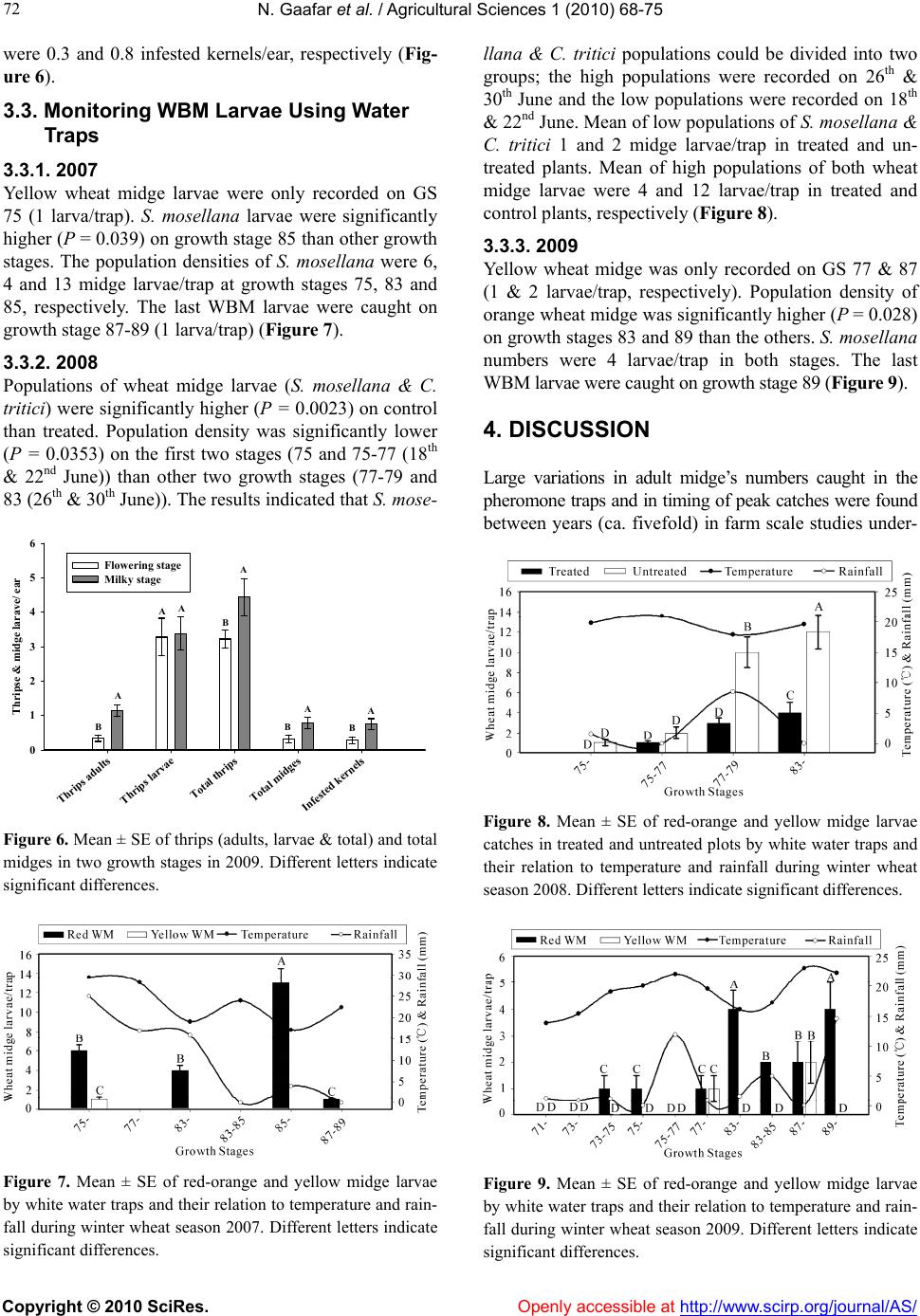 N. Gaafar et al. / Agricultural Sciences 1 (2010) 68-75 Copyright © 2010 SciRes. Openly accessi ble at http://www.scirp.org/journal/AS/ 72 were 0.3 and 0.8 infested kernels/ear, respectively (Fig- ure 6). 3.3. Monitoring WBM Larvae Using Water Traps 3.3.1. 2007 Yellow wheat midge larvae were only recorded on GS 75 (1 larva/trap). S. mosellana larvae were significantly higher (P = 0.039) on growth stage 85 than other growth stages. The population densities of S. mosellana were 6, 4 and 13 midge larvae/trap at growth stages 75, 83 and 85, respectively. The last WBM larvae were caught on growth stage 87-89 (1 larva/trap) (Figure 7). 3.3.2. 2008 Populations of wheat midge larvae (S. mosellana & C. tritici) were significantly higher (P = 0.00 23) on contro l than treated. Population density was significantly lower (P = 0.0353) on the first two stages (75 and 75-77 (18th & 22nd June)) than other two growth stages (77-79 and 83 (26th & 30th June)). The results indicated that S. mose- Thrips adults Thrips larvae Total thrips Total midges Infested kernels Thripse & midge larave/ ear 0 1 2 3 4 5 6 Flowering stage Milky stage A A AA AA B B BB Figure 6. Mean ± SE of thrips (adults, larvae & total) and total midges in two growth stages in 2009. Different letters indicate significant differences. Figure 7. Mean ± SE of red-orange and yellow midge larvae by white water traps and their relation to temperature and rain- fall during winter wheat season 2007. Different letters indicate significant differences. llana & C. tritici populations could be divided into two groups; the high populations were recorded on 26th & 30th June and the low populations were recorded on 18th & 22nd June. Mean of low populations of S. mo sellan a & C. tritici 1 and 2 midge larvae/trap in treated and un- treated plants. Mean of high populations of both wheat midge larvae were 4 and 12 larvae/trap in treated and control plants, respectively (Figure 8). 3.3.3. 2009 Yellow wheat midge was only recorded on GS 77 & 87 (1 & 2 larvae/trap, respectively). Population density of orange wheat midge was significantly higher (P = 0.028) on growth stages 83 and 89 than the others. S. mosellana numbers were 4 larvae/trap in both stages. The last WBM larvae were caught on growth stage 89 (Figure 9). 4. DISCUSSION Large variations in adult midge’s numbers caught in the pheromone traps and in timing of peak catches were found between years (ca. fivefold) in farm scale studies under- Figure 8. Mean ± SE of red-orange and yellow midge larvae catches in treated and untreated plots by white water traps and their relation to temperature and rainfall during winter wheat season 2008. Different letters indicate significant differences. Figure 9. Mean ± SE of red-orange and yellow midge larvae by white water traps and their relation to temperature and rain- fall during winter wheat season 2009. Different letters indicate significant differences. 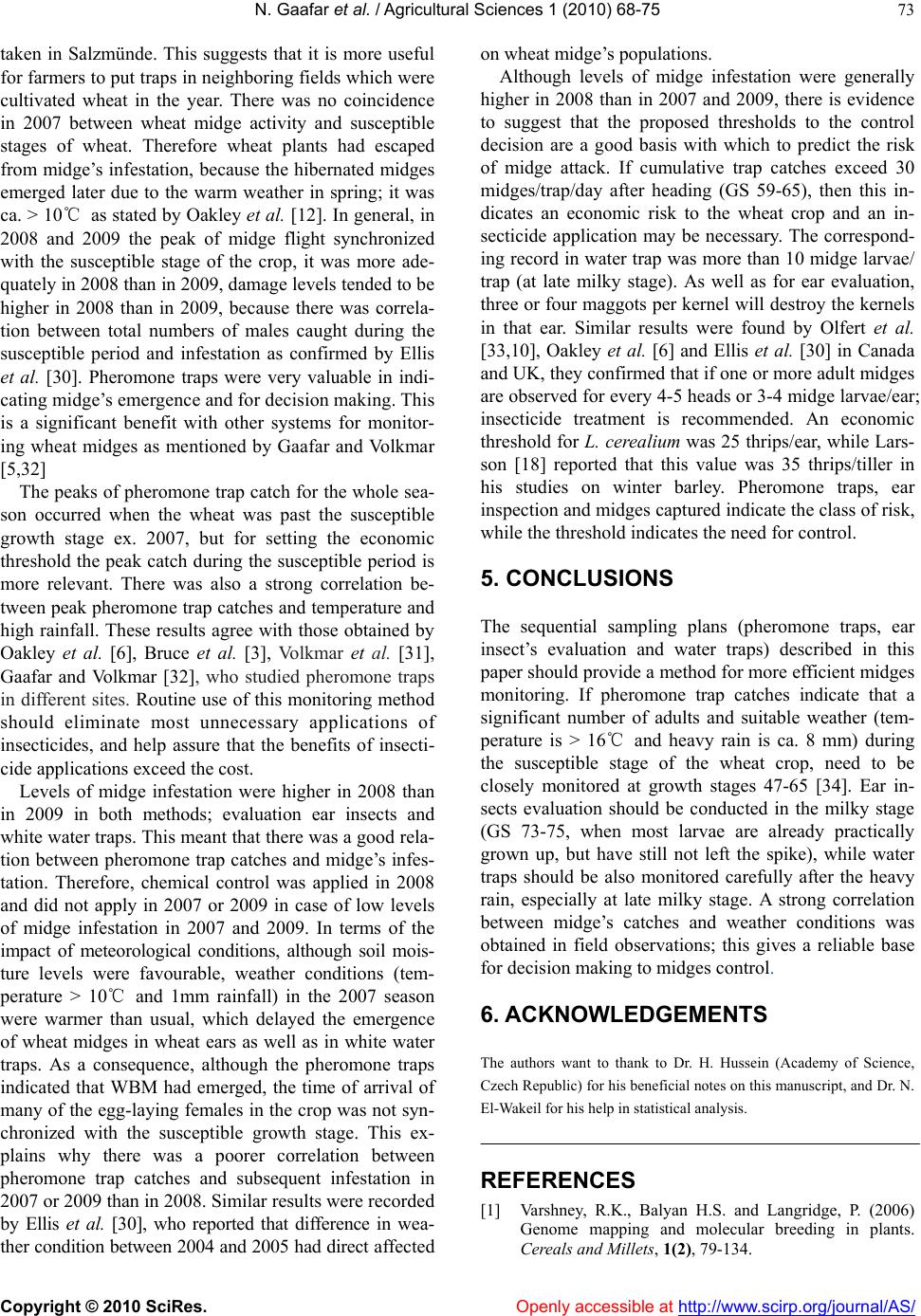 N. Gaafar et al. / Agricultural Sciences 1 (2010) 68-75 Copyright © 2010 SciRes. Openly accessi ble at http://www.scirp.org/journal/AS/ 73 taken in Salzmünde. This suggests that it is more useful for farmers to put traps in neighboring fields which were cultivated wheat in the year. There was no coincidence in 2007 between wheat midge activity and susceptible stages of wheat. Therefore wheat plants had escaped from midge’s infestation, because the hibernated midges emerged later due to the warm weather in spring; it was ca. > 10℃ as stated by Oakley et al. [12]. In general, in 2008 and 2009 the peak of midge flight synchronized with the susceptible stage of the crop, it was more ade- quately in 2008 than in 2009, da mage leve ls tended to b e higher in 2008 than in 2009, because there was correla- tion between total numbers of males caught during the susceptible period and infestation as confirmed by Ellis et al. [30]. Pheromone traps were very valuable in indi- cating midge’s emergence and for decision making. This is a significant benefit with other systems for monitor- ing wheat midges as mentioned by Gaafar and Volkmar [5,32] The peaks of pheromone trap catch for the whole sea- son occurred when the wheat was past the susceptible growth stage ex. 2007, but for setting the economic threshold the peak catch during the susceptible period is more relevant. There was also a strong correlation be- tween peak pheromone trap catches and temperature and high rainfall. These results agree with those obtained by Oakley et al. [6], Bruce et al. [3], Volkmar et al. [31], Gaafar and Volkmar [32], who studied pheromone traps in different sites. Routine use of this monitoring method should eliminate most unnecessary applications of insecticides, and help assure that the benefits of insecti- cide applications exceed the cost. Levels of midge infestation were higher in 2008 than in 2009 in both methods; evaluation ear insects and white water traps. This meant that there was a good rela- tion between pheromone trap catches and midge’s infes- tation. Therefore, chemical control was applied in 2008 and did not apply in 2007 or 2009 in case of low levels of midge infestation in 2007 and 2009. In terms of the impact of meteorological conditions, although soil mois- ture levels were favourable, weather conditions (tem- perature > 10℃ and 1mm rainfall) in the 2007 season were warmer than usual, which delayed the emergence of wheat midges in wheat ears as well as in white water traps. As a consequence, although the pheromone traps indicated that WBM had emerged, the time of arrival of many of the egg-laying females in th e crop was not syn- chronized with the susceptible growth stage. This ex- plains why there was a poorer correlation between pheromone trap catches and subsequent infestation in 2007 or 2009 than in 2008 . Similar resu lts were r eco rded by Ellis et al. [30], who reported that difference in wea- ther condition between 2004 and 2005 had direct affect ed on wheat midge’s populations. Although levels of midge infestation were generally higher in 2008 than in 2007 and 2009, there is evidence to suggest that the proposed thresholds to the control decision are a good basis with which to predict the risk of midge attack. If cumulative trap catches exceed 30 midges/trap/day after heading (GS 59-65), then this in- dicates an economic risk to the wheat crop and an in- secticide application may be necessary. The correspond- ing record in water trap was more than 10 midge larvae/ trap (at late milky stage). As well as for ear evaluation, three or four maggots per kernel will destroy the kernels in that ear. Similar results were found by Olfert et al. [33,10], Oakley et al. [6] and Ellis et al. [30] in Canada and UK, they confirmed th at if one or more adult midges are observed for every 4-5 heads or 3-4 midge larvae/ear; insecticide treatment is recommended. An economic thresho ld for L. cerealium was 25 thrips/ear, while Lars- son [18] reported that this value was 35 thrips/tiller in his studies on winter barley. Pheromone traps, ear inspection and midges captured indicate the class of risk, while the threshold indicates the need for control. 5. CONCLUSIONS The sequential sampling plans (pheromone traps, ear insect’s evaluation and water traps) described in this paper should provide a method for more efficient midges monitoring. If pheromone trap catches indicate that a significant number of adults and suitable weather (tem- perature is > 16℃ and heavy rain is ca. 8 mm) during the susceptible stage of the wheat crop, need to be closely monitored at growth stages 47-65 [34]. Ear in- sects evaluation should be conducted in the milky stage (GS 73-75, when most larvae are already practically grown up, but have still not left the spike), while water traps should be also monitored carefully after the heavy rain, especially at late milky stage. A strong correlation between midge’s catches and weather conditions was obtained in field observations; this gives a reliable base for decision making to midges control. 6. ACKNOWLEDGEMENTS The authors want to thank to Dr. H. Hussein (Academy of Science, Czech Republic) for his beneficial notes on this manuscript, and Dr. N . El-Wakeil for his help in statistical analysis. REFERENCES [1] Varshney, R.K., Balyan H.S. and Langridge, P. (2006) Genome mapping and molecular breeding in plants. Cereals and Millets, 1(2), 79-134. 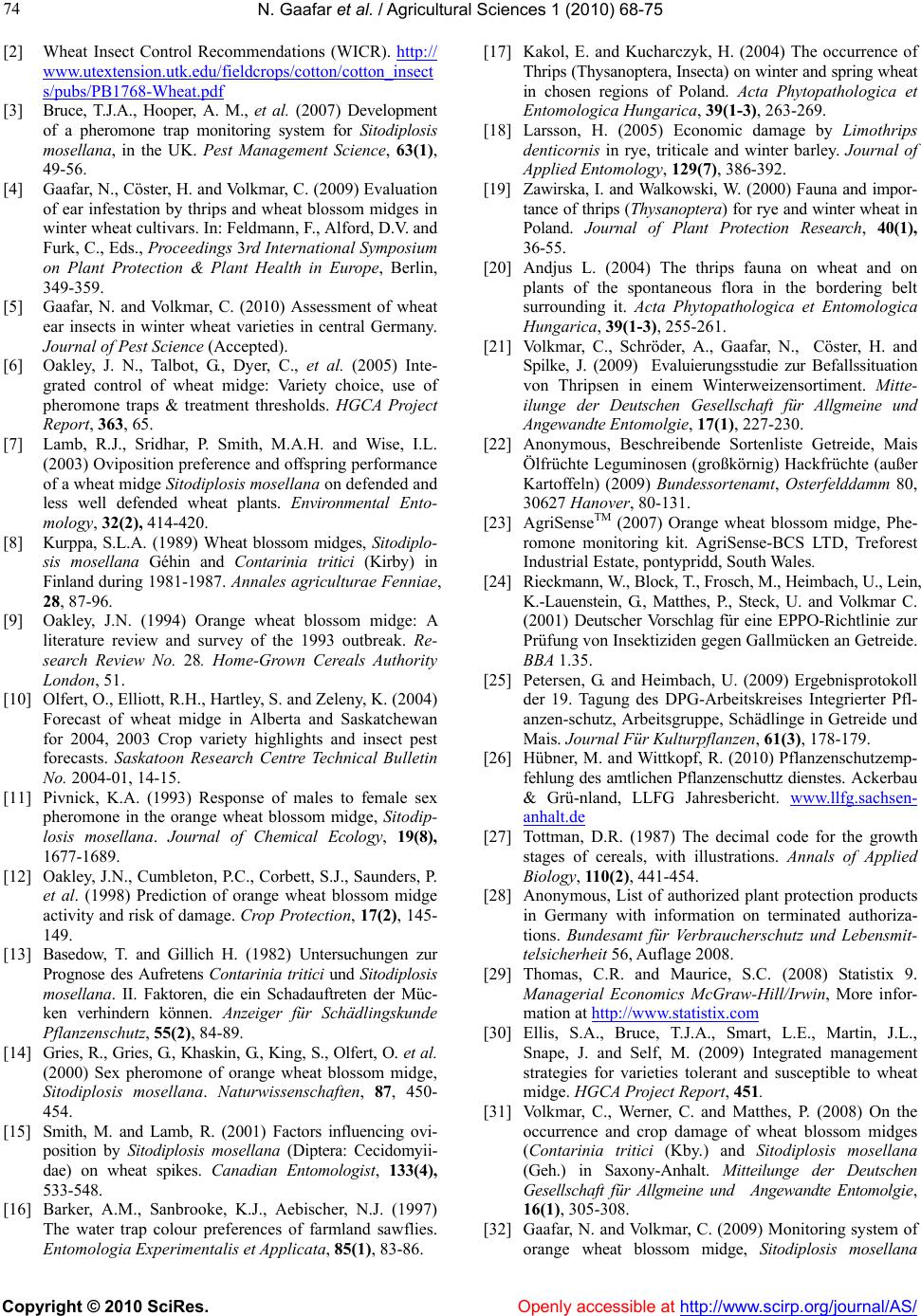 N. Gaafar et al. / Agricultural Sciences 1 (2010) 68-75 Copyright © 2010 SciRes. Openly accessi ble at http://www.scirp.org/journal/AS/ 74 [2] Wheat Insect Control Recommendations (WICR). http:// www.utextension.utk.edu/fieldcrops/cotton/cotton_insect s/pubs/PB1768-Wheat.pdf [3] Bruce, T.J.A., Hooper, A. M., et al. (2007) Development of a pheromone trap monitoring system for Sitodiplosis mosellana, in the UK. Pest Management Science, 63(1), 49-56. [4] Gaafar, N., Cöster, H. and Volkmar, C. (2009) Evaluation of ear infestation by thrips and wheat blossom midges in winter wheat cultivars. In: Feldmann, F., Alford, D.V. and Furk, C., Eds., Proceedings 3rd International Symposium on Plant Protection & Plant Health in Europe, Berlin, 349-359. [5] Gaafar, N. and Volkmar, C. (2010) Assessment of wheat ear insects in winter wheat varieties in central Germany. Journal of Pest Science (Accepted). [6] Oakley, J. N., Talbot, G., Dyer, C., et al. (2005) Inte- grated control of wheat midge: Variety choice, use of pheromone traps & treatment thresholds. HGCA Project Report, 363, 65. [7] Lamb, R.J., Sridhar, P. Smith, M.A.H. and Wise, I.L. (2003) Oviposition preference and offspring performance of a wheat midge Sitodiplosis mosellana on defended and less well defended wheat plants. Environmental Ento- mology, 32(2), 414-420. [8] Kurppa, S.L.A. (1989) Wheat blossom midges, Sitodiplo- sis mosellana Géhin and Contarinia tritici (Kirby) in Finland during 1981-1987. Annales agriculturae Fenniae, 28, 87-96. [9] Oakley, J.N. (1994) Orange wheat blossom midge: A literature review and survey of the 1993 outbreak. Re- search Review No. 28. Home-Grown Cereals Authority London, 51. [10] Olfert, O., Elliott, R.H., Hartley, S. and Zeleny, K. (2004) Forecast of wheat midge in Alberta and Saskatchewan for 2004, 2003 Crop variety highlights and insect pest forecasts. Saskatoon Research Centre Technical Bulletin No. 2004-01, 14-15. [11] Pivnick, K.A. (1993) Response of males to female sex pheromone in the orange wheat blossom midge, Sitodip- losis mosellana. Journal of Chemical Ecology, 19(8), 1677-1689. [12] Oakley, J.N., Cumbleton, P.C., Corbett, S.J., Saunders, P. et al. (1998) Prediction of orange wheat blossom midge activity and risk of damage. Crop Protection, 17(2), 145- 149. [13] Basedow, T. and Gillich H. (1982) Untersuchungen zur Prognose des Aufretens Contarinia tritici und Sitodiplosis mosellana. II. Faktoren, die ein Schadauftreten der Müc- ken verhindern können. Anzeiger für Schädlingskunde Pflanzenschutz, 55(2), 84-89. [14] Gries, R., Gries, G., Kha skin, G., King, S., Olfert, O. et al. (2000) Sex pheromone of orange wheat blossom midge, Sitodiplosis mosellana. Naturwissenschaften, 87, 450- 454. [15] Smith, M. and Lamb, R. (2001) Factors influencing ovi- position by Sitodiplosis mosellana (Diptera: Cecidomyii- dae) on wheat spikes. Canadian Entomologist, 133(4), 533-548. [16] Barker, A.M., Sanbrooke, K.J., Aebischer, N.J. (1997) The water trap colour preferences of farmland sawflies. Entomologia Experimentalis et Applicata, 85(1), 83-86. [17] Kakol, E. and Kucharczyk, H. (2004) The occurrence of Thrips (Thysanoptera, Insecta) on winter and spring wheat in chosen regions of Poland. Acta Phytopathologica et Entomologica Hungarica, 39(1-3), 263-269. [18] Larsson, H. (2005) Economic damage by Limothrips denticornis in rye, triticale and winter barley. Journal of Applied Entomology, 129(7), 386-392. [19] Zawirska, I. and Walkowski, W. (2000) Fauna and impor- tance of thrips (Thysanopte ra) for ry e and winter wheat in Poland. Journal of Plant Protection Research, 40(1), 36-55. [20] Andjus L. (2004) The thrips fauna on wheat and on plants of the spontaneous flora in the bordering belt surrounding it. Acta Phytopathologica et Entomologica Hungarica, 39(1-3), 255-261. [21] Volkmar, C., Schröder, A., Gaafar, N., Cöster, H. and Spilke, J. (2009) Evaluierungsstudie zur Befallssituation von Thripsen in einem Winterweizensortiment. Mitte- ilunge der Deutschen Gesellschaft für Allgmeine und Angewandte Ento molgie, 17(1), 227-230. [22] Anonymous, Beschreibende Sortenliste Getreide, Mais Ölfrüchte Leguminosen (großkörnig) Hackfrüchte (außer Kartoffeln) (2009) Bundessortenamt, Osterfelddamm 80, 30627 Hanover, 80-131. [23] AgriSenseTM (2007) Orange wheat blossom midge, Phe- romone monitoring kit. AgriSense-BCS LTD, Treforest Industrial Estate, pontypridd, South Wales. [24] Rieckmann, W., Block, T., Frosch, M., Heimbach, U., Lein, K.-Lauenstein, G., Matthes, P., Steck, U. and Volkmar C. (2001) Deutscher Vorschlag für eine EPPO-Richtlinie zur Prüfung von Insektiziden gegen Gallmücken an Getreide. BBA 1.35. [25] Petersen, G. and Heimbach, U. (2009) Ergebnisprotokoll der 19. Tagung des DPG-Arbeitskreises Integrierter Pfl- anzen-schutz, Arbeitsgruppe, Schädlinge in Getreide und Mais. Journal Für Kulturpflanzen, 61(3), 178-179. [26] Hübner, M. and Wittkopf, R. (2010) Pflanzenschutzemp- fehlung des amtlichen Pflanzenschuttz dienstes. Ackerbau & Grü-nland, LLFG Jahresbericht. www.llfg.sachsen- anhalt.de [27] Tottman, D.R. (1987) The decimal code for the growth stages of cereals, with illustrations. Annals of Applied Biology, 110(2), 441-454. [28] Anonymous, List of authorized plant protection products in Germany with information on terminated authoriza- tions. Bundesamt für Verbraucherschutz und Lebensmit- telsicherheit 56, Auflage 2008. [29] Thomas, C.R. and Maurice, S.C. (2008) Statistix 9. Managerial Economics McGraw-Hill/Irwin, More infor- mation at http://www.statistix.com [30] Ellis, S.A., Bruce, T.J.A., Smart, L.E., Martin, J.L., Snape, J. and Self, M. (2009) Integrated management strategies for varieties tolerant and susceptible to wheat midge. HGCA Project Report, 451. [31] Volkmar, C., Werner, C. and Matthes, P. (2008) On the occurrence and crop damage of wheat blossom midges (Contarinia tritici (Kby.) and Sitodiplosis mosellana (Geh.) in Saxony-Anhalt. Mitteilunge der Deutschen Gesellschaft für Allgmeine und Angewandte Entomolgie, 16(1), 305-308. [32] Gaafar, N. and Volkmar, C. (2009) Monitoring system of orange wheat blossom midge, Sitodiplosis mosellana 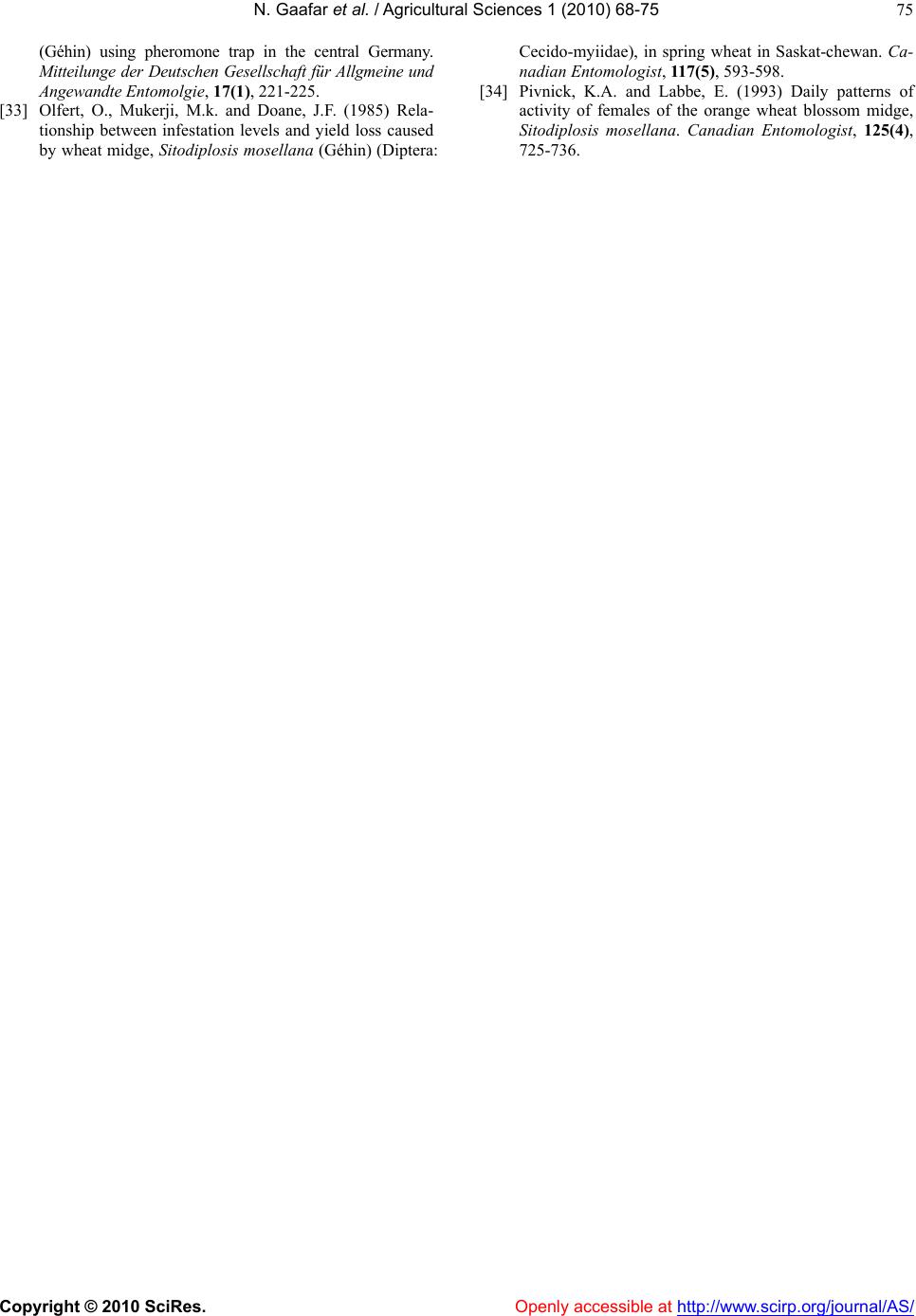 N. Gaafar et al. / Agricultural Sciences 1 (2010) 68-75 Copyright © 2010 SciRes. http://www.scirp.org/journal/AS/Openly accessible at 75 (Géhin) using pheromone trap in the central Germany. Mitteilunge der Deutschen Gesellschaft für Allgmeine und Angewandte Ento molgie, 17(1), 221-225. [33] Olfert, O., Mukerji, M.k. and Doane, J.F. (1985) Rela- tionship between infestation levels and yield loss caused by wheat midge, Sitodiplosis mosellana (Géhin) (Diptera: Cecido-myiidae), in spring wheat in Saskat-chewan. Ca- nadian Entomologist, 117(5), 593-598. [34] Pivnick, K.A. and Labbe, E. (1993) Daily patterns of activity of females of the orange wheat blossom midge, Sitodiplosis mosellana. Canadian Entomologist, 125(4), 725-736. |