

Paper Menu >>
Journal Menu >>
 Vol.1, No.2, 56-61 (2010) doi:10.4236/as.2010.12008 Copyright © 2010 SciRes. Openly accessi ble at http://www.scirp.org/journal/AS/ Agricultural Sciences The HLP mutation confers enhanced resistance to leaf-rust in different wheat genetic backgrounds ——Lesion-mimic mutation confers resistance in wheat Cristina Andrea Kamlofski1, Alberto Acevedo2* 1Estación Experimental Agropecuaria Concepción del Uruguay, CRER, INTA, Concepción del Uruguay, Entre Ríos, Argentina 2Centro de Investigación de Recursos Naturales, INTA Castelar, Castelar, Buenos Aires, Argentina; *Corresponding author: [email protected] Received 8 July 2010; revised 19 July 2010; accepted 20 July 2010. ABSTRACT In several plant species, lesion-mimic mutants simulate the disease-resistance response in the absence of pathogens. Interestingly, some of these mutants confer broad-spectrum resistance to diverse pathogens. We previously demon- strated that the HLP (hypersensitive-like phe- notype) mutant of bread wheat (Triticum aesti- vum L.) exhibited spontaneous hypersensitive response (HR) in the absence of any pathogen input. However, when HLP plants showing HR phenotype were challenged with leaf-rust (Puc- cinia triticina) they were more resistant than plants of the mother-line of comparable devel- opmental stage that did not show spontaneous HR, suggesting that the HLP mutation may confer enhanced resistance to the fungus. In this paper we validate the aforementioned find- ing in several wheat genetic backgrounds. Two- way crosses were performed among the HLP mutant and eight wheat commercial stocks, and third backcross progenies with and without spontaneous HR were challenged with leaf-rust to investigate the response to the fungus. Backcrosses to cv. Sinvalocho M.A., the mother- line, and cv. Purplestraw, highly susceptible to leaf-rust attack, were used as controls. Third backcross progenies of cvs. Sinvalocho M.A., Purplestraw, Buck Guaraní and Pro INTA Impe- rial bearing spontaneous HR phenotype were more resistant to the fungal pathogen than third backcross progenies that did not carry the HLP mutation. Other four wheat stocks were as healthy as the HLP mutant. As expected, back- cross to the mother-line demonstrated that the HLP mutation conferred an additional resistance to the alread y healthy performan ce d isplay ed by the mother-line at adult plant stage. The intro- gression of the HLP mutation conferred heigh- tened leaf-rust resistance and caused no kernel weight red uction on th e backcr ossed pr ogenies. Taken together, these data validate the direct use of this type of mutations in disease-resis- tance breeding. Keywords: Hypersensitive Response; Lesion-Mimic Mutant; Puccinia Triticina, Wheat Commercial Stocks 1. INTRODUCTION Plants have evolved several defense mechanisms to overcome pathogen attack. One of the most common and effective defense responses in plants is the hypersensi- tive response (HR), which results in localized cell death at the site of pathogen infection [1]. Mutants have been identified in several plant species that spontaneously form localized areas of dead tissue resembling those seen in the HR. In these class of mutants, hereafter re- ferred to as lesion-mimic mutants, disease symptoms or HR cell death occur in the absence of pathogens. Several lesion-mimic mutants have been identified and characterized in Arabidopsis: acd [2-4]; dll [5]; hlm [6]; len [7]; lsd [8]; ssi [9,10]. The LSD1 gene coding for a novel zinc finger protein functions as a negative reg ula - tor of plant cell death. Interestingly, the lsd1 mutants were resistant to the bacterial pathogen Pseudomonas syringae and the oomycete Peronospora parasitica [11]. The HLM1 gene encodes a cyclic nucleotide-gated chan- nel that is permeable to K+ and Na+ ions and is activated by cGMP and cAMP. The hlm1 mutants also exhibited increased resistance to a virulent strain of Pseudomonas syringae pv tomato [6]. An underlying agronomic feature of some gramina-  C. A. Kamlofski et al. / Agricultural Sciences 1 (2010) 56-61 Copyright © 2010 SciRes. Openly accessi ble at http://www.scirp.org/journal/AS/ 57 ceous lesion-mimic mutants is that they confer broad- spectrum resistance to different pathogens. Mutations of the barley Mlo gene conferred expression of a lesion- mimic phenotype which provided resistance to all kn own races of the fungus responsible for powdery mildew (Blumeria graminis f.sp. hordei). However, barley seed- lings carrying the mlo mutation showed enhanced sus- ceptibility to the rice blast fungus Magnaporthe grisea [12], and resistance genes ml-o5, ml-o6, and ml-10 were responsible for grain yield reduction in chromosome- doubled haploid lines of barley tested in a disease-free field trial [13]. In rice, some lesion-mimic mutants dis- played enhanced resistance to pathogens: cdr1, cdr2 and cdr3 exhibited heightened resistance to M. grisea [14], spl4, spl5-1, spl5-2, spl7, spl10, spl11, spl12, spl13, spl14 and Spl15 conferred non-race-specific resistance to rice blast and bacterial blight [15,16] and ebr3 showed increased resistance to M. grisea and the bacterial pathogen Xanthomonas oryzae pv. oryzae [17]. Co-seg- regation analyses of blast and bacterial blight resistance and lesion-mimic phenotypes in segregating populations of spl17 and Spl26 demonstrated that enhanced resis- tance to the two diseases was conferred by mutations in the lesion-mimic genes [18]. The wheat mutant M66 showed enhanced resistance to powdery mildew and yellow and brown rusts although its yield was 50% that of the control, (cv. Guardian) [19-21]. Conversely, the HLP mutant of wheat that exhibited spontaneous HR lesions showed also heightened resistance to leaf-rust (Puccinia triticina) and similar yield to that of its mother line (cv. Sinvalocho M.A.) [22]. Because enhanced re- sistance coincided w ith the presence of spontaneous HR, the HLP mutant was backcrossed to different wheat ge- netic stocks and challenged with leaf-rust to genetically validate the phenomenon. We report in this paper that the introgression of the HLP mutation into different wheat genetic stock s confers heightened levels of resistance to leaf-rust and does not affect kernel weight. 2. MATERIALS AND METHODS 2.1. Plant Material and Backcross Program A backcross program was performed among the HLP mutant of bread wheat (Triticum aestivum L.) and eight wheat cultivars to incorporate the mutation induced in HLP into the eight different genetic backgrounds. Culti- var Sinvalocho M.A., mother-line of HLP, and cv. Pur- plestraw, highly susceptible to Puccinia triticina, were selected because they have been used for many years in Argentina as differential hosts in genetic studies involv- ing leaf rust [23-25]. The remaining six wheat cultivars (Pro INTA Don Alberto, Pro INTA Isla Verde, Granero INTA, Pro INTA Imperial, Buck Guaraní, and Klein Ca- cique) were selected from the large public (INTA) and private (Buck and Klein) breeding programs because the average genetic diversity within each of these programs was very similar to the total genetic diversity present in the complete Argentine germplasm [26]. Since the mutation induced in HLP controls the ex- pression of visible and spontaneous HR lesions, its in- trogression into the wheat genetic stocks was traced, by the naked eye, simply by selfing the plant receptor and selecting the HR phenotypes in the plant receptor prog- eny. 2.2. Pathogen Infection Study and Kernel Weight Evaluation A spontaneous leaf-rust infection study was carried out in the experimental field at the Agricultural Experimen- tal Station of Concepción del Uruguay, Entre Ríos, Ar- gentina. Ther e were two sowing dates, 30 May 2006 and 23 May 2007, each with two repetitions. Seeds of third backcross progenies corresponding to the aforemen- tioned crosses were sown in the field in 1.2-m rows separated by 0.2-m. For each cross, natural leaf-rust in- fection was evaluated by scoring the number of pustules on the flag leaf of 10 plants that carried the HLP muta- tion and 10 plants that did not. Evaluated plants were chosen at random. Results were the means of two inde- pendent experiments. The type of infection was also recorded according to the classification described by Mains and Jackson [27]. The evaluation of the kernel weight trait was per- formed by using the same experimental design described for the spontaneous leaf-rust study. Results were the means of two independent experiments. 2.3. Statistical Analyses The Mann-Whitney test was used to statistically analyze the leaf-rust infection response and the kernel weight trait in third backcross progenies with and without spon- taneous HR. 3. RESULTS 3.1. Expression of Resistance of HLP Mutation to Leaf Rust in Different Wheat Stocks Preferentially, lesion mimic mutations have been char- acterized only in the genetic background where they were isolated. Even though it is h ighly d esirable to know as well if the candidate mutation is functional in other genetic stocks different from the original one, knowl- 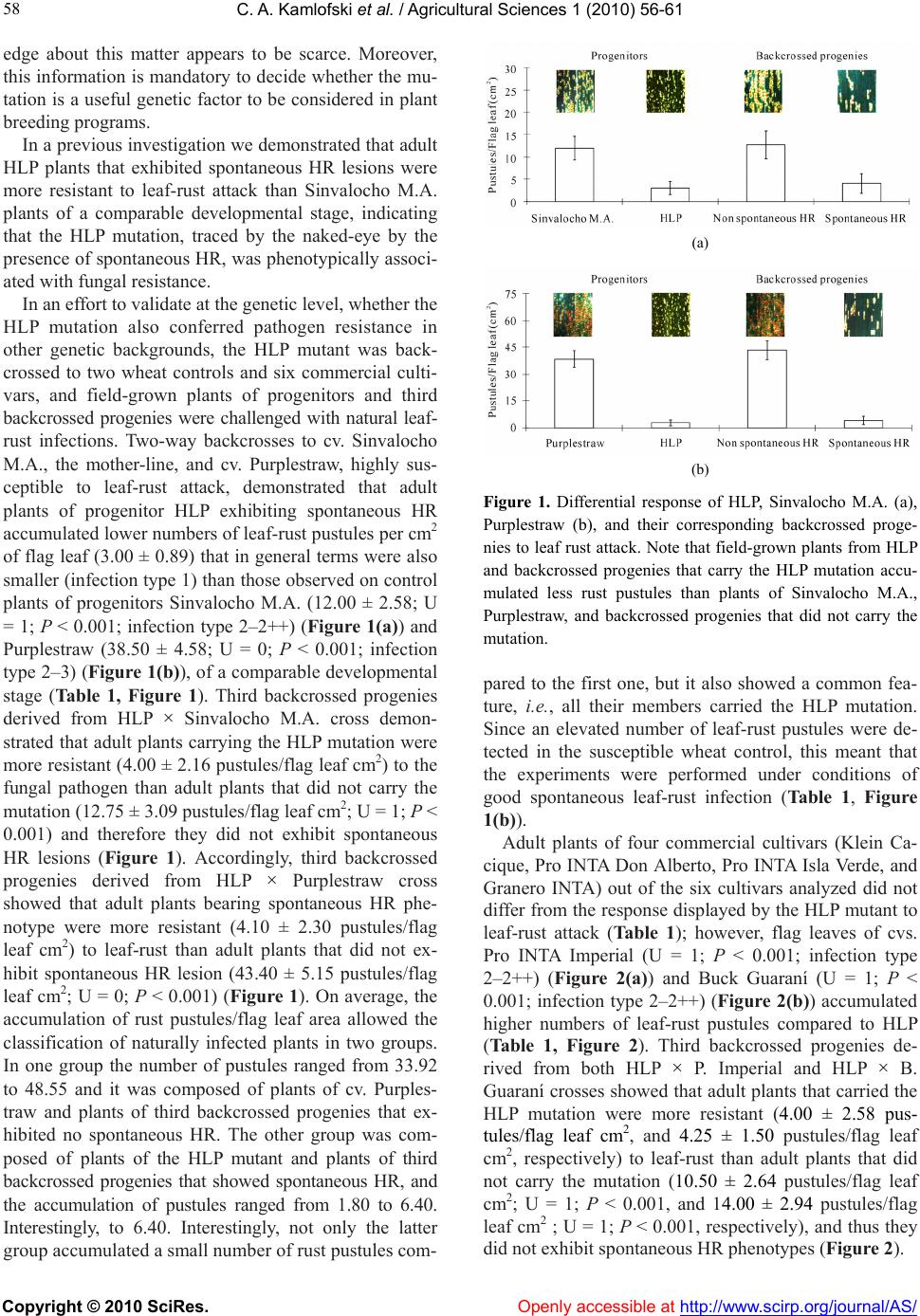 C. A. Kamlofski et al. / Agricultural Sciences 1 (2010) 56-61 Copyright © 2010 SciRes. Openly accessi ble at http://www.scirp.org/journal/AS/ 58 edge about this matter appears to be scarce. Moreover, this information is mandatory to decid e whether the mu- tation is a useful genetic factor to be considered in plant breeding pro gr ams. In a previous investigation we demonstrated that adult HLP plants that exhibited spontaneous HR lesions were more resistant to leaf-rust attack than Sinvalocho M.A. plants of a comparable developmental stage, indicating that the HLP mutation, traced by the naked-eye by the presence of spontaneous HR, was phenotypically associ- ated with fungal resistance. In an effort to validate at the genetic level, whether the HLP mutation also conferred pathogen resistance in other genetic backgrounds, the HLP mutant was back- crossed to two wheat controls and six commercial culti- vars, and field-grown plants of progenitors and third backcrossed progenies were challenged with natural leaf- rust infections. Two-way backcrosses to cv. Sinvalocho M.A., the mother-line, and cv. Purplestraw, highly sus- ceptible to leaf-rust attack, demonstrated that adult plants of progenitor HLP exhibiting spontaneous HR accumulated lower numbers of leaf-rust pustules per cm2 of flag leaf (3.00 ± 0.89) that in general terms were also smaller (infection type 1) than those observed on control plants of progenitors Sinvalocho M.A. (12.00 ± 2.58; U = 1; P < 0.001; infection type 2–2 ++) (Figure 1(a)) and Purplestraw (38.50 ± 4.58; U = 0; P < 0.001; infection type 2–3) (Figure 1(b)), of a comparable developmental stage (Ta ble 1, Fig ure 1). Third backcrossed progenies derived from HLP × Sinvalocho M.A. cross demon- strated that adult plants carrying the HLP mutation were more resistant (4.00 ± 2.16 pustules/flag leaf cm2) to the fungal pathogen than adult plants that did not carry the mutation (12.75 ± 3.09 pustules/flag leaf cm2; U = 1; P < 0.001) and therefore they did not exhibit spontaneous HR lesions (Figure 1). Accordingly, third backcrossed progenies derived from HLP × Purplestraw cross showed that adult plants bearing spontaneous HR phe- notype were more resistant (4.10 ± 2.30 pustules/flag leaf cm2) to leaf-rust than adult plants that did not ex- hibit spontaneous HR lesion (43.40 ± 5.15 pustules/flag leaf cm2; U = 0; P < 0.001) (Figure 1). On average, the accumulation of rust pustules/flag leaf area allowed the classification of naturally infected plants in two groups. In one group the number of pustules ranged from 33.92 to 48.55 and it was composed of plants of cv. Purples- traw and plants of third backcrossed progenies that ex- hibited no spontaneous HR. The other group was com- posed of plants of the HLP mutant and plants of third backcrossed progenies that showed spontaneous HR, and the accumulation of pustules ranged from 1.80 to 6.40. Interestingly, to 6.40. Interestingly, not only the latter group accumulated a small number of rust pustules com- (a) (b) Figure 1. Differential response of HLP, Sinvalocho M.A. (a), Purplestraw (b), and their corresponding backcrossed proge- nies to leaf rust attack. Note that field-grown plants from HLP and backcrossed progenies that carry the HLP mutation accu- mulated less rust pustules than plants of Sinvalocho M.A., Purplestraw, and backcrossed progenies that did not carry the mutation. pared to the first one, but it also showed a common fea- ture, i.e., all their members carried the HLP mutation. Since an elevated number of leaf-rust pustules were de- tected in the susceptible wheat control, this meant that the experiments were performed under conditions of good spontaneous leaf-rust infection (Table 1, Figure 1(b)). Adult plants of four commercial cultivars (Klein Ca- cique, Pro INTA Don Alberto, Pro INTA Isla Verde, and Granero INTA) out of the six cultivars analyzed did not differ from the response displayed by the HLP mutant to leaf-rust attack (Table 1); however, flag leaves of cvs. Pro INTA Imperial (U = 1; P < 0.001; infection type 2–2++) (Figure 2(a)) and Buck Guaraní (U = 1; P < 0.001; infection type 2–2++) (Figure 2(b)) accumulated higher numbers of leaf-rust pustules compared to HLP (Table 1, Figure 2). Third backcrossed progenies de- rived from both HLP × P. Imperial and HLP × B. Guaraní crosses showed that adult plants that carried the HLP mutation were more resistant (4.00 ± 2.58 pus- tules/flag leaf cm2, and 4.25 ± 1.50 pustules/flag leaf cm2, respectively) to leaf-rust than adult plants that did not carry the mutation (10.50 ± 2.64 pustules/flag leaf cm2; U = 1; P < 0.001, and 14.00 ± 2.94 pustules/flag leaf cm2 ; U = 1; P < 0.001, respectively), and thus they did not exhibit spont aneous HR phenotypes ( Figure 2). 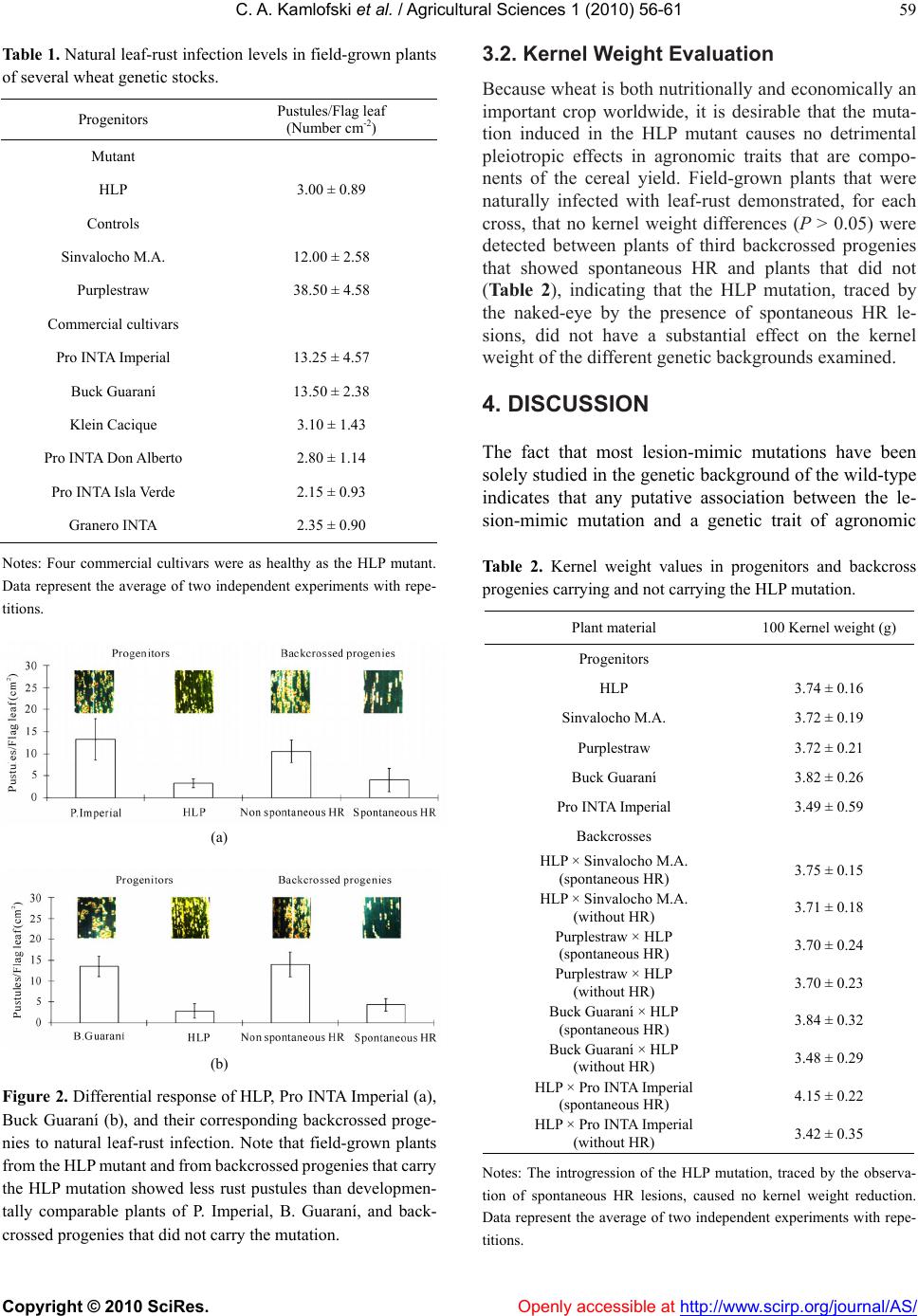 C. A. Kamlofski et al. / Agricultural Sciences 1 (2010) 56-61 Copyright © 2010 SciRes. Openly accessi ble at http://www.scirp.org/journal/AS/ 59 Table 1. Natural leaf-rust infection levels in field-grown plants of several wheat genetic stocks. Progenitors Pustules/Flag leaf (Number cm-2) Mutant HLP 3.00 ± 0.89 Controls Sinvalocho M.A. 12.00 ± 2.58 Purplestraw 38.50 ± 4.58 Commercial cultivars Pro INTA Imperial 13.25 ± 4.57 Buck Guaraní 13.50 ± 2.38 Klein Cacique 3.10 ± 1.43 Pro INTA Don Alberto 2.80 ± 1.14 Pro INTA Isla Verde 2.15 ± 0.93 Granero INTA 2.35 ± 0.90 Notes: Four commercial cultivars were as healthy as the HLP mutant. Data represent the average of two independent experiments with repe- titions. (a) (b) Figure 2. Differential response of HLP, Pro INTA Imperial (a), Buck Guaraní (b), and their corresponding backcrossed proge- nies to natural leaf-rust infection. Note that field-grown plants from the HLP mutant and from backcrossed progenies that carr y the HLP mutation showed less rust pustules than developmen- tally comparable plants of P. Imperial, B. Guaraní, and back- crossed progenies that did not carry the mutation. 3.2. Kernel Weight Evaluation Because wheat is both nutritionally and economically an important crop worldwide, it is desirable that the muta- tion induced in the HLP mutant causes no detrimental pleiotropic effects in agronomic traits that are compo- nents of the cereal yield. Field-grown plants that were naturally infected with leaf-rust demonstrated, for each cross, that no kernel weight differences (P > 0.05) were detected between plants of third backcrossed progenies that showed spontaneous HR and plants that did not (Table 2), indicating that the HLP mutation, traced by the naked-eye by the presence of spontaneous HR le- sions, did not have a substantial effect on the kernel weight of the different genetic backgrounds examined. 4. DISCUSSION The fact that most lesion-mimic mutations have been solely studied in the gen etic background of the wild-typ e indicates that any putative association between the le- sion-mimic mutation and a genetic trait of agronomic Table 2. Kernel weight values in progenitors and backcross progenies carrying and not carrying the HLP mutation. Plant material 100 Kernel weight (g) Progenitors HLP 3.74 ± 0.16 Sinvalocho M.A. 3.72 ± 0.19 Purplestraw 3.72 ± 0.21 Buck Guaraní 3.82 ± 0.26 Pro INTA Imperial 3.49 ± 0.59 Backcrosses HLP × Sinvalocho M.A. (spontaneous HR) 3.75 ± 0.15 HLP × Sinvalocho M.A. (without HR) 3.71 ± 0.18 Purplestraw × HLP (spontaneous HR) 3.70 ± 0.24 Purplestraw × HLP (without HR) 3.70 ± 0.23 Buck Guaraní × HLP (spontaneous HR) 3.84 ± 0.32 Buck Guaraní × HLP (without HR) 3.48 ± 0.29 HLP × Pro INTA Imperial (spontaneous HR) 4.15 ± 0.22 HLP × Pro INTA Imperial (without HR) 3.42 ± 0.35 Notes: The introgression of the HLP mutation, traced by the observa- tion of spontaneous HR lesions, caused no kernel weight reduction. Data represent the average of two independent experiments with repe- titions. 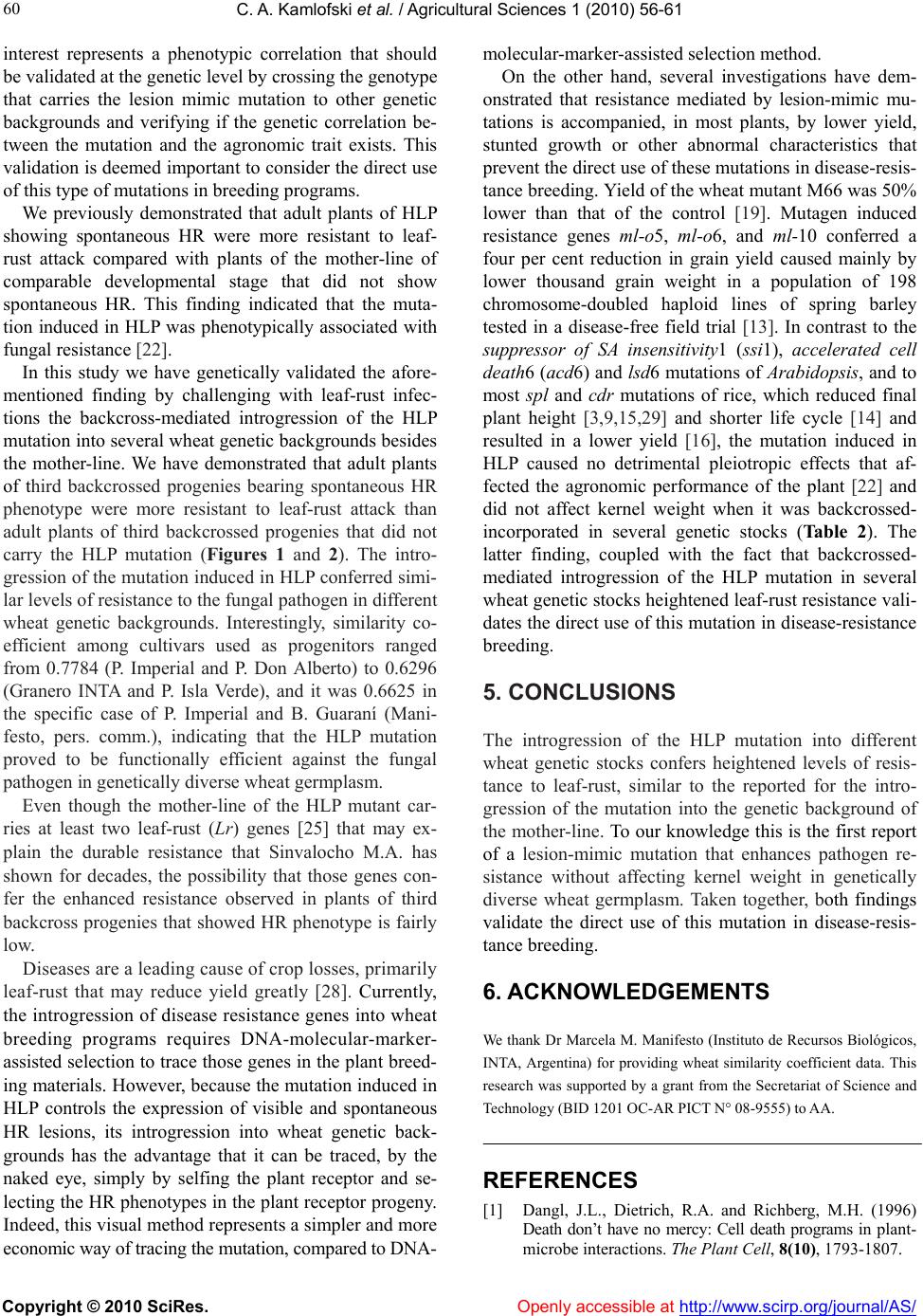 C. A. Kamlofski et al. / Agricultural Sciences 1 (2010) 56-61 Copyright © 2010 SciRes. Openly accessi ble at http://www.scirp.org/journal/AS/ 60 interest represents a phenotypic correlation that should be validated at the genetic level by crossing the genotype that carries the lesion mimic mutation to other genetic backgrounds and verifying if the genetic correlation be- tween the mutation and the agronomic trait exists. This validation is deemed important to co nsider the direct use of this type of mutations in breeding programs. We previously demonstrated that adult plants of HLP showing spontaneous HR were more resistant to leaf- rust attack compared with plants of the mother-line of comparable developmental stage that did not show spontaneous HR. This finding indicated that the muta- tion induced in HLP was phenotypically associated with fungal resistance [22]. In this study we have genetically validated the afore- mentioned finding by challenging with leaf-rust infec- tions the backcross-mediated introgression of the HLP mutation into sev eral wheat genetic background s besides the mother-line. We have demonstrated that adult plants of third backcrossed progenies bearing spontaneous HR phenotype were more resistant to leaf-rust attack than adult plants of third backcrossed progenies that did not carry the HLP mutation (Figures 1 and 2). The intro- gression of the mutation induced in HLP conferred simi- lar levels of resistance to the fungal pathogen in different wheat genetic backgrounds. Interestingly, similarity co- efficient among cultivars used as progenitors ranged from 0.7784 (P. Imperial and P. Don Alberto) to 0.6296 (Granero INTA and P. Isla Verde), and it was 0.6625 in the specific case of P. Imperial and B. Guaraní (Mani- festo, pers. comm.), indicating that the HLP mutation proved to be functionally efficient against the fungal pathogen in genetically diverse wheat germplasm. Even though the mother-line of the HLP mutant car- ries at least two leaf-rust (Lr) genes [25] that may ex- plain the durable resistance that Sinvalocho M.A. has shown for decades, the possibility that those genes con- fer the enhanced resistance observed in plants of third backcross progenies that show ed HR phenotype is fairly low. Diseases are a leading cause of crop losses, primarily leaf-rust that may reduce yield greatly [28]. Currently, the introgression of disease resistance genes into wheat breeding programs requires DNA-molecular-marker- assisted selection to trace those genes in the p lant breed- ing materials. However, because the mutation induced in HLP controls the expression of visible and spontaneous HR lesions, its introgression into wheat genetic back- grounds has the advantage that it can be traced, by the naked eye, simply by selfing the plant receptor and se- lecting the HR phenotypes in the plant receptor progeny. Indeed, this visual method represents a simpler and more economic way of tracing the mutation, compared to DNA- molecular-marker-assisted selection method. On the other hand, several investigations have dem- onstrated that resistance mediated by lesion-mimic mu- tations is accompanied, in most plants, by lower yield, stunted growth or other abnormal characteristics that prevent the direct use of these mutations in disease-resis- tance breeding. Yield of the wheat mutant M66 was 50% lower than that of the control [19]. Mutagen induced resistance genes ml-o5, ml-o6, and ml-10 conferred a four per cent reduction in grain yield caused mainly by lower thousand grain weight in a population of 198 chromosome-doubled haploid lines of spring barley tested in a disease-free field trial [13]. In contrast to the suppressor of SA insensitivity1 (ssi1), accelerated cell death6 (acd6) and lsd6 mutations of Arabidopsis, and to most spl and cdr mutations of rice, which reduced final plant height [3,9,15,29] and shorter life cycle [14] and resulted in a lower yield [16], the mutation induced in HLP caused no detrimental pleiotropic effects that af- fected the agronomic performance of the plant [22] and did not affect kernel weight when it was backcrossed- incorporated in several genetic stocks (Table 2). The latter finding, coupled with the fact that backcrossed- mediated introgression of the HLP mutation in several wheat genetic stocks heightened leaf-rust resistance vali- dates the direct use of this mutation in disease-resistance breeding. 5. CONCLUSIONS The introgression of the HLP mutation into different wheat genetic stocks confers heightened levels of resis- tance to leaf-rust, similar to the reported for the intro- gression of the mutation into the genetic background of the mother-line. To our knowledge this is the first report of a lesion-mimic mutation that enhances pathogen re- sistance without affecting kernel weight in genetically diverse wheat germplasm. Taken together, both findings validate the direct use of this mutation in disease-resis- tance breeding. 6. ACKNOWLEDGEMENTS We thank Dr Marcela M. Manifesto (Instituto de Recursos Biológicos, INTA, Argentina) for providing wheat similarity coefficient data. This research was supported by a grant from the Secretariat of Science and Technology (BID 1201 OC-AR PICT N° 0 8-9555) to AA. REFERENCES [1] Dangl, J.L., Dietrich, R.A. and Richberg, M.H. (1996) Death don’t have no mercy: Cell death programs in pl ant- microbe interactions. The Plant C ell, 8(10), 1793-1807.  C. A. Kamlofski et al. / Agricultural Sciences 1 (2010) 56-61 Copyright © 2010 SciRes. http://www.scirp.org/journal/AS/Openly accessible at 61 [2] Greenberg, J.T. and Ausubel, F.M. (1993) Arabidopsis mutants compromised for the control of cellular damage during pathogenesis and aging. The Plant Journal, 4(2), 327-342. [3] Rate, D.N., Cuenca, J.V., Bowman, G.R., Guttman, D.S. and Greenberg, J.T. (1999) The gain-of-function Arabi- dopsis acd 6 mutant reveals novel regulation and func- tion of the salicylic acid signaling pathway in controlling cell death, defenses, and cell growth. The Plant Cell, 11(2), 191-206. [4] Yao, N. and Greenberg, J.T. (2006) Arabidopsis acceler- ated cell death 2 modulates programmed cell death. Plant Cell, 18(2), 397-411. [5] Pilloff, R.K., Devadas, S.K., Enyedi, A. and Raina, R. (2002) The Arabidopsis gain-of-function mutant dll1 spontaneously develops lesions mimicking cell death as- sociated with disease. The Plant Journal, 30(1), 61-70. [6] Balagué, C., Lin, B., Alcon, C., Flottes, G., Malmstrom, S., Kohler, C., Neuhaus, G., Pelletier, G., Gaymard, F. and Roby, D. (2003) HLM1, an essential signaling compo- nent in the hypersensitive response, is a member of the cyclic nucleotide-gated channel ion channel family. Plant Cell, 15(2), 365-379. [7] Ishikawa, A., Tanaka, H., Nakai, M. and Asahi, T. (2003) Deletion of a chaperonin 60 gene leads to cell death in the Arabidopsis lesion initiation 1 mutant. Plant and Cell Physiology, 44(3), 255-261. [8] Dietrich, R.A., Delaney, T.P., Uknes, S.J., Ward, E.R., Ryals, J.A. and Dangl, J.L. (1994) Arabidopsis mutants simulating disease resistance response. Cell, 77(4), 565- 577. [9] Shah, J., Kachroo, P. and Klessig, D.F. (1999) The Arabidopsis ssi1 mutation restores pathogenesis-related gene expression in npr1 plants and renders defensin gene expression salicylic acid dependent. The Plant Cell, 11(2), 191-206. [10] Kachroo, P., Shanklin, J., Shah, J., Whittle, E.J. and Klessig, D.F. (2001) A fatty acid desaturase modulates the activation of defense signaling pathways in plants. Proceedings of the National Academy of Sciences, 98(16), 9448-9453. [11] Dietrich, R.A., Richberg, M.H., Schmidt, R., Dean, C. and Dangl, J.L. (1997) A novel zinc finger protein is en- coded by the arabidopsis LDS1 gene and functions as a negative regulator of plant cell death. Cell, 88(5), 685-694. [12] Jarosch, B., Kogel, K. and Schaffrath, U. (1999) The ambivalence of the barley mlo locus: Mutations confer- ring resistance against powdery mildew (Blumeria graminis f.sp. hordei) enhance susceptibility to the rice blast fungus Magnaporthe grisea. Molecular Plant- Microbe Interactions, 12, 508-514. [13] Kjær, B., Jensen, H.P., Jensen, J. and Helms, J.J. (1990) Associations between three ml-o powdery mildew resis- tance genes and agronomic traits in barley. Euphytica, 46(3), 185-193. [14] Takahashi, A., Kawasaki, T., Henmi, K., Shi, I.K., Ko- dama, O., Satoh, H. and Shimamoto, K. (1999) Lesion mimic mutants of rice with alterations in early signaling events of defense. The Plant Journal, 17(5), 535-545. [15] Yin, Z., Chen, J., Zeng, L., Goh, M., Leung, H., Khush, G.S. and Wang, G.L. (2000) Characterizing rice lesion mimic mutants and identifying a mutant with broad- spectrum resistance to rice blast and bacterial blight. Mol Plant Microbe Interact, 13(8), 869-876. [16] Mizobuchi, R. and Hirabayashi, H. (2002) Isolation and characterization of rice lesion mimic mutants with en- hanced resistance to rice blast and bacterial blight. Plant Science, 163(2), 345-353. [17] Campbell, M.A. and Ronald, P.C. (2005) Characteriza- tion of four rice mutants with alterations in the defence response pathway. Molecular Plant Pathology, 6(1), 11-12. [18] Wu, C., Bordeos, A., Madamba, M.R., Baraoidan, M., Ramos, M., Wang, G.L., Leach, J.E. and Leung, H. (2008) Rice lesion-mimic mutants with enhanced resistance to diseases. Molecular Genetics and Genomics, 279, 605- 619. [19] Kinane, J.T. and Jones, P.W. (2001) Isolation of wheat mutants with increased resistance to powdery mildew from small induced variant populations. Euphytica, 117(3), 251-260. [20] Boyd, L.A. and Minchin, P.N. (2001) Wheat mutants showing altered adult plant disease resistance. Euphytica, 122(2), 361-368. [21] Boyd, L.A., Smith, P.H., Wilson, A.H. and Minchin, P.N. (2002) Mutations in wheat showing altered field resis- tance to yellow and brown rust. Genome, 45(6), 1035- 1040. [22] Kamlofski, C.A., Antonelli, E., Bender, C., Jaskelioff, M., Danna, C.H., Ugalde, R. and Acevedo, A. (2007) A le- sion-mimic mutant of wheat with enhanced resistance to leaf rust. Plant Pathol, 56(1), 46-54. [23] Sacco, F., Suárez, E.Y. and Naranjo, T. (1998) Mapping of the leaf rust resistance gene Lr3 on chromosome 6B of Sinvalocho M.A. Genome, 41(5), 686-690. [24] Campos, P. (2004) Diferencias en la población patógena de Puccinia triticina que afecta a los cultivos de trigo pan (Triticum aestivum) y trigo candeal (Triticum turgidu m v a r: durum). Actas VI Congreso Nacional de Trigo, Bahía Blanca, Buenos Aires. [25] Ingala, L.R., Saione, H.A., Nisi, J., Helguera, M. and Sacco, F. (2004) Identificación de genes para resistencia a roya de la hoja y de marcadores de ADN asociados a los mismos en un cultivar de trigo con resistencia durable. Actas XXXIII Congreso Argentino de Genética, Sociedad Argentina de Genética, Mendoza, 112. [26] Manifesto, M.M., Schlatter, A.R., Hopp, H.E., Suarez, E.Y. and Dubcovsky, J. (2001) Quantitative evaluation of genetic diversity in wheat germplasm using molecular markers. Crop Science, 41(3), 682-690. [27] Mains, E.B. and Jackson, H.S. (1926) Physiological spe- cialization in the leaf rust of wheat Puccinia triticina Erikss. Phytopathology, 16, 89-120. [28] Roelfs, A.P., Singh, R.P. and Saari, E.E. (1992) Rust diseases of wheat: concepts and methods of disease management. CIMMYT, Mexico, 80. [29] Weymann, K., Hunt, M., Uknes, S., Neuenschwander, U., Lawton, K., Steiner, H.Y. and Ryals, J. (1995) Suppres- sion and restoration of lesion formation in Arabidopsis lsd mutants. The Plant Cell, 7(12), 2013-2022. |