

Paper Menu >>
Journal Menu >>
 Open Journal of Applied Sciences, 2012, 2, 241-247 doi:10.4236/ojapps.2012.24036 Published Online December 2012 (http://www.SciRP.org/journal/ojapps) Efficient Electrochemical Removal of Ammonia with Various Cathodes and Ti/RuO2-Pt Anode Yaning Wang, Xu Guo, Jinglu Li, Yingnan Yang, Zhongfang Lei, Zhenya Zhang* Graduate School of Life and Environmental Sciences, University of Tsukuba, Tsukuba, Japan Email: *[email protected] Received August 31, 2012; revised September 30, 2012; accepted October 12, 2012 ABSTRACT Electrochemical oxidation of ammonia was studied with an objective to enhance the selectivity of ammonia to nitrogen gas and to remove the by-products in an undivided electrochemical cell, in which various cathodes and Ti/RuO2-Pt anode were assembled. In the present study, anodic oxidation of ammonia and cathodic reduction of by-products were achieved, especially with Cu/Zn as cathode. In the presence of 1.0 g/L NaCl the ammonia-N decreased from 100.0 to 0 after 120 min electrolysis at current density of 30 mA/cm2, and no nitrite was detected in the treated solution. The low- est amount of nitrate was formed with Cu/Zn as cathode during electrolysis due to its high reduction ability. Initial pH range from 7 and 9 and uncontrolled temperature were favorable for electrochemical ammonia oxidation and the am- monia oxidation rates with Cu/Zn cathode was higher than that with Ti and Fe cathode. The reduction rate increased with increasing current density in the range of 5 - 50 mA/cm2. As ammonia could be completely removed by the simul- taneous oxidation and reduction in this study, it is suitable for deep treatment of ammonia polluted water. Keywords: Electrochemical Oxidation; Ammonia; Nitrate; Cu/Zn; Sodium Chloride 1. Introduction Nowadays, around the world most of the water bodies are polluted and some are heavily polluted. Among the water pollution, ammonia contamination of water bodies is a widespread environment problem. Ammonia con- taining wastewaters will cause eutrophication and fish kills which disrupt aquatic ecosystems in a severe manner [1-3]. Therefore, aim to reduce consumption and improve treatment method efficiency for water and wastewater should be highlighted as a main public concern in the future [4-6]. Usually, two main groups of treatment pro- cesses, physicochemical and biological treatment methods, were employed for ammonia removal, which are bio- logical process, air stripping, ion exchange, and break- point chlorination. Although air stripping and ion ex- change are widely used, as no destruction of the con- taminant, it needs to be further treated. Breakpoint chlo- rination demands a large amount of chlorine and rela- tively low efficiency. Biological method is effective with the addition of carbon sources, large land areas and sig- nificantly impaired by low temperature in winter [7]. As electrochemical method has the advantage of high treat- ment efficiency, no sludge production, small area occu- pied by the plant and relatively low investment costs, a large number of researchers has focused on it recently. In general, ammonia can be oxidized electrochemi- cally into nitrogen gas, nitrate, or nitrite by direct or in- direct oxidation processes. So far several metals have been investigated [8-10], such as Ti/IrO2-Pt, Lead Dioxide and BDD-TiO2 Anode. It was shown that ammonia is effectively removed from solution while active chlorine was electrogenerated on a Ti/PtOx-IrO2 electrode. Nitrogen gaseous is postulated to be the main by-product of ammonia electrolysis [11]. Direct (non-mediated) electrochemical oxidation of am- monia on boron-doped diamond (BDD) electrode oc- curred mainly when pH value above 8.0 by free ammonia (NH3) oxidation. Otherwise when pH value was below 8.0, oxidation of ammonia was mediated by active free chlorine. Thus, active chlorine effectively removes am- monia from an acidic solution, while the formation of by-products such as chlorate and possibly perchlorate is minimized [12]. Electro-oxidation of ammonia process inhibited the oxygen evolution reaction (OER) as ammo- nia oxidation products was absorbed on the BDD surface. Nitrogen, nitrous oxide, and nitrogen dioxide were de- tected as the ammonia oxidation products. Nitrogen ga- seous was the main product of the oxidation [13]. The electro-activity of the Pt and DSA (Dimensionally Stable Anode) electrodes and Ni were confirmed by cyclic voltammogram at pH 7.0 and pH 9.4. An anodic polari- zation showed the electro-activity of graphite. Anodized *Corresponding author. Copyright © 2012 SciRes. OJAppS  Y. N. WANG ET AL. 242 Al electrodes showed no electro-oxidation activity. The electrochemical activity of Ni electrodes demonstrated this material for ammonia and ammonium ion electro- oxidation at both pH values investigated [14]. A disad- vantage of the platinum electrode is that their activities are disrupted by the formation of a platinum oxide (PtO) layer at the cathodic electrode surface [15]. Combination of graphite and titanium dioxide electrode considerably enhance the removal efficiency for the present study [16]. In general, the anode is believed to be the key factor that affects the ammonia removal, and nitrate and nitrite were found to be the side products during the electrochemical ammonia removal. With our best knowledge, most re- searchers focused on the effect of anode on ammonia oxidation, seldom has focused on the cathode, which may play an important role on the side products gene- rated during electrochemical ammonia oxidation [17]. On the other hand, researchers found that the cathodes such as Cu/Zn and Fe had high efficiency on nitrate and nitrite removal [18]. Therefore, it is possible to decrease the production of side products by employing cathode with high nitrate and nitrite reduction ability. In this work, in order to completely electrochemical oxidize ammonia and reduce the formation of by-pro- ducts, cathodic reduction of by-products and anodic oxi- dation of ammonia were investigated in an undivided cell. As only a few researchers focus on the effect of Fe, Cu/Zn cathode on ammonia removal, and previous re- search had suggested that cathode has significant effect on reduction product. The effect of ammonia removal by varies cathodes (Fe, Cu/Zn, Ti) was investigated, with aim to completely destroy ammonia, to reduce the for- mation of by-products and enhance current efficiency simultaneously. On the other hand, Ti/RuO2-Pt anode was reported to have good oxidation ability, therefore it is employed as anode in the present study. 2. Materials and Methods 2.1. Electrochemical Apparatus Batch experiments were conducted in an apparatus at room temperature (about 23.0˚C - 26.0˚C). A continuous electrochemical cell was designed in our lab with a net working volume of 400.0 ml. The 400-mL electrolysis cell was made of acryl plates with four outer spots for the electrodes assembled. Three metal plates include Cu/Zn (Cu: 62.2 wt%; Zn: 37.8 wt%), Ti and Fe plate of 75.0 cm2 (15.0 cm × 5.0 cm) were used as the cathode more- over Ti/RuO2-Pt (TohoTech company, Japan) was used as the anode with the same area with a distance of 8.0 mm between the two electrodes respectively. A DC power with a voltage range of 0 - 50.0 V and a current range of 0 - 5.0 A was employed as power supply. Test synthetic ammonia solutions were prepared using (NH4)2SO4 and distilled water to give a final concentration of 100.0 mg· L –1, with no Cl−. In the solution, free ammonia con- centration is only 0.0198 mg·L–1. The NaCl dosage of 0 g·L–1, 0.5 g·L–1, 1.0 g·L–1, 2.0 g·L–1 (w/v) were added into the synthetic ammonia solutions to investigate the effect of influencing factors (sodium chloride dosage, current density, temperature, initial pH value; respec- tively). While current density was varied between 5.0 mA/cm2 and 50.0 mA/cm2. The initial pH value was ad- justed from 3.0 to 11.0 by NaOH (0.1 M) or H2SO4 (0.1 M). 0.50 g·L–1 Na2SO4 was added in all solution as sup- porting electrolyte. At different intervals, 1.5 mL of sample was drawn from the electrochemical cell for analysis. The electrolysis was ceased when either 90.0% of initial ammonia was converted or 2 h elapsed. 2.2. Analysis All analyses were done according to standard methods (APHA, 1998). The determination of ammonia was per- formed by Ion meter (Ti 9001, Toyo chemical laborato- ries Co., Ltd.). Nitrate was determined by standard co- lorimetric method using spectrophotometer (DR/4000U Spectrophotometer, USA), and nitrite was analyzed by ion chromatography (Yokogawa IC7000, AS9-HC column). 3. Results and Discussion 3.1. Influence of NaCl Dosages In the present experiment, as NaCl plays an important role on not only the ammonia oxidation rate, but also the formation of the by-product nitrate, the performance of electrochemical ammonia oxidation with different NaCl dosages was investigated. Figures 1 and 2 were concentrations of ammonia-N and nitrate-N with respect of time. It confirmed that without NaCl addition, ammonia re- moval rate showed almost same results with different cathode. Opposite the different amounts of nitrate forma- tion during the electrochemical oxidation of ammonia can be attributed to the different of the cathodes in the absence of NaCl, in which Cu/Zn cathode showed lowest by-product formation. Cupro-zinc materials were well- known as their good corrosion resistance. Moreover, zinc has a good electroactivity while copper displays a good activity of electroreduction. As a result, a synergistic effect of alloying Zn with Cu could be expected. From the observed results, it can be concluded that Cu/Zn cathode is more suitable for ammonia removal than Ti and Fe cathodes in the absence of NaCl because of its high selectivity for ammonia oxidation to nitrogen gas. The effect of varying Cl− concentration on ammo- nia-N and nitrate-N removal was also shown. It can be concluded that these three cathodes showed almost same Copyright © 2012 SciRes. OJAppS 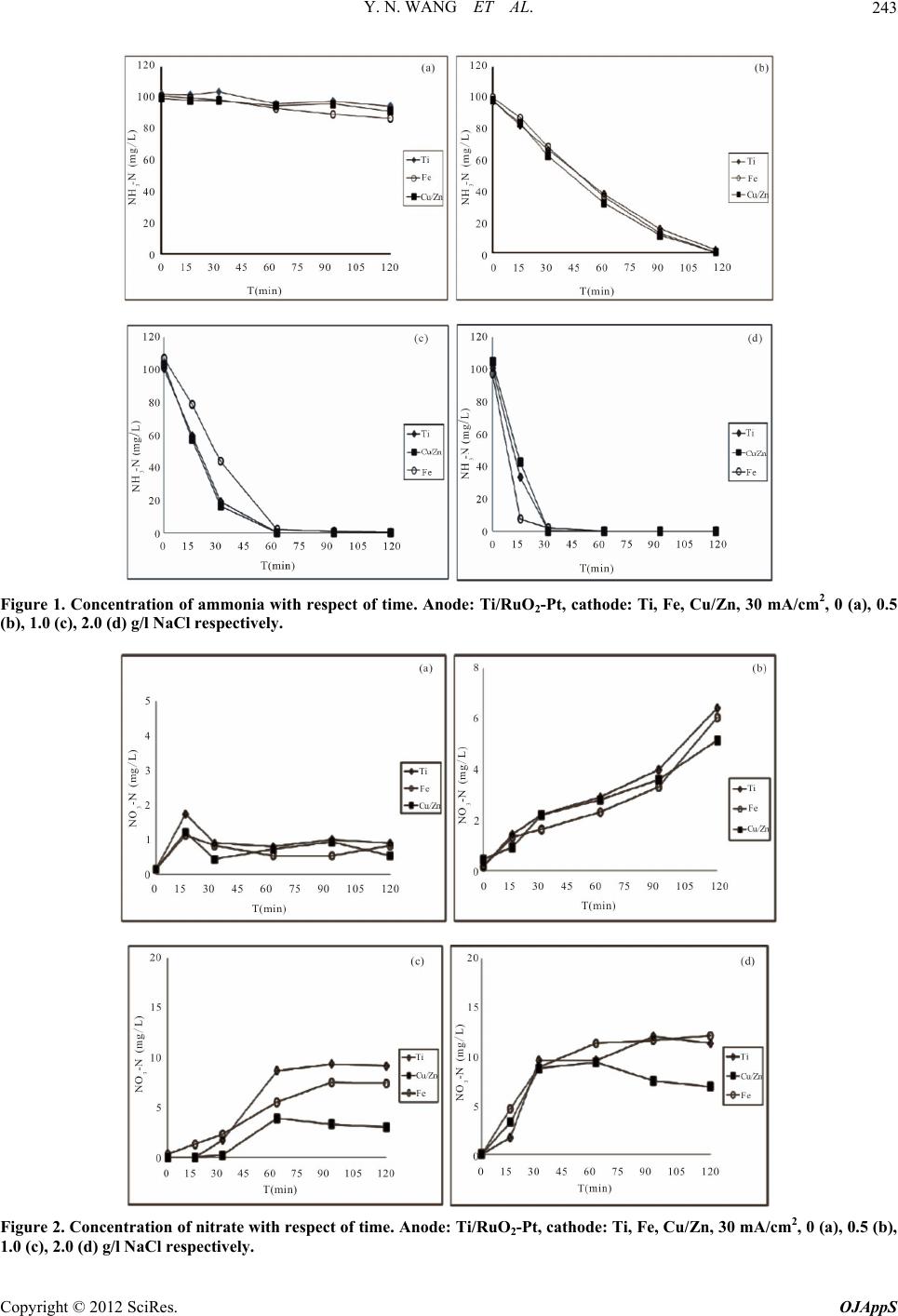 Y. N. WANG ET AL. Copyright © 2012 SciRes. OJAppS 243 Figure 1. Concentration of ammonia with respect of time. Anode: Ti/RuO2-Pt, cathode: Ti, Fe, Cu/Zn, 30 mA/cm2, 0 (a), 0.5 (b), 1.0 (c), 2.0 (d) g/l NaCl respectively. Figure 2. Concentration of nitrate with respect of time. Anode: Ti/RuO2-Pt, cathode: Ti, Fe, Cu/Zn, 30 mA/cm2, 0 (a), 0.5 (b), .0 (c), 2.0 (d) g/l NaCl respect ively. 1  Y. N. WANG ET AL. 244 results on ammonia removal with the same dosage of NaCl. In the presence of 0.5 g/L NaCl after 120 min electrolysis, ammonia-N decreased from 100 mg/L to 1.8 mg/L, 0.4 mg/L and 0.4 mg/L respectively with Ti, Cu/Zn and Fe cathodes. It is clear that the ammonia-N was significantly de- creased compared with that in the absence of NaCl, which proved the key role of indirect oxidation during electrochemical oxidation of ammonia [19]. Meanwhile nitrate-N increased from 0 to 6.4 mg/L, 5.2 mg/L and 6.0 mg/L respectively. In the presence of 1.0 g/L and 2.0 g/L NaCl, the ammonia decreased sharply, which conform that in the presence of chloride ions, hypochlorite ions will be formed and then oxidize the ammonia and by- product presumably to nitrogen gas [20] as listed in Equa- tions (1)-(5). 2 2ClCl 2e (1) 22 ClH OHClOHCl (2) HClOClO H (3) 422 NHHClONH OHCl (4) + 432 NHHClONOH OCl (5) None nitrite was detected throughout the experiment. Overall, about 90% of removed ammonia was changed into N2 gas with NaCl addition, which was similar with other report [21]. The production of N2 could be calculated as equal to the loss of N element according to the N conservation law [22]. Simultaneously, intermediate nitrate ions were formed in the water. On the contrary the by-product formation had different results. The nitrate formation could come from not only the indirect oxidation of ammonia by HClO but also by hydroxyl radicals. The by-product formation generated by Ti and Fe was increased during electrolysis while us- ing Cu/Zn cathode, it increased for the first period of time and then decreased finally. The reason why the 3 N O concentration was the lowest with Cu/Zn cathode was that because of its high reduction ability. Ma’cova’ and Bouzek found that brass containing Zn higher than 35 wt%, lower than 41 wt% will significantly influence the kinetic of current density, and higher electrocatalytic activity of Cu/Zn alloy containing Zn of 35 - 41 wt% than both Cu and Zn was observed It can be concluded that ammonia oxidation rate was increased with the increasing dosage of NaCl, while ni- trate formation was different with various cathodes, which suggested that with an appropriate cathode and an appropriate concentration of chloride ion in the ammonia solution during the electrolysis process, the ammonia can be efficiently removed and relatively low amount of by- products will be formed. Therefore, the electrochemical process in the presence of chlorides showed a higher ca- pacity and selectivity in ammonia transformation into nitrogen gas [22]. It could be considered that an optimum NaCl addition in the present experiment is 1.0 g/L, the best cathode is Cu/Zn cathode. As the combination of Ti/RuO2-Pt anode and Cu/Zn cathode showed a good performance for ammonia oxidation, the influence of several parameters, such as, current density, initial pH, temperatures were studied. 3.2. Influence of Current Density The rate of an electrochemical reaction is measured as current density, current per area. As current density con- trols the reaction rate that may be the most frequently referred term in an electrochemical process [23]. In this work, current densities ranged from 5.0 mA/cm2 as it is the minimum required to achieve an effective oxidation of ammonia. The effect of applied current density on ammonia removal during the electrochemical reduction was shown in Figure 3(a ). As seen, the ammonia oxidation rate almost increased with increasing current density in the range of 5.0 mA/cm2 to 50.0 mA/cm2. Ammonia-N decreased from 100.0 mg/L to 66.9 mg/L, 28.9 mg/L, 0.9 mg/L, 0 mg/L in 120 min respectively. That conformed to the previous report, an increase in current density improves ammo- nia-N treatment efficiencies under the same charge load- ing. The possible reason is that the increased current density during electrochemical oxidation could enhance chlorine generation, which was responsible for subse- quent removal of pollutions [19]. Figure 3(b) showed the variation of nitrate-N during electrolysis at different current densities. The final con- centration of nitrate-N decreased with the increasing of current density. The nitrate-N increased from 0 to 1.8 mg/L, 1.7 mg/L, 2.4 mg/L, 3.0 mg/L, 0.7 mg/L and 0.8 mg/L in 120 min respectively. As it has been reported that the ammonia oxidation rate was linearly in accor- dance with current density, which is in agreement with the present experiments [24]. At lower current density, less amount of hypochlorite acid was produced, which was not enough to oxidize all of the ammonia. Therefore, in the present experiments, in order to remove all of the ammonia, the current density should higher than 30.0 mA/cm2. 3.3. Influence of Initial pH The effect of different initial pH values on ammonia re- moval and by-product formation was shown in Figure 4. It can be seen that the tendencies of reduction of ammo- nia were similar both at initial pH 3.0, 5.0 and 7.0. The ammonia-N decreased from 100.0 mg/L to 3.0 mg/L, 0.8 Copyright © 2012 SciRes. OJAppS 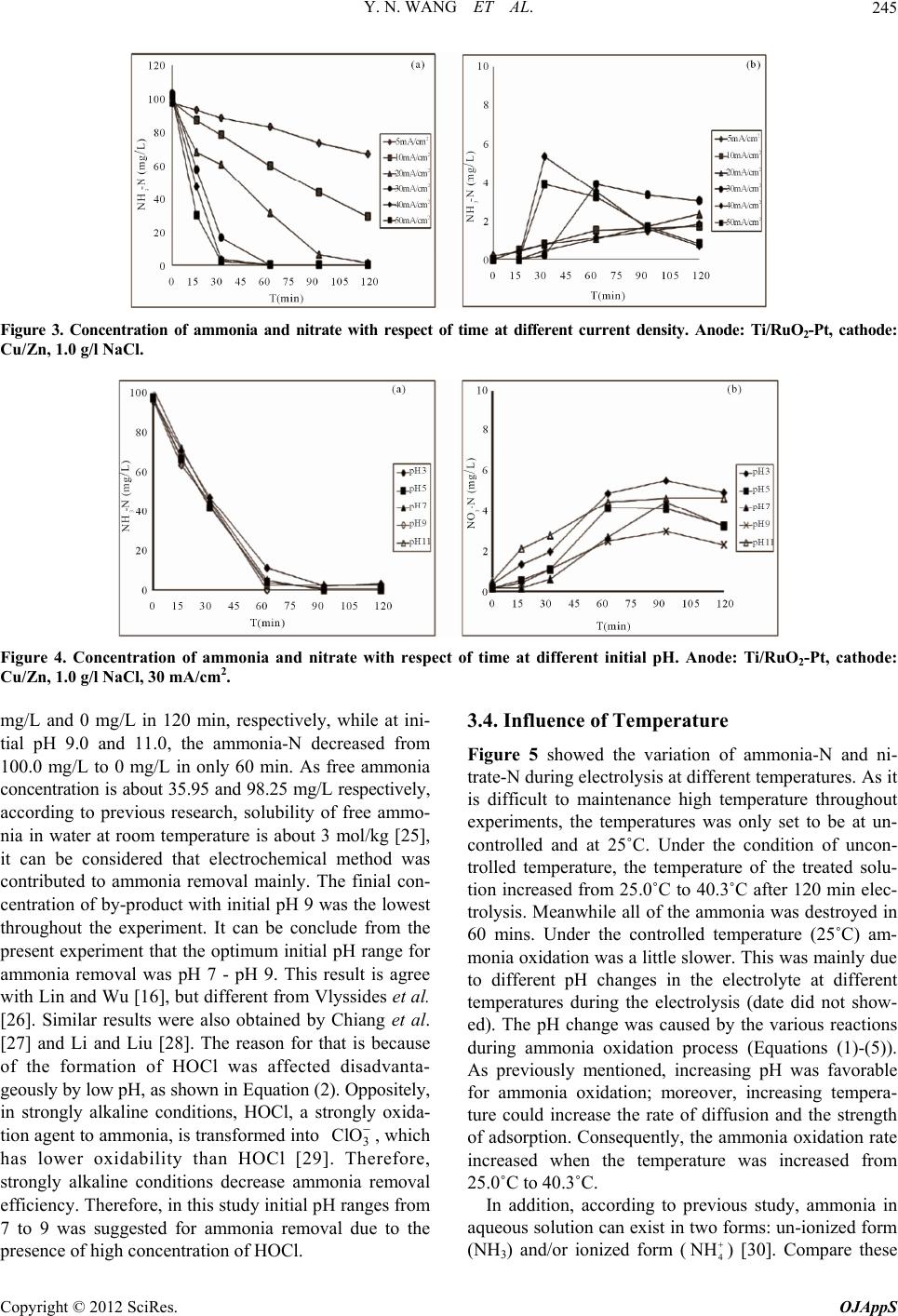 Y. N. WANG ET AL. 245 Figure 3. Concentration of ammonia and nitrate with respect of time at different current density. Anode: Ti/RuO2-Pt, cathode: Cu/Zn, 1.0 g/l NaCl. Figure 4. Concentration of ammonia and nitrate with respect of time at different initial pH. Anode: Ti/RuO2-Pt, cathode: Cu/Zn, 1.0 g/l NaCl, 30 mA/cm2. mg/L and 0 mg/L in 120 min, respectively, while at ini- tial pH 9.0 and 11.0, the ammonia-N decreased from 100.0 mg/L to 0 mg/L in only 60 min. As free ammonia concentration is about 35.95 and 98.25 mg/L respectively, according to previous research, solubility of free ammo- nia in water at room temperature is about 3 mol/kg [25], it can be considered that electrochemical method was contributed to ammonia removal mainly. The finial con- centration of by-product with initial pH 9 was the lowest throughout the experiment. It can be conclude from the present experiment that the optimum initial pH range for ammonia removal was pH 7 - pH 9. This result is agree with Lin and Wu [16], but different from Vlyssides et al. [26]. Similar results were also obtained by Chiang et al. [27] and Li and Liu [28]. The reason for that is because of the formation of HOCl was affected disadvanta- geously by low pH, as shown in Equation (2). Oppositely, in strongly alkaline conditions, HOCl, a strongly oxida- tion agent to ammonia, is transformed into 3 ClO , which has lower oxidability than HOCl [29]. Therefore, strongly alkaline conditions decrease ammonia removal efficiency. Therefore, in this study initial pH ranges from 7 to 9 was suggested for ammonia removal due to the presence of high concentration of HOCl. 3.4. Influence of Temperature Figure 5 showed the variation of ammonia-N and ni- trate-N during electrolysis at different temperatures. As it is difficult to maintenance high temperature throughout experiments, the temperatures was only set to be at un- controlled and at 25˚C. Under the condition of uncon- trolled temperature, the temperature of the treated solu- tion increased from 25.0˚C to 40.3˚C after 120 min elec- trolysis. Meanwhile all of the ammonia was destroyed in 60 mins. Under the controlled temperature (25˚C) am- monia oxidation was a little slower. This was mainly due to different pH changes in the electrolyte at different temperatures during the electrolysis (date did not show- ed). The pH change was caused by the various reactions during ammonia oxidation process (Equations (1)-(5)). As previously mentioned, increasing pH was favorable for ammonia oxidation; moreover, increasing tempera- ture could increase the rate of diffusion and the strength of adsorption. Consequently, the ammonia oxidation rate increased when the temperature was increased from 25.0˚C to 40.3˚C. In addition, according to previous study, ammonia in aqueous solution can exist in two forms: un-ionized form (NH3) and/or ionized form (4 N H) [30]. Compare these Copyright © 2012 SciRes. OJAppS 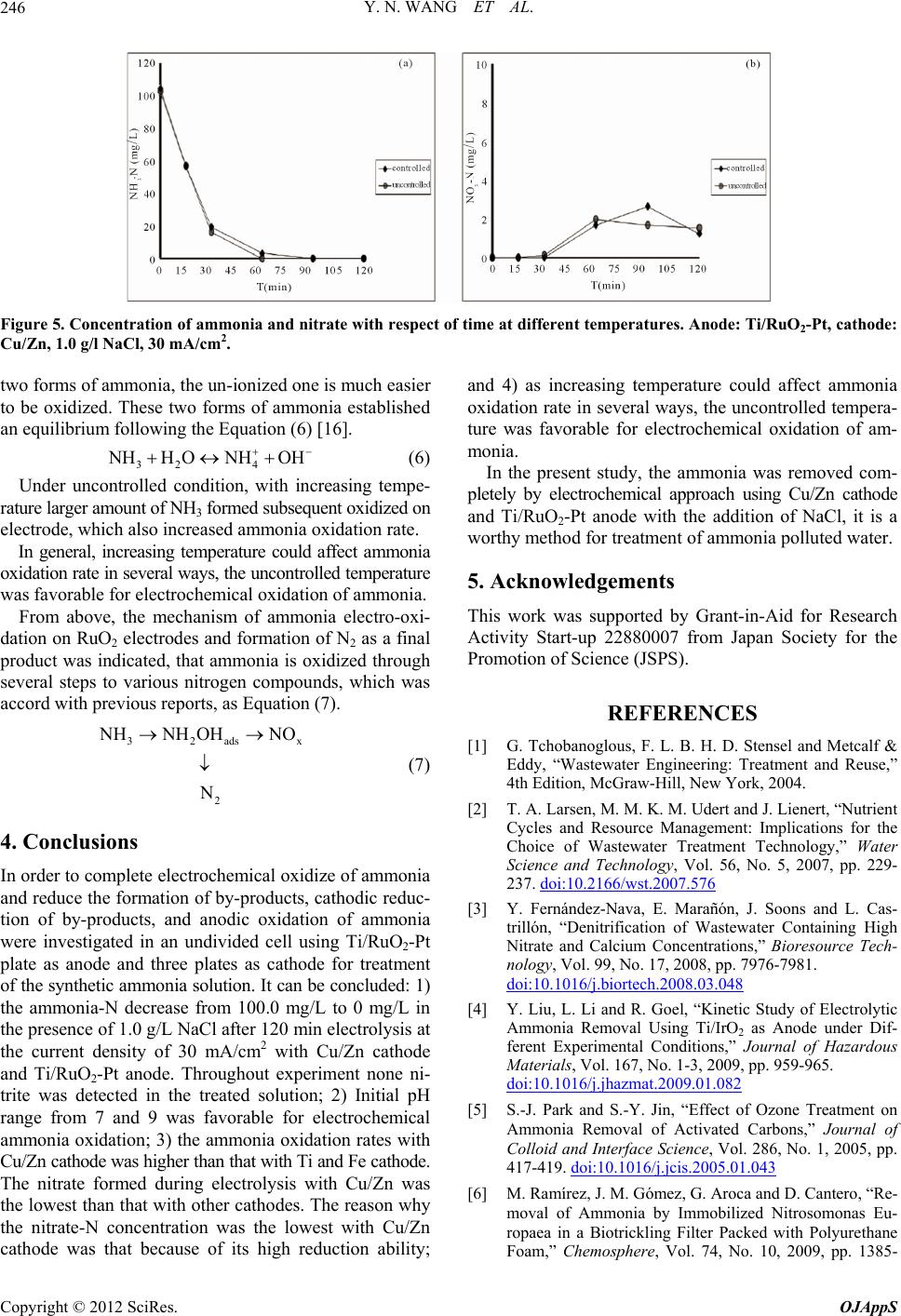 Y. N. WANG ET AL. 246 Figure 5. Concentration of ammonia and nitrate with respect of time at different temperatures. Anode: Ti/RuO2-Pt, cathode: Cu/Zn, 1.0 g/l NaCl, 30 mA/cm2. two forms of ammonia, the un-ionized one is much easier to be oxidized. These two forms of ammonia established an equilibrium following the Equation (6) [16]. 32 4 NHH ONHOH x (6) Under uncontrolled condition, with increasing tempe- rature larger amount of NH3 formed subsequent oxidized on electrode, which also increased ammonia oxidation rate. In general, increasing temperature could affect ammonia oxidation rate in several ways, the uncontrolled temperature was favorable for electrochemical oxidation of ammonia. From above, the mechanism of ammonia electro-oxi- dation on RuO2 electrodes and formation of N2 as a final product was indicated, that ammonia is oxidized through several steps to various nitrogen compounds, which was accord with previous reports, as Equation (7). 32ads 2 N HNHOH NO N (7) 4. Conclusions In order to complete electrochemical oxidize of ammonia and reduce the formation of by-products, cathodic reduc- tion of by-products, and anodic oxidation of ammonia were investigated in an undivided cell using Ti/RuO2-Pt plate as anode and three plates as cathode for treatment of the synthetic ammonia solution. It can be concluded: 1) the ammonia-N decrease from 100.0 mg/L to 0 mg/L in the presence of 1.0 g/L NaCl after 120 min electrolysis at the current density of 30 mA/cm2 with Cu/Zn cathode and Ti/RuO2-Pt anode. Throughout experiment none ni- trite was detected in the treated solution; 2) Initial pH range from 7 and 9 was favorable for electrochemical ammonia oxidation; 3) the ammonia oxidation rates with Cu/Zn cathode was higher than that with Ti and Fe cathode. The nitrate formed during electrolysis with Cu/Zn was the lowest than that with other cathodes. The reason why the nitrate-N concentration was the lowest with Cu/Zn cathode was that because of its high reduction ability; and 4) as increasing temperature could affect ammonia oxidation rate in several ways, the uncontrolled tempera- ture was favorable for electrochemical oxidation of am- monia. In the present study, the ammonia was removed com- pletely by electrochemical approach using Cu/Zn cathode and Ti/RuO2-Pt anode with the addition of NaCl, it is a worthy method for treatment of ammonia polluted water. 5. Acknowledgements This work was supported by Grant-in-Aid for Research Activity Start-up 22880007 from Japan Society for the Promotion of Science (JSPS). REFERENCES [1] G. Tchobanoglous, F. L. B. H. D. Stensel and Metcalf & Eddy, “Wastewater Engineering: Treatment and Reuse,” 4th Edition, McGraw-Hill, New York, 2004. [2] T. A. Larsen, M. M. K. M. Udert and J. Lienert, “Nutrient Cycles and Resource Management: Implications for the Choice of Wastewater Treatment Technology,” Water Science and Technology, Vol. 56, No. 5, 2007, pp. 229- 237. doi:10.2166/wst.2007.576 [3] Y. Fernández-Nava, E. Marañón, J. Soons and L. Cas- trillón, “Denitrification of Wastewater Containing High Nitrate and Calcium Concentrations,” Bioresource Tech- nology, Vol. 99, No. 17, 2008, pp. 7976-7981. doi:10.1016/j.biortech.2008.03.048 [4] Y. Liu, L. Li and R. Goel, “Kinetic Study of Electrolytic Ammonia Removal Using Ti/IrO2 as Anode under Dif- ferent Experimental Conditions,” Journal of Hazardous Materials, Vol. 167, No. 1-3, 2009, pp. 959-965. doi:10.1016/j.jhazmat.2009.01.082 [5] S.-J. Park and S.-Y. Jin, “Effect of Ozone Treatment on Ammonia Removal of Activated Carbons,” Journal of Colloid and Interface Science, Vol. 286, No. 1, 2005, pp. 417-419. doi:10.1016/j.jcis.2005.01.043 [6] M. Ramírez, J. M. Gómez, G. Aroca and D. Cantero, “Re- moval of Ammonia by Immobilized Nitrosomonas Eu- ropaea in a Biotrickling Filter Packed with Polyurethane Foam,” Chemosphere, Vol. 74, No. 10, 2009, pp. 1385- Copyright © 2012 SciRes. OJAppS 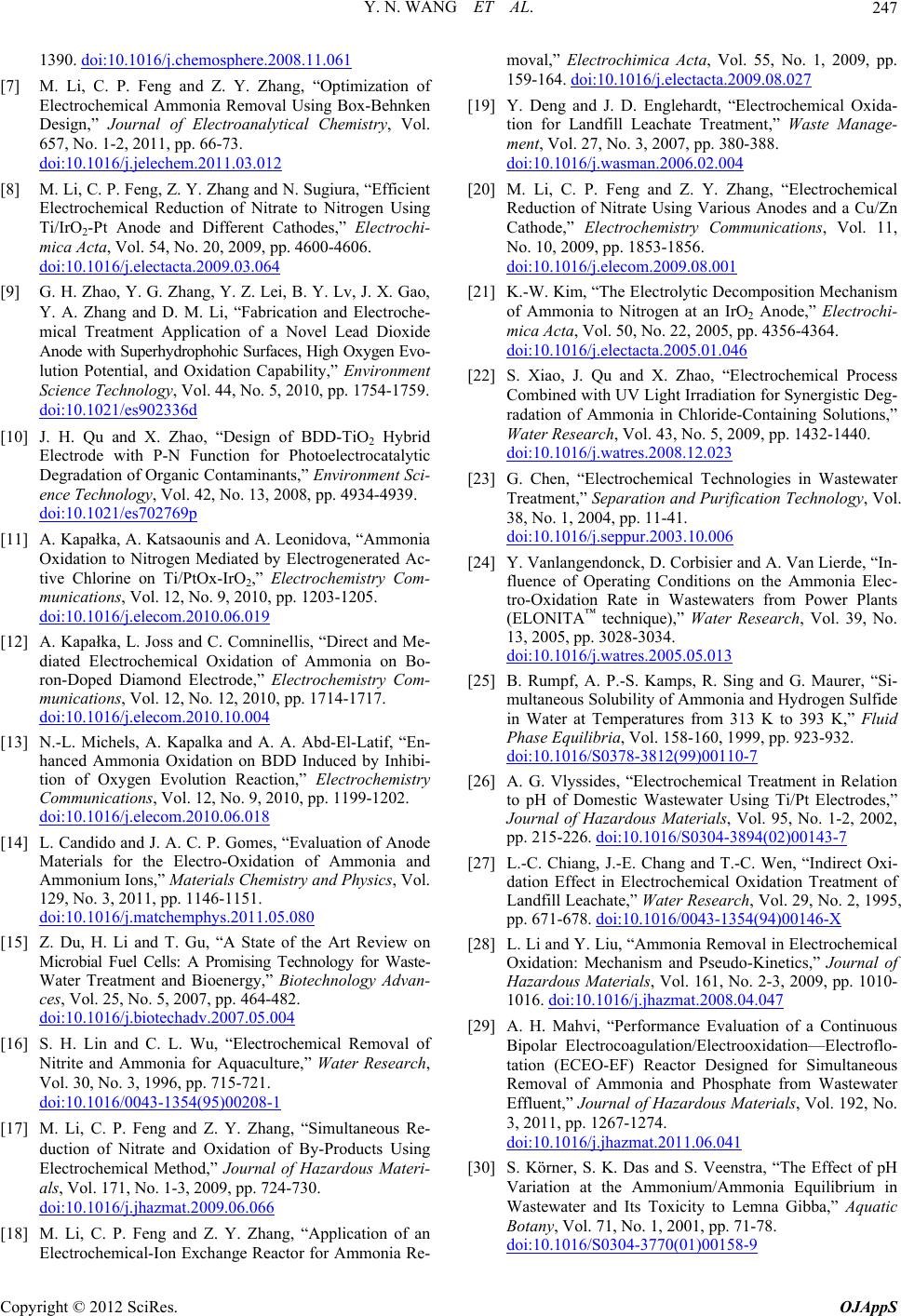 Y. N. WANG ET AL. 247 1390. doi:10.1016/j.chemosphere.2008.11.061 [7] M. Li, C. P. Feng and Z. Y. Zhang, “Optimization of Electrochemical Ammonia Removal Using Box-Behnken Design,” Journal of Electroanalytical Chemistry, Vol. 657, No. 1-2, 2011, pp. 66-73. doi:10.1016/j.jelechem.2011.03.012 [8] M. Li, C. P. Feng, Z. Y. Zhang and N. Sugiura, “Efficient Electrochemical Reduction of Nitrate to Nitrogen Using Ti/IrO2-Pt Anode and Different Cathodes,” Electrochi- mica Acta, Vol. 54, No. 20, 2009, pp. 4600-4606. doi:10.1016/j.electacta.2009.03.064 [9] G. H. Zhao, Y. G. Zhang, Y. Z. Lei, B. Y. Lv, J. X. Gao, Y. A. Zhang and D. M. Li, “Fabrication and Electroche- mical Treatment Application of a Novel Lead Dioxide Anode with Superhydrophohic Surfaces, High Oxygen Evo- lution Potential, and Oxidation Capability,” Environment Science Technology, Vol. 44, No. 5, 2010, pp. 1754-1759. doi:10.1021/es902336d [10] J. H. Qu and X. Zhao, “Design of BDD-TiO2 Hybrid Electrode with P-N Function for Photoelectrocatalytic Degradation of Organic Contaminants,” Environment Sci- ence Technology, Vol. 42, No. 13, 2008, pp. 4934-4939. doi:10.1021/es702769p [11] A. Kapałka, A. Katsaounis and A. Leonidova, “Ammonia Oxidation to Nitrogen Mediated by Electrogenerated Ac- tive Chlorine on Ti/PtOx-IrO2,” Electrochemistry Com- munications, Vol. 12, No. 9, 2010, pp. 1203-1205. doi:10.1016/j.elecom.2010.06.019 [12] A. Kapałka, L. Joss and C. Comninellis, “Direct and Me- diated Electrochemical Oxidation of Ammonia on Bo- ron-Doped Diamond Electrode,” Electrochemistry Com- munications, Vol. 12, No. 12, 2010, pp. 1714-1717. doi:10.1016/j.elecom.2010.10.004 [13] N.-L. Michels, A. Kapalka and A. A. Abd-El-Latif, “En- hanced Ammonia Oxidation on BDD Induced by Inhibi- tion of Oxygen Evolution Reaction,” Electrochemistry Communications, Vol. 12, No. 9, 2010, pp. 1199-1202. doi:10.1016/j.elecom.2010.06.018 [14] L. Candido and J. A. C. P. Gomes, “Evaluation of Anode Materials for the Electro-Oxidation of Ammonia and Ammonium Ions,” Materials Chemistry and Physics, Vol. 129, No. 3, 2011, pp. 1146-1151. doi:10.1016/j.matchemphys.2011.05.080 [15] Z. Du, H. Li and T. Gu, “A State of the Art Review on Microbial Fuel Cells: A Promising Technology for Waste- Water Treatment and Bioenergy,” Biotechnology Advan- ces, Vol. 25, No. 5, 2007, pp. 464-482. doi:10.1016/j.biotechadv.2007.05.004 [16] S. H. Lin and C. L. Wu, “Electrochemical Removal of Nitrite and Ammonia for Aquaculture,” Water Research, Vol. 30, No. 3, 1996, pp. 715-721. doi:10.1016/0043-1354(95)00208-1 [17] M. Li, C. P. Feng and Z. Y. Zhang, “Simultaneous Re- duction of Nitrate and Oxidation of By-Products Using Electrochemical Method,” Journal of Hazardous Materi- als, Vol. 171, No. 1-3, 2009, pp. 724-730. doi:10.1016/j.jhazmat.2009.06.066 [18] M. Li, C. P. Feng and Z. Y. Zhang, “Application of an Electrochemical-Ion Exchange Reactor for Ammonia Re- moval,” Electrochimica Acta, Vol. 55, No. 1, 2009, pp. 159-164. doi:10.1016/j.electacta.2009.08.027 [19] Y. Deng and J. D. Englehardt, “Electrochemical Oxida- tion for Landfill Leachate Treatment,” Waste Manage- ment, Vol. 27, No. 3, 2007, pp. 380-388. doi:10.1016/j.wasman.2006.02.004 [20] M. Li, C. P. Feng and Z. Y. Zhang, “Electrochemical Reduction of Nitrate Using Various Anodes and a Cu/Zn Cathode,” Electrochemistry Communications, Vol. 11, No. 10, 2009, pp. 1853-1856. doi:10.1016/j.elecom.2009.08.001 [21] K.-W. Kim, “The Electrolytic Decomposition Mechanism of Ammonia to Nitrogen at an IrO2 Anode,” Electrochi- mica Acta, Vol. 50, No. 22, 2005, pp. 4356-4364. doi:10.1016/j.electacta.2005.01.046 [22] S. Xiao, J. Qu and X. Zhao, “Electrochemical Process Combined with UV Light Irradiation for Synergistic Deg- radation of Ammonia in Chloride-Containing Solutions,” Water Research, Vol. 43, No. 5, 2009, pp. 1432-1440. doi:10.1016/j.watres.2008.12.023 [23] G. Chen, “Electrochemical Technologies in Wastewater Treatment,” Separation and Purification Technology, Vol. 38, No. 1, 2004, pp. 11-41. doi:10.1016/j.seppur.2003.10.006 [24] Y. Vanlangendonck, D. Corbisier and A. Van Lierde, “In- fluence of Operating Conditions on the Ammonia Elec- tro-Oxidation Rate in Wastewaters from Power Plants (ELONITA™ technique),” Water Research, Vol. 39, No. 13, 2005, pp. 3028-3034. doi:10.1016/j.watres.2005.05.013 [25] B. Rumpf, A. P.-S. Kamps, R. Sing and G. Maurer, “Si- multaneous Solubility of Ammonia and Hydrogen Sulfide in Water at Temperatures from 313 K to 393 K,” Fluid Phase Equilibria, Vol. 158-160, 1999, pp. 923-932. doi:10.1016/S0378-3812(99)00110-7 [26] A. G. Vlyssides, “Electrochemical Treatment in Relation to pH of Domestic Wastewater Using Ti/Pt Electrodes,” Journal of Hazardous Materials, Vol. 95, No. 1-2, 2002, pp. 215-226. doi:10.1016/S0304-3894(02)00143-7 [27] L.-C. Chiang, J.-E. Chang and T.-C. Wen, “Indirect Oxi- dation Effect in Electrochemical Oxidation Treatment of Landfill Leachate,” Water Research, Vol. 29, No. 2, 1995, pp. 671-678. doi:10.1016/0043-1354(94)00146-X [28] L. Li and Y. Liu, “Ammonia Removal in Electrochemical Oxidation: Mechanism and Pseudo-Kinetics,” Journal of Hazardous Materials, Vol. 161, No. 2-3, 2009, pp. 1010- 1016. doi:10.1016/j.jhazmat.2008.04.047 [29] A. H. Mahvi, “Performance Evaluation of a Continuous Bipolar Electrocoagulation/Electrooxidation—Electroflo- tation (ECEO-EF) Reactor Designed for Simultaneous Removal of Ammonia and Phosphate from Wastewater Effluent,” Journal of Hazardous Materials, Vol. 192, No. 3, 2011, pp. 1267-1274. doi:10.1016/j.jhazmat.2011.06.041 [30] S. Körner, S. K. Das and S. Veenstra, “The Effect of pH Variation at the Ammonium/Ammonia Equilibrium in Wastewater and Its Toxicity to Lemna Gibba,” Aquatic Botany, Vol. 71, No. 1, 2001, pp. 71-78. doi:10.1016/S0304-3770(01)00158-9 Copyright © 2012 SciRes. OJAppS |