

Paper Menu >>
Journal Menu >>
 Open Journal of Blood Diseases, 2012, 85-89 http://dx.doi.org/10.4236/ojbd.2012.24016 Published Online December 2012 (http://www.SciRP.org/journal/ojbd) 85 Comparison of High-Dose Dexamethasone and Prednisone for Initial Treatment of Adult Primary Immune Thrombocytopenia Masanao Teramura, Midori Ishiyama, Hiroshi Kazama, Kentaro Yoshinaga, Masayuki Shiseki, Naoki Mori, Toshiko Motoji Department of Hematology, Tokyo Women’s Medical University, Tokyo, Japan. Email: [email protected] Received October 14th, 2012; revised November 18th, 2012; accepted November 30th, 2012 ABSTRACT Prednisone is the most common first-line treatment for adult primary immune thrombocytopenia (ITP). However, the best initial therapeutic approach is still a matter of debate. Prior studies have shown that high-dose dexamethasone (HD-DXM) produces a high sustained efficacy not achieved by conventional prednisone therapy. However, the defini- tion of response widely differs between individual reports, and this heterogeneity makes comparison of the efficacy difficult. The aim of our study was to compare the therapeutic outcomes of a conventional dose of prednisone with HD-DXM for adult ITP patients as initial therapy. Thirty patients treated with prednisone and 22 patients treated HD-DXM were retrospectively analyzed. No significant differences between the HD-DXM and prednisone groups were observed for the rates of complete response (68% vs. 70%) and response (18% vs. 17%). However, 1 year probability of sustained response was significantly greater in the HD-DXM group than in the prednisone group (78% vs. 38%; P = 0.008). No adverse events necessitating discontinuation of treatment were observed in either group. Our retrospective analysis showed that initial treatment with HD-DXM produced longer response duration compared to a conventional dose of prednisone. Randomized clinical trials are warranted to establish the optimal initial steroid therapy for adult ITP. Keywords: Primary Immune Thrombocytopenia; High-Dose Dexamethasone; Prednisone 1. Introduction Primary immune thrombocytopenia (ITP) previously called idiopathic thrombocytopenic purpura is an ac- quired immune-mediated disorder characterized by iso- lated thrombocytopenia defined as a peripheral blood platelet count less than 100 × 109/L, and the absence of any obvious initiating and/or underlying cause of the thrombocytopenia [1]. Treatment is generally given for patients with a low platelet count (≤20 × 109/L or ≤30 × 109/L) or clinically significant bleeding. The standard initial treatment for adult patients with ITP is corticos- teroids. Among corticosteroids, prednisone is widely regarded as the standard first-line treatment. The starting dose is usually set at 1 mg/kg per day and continued for 2 to 4 weeks. If an increase in platelet count is obtained, the dose is gradually tapered. With this approach, an ini- tial response rate of 50% to 60% is obtained, although long-term remission rate after discontinuation are very low (10% to 25%) [2-7]. A short course of high-dose dexamethasone (HD-DXM) has been used in patients with refractory ITP, but its ef- ficacy is controversial [8-10]. In 2003, a study on initial treatment of ITP with HD-DXM found beneficial out- comes. In adult patients with previously untreated ITP, dexamethasone was given in a single 4-day course (40 mg/day, orally). The initial response rate was 85% of patients (106 of 125 patients), and the sustained response (a platelet count > 50,000/μL 6 months after initial treat- ment) was 50% [11]. Subsequently, a multicenter study reported that 89% (16 of 18) ITP patients responded to initial HD-DXM treatment (1 to 6 courses) with 59% achieving 2 - 31 months efficacy [12]. In another large cohort study, 4 cycles of HD-DXM given every 14 days for previously untreated ITP patients produced an 85.6% (77 of 90 patients) response rate with 74% efficacy last- ing for a median duration of 8 months [13]. The results of these studies suggest that HD-DXM treatment for adult ITP may produce better outcomes than conventional prednisone therapy. However, the definition of response widely differs between individual Copyright © 2012 SciRes. OJBD  Comparison of High-Dose Dexamethasone and Prednisone for Initial Treatment of Adult Primary Immune Thrombocytopenia 86 reports, and this heterogeneity makes comparison of the efficacy of these two treatments difficult. To address this issue, in 2009, an international working group proposed standard criteria for assessing response to ITP treatments [1]. The aim of this study is to compare the efficacy of HD-DXM and conventional prednisone treatments using these criteria through the retrospective analysis of ITP patients treated at our institution. 2. Patients and Method 2.1. Patient Selection Adult patients diagnosed with ITP and initially treated with either a conventional dose of prednisone or HD- DXM between 1995-2011 at our institution were retro- spectively analyzed for this study. Diagnosis of ITP was based on findings from complete blood cytology, and other laboratory testing, which were used to rule out other causes of thrombocytopenia. To confirm the diag- nosis, bone marrow aspirate was obtained from all pa- tients, and only those with the presence of a normal or increased number of megakaryocytes without pathologic alterations of erythroblasts, granulocytes or lymphocytes were in- cluded. In addition, all patients had either a plate- let count ≤ 20 × 109/L or clinically significant bleeding with a platelet count ≤ 50 × 109/L. 2.2. Treatment For the HD-DXM group, oral dexamethasone was given as at least 1 cycle of a single daily dose of 40 mg for 4 consecutive days. A maximum of 3 cycles of HD-DEX with a treatment interval of 14 days were given. For the prednisone group, 1 mg/kg per day of prednisone was given for 4 weeks, and in responders, the dose was gradually tapered over several weeks and then stopped. During the initial treatment, all patients did not receive other ITP-specific concomitant treatment including Heli- cobacter pylori eradication. Response was evaluated according to the proposed criteria from an international working group [1]. Com- plete response (CR) was defined as any platelet count of at least 100 × 109/L, and response (R) was defined as any platelet count between 30 and 100 × 109/L and at least doubling of the baseline count. No response (NR) was defined as any platelet count lower than 30 × 109/L or less than doubling of the baseline count. The definition of response required concurrent resolution of bleeding symptoms. Loss of CR was defined as a CR patient whose platelet count later fell below 100 × 109/L, or ex- perienced bleeding. Loss of R was defined as a patient whose platelet count fell later below 30 × 109/L, or to less than 2-fold increase of baseline platelet count or experienced bleeding. Patients who did not respond until 4 weeks after initiation of prednisone, and those who did not response until 2 weeks after completion of HD-DXM were defined as non-responders. The duration of response was measured from the time of achievement of CR or R to time of loss of CR or R (from R). We also measured the duration of response from the time of achievement of CR or R to loss of R (from CR or R). This study was approved by the ethical committee of Tokyo Women’s Medical University. 2.3. Statistical Analysis Prednisone and HD-DXM groups were compared with respect to age, sex, and platelet counts before treatment, initial response rate, and the duration of response. Fisher’s exact test was used to compare categorical variables, and Mann-Whitney U test or Student’s t-test was used to compare continuous variables. The duration of response was analyzed using the Kaplan-Meier method [14]. 3. Results 3.1. Patient Characteristics Fifty two patients diagnosed of ITP were analyzed, of whom 30 were treated with prednisone and 22 treated with HD-DXM. The main clinical characteristics of both groups are listed in Table 1. There were no significant differences between the 2 groups in terms of age, sex, and the pretreatment white blood cell count, platelet count, and Hemoglobin level. In the HD-DXM group, 11, 4, and 7 patients received 1, 2, or 3 treatment cycles, re- spectively. 3.2. Treatment Response The rates of CR, R and overall response (CR plus R) are shown in Table 2. No significant differences between the two treatments groups were observed with respect to the rate of CR, R, and overall response. 3.3. Duration of Response Loss of CR and loss of R (from R) were observed in 10 of 19 patients in the HD-DXM group with a median time of 5.8 months (range 1 - 71 months) after response achie- vement, and in 22 of 26 patients in the prednisone group with a median time of 5.9 months (range 1 - 147 months). Loss of R (from CR or R) was observed in 5 of 19 pa- tients in the HD-DXM group with a median time of 13.6 months (range 1 - 75 months) after response achievement, and in 20 of 26 patients in the prednisone group with a median duration of 8.4 months (range 1 - 147 months). Kaplan-Meier response duration curves for 2 groups were shown in Figure 1. Response duration calculated Copyright © 2012 SciRes. OJBD 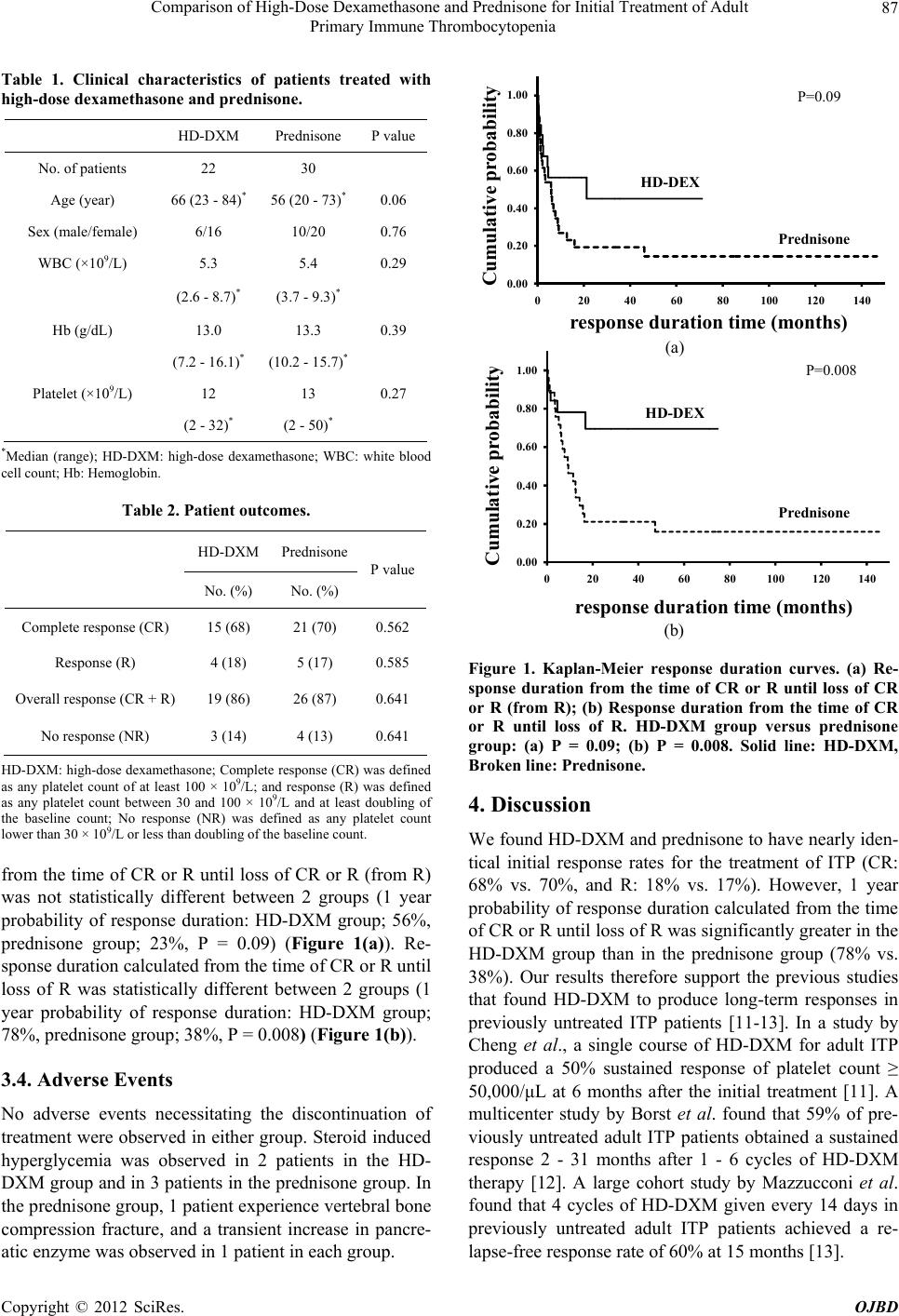 Comparison of High-Dose Dexamethasone and Prednisone for Initial Treatment of Adult Primary Immune Thrombocytopenia 87 Table 1. Clinical characteristics of patients treated with high-dose dexamethasone and prednisone . HD-DXM Prednisone P value No. of patients 22 30 Age (year) 66 (23 - 84)* 56 (20 - 73)* 0.06 Sex (male/female) 6/16 10/20 0.76 WBC (×109/L) 5.3 5.4 0.29 (2.6 - 8.7)* (3.7 - 9.3)* Hb (g/dL) 13.0 13.3 0.39 (7.2 - 16.1)* (10.2 - 15.7)* Platelet (×109/L) 12 13 0.27 (2 - 32)* (2 - 50)* *Median (range); HD-DXM: high-dose dexamethasone; WBC: white blood cell count; Hb: Hemoglobin. Table 2. Patient outcomes. HD-DXM Prednisone No. (%) No. (%) P value Complete response (CR) 15 (68) 21 (70) 0.562 Response (R) 4 (18) 5 (17) 0.585 Overall response (CR + R) 19 (86) 26 (87) 0.641 No response (NR) 3 (14) 4 (13) 0.641 HD-DXM: high-dose dexamethasone; Complete response (CR) was defined as any platelet count of at least 100 × 109/L; and response (R) was defined as any platelet count between 30 and 100 × 109/L and at least doubling of the baseline count; No response (NR) was defined as any platelet count lower than 30 × 109/L or less than doubling of the baseline count. from the time of CR or R until loss of CR or R (from R) was not statistically different between 2 groups (1 year probability of response duration: HD-DXM group; 56%, prednisone group; 23%, P = 0.09) (Figure 1(a)). Re- sponse duration calculated from the time of CR or R until loss of R was statistically different between 2 groups (1 year probability of response duration: HD-DXM group; 78%, prednisone group; 38%, P = 0.008) (Fi gure 1(b) ). 3.4. Adverse Events No adverse events necessitating the discontinuation of treatment were observed in either group. Steroid induced hyperglycemia was observed in 2 patients in the HD- DXM group and in 3 patients in the prednisone group. In the prednisone group, 1 patient experience vertebral bone compression fracture, and a transient increase in pancre- atic enzyme was observed in 1 patient in each group. (B) Cumulative pr obability res p ons e d uration time (months) 0.00 0.20 0.40 0.60 0.80 1.00 020406080100 120 140 0.00 0.20 0.40 0.60 0.80 1.00 020406080100120 140 HD-DEX HD-DEX Prednis one Prednis one res p onse duration tim e (m onth s) Cum ulat ive prob abi lit y P=0.09 P=0.008 (a) (b) Figure 1. Kaplan-Meier response duration curves. (a) Re- sponse duration from the time of CR or R until loss of CR or R (from R); (b) Response duration from the time of CR or R until loss of R. HD-DXM group versus prednisone group: (a) P = 0.09; (b) P = 0.008. Solid line: HD-DXM, Broken line: Prednisone. 4. Discussion We found HD-DXM and prednisone to have nearly iden- tical initial response rates for the treatment of ITP (CR: 68% vs. 70%, and R: 18% vs. 17%). However, 1 year probability of response duration calculated from the time of CR or R until loss of R was significantly greater in the HD-DXM group than in the prednisone group (78% vs. 38%). Our results therefore support the previous studies that found HD-DXM to produce long-term responses in previously untreated ITP patients [11-13]. In a study by Cheng et al., a single course of HD-DXM for adult ITP produced a 50% sustained response of platelet count ≥ 50,000/μL at 6 months after the initial treatment [11]. A multicenter study by Borst et al. found that 59% of pre- viously untreated adult ITP patients obtained a sustained response 2 - 31 months after 1 - 6 cycles of HD-DXM therapy [12]. A large cohort study by Mazzucconi et al. found that 4 cycles of HD-DXM given every 14 days in previously untreated adult ITP patients achieved a re- lapse-free response rate of 60% at 15 months [13]. Copyright © 2012 SciRes. OJBD  Comparison of High-Dose Dexamethasone and Prednisone for Initial Treatment of Adult Primary Immune Thrombocytopenia 88 The optimal number of cycles of HD-DXM for initial ITP treatment warrants further investigation. Cheng et al. [11] used a single course of HD-DXM, while Borst et al. [12], Mazzucconi et al. [13], and we used between 1 - 6 courses. In the study from Mazzucconi et al., response rate was significantly improved between the second and third cycles (75.8% vs. 89%, P = 0.018) but not between the third and fourth [13]. This suggests that 3 cycles of HD-DXM may be appropriate. The mechanism of action of HD-DXM in the treat- ment of ITP is not entirely clear; however, several mechanisms have been postulated. ITP is an autoimmune disease characterized by T helper 1 (Th1) polarization. Guo et al. reported that correction of Th1 polarization was achieved and maintained after HD-DXM therapy in patients who experienced a sustainable response but not maintained in those who relapsed [15]. A subsequent study from the same group showed that HD-DXM re- duced plasma levels of interleukin-18 (IL-18) while in- creasing levels of its endogenous antagonist, IL-18 bind- ing protein (IL-18BP), yielding a reduction of IL-18/IL- 18BP ratio [16]. From these findings, it is suggested that correction of Th1 polarization by HD-DXM is mediated by a decrease in IL-18/IL-18BP ratio, and this could be a potential mechanism of the long-term recovery from ITP. Disruptions in the balance of Fcγ receptors (FcγRs), in- cluding FcγRI, FcγRIIa, FcγRIII, and FcγRIIb have been implicated in the pathogenesis of many autoimmune dis- eases. In ITP, decreased expression of inhibitory FcγRIIb and elevated expression of activating FcγRs (FcγRIIa and FcγRIII) have been observed on monocytes, and HD- DXM therapy for ITP could shift monocyte FcγR balance toward the inhibitory FcγR IIb, resulting in the decrease of monocyte phagocytic capacity [17]. This suggests that FcγR system is possibly involved in the efficacy of HD-DXM for ITP. Other reports have suggested that HD-DXM may achieve its therapeutic effect by inhibit- ing immune responses through the suppression of den- dritic cell functions [18], reducing B-cell activating fac- tor production [19], and increasing production of the regulatory T-cells [20]. Recently, a prospective randomized study involving previously untreated adult ITP comparing the efficacy of a single course of HD-DEX to that of HD-DEX com- bined with rituximab was conducted [21]. The rate of sustained response (platelet count > 50 × 109/L at 6 months after treatment) was significantly higher in pa- tients treated with HD-DEX plus rituximab than in those treated with HD-DXM alone (63% vs. 36%). Further- more, the HD-DXM plus rituximab regimen was effect- tive as salvage therapy in the subgroup of patients who were refractory to initial HD-DXM therapy, achieving a sustained response rate of 56%. This suggests that com- bining HD-DEX with rituximab may be a promising second-line therapy in patients not responding to initial HD-DEX treatment. There are several limitations to our study. First, be- cause our study is retrospective in nature, some bias may have been present. The dates of treatment tended to be different between HD-DEX and prednisone groups; all HD-DEX patients were treated after 2003, whereas most prednisone patients were treated before 2003. In addition, in Japan, Helicobacter pylori eradication was adopted as initial therapy for ITP patients during 2000s [22]. There- fore, another limitation is that the extent of H. pylori in- fection in the 2 groups was likely different, and the pos- sibility that this etiological difference affected our find- ings cannot be ruled out. In conclusion, treatment involving steroid therapy for ITP is used to obtain not only a high initial response rate but also a sustainable response that avoids the need for any further treatment. Based on our findings, HD-DXM could be used as a first-line treatment for adult patients with ITP because it accomplishes both of these. Our ret- rospective analysis showed that initial treatment with HD-DXM produced longer response duration compared to a conventional dose of prednisone. Randomized clini- cal trials are warranted to establish the optimal initial steroid therapy for adult ITP. 5. Acknowledgements We thank all members of the Department of Hematology, Tokyo Women’s Medical University for their support. We also thank Editage for providing editorial assistance. REFERENCES [1] F. Rodeghiero, R. Stasi, T. Gernsheimer, M. Michel, D. Provan, D. M. Arnold, et al., “Standardization of Termi- nology, Definitions and Outcome Criteria in Immune Thrombocytopenic Purpura of Adults and Children: Re- port from an International Working Group,” Blood, Vol. 113, No. 11, 2009, pp. 2386-2393. doi:10.1182/blood-2008-07-162503 [2] S. Bellucci, Y. Charpak, C. Chastang and G. Tobelem, “Low Doses V Conventional Doses of Corticoids in Im- mune Thrombocytopenic Purpura (ITP): Results of a Randomized Clinical Trial in 160 Children, 223 Adults,” Blood, Vol. 71, No. 4, 1988, pp. 1165-1169. [3] D. B. Cines and V. S. Blanchette, “Immune Thrombocy- topenic Purpura,” New England Journal of Medicine, Vol. 346, No. 13, 2002, pp. 995-1008. doi:10.1056/NEJMra010501 [4] J. N. George, M. A. EL-Harake and G. E. Raskob, “Chronic Idiopathic Thrombocytopenic Purpura,” New England Journal of Medicine, Vol. 331, No. 18, 1994, pp. 1207-1211. doi:10.1056/NEJM199411033311807 Copyright © 2012 SciRes. OJBD  Comparison of High-Dose Dexamethasone and Prednisone for Initial Treatment of Adult Primary Immune Thrombocytopenia Copyright © 2012 SciRes. OJBD 89 [5] J. N. George, S. H. Woolf, G. E. Raskob, J. S. Wasser, L. M. Aledort, P. J. Ballem, et al., “Idiopathic Thrombocy- topenic Purpura: A Practice Guideline Developed by Ex- plicit Methods for the American Society of Hematol- ogy,” Blood, Vol. 88, No. 1, 1996, pp. 3-40. [6] M. G. Mazzucconi, M. Francesconi, P. Fidani, G. Di Nucci, G. M. Gandolfo, A. Afeltra, et al., “Treatment of Idiopathic Thrombocytopenic Purpura (ITP): Results of a Multicentric Protocol,” Haematologica, Vol. 70, No. 4, 1985, pp. 329-336. [7] J. E. Portielje, R. G. Westendorp, H. C. Kluin-Nelemans and A. Brand, “Morbidity and Mortality in Adults with Idiopathic Thrombocytopenic Purpura,” Blood, Vol. 97, No. 9, 2001, pp. 2549-2554. doi:10.1182/blood.V97.9.2549 [8] J. C. Andersen, “Response of Resistant Idiopathic Throm- bocytopenic Purpura to Pulsed High-Dose Dexametha- sone Therapy,” New England Journal of Medicine, Vol. 330, No. 22, 1994, pp. 1560-1564. doi:10.1056/NEJM199406023302203 [9] I. Khouri, B. Tuan and K. Grant, “Comment on: Immune Thrombocytopenic Purpura,” New England Journal of Medicine, Vol. 347, No. 6, 2002, pp. 449-450. doi:10.1056/NEJM200208083470617 [10] M. Warner, P. Wasi, S. Couban, C. Hayward, T. Warken- tin and J. D. Kelton, “Failure of Pulse High-Dose Dexa- methasone in Chronic Idiopathic Immune Thrombocyto- penia,” American Journal of Hematology, Vol. 54, No. 4, 1997, pp. 267-270. doi:10.1002/(SICI)1096-8652(199704)54:4<267::AID-AJ H1>3.0.CO;2-T [11] Y. Cheng, R. S. Wong, Y. O. Soo, C. H. Chui, F. Y. Lau, N. P. Chan, et al., “Initial Treatment of Immune Throm- bocytopenic Purpura with High-Dose Dexamethasone,” New England Journal of Medicine, Vol. 349, No. 9, 2003, pp. 831-836. doi:10.1056/NEJMoa030254 [12] F. Borst, J. J. Keuning, H. van Hulsteijn, H. Sinnige and G. Vreugdenhil, “High-Dose dexamethasone as a First- and Second-Line Treatment of Idiopathic Thrombocyto- penic Purpura in Adults,” Annals of Hematology, Vol. 83, No. 12, 2004, pp. 764-768. doi:10.1007/s00277-004-0908-1 [13] M. G. Mazzucconi, P. Fazi, S. Bernasconi, G. De Rossi, G. Leone, L. Gugliotta, et al., “Therapy with High-Dose Dexamethasone (HD-DXM) in Previously Untreated Pa- tients Affected by Idiopathic Thrombocytopenic Purpura: A GIMEMA Experience,” Blood, Vol. 109, No. 4, 2007, pp. 1401-1407. doi:10.1182/blood-2005-12-015222 [14] E. L. Kaplan and P. Meier, “Nonparametric Estimation from Incomplete Observations,” Journal of the American Statistical Association, Vol. 53, No. 282, 1958, pp. 457- 481. doi:10.2307/2281868 [15] C. Guo, X. Chu, Y. Shi, W. He, L. Li, L. Wang, et al., “Correction of Th1-Dominant Cytokine Profiles by High- Dose Dexamethasone in Patients with Chronic Idiopathic Thrombocytopenic Purpura,” Journal of Clinical Immu- nology, Vol. 27, No. 6, 2007, pp. 557-562. doi:10.1007/s10875-007-9111-1 [16] N. N. Shan, X. J. Zhu, Q. Wang, C. Y. Wang, P. Qin, J. Peng, et al., “High-Dose Dexamethasone Regulates Inter- leukin-18 and Interleukin-18 Binding Protein in Idio- pathic Thrombocytopenic Purpura,” Haematologica, Vol. 94, No. 11, pp. 1603-1607. doi:10.3324/haematol.2009.007708 [17] X. G. Liu, S. H. Ma, J. Z. Sun, J. Ren, Y. Shi, L. Sun, et al., “High-Dose Dexamethasone Shifts the Balance of Sti- mulatory and Inhibitory Fcgamma Receptors on Mono- cytes in Patients with Primary Immune Thrombocyto- penia,” Blood, Vol. 117, No. 6, 2011, pp. 2061-2069. doi:10.1182/blood-2010-07-295477 [18] X. X. Chu, B. H. Huang, X. L. Zhang, L. M. Chen, Y. Wang, W. L. Yu, et al., “Dexamethasone Inhibits Immu- noreactivity of Dendritic Cells in Patients with Chronic Idiopathic Thrombocytopenic Purpura,” Blood Coagula- tion & Fibrinolysis, Vol. 21, No. 6, 2010, pp. 564-567. doi:10.1097/MBC.0b013e32833c2b8c [19] X. J. Zhu, Y. Shi, J. Z. Sun, N. N. Shan, J. Peng, C. S. Guo, et al., “High-Dose Dexamethasone Inhibits BAFF Expression in Patients with Immune Thrombocytopenia,” Journal of Clinical Immunology, Vol. 29, No. 5, 2009, pp. 603-610. doi:10.1007/s10875-009-9303-y [20] Y. Ling, X. Cao, Z. Yu and C. Ruan, “Circulating Den- dritic Cells Subsets and CD4+ Foxp3+ Regulatory T- Cells in Adult Patients with Chronic ITP before and after Treatment with High-Dose Dexamethasome,” European Journal of Haematology, Vol. 79, No. 4, 2007, pp. 310- 316. doi:10.1111/j.1600-0609.2007.00917.x [21] F. Zaja, M. Baccarani, P. Mazza, M. Bocchia, L. Gugli- otta, A. Zaccaria et al., “Dexamethasone plus Rituximab Yields Higher Sustained Response Rates than Dexame- thasone Monotherapy in Adults with Primary Immune Thrombocytopenia,” Blood, Vol. 115, No. 14, 2010, pp. 2755-2762. doi:10.1182/blood-2009-07-229815 [22] K. Fujimura, M. Kuwana, Y. Kurata, M. Imamura, H. Harada, H. Sakamaki, et al., “Is Eradication Therapy Use- ful as the First Line of Treatment in Helicobacter Py- lori-Positive Idiopathic Thrombocytopenic Purpura? Ana- lysis of 207 Eradicated Chronic ITP Cases in Japan,” In- ternational Journal of Hematology, Vol. 81, No. 2, 2005, pp. 162-168. doi:10.1532/IJH97.04 |