

Paper Menu >>
Journal Menu >>
 E-Health Telecommunication Systems and Networks, 2012, 1, 37-42 http://dx.doi.org/10.4236/etsn.2012.14006 Published Online December 2012 (http://www.SciRP.org/journal/etsn) Prevalence of Ringing Delusion among Mobile Phone Users Neeraj Kumar, Raees A. Khan Department of Computer Science and Engineering, Shri Ramswaroop Memorial University, Lucknow, India Email: [email protected] Received August 1, 2012; revised September 4, 2012; accepted September 12, 2012 ABSTRACT The exponential application of mobile technology has led to a concern about implications of electromagnetic radiation on human health. As we are aware that mobile phone radiates EMR when users communicate to others and that time subscribers of the device are regularly exposed nearby 40% - 50% of total mobile irradiation. We analyzed the risk of “Ringing Delusion” among normal users, moderate users and heavy users when compared to low users. Although the “Ringing Delusion” has not been added in medical terminology but we found frequently such kind of symptoms among mobile phone users. “Ringing Delusion” may be considered as an imagination of ringing voice from cellular phone. The risk was also compared between urban and rural, male and female and adult and children population. The information was gathered through well designed questionnaires for cellular user’s demographic and social characteristics, adopted safety measures and calling duration. Prevalence of “Ringing Delusion” among rural users was higher than the urban users. A trend for the risk was also observed in male users in comparison to female. Study may support innovators to re-examine health effects of mobile phones. Keywords: Extensive User; Mobile Phone; Ringing Delusion; Survey Study; Questionnaire; Sensitivity 1. Introduction The mobile communication has been a blessing to all human beings and exponential application of mobile phone is a matter of health debate among clinicians and technocrats. Particularly adolescent and children are more fascinated to make use of the mobile phones. De- veloping phase of the children’s brain and its hypersensi- tivity to microwave tends to concern about the possibili- ties of the symptoms by mobile irradiation. Ringing de- lusion is one of the common symptom or sensation which has been frequently reported by mobile phone users. Al- though we have not found the term “Ringing Delusion” in medical terminology but we may define or understand such kind of delusion as psychological sensitivity in which a mobile phone user feels ringing voice of the de- vice suddenly, but in actual there is no ringing of the device. In the race to adopt new technologies, we often ignore the ill effects of the technology and do not real- ize about it. Presently people are adopting the wireless communication devices for varied purposes. They feel comfortable when they communicate to others through wireless communication devices in the air instead of wire. Most of these devices work in the radio frequency/ microwave range. Microwave may cause thermal ef- fects at high exposure levels. Research about the possi- bility of radiofrequency fields, associated with mobile phones indicated to cause other adverse health effects due to over usage. Our previous study [1] has concluded that the extensive users, they hold mobile phone for a period above 3 years, were more attentive for “headache” symptom in comparison to normal users. An established effect from mobile irradiation, even small, could affect public health [2]. The effects of microwave through the mobile phones may produce ac- cumulated adverse effects over time. The increasing popularity of wireless communication/cell phone has caused a concern over possible adverse effects of this energy on the human health. Over the past few years, several studies have suggested that radiation emitted by a cell phone can interact with brain activity and behavior [3-7], gene expression and DNA [8-13], cell growth, pro- liferation and tumours [14-20], hormones, proteins and enzymes [21-27]. There are studies not support the health hazard from radiofrequency radiation [28-33], but this does not prove the non-existence of the hazard. This paper is an attempt to make the reader aware of possible threat to human life and ecosystem, caused by mobile devices and wireless communication systems. Electric currents exist naturally in the human body and are an essential part of its physiology. All nerves relay their signals by transmitting electric impulses. Most bio- chemical reactions i.e. associated with digestion and transmission of impulses in brain activities electric proc- esses. The effects of external electromagnetic fields on the human body depend on the electromagnetic field C opyright © 2012 SciRes. ETSN 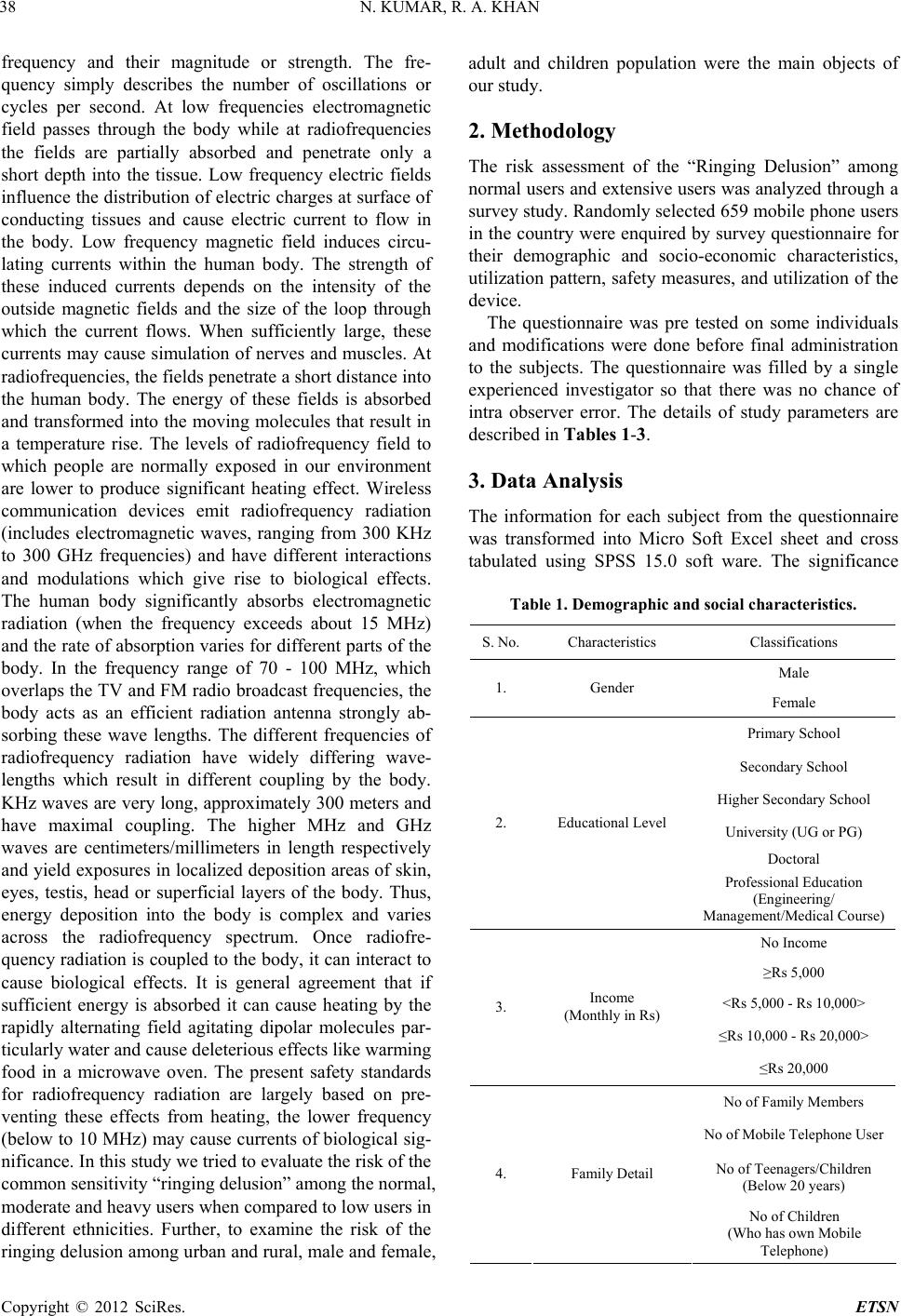 N. KUMAR, R. A. KHAN 38 frequency and their magnitude or strength. The fre- quency simply describes the number of oscillations or cycles per second. At low frequencies electromagnetic field passes through the body while at radiofrequencies the fields are partially absorbed and penetrate only a short depth into the tissue. Low frequency electric fields influence the distribution of electric charges at surface of conducting tissues and cause electric current to flow in the body. Low frequency magnetic field induces circu- lating currents within the human body. The strength of these induced currents depends on the intensity of the outside magnetic fields and the size of the loop through which the current flows. When sufficiently large, these currents may cause simulation of nerves and muscles. At radiofrequencies, the fields penetrate a short distance into the human body. The energy of these fields is absorbed and transformed into the moving molecules that result in a temperature rise. The levels of radiofrequency field to which people are normally exposed in our environment are lower to produce significant heating effect. Wireless communication devices emit radiofrequency radiation (includes electromagnetic waves, ranging from 300 KHz to 300 GHz frequencies) and have different interactions and modulations which give rise to biological effects. The human body significantly absorbs electromagnetic radiation (when the frequency exceeds about 15 MHz) and the rate of absorption varies for different parts of the body. In the frequency range of 70 - 100 MHz, which overlaps the TV and FM radio broadcast frequencies, the body acts as an efficient radiation antenna strongly ab- sorbing these wave lengths. The different frequencies of radiofrequency radiation have widely differing wave- lengths which result in different coupling by the body. KHz waves are very long, approximately 300 meters and have maximal coupling. The higher MHz and GHz waves are centimeters/millimeters in length respectively and yield exposures in localized deposition areas of skin, eyes, testis, head or superficial layers of the body. Thus, energy deposition into the body is complex and varies across the radiofrequency spectrum. Once radiofre- quency radiation is coupled to the body, it can interact to cause biological effects. It is general agreement that if sufficient energy is absorbed it can cause heating by the rapidly alternating field agitating dipolar molecules par- ticularly water and cause deleterious effects like warming food in a microwave oven. The present safety standards for radiofrequency radiation are largely based on pre- venting these effects from heating, the lower frequency (below to 10 MHz) may cause currents of biological sig- nificance. In this study we tried to evaluate the risk of the common sensitivity “ringing delusion” among the normal, moderate and heavy users when compared to low users in different ethnicities. Further, to examine the risk of the ringing delusion among urban and rural, male and female, adult and children population were the main objects of our study. 2. Methodology The risk assessment of the “Ringing Delusion” among normal users and extensive users was analyzed through a survey study. Randomly selected 659 mobile phone users in the country were enquired by survey questionnaire for their demographic and socio-economic characteristics, utilization pattern, safety measures, and utilization of the device. The questionnaire was pre tested on some individuals and modifications were done before final administration to the subjects. The questionnaire was filled by a single experienced investigator so that there was no chance of intra observer error. The details of study parameters are described in Tables 1-3. 3. Data Analysis The information for each subject from the questionnaire was transformed into Micro Soft Excel sheet and cross tabulated using SPSS 15.0 soft ware. The significance Table 1. Demographic and social characteristics. S. No.Characteristics Classifications Male 1. Gender Female Primary School Secondary School Higher Secondary School University (UG or PG) Doctoral 2. Educational Level Professional Education (Engineering/ Management/Medical Course) No Income ≥Rs 5,000 <Rs 5,000 - Rs 10,000> ≤Rs 10,000 - Rs 20,000> 3. Income (Monthly in Rs) ≤Rs 20,000 No of Family Members No of Mobile Telephone User No of Teenagers/Children (Below 20 years) 4. Family Detail No of Children (Who has own Mobile Telephone) Copyright © 2012 SciRes. ETSN 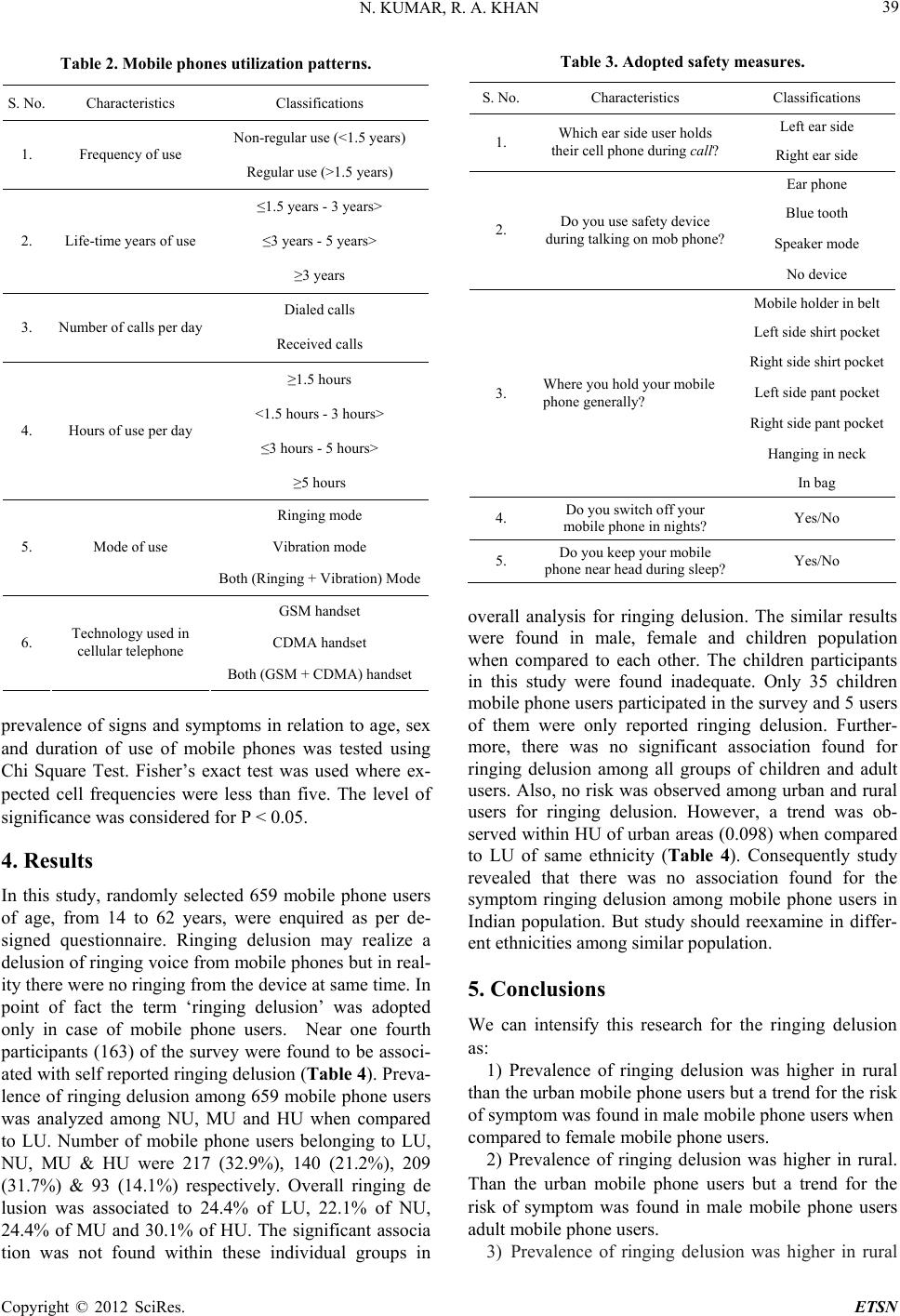 N. KUMAR, R. A. KHAN 39 Table 2. Mobile phones utilization patterns. S. No. Characteristics Classifications Non-regular use (<1.5 years) 1. Frequency of use Regular use (>1.5 years) ≤1.5 years - 3 years> ≤3 years - 5 years> 2. Life-time years of use ≥3 years Dialed calls 3. Number of calls per day Received calls ≥1.5 hours <1.5 hours - 3 hours> ≤3 hours - 5 hours> 4. Hours of use per day ≥5 hours Ringing mode Vibration mode 5. Mode of use Both (Ringing + Vibration) Mode GSM handset CDMA handset 6. Technology used in cellular telephone Both (GSM + CDMA) handset prevalence of signs and symptoms in relation to age, sex and duration of use of mobile phones was tested using Chi Square Test. Fisher’s exact test was used where ex- pected cell frequencies were less than five. The level of significance was considered for P < 0.05. 4. Results In this study, randomly selected 659 mobile phone users of age, from 14 to 62 years, were enquired as per de- signed questionnaire. Ringing delusion may realize a delusion of ringing voice from mobile phones but in real- ity there were no ringing from the device at same time. In point of fact the term ‘ringing delusion’ was adopted only in case of mobile phone users. Near one fourth participants (163) of the survey were found to be associ- ated with self reported ringing delusion (Table 4). Preva- lence of ringing delusion among 659 mobile phone users was analyzed among NU, MU and HU when compared to LU. Number of mobile phone users belonging to LU, NU, MU & HU were 217 (32.9%), 140 (21.2%), 209 (31.7%) & 93 (14.1%) respectively. Overall ringing de lusion was associated to 24.4% of LU, 22.1% of NU, 24.4% of MU and 30.1% of HU. The significant associa tion was not found within these individual groups in Table 3. Adopted safety measures. S. No.Characteristics Classifications Left ear side 1. Which ear side user holds their cell phone during call? Right ear side Ear phone Blue tooth Speaker mode 2. Do you use safety device during talking on mob phone? No device Mobile holder in belt Left side shirt pocket Right side shirt pocket Left side pant pocket Right side pant pocket Hanging in neck 3. Where you hold your mobile phone generally? In bag 4. Do you switch off your mobile phone in nights? Yes/No 5. Do you keep your mobile phone near head during sleep? Yes/No overall analysis for ringing delusion. The similar results were found in male, female and children population when compared to each other. The children participants in this study were found inadequate. Only 35 children mobile phone users participated in the survey and 5 users of them were only reported ringing delusion. Further- more, there was no significant association found for ringing delusion among all groups of children and adult users. Also, no risk was observed among urban and rural users for ringing delusion. However, a trend was ob- served within HU of urban areas (0.098) when compared to LU of same ethnicity (Table 4). Consequently study revealed that there was no association found for the symptom ringing delusion among mobile phone users in Indian population. But study should reexamine in differ- ent ethnicities among similar population. 5. Conclusions We can intensify this research for the ringing delusion as: 1) Prevalence of ringing delusion was higher in rural than the urban mobile phone users but a trend for the risk of symptom was found in male mobile phone users when compared to female mobile phone users. 2) Prevalence of ringing delusion was higher in rural. Than the urban mobile phone users but a trend for the risk of symptom was found in male mobile phone users adult mobile phone users. 3) Prevalence of ringing delusion was higher in rural Copyright © 2012 SciRes. ETSN 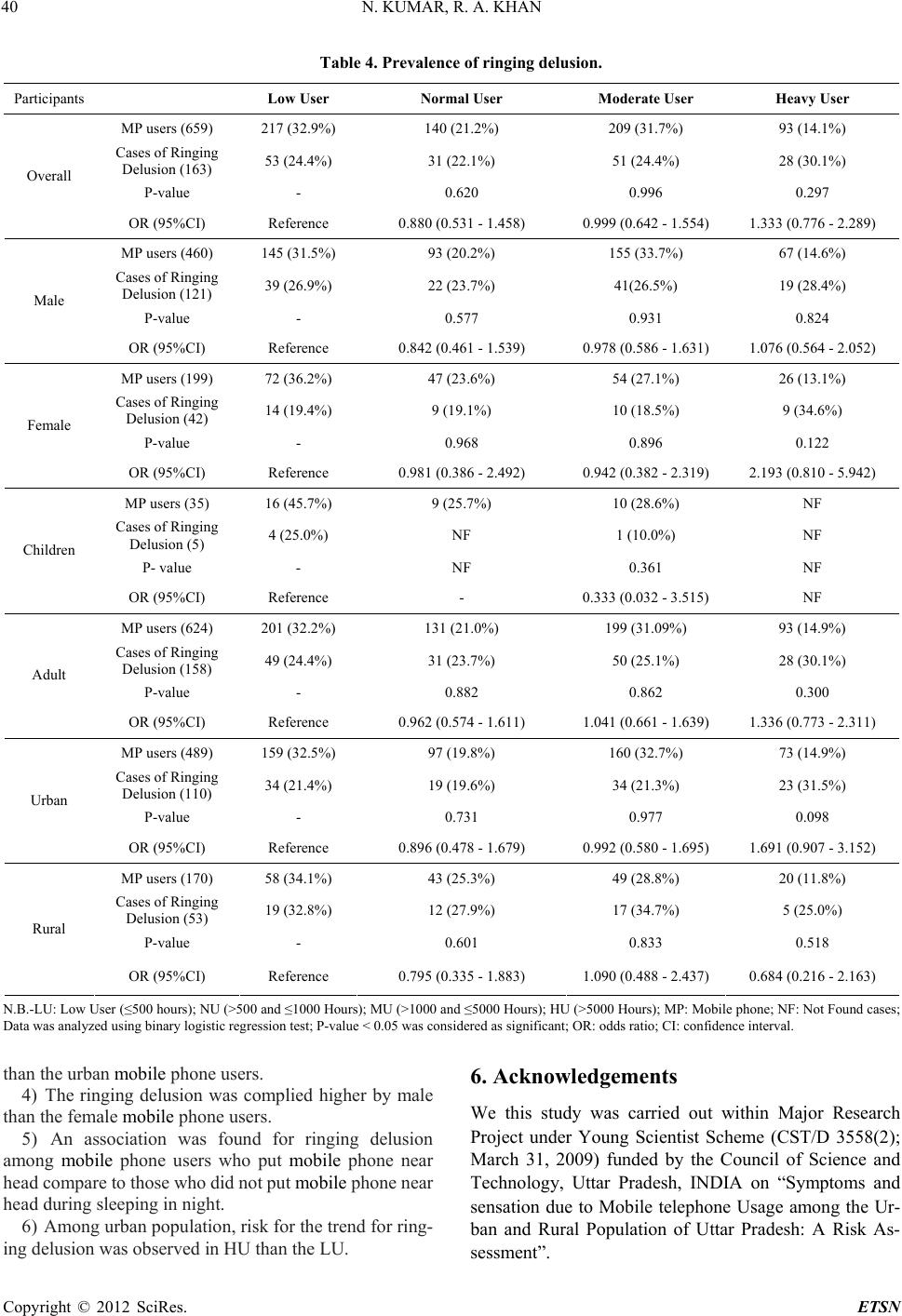 N. KUMAR, R. A. KHAN Copyright © 2012 SciRes. ETSN 40 Table 4. Prevalence of ringing delusion. Participants Low User Normal User Moderate User Heavy User MP users (659) 217 (32.9%) 140 (21.2%) 209 (31.7%) 93 (14.1%) Cases of Ringing Delusion (163) 53 (24.4%) 31 (22.1%) 51 (24.4%) 28 (30.1%) P-value - 0.620 0.996 0.297 Overall OR (95%CI) Reference 0.880 (0.531 - 1.458) 0.999 (0.642 - 1.554) 1.333 (0.776 - 2.289) MP users (460) 145 (31.5%) 93 (20.2%) 155 (33.7%) 67 (14.6%) Cases of Ringing Delusion (121) 39 (26.9%) 22 (23.7%) 41(26.5%) 19 (28.4%) P-value - 0.577 0.931 0.824 Male OR (95%CI) Reference 0.842 (0.461 - 1.539) 0.978 (0.586 - 1.631) 1.076 (0.564 - 2.052) MP users (199) 72 (36.2%) 47 (23.6%) 54 (27.1%) 26 (13.1%) Cases of Ringing Delusion (42) 14 (19.4%) 9 (19.1%) 10 (18.5%) 9 (34.6%) P-value - 0.968 0.896 0.122 Female OR (95%CI) Reference 0.981 (0.386 - 2.492) 0.942 (0.382 - 2.319) 2.193 (0.810 - 5.942) MP users (35) 16 (45.7%) 9 (25.7%) 10 (28.6%) NF Cases of Ringing Delusion (5) 4 (25.0%) NF 1 (10.0%) NF P- value - NF 0.361 NF Children OR (95%CI) Reference - 0.333 (0.032 - 3.515) NF MP users (624) 201 (32.2%) 131 (21.0%) 199 (31.09%) 93 (14.9%) Cases of Ringing Delusion (158) 49 (24.4%) 31 (23.7%) 50 (25.1%) 28 (30.1%) P-value - 0.882 0.862 0.300 Adult OR (95%CI) Reference 0.962 (0.574 - 1.611) 1.041 (0.661 - 1.639) 1.336 (0.773 - 2.311) MP users (489) 159 (32.5%) 97 (19.8%) 160 (32.7%) 73 (14.9%) Cases of Ringing Delusion (110) 34 (21.4%) 19 (19.6%) 34 (21.3%) 23 (31.5%) P-value - 0.731 0.977 0.098 Urban OR (95%CI) Reference 0.896 (0.478 - 1.679) 0.992 (0.580 - 1.695) 1.691 (0.907 - 3.152) MP users (170) 58 (34.1%) 43 (25.3%) 49 (28.8%) 20 (11.8%) Cases of Ringing Delusion (53) 19 (32.8%) 12 (27.9%) 17 (34.7%) 5 (25.0%) P-value - 0.601 0.833 0.518 Rural OR (95%CI) Reference 0.795 (0.335 - 1.883) 1.090 (0.488 - 2.437) 0.684 (0.216 - 2.163) N.B.-LU: Low User (≤500 hours); NU (>500 and ≤1000 Hours); MU (>1000 and ≤5000 Hours); HU (>5000 Hours); MP: Mobile phone; NF: Not Found cases; Data was analyzed using binary logistic regression test; P-value < 0.05 was considered as significant; OR: odds ratio; CI: confidence interval. than the urban mobile phone users. 4) The ringing delusion was complied higher by male than the female mobile phone users. 5) An association was found for ringing delusion among mobile phone users who put mobile phone near head compare to those who did not put mobile phone near head during sleeping in night. 6) Among urban population, risk for the trend for ring- ing delusion was observed in HU than the LU. 6. Acknowledgements We this study was carried out within Major Research Project under Young Scientist Scheme (CST/D 3558(2); March 31, 2009) funded by the Council of Science and Technology, Uttar Pradesh, INDIA on “Symptoms and sensation due to Mobile telephone Usage among the Ur- ban and Rural Population of Uttar Pradesh: A Risk As- sessment”.  N. KUMAR, R. A. KHAN 41 REFERENCES [1] N. Kumar, V. P. Sharma, N. Mathur, M. Y. Khan and R. A. Khan, “Prevalence of Headache among Extensive and Normal Cellular Phone Users,” Journal of Neurochemis- try, Vol. 110, No. S2, 2009, p. 228. [2] J. C. Lin, “Health Aspects of Wireless Communication: Cell Phone Testing and Fundamental Scientific Research,” ACM SIGMOBILE Mobile Computing and Communica- tions Review, Vol. 6, No. 1, 2002, pp. 9-12. [3] C. Krause, L. Sillanmaki, M. Koivisto, A. Haggqvist, C. Saarela, A. Revonsuo, M. Laine and H. Hamalainen, “Ef- fects of Electromagnetic Field Emitted by Cellular Phones on the EEG during a Memory Task,” NeuroRe- port, Vol. 11, No. 4, 2000, pp. 761-764. doi:10.1097/00001756-200003200-00021 [4] C. Krause, L. Sillanmaki, M. Koivisto, A. Haggqvist, C. Saarela, A. Revonsuo, M. Laine and H. Hamalainen, “Ef- fects of Electromagnetic Fields Emitted by Cellular Phones on the Electroencephalogram during a Visual Working Memory Task,” International Journal of Radia- tion Biology, Vol. 76, No. 12, 2000, pp. 1659-1667. doi:10.1080/09553000050201154 [5] N. Edelstyn and A. Oldershaw, “The Acute Effects of Exposure to the Electromagnetic Field Emitted by Mobile Phones on Human Attention,” NeuroReport, Vol. 13, No. 1, 2001, pp. 119-121. doi:10.1097/00001756-200201210-00028 [6] T. M. C. Lee, S. M. Y. Ho, L. Y. H. Tsang, S. Y. C. Yang, L. S. W. Li and C. C. H. Chan, “Effect on Human Atten- tion of Exposure to the Electromagnetic Field Emitted by Mobile Phones,” NeuroReport, Vol. 12, No. 4, 2001, pp. 729-731. doi:10.1097/00001756-200103260-00023 [7] J. W. Smythe and B. Costall, “Mobile Phone Use Facili- tates Memory in Male, but Not Female, Subjects,” Neu- roReport, Vol. 14, No. 2, 2003, pp. 243-246. doi:10.1097/00001756-200302100-00017 [8] I. Trosic and I. Busljeta, “Erythropoietic Dynamic Equi- librium in Rats Maintained after Microwave Irradiation,” Experimental and Toxicologic Pathology, Vol. 57, No. 3, 2006, pp. 247-251. doi:10.1016/j.etp.2005.08.002 [9] B. D. Gorlitz, M. Muller, S. Ebert, H. Hecker, N. Kuster and C. Dasenbrock, “Effects of 1-Week and 6-Week Ex- posure to GSM/DCS Radiofrequency Radiation on Mi- cronucleus Formation in B6C3F1,” Radiation Research, Vol. 164, No. 4, 2005, pp. 431-439. doi:10.1667/RR3440.1 [10] H. Lai and N. P. Singh, “Interaction of Microwaves and a Temporally Incoherent Magnetic Field on Single and Double DNA Strand Breaks in Rat Brain Cells,” Elec- tromagnetic Biology and Medicine, Vol. 24, No. 1, 2005, pp. 23-29. [11] E. Diem, C. Schwarz, F. Adlkofer, O. Jahn and H. Rudi- ger, “Non-Thermal DNA Breakage by Mobile-Phone Ra- diation (1800MHz) in Human Fibroblasts,” Mutation Re- search, Vol. 583, No. 2, 2005, pp. 178-183. [12] M. Mashevich, D. Folkman, A. Kesar, A. Barbul, R. Ko- renstein, E. Jerby and L. Avivi, “Exposure of Human Pe- ripheral Blood Lymphocytes to Electromagnetic Fields Associated with Cellular Phones Leads to Chromosomal Instability,” Bioelectromagnetics, Vol. 24, No. 2, 2003, pp. 82-90. doi:10.1002/bem.10086 [13] R. R. Tice, G. G. Hook, M. Donner, D. I. McRee and A. W. Guy, “Genotoxicity of Radiofrequency Signals. I. In- vestigation of DNA Damage and Micronuclei Induction in Cultured Human Blood Cells,” Bioelectromagnetics, Vol. 23, No. 2, 2002, pp. 113-126. doi:10.1002/bem.104 [14] L. Hardell, M. Carlberg and K. Mild, “Case-Control Study of the Association between the Use of Cellular and Cordless Telephones and Malignant Brain Tumors Diag- nosed during 2000-2003,” Environmental Research, Vol. 100, No. 2, 2005, pp. 232-241. [15] S. Lonn, A. Ahlbom, P. Hall and M. Feychting, “Long- Term Mobile Phone Use and Brain Tumor Risk,” Ameri- can Journal of Epidemiology, Vol. 161, No. 6, 2005, pp. 526-535. doi:10.1093/aje/kwi091 [16] S. Lonn, A. Ahlbom, P. Hall and M. Feychting, “Mobile Phone Use and the Risk of Acoustic Neuroma,” Epidemi- ology, Vol. 15, No. 6, 2004, pp. 653-659. [17] H. C. Christensen, J. Schüz, M. Kosteljanetz, H. S. Poul- sen, J. Thomsen and J. Johansen, “Cellular Telephone Use and Risk of Acoustic Neuroma,” American Journal of Epidemiology, Vol. 159, No. 3, 2004, pp. 277-283. doi:10.1093/aje/kwh032 [18] L. Hardell, A. Hallquist, M. K. Hansson, M. Carlberg, A. Pahlson and A. Lilja, “Cellular and Cordless Telephones and the Risk for Brain Tumours,” European Journal of Cancer Prevention, Vol. 11, No. 4, 2002, pp. 377-386. doi:10.1097/00008469-200208000-00010 [19] A. Auvinen, M. Hietanen, R. Luukkonen and R. S. Kos- kela, “Brain Tumors and Salivary Gland Cancers among Cellular Telephone Users,” Epidemiology, Vol. 13, No. 3, 2002, pp. 356-359. doi:10.1097/00001648-200205000-00018 [20] J. E. Muscat, M. G. Malkin, S. Thompson, R. E. Shore, S. D. Stellman, D. McRee, A. I. Neugut and E. L. Wynder, “Handheld Cellular Telephone Use and Risk of Brain Cancer,” The Journal of American Medical Association, Vol. 284, No. 23, 2000, pp. 3001-3007. doi:10.1001/jama.284.23.3001 [21] M. Lantow, J. Schuderer, C. Hartwig and M. Simko, “Free Radical Release and HSP70 Expression in Two Human Immune-Relevant Cell Lines after Exposure to 1800 MHz RFR,” Radiation Research, Vol. 165, No. 1, 2006, pp. 88-94. doi:10.1667/RR3476.1 [22] M. Simko, C. Hartwig, M. Lantow, M. Lupke, M. O. Matts- son, Q. Rahman and J. Rollwitz, “Hsp70 Expression and Free Radical Release after Exposure to Non-Thermal Ra- dio-Frequency Electromagnetic Fields and Ultrafine Par- ticles in Human Mono Mac 6 cells,” Toxicology Letters, Vol. 161, No. 1, 2006, pp. 73-82. doi:10.1016/j.toxlet.2005.08.005 [23] W. Hamann, S. Abou-Sherif, S. Thompson and S. Hall, “Pulsed Radiofrequency Applied to Dorsal Root Ganglia Causes a Selective Increase in ATF3 in Small Neurons,” European. Journal of Pain, Vol. 10, No. 2, 2006, pp. 171- 176. doi:10.1016/j.ejpain.2005.03.001 [24] I. Sukhotina, J. R. Streckert, A. K. Bitz, V. W. Hansen Copyright © 2012 SciRes. ETSN  N. KUMAR, R. A. KHAN Copyright © 2012 SciRes. ETSN 42 and A. Lerchl, “1800 MHz Electromagnetic Field Effects on Melatonin Release from Isolated Pineal Glands,” Journal of Pineal Research, Vol. 40, No. 1, 2006, pp. 86- 91. doi:10.1111/j.1600-079X.2005.00284.x [25] F. Ozguner, Y. Bardak and S. Comlekci, “Protective Ef- fects of Melatonin and Caffeic Acid Phenethyl Ester against Retinal Oxidative Stress in Long-Term Use of Mobile Phone—A Comparative Study,” Molecular and Cellular Biochemistry, Vol. 282, No. 1-2, 2006, pp. 83-88. doi:10.1007/s11010-006-1267-0 [26] R. Sarimov, L. O. G. Malmgren, E. Markova, B. R. R. Persson and I. Y. Belyaev, “Nonthermal GSM Micro- waves Affect Chromatin Conformation in Human Lym- phocytes Similar to Heat Shock,” IEEE Transactions on Plasma Science, Vol. 32, No. 11, 2004, pp. 1600-1608. doi:10.1109/TPS.2004.832613 [27] A. Di Carlo, N. White, F. Guo, P. Garrett and T. Litovitz, “Chronic Electromagnetic Field Exposure Decreases HSP70 Levels and Lowers Cytoprotection,” Journal of Cellular Biochemistry, Vol. 84, No. 3, 2002, pp. 447-454. doi:10.1002/jcb.10036 [28] R. Russo, E. Fox, C. Cinel, A. Boldini, M. A. Defeyter, D. Mirshekar-Syahkal and A. Mehta, “Does Acute Expow- sure to Mobile Phones Affect Human Attention?” Bio- electromagnetics, Vol. 27, No. 3, 2005, pp. 215-220. [29] C. Haarala, M. Bergman, M. Laine, A. Revonsuo, M. Koivisto and H. Hamalainen, “Electromagnetic Field Emitted by 902 MHz Mobile Phones Shows No Effects on Children’s Cognitive Function,” Bioelectromagnetics, Vol. 7, No. S7, 2005, pp. S144-S150. doi:10.1002/bem.20142 [30] T. Janssen, P. von Boege, J. Mikusch-Buchberg and J. Raczek, “Investigation of Potential Effects of Cellular Phones on Human Auditory Function by Means of Dis- tortion Product Otoacoustic Emissions,” Journal of the Acoustical Society of America Children’s Cognitive Func- tion, Vol. 117, No. 3, 2005, pp. 1241-1247. doi:10.1121/1.1854331 [31] I. Uloziene, V. Uloza, E. Gradauskiene and V. Saferis, “Assessment of Potential Effects of the Electromagnetic Fields of Mobile Phones on Hearing,” BMC Public He a lt h , Vol. 5, No. 1, 2005, p. 39. doi:10.1186/1471-2458-5-39 [32] P. M. Monnery, E. I. Srouji and J. Bartlett, “Is Cochlear Outer Hair Cell Function Affected by Mobile Telephone Radiation?” Clinical Otolaryngology & Allied Sciences, Vol. 29, No. 6, 2004, pp. 747-749. doi:10.1111/j.1365-2273.2004.00877.x [33] O. Celik and S. Hascalik, “Effect of Electromagnetic Field Emitted by Cellular Phones on Fetal Heart Rate Pat- terns,” European Journal of Obstetrics, Gynecology, and Reproductive Biology, Vol. 112, No. 1, 2004, pp. 55-56. |