

Paper Menu >>
Journal Menu >>
 Journal of Minerals and Materials Characterization and Engineering, 2012, 11, 1108-1112 Published Online November 2012 (http://www.SciRP.org/journal/jmmce) Effect of Titanium Addition on Behavior of Medium Carbon Steel Hoda S. El-Faramawy, Saeed N. Ghali*, Mamdouh M. Eissa Steel Technology Department, Central Metallurgical R & D Institute (CMRDI), Cairo, Egypt Email: *[email protected] Received July 10, 2012; revised August 15, 2012; accepted August 31, 2012 ABSTRACT This work aims at investigating the influence of titanium addition on behavior of medium carbon steel. Three types of medium carbon steel with different titanium content and one reference steel titanium free were produced in 100 kg in- duction furnace. Titanium addition was increased up to 0.230%. The produced steels were forged at start temperature 1150˚C. Forging process was finished at temperatures 900˚C, 975˚C, and 1050˚C. Microstructure examination and hardness measurement were carried out for forged steels. Mechanical properties and impact measurements were carried out for quenched tempered steels. Ti addition was found to have significant influence on refinement of grains and in- crease of ferrite/pearlite ratio. It was also, observed that grain size decreases as finishing temperature of forging process decreases. Both Ti addition and lowering finishing forging temperature have positive effect on hardness. In addition, results indicated that addition of titanium has significan t effect on the mechanical properties and toughness. Keywords: Titanium; Refinement; Ferrite; Pearlite; Forging 1. Introduction Mechanical properties of steels are strongly connected to their microstructure obtained after heat treatments that are generally performed in order to achieve a good hardness and/or tensile strength with sufficient ductility [1]. Microalloyed steels have been developed for many years and are widely used in modern industry. It is well known that microalloyed high-strength low-alloy steels are essentially carbon low-alloy steels that contain small additions of alloying elements such as Nb, V, or Ti [2-6]. These elements act as solution atoms or precipitation to suppress the recrystallization and grain growth of auste- nite. Microalloying of carbon steels is widely used in practice. At the same time, little attention has been given to medium carbon steels containing vanadium, niobium and titanium. The obtained fine grain microstructure can enhance the mechanical properties of steels obviously. In addition, multimicroalloying can lead to the formation of carbide and nitride particles which can further influence on the mechanical properties of steels [7-10]. Due to the high price of niobium and vanadium, the development of titanium microallo yed steels seems to be attracted and get more attention recently. Steel alloyed with titanium alone esp ecially the forma- tion mechanism of TiC precipitation during different processes and its effect are seldom studied in carbon steel. This work aims at investigating the influence of tita- nium additions in medium carbon steels on mechanical properties and also investigation of the effect of finishing forging temperatures on grain refinem ents. 2. Experimental Four steels with different titanium contents were melted in induction furnace of capacity 100 kg and cast in sand mold. Complete chemical analysis has been carried out for all cast steels. Ingots with diameter 90 mm were hot forged to about 40 mm square. The ingots were reheated up to 1200˚C and hold to 30 min then start forging. Starting forging temperature was 1150˚C while forging process was ended at temperatures 900˚C, 975˚C, and 1050˚C for the four steels. Microstructure examination and hardness measurements were carried out after for- ging process. Ferrite/pearlite ratios were measured using software Paxit program for forged steels. The forged bars —which ended at 975˚C—were reheated up to 960˚C for 1 hour and water-coo led followed by tempering at 260˚C for 30 min. The mechanical properties were measured for tempered steels. The standard V-notch Charpy specimens samples (10 mm × 10 mm × 55 mm, notch depth 2 mm) was prepared to investigate the influence of the titanium addition on impact toughness at 25˚C for tempered steels. *Corresponding author. Copyright © 2012 SciRes. JMMCE 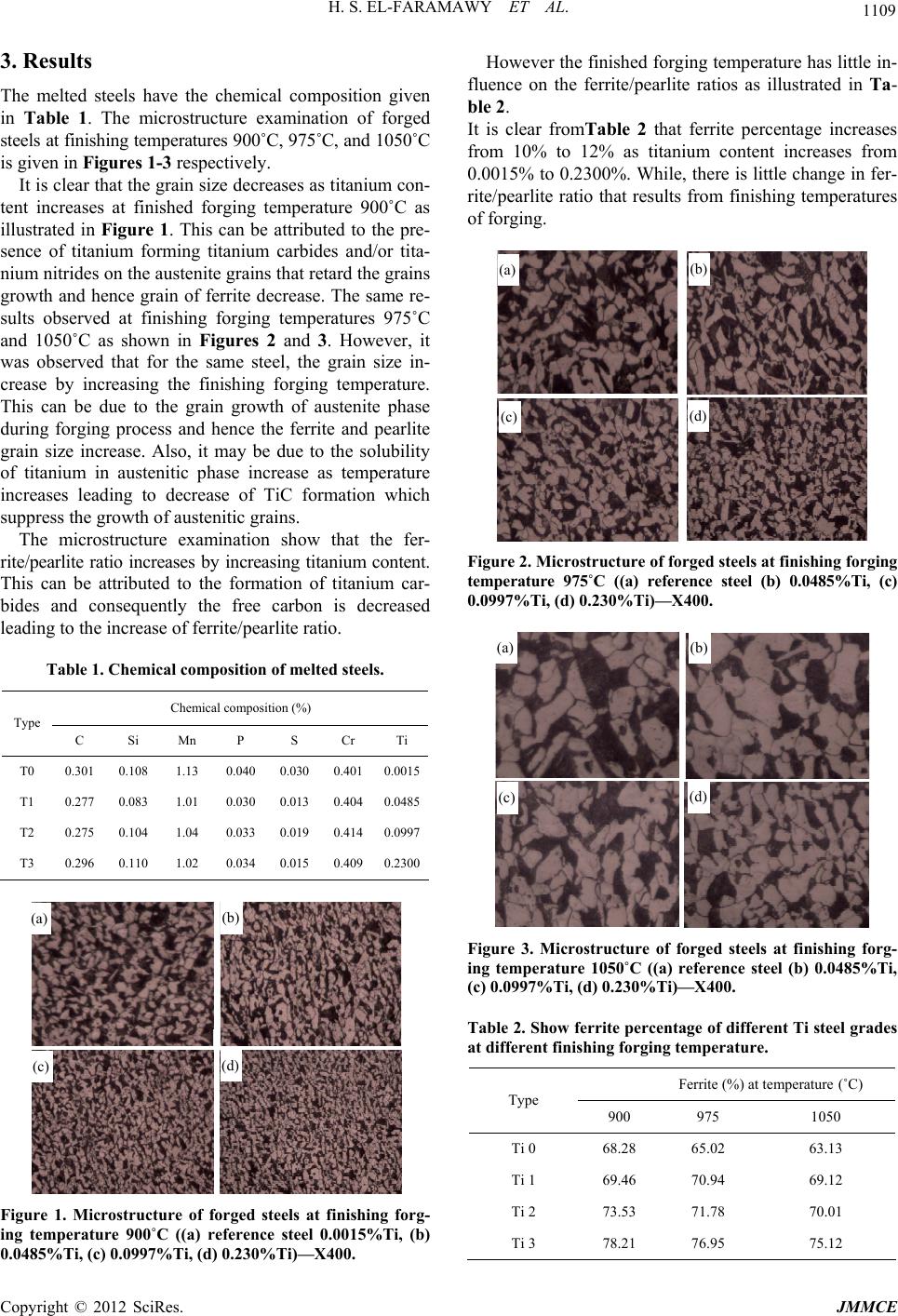 H. S. EL-FARAMAWY ET AL. 1109 3. Results The melted steels have the chemical composition given in Table 1. The microstructure examination of forged steels at finishing temperatures 900˚C, 975˚C, and 1050˚C is given in Figures 1-3 respectively. It is clear that the grain size decreases as titanium con- tent increases at finished forging temperature 900˚C as illustrated in Figure 1. This can be attributed to the pre- sence of titanium forming titanium carbides and/or tita- nium nitrides on the austenite grains th at retard the grains growth and hence grain of ferrite decrease. The same re- sults observed at finishing forging temperatures 975˚C and 1050˚C as shown in Figures 2 and 3. However, it was observed that for the same steel, the grain size in- crease by increasing the finishing forging temperature. This can be due to the grain growth of austenite phase during forging process and hence the ferrite and pearlite grain size increase. Also, it may be due to the solubility of titanium in austenitic phase increase as temperature increases leading to decrease of TiC formation which suppress the growth of austenitic grains. The microstructure examination show that the fer- rite/pearlite ratio increases by increasing titanium content. This can be attributed to the formation of titanium car- bides and consequently the free carbon is decreased leading to the increase of ferrite/pearlite ratio. Table 1. Chemical composition of melted steels. Chemical composition (%) Type C Si Mn P S Cr Ti T0 0.301 0.108 1.13 0.040 0.030 0.4010.0015 T1 0.277 0.083 1.01 0.030 0.013 0.4040.0485 T2 0.275 0.104 1.04 0.033 0.019 0.4140.0997 T3 0.296 0.110 1.02 0.034 0.015 0.4090.2300 (a) (b) (c) (d) Figure 1. Microstructure of forged steels at finishing forg- ing temperature 900˚C ((a) reference steel 0.0015%Ti, (b) 0.0485%Ti, (c) 0.0997%Ti, (d) 0.230%Ti)—X400. However the finished forging temperature has little in- fluence on the ferrite/pearlite ratios as illustrated in Ta - ble 2. It is clear fromTable 2 that ferrite percentage increases from 10% to 12% as titanium content increases from 0.0015% to 0.2300%. While, th ere is little change in fer- rite/pearlite ratio that results from finishing temperatures of forging. (a) (b) (c) (d) Figure 2. Microstructure of forged steels at finishing forging temperature 975˚C ((a) reference steel (b) 0.0485%Ti, (c) 0.0997%Ti, (d) 0.230%Ti)—X400. (a) (b) (c) (d) Figure 3. Microstructure of forged steels at finishing forg- ing temperature 1050˚C ((a) reference steel (b) 0.0485%Ti, (c) 0.0997%Ti, (d) 0.230%Ti)—X400. Table 2. Show ferrite percentage of different Ti steel grades at different finishing forging temperature. Ferrite (%) at temperature (˚C) Type 900 975 1050 Ti 0 68.28 65.02 63.13 Ti 1 69.46 70.94 69.12 Ti 2 73.53 71.78 70.01 Ti 3 78.21 76.95 75.12 Copyright © 2012 SciRes. JMMCE 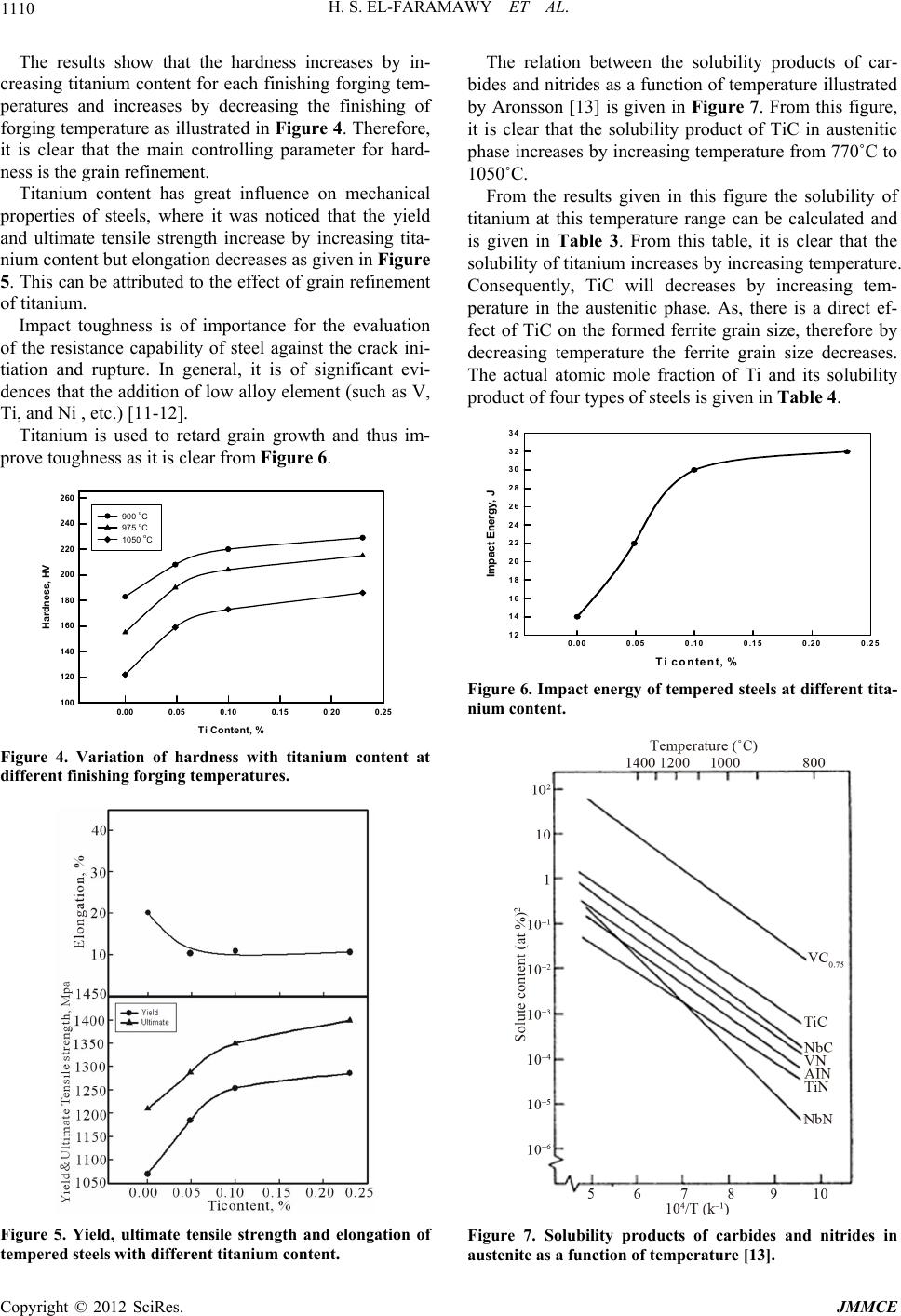 H. S. EL-FARAMAWY ET AL. 1110 The results show that the hardness increases by in- creasing titanium content for each finishing forging tem- peratures and increases by decreasing the finishing of forging temperature as illustrated in Figure 4. Theref ore, it is clear that the main controlling parameter for hard- ness is the grain refinement. Titanium content has great influence on mechanical properties of steels, where it was noticed that the yield and ultimate tensile strength increase by increasing tita- nium content but elongation decreases as given in Figure 5. This can be attributed to the effect of grain refinement of titanium. Impact toughness is of importance for the evaluation of the resistance capability of steel against the crack ini- tiation and rupture. In general, it is of significant evi- dences that the additio n of low alloy element (such as V, Ti, and Ni , etc.) [11-12]. Titanium is used to retard grain growth and thus im- prove toughness as it is clear from Figure 6. Ti Content, % 0.00 0.05 0.10 0.15 0.20 0.25 Hardness, HV 100 120 140 160 180 200 220 240 260 900 oC 975 oC 1050 oC Figure 4. Variation of hardness with titanium content at different finishing forging temperatures. Figure 5. Yield, ultimate tensile strength and elongation of tempered steels with different titanium content. The relation between the solubility products of car- bides and nitrides as a fun ction of temperature illustrated by Aronsson [13] is given in Figure 7. From this figure, it is clear that the solubility product of TiC in austenitic phase increases by increasing temperature from 770˚C to 1050˚C. From the results given in this figure the solubility of titanium at this temperature range can be calculated and is given in Table 3. From this table, it is clear that the solubility of titanium increases by increasing temperature. Consequently, TiC will decreases by increasing tem- perature in the austenitic phase. As, there is a direct ef- fect of TiC on the formed ferrite grain size, therefore by decreasing temperature the ferrite grain size decreases. The actual atomic mole fraction of Ti and its solubility product of four types of steels is given in Table 4. Ti content, % 0.00 0.05 0.10 0.15 0.20 0.25 Impact Energy, J 12 14 16 18 20 22 24 26 28 30 32 34 Figure 6. Impact energy of tempered steels at different tita- nium content. Figure 7. Solubility products of carbides and nitrides in austenite as a function of temperature [13]. Copyright © 2012 SciRes. JMMCE 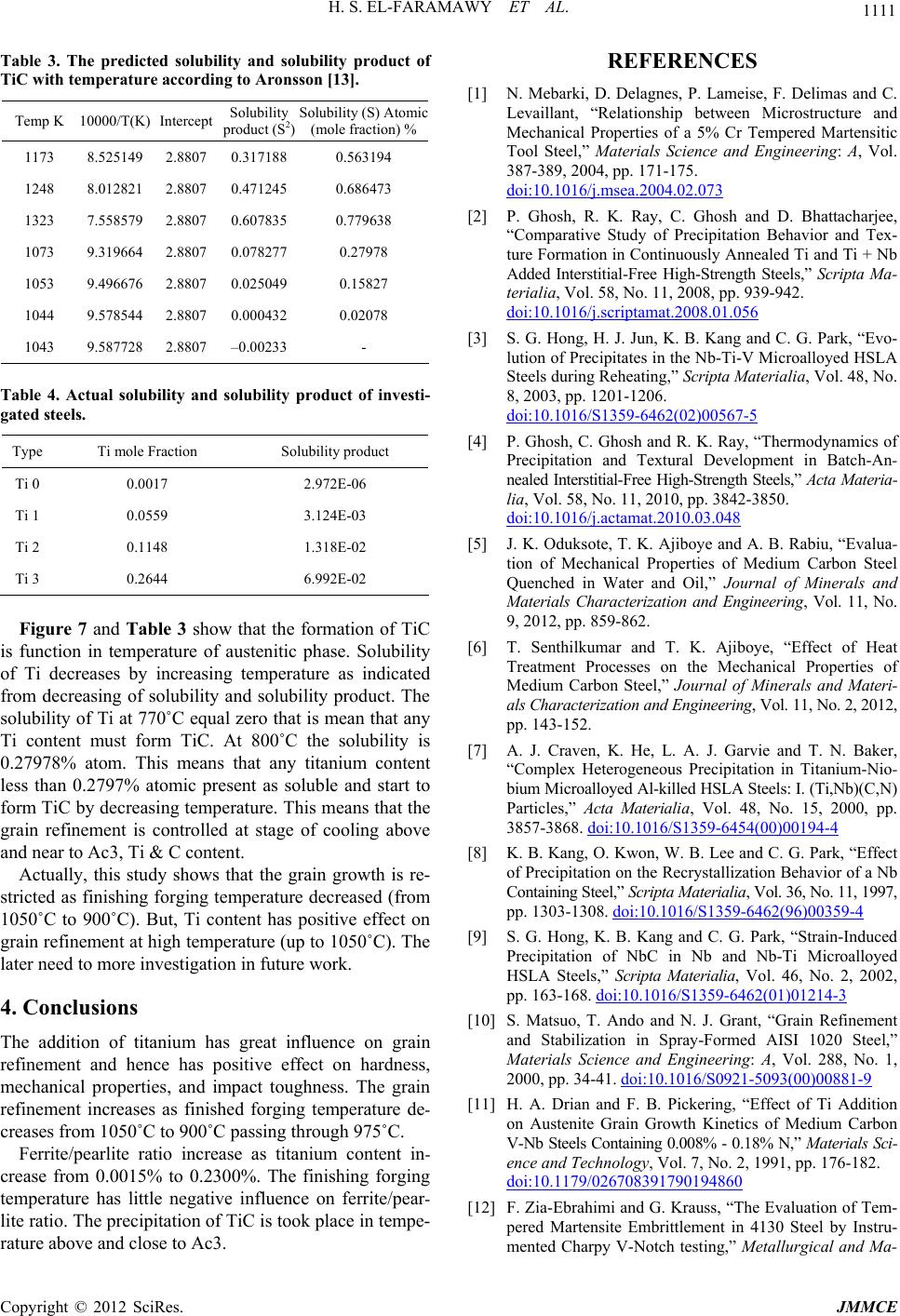 H. S. EL-FARAMAWY ET AL. 1111 Table 3. The predicted solubility and solubility product of Temp K 10000/T(K) Intercept mic TiC with temperature according to Aronsson [13]. Solubility Solubility (S) Ato product (S2) (mole fraction) % 1173 8.525149 2.8807 0.317188 0.563194 1248 8.012821 2.8807 0.471245 0.686473 1323 7.558579 2.8807 0.607835 0.779638 1073 9.319664 2.8807 0.078277 0.27978 1053 9.496676 2.8807 0.025049 0.15827 1044 9.578544 2.8807 0.000432 0.02078 1043 9.587728 2.8807 –0.00233 - able 4. Actual solubility and solubility product of investi- Type Ti mole Fraction Solubility product T gated steels. Ti 0 0.0017 2.972E-06 Ti 1 0.0559 3.124E-03 Ti 2 0.1148 1.318E-02 Ti 3 0.2644 6.992E-02 Figure 7 and Table 3 show that the formation of TiC is the grain growth is re- st 4. Conclusions nium has great influence on grain cr [1] N. Mebarki, D. Delagnes, P. Lameise, F. Delimas and C. Levaillant, “Ricrostructure and Mechanical Prpered Martensitic function in temperature of austenitic phase. Solubility of Ti decreases by increasing temperature as indicated from decreasing of solubility and solubility product. The solubility of Ti at 770˚C equal zero that is mean that any Ti content must form TiC. At 800˚C the solubility is 0.27978% atom. This means that any titanium content less than 0.2797% atomic present as soluble and start to form TiC by decreasing temperature. This means that the grain refinement is controlled at stage of cooling above and near to Ac3, Ti & C content. Actually, this study shows that ricted as finishing forging temperature decreased (from 1050˚C to 900˚C). But, Ti content has positive effect on grain refinement at high temperature (up to 1050˚C). The later need to more investigation in future work. The addition of tita refinement and hence has positive effect on hardness, mechanical properties, and impact toughness. The grain refinement increases as finished forging temperature de- creases fro m 1050˚C to 900˚C passing through 975˚C. Ferrite/pearlite ratio increase as titanium content in- ease from 0.0015% to 0.2300%. The finishing forging temperature has little negative influence on ferrite/pear- lite ratio. The precipitation of TiC is took place in tempe- rature above an d close to Ac3. REFERENCES elationship between M operties of a 5% Cr Tem Tool Steel,” Materials Science and Engineering: A, Vol. 387-389, 2004, pp. 171-175. doi:10.1016/j.msea.2004.02.073 [2] P. Ghosh, R. K. Ray, C. Ghosh and D. Bhattacharjee, “Comparative Study of Precipita ture Formation in Continuously Annealed tion Behavior and Tex- Ti and Ti + Nb Added Interstitial-Free High-Strength Steels,” Scripta Ma- terialia, Vol. 58, No. 11, 2008, pp. 939-942. doi:10.1016/j.scriptamat.2008.01.056 [3] S. G. Hong, H. J. Jun, K. B. Kang and C. G. Park, “Evo- lution of Precipitates in the Nb-Ti-V Microallo Steels during Reheating,” Sc ripta Mateyed HSLA rialia, Vol. 48, No. 8, 2003, pp. 1201-1206. doi:10.1016/S1359-6462(02)00567-5 [4] P. Ghosh, C. Ghosh and R. K. Ray, “Thermodynamics of Precipitation and Textural Developm nealed Interstitial-Free High-Strength Stent in Batch-An- eels,” Acta Materi a- lia, Vol. 58, No. 11, 2010, pp. 3842-3850. doi:10.1016/j.actamat.2010.03.048 [5] J. K. Oduksote, T. K. Ajiboye and A. B. Rabiu, “Evalua- tion of Mechanical Properties of Medium Quenched in Water and Oil,” Jou Carbon Steel rnal of Minerals and ” Journal of Minerals and Materi- oyed Al-killed HSLA Steels: I. (Ti,Nb)(C , N) Materials Characterization and Engineering, Vol. 11, No. 9, 2012, pp. 859-862. [6] T. Senthilkumar and T. K. Ajiboye, “Effect of Heat Treatment Processes on the Mechanical Properties of Medium Carbon Steel, als Characterization and Engi neering, Vol. 11, No. 2, 2012, pp. 143-152. [7] A. J. Craven, K. He, L. A. J. Garvie and T. N. Baker, “Complex Heterogeneous Precipitation in Titanium-Nio- bium Microall Particles,” Acta Materialia, Vol. 48, No. 15, 2000, pp. 3857-3868. doi:10.1016/S1359-6454(00)00194-4 [8] K. B. Kang, O. Kwon, W. B. Lee and C. G. Park, “Effect of Precipitation on the Recrystallization Behavior of a Nb Containi ng Steel,” Scripta Materialia, Vol. 36, No. 11, 1997, pp. 1303-1308. doi:10.1016/S1359-6462(96)00359-4 [9] S. G. Hong, K. B. Kang and C. G. Park, “Strain-Induced Precipitation of NbC in Nb and Nb-Ti Microalloyed HSLA Steels,” Scripta Materialia, Vol. 46, No. 2, 2002, pp. 163-168. doi:10.1016/S1359-6462(01)01214-3 [10] S. Matsuo, T. Ando and N. J. Grant, “Grain Refinement and Stabilization in Spray-Formed AISI 1020 Steel,” Materials Science and Engineering: A, Vol. 288, No. 1, 2000, pp. 34-41. doi:10.1016/S0921-5093(00)00881-9 [11] H. A. Drian and F. B. Pickering, “Effect of Ti Addition on Austenite Grain Growth Kinetics of Medium Carbon V-Nb Steels Containing 0.008% - 0.18% N,” Materi als Sci- ence and Technology, Vol. 7, No. 2, 1991, pp. 176-182. doi:10.1179/026708391790194860 [12] F. Zia-Ebrahimi and G. Krauss, “The Evaluation of Tem- pered Martensite Embrittlement in 4130 Steel by Instru- mented Charpy V-Notch testing,” M etallurgical and Ma- Copyright © 2012 SciRes. JMMCE  H. S. EL-FARAMAWY ET AL. Copyright © 2012 SciRes. JMMCE 1112 , “In Steel Strengthening Mechanisms,” Climax terials Transactions A, Vol. 14A, No. 6, 1983, pp. 1109- 1119. [13] Aronsson Molybdenum Co., Michigan, 1969. |