

Paper Menu >>
Journal Menu >>
 American Journal of Plant Sciences, 2012, 3, 1613-1618 http://dx.doi.org/10.4236/ajps.2012.311195 Published Online November 2012 (http://www.SciRP.org/journal/ajps) 1613 Broadleaf Weed Control and Crop Safety with Premixed Pyrasulfotole and Bromoxynil in Winter Wheat Seshadri S. Reddy1*, Phillip W. Stahlman1, Patrick W. Geier1, Dallas E. Peterson2 1Agricultural Research Center, Kansas State University, Hays, USA; 2Department of Agronomy, Kansas State University, Manhattan, USA. Email: *[email protected] Received August 4th, 2012; revised September 17th, 2012; accepted October 15th, 2012 ABSTRACT For more than two decades acetolactate synthase (ALS) inhibiting herbicides have been the major weed control tools in winter wheat which resulted in selection of resistant weeds to those herbicides. Premixed pyrasulfotole & bromoxynil (Huskie®) is a relatively new herbicide registered for use in wheat in 2008. Pyrasulfotole inhibits 4-hydoxyphenylpy- ruvate dioxygenase (HPPD) enzyme in susceptible plants and is the first significant new mode of action for use in cere- als in more than two decades. Field experiments were conducted from 2007 to 2010 at two locations in Kansas, USA to test the efficacy of pyrasulfotole & bromoxynil for broadleaf weed control and crop safety in winter wheat. Treatments included pyrasulfotole & bromoxynil alone at 253 g·ai·ha−1 and tank mixtures of pyrasulfotole & bromoxynil at 207 g·ai·ha−1 with MCPA at 280 g·ai·ha−1, dicamba at 140 g·ai·ha−1 or metsulfuron-methyl at 4.2 g·ai·ha−1. Herbicides were applied postemergence in fall and spring seasons. Pyrasulfotole & bromoxynil alone or in combination with tank-mix partners, regardless of application time, controlled flixweed, blue mustard, bushy wallflower and field pennycress 98% or more. Henbit control was better when pyrasulfotole & bromoxynil treatments were applied in fall than spring (≥98% vs ≥67%). Pyrasulfotole & bromoxynil alone applied in spring was not effective on wild buckwheat, but tank mixing with dicamba or metsulfuron-methyl controlled wild buckwheat 84% or more. Pyrasulfotole & bromoxynil alone or in tank mixtures caused little (≤7%) or no injury to wheat and the injury did not influence wheat grain yields. Based on excellent control of broadleaf weeds evaluated, pyrasulfotole & bromoxynil is an alternative tool to control ALS-inhibitor resistant weeds in winter wheat. Fall season application and tank mixing with other herbicides are desir- able for effective broad spectrum weed control. Keywords: Huskie®; Henbit; Blue Mustard; Flixweed; Bushy Wallflower; Field Pennycress; Wild Buckwheat; Postemergence; Injury 1. Introduction Wheat (Triticum aestivum L.) is the most important ce- real crop in the USA, where it was planted on 23 million ha in 2012 [1]. Most of the wheat grown in the USA is winter wheat (17 million ha). Kansas state ranks first in winter wheat cultivation (4 million ha) in the USA [1]. Winter wheat is not a good competitor with some broad- leaf weeds even when wheat emerges before weeds [2]. Common weeds found in winter wheat in the US are blue mustard [Chorispora tenella (Pallas) DC.], henbit (La- mium amplexicaule L.), flixweed [Descurainia sophia (L.) Webb. Ex Prantl], bushy wallflower (Erysimum re- pandum L.), field pennycress (Thlaspi arvense L.), wild buckwheat (Polygonum convolvulus), shepherd’s purse [Capsella bursa-pastoris (L.) Medik.], and pinnate tan- symustard [Descurainia pinnata (Walt.) Britt.]. Their interference can cause significant yield reduction in win- ter wheat. Season-long competition of 11, 33, and 98 blue mustard plants·m−2 reduced wheat grain yields by 28%, 42%, and 51%, respectively [2]. Conley and Brad- ley (2005) [3] reported yield reductions of 13 and 38% because of henbit interference at 82 and 155 plants·m−2, respectively. Northam et al. (1993) [4] also reported wheat grain yield loss of 48% with 221 henbit plants·m−2. Bushy wallflower at 272 plants·m−2 reduced wheat yields by 25% [5]. Hence, winter annual broadleaf weed control is very important for successful wheat production. For more than two decades acetolactate synthase (ALS)-inhibiting herbicides have been primary herbi- cides used in winter wheat, however continuous usage of those herbicides led to selection of ALS-inhibitor resis- tant weeds. Currently 126 ALS-inhibitor resistant weed species have been reported worldwide; 45 in the USA [6]. Bushy wallflower and flixweed, two common broadleaf *Corresponding author. Copyright © 2012 SciRes. AJPS 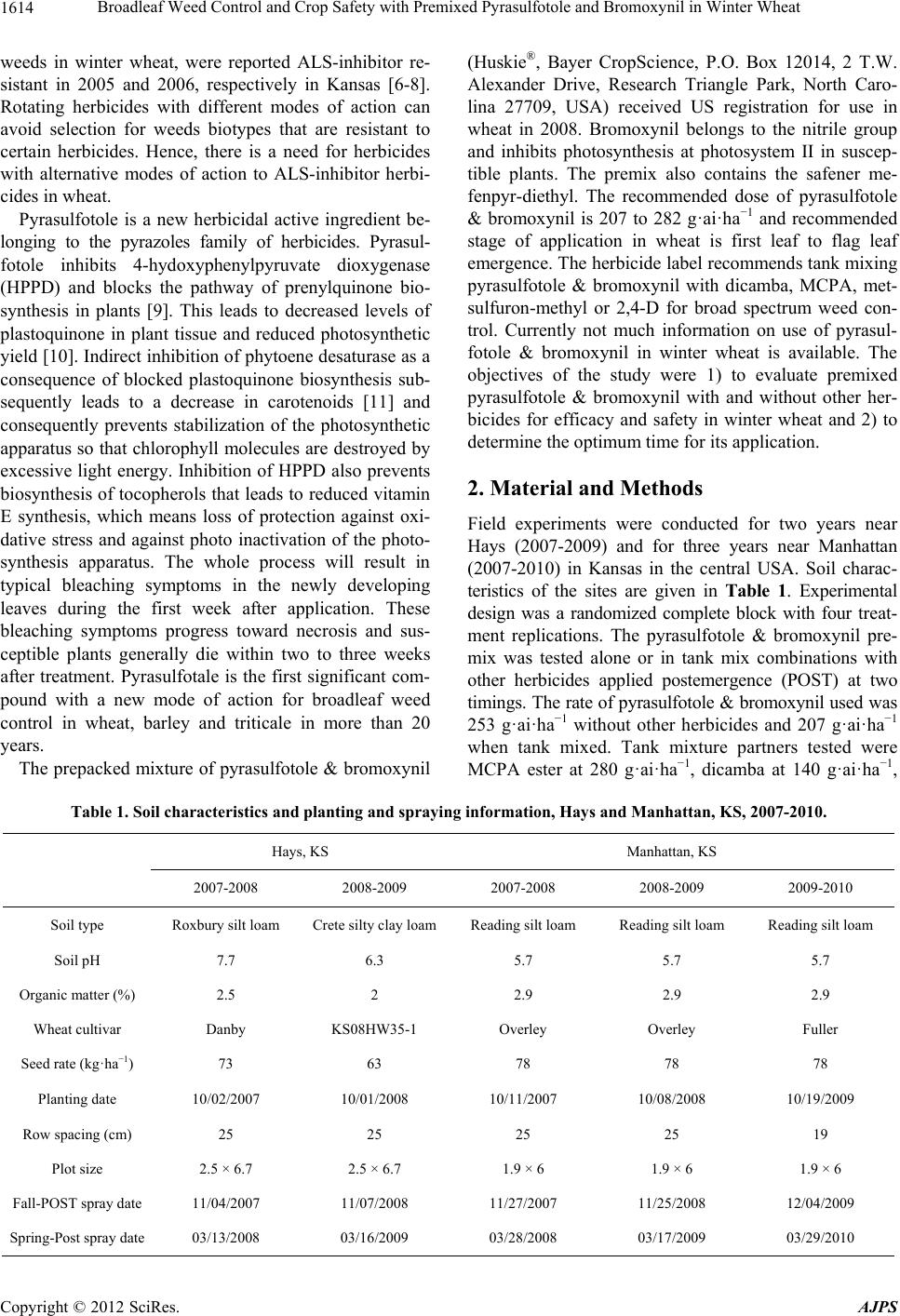 Broadleaf Weed Control and Crop Safety with Premixed Pyrasulfotole and Bromoxynil in Winter Wheat 1614 weeds in winter wheat, were reported ALS-inhibitor re- sistant in 2005 and 2006, respectively in Kansas [6-8]. Rotating herbicides with different modes of action can avoid selection for weeds biotypes that are resistant to certain herbicides. Hence, there is a need for herbicides with alternative modes of action to ALS-inhibitor herbi- cides in wheat. Pyrasulfotole is a new herbicidal active ingredient be- longing to the pyrazoles family of herbicides. Pyrasul- fotole inhibits 4-hydoxyphenylpyruvate dioxygenase (HPPD) and blocks the pathway of prenylquinone bio- synthesis in plants [9]. This leads to decreased levels of plastoquinone in plant tissue and reduced photosynthetic yield [10]. Indirect inhibition of phytoene desaturase as a consequence of blocked plastoquinone biosynthesis sub- sequently leads to a decrease in carotenoids [11] and consequently prevents stabilization of the photosynthetic apparatus so that chlorophyll molecules are destroyed by excessive light energy. Inhibition of HPPD also prevents biosynthesis of tocopherols that leads to reduced vitamin E synthesis, which means loss of protection against oxi- dative stress and against photo inactivation of the photo- synthesis apparatus. The whole process will result in typical bleaching symptoms in the newly developing leaves during the first week after application. These bleaching symptoms progress toward necrosis and sus- ceptible plants generally die within two to three weeks after treatment. Pyrasulfotale is the first significant com- pound with a new mode of action for broadleaf weed control in wheat, barley and triticale in more than 20 years. The prepacked mixture of pyrasulfotole & bromoxynil (Huskie®, Bayer CropScience, P.O. Box 12014, 2 T.W. Alexander Drive, Research Triangle Park, North Caro- lina 27709, USA) received US registration for use in wheat in 2008. Bromoxynil belongs to the nitrile group and inhibits photosynthesis at photosystem II in suscep- tible plants. The premix also contains the safener me- fenpyr-diethyl. The recommended dose of pyrasulfotole & bromoxynil is 207 to 282 g·ai·ha−1 and recommended stage of application in wheat is first leaf to flag leaf emergence. The herbicide label recommends tank mixing pyrasulfotole & bromoxynil with dicamba, MCPA, met- sulfuron-methyl or 2,4-D for broad spectrum weed con- trol. Currently not much information on use of pyrasul- fotole & bromoxynil in winter wheat is available. The objectives of the study were 1) to evaluate premixed pyrasulfotole & bromoxynil with and without other her- bicides for efficacy and safety in winter wheat and 2) to determine the optimum time for its application. 2. Material and Methods Field experiments were conducted for two years near Hays (2007-2009) and for three years near Manhattan (2007-2010) in Kansas in the central USA. Soil charac- teristics of the sites are given in Table 1. Experimental design was a randomized complete block with four treat- ment replications. The pyrasulfotole & bromoxynil pre- mix was tested alone or in tank mix combinations with other herbicides applied postemergence (POST) at two timings. The rate of pyrasulfotole & bromoxynil used was 253 g·ai·ha−1 without other herbicides and 207 g·ai·ha−1 when tank mixed. Tank mixture partners tested were MCPA ester at 280 g·ai·ha−1, dicamba at 140 g·ai·ha−1, Table 1. Soil characteristics and planting and spraying information, Hays and Manhattan, KS, 2007-2010. Hays, KS Manhattan, KS 2007-2008 2008-2009 2007-2008 2008-2009 2009-2010 Soil type Roxbury silt loam Crete silty clay loamReading silt loam Reading silt loam Reading silt loam Soil pH 7.7 6.3 5.7 5.7 5.7 Organic matter (%) 2.5 2 2.9 2.9 2.9 Wheat cultivar Danby KS08HW35-1 Overley Overley Fuller Seed rate (kg·ha−1) 73 63 78 78 78 Planting date 10/02/2007 10/01/2008 10/11/2007 10/08/2008 10/19/2009 Row spacing (cm) 25 25 25 25 19 Plot size 2.5 × 6.7 2.5 × 6.7 1.9 × 6 1.9 × 6 1.9 × 6 Fall-POST spray date 11/04/2007 11/07/2008 11/27/2007 11/25/2008 12/04/2009 Spring-Post spray date 03/13/2008 03/16/2009 03/28/2008 03/17/2009 03/29/2010 Copyright © 2012 SciRes. AJPS 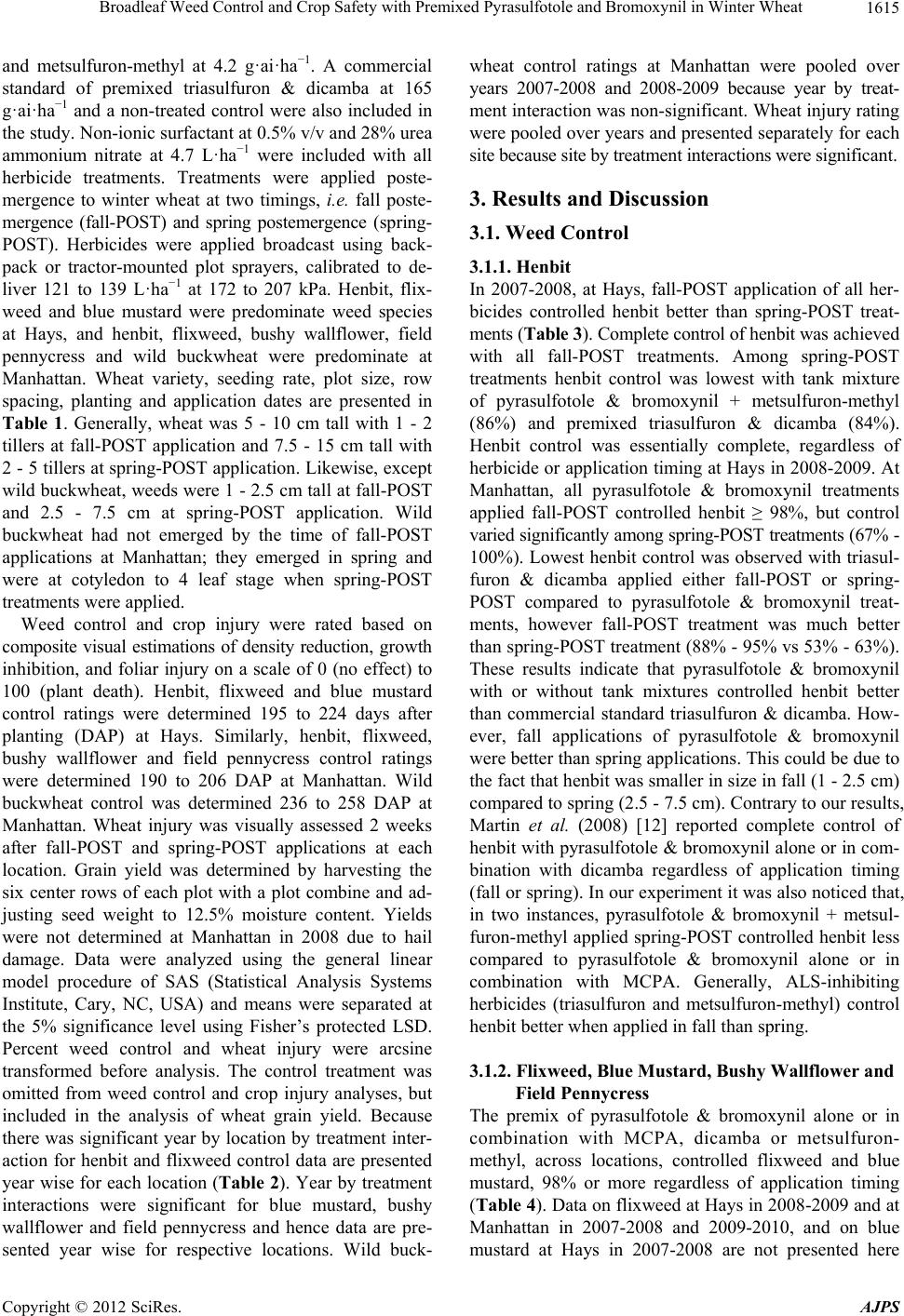 Broadleaf Weed Control and Crop Safety with Premixed Pyrasulfotole and Bromoxynil in Winter Wheat 1615 and metsulfuron-methyl at 4.2 g·ai·ha−1. A commercial standard of premixed triasulfuron & dicamba at 165 g·ai·ha−1 and a non-treated control were also included in the study. Non-ionic surfactant at 0.5% v/v and 28% urea ammonium nitrate at 4.7 L·ha−1 were included with all herbicide treatments. Treatments were applied poste- mergence to winter wheat at two timings, i.e. fall poste- mergence (fall-POST) and spring postemergence (spring- POST). Herbicides were applied broadcast using back- pack or tractor-mounted plot sprayers, calibrated to de- liver 121 to 139 L·ha−1 at 172 to 207 kPa. Henbit, flix- weed and blue mustard were predominate weed species at Hays, and henbit, flixweed, bushy wallflower, field pennycress and wild buckwheat were predominate at Manhattan. Wheat variety, seeding rate, plot size, row spacing, planting and application dates are presented in Table 1. Generally, wheat was 5 - 10 cm tall with 1 - 2 tillers at fall-POST application and 7.5 - 15 cm tall with 2 - 5 tillers at spring-POST application. Likewise, except wild buckwheat, weeds were 1 - 2.5 cm tall at fall-POST and 2.5 - 7.5 cm at spring-POST application. Wild buckwheat had not emerged by the time of fall-POST applications at Manhattan; they emerged in spring and were at cotyledon to 4 leaf stage when spring-POST treatments were applied. Weed control and crop injury were rated based on composite visual estimations of density reduction, growth inhibition, and foliar injury on a scale of 0 (no effect) to 100 (plant death). Henbit, flixweed and blue mustard control ratings were determined 195 to 224 days after planting (DAP) at Hays. Similarly, henbit, flixweed, bushy wallflower and field pennycress control ratings were determined 190 to 206 DAP at Manhattan. Wild buckwheat control was determined 236 to 258 DAP at Manhattan. Wheat injury was visually assessed 2 weeks after fall-POST and spring-POST applications at each location. Grain yield was determined by harvesting the six center rows of each plot with a plot combine and ad- justing seed weight to 12.5% moisture content. Yields were not determined at Manhattan in 2008 due to hail damage. Data were analyzed using the general linear model procedure of SAS (Statistical Analysis Systems Institute, Cary, NC, USA) and means were separated at the 5% significance level using Fisher’s protected LSD. Percent weed control and wheat injury were arcsine transformed before analysis. The control treatment was omitted from weed control and crop injury analyses, but included in the analysis of wheat grain yield. Because there was significant year by location by treatment inter- action for henbit and flixweed control data are presented year wise for each location (Table 2). Year by treatment interactions were significant for blue mustard, bushy wallflower and field pennycress and hence data are pre- sented year wise for respective locations. Wild buck- wheat control ratings at Manhattan were pooled over years 2007-2008 and 2008-2009 because year by treat- ment interaction was non-significant. Wheat injury rating were pooled over years and presented separately for each site because site by treatment interactions were significant. 3. Results and Discussion 3.1. Weed Control 3.1.1. Henb it In 2007-2008, at Hays, fall-POST application of all her- bicides controlled henbit better than spring-POST treat- ments (Ta b le 3 ). Complete control of henbit was achieved with all fall-POST treatments. Among spring-POST treatments henbit control was lowest with tank mixture of pyrasulfotole & bromoxynil + metsulfuron-methyl (86%) and premixed triasulfuron & dicamba (84%). Henbit control was essentially complete, regardless of herbicide or application timing at Hays in 2008-2009. At Manhattan, all pyrasulfotole & bromoxynil treatments applied fall-POST controlled henbit ≥ 98%, but control varied significantly among spring-POST treatments (67% - 100%). Lowest henbit control was observed with triasul- furon & dicamba applied either fall-POST or spring- POST compared to pyrasulfotole & bromoxynil treat- ments, however fall-POST treatment was much better than spring-POST treatment (88% - 95% vs 53% - 63%). These results indicate that pyrasulfotole & bromoxynil with or without tank mixtures controlled henbit better than commercial standard triasulfuron & dicamba. How- ever, fall applications of pyrasulfotole & bromoxynil were better than spring applications. This could be due to the fact that henbit was smaller in size in fall (1 - 2.5 cm) compared to spring (2.5 - 7.5 cm). Contrary to our results, Martin et al. (2008) [12] reported complete control of henbit with pyrasulfotole & bromoxynil alone or in com- bination with dicamba regardless of application timing (fall or spring). In our experiment it was also noticed that, in two instances, pyrasulfotole & bromoxynil + metsul- furon-methyl applied spring-POST controlled henbit less compared to pyrasulfotole & bromoxynil alone or in combination with MCPA. Generally, ALS-inhibiting herbicides (triasulfuron and metsulfuron-methyl) control henbit better when applied in fall than spring. 3.1.2. Flixweed, Blue Mustard, Bushy Wallflower and Field Pennycress The premix of pyrasulfotole & bromoxynil alone or in combination with MCPA, dicamba or metsulfuron- methyl, across locations, controlled flixweed and blue mustard, 98% or more regardless of application timing (Table 4). Data on flixweed at Hays in 2008-2009 and at Manhattan in 2007-2008 and 2009-2010, and on blue mustard at Hays in 2007-2 08 are not presented here 0 Copyright © 2012 SciRes. AJPS 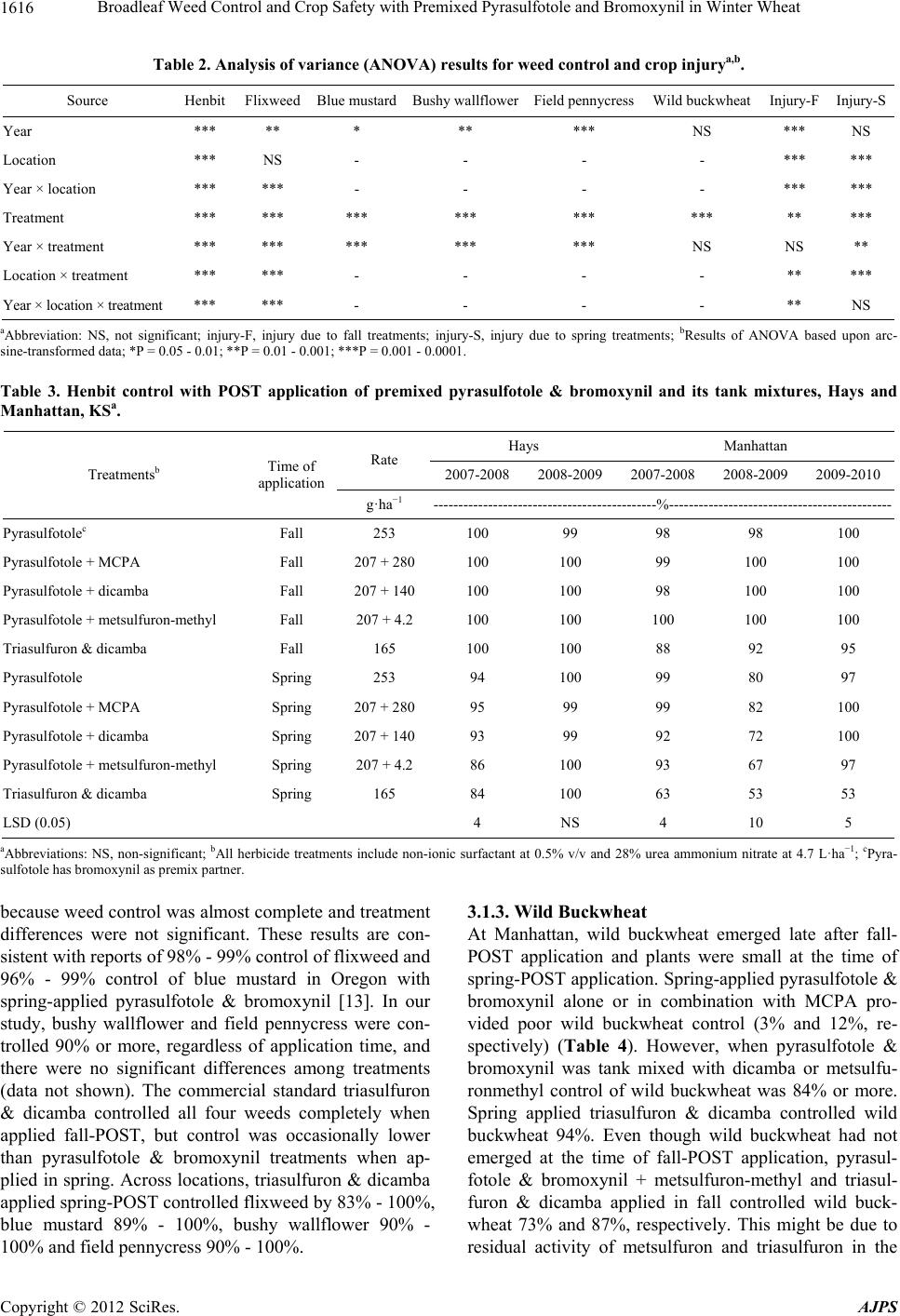 Broadleaf Weed Control and Crop Safety with Premixed Pyrasulfotole and Bromoxynil in Winter Wheat 1616 Table 2. Analysis of variance (ANOVA) results for weed control and crop injurya,b. Source HenbitFlixweed Blue mustardBushy wallflowerField pennycressWild buckwheat Injury-FInjury-S Year *** ** * ** *** NS *** NS Location *** NS - - - - *** *** Year × location *** *** - - - - *** *** Treatment *** *** *** *** *** *** ** *** Year × treatment *** *** *** *** *** NS NS ** Location × treatment *** *** - - - - ** *** Year × location × treatment *** *** - - - - ** NS aAbbreviation: NS, not significant; injury-F, injury due to fall treatments; injury-S, injury due to spring treatments; bResults of ANOVA based upon arc- sine-transformed data; *P = 0.05 - 0.01; **P = 0.01 - 0.001; ***P = 0.001 - 0.0001. Table 3. Henbit control with POST application of premixed pyrasulfotole & bromoxynil and its tank mixtures, Hays and Manhattan, KSa. Hays Manhattan Rate 2007-2008 2008-2009 2007-2008 2008-2009 2009-2010 Treatmentsb Time of application g·ha−1 ---------------------------------------------%--------------------------------------------- Pyrasulfotolec Fall 253 100 99 98 98 100 Pyrasulfotole + MCPA Fall 207 + 280 100 100 99 100 100 Pyrasulfotole + dicamba Fall 207 + 140 100 100 98 100 100 Pyrasulfotole + metsulfuron-methyl Fall 207 + 4.2 100 100 100 100 100 Triasulfuron & dicamba Fall 165 100 100 88 92 95 Pyrasulfotole Spring 253 94 100 99 80 97 Pyrasulfotole + MCPA Spring 207 + 280 95 99 99 82 100 Pyrasulfotole + dicamba Spring 207 + 140 93 99 92 72 100 Pyrasulfotole + metsulfuron-methyl Spring 207 + 4.2 86 100 93 67 97 Triasulfuron & dicamba Spring 165 84 100 63 53 53 LSD (0.05) 4 NS 4 10 5 aAbbreviations: NS, non-significant; bAll herbicide treatments include non-ionic surfactant at 0.5% v/v and 28% urea ammonium nitrate at 4.7 L·ha−1; cPyra- sulfotole has bromoxynil as premix partner. because weed control was almost complete and treatment differences were not significant. These results are con- sistent with reports of 98% - 99% control of flixweed and 96% - 99% control of blue mustard in Oregon with spring-applied pyrasulfotole & bromoxynil [13]. In our study, bushy wallflower and field pennycress were con- trolled 90% or more, regardless of application time, and there were no significant differences among treatments (data not shown). The commercial standard triasulfuron & dicamba controlled all four weeds completely when applied fall-POST, but control was occasionally lower than pyrasulfotole & bromoxynil treatments when ap- plied in spring. Across locations, triasulfuron & dicamba applied spring-POST controlled flixweed by 83% - 100%, blue mustard 89% - 100%, bushy wallflower 90% - 100% and field pennycress 90% - 100%. 3.1.3. Wi ld Buckwh eat At Manhattan, wild buckwheat emerged late after fall- POST application and plants were small at the time of spring-POST application. Spring-applied pyrasulfotole & bromoxynil alone or in combination with MCPA pro- vided poor wild buckwheat control (3% and 12%, re- spectively) (Table 4). However, when pyrasulfotole & bromoxynil was tank mixed with dicamba or metsulfu- ronmethyl control of wild buckwheat was 84% or more. Spring applied triasulfuron & dicamba controlled wild buckwheat 94%. Even though wild buckwheat had not emerged at the time of fall-POST application, pyrasul- fotole & bromoxynil + metsulfuron-methyl and triasul- furon & dicamba applied in fall controlled wild buck- wheat 73% and 87%, respectively. This might be due to residual activity of metsulfuron and triasulfuron in the Copyright © 2012 SciRes. AJPS 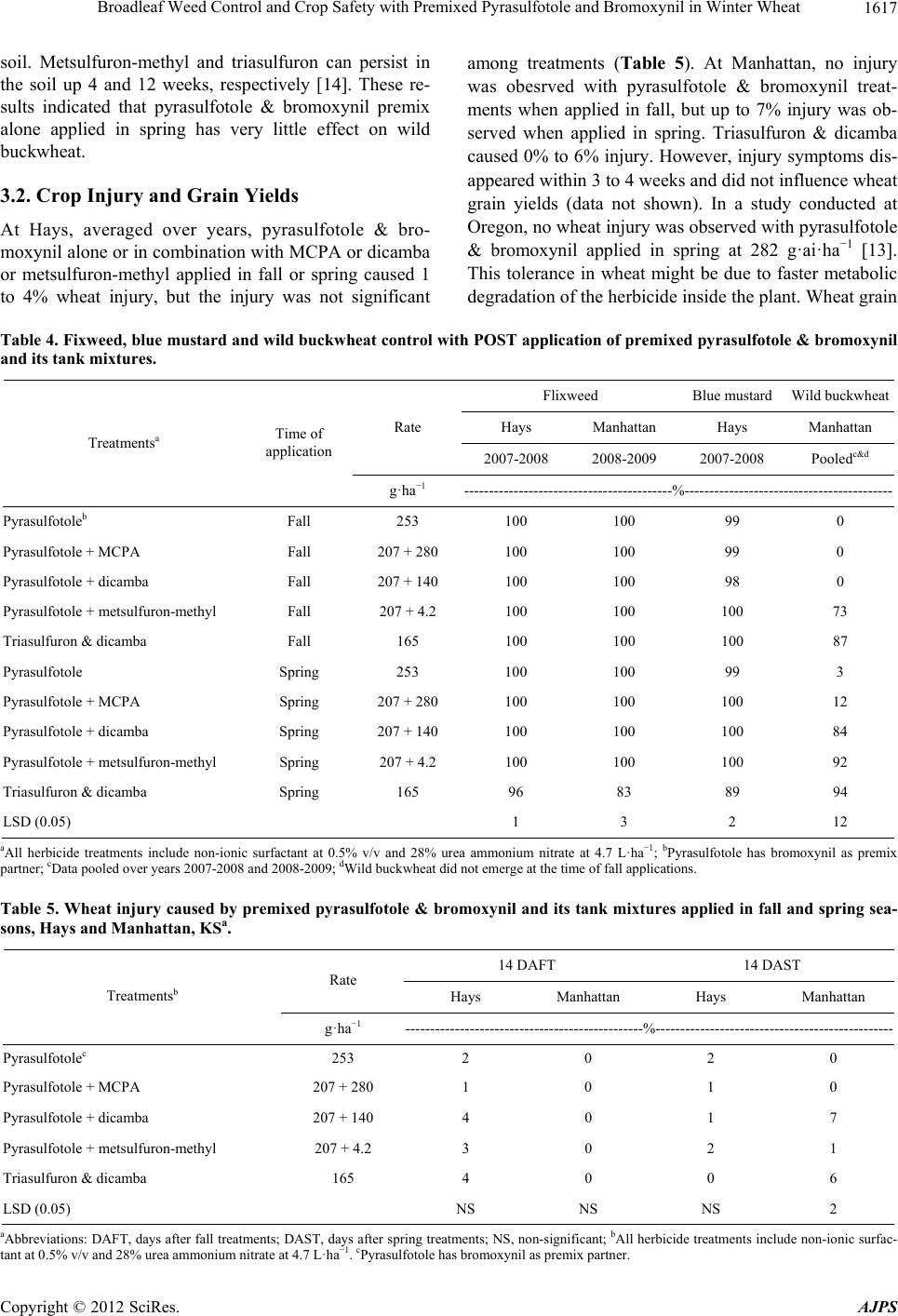 Broadleaf Weed Control and Crop Safety with Premixed Pyrasulfotole and Bromoxynil in Winter Wheat 1617 soil. Metsulfuron-methyl and triasulfuron can persist in the soil up 4 and 12 weeks, respectively [14]. These re- sults indicated that pyrasulfotole & bromoxynil premix alone applied in spring has very little effect on wild buckwheat. 3.2. Crop Injury and Grain Yields At Hays, averaged over years, pyrasulfotole & bro- moxynil alone or in combination with MCPA or dicamba or metsulfuron-methyl applied in fall or spring caused 1 to 4% wheat injury, but the injury was not significant among treatments (Table 5). At Manhattan, no injury was obesrved with pyrasulfotole & bromoxynil treat- ments when applied in fall, but up to 7% injury was ob- served when applied in spring. Triasulfuron & dicamba caused 0% to 6% injury. However, injury symptoms dis- appeared within 3 to 4 weeks and did not influence wheat grain yields (data not shown). In a study conducted at Oregon, no wheat injury was observed with pyrasulfotole & bromoxynil applied in spring at 282 g·ai·ha−1 [13]. This tolerance in wheat might be due to faster metabolic degradation of the herbicide inside the plant. Wheat grain Table 4. Fixweed, blue mustar d and wild buckwheat control with POST application of premixed pyrasulfotole & bromoxynil and its tank mixtures. Flixweed Blue mustard Wild buckwheat Hays Manhattan Hays Manhattan Rate 2007-2008 2008-2009 2007-2008 Pooledc&d Treatmentsa Time of application g·ha−1 ------------------------------------------%------------------------------------------ Pyrasulfotoleb Fall 253 100 100 99 0 Pyrasulfotole + MCPA Fall 207 + 280 100 100 99 0 Pyrasulfotole + dicamba Fall 207 + 140 100 100 98 0 Pyrasulfotole + metsulfuron-methyl Fall 207 + 4.2 100 100 100 73 Triasulfuron & dicamba Fall 165 100 100 100 87 Pyrasulfotole Spring 253 100 100 99 3 Pyrasulfotole + MCPA Spring 207 + 280 100 100 100 12 Pyrasulfotole + dicamba Spring 207 + 140 100 100 100 84 Pyrasulfotole + metsulfuron-methyl Spring 207 + 4.2 100 100 100 92 Triasulfuron & dicamba Spring 165 96 83 89 94 LSD (0.05) 1 3 2 12 aAll herbicide treatments include non-ionic surfactant at 0.5% v/v and 28% urea ammonium nitrate at 4.7 L·ha−1; bPyrasulfotole has bromoxynil as premix partner; cData pooled over years 2007-2008 and 2008-2009; dWild buckwheat did not emerge at the time of fall applications. Table 5. Wheat injury caused by premixed pyrasulfotole & bromoxynil and its tank mixtures applied in fall and spring sea- sons, Hays and Manhattan, KSa. 14 DAFT 14 DAST Rate Hays Manhattan Hays Manhattan Treatmentsb g·ha−1 ------------------------------------------------%------------------------------------------------ Pyrasulfotolec 253 2 0 2 0 Pyrasulfotole + MCPA 207 + 280 1 0 1 0 Pyrasulfotole + dicamba 207 + 140 4 0 1 7 Pyrasulfotole + metsulfuron-methyl 207 + 4.2 3 0 2 1 Triasulfuron & dicamba 165 4 0 0 6 LSD (0.05) NS NS NS 2 aAbbreviations: DAFT, days after fall treatments; DAST, days after spring treatments; NS, non-significant; bAll herbicide treatments include non-ionic surfac- tant at 0.5% v/v and 28% urea ammonium nitrate at 4.7 L·ha−1. cPyrasulfotole has bromoxynil as premix partner. Copyright © 2012 SciRes. AJPS 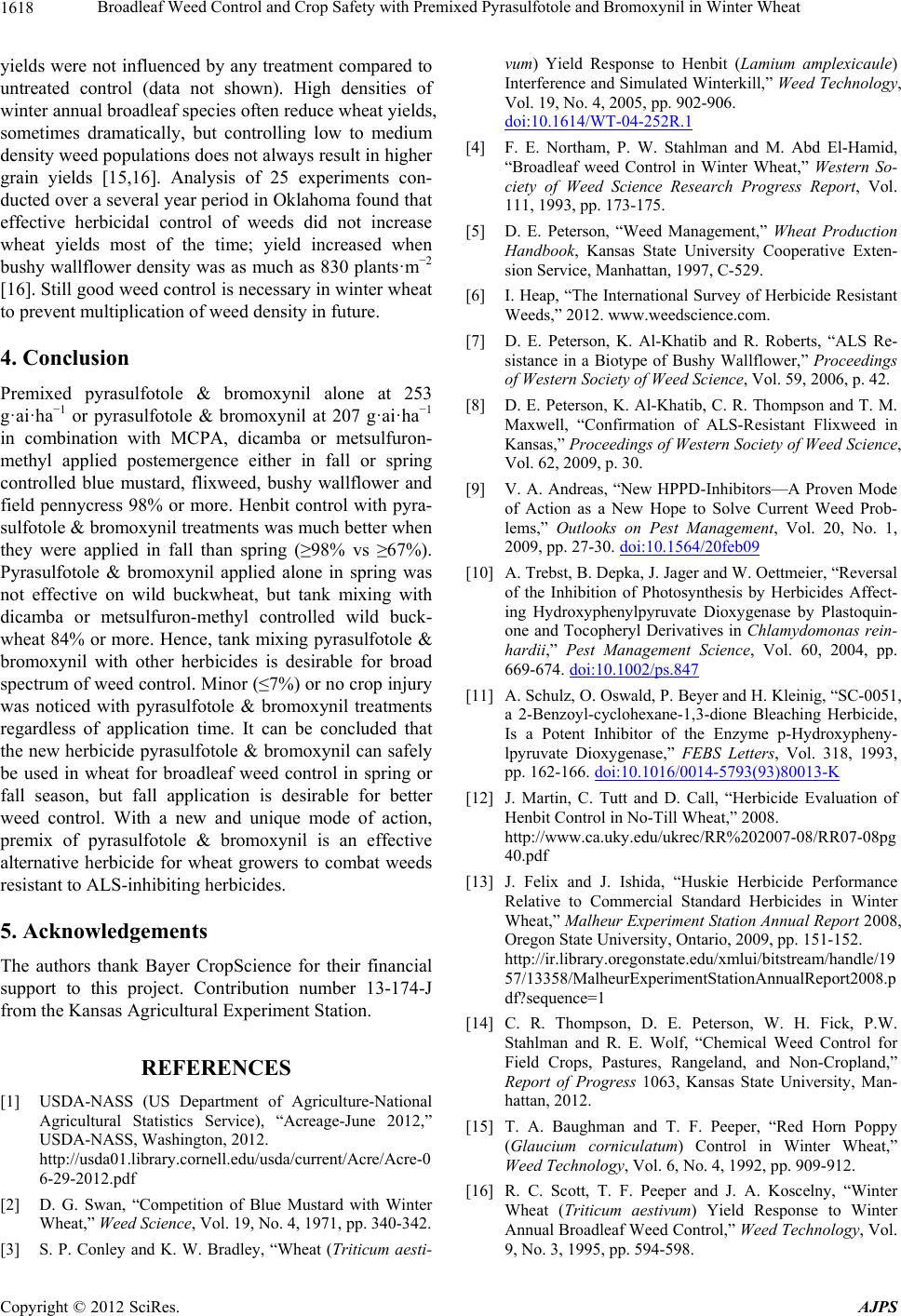 Broadleaf Weed Control and Crop Safety with Premixed Pyrasulfotole and Bromoxynil in Winter Wheat 1618 yields were not influenced by any treatment compared to untreated control (data not shown). High densities of winter annual broadleaf species often reduce wheat yields, sometimes dramatically, but controlling low to medium density weed populations does not always result in higher grain yields [15,16]. Analysis of 25 experiments con- ducted over a several year period in Oklahoma found that effective herbicidal control of weeds did not increase wheat yields most of the time; yield increased when bushy wallflower density was as much as 830 plants·m−2 [16]. Still good weed control is necessary in winter wheat to prevent multiplication of weed density in future. 4. Conclusion Premixed pyrasulfotole & bromoxynil alone at 253 g·ai·ha−1 or pyrasulfotole & bromoxynil at 207 g·ai·ha−1 in combination with MCPA, dicamba or metsulfuron- methyl applied postemergence either in fall or spring controlled blue mustard, flixweed, bushy wallflower and field pennycress 98% or more. Henbit control with pyra- sulfotole & bromoxynil treatments was much better when they were applied in fall than spring (≥98% vs ≥67%). Pyrasulfotole & bromoxynil applied alone in spring was not effective on wild buckwheat, but tank mixing with dicamba or metsulfuron-methyl controlled wild buck- wheat 84% or more. Hence, tank mixing pyrasulfotole & bromoxynil with other herbicides is desirable for broad spectrum of weed control. Minor (≤7%) or no crop injury was noticed with pyrasulfotole & bromoxynil treatments regardless of application time. It can be concluded that the new herbicide pyrasulfotole & bromoxynil can safely be used in wheat for broadleaf weed control in spring or fall season, but fall application is desirable for better weed control. With a new and unique mode of action, premix of pyrasulfotole & bromoxynil is an effective alternative herbicide for wheat growers to combat weeds resistant to ALS-inhibiting herbicides. 5. Acknowledgements The authors thank Bayer CropScience for their financial support to this project. Contribution number 13-174-J from the Kansas Agricultural Experiment Station. REFERENCES [1] USDA-NASS (US Department of Agriculture-National Agricultural Statistics Service), “Acreage-June 2012,” USDA-NASS, Washington, 2012. http://usda01.library.cornell.edu/usda/current/Acre/Acre-0 6-29-2012.pdf [2] D. G. Swan, “Competition of Blue Mustard with Winter Wheat,” Weed Scie nce, Vol. 19, No. 4, 1971, pp. 340-342. [3] S. P. Conley and K. W. Bradley, “Wheat (Triticum aesti- vum) Yield Response to Henbit (Lamium amplexicaule) Interference and Simulated Winterkill,” Weed Technology, Vol. 19, No. 4, 2005, pp. 902-906. doi:10.1614/WT-04-252R.1 [4] F. E. Northam, P. W. Stahlman and M. Abd El-Hamid, “Broadleaf weed Control in Winter Wheat,” Western So- ciety of Weed Science Research Progress Report, Vol. 111, 1993, pp. 173-175. [5] D. E. Peterson, “Weed Management,” Wheat Production Handbook, Kansas State University Cooperative Exten- sion Service, Manhattan, 1997, C-529. [6] I. Heap, “The International Survey of Herbicide Resistant Weeds,” 2012. www.weedscience.com. [7] D. E. Peterson, K. Al-Khatib and R. Roberts, “ALS Re- sistance in a Biotype of Bushy Wallflower,” Proceedings of Western Society of Weed Science, Vol. 59, 2006, p. 42. [8] D. E. Peterson, K. Al-Khatib, C. R. Thompson and T. M. Maxwell, “Confirmation of ALS-Resistant Flixweed in Kansas,” Proceedings of Western Society of Weed Science, Vol. 62, 2009, p. 30. [9] V. A. Andreas, “New HPPD-Inhibitors—A Proven Mode of Action as a New Hope to Solve Current Weed Prob- lems,” Outlooks on Pest Management, Vol. 20, No. 1, 2009, pp. 27-30. doi:10.1564/20feb09 [10] A. Trebst, B. Depka, J. Jager and W. Oettmeier, “Reversal of the Inhibition of Photosynthesis by Herbicides Affect- ing Hydroxyphenylpyruvate Dioxygenase by Plastoquin- one and Tocopheryl Derivatives in Chlamydomonas rein- hardii,” Pest Management Science, Vol. 60, 2004, pp. 669-674. doi:10.1002/ps.847 [11] A. Schulz, O. Oswald, P. Beyer and H. Kleinig, “SC-0051, a 2-Benzoyl-cyclohexane-1,3-dione Bleaching Herbicide, Is a Potent Inhibitor of the Enzyme p-Hydroxypheny- lpyruvate Dioxygenase,” FEBS Letters, Vol. 318, 1993, pp. 162-166. doi:10.1016/0014-5793(93)80013-K [12] J. Martin, C. Tutt and D. Call, “Herbicide Evaluation of Henbit Control in No-Till Wheat,” 2008. http://www.ca.uky.edu/ukrec/RR%202007-08/RR07-08pg 40.pdf [13] J. Felix and J. Ishida, “Huskie Herbicide Performance Relative to Commercial Standard Herbicides in Winter Wheat,” Malheur Experiment Station Annual Report 2008, Oregon State University, Ontario, 2009, pp. 151-152. http://ir.library.oregonstate.edu/xmlui/bitstream/handle/19 57/13358/MalheurExperimentStationAnnualReport2008.p df?sequence=1 [14] C. R. Thompson, D. E. Peterson, W. H. Fick, P.W. Stahlman and R. E. Wolf, “Chemical Weed Control for Field Crops, Pastures, Rangeland, and Non-Cropland,” Report of Progress 1063, Kansas State University, Man- hattan, 2012. [15] T. A. Baughman and T. F. Peeper, “Red Horn Poppy (Glaucium corniculatum) Control in Winter Wheat,” Weed Technology, Vol. 6, No. 4, 1992, pp. 909-912. [16] R. C. Scott, T. F. Peeper and J. A. Koscelny, “Winter Wheat (Triticum aestivum) Yield Response to Winter Annual Broadleaf Weed Control,” Weed Technology, Vol. 9, No. 3, 1995, pp. 594-598. Copyright © 2012 SciRes. AJPS |