

Paper Menu >>
Journal Menu >>
 American Journal of Plant Sciences, 2012, 3, 1608-1612 http://dx.doi.org/10.4236/ajps.2012.311194 Published Online November 2012 (http://www.SciRP.org/journal/ajps) Effects of the Pesticide Furadan on Traits Associated with Reproduction in Wild Potato Species Alfonso del Rio1, John Bamberg1, Ruth Centeno-Diaz2, Alberto Salas2, William Roca2, David Tay2 1USDA/Agriculture Research Service, US Potato Genebank, Wisconsin, USA; 2International Potato Center (CIP), Lima, Peru. Email: [email protected] Received August 5th, 2012; revised September 18th, 2012; accepted October 20th, 2012 ABSTRACT Natural populations of wild potato species are the backups for the diversity held in genebanks for research and breeding. Some potato species are known to grow in close proximity to cultivated fields, thus are potentially impacted by human activity, including exposure to pesticides. The present study tested the effects of a common pesticide on reproductive traits of potatoes known to grow in or near pesticide-treated fields in central Peru. Furadan® 4F, an insecticide— nematicide (common name = carbofuran) was applied at two different rates to populations representing 15 wild potato species in a greenhouse environment in Peru. Flowering duration of these populations was usually significantly reduced in comparison to a water control, and in a few cases, percent viable pollen also was. These findings suggest that ag- richemicals may be having unintentional effects on wild potato populations in ways that could compromise their genetic diversity. Keywords: Potato Species; Pesticide Contamination; Genetic Drift; Reproductive Capacity 1. Introduction Wild potato populations are being impacted by human activity, most extremely when they go extinct, per se, as a result of having their habitats converted to some other uses (Coca-Morante and Castillo-Plata, 2007) [1]. But more subtle influences may be occurring, perhaps only eliminating specific traits or otherwise narrowing the genetic base of populations. According to a recent taxonomic estimate by Spooner (2009) [2], potato wild relatives are represented by about 100 species which are distributed in many different types of eco-geographic niches from the southwestern USA to southern Chile (Hijmans and Spooner, 2001) [3]. Some are known to grow within or very close to fields in which potato or other crops are cultivated. Pesticides are used in virtually all potato fields in the Andean region. These fields receive up to seven pesticide applications per sea- son with each application averaging 2 - 3 different prod- ucts (Yanggen et al., 2003) [4]. Carbofuran and metami- dofos are the major insecticides used and constitute 47% and 43%, respectively, of all the active ingredients ap- plied (Forbes et al., 2009) [5]. Flowering and pollen production are essential in plant sexual reproduction, so changes could impact genetic diversity and population fitness (Ennos 1994 [6]; Ham- rick et al., 1979 [7]; Loveless and Hamrick, 1984 [8]). There is evidence that agrichemicals can alter plant bio- chemistry and metabolic mechanisms as well as disrupt mitotic and meiotic cycles in plants. Application of pes- ticides was related to the modulation of the biosynthetic pathways leading to polyphenol formation in peas, oats, potatoes, raspberries, etc. (Daniel et al., 1999) [9] and, Lydon and Duke (1989) [10] reported significant changes in the content of secondary compounds. Asita and Mate- besi (2010) [11] found that pesticides caused cytotoxic and genotoxic effects in root meristems of Allium cepa, Vicia faba and Zea mays. These effects varied from point mutations to chromosome aberrations. Other studies in- dicated that fungicides affected germination, mitotic and meiotic activity, and pollen fertility in barley and toma- toes (Behera et al. 1982 [12]; Fairbanks et al. 2002 [13]; Tort et al. 2005 [14]), pollen viability in tomatoes (Cali and Candan 2009) [15] and flower production in differ- ent species (Spiers et al. 2006) [16]. The literature, how- ever, does not report impacts of agrichemicals in species related to potatoes. Ahmad et al. (1979) [17] reported that site-specific environmental variables determine persistence of pesti- cides and their biological impact. For example, while carbofuran degrades rapidly at high soil pH, Finlayson et al. (1979) [18] estimated it has a half-life of about 16 years in soils of pH 5.5. The pH of the Andes soils, from which the species tested in our study originated, are Copyright © 2012 SciRes. AJPS 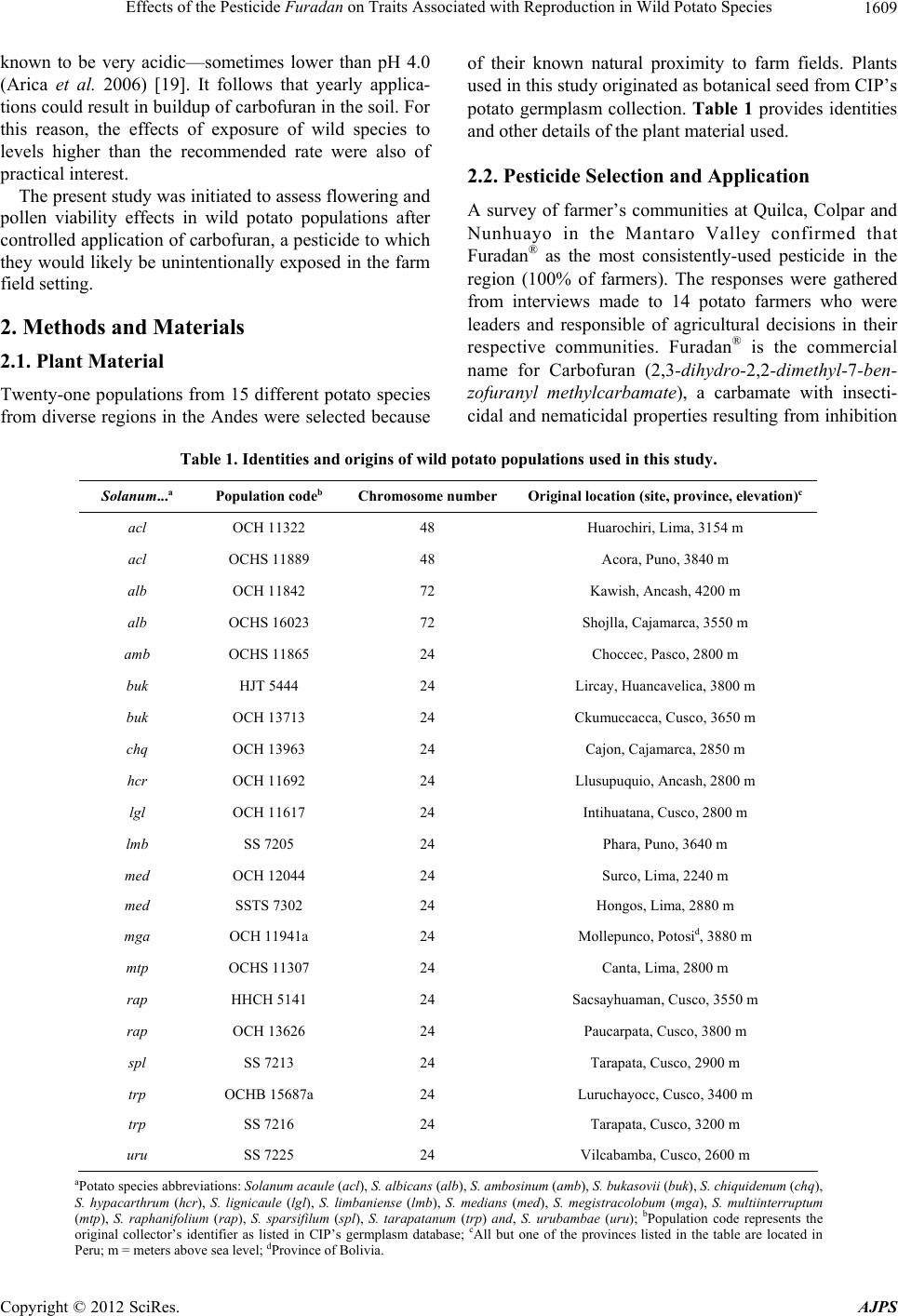 Effects of the Pesticide Furadan on Traits Associated with Reproduction in Wild Potato Species 1609 known to be very acidic—sometimes lower than pH 4.0 (Arica et al. 2006) [19]. It follows that yearly applica- tions could result in buildup of carbofuran in the soil. For this reason, the effects of exposure of wild species to levels higher than the recommended rate were also of practical interest. The present study was initiated to assess flowering and pollen viability effects in wild potato populations after controlled application of carbofuran, a pesticide to which they would likely be unintentionally exposed in the farm field setting. 2. Methods and Materials 2.1. Plant Material Twenty-one populations from 15 different potato species from diverse regions in the Andes were selected because of their known natural proximity to farm fields. Plants used in this study originated as botanical seed from CIP’s potato germplasm collection. Table 1 provides identities and other details of the plant material used. 2.2. Pesticide Selection and Application A survey of farmer’s communities at Quilca, Colpar and Nunhuayo in the Mantaro Valley confirmed that Furadan® as the most consistently-used pesticide in the region (100% of farmers). The responses were gathered from interviews made to 14 potato farmers who were leaders and responsible of agricultural decisions in their respective communities. Furadan® is the commercial name for Carbofuran (2,3-dihydro-2,2-dimethyl-7-ben- zofuranyl methylcarbamate), a carbamate with insecti- cidal and nematicidal properties resulting from inhibition Table 1. Identities and origins of wild potato populations used in this study. Solanum...a Population codeb Chromosome number Original location (site, province, elevation)c acl OCH 11322 48 Huarochiri, Lima, 3154 m acl OCHS 11889 48 Acora, Puno, 3840 m alb OCH 11842 72 Kawish, Ancash, 4200 m alb OCHS 16023 72 Shojlla, Cajamarca, 3550 m amb OCHS 11865 24 Choccec, Pasco, 2800 m buk HJT 5444 24 Lircay, Huancavelica, 3800 m buk OCH 13713 24 Ckumuccacca, Cusco, 3650 m chq OCH 13963 24 Cajon, Cajamarca, 2850 m hcr OCH 11692 24 Llusupuquio, Ancash, 2800 m lgl OCH 11617 24 Intihuatana, Cusco, 2800 m lmb SS 7205 24 Phara, Puno, 3640 m med OCH 12044 24 Surco, Lima, 2240 m med SSTS 7302 24 Hongos, Lima, 2880 m mga OCH 11941a 24 Mollepunco, Potosid, 3880 m mtp OCHS 11307 24 Canta, Lima, 2800 m rap HHCH 5141 24 Sacsayhuaman, Cusco, 3550 m rap OCH 13626 24 Paucarpata, Cusco, 3800 m spl SS 7213 24 Tarapata, Cusco, 2900 m trp OCHB 15687a 24 Luruchayocc, Cusco, 3400 m trp SS 7216 24 Tarapata, Cusco, 3200 m uru SS 7225 24 Vilcabamba, Cusco, 2600 m aPotato species abbreviations: Solanum acaule (acl), S. albicans (alb), S. ambosinum (amb), S. bukasovii (buk), S. chiquidenum (chq), S. hypacarthrum (hcr), S. lignicaule (lgl), S. limbaniense (lmb), S. medians (med), S. megistracolobum (mga), S. multiinterruptum (mtp), S. raphanifolium (rap), S. sparsifilum (spl), S. tarapatanum (trp) and, S. urubambae (uru); bPopulation code represents the original collector’s identifier as listed in CIP’s germplasm database; cAll but one of the provinces listed in the table are located in Peru; m = meters above sea level; dProvince of Bolivia. Copyright © 2012 SciRes. AJPS  Effects of the Pesticide Furadan on Traits Associated with Reproduction in Wild Potato Species 1610 of cholinesterase, which catalyzes the neurotransmitter acetylcholine. Furadan® is systemic, with high water solubility and rapid uptake from roots and leaves (PAN 2008) [20]. The experiment was conducted in the greenhouses at CIP’s Santa Ana Station in Huancayo, Peru (12.067˚S × 75.217˚W; 3380 m) in the summer (January-March). Each of the 21 populations was replicated 3 times in a Completely Random Design with experimental units composed of 5 seedlings each. Seeds were sown and transplanted into 20 cm plastic pots filled with a mix of soil and peat moss, and fertilized and hand watered as standard for optimal growth. Furadan® in liquid form (480 g/L active ingredient) was obtained from Farmagro S.A., Lima. Two treatment concentrations (per liter) were applied: trt3.5 = 3.5 ml, trt4.5 = 4.5 ml, and compared to control plants. Leaves of all plants were sprayed to drip a total of 5 times at 10-day intervals over the growing sea- son. The control plants (similarly sprayed but with pure water) were grown in a separate greenhouse to prevent accidental exposure to the pesticide. 2.3. Trait Evaluation Flowering was considered to have begun when at least one plant in the experimental unit had five inflorescences in bud stage, and to have ended when all flowers had dried up. Plants were inspected daily to see if these con- ditions were met. Pollen was collected from each popula- tion at estimated peak flowering, from at least one flower from each plant in the experimental unit. Pollen grains were collected by mechanical vibration using a doorbell buzzer and were examined microscopically in a 2% solu- tion of acetocarmine glycerol. The average percent stained pollen was recorded for three random fields of view at 40×. Acetocarmine is not a vital stain per se, but staining indicates that normal pollen development has occurred, so unstained grains were considered inviable. Analysis of variance was conducted using JMP statis- tical software (JMP9 2011) [21] to calculate treatment’s LSD in each trait assessed. In the test of pollen viability, percentdata were arcsine transformed before analysis. 3. Results and Discussion 3.1. Flowering Duration Populations varied in control flowering duration from 30 to 79 days (see Table 2). The standard application of Furadan (trt3.5) commonly depressed flowering duration at average of 25% relative to controls (from 48 to 36 days), which was significant (p < 0.05) for 17 of the 21 populations examined. Populations with more robust control flowering tended to be reduced more in response to Furadan exposure. Note for example, that the four populations which did not show significant reduction in response to Furadan application all had among the lowest control flowering. The mechanism responsible for the observed differences in pesticide sensitivity is not known, but it is common for a pesticide to be toxic to one plant species and not to another (Dalvi et al. 1972 [22]; Pereira et al. 2010 [23]). Increasing the dosage to trt4.5 did not often result a significant additional reduction of flower- ing duration—being the case in only for three of the populations. 3.2. Stainable Pollen Percent Pollen viability estimates were very high in control, av- eraging 91% and ranging from 75% to 100% (see Table 2). Standard Furadan application (trt3.5) reduced percent stainable pollen by an average of only about 7%, and only significantly in 3 of the 21 populations. The greatest effect was found in populations of buk and lgl, where pollen viability was reduced by 25% and 24%, respec- tively. In three other populations, the higher dose (trt4.5) resulted in significant reduction compared to control. While Furadan treatment never resulted in a substantial increase in flowering duration, in one case (med-OCH 12044), it appeared to increase percent stainable pollen. This coincided with particularly low percent stainable pollen in the corresponding control plants. This observa- tion implies need for follow-up experiments to confirm the pollen viability-enhancing effect of Furadan and identify the sub-optimal control environment conditions that the presence of Furadan apparently improves in some germplasm. This experiment was not designed to differentiate spe- cies according to Furadan effects, nor associate flowering and pollen effects in a given population. However, re- sults in Table 2 do not suggest any obvious pattern of species susceptibility, and the correlation between Furadan impact on flowering and pollen viability is a non-sig- nificant −26%, suggesting no obvious link between the two. 3.3. Potential Impact on Potato Genetic Diversity Solanum species and other native plants in the Andes often compete for the same few insect pollinators that are available at high elevations. Altered flowering could di- vert bees to other plants and impact potato reproduction potential by suppressing (or limiting) pollination (Hus- band and Schemske 1996) [24]. The prospects of popula- tion genetic impact seem particularly relevant consider- ing that majority of the potato species examined here are diploid obligate out crossers (Table 1)—a breeding sys- tem that is vulnerable to genetic drift when effective population size is restricted (Bamberg and del Rio 2004 25]; Loveless and Hamrick 1984) [8]. [ Copyright © 2012 SciRes. AJPS 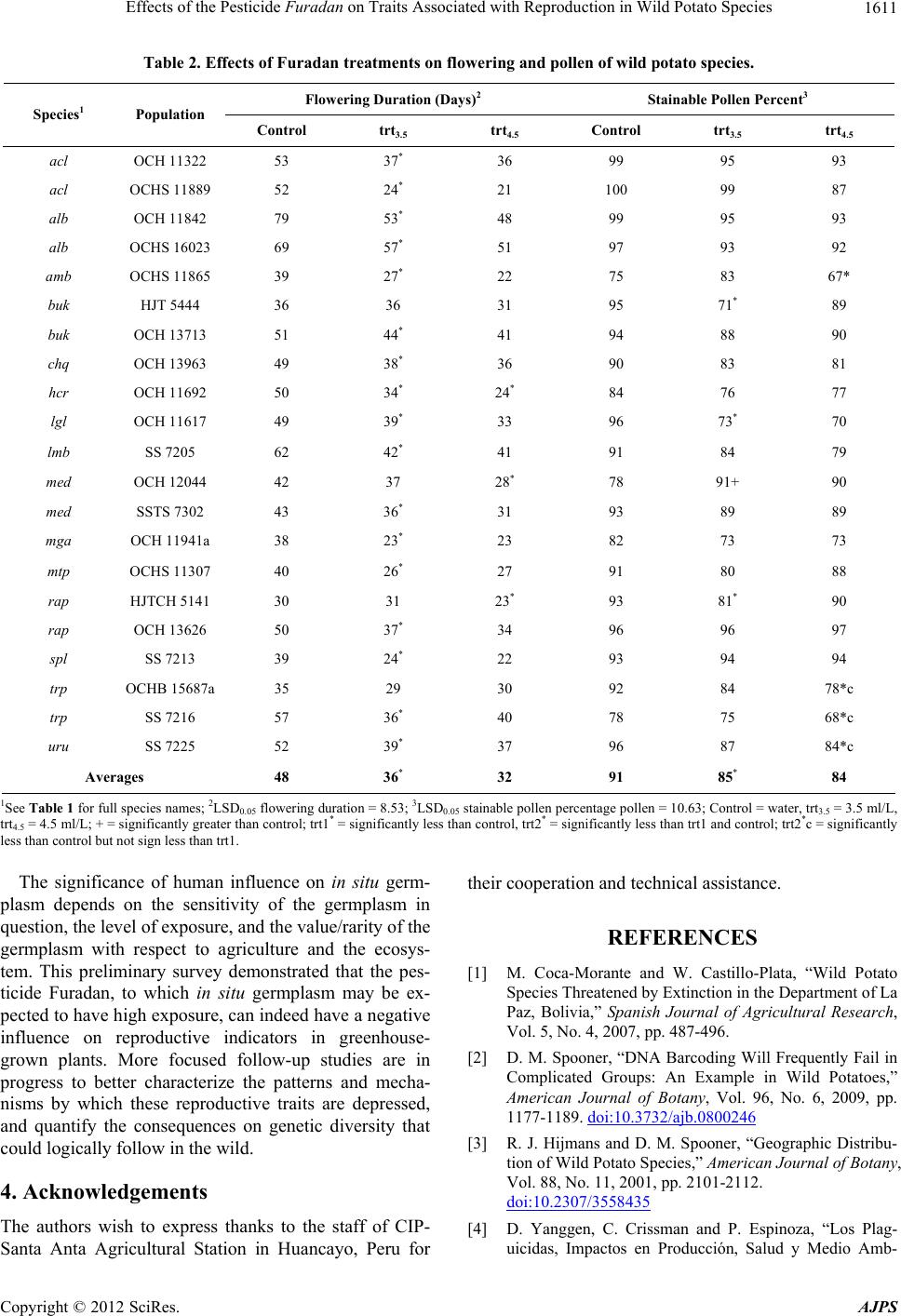 Effects of the Pesticide Furadan on Traits Associated with Reproduction in Wild Potato Species 1611 Table 2. Effects of Furadan treatments on flowering and pollen of wild potato spe cies. Flowering Duration (Days)2 Stainable Pollen Percent3 Species1 Population Control trt3.5 trt4.5 Control trt3.5 trt4.5 acl OCH 11322 53 37* 36 99 95 93 acl OCHS 11889 52 24* 21 100 99 87 alb OCH 11842 79 53* 48 99 95 93 alb OCHS 16023 69 57* 51 97 93 92 amb OCHS 11865 39 27* 22 75 83 67* buk HJT 5444 36 36 31 95 71* 89 buk OCH 13713 51 44* 41 94 88 90 chq OCH 13963 49 38* 36 90 83 81 hcr OCH 11692 50 34* 24* 84 76 77 lgl OCH 11617 49 39* 33 96 73* 70 lmb SS 7205 62 42* 41 91 84 79 med OCH 12044 42 37 28* 78 91+ 90 med SSTS 7302 43 36* 31 93 89 89 mga OCH 11941a 38 23* 23 82 73 73 mtp OCHS 11307 40 26* 27 91 80 88 rap HJTCH 5141 30 31 23* 93 81* 90 rap OCH 13626 50 37* 34 96 96 97 spl SS 7213 39 24* 22 93 94 94 trp OCHB 15687a 35 29 30 92 84 78*c trp SS 7216 57 36* 40 78 75 68*c uru SS 7225 52 39* 37 96 87 84*c Averages 48 36* 32 91 85* 84 1See Table 1 for full species names; 2LSD0.05 flowering duration = 8.53; 3LSD0.05 stainable pollen percentage pollen = 10.63; Control = water, trt3.5 = 3.5 ml/L, trt4.5 = 4.5 ml/L; + = significantly greater than control; trt1* = significantly less than control, trt2* = significantly less than trt1 and control; trt2*c = significantly less than control but not sign less than trt1. The significance of human influence on in situ germ- plasm depends on the sensitivity of the germplasm in question, the level of exposure, and the value/rarity of the germplasm with respect to agriculture and the ecosys- tem. This preliminary survey demonstrated that the pes- ticide Furadan, to which in situ germplasm may be ex- pected to have high exposure, can indeed have a negative influence on reproductive indicators in greenhouse- grown plants. More focused follow-up studies are in progress to better characterize the patterns and mecha- nisms by which these reproductive traits are depressed, and quantify the consequences on genetic diversity that could logically follow in the wild. 4. Acknowledgements The authors wish to express thanks to the staff of CIP- Santa Anta Agricultural Station in Huancayo, Peru for their cooperation and technical assistance. REFERENCES [1] M. Coca-Morante and W. Castillo-Plata, “Wild Potato Species Threatened by Extinction in the Department of La Paz, Bolivia,” Spanish Journal of Agricultural Research, Vol. 5, No. 4, 2007, pp. 487-496. [2] D. M. Spooner, “DNA Barcoding Will Frequently Fail in Complicated Groups: An Example in Wild Potatoes,” American Journal of Botany, Vol. 96, No. 6, 2009, pp. 1177-1189. doi:10.3732/ajb.0800246 [3] R. J. Hijmans and D. M. Spooner, “Geographic Distribu- tion of Wild Potato Species,” American Journal of Botany, Vol. 88, No. 11, 2001, pp. 2101-2112. doi:10.2307/3558435 [4] D. Yanggen, C. Crissman and P. Espinoza, “Los Plag- uicidas, Impactos en Producción, Salud y Medio Amb- Copyright © 2012 SciRes. AJPS  Effects of the Pesticide Furadan on Traits Associated with Reproduction in Wild Potato Species 1612 iente en Carchi,” CIP and INIAP. Abya-Yala, Eds., Quito, Ecuador, 2003, 199 p. [5] V. E. Forbes, U. Hommen, P. Thorbek, F. J. Heimbach, P. J. Van den Brink, J. Wogram, H. H. Thulke and V. Grimm, “Ecological Models in Support of Regulatory Risk Assessments of Pesticides: Developing a Strategy for the Future,” Integrated Environmental Assessment and Management, Vol. 5, No. 1, 2009, pp. 167-172. doi:10.1897/IEAM_2008-029.1 [6] R. A. Ennos, “Estimating the Relative Rates of Pollen and Seed Migration among Plant Populations,” Heredity, Vol. 72, 1994, pp. 250-259. doi:10.1038/hdy.1994.35 [7] J. L. Hamrick, Y. B. Linhart and J. B. Mitton, “Relation- ships between Life History Characteristics and Electro- phoretically Detectable Genetic Variation in Plants,” An- nual Review of Ecology and Systematics, Vol. 10, 1979, pp. 173-200. doi:10.1146/annurev.es.10.110179.001133 [8] M. D. Loveless and J. L. Hamrick, “Ecological Determi- nants of Genetic Structure in Plant Populations,” Annual Review of Ecology and Systematics, Vol. 15, No. 1, 1984, pp. 65-95. doi:10.1146/annurev.es.15.110184.000433 [9] O. Daniel, M. S. Meier, J. Schlatter and P. Frischknecht, “Selected Phenolic Compounds in Cultivated Plants: Eco- logic Functions, Health Implications, and Modulation by Pesticides,” Environmental Health Perspectives, Vol. 107, No. 1, 1999, pp. 109-114. doi:10.1289/ehp.99107s1109 [10] J. Lydon and S. O. Duke, “Pesticide Effects on Secondary Metabolism of Higher Plants,” Pesticide Science, Vol. 25, No. 4, 1989, pp. 361-373. doi:10.1002/ps.2780250406 [11] A. O. Asita and L. P. Matebesi, “Genotoxicity of Hor- moban and Seven Other Pesticides to Onion Root Tip Meristematic Cells,” African Journal of Biotechnology, Vol. 9, No. 27, 2010, pp. 4225-4232. [12] B. N. Behera, R. K. Sahu and C. B. S. R. Sharma, “Cyto- genetic Hazards from Agricultural Chemicals; Sequential Screening in the Barley Progeny: Test for Cytogenetic Activity of Some Systemic Fungicides and a Metabolite,” Toxicology Letters, Vol. 10, No. 2-3, 1982, pp. 195-203. doi:10.1016/0378-4274(82)90074-1 [13] M. M. Fairbanks, G. E. J. St. Hardy and J. A. McComb, “Mitosis and Meiosis in Plants Are Affected by the Fun- gicide Phosphate,” Australasian Plant Pathology, Vol. 31, No. 3, 2002, pp. 281-289. doi:10.1071/AP02025 [14] N. Tort, I. Ozturk and A. Guvensen, “Effects of Some Fungicides on Pollen Morphology and Anatomy of To- mato (Lycopersiconesculentum Mill.),” Pakistan Journal of Botany, Vol. 37, 2005, pp. 23-30. [15] I. O. Cali and F. Candan, “Effects of a Fungicide on the Morphology and Viability of Pollens of Tomato (Ly- copersiconesculentum Mill.),” Bangladesh Journal of Botany, Vol. 38, 2009, pp. 115-118. [16] J. D. Spiers, F. T. Davies, C. He, C. Bográn, K. M. Heinz, T. W. Starman and A. Chau, “Effects of Insecticides on Gas Exchange, Vegetative and Floral Development, and Overall Quality of Gerbera,” HortScience, Vol. 41, No. 3, , pp. 701-706. [17] N. Ahmad, D. D. Walgenbach and G. R. Sutter, “Degra- dation Rates of Technical Carbofuran and a Granular Formulation in Four Soils with Known Insecticide Use History,” Bulletin of Environmental Contamination and Toxicology, Vol. 23, No. 1, 1979, pp. 572-574. doi:10.1007/BF01770005 [18] D. G. Finlayson, J. R. Graham, R. Greenhalgh, J. R. Rob- erts, E. A. H. Smith, P. Whitehead, R. F. Willes and I. Williams, “Carbofuran: Criteria for Interpreting the Ef- fects of Its Use on Environmental Quality,” National Re- search Council Canada, Publ. NRCC 16740, 1979, 191 p. [19] D. Arica, J. Kroschel, G. Forbes and K. St. Pere, “Persis- tent Organic Pollutants and Hazardous Pesticide in An- dean Farming Communities in Peru-Final Report,” Inter- national Potato Center, Lima, 2006, 48 p. [20] PAN (Pesticide Action Network), “PAN Pesticide Data- base, Version 8.0,” 2008. http://www.pesticideinfo.org/ [21] JMP 9, “Statistical Discovery. Version 9.0.0,” Statistical Analysis System Institute Inc., Cary, 2011. [22] R. R. Dalvi, B. Singh and D. K. Salunkhe, “Influence of Selected Pesticides on Germination and Associated Meta- bolic Changes in Wheat and Mung Bean Seeds,” Journal of Agricultural and Food Chemistry, Vol. 20, No. 5, 1972, pp. 1000-1003. doi:10.1021/jf60183a034 [23] R. Pereira, C. Monterroso and F. Macias, “Phytotoxicity of Hexachlorocyclohexane: Effect on Germination and Early Growth of Different Plant Species,” Chemosphere, Vol. 79, No. 3, 2010, pp. 326-333. doi:10.1016/j.chemosphere.2010.01.035 [24] B. C. Husband and D. W. Schemske, “Evolution of the Magnitude and Timing of Inbreeding Depression in Plants,” Evolution, Vol. 50, No. 1, 1996, pp. 54-70. doi:10.2307/2410780 [25] J. B. Bamberg and A. H. del Rio, “Genetic Heterogeneity Estimated by RAPD Polymorphism of Four Tuber-Bear- ing Potato Species Differing by Breeding Structure,” American Journal of Potato Research, Vol. 81, 2004, pp. 377-383. doi:10.1007/BF02870198 Copyright © 2012 SciRes. AJPS |