

Paper Menu >>
Journal Menu >>
 American Journal of Plant Sciences, 2012, 3, 1535-1540 http://dx.doi.org/10.4236/ajps.2012.311185 Published Online November 2012 (http://www.SciRP.org/journal/ajps) 1535 The Effect of Plant Growth Re gulator and Active Charcoal on the Development of Microtubers of Potatoes Maolin Peng, Xiyao Wang*, Liqin Li College of Agronomy, Sichuan Agricultural University, Chengdu, China. Email: *[email protected] Received August 4th, 2012; revised September 15th, 2012; accepted October 7th, 2012 ABSTRACT With the detoxicated seedling of a potato cultivation breed named “Mire” as the material, the effect of auxins CCC, 6-BA, and active carbon to microtubers of potato (Solanum tubersum L.) was investigated under the in-vitro circum- stances. The result indicated the exogenous auxins improved the production and quality of microtubers of potatoes. The effect of induction can be described as CCC > CCC + 6-BA > 6-BA > CK, the number of microtubers in per flask is 8.17 > 7.67 > 7.29 > 5.46, and the number of large potatoes in per flask is 6.33 > 5.17 > 3.17 > 1. In addition, by adding 0.5‰ of active charcoal, the growth period was shortened from 25.0 days to 9.33 days on average, and the amount of larger potatoes increased 8.54%. These results benefited the growth of microtubers of potato. Keywords: Plant Growth Regulators; Active Charcoal; Microtubers of Potato 1. Introduction Potato (Solanum tubersum L.) is crucial crops to econo- mies. They are cultivated around the world with an av- erage annual cultivation area beyond 20 million hm2. It has the fourth greatest global production [1]. China, which area of cultivation is around 3 million to 3.33 mil- lion hm2, is the second largest area of potato cultivation in the world [2]. Potatoes are praised by its short growth period, high adaptability and production, great potential of yield increase, and et al. Potatoes mainly reproduce asexually. Its degeneration causes its quality and quantity produced to drop [3]. With the development of the plant meristem culture, it was possible to produce detoxicated “rejuvenated” potatoes. This could solve the global issue of seed potato degeneration [2]. Ever since the success of the induction of microtubers [4], experts around the world had started thorough studies on this and seen rela- tively great improvements [5-7]. Microtubers of potatoes have outstanding advantages as small volume, light weight, unlimited producing seasons, easy to storage, faster reproducing rate comparing to average agricultural production, and high cultivation survival rate[8]. Micro- tubers can be used to exchange the germplasm resources. Their production and transportation are more convenient than other forms of germplasm. Other than this, micro- tubers play the role of receptors of gene transfer in con- temporary studies of potato genes engineering. In addi- tion, it is an ideal method to study the tuber formation mechanism of potatoes by inducing the formation of po- tato tubers under in-vitro circumstances [9]. Fundamental principles of the formation of microtu- bers are extremely complicated, because their formation is influenced by multiple factors including, temperature [10], genotype, age, health of the plantlets, as well as mineral nutrition [11], carbon source [12], exogenous auxins [13,14], method, the plant growth retardants [15], other adjunctions, the illumination [16] and other envi- ronmental factors. However, different breeds of potatoes have relatively different level adaptability to the planting conditions. There’s no universal and high effective in- duction method for microtubers of potatoes, which re- sulted inconvenience for our agricultural production and studies. The purpose is to produce high-quality microtu- bers at a low cost, which is significantly meaningful for the occurrence of future agricultural production and ex- perimental work. 2. Materials and Methods The virus-free seedlings of potato “Mire” was obtained from the potato Research Centre of Sichuan Agriculture University. The sterile explants “Mire” were cut into stem pieces with a single or two axillary buds, and in- oculated vertically into a flask (100 ml) with 20 ml of initiation MS medium [17], containing 3% (w/v) sucrose and 0.7% (w/v) agar according to a standard yam nodal segment culture protocol [18,19], the pH was adjusted to *Corresponding author. Copyright © 2012 SciRes. AJPS 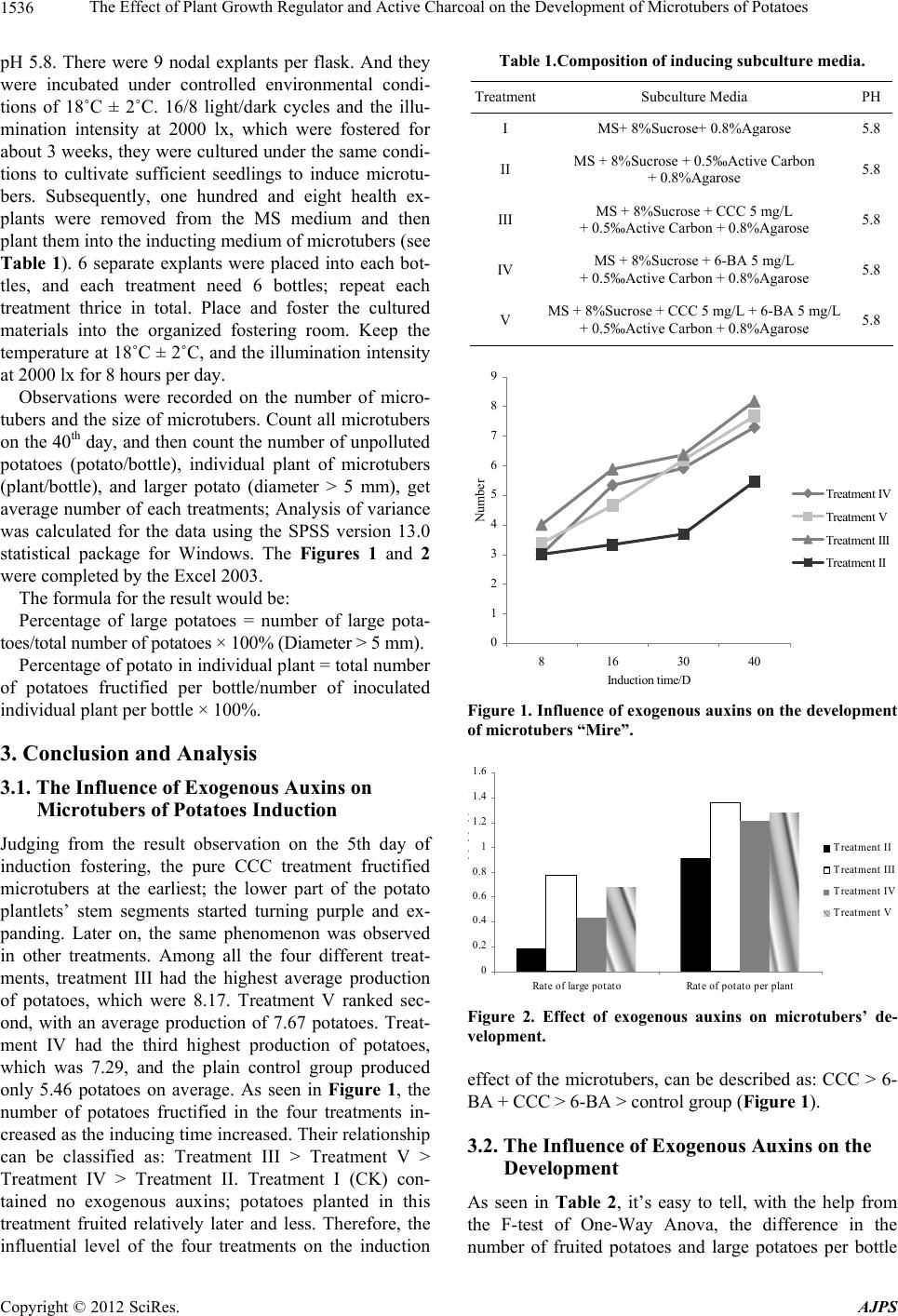 The Effect of Plant Growth Regulator and Active Charcoal on the Development of Microtubers of Potatoes 1536 pH 5.8. There were 9 nodal explants per flask. And they were incubated under controlled environmental condi- tions of 18˚C ± 2˚C. 16/8 light/dark cycles and the illu- mination intensity at 2000 lx, which were fostered for about 3 weeks, they were cultured under the same condi- tions to cultivate sufficient seedlings to induce microtu- bers. Subsequently, one hundred and eight health ex- plants were removed from the MS medium and then plant them into the inducting medium of microtubers (see Table 1). 6 separate explants were placed into each bot- tles, and each treatment need 6 bottles; repeat each treatment thrice in total. Place and foster the cultured materials into the organized fostering room. Keep the temperature at 18˚C ± 2˚C, and the illumination intensity at 2000 lx for 8 hours per day. Observations were recorded on the number of micro- tubers and the size of microtubers. Count all microtubers on the 40th day, and then count the number of unpolluted potatoes (potato/bottle), individual plant of microtubers (plant/bottle), and larger potato (diameter > 5 mm), get average number of each treatments; Analysis of variance was calculated for the data using the SPSS version 13.0 statistical package for Windows. The Figures 1 and 2 were completed by the Excel 2003. The formula for the result would be: Percentage of large potatoes = number of large pota- toes/total number of potatoes × 100% (Diameter > 5 mm). Percentage of potato in individual plant = total number of potatoes fructified per bottle/number of inoculated individual plant per bottle × 100%. 3. Conclusion and Analysis 3.1. The Influence of Exogenous Auxins on Microtubers of Potatoes Induction Judging from the result observation on the 5th day of induction fostering, the pure CCC treatment fructified microtubers at the earliest; the lower part of the potato plantlets’ stem segments started turning purple and ex- panding. Later on, the same phenomenon was observed in other treatments. Among all the four different treat- ments, treatment III had the highest average production of potatoes, which were 8.17. Treatment V ranked sec- ond, with an average production of 7.67 potatoes. Treat- ment IV had the third highest production of potatoes, which was 7.29, and the plain control group produced only 5.46 potatoes on average. As seen in Figure 1, the number of potatoes fructified in the four treatments in- creased as the inducing time increased. Their relationship can be classified as: Treatment III > Treatment V > Treatment IV > Treatment II. Treatment I (CK) con- tained no exogenous auxins; potatoes planted in this treatment fruited relatively later and less. Therefore, the influential level of the four treatments on the induction Table 1.Composition of inducing subculture me dia. Treatment Subculture Media PH I MS+ 8%Sucrose+ 0.8%Agarose 5.8 II MS + 8%Sucrose + 0.5‰Active Carbon + 0.8%Agarose 5.8 III MS + 8%Sucrose + CCC 5 mg/L + 0.5‰Active Carbon + 0.8%Agarose 5.8 IV MS + 8%Sucrose + 6-BA 5 mg/L + 0.5‰Active Carbon + 0.8%Agarose 5.8 V MS + 8%Sucrose + CCC 5 mg/L + 6-BA 5 mg/L + 0.5‰Active Carbon + 0.8%Agarose 5.8 0 1 2 3 4 5 6 7 8 9 8163040 Induction time/ D Treatment IV Treatment V Treatment III Treatment II Number Figure 1. Influence of exogenous auxins on the development of microtubers “Mire”. 91% 3 6.17% 2 1.50% 2 7.83% 0 0.2 0.4 0.6 0.8 1 1.2 1.4 1.6 Rate of large potatoRate of potato per plant Treatment II Treatment III Treatment IV Treatment V Figure 2. Effect of exogenous auxins on microtubers’ de- velopment. effect of the microtubers, can be described as: CCC > 6- BA + CCC > 6-BA > control group (Figure 1). 3.2. The Influence of Exogenous Auxins on the Development As seen in Table 2, it’s easy to tell, with the help from the F-test of One-Way Anova, the difference in the number of fruited potatoes and large potatoes per bottle Copyright © 2012 SciRes. AJPS 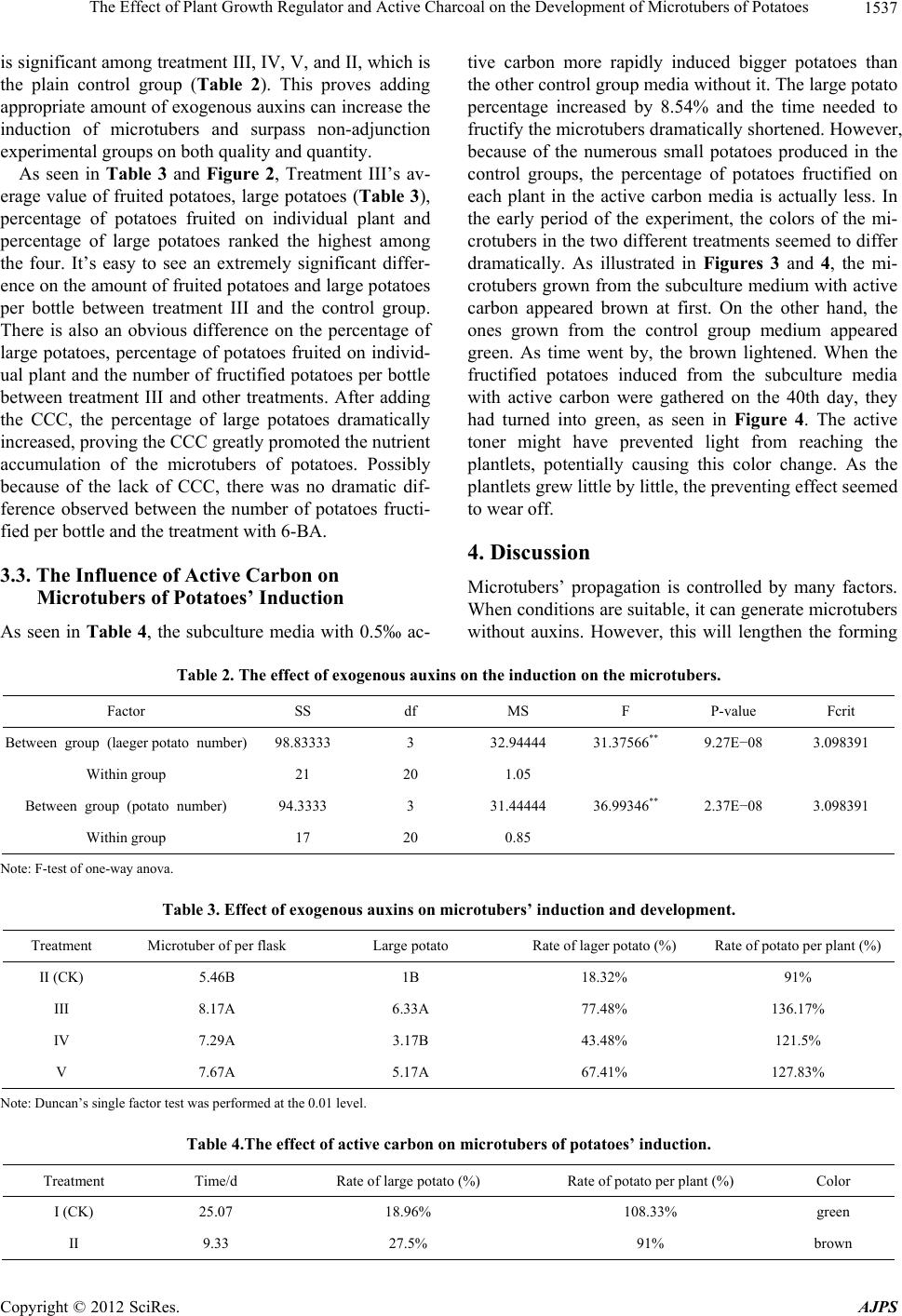 The Effect of Plant Growth Regulator and Active Charcoal on the Development of Microtubers of Potatoes Copyright © 2012 SciRes. AJPS 1537 is significant among treatment III, IV, V, and II, which is the plain control group (Table 2). This proves adding appropriate amount of exogenous auxins can increase the induction of microtubers and surpass non-adjunction experimental groups on both quality and quantity. As seen in Table 3 and Figure 2, Treatment III’s av- erage value of fruited potatoes, large potatoes (Table 3), percentage of potatoes fruited on individual plant and percentage of large potatoes ranked the highest among the four. It’s easy to see an extremely significant differ- ence on the amount of fruited potatoes and large potatoes per bottle between treatment III and the control group. There is also an obvious difference on the percentage of large potatoes, percentage of potatoes fruited on individ- ual plant and the number of fructified potatoes per bottle between treatment III and other treatments. After adding the CCC, the percentage of large potatoes dramatically increased, proving the CCC greatly promoted the nutrient accumulation of the microtubers of potatoes. Possibly because of the lack of CCC, there was no dramatic dif- ference observed between the number of potatoes fructi- fied per bottle and the treatment with 6-BA. 3.3. The Influence of Active Carbon on Microtubers of Potatoes’ Induction As seen in Table 4, the subculture media with 0.5‰ ac- tive carbon more rapidly induced bigger potatoes than the other control group media without it. The large potato percentage increased by 8.54% and the time needed to fructify the microtubers dramatically shortened. However, because of the numerous small potatoes produced in the control groups, the percentage of potatoes fructified on each plant in the active carbon media is actually less. In the early period of the experiment, the colors of the mi- crotubers in the two different treatments seemed to differ dramatically. As illustrated in Figures 3 and 4, the mi- crotubers grown from the subculture medium with active carbon appeared brown at first. On the other hand, the ones grown from the control group medium appeared green. As time went by, the brown lightened. When the fructified potatoes induced from the subculture media with active carbon were gathered on the 40th day, they had turned into green, as seen in Figure 4. The active toner might have prevented light from reaching the plantlets, potentially causing this color change. As the plantlets grew little by little, the preventing effect seemed to wear off. 4. Discussion Microtubers’ propagation is controlled by many factors. When conditions are suitable, it can generate microtubers without auxins. However, this will lengthen the forming Table 2. The effect of exogenous auxins on the induc tion on the microtubers. Factor SS df MS F P-value Fcrit Between group (laeger potato number) 98.83333 3 32.94444 31.37566** 9.27E−08 3.098391 Within group 21 20 1.05 Between group (potato number) 94.3333 3 31.44444 36.99346** 2.37E−08 3.098391 Within group 17 20 0.85 Note: F-test of one-way anova. Table 3. Effect of exogenous auxins on microtubers’ induction and development. Treatment Microtuber of per flask Large potato Rate of lager potato (%) Rate of potato per plant (%) II (CK) 5.46B 1B 18.32% 91% III 8.17A 6.33A 77.48% 136.17% IV 7.29A 3.17B 43.48% 121.5% V 7.67A 5.17A 67.41% 127.83% Note: Duncan’s single factor test was performed at the 0.01 level. Table 4.The effect of ac tive carbon on microtubers of potatoes’ induction. Treatment Time/d Rate of large potato (%) Rate of potato per plant (%) Color I (CK) 25.07 18.96% 108.33% green II 9.33 27.5% 91% brown 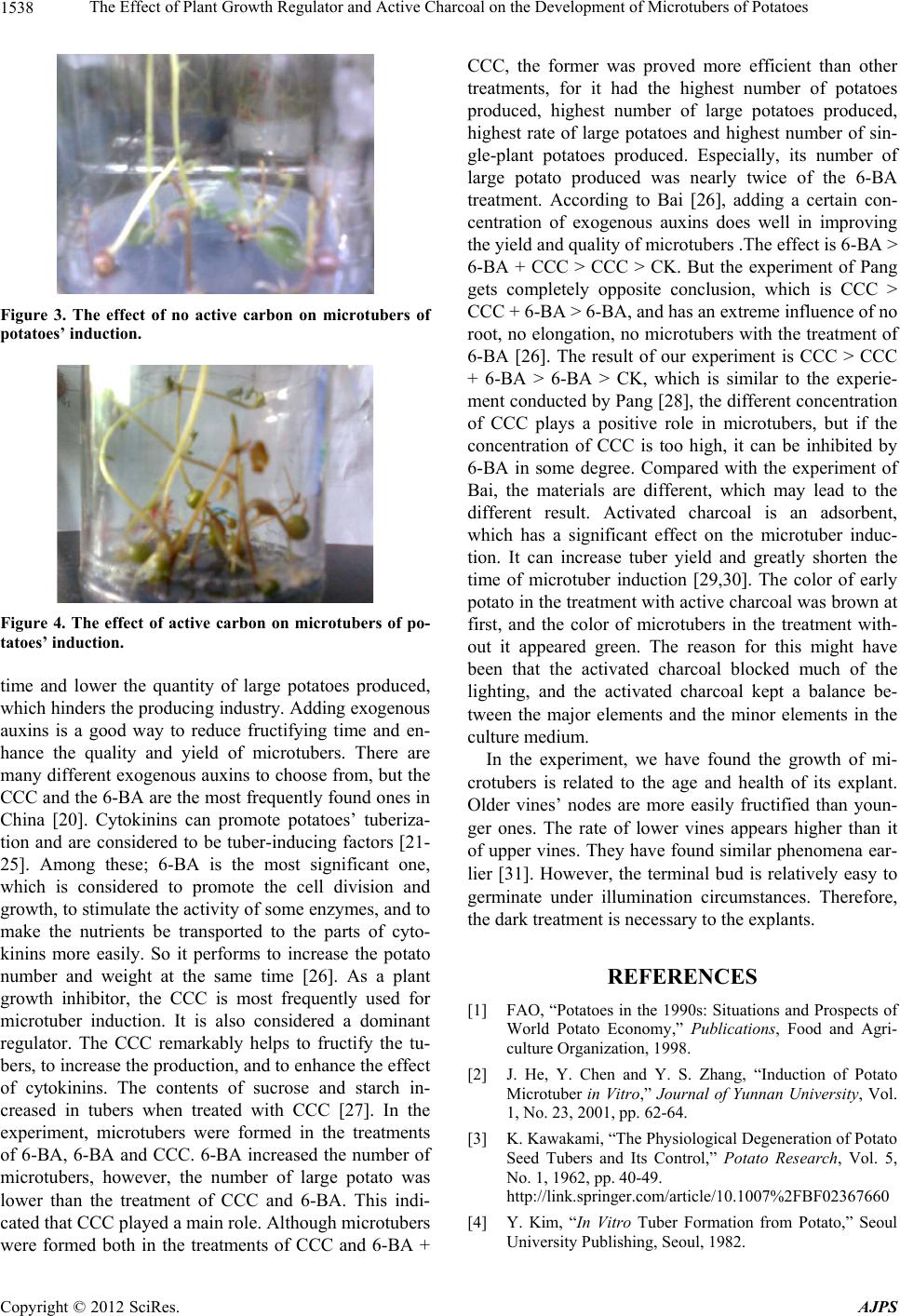 The Effect of Plant Growth Regulator and Active Charcoal on the Development of Microtubers of Potatoes 1538 Figure 3. The effect of no active carbon on microtubers of potatoes’ induction. Figure 4. The effect of active carbon on microtubers of po- tatoes’ induction. time and lower the quantity of large potatoes produced, which hinders the producing industry. Adding exogenous auxins is a good way to reduce fructifying time and en- hance the quality and yield of microtubers. There are many different exogenous auxins to choose from, but the CCC and the 6-BA are the most frequently found ones in China [20]. Cytokinins can promote potatoes’ tuberiza- tion and are considered to be tuber-inducing factors [21- 25]. Among these; 6-BA is the most significant one, which is considered to promote the cell division and growth, to stimulate the activity of some enzymes, and to make the nutrients be transported to the parts of cyto- kinins more easily. So it performs to increase the potato number and weight at the same time [26]. As a plant growth inhibitor, the CCC is most frequently used for microtuber induction. It is also considered a dominant regulator. The CCC remarkably helps to fructify the tu- bers, to increase the production, and to enhance the effect of cytokinins. The contents of sucrose and starch in- creased in tubers when treated with CCC [27]. In the experiment, microtubers were formed in the treatments of 6-BA, 6-BA and CCC. 6-BA increased the number of microtubers, however, the number of large potato was lower than the treatment of CCC and 6-BA. This indi- cated that CCC played a main role. Although microtubers were formed both in the treatments of CCC and 6-BA + CCC, the former was proved more efficient than other treatments, for it had the highest number of potatoes produced, highest number of large potatoes produced, highest rate of large potatoes and highest number of sin- gle-plant potatoes produced. Especially, its number of large potato produced was nearly twice of the 6-BA treatment. According to Bai [26], adding a certain con- centration of exogenous auxins does well in improving the yield and quality of microtubers .The effect is 6-BA > 6-BA + CCC > CCC > CK. But the experiment of Pang gets completely opposite conclusion, which is CCC > CCC + 6-BA > 6-BA, and has an extreme influence of no root, no elongation, no microtubers with the treatment of 6-BA [26]. The result of our experiment is CCC > CCC + 6-BA > 6-BA > CK, which is similar to the experie- ment conducted by Pang [28], the different concentration of CCC plays a positive role in microtubers, but if the concentration of CCC is too high, it can be inhibited by 6-BA in some degree. Compared with the experiment of Bai, the materials are different, which may lead to the different result. Activated charcoal is an adsorbent, which has a significant effect on the microtuber induc- tion. It can increase tuber yield and greatly shorten the time of microtuber induction [29,30]. The color of early potato in the treatment with active charcoal was brown at first, and the color of microtubers in the treatment with- out it appeared green. The reason for this might have been that the activated charcoal blocked much of the lighting, and the activated charcoal kept a balance be- tween the major elements and the minor elements in the culture medium. In the experiment, we have found the growth of mi- crotubers is related to the age and health of its explant. Older vines’ nodes are more easily fructified than youn- ger ones. The rate of lower vines appears higher than it of upper vines. They have found similar phenomena ear- lier [31]. However, the terminal bud is relatively easy to germinate under illumination circumstances. Therefore, the dark treatment is necessary to the explants. REFERENCES [1] FAO, “Potatoes in the 1990s: Situations and Prospects of World Potato Economy,” Publications, Food and Agri- culture Organization, 1998. [2] J. He, Y. Chen and Y. S. Zhang, “Induction of Potato Microtuber in Vitro,” Journal of Yunnan University, Vol. 1, No. 23, 2001, pp. 62-64. [3] K. Kawakami, “The Physiological Degeneration of Potato Seed Tubers and Its Control,” Potato Research, Vol. 5, No. 1, 1962, pp. 40-49. http://link.springer.com/article/10.1007%2FBF02367660 [4] Y. Kim, “In Vitro Tuber Formation from Potato,” Seoul University Publishing, Seoul, 1982. Copyright © 2012 SciRes. AJPS  The Effect of Plant Growth Regulator and Active Charcoal on the Development of Microtubers of Potatoes 1539 [5] M. J. Hossain and N. Sultana, “Effect of Benzyl Amino Purine (BAP) and Chloro Choline Chloride (CCC) on in Vitro Tuberization of Potato,” Bangladesh Journal of Ag- riculture Research, Vol. 4, No. 23, 1998, pp. 685-690. [6] J. Gopal, J. L. Minocha and H. S. Dhaliwal, “Microtuber- ization in Potato (Solanum tubersum L.),” Plant Cell Re- ports, Vol. 17, No. 10, 1998, pp. 794-798. doi:10.1007/s002990050485 [7] R. Estrada, P. Tovar and J. H. Dodds, “Introduction of in Vitro Tubers in a Broad Range of Potato Genotypes,” Plant Cell, Tissue and Organ Culture, Vol. 7, No. 1, 1986, pp. 3-10. doi:10.1007/BF00043915 [8] J. L. John, W. H. Courtney and D. R. Decoteau, “The Influence of Plant Growth Regulators and Light on Mi- crotuber Induction and Formation in Dioscorea alata L. Cultures,” Plant Cell, Tissue and Organ Culture, Vol. 34, No. 3, 1993, pp. 245-252. doi:10.1007/BF00029713 [9] W. S. Hao, Y. X. Zhao and Q. H. Gao, “The Progress of Potato Microtubers Induction in China,” Inner Monglia Agricultural Science and Technology, Vol. 6, 2002, pp. 4-7. [10] M. E. Hoque, “In Vitro Tuberization in Potato (Solanum tuberosum L.),” Plant Omics Journal, Vol. 1, No. 3, 2010, pp. 7-11. [11] D. Sarkar and P. S. Naik, “Effect of Inorganic Nitrogen Nutrition on Cytokinin-Induced Potato Microtuber Pro- duction in Vitro,” Potato Research, Vol. 41, No. 3, 1998, pp. 211-217. doi:10.1007/BF02358191 [12] O. O. Paul, K. Claire and D. Jacques, “Effects of Reduc- ing Sugar Concentration on in Vitro Tuber Formation and Sprouting in Yam (Dioscorea cayenensis-D. rotundata Complex),” Plant Cell, Tissue and Organ Culture, Vol. 99, No. 1, 2009, pp. 55-59. doi:10.1007/s11240-009-9575-1 [13] O. Mahmoud, C. S. Farhad and N. Paul, “Effects of Tem- perature Fluctuation during in Vitro Phase on in Vitro Microtuber Production in Different Cultivars of Potato (Solanum tubersum L.),” Plant Cell, Tissue and Organ Culture, Vol. 98, No. 2, 2009, pp. 213-218. doi:10.1007/s11240-009-9554-6 [14] K. Pruski, T. Astatkie, P. Duplessis, T. Lewis, J. Nowak and P. C. Struik, “Use of Jasmonate for Conditioning of Potato Plantlets and Microtubers in Greenhouse Produc- tion of Minitubers,” American Journal of Potato Re- search, Vol. 80, No. 3, 2003, pp. 183-193. doi:10.1007/BF02855690 [15] P. Kris, A. Tess and N. Jerzy, “Jasmonate Effects on in Vitro Tuberization and Tuber Bulking in Two Potato Cul- tivars (Solanum tubersum L.) under Different Media and Photoperiod Conditions,” In Vitro Cellular & Develop- mental Biology—Animal, Vol. 38, No. 2, 2002, pp. 203- 209. http://rd.springer.com/article/10.1079/IVPIVP2001265 [16] Janet E. A. Seabrook, “Light Effects on the Growth and Morphogenesis of Potato (Solanum tubersum) in Vitro: A Review,” American Journal of Potato Research, Vol. 82, No. 5, 2005, pp. 353-367. http://rd.springer.com/article/10.1007/BF02871966 [17] T. Murashige and F. Skoog, “A Revised Medium for Rapid Growth and Bioassays with Tobacco Tissue Cul- tures,” Physiologia Plantarum, Vol. 15, No. 3, 1962, pp. 473-497. doi:10.1111/j.1399-3054.1962.tb08052.x [18] S. H. Mantell, S. Q. Haque and A. P. Whitehall, “Clonal Multiplication of Dioscorea alata L. and Dioscorea ro- tundata Poir. Yams by Tissue Culture,” The Journal of Horticultural Science, Vol. 53, No. 2, 1978, pp. 95-98. [19] S. H. Mantell and S. A. Hugo, “Effects of Photoperiod, Mineral Medium Strength, Inorganic Ammonium, Su- crose and Cytokinin on Root, Shoot and Microtuber De- velopment in Shoot Cultures of Dioscorea alata L. and D. bulbifera L. Yams,” Plant Cell, Tissue and Organ Cul- ture, Vol. 16, No. 1, 1989, pp. 23-37. doi:10.1007/BF00044069 [20] H. Q. Wang and L. T. Xiao, “Effects of Chlorocholine Chloride on Phytohormones and Photosynthetic Charac- teristics in Potato (Solanum tubersum L.),” Journal of Plant Growth Regulation, Vol. 28, No. 1, 2009, pp. 21-27. doi:10.1007/s00344-008-9069-0 [21] J. Martine and C. Mario, “Effects of Some Growth Gegu- lator on in Vitro Tuberization in Dioscorea Alata L. ‘Brazo Fuerte’ and D. abyssinica Hoch,” Plant Cell Re- ports, Vol. 11, No. 1, 1992, pp. 34-38. http://www.springerlink.com/content/b52e1efd7fb94e9e/ [22] C. E. Palmer and O. E. Smith, “Cytokinins and Tuber Initiation in the Potato Solanum tubersum L.,” Nature, Vol. 221, 1969, pp. 279-280. doi:10.1038/221279a0 [23] C. S. Mauk and A. R. Langille, “Physiology of Tuberiza- tion in Solanum tubersum L.,” Plant Physiology, Vol. 62, No. 3, 1978, pp. 438-442. doi:10.1104/pp.62.3.438 [24] H. Obata-Sasamoto and H. Suzuki, “Activities of En- zymes Relating to Starch Synthesis and Endogenous Lev- els of Growth Regulators during Tuberization of Isolated Potato Stolons Cultured in Vitro,” Zeitschrift für Pflan- zenphysiologie, Vol. 95, No. 1, 1979, pp. 69-75. http://www.sciencedirect.com/science/article/pii/S004432 8X7980029X [25] G. Hussey and N. J. Stacey, “Factors Affecting the For- mation of in Vitro Tubers of Potato (Solanum tuberosum L.),” Annals of Botany, Vol. 53, No. 4, 1984. pp. 565-578. http://aob.oxfordjournals.org/content/53/4/565.short [26] S. X. Bai, Z. M. An, X. Z. Feng and J. Wang, “Studies on the Factors Affecting the Induction of in Vitro Potato Mi- crober,” China Potato, Vol. 5, No. 15, 2001, pp. 271-273. [27] H. Y. Yang, D. Wang and X. Pan, “Effect of Hormone and Culture Methods on Potato Microtuber Induction,” Journal of Gansu Agricultural University, Vol. 2, 2008, pp. 74-77. [28] S. Pang, G. N. Fang, J. X. Li and J. X. Zhao, “Effect of Kinds Growth Regulator on Potato Micro-Tubers Induc- tion,” Journal of Changjiang Vegetables, Vol. 20, 2009, pp. 25-27. [29] C. Z. Xu, X. J. Zhang and A. J. Liu, “Effect of Activated Chroal on Explant Growth and Tuberization in Potato,” Review of China Agricultural Science and Technology, Vol. 5, 2003, pp. 106-107. [30] R. X. Liu, “Effect of Activated Charcoal and Inorganic Copyright © 2012 SciRes. AJPS  The Effect of Plant Growth Regulator and Active Charcoal on the Development of Microtubers of Potatoes Copyright © 2012 SciRes. AJPS 1540 Nutrition on the Induction of the Test-Tube Potato,” Plant Physiology Journal, Vol. 37, 2001, pp. 295-298. [ 31] Y. Luo, H. Tian and T. Zhang, “Effect of Coumarin on Microtuber Induction in Potato,” China Potato, Vol. 1, No. 14, 2000, pp. 4-8. |