

Paper Menu >>
Journal Menu >>
 American Journal of Plant Sciences, 2012, 3, 1520-1526 http://dx.doi.org/10.4236/ajps.2012.311183 Published Online November 2012 (http://www.SciRP.org/journal/ajps) Molecular Cloning, Sequence Analysis and Expression Analysis of an NtWRKY6 from Tobacco (Nicotiana tabacum L.) in Abiotic Strsss Liqin Li, Yubi Huang*, Wei Wang, Yaling Xu College of Agronomy, Sichuan Agricultural University, Chengdu, China. Email: *[email protected] Received August 14th, 2012; revised September 17th, 2012; accepted October 8th, 2012 ABSTRACT In higher plants, WRKY gene family plays a significant role in transcriptional regulation. They are widely involved in biotic stress, abiotic stress, growth, development and metabolism regulation. In this study WRKY6 from tobacco is cloned by homology cloning. 1647 nucleotide sequences were obtained. The deduced protein sequences show that this protein belongs to the second group of WRKY family, only have one WRKY structure, and the zinc-finger structure is C-X4-C-X23-H-X1-H. Phylogeny results show NtWRKY6 is much closer to NtWRKY1 generated 97% amino acids similarity. RT-PCR analysis has revealed that expression levels of NtWRKY6 has increased rapidly at 3 h under NaCI and PEG treatment. The results suggest that NtWRKY6 is an early responder and may be involved in NaCl and PEG abiotic stress in tobacco. Keywords: WRKY Protein; Molecular Cloning; Tobacco; RT-PCR; Expression Analysis 1. Introduction WRKY protein was originally found in sweet potato and named SPF1 [1], so far, this family protein was also found in many plants such as Arabidopsis thaliana, po- tato, Gossypium spp, Oryza sativa; Nicotiana tabacum [2-6]. Until the 2005 year, WRKY homologues from two non-plant eukaryotic species Giardia lamblia and Dic- tyostelium discoideum were found [7]. WRKY proteins have been reported to be involved in defense against bacteria, fungi [8,9], wounding [10], senescence [11], development [12] and abiotic stresses [13,14]. WRKY family proteins are characterized by one or two highly conserved WRKYGQK domains, The WRKY domain is about 60 amino acids in length and a Cys(2) His(2) or Cys(2)HisCys zinc-binding motif [15]. The two motifs of WRKY proteins are necessary for the high binding affinity of WRKY proteins to DNA sequence motif (W-boxes), which contain an invariant DNA se- quence (T)(T)TGAC(C/T) [16]. Abiotic stress is an important factor which affects plant growth, distribution, yield and quality in nature. NtWRKY6 was identified in the native tobacco Nico- tiana attenuate, whose wound responses was signifi- cantly amplified when fatty acid amino acid conjugates (FACs) in larval oral secretions was introduced into wounds during feeding [17]. The report of NtWRKY6 involved in abiotic stresses had not been seen. The tobacco Varieties K326 is the main cultivated species in the world, our researches first reported that WRKY6 gene was cloned from the species, 1647 nucleo- tide sequences were obtained. The deduced protein se- quence showed that this protein belonged to the second group of WRKY family, only had one WRKY structure, and the zinc-finger structure was C-X4-C-X23-H-X1-H. RT-PCR analysis had revealed that expression levels of NtWRKY6 had increased rapidly at 3 h under NaCI and PEG abiotic stress treatment. 2. Materials and Methods 2.1. Plant Materials and Sample Preparation Tobacco (Nicotiana tabacum L.) K326 was used in this study. Seeding was sown on MS medium under a 16-h light/8-h dark cycle at 28˚C. When the second leaves were fully expanded, the tobacco tissues were collected for investigation or frozen in liquid nitrogen immediately, stored at −80˚C for further analysis. For NaCI and PEG treatment, the seeding when had second leaves were transferred to MS medium with 250 mM NaCI or 300 m M PEG for 0, 3, 6, 12, 24 h treatment. *Corresponding author. Copyright © 2012 SciRes. AJPS 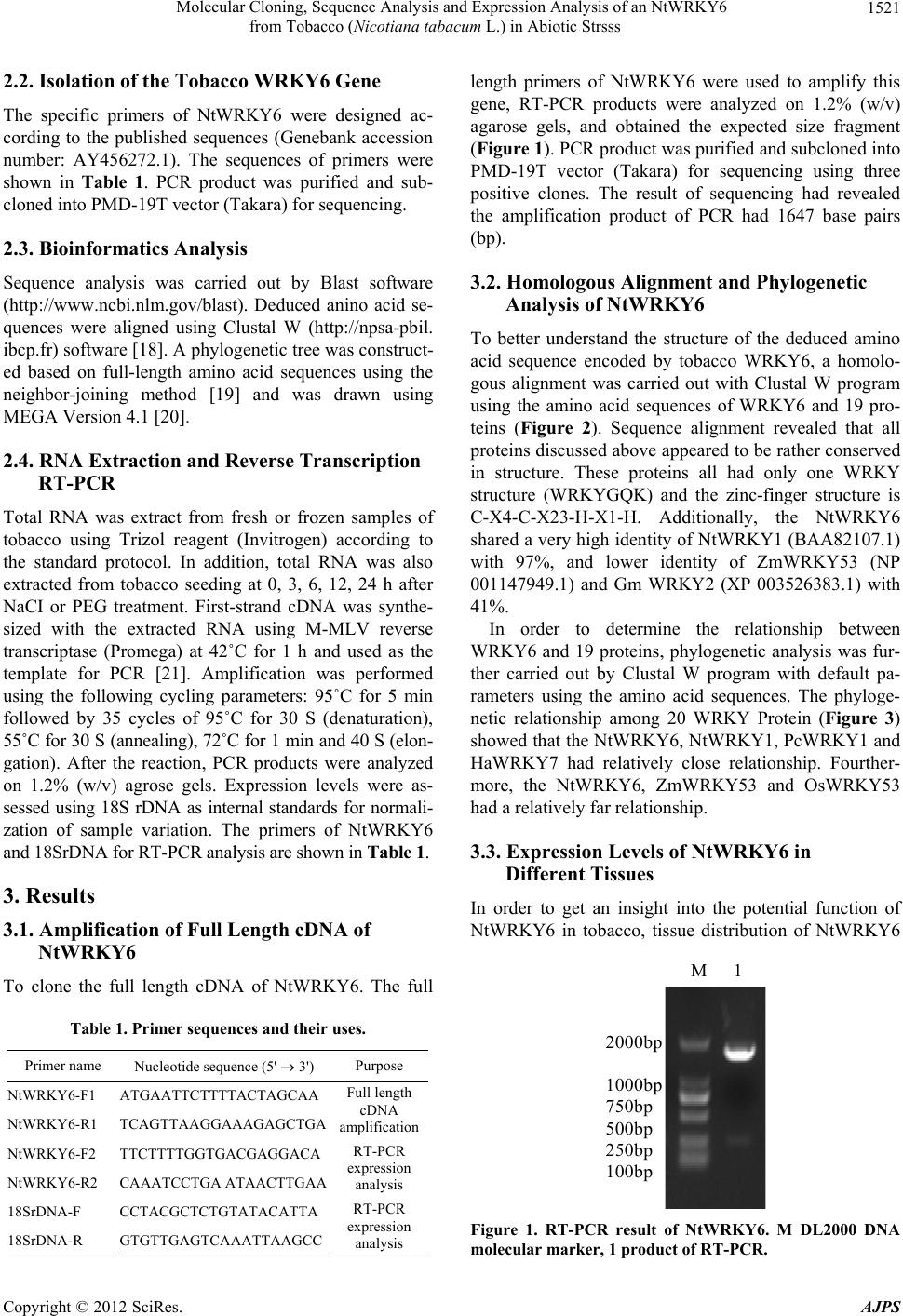 Molecular Cloning, Sequence Analysis and Expression Analysis of an NtWRKY6 from Tobacco (Nicotiana tabacum L.) in Abiotic Strsss 1521 2.2. Isolation of the Tobacco WRKY6 Gene The specific primers of NtWRKY6 were designed ac- cording to the published sequences (Genebank accession number: AY456272.1). The sequences of primers were shown in Table 1. PCR product was purified and sub- cloned into PMD-19T vector (Takara) for sequencing. 2.3. Bioinformatics Analysis Sequence analysis was carried out by Blast software (http://www.ncbi.nlm.gov/blast). Deduced anino acid se- quences were aligned using Clustal W (http://npsa-pbil. ibcp.fr) software [18]. A phylogenetic tree was construct- ed based on full-length amino acid sequences using the neighbor-joining method [19] and was drawn using MEGA Version 4.1 [20]. 2.4. RNA Extraction and Reverse Transcription RT-PCR Total RNA was extract from fresh or frozen samples of tobacco using Trizol reagent (Invitrogen) according to the standard protocol. In addition, total RNA was also extracted from tobacco seeding at 0, 3, 6, 12, 24 h after NaCI or PEG treatment. First-strand cDNA was synthe- sized with the extracted RNA using M-MLV reverse transcriptase (Promega) at 42˚C for 1 h and used as the template for PCR [21]. Amplification was performed using the following cycling parameters: 95˚C for 5 min followed by 35 cycles of 95˚C for 30 S (denaturation), 55˚C for 30 S (annealing), 72˚C for 1 min and 40 S (elon- gation). After the reaction, PCR products were analyzed on 1.2% (w/v) agrose gels. Expression levels were as- sessed using 18S rDNA as internal standards for normali- zation of sample variation. The primers of NtWRKY6 and 18SrDNA for RT-PCR analysis are shown in Table 1. 3. Results 3.1. Amplification of Full Length cDNA of NtWRKY6 To clone the full length cDNA of NtWRKY6. The full Table 1. Primer sequence s and the ir uses. Primer name Nucleotide sequence (5' 3') Purpose NtWRKY6-F1 ATGAATTCTTTTACTAGCAA NtWRKY6-R1 TCAGTTAAGGAAAGAGCTGA Full length cDNA amplification NtWRKY6-F2 TTCTTTTGGTGACGAGGACA NtWRKY6-R2 CAAATCCTGA ATAACTTGAA RT-PCR expression analysis 18SrDNA-F CCTACGCTCTGTATACATTA 18SrDNA-R GTGTTGAGTCAAATTAAGCC RT-PCR expression analysis length primers of NtWRKY6 were used to amplify this gene, RT-PCR products were analyzed on 1.2% (w/v) agarose gels, and obtained the expected size fragment (Figure 1). PCR product was purified and subcloned into PMD-19T vector (Takara) for sequencing using three positive clones. The result of sequencing had revealed the amplification product of PCR had 1647 base pairs (bp). 3.2. Homologous Alignment and Phylogenetic Analysis of NtWRKY6 To better understand the structure of the deduced amino acid sequence encoded by tobacco WRKY6, a homolo- gous alignment was carried out with Clustal W program using the amino acid sequences of WRKY6 and 19 pro- teins (Figure 2). Sequence alignment revealed that all proteins discussed above appeared to be rather conserved in structure. These proteins all had only one WRKY structure (WRKYGQK) and the zinc-finger structure is C-X4-C-X23-H-X1-H. Additionally, the NtWRKY6 shared a very high identity of NtWRKY1 (BAA82107.1) with 97%, and lower identity of ZmWRKY53 (NP 001147949.1) and Gm WRKY2 (XP 003526383.1) with 41%. In order to determine the relationship between WRKY6 and 19 proteins, phylogenetic analysis was fur- ther carried out by Clustal W program with default pa- rameters using the amino acid sequences. The phyloge- netic relationship among 20 WRKY Protein (Figure 3) showed that the NtWRKY6, NtWRKY1, PcWRKY1 and HaWRKY7 had relatively close relationship. Fourther- more, the NtWRKY6, ZmWRKY53 and OsWRKY53 had a relatively far relationship. 3.3. Expression Levels of NtWRKY6 in Different Tissues In order to get an insight into the potential function of NtWRKY6 in tobacco, tissue distribution of NtWRKY6 M 1 2000bp 1000bp 750bp 500bp 250bp 100bp Figure 1. RT-PCR result of NtWRKY6. M DL2000 DNA olecular marker, 1 product of RT-PCR. m Copyright © 2012 SciRes. AJPS 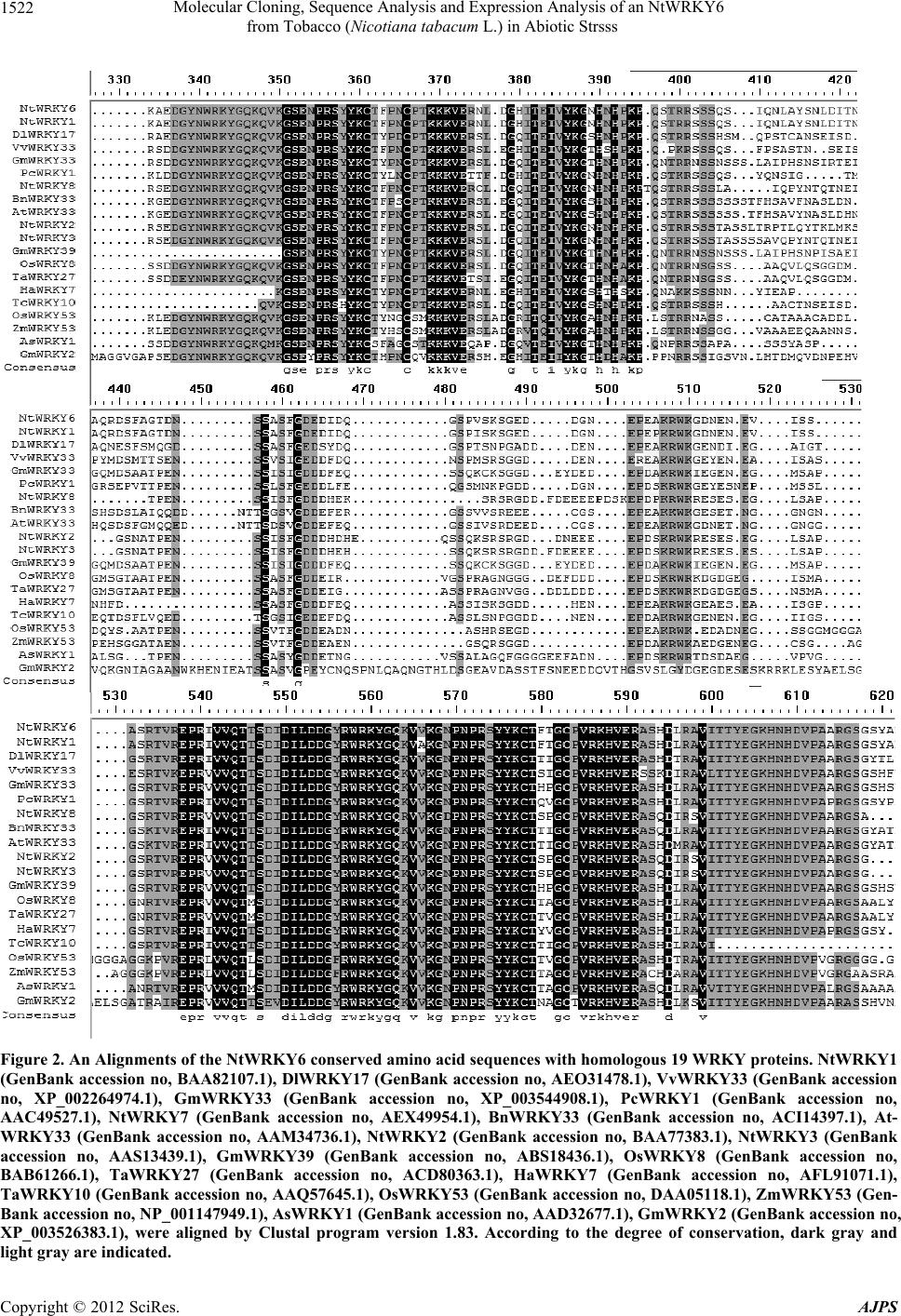 Molecular Cloning, Sequence Analysis and Expression Analysis of an NtWRKY6 from Tobacco (Nicotiana tabacum L.) in Abiotic Strsss Copyright © 2012 SciRes. AJPS 1522 Figure 2. An Alignments of the NtWRKY6 conserved amino acid sequences with homologous 19 WRKY proteins. NtWRKY1 (GenBank accession no, BAA82107.1), DlWRKY17 (GenBank accession no, AEO31478.1), VvWRKY33 (GenBank accession no, XP_002264974.1), GmWRKY33 (GenBank accession no, XP_003544908.1), PcWRKY1 (GenBank accession no, AAC49527.1), NtWRKY7 (GenBank accession no, AEX49954.1), BnWRKY33 (GenBank accession no, ACI14397.1), At- WRKY33 (GenBank accession no, AAM34736.1), NtWRKY2 (GenBank accession no, BAA77383.1), NtWRKY3 (GenBank accession no, AAS13439.1), GmWRKY39 (GenBank accession no, ABS18436.1), OsWRKY8 (GenBank accession no, BAB61266.1), TaWRKY27 (GenBank accession no, ACD80363.1), HaWRKY7 (GenBank accession no, AFL91071.1), TaWRKY10 (GenBank accession no, AAQ57645.1), OsWRKY53 (GenBank accession no, DAA05118.1), ZmWRKY53 (Gen- Bank accession no, NP_001147949.1), AsWRKY1 (GenBank accession no, AAD32677.1), GmWRKY2 (GenBank accession no, XP_003526383.1), were aligned by Clustal program version 1.83. According to the degree of conservation, dark gray and ight gray are indicated. l 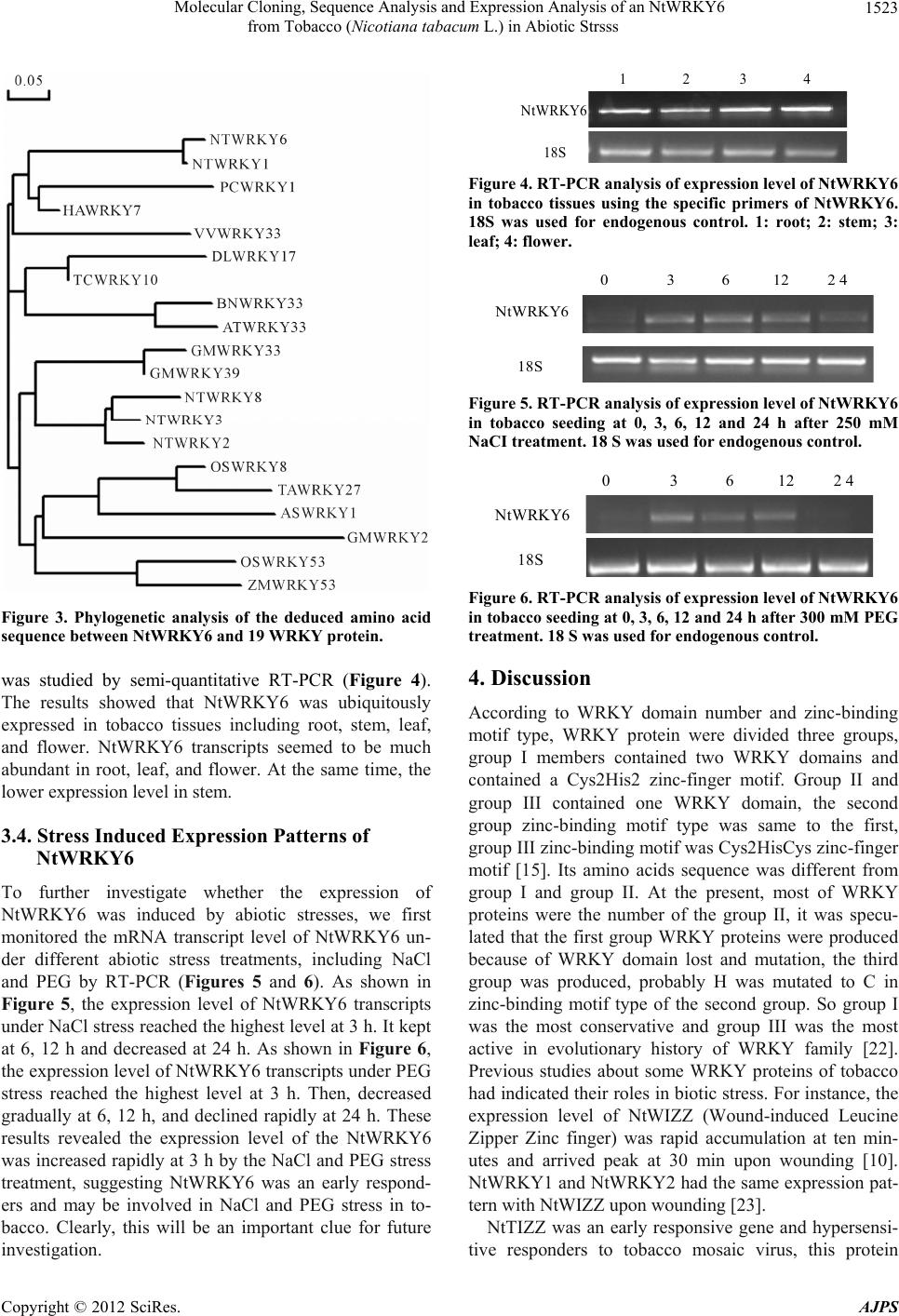 Molecular Cloning, Sequence Analysis and Expression Analysis of an NtWRKY6 from Tobacco (Nicotiana tabacum L.) in Abiotic Strsss 1523 Figure 3. Phylogenetic analysis of the deduced amino acid sequence betw een NtWRKY6 and 19 WRKY protein. was studied by semi-quantitative RT-PCR (Figure 4). The results showed that NtWRKY6 was ubiquitously expressed in tobacco tissues including root, stem, leaf, and flower. NtWRKY6 transcripts seemed to be much abundant in root, leaf, and flower. At the same time, the lower expression level in stem. 3.4. Stress Induced Expression Patterns of NtWRKY6 To further investigate whether the expression of NtWRKY6 was induced by abiotic stresses, we first monitored the mRNA transcript level of NtWRKY6 un- der different abiotic stress treatments, including NaCl and PEG by RT-PCR (Figures 5 and 6). As shown in Figure 5, the expression level of NtWRKY6 transcripts under NaCl stress reached the highest level at 3 h. It kept at 6, 12 h and decreased at 24 h. As shown in Figure 6, the expression level of NtWRKY6 transcripts under PEG stress reached the highest level at 3 h. Then, decreased gradually at 6, 12 h, and declined rapidly at 24 h. These results revealed the expression level of the NtWRKY6 was increased rapidly at 3 h by the NaCl and PEG stress treatment, suggesting NtWRKY6 was an early respond- ers and may be involved in NaCl and PEG stress in to- bacco. Clearly, this will be an important clue for future investigation. 18S NtWRKY6 1 2 3 4 Figure 4. RT-PCR analysis of expression level of NtWRKY6 in tobacco tissues using the specific primers of NtWRKY6. 18S was used for endogenous control. 1: root; 2: stem; 3: leaf; 4: flower. NtWRKY6 18S 0 3 6 12 2 4 Figure 5. RT-PCR analysis of expression level of NtWRKY6 in tobacco seeding at 0, 3, 6, 12 and 24 h after 250 mM NaCI treatment. 18 S was use d for endoge nous c o ntr ol. NtWRKY6 18S 0 3 6 12 2 4 Figure 6. RT-PCR analysis of expression level of NtWRKY6 in tobacco seeding at 0, 3, 6, 12 and 24 h after 300 mM PEG treatment. 18 S was used for endogenous co ntr o l. 4. Discussion According to WRKY domain number and zinc-binding motif type, WRKY protein were divided three groups, group I members contained two WRKY domains and contained a Cys2His2 zinc-finger motif. Group II and group III contained one WRKY domain, the second group zinc-binding motif type was same to the first, group III zinc-binding motif was Cys2HisCys zinc-finger motif [15]. Its amino acids sequence was different from group I and group II. At the present, most of WRKY proteins were the number of the group II, it was specu- lated that the first group WRKY proteins were produced because of WRKY domain lost and mutation, the third group was produced, probably H was mutated to C in zinc-binding motif type of the second group. So group I was the most conservative and group III was the most active in evolutionary history of WRKY family [22]. Previous studies about some WRKY proteins of tobacco had indicated their roles in biotic stress. For instance, the expression level of NtWIZZ (Wound-induced Leucine Zipper Zinc finger) was rapid accumulation at ten min- utes and arrived peak at 30 min upon wounding [10]. NtWRKY1 and NtWRKY2 had the same expression pat- tern with NtWIZZ upon wounding [23]. NtTIZZ was an early responsive gene and hypersensi- tive responders to tobacco mosaic virus, this protein Copyright © 2012 SciRes. AJPS  Molecular Cloning, Sequence Analysis and Expression Analysis of an NtWRKY6 from Tobacco (Nicotiana tabacum L.) in Abiotic Strsss 1524 maybe play an important role in defense response [24]. NtWRKY3 and NtWRKY9 were induced by pathogen and salicylic acid, this suggested they were participated in pathogen and salicylic acid pathway [6]. NtWRKY3 was downstream genes of MAPK, silencing of tobacco WRKY8 decreased the expression of defense-related genes and increased disease susceptibility to the patho- gens Phytophthora infestans and Colletotrichum orbicu- lare [25]. Only one report about WRKY from tobacco was involved in abiotic stress, which had showed a WRKY gene expression was active by drought stress and heat shock together, but not by only one factors [26]. We had cloned NtWRKY6 from tobacco Varieties K326, NtWRKY6 encoded a protein of 549 amino acids. Phylogenetic analysis showed that the NtWRKY6, NtWRKY1, PcWRKY1 and HaWRKY7 had a relatively close relationship. RT-PCR analysis had revealed that NtWRKY6 was ubiquitously expressed in tobacco tis- sues including root, stem, leaf, and flower. To further explore the function of NtWRKY6, RT-PCR was also used to examine the expression of NtWRKY6 under NaCl and PEG treatments for 0, 3, 6, 12, 24 h. we had observed that the expression of NtWRKY6 reached the highest level at 3 h. It kept 6, 12 h and decreased at 24 h under NaCl treatment, indicating that NtWRKY6 was a rapidly responder to NaCl stress. Previous studies had detected that transcript levels of BcWRKY46 (Brassica campestrisssp Chinensis.) was induced after 2 h of 150 mM NaCl treatment with real-time RT-PCR [27]. Drought is one of the major factors to limit the plant growth and development in China, the expression level of NtWRKY6 transcripts under PEG stress reached the highest level at 3 h. Then, decreased gradually at 6, 12 h, and declined rapidly at 24 h. This result showed that NtWRKY6 was participated in drought stress. Recently there are many researches about WRKY genes involved in PEG stress, such as Zhang have showed the transcrip- tion of HbWRKY1 (Hevea brasiliensis Muell. Arg.) in leaves was gradually up-regulated and came to its peak at 12 h after 20% PEG 6000 treatment [28]. So, we can conclude NtWRKY6 might be upstream regulator in salt and drought pathway. When tobacco faces this two stress, the expression level of NtWRKY6 rising will increase or decrease downstream target gene expression, some re- searches had reported the expression of BcWRKY46 (Brassica campestrisssp Chinensis.) and LtWRKY21 (Larrea tridentata) were both enhanced by drought and high salinity [27,29]. On the other hand, under drought and salt stress, no obviously change of the GhWRKY3 expression was observed [30]. OsWRKY80 expression was up-regulated by drought stress and there was no change under 100 mM NaCl stress [31]. These results suggested WRKY protein from different plants had many different expression patterns and functions. In conclusion, we have isolated and characterized NtWRKY6 from tobacco (Nicotiana tabacum L.), then have examined the tissue distribution and expression pattern of NtWRKY6 with RT-PCR. According to our results, NtWRKY6 may play a vital role in the NaCl and PEG stress of tobacco. However, for further study, detailed investigations should be carried out to clarify the function of NtWRKY6, such as acquiring transgenic plants of over-expression NtWRKY6 and prokaryotic expression NtWRKY6, these experiments will be very important in our future work. 5. Acknowledgements This work was supported by Natural Science Foundation of China (No. 31070244). REFERENCES [1] S. Ishiguro and K. Nakamura, “Characterization of a cDNA Encoding a Novel DNA-Binding Protein, SPF1, That Recognizes 1SP8 Sequences in the 50 Upstream Re- gions of Genes Coding for Sporamin and Beta-Amylase from Sweet Potato,” Molecular Genetics and Genomics, Vol. 244, No. 6, 1994, pp. 563-571. doi:10.1007/BF00282746 [2] S. Robatzek and I. E. Somssich, “A New Member of the Arabidopsis WRKY Transcription Factor Family, At- WRKY6, Is Associated with Both Senescence- and De- fense-Related Processes,” The Plant Journal, Vol. 28, 2001, pp. 123-133. [3] M. Lagacé and D. P. Matton, “Characterization of a WRKY Transcription Factor Expressed in Late Torpedo Stage Embryos of Solanum chacoense,” Planta, Vol. 219, No. 1, 2004, pp. 185-189. doi:10.1007/s00425-004-1253-2 [4] Y. H. Xu, J. W. Wang, S. Wang, J. Y. Wang and X. Y. Chen, “Characterization of GaWRKY1, a Cotton Tran- scription Factor That Regulates the Sesquiterpene Syn- thase Gene (+)-δ-Cadinene Synthase-A,” Plant Physiol- ogy, Vol. 135, No. 1, 2004, pp. 507-515. doi:10.1104/pp.104.038612 [5] Z. L. Zhang, Z. Xie, X. L. Zou, J. Casaretto, T. H. David and Q. X. Shen, “A Rice WRKY Gene Encodes a Tran- scriptional Repressor of the Gibberellin Signaling Path- way in Aleurone Cells,” Plant Physiology, Vol. 134, No. 4, 2004, pp. 1500-1513. [6] C. Chen and Z. Chen, “Isolation and Characterization of Two Pathogen and Salicylic Acid-Induced Genes Encod- ing WRKY DNA-Binding Proteins from Tobacco,” Plant Molecular Biology, Vol. 42, No. 2, 2000, pp. 387-396. doi:10.1023/A:1006399311615 [7] Y. Zhang and L. Wang, “The WRKY Transcription Fac- tor Superfamily: Its Origin in Eukaryotes and Expansion in Plants,” BMC Evolutionary Biology, Vol. 5, 2005, pp. 1-12. doi:10.1186/1471-2148-5-1 Copyright © 2012 SciRes. AJPS  Molecular Cloning, Sequence Analysis and Expression Analysis of an NtWRKY6 from Tobacco (Nicotiana tabacum L.) in Abiotic Strsss 1525 [8] P. Z. Yang, C. H. Chen, Z. P. Wang, B. F. Fan and Z. X. Chen, “A Pathogen and Salicylic Acid-Induced WRKY DNA-Binding Activity Recognizes the Elicitor Response Element of the Tobacco Class I Chitinase Gene Pro- moter,” The Plant Journal, Vol. 18, No. 2, 1999, pp. 141- 149. [9] L. Du and Z. Chen, “Identification of Genes Encoding Receptorlikeprotein Kinases as Possible Targets of Patho- gen-Andsalicylic Acid-Induced WRKY DNA-Binding Proteins in Arabidopsis,” The Plant Journal, Vol. 24, No. 6, 2000, pp. 837-847. [10] K. Hara, M. Yagi, T. Kusano and H. Sano, “Rapid Sys- temic Accumulation of Transcripts Encoding a Tobacco WRKY Transcription Factor upon Wounding,” Molecu- lar Genetics and Genomics, Vol. 263, No. 1, 2000, pp. 30-37. doi:10.1007/PL00008673 [11] S. Robatzek and I. E. Somssich, “Targets of AtWRKY6 Regulation during Plant Senescence and Pathogen De- fense,” Genes & Development, Vol. 16, 2002, pp. 1139- 1149. doi:10.1101/gad.222702 [12] M. Luo, E. S. Dennis, F. Berger, W. J. Peacock and A. Chaudhury, “A MINI SEED3 (MINI3), a WRKY Family Gene, and HAIKU2 (IKU2), a Leucine-Rich Repeat (LRR) Kinase Gene, Are Regulators of Seed Size in Arabidopsis,” Proceedings of the National Academy of Sciences of the USA, Vol. 102, No. 48, 2005, pp. 17531- 17536. doi:10.1073/pnas.0508418102 [13] B. N. Devaiah, A. S. Karthikeyan and K. G. Raghothama, “WRKY75 Transcription Factor Is a Modulator of Phos- phate Acquisition and Root Development in Arabidop- sis,” Plant Physiology, Vol. 143, No. 4, 2007, pp. 1789- 1801. [14] Y. F. Chen, L. Q. Li, Q. Xu, Y. H. Kong, H. Wang and W. H. Wu, “The WRKY6 Transcription Factor Modulates PHOSPHATE1 Expression in Response to Low Pi Stress in Arabidopsis,” The Plant Cell, Vol. 21, No. 11, 2009, pp. 3554-3566. doi:10.1105/tpc.108.064980 [15] T. Eulgem, P. J. Rushton, S. Robatzek and I. E. Somssich, “The WRKY Superfamily of Plant Transcription Fac- tors,” Trends in Plant Science, Vol. 5, No. 5, 2000, pp. 199-206. doi:10.1016/S1360-1385(00)01600-9 [16] P. J. Rushton, H. Macdonald, A. K. Huttly, C. M. Lazarus and R. Hooley, “Members of a New Family of DNA- Binding Proteins Bind to a Conserved cis-Element in the Promoters of Alpha-Amy2 Genes,” Plant Molecular Bi- ology, Vol. 29, No. 4, 1995, pp. 691-702. [17] M. Skibbe, N. Qu, I. Galis and I. T. Baldwin, “Induced Plant Defenses in the Natural Environment: Nicotiana Attenuata WRKY3 and WRKY6 Coordinate Responses to Herbivory,” The Plant Cell, Vol. 20, No. 7, 2008, pp. 1984-2000. doi:10.1105/tpc.108.058594 [18] Y. L. Zhuang, G. J. Ren, C. M. He, X. Y. Li, Q. M. Meng, C. F. Zhu, R. C. Wang and J. Zhang, “Cloning and Char- acterization of a Maize cDNA Encoding Glutamate De- carboxylase,” Plant Molecular Biology Reporter, Vol. 28, No. 4, 2010, pp. 620-626. [19] X. M. Liu, J. M. Anderson and P. M. Pijut, “Cloning and Characterization of Prunus serotina AGAMOUS, a Puta- tive Flower Homeotic Gene,” Plant Molecular Biology Reporter, Vol. 28, No. 2, 2010, pp. 193-203. doi:10.1007/s11105-009-0140-1 [20] K. Tamura, J. Dudley, M. Nei and S. Kumar, “MEGA4: Molecular Evolutionary Genetics Analysis (MEGA) Software Version 4.0,” Molecular Biology and Evolution, Vol. 24, No. 8, 2007, pp. 1596-1599. [21] L. J. Wu, X. T. Wang, L. C. Wu, P. G. Wang and Y. H. Chen, “Molecular Cloning and Expression Analysis of an HINT1Homologue from Maize (Zea mays L.),” Plant Molecular Biology Reporter, Vol. 29, 2011, pp. 1006- 1012. [22] B. Ulker and I. E. Somssich, “WRKY Transcription Fac- tors: From DNA Binding towards Biological Function,” Current Opinion in Plant Biology, Vol. 263, No. 5, 2004, pp. 491-498. doi:10.1016/j.pbi.2004.07.012 [23] T. Nishiuchi, H. Shinshi and K. Suzuki, “Rapid and Tran- sient Activation of Transcription of the ERF3 Gene by Wounding in Tobacco Leaves Possible Involvement of NtWRKYs and Auto Repression,” Journal of Biological Chemistry, Vol. 279, No. 53, 2011, pp. 55355-55361. doi:10.1074/jbc.M409674200 [24] H. Yoda, M. Ogawa, Y. Yamaguchi, N. Koizumi, T. Ku- sano and H. Sano, “Identification of Early-Responsive Genes Associated with the Hypersensitive Response to Tobacco Mosaic Virus and Characterization of a WRKY- Type Transcription Factor in Tobacco Plants,” Molecular Genetics and Genomics, Vol. 267, No. 2, 2002, pp. 154- 161. doi:10.1007/s00438-002-0651-z [25] N. Ishihama, R. Yamada, M. Yoshioka, S. Katou and H. Yoshioka, “Phosphorylation of the Nicotiana Bentha- miana WRKY8 Transcription Factor by MAPK Functions in the Defense Response,” The Plant Cell, Vol. 23, No. 3, 2011, pp. 1153-1170. [26] L. Rizhsky, H. Liang and R. Mittler, “The Combined Effect of Drought Stress and Heat Shock on Gene Ex- pression in Tobacco,” Plant Physiology, Vol. 130, No. 3, 2012, pp.1143-1151. doi:10.1104/pp.006858 [27] F. Wang, X. L. Hou, J. Tang, Z. Wang, S. M. Wang, F. Jiang and Y. Li, “A Novel Cold-Inducible Gene from Pak-Choi (Brassica campestrisssp. chinensis), BcWRKY46, Enhances the Cold, Salt and Dehydration Stress Toler- ance in Transgenic Tobacco,” Molecular Biology Reports, Vol. 39, No. 4, 2012, pp. 4553-4564. doi:10.1007/s11033-011-1245-9 [28] Q. Q. Zhang, J. H. Zhu, Y. M. Ni, Y. B. Cai and Z. L. Zhang, “Expression Profiling of HbWRKY1, an Ethe- phon-Induced WRKY Gene in Latex from Hevea brasil- iensis in Responding to Wounding and Drought,” Trees, Vol. 26, No. 2, 2012, pp. 587-595. doi:10.1007/s00468-011-0623-1 [29] X. L. Zou, Q. Shen and D. Neuman, “An ABA Inducible WRKYgene Integrates Responses of Creosote Bush (Lar- rea tridentata) to Elevated CO2 and Abiotic Stresses,” Plant Science, Vol. 172, No. 5, 2004, pp. 997-1004. doi:10.1016/j.plantsci.2007.02.003 [30] R. Y. Guo, F. F. Yu, Z. Gao, H. L. An, X. C. Cao and X. Q. Guo, “GhWRKY3, a Novel Cotton (Gossypium hirsu- Copyright © 2012 SciRes. AJPS  Molecular Cloning, Sequence Analysis and Expression Analysis of an NtWRKY6 from Tobacco (Nicotiana tabacum L.) in Abiotic Strsss Copyright © 2012 SciRes. AJPS 1526 tum L.) WRKY Gene, Is Involved in Diverse Stress Re- sponses,” Molecular Biology Reports, Vol. 38, No. 1, 2011, pp. 49-58. doi:10.1007/s11033-010-0076-4 [31] K. Felipe, R. Ricachenevsky, S. Antonio, K. Paloma, J. Menguer and F. Palma, “Identification of Fe-Excess-In- duced Genes in Rice Shoots Reveals a WRKY Transcrip- tion Factor Responsive to Fe, Drought and Senescence,” Molecular Biology Reports, Vol. 37, No. 8, 2010, pp. 3735-3745. |