

Paper Menu >>
Journal Menu >>
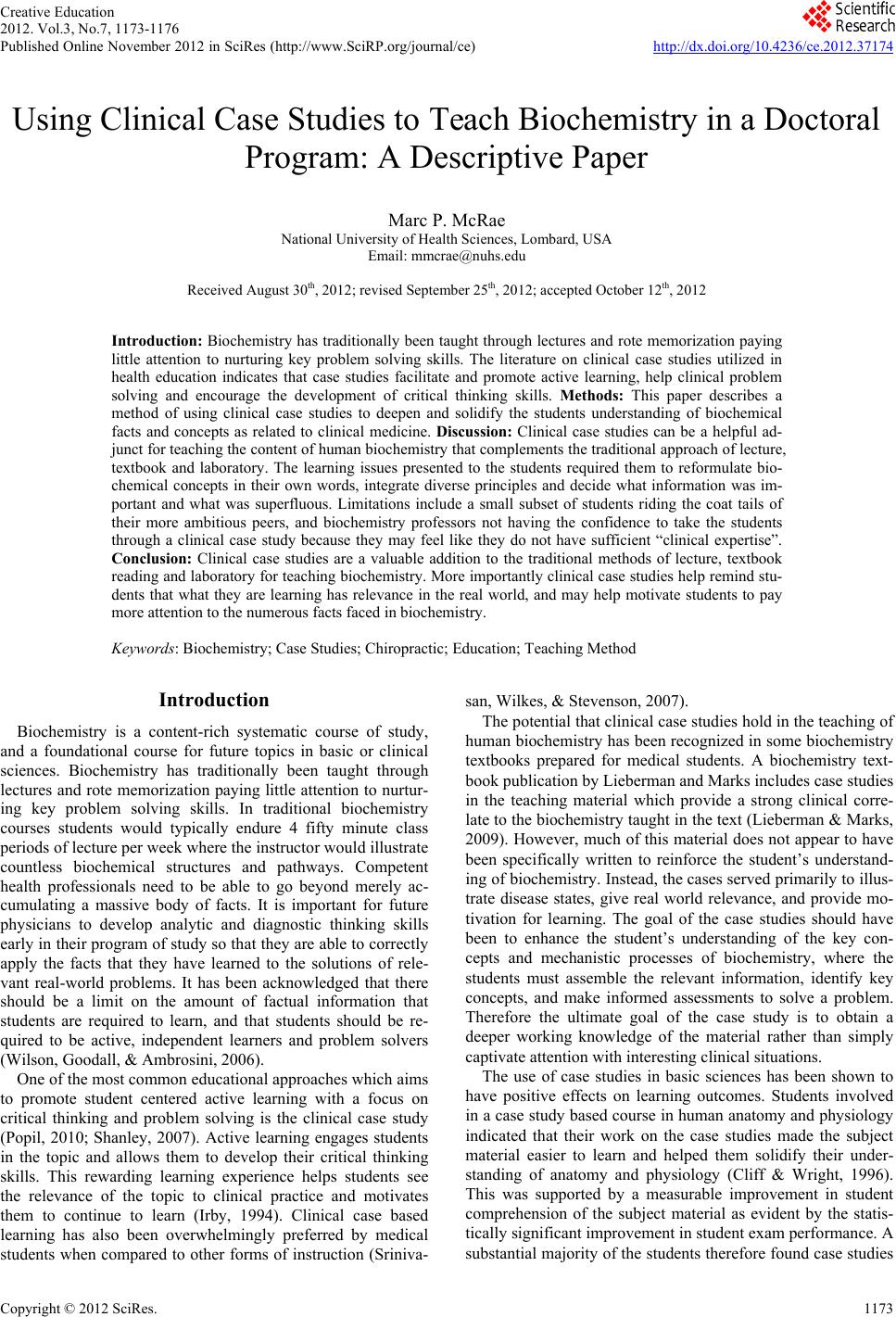 Creative Education 2012. Vol.3, No.7, 1173-1176 Published Online November 2012 in SciRes (http://www.SciRP.org/journal/ce) http://dx.doi.org/10.4236/ce.2012.37174 Copyright © 2012 SciRe s . 1173 Using Clinical Case Studies to Teach Biochemistry in a Doctoral Program: A Descriptive Paper Marc P. McRae National University of Health Sciences, Lombard, USA Email: [email protected] Received August 30th, 2 012; revised September 25th, 2012; accepted October 12th, 2012 Introduction: Biochemistry has traditionally been taught through lectures and rote memorization paying little attention to nurturing key problem solving skills. The literature on clinical case studies utilized in health education indicates that case studies facilitate and promote active learning, help clinical problem solving and encourage the development of critical thinking skills. Methods: This paper describes a method of using clinical case studies to deepen and solidify the students understanding of biochemical facts and concepts as related to clinical medicine. Discussion: Clinical case studies can be a helpful ad- junct for teaching the content of human biochemistry that complements the traditional approach of lecture, textbook and laboratory. The learning issues presented to the students required them to reformulate bio- chemical concepts in their own words, integrate diverse principles and decide what information was im- portant and what was superfluous. Limitations include a small subset of students riding the coat tails of their more ambitious peers, and biochemistry professors not having the confidence to take the students through a clinical case study because they may feel like they do not have sufficient “clinical expertise”. Conclusion: Clinical case studies are a valuable addition to the traditional methods of lecture, textbook reading and laboratory for teaching biochemistry. More importantly clinical case studies help remind stu- dents that what they are learning has relevance in the real world, and may help motivate students to pay more attention to the numerous facts faced in biochemistry. Keywords: Biochemistry; Case Studies; Chiropractic; Education; Teaching Method Introduction Biochemistry is a content-rich systematic course of study, and a foundational course for future topics in basic or clinical sciences. Biochemistry has traditionally been taught through lectures and rote memorization paying little attention to nurtur- ing key problem solving skills. In traditional biochemistry courses students would typically endure 4 fifty minute class periods of lecture per week where the instructor would illustrate countless biochemical structures and pathways. Competent health professionals need to be able to go beyond merely ac- cumulating a massive body of facts. It is important for future physicians to develop analytic and diagnostic thinking skills early in their program of study so that they are able to correctly apply the facts that they have learned to the solutions of rele- vant real-world problems. It has been acknowledged that there should be a limit on the amount of factual information that students are required to learn, and that students should be re- quired to be active, independent learners and problem solvers (Wilson, Goodall, & Ambrosini, 2006). One of the most common educational approaches which aims to promote student centered active learning with a focus on critical thinking and problem solving is the clinical case study (Popil, 2010; Shanley, 2007). Active learning engages students in the topic and allows them to develop their critical thinking skills. This rewarding learning experience helps students see the relevance of the topic to clinical practice and motivates them to continue to learn (Irby, 1994). Clinical case based learning has also been overwhelmingly preferred by medical students when compared to other forms of instruction (Sriniva- san, Wilkes, & Stevenson, 2007). The potential that clinical case studies hold in the teaching of human biochemistry has been recognized in some biochemistry textbooks prepared for medical students. A biochemistry text- book publication by Lieberman and Marks includes case studies in the teaching material which provide a strong clinical corre- late to the biochemistry taught in the text (Lieberman & Marks, 2009). However, much of this material does not appear to have been specifically written to reinforce the student’s understand- ing of biochemistry. Instead, the cases served primarily to illus- trate disease states, give real world relevance, and provide mo- tivation for learning. The goal of the case studies should have been to enhance the student’s understanding of the key con- cepts and mechanistic processes of biochemistry, where the students must assemble the relevant information, identify key concepts, and make informed assessments to solve a problem. Therefore the ultimate goal of the case study is to obtain a deeper working knowledge of the material rather than simply captivate attention with interesting clinical situations. The use of case studies in basic sciences has been shown to have positive effects on learning outcomes. Students involved in a case study based course in human anatomy and physiology indicated that their work on the case studies made the subject material easier to learn and helped them solidify their under- standing of anatomy and physiology (Cliff & Wright, 1996). This was supported by a measurable improvement in student comprehension of the subject material as evident by the statis- tically significant improvement in student exam performance. A substantial majority of the students therefore found case studies 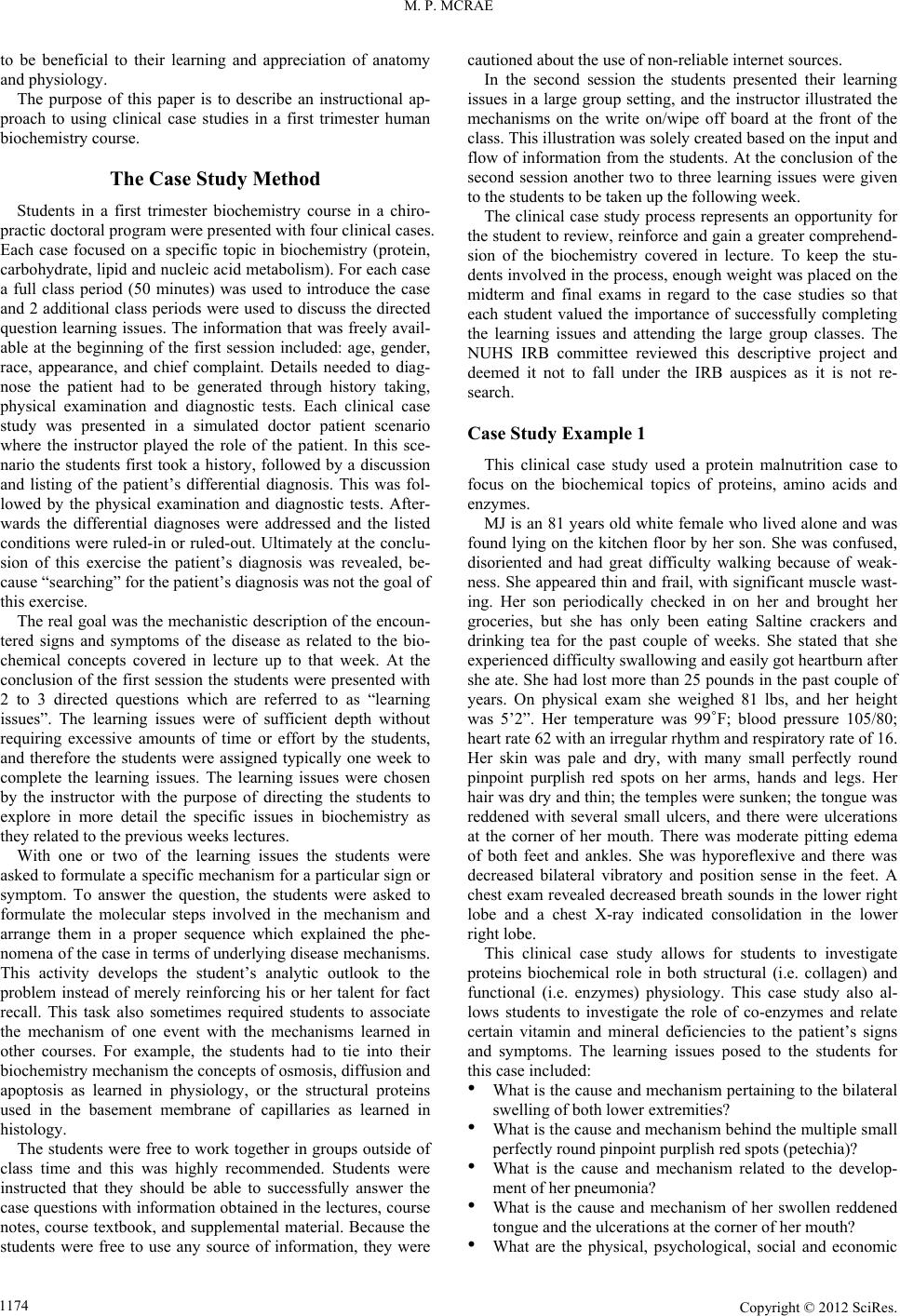 M. P. MCRAE to be beneficial to their learning and appreciation of anatomy and physiology. The purpose of this paper is to describe an instructional ap- proach to using clinical case studies in a first trimester human biochemistr y course. The Case Study Method Students in a first trimester biochemistry course in a chiro- practic doctoral program were presented with four clinical cases. Each case focused on a specific topic in biochemistry (protein, carbohydrate, lipid and nucleic acid metabolism). For each case a full class period (50 minutes) was used to introduce the case and 2 additional class periods were used to discuss the directed question learning issues. The information that was freely avail- able at the beginning of the first session included: age, gender, race, appearance, and chief complaint. Details needed to diag- nose the patient had to be generated through history taking, physical examination and diagnostic tests. Each clinical case study was presented in a simulated doctor patient scenario where the instructor played the role of the patient. In this sce- nario the students first took a history, followed by a discussion and listing of the patient’s differential diagnosis. This was fol- lowed by the physical examination and diagnostic tests. After- wards the differential diagnoses were addressed and the listed conditions were ruled-in or ruled-out. Ultimately at the conclu- sion of this exercise the patient’s diagnosis was revealed, be- cause “searching” for the patient’s diagnosis was not the goal of this exercise. The real goal was the mechanistic description of the encoun- tered signs and symptoms of the disease as related to the bio- chemical concepts covered in lecture up to that week. At the conclusion of the first session the students were presented with 2 to 3 directed questions which are referred to as “learning issues”. The learning issues were of sufficient depth without requiring excessive amounts of time or effort by the students, and therefore the students were assigned typically one week to complete the learning issues. The learning issues were chosen by the instructor with the purpose of directing the students to explore in more detail the specific issues in biochemistry as they related to the previous weeks lectures. With one or two of the learning issues the students were asked to formulate a specific me chanism for a particular sign or symptom. To answer the question, the students were asked to formulate the molecular steps involved in the mechanism and arrange them in a proper sequence which explained the phe- nomena of the case in terms of underlying disease mechanisms. This activity develops the student’s analytic outlook to the problem instead of merely reinforcing his or her talent for fact recall. This task also sometimes required students to associate the mechanism of one event with the mechanisms learned in other courses. For example, the students had to tie into their biochemistry mechanism the concepts of osmosis, diffusion and apoptosis as learned in physiology, or the structural proteins used in the basement membrane of capillaries as learned in histology. The students were free to work together in groups outside of class time and this was highly recommended. Students were instructed that they should be able to successfully answer the case questions with information obtained in the lectures, course notes, course textbook, and supplemental material. Because the students were free to use any source of information, they were cautioned about the use of non-reliabl e i n t e rnet sources. In the second session the students presented their learning issues in a large group setting, and the instructor illustrated the mechanisms on the write on/wipe off board at the front of the class. This illustration was solely created based on the input and flow of information from the students. At the conclusion of the second session another two to three learning issues were given to the students to be taken up the following week. The clinical case study process represents an opportunity for the student to review, reinforce and gain a greater comprehend- sion of the biochemistry covered in lecture. To keep the stu- dents involved in the process, enough weight was placed on the midterm and final exams in regard to the case studies so that each student valued the importance of successfully completing the learning issues and attending the large group classes. The NUHS IRB committee reviewed this descriptive project and deemed it not to fall under the IRB auspices as it is not re- search. Case Study Example 1 This clinical case study used a protein malnutrition case to focus on the biochemical topics of proteins, amino acids and enzymes. MJ is an 81 years old white female who lived alone and was found lying on the kitchen floor by her son. She was confused, disoriented and had great difficulty walking because of weak- ness. She appeared thin and frail, with significant muscle wast- ing. Her son periodically checked in on her and brought her groceries, but she has only been eating Saltine crackers and drinking tea for the past couple of weeks. She stated that she experienced difficulty swallowing and easily got heartburn after she ate. She had lost more than 25 pounds in the past couple of years. On physical exam she weighed 81 lbs, and her height was 5’2”. Her temperature was 99˚F; blood pressure 105/80; heart rate 62 with an irregular rhythm and respiratory rate of 16. Her skin was pale and dry, with many small perfectly round pinpoint purplish red spots on her arms, hands and legs. Her hair was dry and thin; the temples were sunken; the tongue was reddened with several small ulcers, and there were ulcerations at the corner of her mouth. There was moderate pitting edema of both feet and ankles. She was hyporeflexive and there was decreased bilateral vibratory and position sense in the feet. A chest exam revealed decreased breath sounds in the lower right lobe and a chest X-ray indicated consolidation in the lower right lobe. This clinical case study allows for students to investigate proteins biochemical role in both structural (i.e. collagen) and functional (i.e. enzymes) physiology. This case study also al- lows students to investigate the role of co-enzymes and relate certain vitamin and mineral deficiencies to the patient’s signs and symptoms. The learning issues posed to the students for this case included: • What is the cause and mechanism pertaining to the bilateral swelling of both lower extremities? • What is the cause and mechanism behind the multiple small perfectly round pinpoint purplish red spots (petechia)? • What is the cause and mechanism related to the develop- ment of her pneumonia? • What is the cause and mechanism of her swollen reddened tongue and the ulcerations at the corner of her mouth? • What are the physical, psychological, social and economic Copyright © 2012 SciRe s . 1174 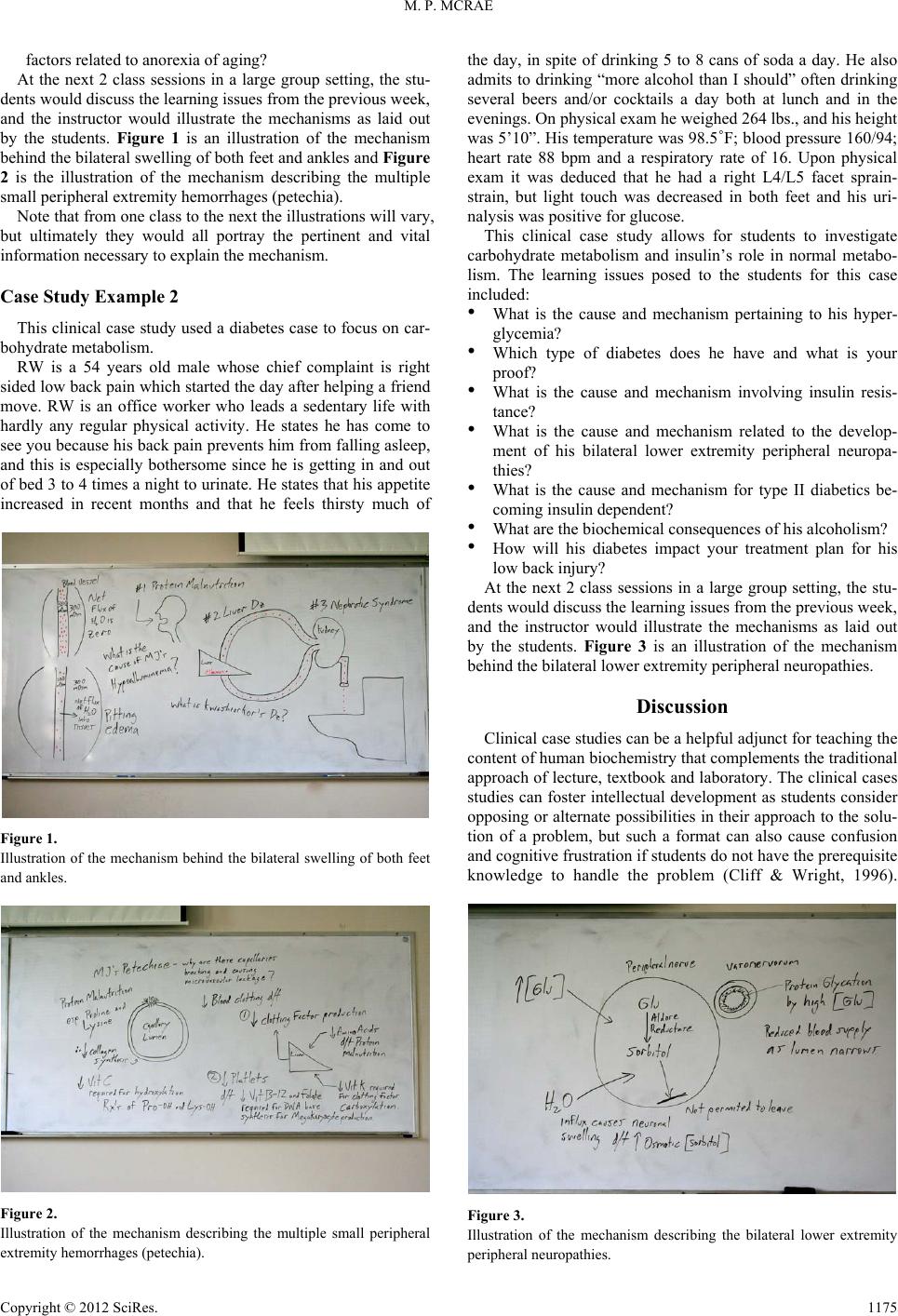 M. P. MCRAE factors related to anorexia of aging? At the next 2 class sessions in a large group setting, the stu- dents would discuss the learning issues from the previous week, and the instructor would illustrate the mechanisms as laid out by the students. Figure 1 is an illustration of the mechanism behind the bilateral swelling of both feet and ankles and Figure 2 is the illustration of the mechanism describing the multiple small peripheral extremity hemorrhages (petechia). Note that from one class to the next the illustrations will vary, but ultimately they would all portray the pertinent and vital information necessary to explain the mechanism. Case Study Example 2 This clinical case study used a diabetes case to focus on car- bohydrate metabolism. RW is a 54 years old male whose chief complaint is right sided low back pain which started the day after helping a friend move. RW is an office worker who leads a sedentary life with hardly any regular physical activity. He states he has come to see you because his back pain prevents him from falling asleep, and this is especially bothersome since he is getting in and out of bed 3 to 4 times a night to urinate. He states that his appetite increased in recent months and that he feels thirsty much of Figure 1. Illustration of the mechanism behind the bilateral swelling of both feet and ankles. Figure 2. Illustration of the mechanism describing the multiple small peripheral extremity hemorrhages (petechia). the day, in spite of drinking 5 to 8 cans of soda a day. He also admits to drinking “more alcohol than I should” often drinking several beers and/or cocktails a day both at lunch and in the evenings. On physical exam he weighed 264 lbs., and his height was 5’10”. His temperature was 98.5˚F; blood pressure 160/94; heart rate 88 bpm and a respiratory rate of 16. Upon physical exam it was deduced that he had a right L4/L5 facet sprain- strain, but light touch was decreased in both feet and his uri- nalysis was positive for glucose. This clinical case study allows for students to investigate carbohydrate metabolism and insulin’s role in normal metabo- lism. The learning issues posed to the students for this case included: • What is the cause and mechanism pertaining to his hyper- glycemia? • Which type of diabetes does he have and what is your proof? • What is the cause and mechanism involving insulin resis- tance? • What is the cause and mechanism related to the develop- ment of his bilateral lower extremity peripheral neuropa- thies? • What is the cause and mechanism for type II diabetics be- coming insulin dependent? • What are the biochemical consequences of his alcoholism? • How will his diabetes impact your treatment plan for his low back injury? At the next 2 class sessions in a large group setting, the stu- dents would discuss the learning issues from the previous week, and the instructor would illustrate the mechanisms as laid out by the students. Figure 3 is an illustration of the mechanism behind the bilateral lower extremity peripheral neuropathies. Discussion Clinical case studies can be a helpful adjunct for teaching the content of human biochemistry that complements the traditional approach of lecture, textbook and laboratory. The clinical cases studies can foster intellectual development as students consider opposing or alternate possibilities in their approach to the solu- tion of a problem, but such a format can also cause confusion and cognitive frustration if students do not have the prerequisite knowledge to handle the problem (Cliff & Wright, 1996). Figure 3. Illustration of the mechanism describing the bilateral lower extremity peripheral neuropathies. Copyright © 2012 SciRe s . 1175  M. P. MCRAE Copyright © 2012 SciRe s . 1176 Therefore it is believed that the case studies must be designed to encourage successful learning and not overly frustrate stu- dents (Sandstrom, 2006). Although very few first trimester students possess any significant clinical knowledge, collec- tively as a group, the knowledge possessed by single individu- als will collectively come together, and therefore as a group they will adequately get through the case. Another significant limitation involves students not follow- ing through on the learning issues and deciding to ride the coat tails of their more ambitious peers. As well, in the large group session, there is the potential that a subset of students may de- cide to hide behind the efforts made by more outgoing and enthusiastic students. This decision on their part essentially cuts these students off from experiencing the rewarding opportunity the clinical case study can provide. Finally not all biochemistry professors will have the confidence to take the students through a clinical case study because they may feel like they do not have sufficient “clinical expertise”. However the case study experience can be designed to script out the clinical pathway, and so the instructor can tailor the case to fit the level of clini- cal experience he or she possesses. The clinical case studies presented in the biochemistry course will help remind students that what they are learning has rele- vance in the real world, and may also help motivate students to pay more attention to the numerous facts faced in biochemistry. The learning issues presented to the students requires them to reformulate biochemical concepts in their own words, integrate diverse principles and decide what information was important and what was superfluous. Clinical case studies enable students to lea rn a wi de r sco pe of ma te ri al t han c ou ld be pr e se nt e d in t he lecture, and learning in the context of specific cases facilitates cognitive flexibility and improves the student’s higher order reasoning skills (Irby, 1994). Student’s discourse during the large group sessions also provided opportunities for connecting, challenging and extending their knowledge. However, whether students actually attain a more sophisticated knowledge as a result of this experience will require further study with the next step being to develop a study to compare students who use case studies versus those who do not. Conclusion Clinical case studies are a valuable addition to the traditional methods of lecture, textbook reading and laboratory for teach- ing biochemistry. More importantly clinical case studies help remind students that what they are learning has relevance in the real world, and may help motivate students to pay more atten- tion to the numerous facts faced in biochemistry. REFERENCES Cliff, W. H., & Wright, A. W. (1996). Directed case study method for teaching human anatomy and physiology. Advances in Physiology Education, 15, S19-S28. Irby, D. M. (1994). Three exemplary models of case-based teaching. Journal of the American College of Cardiology, 6 9, 947-953. Lieberman, M., & Marks, A. D. (2009). Basic medical biochemistry (3rd ed.). Baltimore, MD: Lippincott Williams & Wilkins. Popil, I. (2010). Promotion of critical thinking by using case studies as teaching method. Nurse Education Today, 31, 204-207. doi:10.1016/j.nedt.2010.06.002 Sandstrom, S. (2006). Use of case studies to teach diabetes and other chronic illnesses to nursing students. Journal of Nutrition Education, 45, 229-232. Shanley, P. F. (2007). Viewpoint: Leaving the “empty glass” of prob- lem-based learning behind: New assumptions and a revised model for case study in preclinical medical education. Academic Medicine, 82, 479-485. doi:10.1097/ACM.0b013e31803eac4c Srinivasan, M., Wilkes, M., Stev enson, F., Nguyen, T., & Slavin, S. (2007). Comparing problem-based leaning with case-based learning: Effects of a major curricular shift at two institutions. Academic Medicine, 82, 74-82. doi:10.1097/01.ACM.0000249963.93776.aa Wilson, A. S., Goodall, J. E., Ambrosini, G. et al. (2006). Development of an interactive learning tool for teaching rheumatology—A simu- lated clinical case studies program. Rheumatology, 45, 1158-1161. doi:10.1093/rheumatology/kel077 |